
Listen Now
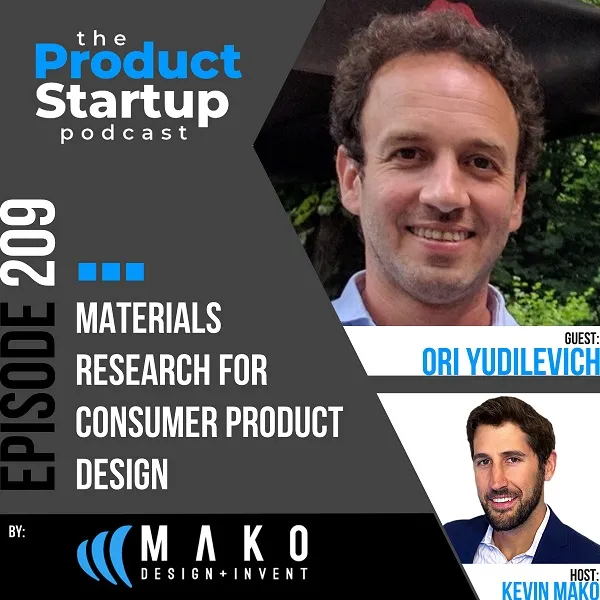
Guest: Ori Yudilevich, CTO of Materials Zone, a materials information platform for hardware product development.
Host: Kevin Mako, founder of Product Startup and the leading expert in hardware startup consulting. A hardware entrepreneur since 1999, Kevin has advised more than 1,500 founders and built and scaled MAKO Invent through its acquisition by TriMech in 2024.
Episode Overview
Ori Yudilevich explains why materials research belongs near the beginning of product development, not after key design decisions are locked in. The conversation covers performance, manufacturability, supply flexibility, sustainability, regulatory requirements, and how material choices influence what customers think of a product.
What You’ll Learn in This Episode
- Materials are in everything!
- The product development process for all products requires a lot of research into materials.
- Materials research is core to achieving progress with your invention idea.
- Materials selection is an integral component of hardware development and is often overlooked by non-designers.
- Materials selection is much like selecting ingredients when cooking. You can cut corners to minimize cost, but it will ultimately be noticeable to the consumers!
- How to choose materials that best align with your product’s purpose and the process of making those materials.
- Materials are evolving, so it is important to remain up-to-date on the best materials available today.
- Sustainable materials selection is a big trend right now!
- Your customers are looking at what your product is made of, so carefully thought-out materials selection will boost its success beyond the manufacturing process.
- The supply chain is a critical consideration, so it is best to choose materials that have supply flexibility.
- Researching materials regulations according to your location is key, as certain rules need to be adhered to depending on the country you are selling in.
- Think of materials selection from a manufacturing perspective and a product sales (customer) perspective.
Episode transcript
This transcript is provided for accessibility and reference. Download the SRT transcript.
Read the full episode transcript
Kevin Mako: Hello, product innovators. Today we learn about the importance and major trends in materials selection in product design from a Ph.D. who is CTO of a materials data platform.
Kevin Mako: This is the Product Startup Podcast, a show to learn from top leaders in hardware product development, prototyping, manufacturing, product selling, and everything in between.
Kevin Mako: Hosted by Kevin Mako, the leading expert on product development for hardware startups.
Kevin Mako: Welcome back, everyone. I'm very excited to introduce Ori Yudilevich to the show.
Kevin Mako: Ori is the CTO of Materials Zone, a materials information platform for hardware product development.
Kevin Mako: He has a PhD and has been in academics and higher education lecturing for over 15 years before transitioning over to industry.
Kevin Mako: Today, Ori will share valuable knowledge for inventors, startups, and small manufacturers on why materials are so important to the hardware product design process, what the trends are in materials science today, and how to ensure you select the right materials for manufacturing and for product marketing together.
Kevin Mako: Now, on to the episode.
Kevin Mako: This show is produced by Mako Design, the original firm providing end-to-end consumer product development services tailored specifically to hardware startups, small manufacturers, and inventors.
Kevin Mako: Take your product from idea to store shelves at MakoDesign.com.
Kevin Mako: Now on to the episode.
Kevin Mako: Hi, Ori, welcome to the show.
Ori Yudilevich: Hi, Kevin. Really nice to be here.
Kevin Mako: Well, we're excited to have you on today to talk about materials.
Kevin Mako: Materials are obviously important part of the product development, product, and
Kevin Mako: engineering, product prototyping, and of course, product manufacturing process.
Kevin Mako: And what better person than you to talk about it today, you're behind, obviously, a lot of the
Kevin Mako: technology that brings some of these informatics to actual materials and how to choose
Kevin Mako: materials and all these other great things about understanding materials in development and through
Kevin Mako: to manufacturing and so on for hardware products. Before we get into all of this, give us a bit
Kevin Mako: of a background of how you became the success story that you are today.
Ori Yudilevich: Thanks for the introduction, Kevin.
Ori Yudilevich: I have spent actually a lot of years in academia, studied chemistry and physics, and I have a PhD in mathematics.
Ori Yudilevich: For academia, I actually worked in a company called Deal Time that was later bought by eBay.
Ori Yudilevich: That was a comparison website, one of the first ones.
Ori Yudilevich: Today, I work for four years already.
Ori Yudilevich: I work for a company called Material Zone, a great company that's a data management platform
Ori Yudilevich: that helps companies in any industry that produces hardware, that produces products, hard products, that
Ori Yudilevich: are made out of materials, where materials research is being done. We empower that process.
Kevin Mako: Let's start big picture here. What are materials? And then why are they so important to the product
Ori Yudilevich: development process? Yeah. So, I mean, materials are basically the building pieces of everything that we
Ori Yudilevich: have around us, right? Everything that is in your room right now, the car that you're driving,
Ori Yudilevich: the airplane that you take, everything is made out of materials. And every,
Ori Yudilevich: product that you use has, you know, years and years of sometimes dozens of years of research
Ori Yudilevich: behind them. To give like a simple example, you know, like I have this mug of tea here. So it's made
Ori Yudilevich: out of materials that can sustain the heat of my tea, right? That's like very simple. But like the solar
Ori Yudilevich: panels on your roof, you want to get them to be more and more efficient. You want the batteries.
Ori Yudilevich: If there's batteries inside them, you want that to store energy, all of this requires better and more
Ori Yudilevich: optimized the materials for the job. So materials, research is really core to progress, especially
Ori Yudilevich: when we talk today about a world of global warming, we need to be much more efficient than everything
Ori Yudilevich: we do. So materials are our core.
Kevin Mako: Materials is such a big part of product development. And especially for non-technical or
Kevin Mako: non-design founders, it's often something that's relatively overlooked. It's just kind of an assumption
Kevin Mako: that, well, you design a great product. And of course, you're going to have some materials,
Kevin Mako: plastics, metals, et cetera, that put it together. But the reality of product development
Kevin Mako: is that materials have a major impact on the design, the visual design of the product.
Kevin Mako: The engineering details of the product, how the product actually works and the functionality,
Kevin Mako: et cetera, weighs very heavily on a materials. There's lots of things that you can do with one material,
Kevin Mako: but you can't do with another material. And that weighs into some of even the early design
Kevin Mako: and ideation process and understanding what are those material parameters and why do you
Kevin Mako: need to understand what they're going to be so that you can actually do the 3D CAD design around best
Kevin Mako: practices, not just for the product, but for the underlying material.
Kevin Mako: that that products is going to rely on. So talk a bit about the importance of this kind of
Kevin Mako: materials research phase as you're doing the development of a new hardware product.
Ori Yudilevich: That was a great description that you just gave. The analogy that we like to give always in our
Ori Yudilevich: company, when we try to explain exactly the question that you ask is that building product out
Ori Yudilevich: of materials is in a way, you know, at least for the non-chemist, is very similar to cooking.
Ori Yudilevich: When you cook, you want to make the best pasta or lasagna, you have to use ingredients, right?
Ori Yudilevich: Ingredients are the analogy of materials. You know, there's a huge difference if you use a whole wheat flour, white flour, right?
Ori Yudilevich: So the analogy here would be if you use a cheap material or a very high quality material,
Ori Yudilevich: you know, the question of the choice of materials that you use.
Ori Yudilevich: And there's also the question of the process, right? That's also a big part of what are you going to do with those materials?
Ori Yudilevich: How are you going to mix them? What process are they going to go through?
Ori Yudilevich: What's going to be the temperature and the machines that you're making them?
Ori Yudilevich: The pressure, if there's any light around.
Ori Yudilevich: all these things, every little parameter, and these can accumulate hundreds of parameters
Ori Yudilevich: that affect your end product, how good your end product is. So you could use sometimes cheaper materials
Ori Yudilevich: if you do your process better, or you'll end up using more expensive materials if your process is not
Ori Yudilevich: optimized. And there's a lot of science and a lot of research put in to reach, as I said before,
Ori Yudilevich: all these amazing products that surround us.
Kevin Mako: And it's so important to understand what some of the common trends are in technology.
Kevin Mako: around those materials as well.
Kevin Mako: Every year, I know from the design firm perspective, every year we get introduced to new properties,
Kevin Mako: new materials, new use cases that elevate the amount of tools as designers we have in order
Kevin Mako: to make certain things function in certain ways.
Kevin Mako: So staying on top of what some of the latest and greatest technologies are can increase quality,
Kevin Mako: but it can also reduce costs, and it can also have a whole bunch of other benefits like
Kevin Mako: sustainability, time to market.
Kevin Mako: manufacturing regions, you name it. So talk a bit about some of the trends that you're seeing
Kevin Mako: on the materials engineering side and how that potentially could affect hardware development.
Kevin Mako: So let's look at the trends and then potentially some of the effects or some of the nuggets from
Kevin Mako: those trends for people who are working on the development and or manufacturing of their
Ori Yudilevich: products today. There are a few trends that are becoming more and more dominant these days
Ori Yudilevich: that are affecting how difficult it is to create a product, how a flexixt.
Ori Yudilevich: we have to be in adapting to changes much more than we see in the past. I'll mention
Ori Yudilevich: a few of these. So one of them is, as you said, sustainability. Sustainability is becoming a more
Ori Yudilevich: and more essential part of our lives. It's about agreements between countries to reduce carbon footprint.
Ori Yudilevich: All of these things, they have a lot of influence on how we make our products. Certain
Ori Yudilevich: materials that we use might have a higher carbon footprint. You want to replace them with other
Ori Yudilevich: materials. Your clients, the people buying the other product,
Ori Yudilevich: from you, they're looking at these parameters, right? They're being also measured. Where
Ori Yudilevich: you're buying your materials from, right? Materials are coming from far away countries that have to go
Ori Yudilevich: by plane. Their carbon footprint is much higher. So there's even a choice in geography here. This is one
Ori Yudilevich: example, sustainability. Another example is supply chain problems, right? We've seen a lot of these
Ori Yudilevich: in the last couple of years with the geopolitics around the world, and these are putting a lot
Ori Yudilevich: of constraints. So some companies that are used to using a certain supplier, a certain
Ori Yudilevich: material, they just don't have access to that material anymore. They have to adapt quickly.
Ori Yudilevich: They have to find alternatives for that material. Give one maybe last example, and these are
Ori Yudilevich: regulations. Strengthening regulations. We're much more aware about what kind of packaging
Ori Yudilevich: we put our food in. Some packaging might be toxic. In the past, we maybe weren't aware of it,
Ori Yudilevich: or we weren't as careful about it. And today, they're strengthening regulations. And from one day to
Ori Yudilevich: another, suddenly you're not allowed to use a certain type of material. You have to move to
Ori Yudilevich: another kind of material. So all of these things, these are mentioned like three different trends that are
Ori Yudilevich: affecting material development and product development highly. Absolutely. And all those things are really
Kevin Mako: important. I love how you touched on two very different angles there. One, you're looking at the supply
Kevin Mako: side. So how does this increase the quality of your product or the sustainability of your product or
Kevin Mako: the regional availability of the product? So making sure that you're using materials that
Kevin Mako: have regional flexibility so that you can move, if necessary, from one zone to another,
Kevin Mako: without being hyper-restricted potentially to a material that's only offered in one manufacturing
Kevin Mako: region or district or is difficult to get access to or may have supply fluctuations. Sometimes
Kevin Mako: it's available. Sometimes it's not. Those considerations are really important from the back-end side,
Kevin Mako: but you also mention the front-end side. Sales. Customers are more educated than ever before.
Kevin Mako: Reviews are prevalent. The internet is a fast place where they can get informed very quickly about
Kevin Mako: what materials should be being used depending on the type of product that you're selling.
Kevin Mako: So it's not only thinking about materials to ensure you're making the best product,
Kevin Mako: but also so that you're giving the best offering to your customers that matches what they believe
Kevin Mako: and what they understand about the importance of materials. We're seeing this across the board.
Kevin Mako: Customer demand is really sometimes pushing you into a certain way of considering materials or a certain
Kevin Mako: approach to materials. So you've got to think about both these ends, front end and back end.
Kevin Mako: And you address both of those, both of those especially more than ever, should always be considered
Kevin Mako: in the design, even early design, especially as you get into manufacturing. As you get into manufacturing,
Kevin Mako: you've really got to nail those things down because at some point you've got to pull the trigger and
Kevin Mako: produce. So making sure that you've really designed a product that is obviously well engineered,
Kevin Mako: but also well thought out in terms of the actual materials composition. That's what makes for a great
Kevin Mako: product. Again, as we mentioned, both on the back end and on the front end.
Kevin Mako: So talk a bit about Material Zone and how this helps with that process because I'm a big fan,
Kevin Mako: obviously, from the design firm perspective of any kind of increased in flexibility ease and data
Kevin Mako: around selecting, working with, designing for, and manufacturing using the best materials possible
Ori Yudilevich: at modern times. Yeah. Good question, of course. I like talking about my workplace and what I do.
Ori Yudilevich: So Material Zone helps in exactly these problems.
Ori Yudilevich: that we discussed, right? So we discussed having to deal with very complex recipes,
Ori Yudilevich: right, which was the number of materials we can use to make a product, the very complex process that it can
Ori Yudilevich: go through, all the parameters that such a big wiggle space that you have when you're producing
Ori Yudilevich: these things, and then you have all these constraints that we discussed. The carbon footprint you want
Ori Yudilevich: to reduce, the regulations, and material zone is a platform. It's a SaaS platform that companies can
Ori Yudilevich: use to connect all of this data end to end. So you can combine data coming all the way
Ori Yudilevich: from procurement, right? And that's, you know, where you're buying these things from. We talked about
Ori Yudilevich: sustainability and how distance matters. Pricing, you know, which material, the prices, of course,
Ori Yudilevich: are a big factor. Regulation departments, everybody can feed all of this data into the platform.
Ori Yudilevich: Then you have one unified place where all this data is being collected. Then the R&D engineer, the person
Ori Yudilevich: that is actually designing the product that has to make these choices, that has to try out all
Ori Yudilevich: these recipes can have like one place where they can see all the data. They can visualize it in an easy way.
Ori Yudilevich: And most importantly, they can model the data. They can use modern AI technology, machine learning,
Ori Yudilevich: to build models that can predict what happens in certain situations, right? So typically you would need
Ori Yudilevich: now to try out maybe thousands of different recipes before you find what you need. This is very
Ori Yudilevich: costly. Just the materials themselves are expensive, but also devices that you need to use.
Ori Yudilevich: Maybe you need to outsource this and you're paying per hour, right? So modeling this and having some idea
Ori Yudilevich: idea where to explore, right, which materials to explore, which process to explore. This can reduce the time
Ori Yudilevich: to market substantially. It can reduce the amount of money you have to spend on all these resources.
Ori Yudilevich: And that's what material zone does. We accelerate material discovery and we make the process much
Ori Yudilevich: smoother. We connect the different ends of the company, proving visibility. Everybody
Kevin Mako: can see what everybody else does. Well, it's very helpful and it's great information. I can tell you it's
Kevin Mako: much appreciated from the design firm perspective because almost every project, you've got a number of
Kevin Mako: materials and design elements that you've really nailed before. Even as a design firm,
Kevin Mako: you've got a bunch of these things in your library and you work with certain materials. You're
Kevin Mako: very comfortable with certain things. You understand their properties. But then there's this fringe
Kevin Mako: element, which is on kind of the outside, which is something that's unique or proprietary
Kevin Mako: or something like you said, you have to experiment with or test out. And that is where this can
Kevin Mako: become very valuable, but also not just on, let's call it, the experimental portion of the
Kevin Mako: project, but on the routine development side of the project, too, it can be kind of helpful in
Kevin Mako: making sure that you're up to speed. So are your assumptions from last year still relevant this
Kevin Mako: year? Are the regulation still intact? Is the supply chain availability?
Kevin Mako: still intact. So not only is it good for that new stuff, but it's good for the stuff
Kevin Mako: that you're comfortable with as well from design, engineering, prototyping, and onto production
Kevin Mako: process. So much appreciated for the work that you're doing. What is the website that people can
Ori Yudilevich: learn more if they want to check it out for themselves? So people are very welcome to visit our website
Ori Yudilevich: www.materials.zone. You can find the information about our platform, our product. You can find our contact
Ori Yudilevich: details and we're very happy to talk to anybody listening to this show.
Kevin Mako: Ori, much appreciated it for all your words of wisdom. And as always, I will put the link in the
Kevin Mako: show notes below so anyone can just click through. Thanks again for all your help today.
Ori Yudilevich: And we look forward to talk it again soon. Thank you, Kevin. This was a lot of fun.
Kevin Mako: Thanks, all right. Appreciate it and take care. Thanks for tuning in to this episode of the
Kevin Mako: Product Startup Podcast. If you found some value in the show, please do us a huge favor and hit
Kevin Mako: the like button and subscribe. If you have any questions,
Kevin Mako: suggestions or anything else, feel free to reach out to us anytime at our email,
Kevin Mako: podcast at MakoDesign.com. This show is hosted by Kevin Mako, North America's
Kevin Mako: leading expert on product development for hardware startups, and the podcast is produced by
Kevin Mako: Mako Design, the original firm providing end-to-end consumer product development services
Kevin Mako: tailored specifically to hardware startups, small manufacturers, and inventors. Take your
Kevin Mako: product from idea to store shelves at MakoDesign.com. That's M.
Kevin Mako: a k0.com.com. Thanks for joining and see you again soon.
Materials Strategy for Product Founders
Make Better Material Decisions Earlier
Work directly with Kevin Mako to pressure-test how material choices affect performance, cost, manufacturing risk, sourcing flexibility, sustainability claims, compliance planning, and customer perception.
Kevin can help you turn those priorities into a clear decision framework and connect you with suitable materials, design, engineering, manufacturing, or testing experts when needed.
Request a Materials Strategy Call
Tell Kevin what you are building, the decisions already made, and the material questions holding up progress.