
Listen Now
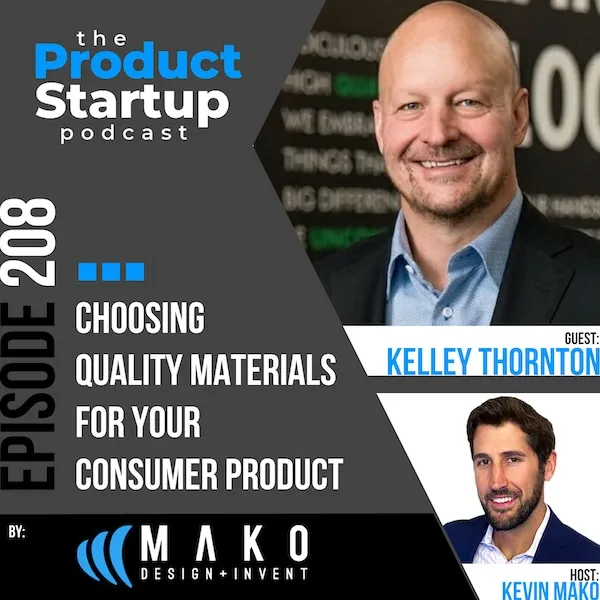
Guest: Kelley Thornton, CEO of Tiege Hanley, Inc., a direct-to-consumer men’s skincare brand that has sold more than 16 million products in over 100 countries.
Host: Kevin Mako, founder of Product Startup and the leading expert in hardware startup consulting. A hardware entrepreneur since 1999, Kevin has advised more than 1,500 founders and built and scaled MAKO Invent through its acquisition by TriMech in 2024.
Episode Overview
Kelley Thornton explains why founders should define their intended level of product quality before selecting materials or ingredients. He discusses clear manufacturer specifications, the relationship between quality and margins, and how strong material choices can become part of the customer value proposition.
What You’ll Learn in This Episode
- What are hardware product materials, and why are they important?
- Make a decision about the level of quality you want to achieve with your product up front because this will guide your materials decision-making.
- Intuitive materials decision-making is salient to having great products.
- Understanding the chemistry of ingredients is so important to delivering product results.
- Calling out the ingredients at the manufacturing level will ensure the production of a quality product.
- All manufacturers have strengths and weaknesses, so make sure everyone is on board with the way the product is formed.
- Be clear about intellectual property, especially if the manufacturer makes changes that you agree with when choosing quality materials for your consumer product!
- Another key reason you should push for high-quality materials is that it will serve as a reason why your customers should choose your product brand over others.
- You can also use the quality of your ingredients in your marketing efforts!
- Always start with higher quality materials and then, over time, figure out how to value engineer that into cost savings through scale, innovation, etc., to bring your costs down.
- Ensure that your margins are high enough to afford quality, and that should be the case when you’ve got a new proprietary product.
Episode transcript
This transcript is provided for accessibility and reference. Download the SRT transcript.
Read the full episode transcript
Kevin Mako: Hello, product innovators. Today we learn about the importance and strategies around product materials from the founder of a booming international product brand.
Kevin Mako: This is the Product Startup Podcast, a show to learn from top leaders in hardware product development, prototyping, manufacturing, product selling, and everything in between.
Kevin Mako: Hosted by Kevin Mako, the leading expert on product development for hardware startups.
Kevin Mako: Welcome back, everyone. I'm very excited to introduce Kelley Thornton to the show.
Kevin Mako: Kelley is the CEO of Tiege Hanley, a direct-to-consumer skincare product brand for men that has sold over 16 million products in more than 100 countries.
Kevin Mako: Today, Kelley will share valuable knowledge for inventors, startups, and small manufacturers on the importance of materials selection for your new product, how to work with manufacturers on ensuring the best quality of materials and why materials are important to both your customers and your product business.
Kevin Mako: Now, on to the episode.
Kevin Mako: This show is produced by Mako Design, the original firm providing end-to-end,
Kevin Mako: consumer product development services tailored specifically to hardware startups, small
Kevin Mako: manufacturers, and inventors. Take your product from idea to store shelves at MakoDesign.com.
Kevin Mako: Now on to the episode. Hey, Kelley, welcome to the show.
Kelley Thornton: Thanks for having me.
Kevin Mako: Well,
Kevin Mako: we're looking forward today to talk about materials. And obviously, materials are a big part of any
Kevin Mako: product, whether it's a consumer package good or an electronics product or just a household tool.
Kevin Mako: Everything comes down to the actual materials that.
Kevin Mako: your products made with. Those materials composed through to make your parts and your parts
Kevin Mako: are what make the product. So materials are really important and often overlooked, especially by a newer
Kevin Mako: hardware startup. So today, we're going to talk about materials, why they're important,
Kevin Mako: and how to make sure that your manufacturing of those materials is done correctly and how to make sure
Kevin Mako: that you're doing an audit and review of those materials processes and the actual output of those
Kevin Mako: materials into your real product itself to make sure that you're on track so your customers get
Kevin Mako: the best possible product.
Kevin Mako: Before we jump into all of that, just give us a bit of a background of your 30-year history
Kevin Mako: in the manufacturing space.
Kelley Thornton: Yeah. I mean, I started in Newark, New Jersey in the packaging business. So we were making
Kelley Thornton: industrial packaging, point-and-purchase displays, retail, physical hardware retail displays. And I
Kelley Thornton: was in that space for over 20 years before I started a global in-store design and strategy
Kelley Thornton: company. It was really a strategy design-focused company.
Kelley Thornton: Out of that company, I actually did create some physical hardware, which I have some patents on,
Kelley Thornton: that are time-stamped, weight-censored data that helps retailers and brand people understand
Kelley Thornton: the velocity of products being sold at retail off the shelves. So they can measure the performance
Kelley Thornton: of certain stimulus, such as messaging and colors and packaging and offers that are being sold
Kelley Thornton: at retail.
Kelley Thornton: After that, I founded Tiege Hanley, men's skincare brand. We're a DTC Global Skin Care Brand. We
Kelley Thornton: focus on healthy skincare routines for men, and we ship our products around the world.
Kevin Mako: That's amazing.
Kevin Mako: And obviously, a major success story. You're shipping to over 100 countries every month. I think you
Kevin Mako: mentioned that you had just shipped your 16 millionth actual unit of products that is selling
Kevin Mako: these kits, so eight products per kit per box, over 2 million boxes sold.
Kelley Thornton: That's a huge.
Kelley Thornton: success as a CPG brand. Thank you very much. We hand delivered that box to a gentleman
Kelley Thornton: named Blake. I went with my business partners down to Atlanta and had an opportunity to spend
Kelley Thornton: an hour with him talking about how he develops healthy habits in his life.
Kevin Mako: That's amazing. What a story.
Kevin Mako: So let's dig into that because obviously materials are a big part of what makes your product great,
Kevin Mako: but for anybody with their physical consumer product, no matter what type of product it is,
Kevin Mako: the materials are a critical element of it. So to
Kevin Mako: We're talking specifically about materials and how to make sure that it's done right. Let's just
Kevin Mako: talk big picture in the beginning here. What are we talking about when we talk product
Kelley Thornton: materials? Yeah, I mean, I think there's a strategic decision that needs to be made way up front
Kelley Thornton: about your materials. I had this conversation with my business partners and our chemists,
Kelley Thornton: the people to develop our products that are part of our company about really what we want
Kelley Thornton: to be known as. Do we want to be known as innovators that use the best product?
Kelley Thornton: that are the most efficacious? Or do we just want some really good product in a bottle that
Kelley Thornton: we can be very good marketers at? We chose to have ingredients and materials as a strategic asset of our
Kelley Thornton: business. And what we mean by that is that we think that materials are critical to having very good
Kelley Thornton: products and controlling those materials all the way down to the inky number, which is the actual name of
Kelley Thornton: the actual component, chemical name of the component is something that was really important
Kelley Thornton: to our business. Not only because we have really good product, but we also wanted to make sure
Kelley Thornton: that we can control consistency and control our supply. So let's talk about controlling consistency and
Kevin Mako: supply. That obviously comes down to quality. So talk a bit about how you ensure that the quality
Kevin Mako: of your materials is there and really what makes up quality. What is that? What does that word mean?
Kelley Thornton: the framework of materials. Yeah, it's interesting. Early on, we were not myself and my business
Kelley Thornton: partners were not chemists. So we do make, you know, a product that goes on your skin. We did not
Kelley Thornton: understand chemistry. Our background's more on the marketing side of the business. We brought a chemist
Kelley Thornton: in as a business partner. And our chemist is a very technical man who really understands the
Kelley Thornton: chemistry of ingredients and understands how ingredients and
Kelley Thornton: chemistry goes about having delivering results. When we started shopping and what I mean by that
Kelley Thornton: is having our products made by manufacturers, a lot of manufacturers came back to us and
Kelley Thornton: said, you have Ferrari formulas. There's no really reason to have this level of detail and
Kelley Thornton: this level of efficacy at these percentages of active ingredients in your formulas. No one's
Kelley Thornton: really going to know. For us, it was really critical that we had very efficacious
Kelley Thornton: this product. As I mentioned, that was a strategic decision early on that we wanted to have
Kelley Thornton: very good product. So getting down to the actual breakdown of the ingredient and calling out
Kelley Thornton: the ingredient at the manufacturer's level saying that we want this component produced from this vendor
Kelley Thornton: was really important to us and the way we thought about our business. That's so important to
Kevin Mako: actually put that together before you're even reaching out to the manufacturers or at least
Kevin Mako: at a minimum in conjunction with the manufacturers. So you can consider these things
Kevin Mako: and ensure that the product materials that you have match the desired output that you want for
Kevin Mako: the actual product. Don't let your manufacturer decide what they think your business model is.
Kevin Mako: You are the one that decides your business model. And we talk about a lot on the show because
Kevin Mako: quite often in product development, especially in hardware development, especially the more
Kevin Mako: complicated product, people want to essentially get something to a certain design level
Kevin Mako: and then hopefully send it over to the manufacturer for them to solve a number of your problems.
Kevin Mako: Right. Well, we know that from the mechanical engineering, electronic engineering,
Kevin Mako: industrial design side of things. That's not what manufacturers are made for.
Kevin Mako: Manufacturers really just do three key things. They make parts to specification
Kevin Mako: on time and on budget. The better the manufacturer, the more reliable they are on those three
Kevin Mako: criteria. So what they don't do is they don't design your product. And we're not just talking
Kevin Mako: the physical elements here, or the actual mechanical or electronic elements, we're also
Kevin Mako: talking the underlying materials and the formulas that go into those materials. I thought that's
Kevin Mako: really interesting about what you guys were trying to do is you built in all of that design engineering,
Kevin Mako: understanding of what you wanted the product. So you could then approach the manufacturer and
Kevin Mako: just say, can you do these three things? Get us a great quality product specification on time
Kelley Thornton: and on budget. Yeah, that's correct. The only overlay I would say to that is selecting materials that
Kelley Thornton: your contract manufacturers can work with. All have specific strengths and weaknesses
Kelley Thornton: in terms of machinery and chemistry and things of that nature.
Kevin Mako: So, you know, making sure that they're
Kelley Thornton: on board with what the selection process that you made in your materials, helping them understand
Kelley Thornton: why you made those decisions and why that's important to your business, I think is really important.
Kelley Thornton: And then to the extent that they could lend their expertise and making sure that things can
Kelley Thornton: be replicated in the exact way that you want it.
Kelley Thornton: is really an important part of the partnership.
Kelley Thornton: Most businesses call that a tech transfer. We spend hours and hours and hours in the lab
Kelley Thornton: formulating our own ingredients and our own materials and making the product exactly how we want the
Kelley Thornton: product to be, viscosity, color, feel, smell, texture, on and on and on. And so when we get to the
Kelley Thornton: manufacturing process, we want to make sure that we're working really hand in hand with a manufacturer
Kelley Thornton: or several manufacturers that can replicate that and we help them through the process.
Kevin Mako: I like that you mentioned that feedback loop too because it isn't exactly set in stone exactly
Kevin Mako: where that transfer takes place. So it's always helpful as you're developing your theories and your
Kevin Mako: models and your details from everything, from design, the engineering to the materials that's going
Kevin Mako: into it, et cetera. You've got your initial theories. But then, of course, they do have experience
Kevin Mako: on the production side of things. That experience can sometimes alter or change the way
Kevin Mako: that you see your product to be made. But at least you go in there with an initial
Kevin Mako: presentation of what you want. And then when they push back on it, it's up to you to decide whether
Kevin Mako: that pushback is relevant advice or whether that pushback is for an interest that really
Kelley Thornton: isn't core to your brand's vision. Yeah, I love that. And, you know, taking that just one
Kelley Thornton: little step further, you know, you really need to be clear about owning IP and who owns IP and what
Kelley Thornton: happens when you make slight changes to things to make a manufacturer or make the manufacturer
Kelley Thornton: get them to the point where you're really happy with a product. So having that all laid out
Kelley Thornton: ahead of time is really critical. Unfortunately, you do need to be mindful that if your IP changes a
Kelley Thornton: little bit based on a contract manufacturer's input, then there is a question about who owns that IP.
Kelley Thornton: And depending on the industry, you're in, it can be gray area. So work that out off front.
Kevin Mako: Yeah, that's a great tip. You might as well have that in the contract.
Kevin Mako: contract that you own the IP, you own the rights to it. And if there's pushback on that for whatever
Kevin Mako: reason from the other side, then understand why that is. And it better be for a good reason.
Kevin Mako: Otherwise, if this is your product and this is your baby, you better own that IP. Let's move on and
Kevin Mako: talk a bit about quality and what that means to your actual customer. What was the reason that you
Kevin Mako: focused on ensuring that the materials quality was to the level that it was? Like, why did you actually
Kevin Mako: do that as a conscious decision for your brand relating to your customer?
Kelley Thornton: We discussed early on, do we want our product to be highly efficacious or do we want to be
Kelley Thornton: organic or natural, these type of things? So it was really about very early on, it was a strategic
Kelley Thornton: decision about how we wanted to present ourselves as a company to our customers. What we thought
Kelley Thornton: the solution that the marketplace was looking for and where we felt we, as Tiege Hanley, a skincare
Kelley Thornton: company where we would fit into the market. What area segment of the market did we want to play in?
Kelley Thornton: We knew that we didn't want to be considered an all-natural type of brand that wasn't really,
Kelley Thornton: you know, that wasn't important to us. It wasn't the primary importance to us. The primary
Kelley Thornton: importance to us was that we wanted great results in our product. So we did focus on getting
Kelley Thornton: to a point of having the most efficacious ingredients on the market. And that,
Kelley Thornton: was very critical early on in our development of our products. And it was because we knew for
Kelley Thornton: our company, we're a subscription-based company. We make a lot of our revenue on subscription.
Kelley Thornton: We knew that if our products worked very well, then that would allow us to have people continue
Kelley Thornton: to be involved and buy our products over time. So we really went hardcore into high quality
Kelley Thornton: ingredients, high actives at a high percentage rate in our product. And that was a very strategic
Kelley Thornton: decision early on. And I can hear my chemist Stephen saying to me, and this was eight,
Kelley Thornton: nine years ago, do you want your products to be natural or do you really want them to work?
Kelley Thornton: We can make sure we use some natural ingredients. But if you really want to make them work, we have
Kelley Thornton: to use cutting edge technology. That's great. Now, I imagine you put all this effort into making
Kelley Thornton: sure that these materials were the best of the best. Presumably, you're using that work in your
Kelley Thornton: marketing efforts. Yeah, that's interesting. We do talk.
Kelley Thornton: a lot about the science. We do talk a lot about hexyl peptideate and retinol and different
Kelley Thornton: versions of vitamins A, vitamin B, these type of ingredients. We talk about ingredients a lot.
Kelley Thornton: There's a certain customer that is very interested in understanding, and surprisingly,
Kelley Thornton: it's even geographical to some degree, understanding the ingredients, the impact in ingredients,
Kelley Thornton: the level of active ingredients, percentages, which we don't share with our customers.
Kelley Thornton: There's a segment of customers that are really interested in that. There's also a lot of
Kelley Thornton: customers that just care about whether or not it works. And that's all they care about. So it depends
Kelley Thornton: on the type of customer and how deep they go. Today's American consumer isn't in the same level
Kelley Thornton: yet. We're getting there in terms of concerned about what you put on your skin, what you put in
Kelley Thornton: your body as, like, for instance, the European customers. We go through much more rigorous
Kelley Thornton: consumer product safety testing, compatibility, stability, RIPT, which is a rapid patch test
Kelley Thornton: on skin to make sure that we're compliant globally. Our global compliant requirements are much more
Kelley Thornton: stringent than our U.S. today. But those are things that are very, very important that we are
Kelley Thornton: constantly looking at in our business.
Kevin Mako: That's great. I mean, that's amazing that you see this from a
Kevin Mako: worldwide perspective, but know that typically on a global scale, people are getting more interested
Kevin Mako: in the quality of their products. And it's not just the function. It may go deeper into,
Kevin Mako: well, how is it actually made in order to satisfy that function. But no matter what way,
Kevin Mako: you look at it, the quality of materials is better than almost certainly the quality of the output
Kevin Mako: or the desired result is going to be better of the product itself. So all these things kind of go
Kevin Mako: hand in hand, really pushing the quality brand. One of the things we talk about a lot on the show is
Kevin Mako: especially as a new hardware startup, you're creating something proprietary, something innovative,
Kevin Mako: something special. Typically, you're designing it as a newly
Kevin Mako: designed product because you're developing it recently. So it's modern, it's sexy. One of those
Kevin Mako: themes that is also very prevalent is quality. So when people see a new brand, they want to understand
Kevin Mako: the product that has been created for them is world class in terms of the quality that they're
Kevin Mako: expecting from a new proprietary special project. So if you're looking at your kind of cost
Kevin Mako: benefit analysis, especially as a new product brand, you're always better to push more towards
Kevin Mako: quality and less towards cost savings, especially in the beginning until you, you know,
Kevin Mako: hit that critical mass where you can really start making very sound decisions on if it's worth
Kevin Mako: it to sacrifice quality in order to lower the cost. And typically the answer is no, especially for an
Kevin Mako: emerging brand. It's all about your brand value and it's a lot easier to be quality and bring your brand down
Kevin Mako: than to start with a low quality product, get that reputation, and then try and increase the quality
Kelley Thornton: at a later date. It's very brand damage. It'll never happen that way. The latter does
Kelley Thornton: not happen. You always need to start with the highest quality ingredients, materials, processes,
Kelley Thornton: and over time, figure out how to value engineer that into, whether it's through scale,
Kelley Thornton: whether it's through innovation and new technologies, that you can bring your cost down,
Kelley Thornton: but still maintain the same level of quality. But one thing I will say, you know, everybody knows
Kelley Thornton: this. If you're starting a business, you're pushing for quality and you're pushing for material costs,
Kelley Thornton: which we do at our company that are very expensive. There needs to be a clear business case.
Kelley Thornton: If you ask me, it should be an immediate need within your organization to have a high enough margin
Kelley Thornton: and a large enough total addressable market for that product at that price point or you're going to run
Kelley Thornton: into trouble quickly. You need to make sure that you've got the margins to afford the quality
Kelley Thornton: and the marketplace that's willing to pay for it that's large enough to support the growth
Kevin Mako: of your business. Love it. I mean, that's such an important part to business, especially new products,
Kevin Mako: new innovative products. You are doing something that is arguably better than what is out there now.
Kevin Mako: So you should be able to charge more and you should be able to have those margins, assuming that it is
Kevin Mako: truly something that people want, especially the new innovative product. But if you design it to modern
Kevin Mako: standards. You focus on quality over cost savings. You do a really good job at
Kevin Mako: learning what the customer wants and fulfilling that need through your product. That's how brands
Kevin Mako: are built. And we're talking to Kelley right now who did this very thing and has created a large
Kevin Mako: product brand shipping all over the world now with this exact concept that we're talking about on the show.
Kevin Mako: Kelley, before I let you go, can you just give us a quick rundown of what you guys are doing at
Kevin Mako: Tiege Hanley as a business and where people can find out more?
Kelley Thornton: about the product. We're thinking about routines for men and we're in this larger health
Kelley Thornton: ecosystem. You know, Kevin, everybody's talking about the importance of maintaining your health,
Kelley Thornton: right? And that's your physical health, your mental health. And why do we want to do that?
Kelley Thornton: And watching what we eat and watching what we sleep, getting enough sleep, going to the
Kelley Thornton: doctors regularly. Skin care is a small part of it. So a healthy routine, you get the right number
Kelley Thornton: of sleep, you stick to a routine, you get up in the morning, you go and you work out, you get
Kelley Thornton: to work, you do the things that you want to do to make yourself the best person you can be.
Kelley Thornton: We play a very small part. We're helping men in the morning at night, wash their face and
Kelley Thornton: use skincare products, which we've just talked about extensively, it lead to great results. Your
Kelley Thornton: skin looks good, you feel good about yourself, and you're out there to kick ass. And why do you
Kelley Thornton: want to do that because it's important for us men. And we sell men skincare. So I know you have
Kelley Thornton: women listeners, but I'm speaking to our clients. It's important as men to take care of ourselves
Kelley Thornton: because we want to be the best we can be for our families, for ourselves, for our children, so that we can be
Kelley Thornton: as productive as possible. Taking care of yourself and creating healthy skincare routines is the first
Kelley Thornton: place to start. Love the vision. Love the messaging as well. Where can folks go on the web to buy
Kelley Thornton: product. Yeah, go to teach.com. Actually, we have a very good offer for your listeners.
Kelley Thornton: If they want to go to to teach.com backslash Product Startup Podcast, there's a phenomenal,
Kelley Thornton: I think our best offer ever of the years there right now. It's teach.com backslash product startup
Kelley Thornton: podcast. But look for me on LinkedIn. It's Kelley Thornton. I talk about business and I am very
Kelley Thornton: very interested in helping people to the extent that I can. Got a lot of years of experience and I'm
Kelley Thornton: and the pay it forward time of my life. So I'd really be more than happy to help out
Kelley Thornton: and answer any questions I can. Kelley, much appreciated for all your words of wisdom today. And as always,
Kevin Mako: I will put the links in the show notes below for anyone who wants to click through. Kelley,
Kevin Mako: thanks again. We look forward to talking to you again soon. Thanks, Kevin. Have a good day.
Kevin Mako: Thank you. And take care. Thanks for tuning in to this episode of the Product Startup Podcast.
Kevin Mako: If he found some value in the show, please do us a huge favor and hit the like button and subscribe.
Kevin Mako: If you have any questions, guest suggestions.
Kevin Mako: or anything else, feel free to reach out to us anytime at our email, podcast at MakoDesign.com.
Kevin Mako: This show is hosted by Kevin Mako, North America's leading expert on product development
Kevin Mako: for hardware startups. And the podcast is produced by Mako Design, the original firm providing
Kevin Mako: end-to-end consumer product development services tailored specifically to hardware startups, small
Kevin Mako: manufacturers, and inventors. Take your product from idea to store shelves at MakoDesign.com. That's
Kevin Mako: m-a-o-design.com. Thanks for joining and see you again soon.
Product Quality Strategy for Founders
Set the Right Quality Standard Before You Scale
Work directly with Kevin Mako to align your product promise, material priorities, target cost, margins, manufacturer expectations, quality controls, and customer-facing claims before production decisions become expensive to reverse.
Kevin can help you identify tradeoffs, prepare stronger questions for technical partners and suppliers, and build a practical path from premium early decisions to thoughtful value engineering at scale.
Request a Product Quality Strategy Call
Tell Kevin what you are making, the quality level you want to own, and the cost or supplier tradeoff you are facing.