
Listen Now
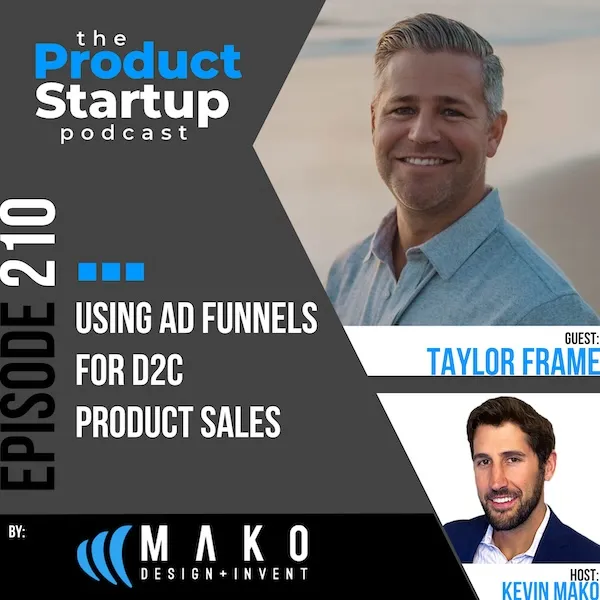
Guest: Taylor Frame, Co-Founder of Focus Funnels, a direct-to-consumer marketing agency that has worked with hundreds of businesses.
Host: Kevin Mako, founder of Product Startup and the leading expert in hardware startup consulting. A hardware entrepreneur since 1999, Kevin has advised more than 1,500 founders and built and scaled MAKO Invent through its acquisition by TriMech in 2024.
Episode Overview
Taylor Frame breaks down the four foundations of a direct-to-consumer funnel: product, positioning, placement, and promotion. He also explains how focused acquisition paths, simple creative testing, and a complete landing-page story can move a new consumer product from attention to purchase.
What You’ll Learn in This Episode
- What are the frameworks for bringing new hardware to market?
- Positioning is how your product is differentiated in the market.
- Placement is key! Put time into researching where your audience is spending their time online.
- Have a good understanding of what your audience cares about.
- A focused acquisition funnel is always best!
- Strive to achieve a customer journey that persuades someone to buy something.
- What are the three critical aspects of delivery for ads?
- Content is about your core pillars; build content that aligns with them to effectively sell the value of your product.
- Once you have content developed, get it out there fast!
- Paid ads versus organic ads.
- The barrier to entry on D2C sales has been lower than ever recently, making it easy to get in front of eyeballs through ad funnels.
- A key step is to ensure that when someone clicks on your content, you have a product landing page that promotes the product’s value.
- Keep your advertising simple, as if you’re talking to a friend about their problem and your solution.
- Keep your ads simple at the beginning, and then begin to test more complex pieces of content.
- Test 3 or 4 different types of ads every week or two.
- It is better to have more information on your website to ensure your page tells a whole story.
- Startups have a sizeable competitive advantage over big box retailers, as they have authenticity behind their products!
Episode transcript
This transcript is provided for accessibility and reference. Download the SRT transcript.
Read the full episode transcript
Kevin Mako: Hello, product innovators. Today we learn how to use website funnels to sell your new product directly to end customers from an expert who's worked with over 400 direct-to-consumer businesses.
Kevin Mako: This is the Product Startup Podcast, a show to learn from top leaders in hardware product development, prototyping, manufacturing, product selling, and everything in between.
Kevin Mako: Hosted by Kevin Mako, the leading expert on product development for hardware startups.
Kevin Mako: Welcome back, everyone. I'm very excited to introduce Taylor Frame to the show.
Kevin Mako: Taylor Frame is a co-founder of Focus Funnels, a direct-to-consumer agency that's been around for over eight years and worked with hundreds of businesses.
Kevin Mako: Before that, he worked with big brands such as The Gap, J.Crew, Adobe, and more on this very thing.
Kevin Mako: Today, Taylor will share valuable knowledge for inventors, startups, and small manufacturers on the four pillars of a direct-to-consumer funnel,
Kevin Mako: how to best ensure the sales funnel is built correctly, and best practices specific to physical product startups launching their first product to consumers online.
Kevin Mako: Now, on to the episode.
Kevin Mako: This show is produced.
Kevin Mako: by Mako Design, the original firm providing end-to-end consumer product development services
Kevin Mako: tailored specifically to hardware startups, small manufacturers, and inventors. Take your product from
Kevin Mako: idea to store shelves at MakoDesign.com. Now on to the episode. Hey, Taylor, welcome to the show.
Taylor Frame: Thank you. Excited to be here.
Kevin Mako: Well, we're excited to talk to you today about selling a new hardware
Kevin Mako: product directly to your customers on your own website. So how do you sell even just a small amount of
Kevin Mako: units up to millions of dollars of units, just selling directly to customers who are looking
Kevin Mako: for your very product. And who better to bring on the show today than you that has done
Kevin Mako: literally tens of millions of dollars in ad spend, almost 10 years, working with hundreds of
Kevin Mako: direct consumer brands. Before I get into the best practices here and the topic that we're talking
Kevin Mako: about today in terms of actually building out and the logic you need as a hardware startup to sell
Kevin Mako: direct to customers, Taylor, just give us a bit of a background of how you became the success story
Taylor Frame: you are today. Yeah, thank you. So my name is Taylor. I was one of the co-founders here at
Taylor Frame: Focus Funnels. We've been in the space for over eight years now. And I've directly been in the
Taylor Frame: direct-to-consumer, you know, website, experience space for over 10 years. And so tons of experience
Taylor Frame: boots on the ground, really in the trenches, helping big and small startup brands figure out
Taylor Frame: how do you connect with that consumer and get your product into their hands?
Taylor Frame: And so it's just been an amazing journey we've had over here and excited to share some tidbits
Taylor Frame: and some tips that'll help your people today. Yeah, right on. I mean, even in the early days,
Kevin Mako: you were working with companies like Gap, J. Crew while you're working at Adobe on some big
Kevin Mako: brand policies on how do they get more eyeballs on their product and more purchases on their website?
Taylor Frame: You know, that really kind of got the bug in me where I was working with these big brands and we
Taylor Frame: come to the table with these really innovative strategies. And then there was so much excitement
Taylor Frame: on both sides. And we'd sometimes see the strategies integrated like over a year. And it was never,
Taylor Frame: ever close to like our vision or what we had for the brand. And now I get to work with mid-tier and kind
Taylor Frame: of startup brands where we can come up with a strategy. And seven days later, it's implemented and
Taylor Frame: we're testing and we're seeing results. It is so gratifying. The big guys were fun to work with,
Taylor Frame: but the ability to work and impact people's lives on that granular level is so much more impactful.
Kevin Mako: Yeah, I mean, it's such a good feeling when you start selling products, especially a new product, right?
Kevin Mako: Somebody who really has never sold anything before, which is very typical for a hardware startup.
Kevin Mako: This is their first time coming to bat and the first time getting any product to the market.
Kevin Mako: And it's a new product that's coming to the market for the first time as well.
Kevin Mako: So you put these things together and it's a really exciting experience.
Kevin Mako: So for today and for the conversation, let's talk about how that's done.
Kevin Mako: Give us a bit of an overview and then let's jump into these various pillars of a direct-to-consumer.
Taylor Frame: advertising play. Yes. So we have worked with probably 100 plus brands that are bringing
Taylor Frame: new products to market. We actually play very heavily in the mom and baby space. There's a lot of
Taylor Frame: innovation in that space. And so we've had a lot of experience bringing these products to market.
Taylor Frame: So here's the framework that you need to think about. If you're a new brand, you've got a new hardware
Taylor Frame: that you're going to be bringing to market. You need to be thinking about four things. The first is your
Taylor Frame: product. You know, Kevin,
Taylor Frame: And that's your specialty, right? We're not product development guys, but that's your
Taylor Frame: specialty. So the first is you've got to get your product dialed. The second thing is positioning,
Taylor Frame: meaning why is your product different? What problems does it solve? And if I have limited money,
Taylor Frame: why should I buy your product as opposed to the competitors? Okay. So that's product and then positioning.
Taylor Frame: The next one is placement, right? Let's say we're doing a weighted blanket for kids. And this is
Taylor Frame: actually one of our big case studies. We took this weighted blanket brand from doing five to
Taylor Frame: six K a month. When they took all their stuff in house, they were doing over a million dollars a month
Taylor Frame: over the course of about a year and a half. We helped them with that whole launch and scale. It was all
Taylor Frame: direct consumer. The second, so you got your product, you got your positioning, then you have your
Taylor Frame: placement. Where is your audience spending your time? For a lot of our customers, we're marketing
Taylor Frame: to moms and women. They spend a lot of time on Instagram. They spend a lot of time on Facebook. They
Taylor Frame: spend a lot of time on TikTok. So we put the content there, right? But if you're an innovative brand
Taylor Frame: that's like potentially marketing to like golfers or rock climbers or some other demographic,
Taylor Frame: you've got to find out where they're spending their time online and you need to be there. Okay,
Taylor Frame: so we've got product, we have positioning, we have placement. The last one is audience. What does my audience
Taylor Frame: care about? So let's take this weighted blanket, for example. As a parent, the most
Taylor Frame: painful thing you can experience is when your child is not sleeping. And you will pay any level
Taylor Frame: of money to solve that problem. I've got three kids, so I feel you. Yeah, me too. My son was up twice
Taylor Frame: last night. So it's painful. And so what we did is we started talking to this audience about solving
Taylor Frame: that core problem, right? So what I just described is called a focused acquisition funnel. And let me
Taylor Frame: break that down into a non-marketing term. It's a customer.
Taylor Frame: journey that gets someone to buy something. Okay. So a focused acquisition funnel.
Taylor Frame: And it's designed to get in front of somebody that's never heard of you before and say,
Taylor Frame: oh my gosh, where has this product been my whole life? And hit the checkout button. Right. So inside of that,
Taylor Frame: there are three core aspects you need to have. Once you've got product, positioning,
Taylor Frame: placement, and audience down, right? In the framework, there are three aspects you need to figure out.
Taylor Frame: The first one is your content. Okay? And you use that product positioning placement audience
Taylor Frame: to guide your content. If I'm selling a weighted blanket, I'm going to tell a story about
Taylor Frame: keeping my child asleep at night. And that content, because I'm serving it on Instagram,
Taylor Frame: and because I'm serving it to tired moms, it's got to be engaging, it's got to be quick,
Taylor Frame: it's got to solve the problem, right? So the first piece that you have to solve for is you've got
Taylor Frame: to build the right content. And the content has to sell the value of your product. Okay. So that's
Taylor Frame: step one. Step two, once you've got your content dialed, is next, it's, all right,
Taylor Frame: how do I get this content out there? If you've got a little bit of budget, paid ads are an amazing
Taylor Frame: way to get in front of the right audience very quickly. If you have no budget and you're like totally
Taylor Frame: bootstrapping, now you can use influencers. You can have friends and family call you out. You can start
Taylor Frame: building an audience on Facebook and Instagram. It's never been easier to get in front of your people
Taylor Frame: right now. Like the barrier to entry is as low as it's ever been in the history of the world. Right. So if you have
Taylor Frame: no money, you can get creative and that's going to require more work, but it's still very doable. The second aspect,
Taylor Frame: once you got your content dialed and your creative set, then it's about how do I get this message out there?
Taylor Frame: So that's usually paid ads or organic. Step three is when somebody clicks on that. They see that way to
Taylor Frame: blanket. They're super interested. They click on it. Where are they going? This is your product page.
Taylor Frame: or your landing page needs to be dialed in to sell the value of the hardware that you've
Taylor Frame: built. Why is it valuable? What problems does it solve? What are my reviews? What was the manufacturing
Taylor Frame: process? Answer all the questions that someone's going to have before they ever have them. So that's the
Taylor Frame: framework of solve these four things, product, positioning, placement audience, and then build out
Taylor Frame: your funnel with content, your media buying strategy, and then the landing page. You get those
Taylor Frame: things in lock? The world is your oyster. That's so powerful. And I love how you broke it out
Kevin Mako: into those pieces. The reality here is, especially when you talk about the organic search volume,
Kevin Mako: you can do this without even paying for it. In reality, when it comes to a very basic version of this,
Kevin Mako: if you're not using a great agency, if you're not using a great web dev, if you're not using
Kevin Mako: pay ads, you can start small and work your way up depending on whatever your budget is. I think what
Kevin Mako: you've dialed in here is, if you put this structure together,
Kevin Mako: anybody can sell a great product. Now, I like how you mentioned as well, and I've got to address it
Kevin Mako: the fact that you started with product. That's the very first thing. Us as a product design firm,
Kevin Mako: that is our first and largest objective. Build a great thing that people truly want. That's got to be
Kevin Mako: your step one. After you have that thing, which most hardware startups, they've come up with something
Kevin Mako: innovative, something amazing. And if they've gone through the correct efforts and they've done the design
Kevin Mako: right and they've tested through prototyping and they're ready to go into manufacturing and they've got the right
Kevin Mako: manufacturing partners engage, they've got a great product that's innovative. So there are
Kevin Mako: people out there who you've solved a paypoint that they need. And now it comes to Taylor's world,
Kevin Mako: which is, okay, you've figured out this object. You've got it in production or ready for production,
Kevin Mako: let's say. Now, how do you get it in front of the eyeballs and get those people to convert?
Kevin Mako: Yes. That's so powerful how you've expressed that journey. Are there pieces of that puzzle that you
Kevin Mako: want to dive into for someone who's really kind of new to the process or things that can
Kevin Mako: help kind of dip their toe in the water, let's say, of this process. Yeah. So the first thing I
Taylor Frame: will say is you want to keep it simple. There are so many people that overcomplicate this. And
Taylor Frame: the reason they overcomplicate it is they want you to hire them. You need to keep things simple at the
Taylor Frame: beginning. So your content, you need to clearly articulate like you would to a friend at a coffee shop.
Taylor Frame: You have a problem. My product helps you solve that problem in here.
Taylor Frame: why. And here's how it does it. It needs to be conversational. So that's the first
Taylor Frame: tip. Realize that there's a person on the other end of that content that has the same experience as you do
Taylor Frame: and you just need to speak to them like you would speak to your friend at a coffee shop. Second piece
Taylor Frame: is if you are doing paid ads or you are doing organic, keep it simple at the beginning. Do broad
Taylor Frame: targeting, create some great content, and then test your first two or three pieces of content.
Taylor Frame: content probably aren't going to work. But those tests influence what you need to change.
Taylor Frame: So we, with our brands, will test anywhere from three to four pieces of content every week and a half.
Taylor Frame: And those pieces of content have different hooks. They have different problems they solve. They have
Taylor Frame: different promises. It's all built in, right? So you have to test. Even us with millions of dollars
Taylor Frame: of ad experience and so many up at bats, we have to test for every single brand. Okay, so step one,
Taylor Frame: keep it simple. Get a really good value prop. Test the value prop. And then three,
Taylor Frame: on the website, answer the questions. More is better in terms of information. If you've got a small
Taylor Frame: product description that's like handcrafted in Malaysia and solves this problem, that's not enough.
Taylor Frame: You've got to go and do tons of detail around this product because consumers are more educated than
Kevin Mako: they've ever been. And once they're on the site, they're willing to spend the time. They're either going
Kevin Mako: to buy or leave, but the reality is the more information you can get them, the higher
Kevin Mako: the probability you're going to convince them. Maybe not on the first or second or third thing
Kevin Mako: they read, but it might be the fourth thing, that that hits whatever the corridors that they were
Kevin Mako: particularly looking for or the validation point they needed or just the right combination of things
Kevin Mako: that they finally said by the time they've read and read and read, aha, that's the one I'm finally ready
Taylor Frame: to make a buying decision. Yeah, totally. And there needs to be a lot of content around that.
Taylor Frame: I'll go to sites that have innovative products and they'll have like three pictures.
Taylor Frame: They look like stock images that they pulled off of like a Google Drive. Tell the story. Record some
Taylor Frame: videos. Do some selfie cam. Like get some information around this product. Show your consumers how it
Taylor Frame: works. The ability to create content, we all have our phones in our pocket that shoot in 4K. So the ability
Taylor Frame: that like I said at the beginning, the barriers to entry are the lowest they've ever been. You just have to
Kevin Mako: take action. It's interesting when you mentioned about the phone too because I find that more
Kevin Mako: than ever, especially with new and emerging brands, people almost appreciate that more than having
Kevin Mako: some stuffy corporate brand that has every single piece perfect. So if you've got a video you
Kevin Mako: recorded of yourself using the product on your phone as the founder, people love it. Because
Kevin Mako: you know what? They don't see that when they go onto the big corporate's website. So the authenticity
Kevin Mako: comes through. That authenticity, at least in today's era, really.
Kevin Mako: sells product as opposed to, you know, we don't know what the future holds. And we know in the past
Kevin Mako: there's been times where corporate trust has been incredibly high and people trusted startups
Kevin Mako: potentially lower. But we know that as of right now, people trust startups immensely. It's a hot
Kevin Mako: topic. People want to see that young, energetic emerge product. And as long as you can validate it and
Kevin Mako: they can trust and believe in what you are saying in terms of your brand promise and the product
Kevin Mako: promise and the value, as long as they trust that, they're going to want to buy from you over the
Kevin Mako: companies that are potentially a lot bigger than you that you are maybe originally afraid of
Kevin Mako: competing against. You've got to make your competitive advantage. So you utilize that competitive
Taylor Frame: advantage, especially as a new emerging brand. 100%, Kevin, like you nailed it right on the head.
Taylor Frame: And so this is exactly what we do here at Focus Funnels is we help people solve this equation.
Taylor Frame: So we have a full content shop. We can help you build the content and the creative and the copywriting
Taylor Frame: that's going to get your vision properly in front of people, right? We have the whole
Taylor Frame: media buying team, whether it's meta, which is Facebook and Instagram, Google, YouTube,
Taylor Frame: Pinterest, TikTok. We're absolute experts on all those platforms. We've literally spent millions and
Taylor Frame: millions of dollars on those. And then all the way down to the product page or the landing page,
Taylor Frame: we build all that out, helping create that authenticity and that trust. And so when people
Taylor Frame: come to this thing, if this is so overwhelming for you, we can help you build out that entire customer
Taylor Frame: journey and that's really where our expertise comes in. Can you give everyone the website
Kevin Mako: of where they can find out to learn more about the services you offer in case they're looking
Kevin Mako: to hire an agency and work with somebody like you to develop this thing out? Yeah, I love that. So
Taylor Frame: it's FocusFunnels.com. FocusFunnels and Funnels has an S on it. FocusFunnels.com. And on that site,
Taylor Frame: we have a ton of information about what we do. You've got customer reviews. We even have a little small
Taylor Frame: podcast where we feature some of our customers, some of our case studies on there. And then
Taylor Frame: last thing I'll say is, anybody that's interested, book a call with my team, because we will add
Taylor Frame: serious value, even if you don't work with us. We are very honest and open with our leads being like,
Taylor Frame: hey, you're ready for us. Or you know what? You should do things organically for a little bit before you
Taylor Frame: engage with us. So we're not here just trying to get that sale at any cost necessary. We really
Taylor Frame: think about what is best for the consumer and the customer. And we put that first in our sales
Taylor Frame: process. So feel free to book a time and we'll chat with you. Taylor, that's much appreciated. And as
Kevin Mako: always, I will put the links below for anyone who wants to just click through. They can click through
Kevin Mako: to Focus Funnels and learn more. Taylor, much appreciated for your words of wisdom today on the show,
Kevin Mako: showing people how you can go from that idea, that manufactured product, and then into actual sales
Kevin Mako: himself directly on your own website, directly to your end customers. Love it. Thank you.
Kevin Mako: Thanks, Taylor. Take care.
Kevin Mako: Thanks for tuning in to this episode of the Product Startup Podcast.
Kevin Mako: If you found some value in the show, please do us a huge favor and hit the like button and subscribe.
Kevin Mako: If you have any questions, guest suggestions, or anything else, feel free to reach out to us anytime at our email,
Kevin Mako: podcast at MakoDesign.com. This show is hosted by Kevin Mako, North America's leading expert on product
Kevin Mako: development for hardware startups. And the podcast is produced by Mako Design, the original
Kevin Mako: firm providing end-to-end consumer product development services tailored specifically to hardware
Kevin Mako: startups, small manufacturers, and inventors. Take your product from idea to store shelves at MakoDesign.com.
Kevin Mako: That's M-A-K-O-Design.com. Thanks for joining and see you again soon.
D2C Growth Strategy for Product Founders
Turn Product Interest Into D2C Sales
If you are preparing to sell a physical product through your own website, work directly with Kevin Mako to pressure-test your positioning, audience, offer, channel plan, creative testing, landing-page story, and unit economics before you increase ad spend.
Kevin can help you identify the highest-leverage gaps across product readiness, marketing, fulfillment, and funding, then connect you with proven specialists when the plan calls for them.
Tell Kevin what you are selling, where traffic comes from, and where your funnel is losing momentum.