
Listen Now
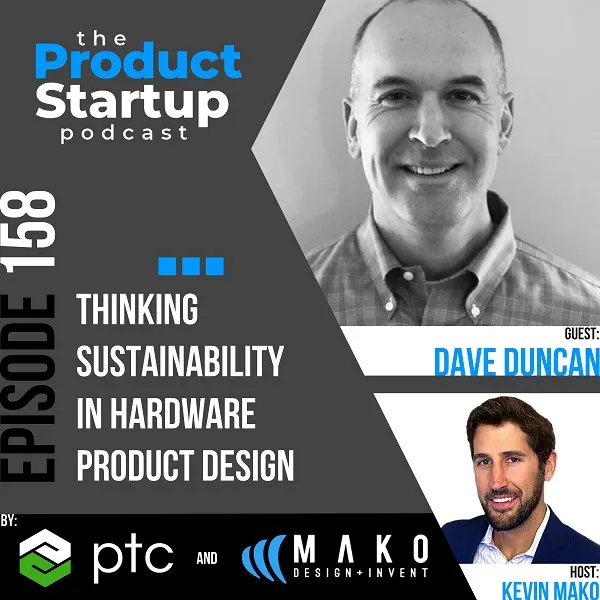
Guest: Dave Duncan, Vice President of Sustainability at PTC, with more than two decades of experience in product design software.
Host: Kevin Mako, founder of Product Startup and the leading expert in hardware startup consulting. A hardware entrepreneur since 1999, Kevin has advised more than 1,500 founders and built and scaled MAKO Invent through its acquisition by TriMech in 2024.
Episode Overview
Dave Duncan explains three connected dimensions of product sustainability: design, manufacturing, and lifecycle management. He discusses carbon impact, regulatory requirements, early material and architecture choices, marketability, and why sustainability becomes more difficult and expensive to add after development is already advanced.
What You’ll Learn in This Episode
- Designing with sustainability in mind is crucial for creating environmentally responsible products.
- Sustainable manufacturing practices must be employed to minimize the environmental impact of production.
- Effective product lifecycle management is essential for maintaining product sustainability over time.
- Incorporating sustainable design principles early in the product development process is important for maximizing impact.
- Carbon emissions are a primary environmental impact of product manufacturing and should be minimized through sustainable design and manufacturing practices.
- Sustainable product design is a viable option and should be considered when developing new products.
- Adhering to sustainability regulations is necessary, but it’s also important to go beyond these regulations to improve product sustainability.
- Sustainability should be incorporated early in the product design lifecycle to ensure maximum impact.
- Software tools can help analyze sustainable design options and make informed decisions.
- Building sustainability into product design from the outset is key to achieving environmentally responsible outcomes.
- Even in B2B product sales, there is a growing interest in sustainable products, which can give businesses a competitive edge.
- As a startup, sustainability can be a valuable advantage in differentiating products and services.
- The majority of a product’s environmental impact is determined during the design phase, with only a smaller percentage able to be reduced during manufacturing.
- Bottleneck analysis and energy management are critical tools for improving product sustainability.
- Implementing circular economy principles and circular product design can help reduce waste and extend the useful life of products.
- When designing a product, it’s important to consider end-of-life scenarios, such as re-use, recycling, or reconfiguration.
- Developing commercial relationships with customers around end-of-useful-life scenarios can help extend product sustainability.
- Generative design tools, such as those available in OnShape, can help reduce materials use through AI-driven optimization.
- With the help of tools like Arena, bill of materials management and analysis can help improve product sustainability.
Episode transcript
This transcript is provided for accessibility and reference. Download the SRT transcript.
Read the full episode transcript
Kevin Mako: Hello, product innovators. Today we learn from a leader in design software for the hardware industry on developing a product for full life cycle sustainability.
Narrator: You're listening to the product startup podcast, a show to learn from top leaders in product development, prototyping, manufacturing, product selling, and everything in between.
Narrator: hosted by Kevin Mako, the leading expert on product development for physical product startups, sponsored by PTC's two best in class 3D CAD product development software solutions,
Narrator: Onshape, and Creo, and produced by Mako Design + Invent, the original firm providing world-class consumer product development services tailored specifically
Narrator: to startups, small manufacturers, and inventors.
Kevin Mako: Welcome back, everyone. Today I'm very excited to introduce Dave Duncan to the show. Dave is the vice president's sustainability at PTC Corp,
Kevin Mako: the company behind multiple product design software solutions, including Onshape and Creo.
Kevin Mako: He has spent over 20 years in the product design software world and has his bachelor's of engineering from Princeton University.
Kevin Mako: Today, Dave is going to share some valuable knowledge for inventors, startups, and small manufacturers on what it means
Kevin Mako: to develop a sustainable product, what the three different types of product sustainability are,
Kevin Mako: and how to use modern best practices and ensuring your product is the most marketable by including sustainability as one of your key product development priorities.
Kevin Mako: Now, on to the episode.
Kevin Mako: Hey, Dave, welcome to the show. Yeah, thanks, Kevin. Thanks for having me.
Kevin Mako: Dave, I'm excited to have you on today to talk about sustainability.
Kevin Mako: specifically in product developments. Sustainability is obviously a big buzzword, and there's lots of media hype around it, lots of sales value around it,
Kevin Mako: lots of global value around sustainability. But the question is, if you're a new hardware startup or you're a product brand
Kevin Mako: and you're looking to redevelop your product for sustainability,
Kevin Mako: how do you think about that from the early days? And what better person than to have you on the show today to talk about everything from starting from the early days
Kevin Mako: of developing the product all the way through to the actual product lifecycle management. Now, before we get into,
Kevin Mako: all of that, just give us a bit of a history of how you got to where you are today.
Dave Duncan: Yeah, sure. So, I mean, I got a civil engineering degree initially, but if you ever see a bridge with my name on it, don't drive over it.
Dave Duncan: I went in the Army right afterwards before I got my engineering certificate. When I got out, software was just really appealing for me in the late
Dave Duncan: 90s. So I switched careers, got into that, you know, right away into ERP, which was manufacturing.
Dave Duncan: Then I got into a startup for service software, which was acquired twice, ultimately by PTC.
Dave Duncan: So I've done service software, manufacturing software, and engineering software as well. So cover the lifecycle.
Dave Duncan: About three months ago, we started a new role at the company for sustainability because it's just at the forefront of manufacturing now.
Dave Duncan: So we're giving it good funded discipline. So my new role is to work across all of our product groups to determine, hey, how do
Dave Duncan: capabilities in each thing that we offer, move the needle for manufacturers that are trying to build sustainable products to design, manufacture, and service them.
Kevin Mako: Yeah, that's amazing. I love how you look at all of those three elements. Let's break it down.
Kevin Mako: What does it mean to design, manufacture, and service in and around the topic of sustainability,
Dave Duncan: especially for a hardware product? Yeah. So just first, maybe high level for sustainability. It's a word that everybody hears.
Dave Duncan: It's everywhere, whether you're sustainability, green, ESG, whatever it might be. The fundamental of sustainability is that our generation desires
Dave Duncan: to leave the planet in a space or a condition for the next generation to enjoy it as much as we have. So that's effectively what we're trying to do at a high level.
Dave Duncan: And if you break that down in the terms of how a hardware startup can participate, it's reducing
Dave Duncan: carbon impact of your manufacturing operation and service and also reducing the amount of material
Dave Duncan: waste that you have along the way, right, as far as extracting minerals from the ground, using it in your products, waste from manufacturing,
Dave Duncan: and then, you know, ultimately, end of life, what do you do with it? Can you take big modules off of it? Can you recycle it? Is it buried in the ground? Is it somewhere in between?
Dave Duncan: So it really boils down to the main impacts that we've seen are around carbon emissions,
Kevin Mako: specifically, and waste. That's very helpful. I like how you broke down those three elements to it. And it's key to
Kevin Mako: understand from the earlier faces, the earlier that you understand sustainability, the easier it is
Kevin Mako: to actually implement that, not only to your product, but in terms of your entire product business as well.
Kevin Mako: To break it down, what can a hardware startup do in the early days to get ahead of and be a beacon for sustainability?
Dave Duncan: Yeah. One thing I haven't come rooming cover it later is you can design a product that's purpose is to move the needle on sustainability,
Dave Duncan: But more in general, other you're doing planes, trains, automobiles, shoes, whatever it might be, you know, generically, there's things that you can do and we'll cover that.
Dave Duncan: So if you think all the way at the forefront of your product design, the first thing you need to do is understand, hey, what do you have to do?
Dave Duncan: And then what is, what can you optionally do that could potentially give you differentiation for sustainability, right?
Dave Duncan: There's certain things that you have to do for like reach and rose for hazmat, you know, more and more there are.
Dave Duncan: are carbon reporting standards that are coming out in various regions that you may want to go to
Dave Duncan: market in, whether the European Union being a big one, they have some of the leading more stringent ones. The U.S. is a fast follower in that regard, and there's others.
Dave Duncan: So regionally, you need to understand those and make sure that they're baked into your requirements, which will ultimately
Dave Duncan: link to your design specs, whether that's CAD and PLM combined or just CAD. So that's sort of the first aspect of it.
Dave Duncan: The second aspect is historically the way that this has been done is you design your product according to your requirements.
Dave Duncan: When you're at a much later stage gate, you either organically or outsource it to a environmental
Dave Duncan: engineer who will do what's called a life cycle analysis of your design. And they will peel back the onion on all of your materials and all of your manufacturing
Dave Duncan: processes and geographically where you're sourcing it from, where you're manufacturing it, where your sales distribution will be operations, et cetera, the full assessment.
Dave Duncan: It's a very specific thing to do and involved. The output's super useful and insightful. The problem is it's so late in the life cycle.
Dave Duncan: And if you're going to take any of the learnings from that at that stage, you need two things that a startup doesn't have. You need time and money.
Dave Duncan: You could significantly have to delay your launch to make big changes, and it'll cost you a bunch of money to make those big changes. So we're finding as more and more you can use,
Dave Duncan: software to advise on those decisions very early on. For example, if you're in CAD and you're
Dave Duncan: making a material and or manufacturing process decision, or what you do very often in a startup,
Dave Duncan: as a hardware manufacturer, you're assembling components that you buy from component manufacturers.
Dave Duncan: So whether it's raw material for a make part, components for a bi-part, and then manufacturing process thereof, you have databases that you can link to.
Dave Duncan: that can return information to give you information about what is its embodied carbon
Dave Duncan: at the point that you receive it and reach rose hazmat how recyclable is it how much does it weigh
Dave Duncan: if you're developing a mobility product and it can roll all those up so it can inform you
Dave Duncan: hey so far your design looks like it has these types of impacts based upon those inputs and then you can go ahead and explore alternative materials manufacturing
Dave Duncan: process components and see how that, you know, changes that prediction, if you will. It's not as thorough as an LCA, but it gets the 80% of the way.
Dave Duncan: And frankly, it's those big decisions that you want to make up front and they're going to be reasonably right. You're not going to have to change them
Kevin Mako: later on. That's a good way for it to flow. That's such great advice. And I can tell you from
Kevin Mako: the product development standpoint, when we're looking at a new project, if we've scoped out certain elements of sustainability before we've even gone down the path of
Kevin Mako: sketching and doing the CAD, even initial conceptual CAD designs, there's a lot of decisions that are being made by industrial designers, mechanical engineers, electronic engineers
Kevin Mako: that are related to those original specifications or the product requirements that a hardware startup or a hardware brand is trying to achieve with their product.
Kevin Mako: Well, of one of those line items is a certain level of sustainability. Maybe it's around the materials, the carbon footprint,
Kevin Mako: I mean, those two things could be combined, many other elements of the product, including the components that go into it or the build or how it's being built.
Kevin Mako: All of those things will factor in to help the IDs, EEs, MEs figure out the path of lease resistance to create the specifications that
Kevin Mako: you want with the features you want, the design that you want, but also with the sustainability that you're
Kevin Mako: looking for. And because the tools, like Onshape as an example, obviously, we're a big user of that macro design and we're a big fan of PTC.
Kevin Mako: One of the biggest advantages that we find in using the tools that are actually embedded in the software is to be able to have that knowledge right at our fingertips
Kevin Mako: quickly so that we can almost iteratively consider design these things or trial and error them a bit to
Kevin Mako: try and figure out, okay, can I use this recycled material in this particular part? Let's try it out. It doesn't look like it's working.
Kevin Mako: Okay, how about this thicker version of that same recycled material? Try it out. Okay, that seems to have the rigidity that we are looking for in that
Kevin Mako: certain part. Now, these are the sorts of decisions that are happening at very small levels throughout the development process well before it gets to the end final spec
Kevin Mako: in the original way that you mentioned when you get to that lifecycle management individual who looks at it and says, well,
Kevin Mako: now we need to shave all these things to reverse the design. It's much easier to do it in the early
Kevin Mako: phases, even in that original specification document, so that you can push your designers,
Kevin Mako: your engineers, et cetera, to figure out those details, utilize the software and the technology that's baked in it to figure that stuff out, then produce a product that's
Kevin Mako: hitting those metrics, at least as close as possible before you get into manufacturing, like you said, most of the time
Kevin Mako: you're going to get it there 80% of the way, which really does happen if you've thought about it from day one.
Kevin Mako: It'll be baked into the design naturally and organically from those designers and then
Kevin Mako: creates a better product at the end of the day as well that hits the sustainability matrix that you are looking for right out of the gate. Plus, you can sell that.
Kevin Mako: It's a sellable feature. And that's one of the big points of sustainability. It's not just about saving the environment. Obviously, that's incredible and that's great.
Kevin Mako: It makes you feel good. But know that consumers demand this more than ever before. So you're doing something that's good for the environment,
Dave Duncan: but you're also doing something that's good for your business. Yeah, exactly. It's not just B to C products. It's B to B products as well.
Dave Duncan: So just a quick lesson on how the economic work there is companies more and more are reporting their emissions footprint.
Dave Duncan: And a big part of a company's footprint is they're purchased goods and services.
Dave Duncan: So when you're selling a hardware product to a business, you know, that business will have to account for the embodied carbon in that product that they buy from you, as
Dave Duncan: well as any carbon that's generated by your product during its life to include its waste if it's thrown out.
Dave Duncan: So those are all things that they don't want to have to accrue on their balance sheet of carbon that they're reporting on. So they will look for vendors that do two things.
Dave Duncan: One, they already offer a green product. And secondly, are on a trajectory to reduce carbon over time and have some sort of commitment to do that.
Dave Duncan: So there's big buying decisions there. If you look at Salesforce.com as an example, you know, they put out a memo in 2021 that says,
Dave Duncan: hey, if you're a supplier of hours and you expect to renew with us in 2023 for 2024 and beyond,
Dave Duncan: they're saying, hey, we need to see that you've baseline your carbon, that you have such commitments to do so,
Dave Duncan: or we're going to put it in the contract that you have to do that, or potentially it's implied that if you're not
Dave Duncan: going to do that and you're not going to accept those contract terms, we'll find somebody else. So it's becoming a mandate, and that's an advantage as a startup.
Dave Duncan: Like, you can move faster on that than a large company. Like, you can come out of the gate with, one, a greener product and two, a faster commitment
Dave Duncan: to drive down towards net zero in a shorter amount of time. And those are all things that will factor in RFIs with your customers. It's coming fast.
Kevin Mako: And it's a super opportunity for you as a startup to do this. It's nice to see it's happening at the corporate level, the consumer level, and now obviously
Kevin Mako: design and manufacturing level as well. Right. Because all of this stuff really helps to improve. overall global economy in and around sustainability.
Kevin Mako: Not only are we creating better innovations, newer products that help people in some way or another, as all innovations should or ought to, and most of them that's the goal.
Kevin Mako: They're also helping improve the future. And that's a big part of the value of what you're offering, but it's also very enjoyable to work on. I can tell you
Kevin Mako: from the design perspective, designers love that stuff. We love when somebody's really thinking
Kevin Mako: about the full life cycle of their product and how that actually is going to evolve over time,
Kevin Mako: that pairs very nicely with what you're saying about corporate as well, because they have an increasing mandate over time.
Kevin Mako: So if you can get in now with a sustainable first product, as your product evolves, or as you come up with second or third versions, or just other
Kevin Mako: supplementary products, as you're building your brand over the years, you've already cracked the door open to a corporation that is basically telling you that they are going to
Kevin Mako: expand into this category over time. So as your business expansion,
Dave Duncan: And so is theirs in terms of a purchasing channel. What a great relationship. Yeah, exactly.
Kevin Mako: They'll want to expand with you if you're a high performer out of the gate. Yeah, no doubt. Dave, can you talk a bit about manufacturing and some of the value that you're seeing in
Kevin Mako: sustainability or some of the methods that are helping produce products in a more sustainable way at the manufacturing level?
Dave Duncan: And then after that, I'd like to talk about life cycle. Yeah. Okay. So manufacturing, it varies widely. Reasonably verified statistic is that 80,
Dave Duncan: percent of a product's footprint overall, whether it's carbon, waste, material, 80 percent of its footprint is determined at design time.
Dave Duncan: So like all those decisions and the different data that we just talked about that you can use for a design to include the manufacturing process will
Dave Duncan: predetermine 80 percent. And then there's 20 percent that you can do, you know, in the factory to reduce that further.
Dave Duncan: But as a startup, you're most likely using contract manufacturers. So I'll explain a little.
Dave Duncan: little bit about what a large-scale contract manufacturer might do in regards. And there's a couple things they'll do there.
Dave Duncan: One is bottleneck analysis, and the second is energy management. So what bottleneck analysis is usually within a factory, your problem, children are a Pareto. So if you have
Dave Duncan: a hundred machines in your factory, just use a round number, it's usually eight to ten of them that cause you problems, where it's causing too much scrap.
Dave Duncan: You're using too much energy. It has too much downtime where you have things that are turned on and they're not producing. So the energy
Dave Duncan: usage per unit manufactured is going down and your waste goes up and your scrap. And of course,
Dave Duncan: that causes sustainability issues, but it's also directly linked to the bottom line as well. So with bottleneck analysis, you focus your censoring
Dave Duncan: and your analysis on those eight to 10 machines and one by one you discover and
Dave Duncan: you mitigate the next most severe issue. Rinse repeat, rinse, repeat.
Dave Duncan: So that's generally what your contract manufacturers will do to reduce the footprint of your process.
Dave Duncan: The other is energy management, which is basically just sort of lightly censoring, say, all 100 machines in the same factory and then having upper and lower control
Dave Duncan: limits on its energy use so you can find if something's wrong and then operate efficiently.
Dave Duncan: But Kevin, I think part of what you're trying to get at is, like, should you use additive,
Dave Duncan: should you use subtractive, should you use this or that, or she'd use aluminum, should you use steel.
Dave Duncan: And frankly, there's so many variables that come and play there, but there's certain simulations that help a lot, like A Priori is a partner of PTCs.
Dave Duncan: And what they do is they sell to manufacturers who make digital models of their factory machines
Dave Duncan: and process capabilities in their software, and you could upload a CAD model to it, and it will
Dave Duncan: spit back an estimate of, hey, how much is it going to cost to manufacture this and how much footprint is it going to produce?
Dave Duncan: And not only that, but also give you the reasons why and how you can change that. Like, for example, you may use, say, hey, I want to use aluminum because it's lighter.
Dave Duncan: It's more malleable for a cleaner manufacturing process. But then it may end up, it's like,
Dave Duncan: well, you know, just to get the aluminum in the first place, that's much more embodied carbon than iron does.
Dave Duncan: So you might be better off getting dirtier, heavier iron up front and then you using a cleaner manufacturing process, or maybe all else being equal,
Dave Duncan: how do you flip the coin? Well, aluminum is like 100% recyclable and maybe some other metals aren't. So it'll take all those things into consideration in a way that a design
Dave Duncan: engineer can consume the information. Like it'll curate the answer back to you as a CAD designer, not in an environmental engineering
Dave Duncan: language, but in something that's actionable for you to make that decision. So I can't really say that, hey, additives always better than subtractive or casting or whatever
Dave Duncan: might be. It all depends. It's so correlated with how the product's going to be used. Does weight matter? How's it extracted? Is it extracted in Finland versus chili?
Kevin Mako: All sorts of factors there. There's simulation software that can help you make those decisions. The most powerful thing is just to have it top of mind.
Kevin Mako: Look at all the different analysis that you're talking about here, Dave. There's a lot of considerations
Kevin Mako: that go into it that most people, especially in the early development phases of a product,
Kevin Mako: or in the startup phases or even in the ideation phases of the product overall, you're just not thinking about.
Kevin Mako: But as you get closer and closer to creating a design and then actually designing it yourself, then actually designing it professionally and properly and then going
Kevin Mako: through all the processes for engineering, prototyping, etc., to get it to production, you should
Kevin Mako: be increasing your consideration if sustainability is a metric that matters to you. And it should
Kevin Mako: matter to you. So as that goes through the process, you're increasing your knowledge base more
Kevin Mako: and more. I love how you brought up that statistic that 80% of the product's carbon waste footprint is essentially predetermined in that development phase.
Kevin Mako: This is where you're making the decisions that will affect how it's produced. How it's produced is really where that carbon footprint is
Kevin Mako: affected. So if you're very careful throughout the process of thinking forward on how you're
Kevin Mako: actually going to do all of this, then you should be much further ahead than if you try and do it retroactively. That comes to the manufacturing level.
Kevin Mako: As you mentioned, there's a little bit more that you can do there. And again, if you're conscious of it and you work with your factory, of course,
Kevin Mako: you're not going to find the answers here today on the show. But by planting that seed in your mind,
Kevin Mako: hopefully you will have those conversations with your producer, especially as you scale and especially
Kevin Mako: as you grow so that not only have you designed a product that's great, sustainable, but you're also working with the factory so that there as efficient as possible as well.
Kevin Mako: And that leads to the last part, which is the actual life cycle of the product itself, which is something that is often, probably the
Kevin Mako: most overlooked category of the concept of design for sustainability is what happens to your product in its journey and in its essentially its death.
Kevin Mako: And that's where the last part of this should be thought about.
Dave Duncan: And I'd like you to highlight what you've seen in terms of life cycle management, Dave and best practices around that. Yeah. So this is what they call the circular
Dave Duncan: economy or having a circular product. And it's a new emerging field. It's getting a lot of attention. But there's not a huge amount of answers there yet.
Dave Duncan: But I'll talk about a few areas that can help a startup. You know, the first is, is you want to design your
Dave Duncan: product so when it is end of life, that as much of that material as possible can be recovered.
Dave Duncan: And what I mean by that is not like 100% recyclability. You should strive to do better than that,
Dave Duncan: which is if you have a modular design of the product, if you just think of like big Lego bricks,
Dave Duncan: you should be able to take out sizable Lego bricks from that end of life product and either restock that in a service parts warehouse or bring
Dave Duncan: that back for remanufacturing into a new product and for whatever's left, yes, you want to make sure that that can be extracted and
Dave Duncan: recycled in a commercially practical way, whether it cycles back as material back in your factory or a secondary market or compost.
Dave Duncan: Those are the first more like technical engineering aspects that you should think about. The other is your commercial arrangements to make that happen.
Dave Duncan: And that can be a massive advantage for you as well. You know, today and now, if you have a product and
Dave Duncan: you stock it in Walmart or somewhere and somebody buys it, you've lost control of it. You have no idea what's going to happen to that once it's end of life.
Dave Duncan: Now, if you have some other relationship with your customer, like, I just ordered a pair of shoes. I've never done this before. I went on a whim, some running shoes.
Dave Duncan: Like, I'm in a new sustainability role. I've got to find some shoes. So I found this shoe company, and they had this CAD diagram with a shoe, and it described all
Dave Duncan: the materials and the carbon footprint and how recycled. But it's like literally all of it's compostable or reusable except for, I think.
Dave Duncan: It's just some polyester stitching around the laces. And they say, hey, Dave, we're going to sell you these shoes. We're going to ship them to you.
Dave Duncan: If you ever want a new pair of shoes from us, you can send back your old pair and we'll give you a 10% discount.
Dave Duncan: So they have this business model where I'm going to send back the shoes when I'm done with it. And they're going to get value out of that material to build new shoes.
Dave Duncan: And they've got me for a resale because I'm going to go back. I get 10% discount, send me another one. And I'm going to feel good about it, too, because I'm sending it back.
Dave Duncan: I mean, that's a simple example as a shoe.
Kevin Mako: But, you know, that type of out of the shoebox thinking, if you will, is, you know, what's going to win in the startup markets for you.
Kevin Mako: That's so powerful because think about how that increases the probability of fully lengthening your customer relationship for the lifetime of that customer.
Kevin Mako: You haven't just sold one shoe. You've potentially sold a lifetime of shoes with that customer. You've created a brand ambassador.
Kevin Mako: You've created sustainable circle around that product. There's so many pieces of value beyond just the sustainability.
Kevin Mako: element for doing things in this way, that even if you're just looking at the hardcore dollars and cents, which I always believe you should look beyond.
Kevin Mako: But even if you're just looking at the dollars and cents, understand that there's both direct value that's happening from this relationship and indirect.
Kevin Mako: So look at the two of those and really try and look at that over the life of your business that you're trying to build.
Kevin Mako: How does that actually start compounding over time? And some of these examples, I love the shoe example, are really powerful in terms of how you can think about this in the
Kevin Mako: early design phases of your idea to think about your product beyond just those first sales
Kevin Mako: and how it actually can build your brand as you accelerate, not just by adding more products,
Dave Duncan: but adding more loopback cycles with your customers and with the actual materials that you've sold your customers. Right. Yeah. It maintains the relationship.
Kevin Mako: Customer feels good. You make money. Repeat sales. It's a great product market fit to do circular design.
Kevin Mako: Dave, I'd like to talk a bit about the tools in OnShap and how that's helping accelerate the design in sustainability. Can you just highlight some of that?
Dave Duncan: And as well, for anybody listening, we'll have a link below that you can try with the software for free and give it a whirl and try some of these tools yourself. Yeah, of course.
Dave Duncan: So a lot of the things that we talked about today, you know, whether it's standalone and Onshape or if it's Onshape with Arena for PLM, we look to offer
Dave Duncan: Onshape slash arena as like your home system. Like Kevin, you mentioned it earlier that you're a designer. You want to be in your CAD product like OnShap all day, every day.
Dave Duncan: and you want the data to kind of come to you and make those decisions of those products. So Onshape is, of course, something that you can try.
Dave Duncan: One of those loops that's available directly with an Onshape goes out to generative design.
Dave Duncan: And what that will do is that will lightweight and remove material from your design. So you can say, hey, I have these structural constraints and other constraints
Dave Duncan: in my design. I made this three-legged stool. I'm going to send it off to generative design, generative design. based upon those constraints can either return you.
Dave Duncan: It could be like a normal looking stool, but it only has the amount of mass of the material that you need. Or if you want to build it through additive,
Dave Duncan: it can even return this like crazy organic structure that will use like the minimal amount of material to hold whatever weight you want to hold out of the stool,
Dave Duncan: you know, as an example. So that's called light weighting, and you can lightweight and use your design for other things. So that's one subroutine.
Dave Duncan: Another subroutine would be with Arena where you're actually managing the building, materials so you can do bomb roll-ups, where you can do a subroutine out to component databases.
Dave Duncan: Like if you need a capacitor, you can go out to Silicon Expert or Octopart or another catalog, and then that'll return component data to you.
Dave Duncan: And it will tell you form, fit, function, costs, supply chain risk, footprints, recyclability, reach rose, hazmat compliance,
Dave Duncan: all sorts of stuff like that. And what we're working on is to be able to do similar with
Dave Duncan: materials. Like we're starting with our partner, Ancis Granta, to be able to offer similar loops
Dave Duncan: from our home systems, but now, of course, not just restrict to one vendor, but allow similar loops to other vendors as well.
Kevin Mako: So those are things that you can try out today. You know, the Onshape, gender of things really cool. That's fun going to toy with, you know, right away.
Kevin Mako: So I recommend starting there. That's amazing tools. It really just makes the job so much easier
Kevin Mako: for designers to really get into the details of those sorts of things to find those efficiencies when it's not right in front of you. I love that gender design.
Kevin Mako: We play around with that a lot because especially when you're reducing materials, you could play around with it a lot.
Kevin Mako: You could design multiple different CAD files and then do all the analysis, run all the FEA test
Kevin Mako: to see if it would break or not, or you can just ask the AI robot to do it for you and figure
Kevin Mako: out what's the best metric for this particular hinge or model or corner or whatever it is. And bam, it shoots it out for you. And over time, these tools are getting more powerful.
Kevin Mako: You mentioned that you're coming out with more tools for materials and sustainability, more catalogs, more vendors that are coming on board with these sorts of things.
Kevin Mako: your software is all cloud-based, so you can continue to roll up these features automatically in
Kevin Mako: the back end, which is great because at the end of the day, you can learn a structure, you can learn these tools, you can get good at what's there today.
Kevin Mako: You can use some of these things to your advantage if you're not already, but know that over time, there's going to be more and
Kevin Mako: more offerings that are coming to the table, making your job and making a sustainable product, easier,
Dave Duncan: more efficient, better for the environment, all these sorts of benefits over time and growing as the software evolves.
Dave Duncan: Yeah, there's a massive amount of venture capital that's going into material databases and material management. Of course, they're all SaaS-based too, which is nice.
Dave Duncan: So our approach is that's a market of its own. As PTC, we need to connect to it. So your CAD systems, your home system, your PLM system's your home system,
Dave Duncan: and you should be able to work in that system and pull on that data whenever you need to, how often you need to, and in a format that you can understand and make a decision on.
Kevin Mako: That's sort of the direction that we're taking to help designers. take advantage of all of the sustainability data that's available early in your design decisions.
Dave Duncan: Dave, much appreciated for all your words of wisdom around sustainability today. Looking forward to chatting to you again. Yeah, definitely. Thank you, Kevin.
Dave Duncan: Thanks, and take care.
Narrator: Thanks for tuning in to this episode of the Product Startup Podcast. If you found some value in the show, please do us a huge favor and leave us a quick five-star review.
Narrator: If you have any questions, guest suggestions, or anything else, feel free to reach out to us anytime at our email, podcast at MakoDesign.com. That's podcast at MakoDesign.com.
Narrator: This show is hosted by Kevin Mako, North America's leading expert on product development for physical product startups.
Narrator: Huge thanks to our sponsors, PTC, and their two best-in-class 3D CAD product development software solutions Onshape and Creo, and Mako Design + Invent,
Narrator: the original firm providing world-class consumer product development services tailored specifically to startups, small manufacturers, and inventors.
Narrator: Thanks for joining and see you next time.
Sustainability Strategy for Product Founders
Put Sustainability Into the Product Plan Early
Work directly with Kevin Mako to identify where materials, durability, repair, packaging, manufacturing, logistics, lifecycle, and credible sustainability claims fit your product and customer value.
Kevin can help you prioritize practical decisions, prepare for specialist and supplier conversations, and balance environmental goals with cost, quality, compliance planning, and market readiness.
Request a Sustainability Strategy Call
Tell Kevin what you are building, which sustainability goal matters most, and where cost or technical tradeoffs are creating friction.