
Listen Now
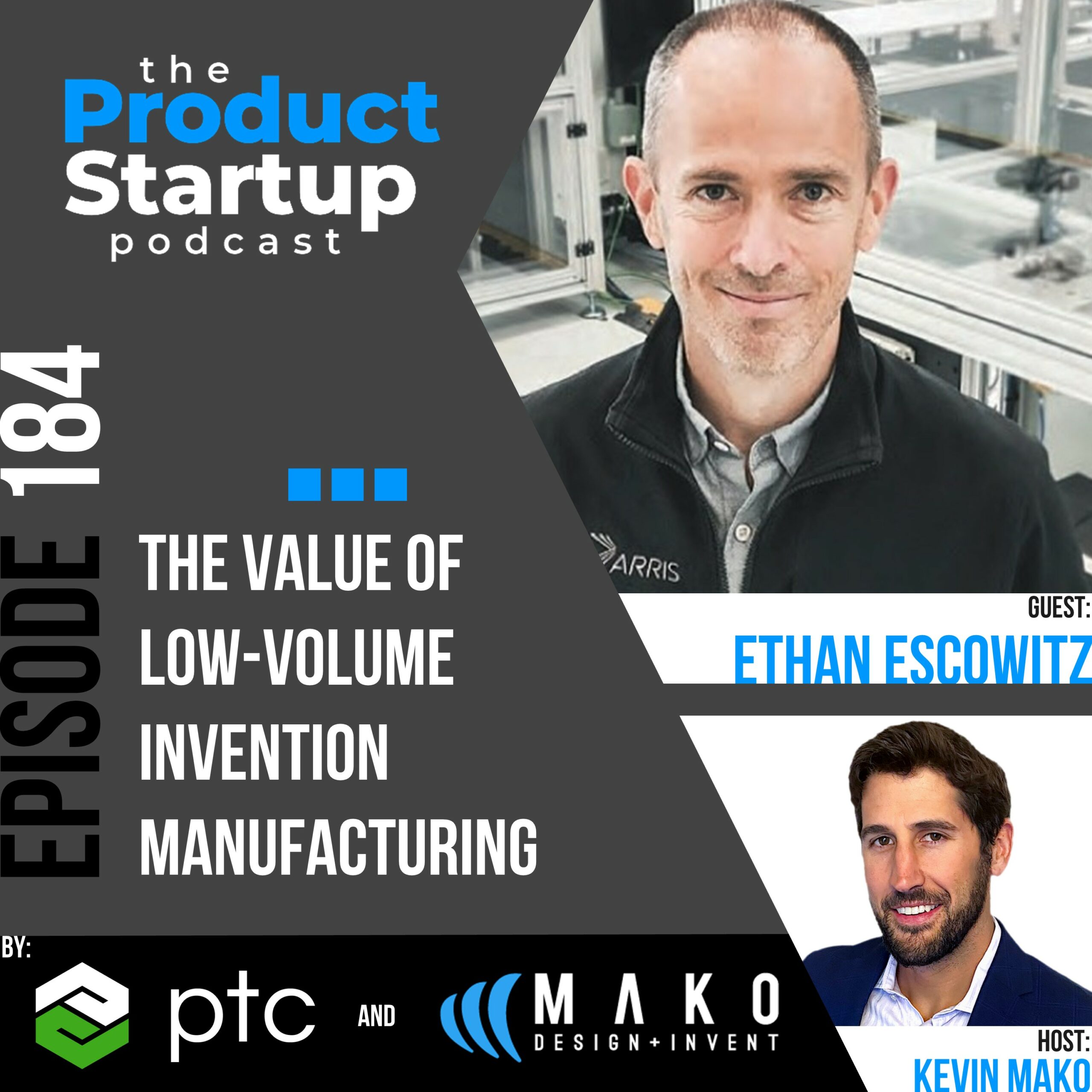
Guest: Ethan Escowitz, Founder of Arris Composites, with two decades of experience in advanced manufacturing processes and materials.
Host: Kevin Mako, founder of Product Startup and the leading expert in hardware startup consulting. A hardware entrepreneur since 1999, Kevin has advised more than 1,500 founders and built and scaled MAKO Invent through its acquisition by TriMech in 2024.
Episode Overview
Ethan Escowitz explains how new manufacturing methods make high-quality, low-volume parts more practical for product founders. He covers reduced tooling exposure, faster iteration, customer feedback, advanced materials, distinctive design possibilities, and the transition toward larger production volumes.
What You’ll Learn in This Episode
- Discover the transformative potential of new manufacturing capabilities for product developers.
- Expedite your product production process to maximize efficiency.
- Benefit from low-volume parts without the need for expensive upfront tooling costs.
- Harness technology to enable low-volume production and empower your manufacturing.
- Differentiate between consumer-facing products and non-consumer-facing products.
- Cater to consumer demands for high-quality, aesthetically pleasing parts.
- Leverage advanced technology to create unique, beautifully designed parts that diverge from conventional moulding methods.
- Challenge the invention manufacturing world’s traditional limitations and drive innovation.
- Utilize the first production run to gain valuable insights into customer buying patterns and areas for engineering improvement.
- Navigating the complexities of product engineering becomes even more challenging when integrating new capabilities and technologies, but the rewards are substantial as you uncover remarkable advancements.
- Embrace innovation and new technologies to significantly increase the equity valuations of your product inventions and the underlying technology.
- Hardware startups enjoy a significant advantage in terms of agility and innovation.
- Avoid feature creep in your initial version and prioritize customer input.
- Following Steve Jobs’ philosophy, identify unmet needs and communicate your unique product idea that revolutionizes the market.
Episode transcript
This transcript is provided for accessibility and reference. Download the SRT transcript.
Read the full episode transcript
Kevin Mako: Hello, product innovators. Today we learn from a 20-year manufacturing technology expert on the importance of low-volume
Kevin Mako: manufacturing for the first production run of your invention idea.
Narrator: You're listening to the Product Startup Podcast, a show to learn from top leaders in product development, prototyping, manufacturing, product selling, and everything in between.
Narrator: Hosted by Kevin Mako, the leading expert on product development for physical product startups,
Narrator: sponsored by PTC's two best-in-class 3D CAD product development software solutions, Onshape, and Creo, and produced by Mako Design + Invent,
Narrator: the original firm providing world-class consumer product development services tailored specifically to startups, small manufacturers, and inventors.
Kevin Mako: Welcome back, everyone. Today, I'm very excited to introduce Ethan Escowitz to the show. Ethan is the founder of Arris Composites, a company that makes advanced manufacturing
Kevin Mako: processes and materials. He also sits on a number of boards in the hardware space given his 20-year history in
Kevin Mako: the industry working with many Fortune 500 companies and hardware startups. Today, Ethan is going to share some valuable knowledge for inventors,
Kevin Mako: and small manufacturers on what short run manufacturing is, why iterative manufacturing is so important
Kevin Mako: to hardware startups, and how to scale through feedback on low volume production runs of your hardware product invention. Now, on to the episode.
Kevin Mako: Hey, Ethan, welcome to the show. Hey, great to be here. Very excited today to talk with you about the evolution of short run manufacturing. What's
Kevin Mako: happening, especially for hardware startups, although everybody's using it from big corporation down to startups. Point is, there's a lot happening, making it cheaper, easier,
Kevin Mako: faster and at a better quality to get a new design product to manufacturing in a small
Kevin Mako: volume without the traditional upfront tooling costs, potentially for many different types of hardware products out there. You've been in the manufacturing space for a couple
Kevin Mako: decades now. You've seen quite a bit worked with hundreds of products and product brands, many Fortune 500 companies. So we're really excited today to talk to you about what you're
Kevin Mako: seeing on the development of some of the manufacturing tools, especially for low volume initial manufacturing for new products.
Kevin Mako: Before we get into all that, give us a bit of a
Ethan Escowitz: background to how you got to be the success that you are today. So I had started in the conventional
Ethan Escowitz: manufacturing technologies like machining and molding, stamping and the rest. And in the late
Ethan Escowitz: 2000s is when the most exciting clients I was working with were in 3D printing. So I was lucky to
Ethan Escowitz: get early into the 3D printing industry and work on the development of a variety of applications, working at Objet, went through the merger with Stratasys, and
Ethan Escowitz: then went on to work with venture-backed development of new additive technologies. And then that's where I really kind of
Ethan Escowitz: found my niche and finding new manufacturing capabilities that unlock design latitudes and
Ethan Escowitz: unlocked opportunities for product developers, because ultimately you give somebody new capabilities
Ethan Escowitz: that bring something compelling to the market and the products they love and use. And that's very meaningful.
Ethan Escowitz: And it moves the needle and kind of the classic Peter Thiel, zero to one kind of way to really rethink how products in a space can perform.
Kevin Mako: That's amazing. And you've been so deeply involved in the underlying technologies that allow these various manufacturing platforms to exist and to be able to do these
Kevin Mako: sorts of things for new products, to be able to produce low volumes of product. Before we get into that, just give a bit of a description on what low volume
Kevin Mako: or short run manufacturing is. And then we'll dive into what's happening in 2023 with some of these technologies
Ethan Escowitz: to enable hardware startups to get to market faster than ever before. Yeah, it's something I'm sure your audience is familiar with that you want
Ethan Escowitz: to produce product as quickly as possible to get that design feedback. but you're always fighting the minimum order quantity associated with
Ethan Escowitz: a production run of product. So you have to put in a $100,000 to get a production run of production quality products.
Ethan Escowitz: So that's where 3D printing and different room temperature resin molding technologies came in
Ethan Escowitz: and just played this important role to make lower volume parts that could then be sold
Ethan Escowitz: as production quality parts to get that market feedback, and you try and get that market feedback
Ethan Escowitz: until you had enough commitment to get a production order and then expand from there. But it's really
Ethan Escowitz: an abyss between those first units and a production run, the economics of it, the commitment
Ethan Escowitz: of it. And a lot of it has kind of come from this consolidated supply chain and Asia and just the
Ethan Escowitz: nature of some of those production technologies. And this is really the area that I was focused on, just how do we eliminate those break-evens?
Ethan Escowitz: How do we technologically enable lower volume production that can then scale to medium and
Ethan Escowitz: high volume without those abysses in between that make it so difficult to understand whether the market really likes it?
Ethan Escowitz: And then if you have three versions or three models and one fails, two is marginal and three is
Ethan Escowitz: great to double down on three and maybe do a little bit more of two and see if maybe marketing is a little bit different.
Ethan Escowitz: That is where there's a challenge in the product development space and why there's so
Ethan Escowitz: much emphasis on that minimum viable product and getting consumers to actually part ways with
Kevin Mako: money to give you that feedback and commitment to make the bigger investment. That's so much good information there. A lot to unpack.
Kevin Mako: The reality for a hardware startup is there is a massive milestone. The milestone of milestones for a hardware startup is when you get real customers
Kevin Mako: to purchase even just a few of your units and then ideally give you really good reviews about that. That changes everything.
Kevin Mako: That means you've gone through all the ideation, the research, the design engineering, the rounds of prototypes and you've actually now manufactured units and had manufacturers
Kevin Mako: units sell. That is the holy grail for a hardware startup and so many never even get there. Now, what we're
Kevin Mako: talking about today is the fact that that leap from your final round of prototyping when you know
Kevin Mako: you've got the product nailed in terms of the way you want it and actually getting that product
Kevin Mako: to market. Well, that's a big leap because traditionally what we were talking about is manufacturing units via tooling and large minimum order quantities.
Kevin Mako: Tooling is an upfront cost. Whether you sell one or 10,000 units, it's the same cost. It's the capital cost. And that's what kind of you're
Kevin Mako: alluding to. Traditionally, you'd spend $100,000 on these steel or aluminum molds to produce the
Kevin Mako: product. And then on top of that, you've got your variable cost, but it usually comes with the large minimum order quantity, 500,000, sometimes multi-thousand units
Kevin Mako: that you're required to order before you've even sold one and received any feedback. So what Ethan's talking about to
Kevin Mako: Today is the fact that short run manufacturing fills that void and gets you as a hardware startup
Kevin Mako: into the real world, into what really is the startup scale up level, which is where you start making money as opposed to spending money.
Kevin Mako: And that's an amazing milestone and something we should all try and achieve. So in order to do that, we really need to look at the technologies
Kevin Mako: of today. And for listeners that have been on my podcast for a while, you know, I talk a lot about short run manufacturing.
Kevin Mako: I always advise design firms or hardware startups or designers or whoever's working on your product to first explore opportunities to
Kevin Mako: manufacture a low volume of units to get those units in front of customers. And Ethan's worked with a whole bunch of different technologies.
Kevin Mako: So, Ethan, I'd love to hear it from you. What are some of those technologies that are coming into place now, especially in 2023,
Ethan Escowitz: that are really allowing that to be reasonably cost effective for hardware startups? Yeah, I think that it is important to kind of qualify two
Ethan Escowitz: big groups. One is you've got consumer-facing products, and then the other is non-consumer-facing products,
Ethan Escowitz: and volume matters quite a bit as well. So a lot of the technologies, CNC, 3D printing,
Ethan Escowitz: are amazing at making all kinds of industrial widgets. But I'm going to really focus on the consumer product space
Ethan Escowitz: because consumers don't want build lines, machining lines. They want beautiful parts that look like the
Ethan Escowitz: incredible level of surface finish they've come to expect from the consumer products that surround them every day.
Ethan Escowitz: And this is an area where the tooling that you mentioned and then the expensive $100,000 tool being bolted
Ethan Escowitz: to a half a million or million dollar machine to produce those beautiful surface finishes creates a real bottleneck to.
Ethan Escowitz: producing a run of those beautiful consumer products. So the conventional way to solve this is you can
Ethan Escowitz: 3D print or room temperature mold and finish and paint and have essentially models. But the cost on that is very high per unit.
Ethan Escowitz: So the area that I've really focused on recently is how do we make a technology that enables beautiful
Ethan Escowitz: parts with unique surface? surface finishes that are differentiated and different from the conventional molding methods,
Ethan Escowitz: that give designers more latitude to make something kind of attractive or distinct from other
Ethan Escowitz: products in the market, but not have the break-even cliff where you can't make a batch of
Ethan Escowitz: 100. And based on, say, a batch of 100 with four different designs, see what works, double down on
Ethan Escowitz: that throw away the one that doesn't and perhaps tweak the marketing on the other two that you get just marginal results from.
Ethan Escowitz: The amazing thing about the digital world today is this AB testing that you can do, but the manufacturing world doesn't accommodate
Ethan Escowitz: this really amazing capability
Kevin Mako: of the digital marketplace that so many of these products are sold today. I love the way that you look at this in terms of AB testing because one of the biggest value points
Kevin Mako: for a short manufacturing run is customer feedback. There's actually two key points and one is often overlooked. Customer feedback is one, which is huge.
Kevin Mako: The other one also is engineering and design feedback. So really making sure that that product has the quality, the reliability, the functionality that
Kevin Mako: you desire in production with real users. And then, of course, a lot of that feedback is coming from that primary feedback point, which is the customer themselves.
Kevin Mako: And that's the front facing value. Does your product sell? Does it sell well? Is it something that people are talking about? Are they writing good reviews?
Kevin Mako: Are they spreading the word about it? If not, why? And you use that customer base to get that feedback and then iterate.
Kevin Mako: And this is pulling from the software world of agile development, you can actually start to iterate in the hardware space once you have these short run manufacturing technologies.
Kevin Mako: Because after your first production run, you use those two feedback loops, one for the marketability, what
Kevin Mako: the customer wants, the other for the engineering quality, making sure it's top notch and world class.
Kevin Mako: And in combination, any shortcomings in your first production run, you can start to adjust for your second.
Kevin Mako: any opportunities that you see you can adjust for in that second production run. If you do this a number of times, not even that many, do that cycle three times.
Kevin Mako: And almost certainly you will have a very successful product because you're using the actual market to validate both the engineering and the sellability of the actual product.
Kevin Mako: And you're learning and adapting with the actual users that want to buy the product. What better way than to have these underlying technologies to be able to now enable you
Kevin Mako: to have that level of agile development. It just de-risks the entire development process.
Ethan Escowitz: It de-risks the entire venture of your hardware product. You're speaking about just a really interesting place for me, because it's where I've focused most of my career,
Ethan Escowitz: is where are there underlying technologies that enable a performance in the product
Ethan Escowitz: that is superior to what's in market today? So in this engineering validation that you're referring to that's so critical,
Ethan Escowitz: It is challenging just getting a new product validated from an engineering standpoint with doing everything
Ethan Escowitz: as it's conventionally been done in that product for a decade or multiple decades.
Ethan Escowitz: But as soon as you start introducing any new capabilities or any new underlying technologies, your risk and your engineering validation
Ethan Escowitz: becomes more complicated and potentially riskier. but there's also significant rewards there.
Ethan Escowitz: The company I founded and am on the board of, Arris Composites, is actually a great example where they have enabled a higher-performance
Ethan Escowitz: composite part than has come before. And the way in which footwear companies can make higher performance shoes than existed
Ethan Escowitz: with previous composite technologies and bike companies and aerospace companies, it really kind of underscores how looking at what's kind of,
Ethan Escowitz: of conventional baseline is one thing, but when those technologies come that offer those zero to one
Ethan Escowitz: type innovations, taking on perhaps a little bit more risk can actually pay off in huge rewards
Ethan Escowitz: if you have something that just meets the needs of the customer
Kevin Mako: better than what exists. But you have to really balance the risk with that opportunity. I really like how you brought that up,
Kevin Mako: especially from a design and engineering perspective because that's one of the bottlenecks in designing a new product, especially as a hardware startup, you're on a limited budget.
Kevin Mako: So first and foremost, you've got, usually your core innovation. One of the best things you can do, we talk about it a lot on the show is focus on a MVP, but
Kevin Mako: a really high quality version of it. So don't go crazy on feature creep. Stick to what was your core innovation.
Kevin Mako: What was the core value ad that you saw and then do a really good job of perfecting that value ad. Then, as we're talking about, take it to the next level.
Kevin Mako: Use customer feedback to figure out what your pro-ver version is or your platinum edition or just your version 2.0 is going to be that maybe has some of those bells and whistles.
Kevin Mako: However, if you do happen to hit one of those design and engineering bottlenecks where it's a tricky situation, it's experimental, the technology hasn't been done
Kevin Mako: before that's required to satisfy the invention idea, it does take a lot of extra work and also a lot of uncertainty.
Kevin Mako: Will it be solved within a month and one prototype? Or will it take five prototype and a year to figure out that technology. A lot of the time, that's very scary,
Kevin Mako: especially to a hardware startup. But I like how you mention the flip side, because if you figure that
Kevin Mako: out, not only have you satisfied this invention idea that you have to the customer, but you've also figured out a core technology. And both of those are very valuable.
Kevin Mako: And that compounds the actual equity value of the product that you're making, especially if you can get to what we're talking about
Kevin Mako: today, get to that point we're actually selling units to customers, proving that you've got this new
Kevin Mako: technology that's now used in a very specific innovation that's being used by a customer
Ethan Escowitz: in a particular manufactured product. You're now in the big leagues. That's a very serious turning point for your business.
Ethan Escowitz: Yeah, I think one thing that I think I have a very unique insight into, it's the degree to which a hardware startup has
Ethan Escowitz: immense advantage in their ability to take on more risk and many of the very large competitors they might be
Ethan Escowitz: up against because it's difficult. When you start getting into large companies, large teams, and kind of large revenue
Ethan Escowitz: streams associated with your product, there is pressure to ensure a consistency of quality that you
Ethan Escowitz: need to go to very high volumes very quickly. You can only integrate new technologies very cautiously
Ethan Escowitz: because that revenue stream that is a substantial piece of making your company successful and
Ethan Escowitz: employing your hundreds of thousands of employees relies on a very incremental introduction of new technologies.
Ethan Escowitz: And this is where hardware startups have incredible advantages to take on more risk, be more agile, bring something very differentiated to market.
Ethan Escowitz: But you also have to be very sober about how valuable is this capability really?
Ethan Escowitz: Because the tendency is to kind of latch on to of kind of flashy things that enhance your value proposition, but might not
Ethan Escowitz: really matter to consumers that much. You've got to take your Kool-Aid and give it to someone else and ask them, you know, somebody that is credible in the space.
Ethan Escowitz: And you can obviously test it with the testing that you're referring to as well with real world customers.
Kevin Mako: How important is bringing this additional risk into our manufacturing process in selling our product? That's so valuable. And that's a big,
Kevin Mako: big thing for hardware startups is feature creep and the desire to add all these bells and whistles because you want that first product just hit the market so hard.
Kevin Mako: But very rarely is it the case that a hardware startup can afford to innovate on multiple different levels. You've got your core
Kevin Mako: innovations. Start there and then learn from the market. It's the turtle versus the hair approach. And the reality is in hardware startups, it's the only way.
Kevin Mako: You don't have the millions or tens of millions of dollars in a typical hardware startup to put years of work into releasing the next
Kevin Mako: hottest, greatest, most feature-rich product. So you really have to look at it as your incremental value. You've obviously caught onto some innovation somehow.
Kevin Mako: You've discovered something. Focus on that. Do that well. Never sacrifice quality. That is the hardware world. You do not want to
Kevin Mako: release a poor quality product, but absolutely you don't need to release a majorly feature-rich product
Kevin Mako: for the first version, especially before you've got that real-world customer. interaction in terms of what that's actually going to be that's driving the actual purchases of your
Kevin Mako: product. You may think it's valuable. They may not. And that's why focus on the core and then learn
Kevin Mako: what are the next highest priorities for your customer and develop around that. It de-risks the whole thing yet again on your next version.
Kevin Mako: And you're also doing exactly what your buyers want. Not even just end customers. This may be bigger buyers. When you start to have products in the
Kevin Mako: actual market, now your end customers are wholesalers, distributors, retailers, brand partners. white label deals.
Kevin Mako: You name it. There's a lot of different specializations out there that buy product in bulk. That may be your next customer telling you, if you had this handle on it, we
Kevin Mako: would buy 10,000 units. Well, what better avenue now to say, okay, I'm willing to invest in the design, engineering,
Ethan Escowitz: and manufacturing of that additional feature knowing full well, I've got a purchase order on the back end to fill it. Yeah. And I think this is where the Steve Jobs caveat needs
Ethan Escowitz: to be inserted, that you also have to think about even if you are testing it with consumers or asking experts in the field, to what
Ethan Escowitz: degree is there a story here or is there an unmet, unknown need in a space?
Ethan Escowitz: Obviously, Steve Jobs popularized a lot of these ideas. However, when you think about it very tactically, a lot of it kind
Ethan Escowitz: of falls under the marketing umbrella. And just as an example, we're developing a more sustainable manufacturing method.
Ethan Escowitz: And lots of people are working on sustainable manufacturing and materials. But then because it's so much substantially better in the life
Ethan Escowitz: cycle analysis, we really had to look at how do we communicate this thing that's been over communicated to the market.
Ethan Escowitz: And the market has kind of gotten a little bit of resistance to really understand our value proposition that's very differentiated.
Ethan Escowitz: So sometimes like the simple observation. the simple feedback doesn't really show you what
Ethan Escowitz: you could create with a concerted effort with good marketing to tell your unique story.
Ethan Escowitz: And that unique story can break through the initial feedback that you get back. But that's where there's always the balancing act. You can't be
Ethan Escowitz: so arrogant to say, these customers, they don't know how good we are. Just wait until we place
Kevin Mako: our quarter of a million dollar order and they see how great we are with our new marketing. that's a dangerous place to go.
Kevin Mako: So you're always kind of balancing these different things. I like to imagine that, though, because it is important. You as the founder, the innovator,
Kevin Mako: you are an incredibly important stakeholder. You are the one who had the initial vision. And the world maybe isn't yet in a place to fully appreciate
Kevin Mako: what's happened. You may need to educate that market. And that's, you know, category pirates, right? Those are individuals who create
Kevin Mako: essentially new categories that haven't been done before. Well, it's difficult to get feedback. So a balanced approach is very right there.
Kevin Mako: Understand some of the feedback and make sure you're weighing that into your decision making, but also don't ignore your own dream, your own vision, pioneering your own set
Kevin Mako: of circumstances, creating your own destiny for how you believe the product really will best fit the market as well.
Kevin Mako: So I really appreciate that you brought that balancing to the feedback equation that isn't
Kevin Mako: often talked about, but definitely is powerful, especially in the hardware entrepreneurship space.
Kevin Mako: If you talk about to a lot of the founders, at least in the initial vision and the initial product there. It was largely their vision.
Kevin Mako: And then over time, it became more of a balanced approach between various different stakeholders. But originally, you've got to trust your instinct. If you believe in
Kevin Mako: the product, go all in on that thing. If you really think that it has some merit, but start smart
Kevin Mako: in a balanced approach, starting with your MVP, high quality version, then growing it over time in a stepping stone approach.
Ethan Escowitz: I think if you do that right, as we've seen time and time again, you take a proper strategic approach to getting a new hardware product off the ground, incredibly rewarding
Kevin Mako: in the long run. Ultimately, you're right. It is founder vision.
Ethan Escowitz: You have to take all the feedback and then ultimately do what you think is right. Ethan, very valuable advice. Thanks so much for all
Ethan Escowitz: your words of wisdom today and much appreciated for having you on the show.
Kevin Mako: Great to be here. Thanks for having me. I apologize. I usually have neat products around me in my office, but I'm in New York in a hotel room.
Kevin Mako: Next time we chat, I can show you some interesting products. Thanks and take care.
Narrator: Thanks for tuning in to this episode of the product startup podcast. If you found some value in the show, please do us a huge favor and leave us a quick five-star review.
Narrator: If you have any questions, guest suggestions, or anything else, feel free to reach out to us anytime at our email, podcast at MakoDesign.com. That's podcast at MakoDesign.com.
Narrator: This show is hosted by Kevin Mako. North America's leading expert on product development for physical product startups. Huge thanks to our sponsors, PTC,
Narrator: and their two best-in-class 3D CAD product development software solutions, Onshape and Creo, and Mako Design + Invent.
Narrator: The original firm providing world-class consumer product development services tailored specifically to startups, small manufacturers, and inventors.
Narrator: Thanks for joining and see you next time.
Low-Volume Manufacturing Strategy for Founders
Use a Small Production Run to Reduce Big Risks
Work directly with Kevin Mako to evaluate whether low-volume manufacturing fits your product, what the run must prove, how much to produce, which quality standards matter, and how customer feedback should shape the next iteration.
Kevin can help you compare paths, prepare for supplier discussions, align the run with cash flow and market testing, and plan the transition toward scalable manufacturing.
Request a Manufacturing Strategy Call
Tell Kevin your target volume, product stage, and the technical or market risk you want a first run to resolve.