
Listen Now
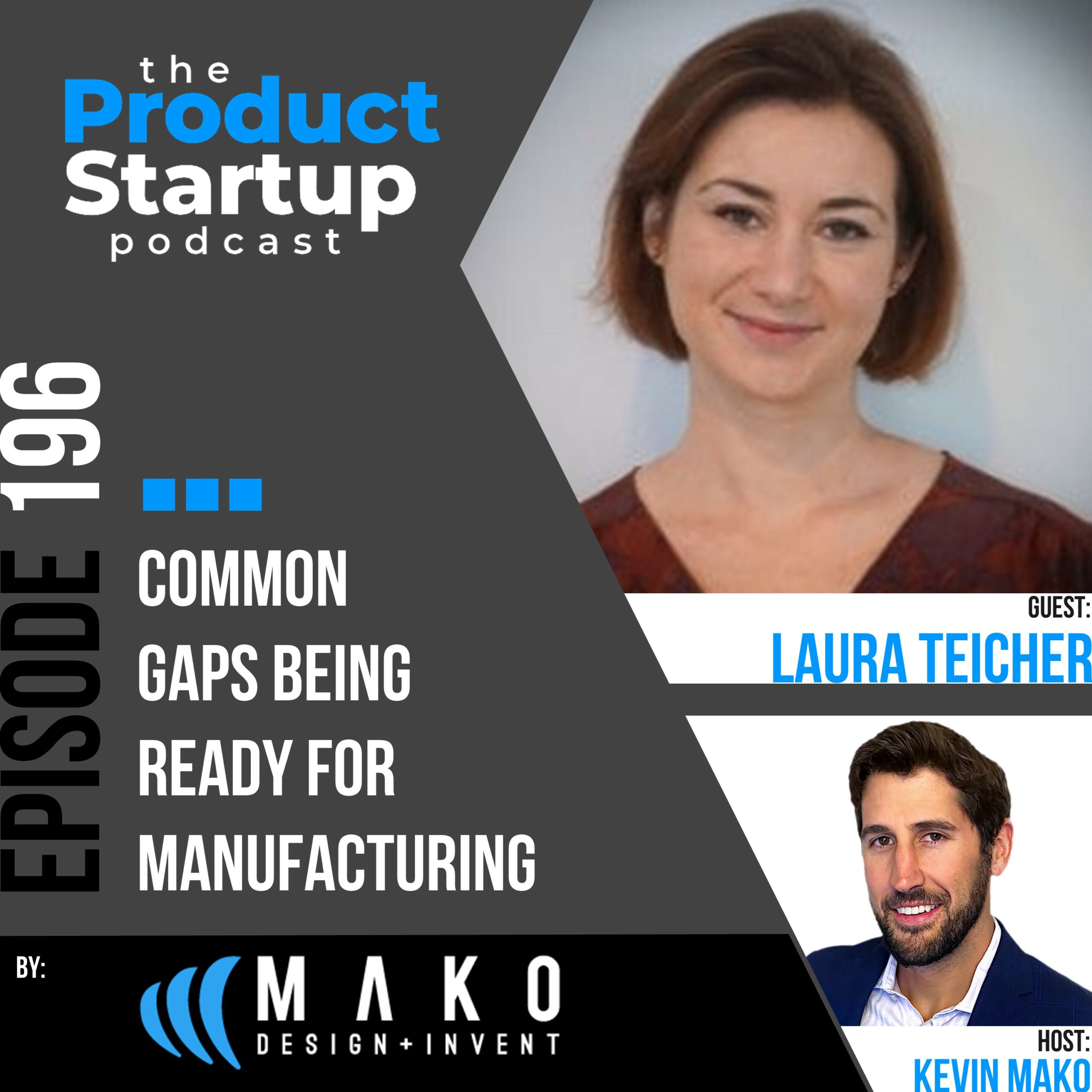
Guest: Laura Teicher, President of FORGE, a nonprofit that has supported more than 700 physical product startups moving from prototypes into manufacturing growth.
Host: Kevin Mako, founder of Product Startup and the leading expert in hardware startup consulting. A hardware entrepreneur since 1999, Kevin has advised more than 1,500 founders and built and scaled MAKO Invent through its acquisition by TriMech in 2024.
Episode Overview
Laura Teicher explains why a manufacturer should not be expected to repair an unfinished product design. She outlines the need for design for manufacturing, sufficient testing, complete documentation, clear production requirements, and the right supplier relationships before founders attempt to scale.
What You’ll Learn in This Episode
- The importance of building a simplified design for manufacturing
- Design for manufacturing is required to ensure the product is ready for production, and does not need any more design to complete to what is needed for market or for reliability or for certifications.
- What to do when you haven’t tested enough the design
- There is a false assumption that manufacturers are going to fix your design problems.
- Use design firms to do design for manufacturing, specifically
- The effects of a lack of manufacturing documentation
- Reaching out to partners too soon
Episode transcript
This transcript is provided for accessibility and reference. Download the SRT transcript.
Read the full episode transcript
Kevin Mako: Hello, product innovators. Today we learned how to properly prepare for your first manufacturing run from an MBA who has helped hundreds of hardware startups scale up.
Narrator: This is the Product Startup Podcast, a show to learn from top leaders in hardware product development, prototyping, manufacturing, product selling, and everything in between.
Narrator: Hosted by Kevin Mako, the leading expert on product development for hardware startups.
Kevin Mako: Welcome back, everyone. Today I'm very excited to introduce Laura Teicher to the show. Laura's the president of Forge, a nonprofit organization that helps.
Kevin Mako: specifically hardware startups and scaling from prototyping to manufacturing growth. They have worked with over 700 physical product startups to ensure that those companies are
Kevin Mako: a commercial success by ensuring new product manufacturing is done right. Today, Laura is going to share some valuable knowledge for inventors,
Kevin Mako: and small manufacturers on how to ensure your product is designed properly and correctly for manufacturing, how to ensure your documentation is complete,
Kevin Mako: and how to best approach contract manufacturers to transition your developed product into a successful first manufacturing run. Now, on to the episode.
Narrator: This show is produced by MakoDesign, the original firm providing end-to-end consumer product
Narrator: development services tailored specifically to hardware startups, small manufacturers, and inventors.
Narrator: Take your product from idea to store shelves at MakoDesign.com. Now, on to the episode.
Kevin Mako: Laura, welcome to the show. Thank you so much for having me. Well, we're very excited to talk to you today about best practices in terms of being sure you're doing things
Kevin Mako: the right way on your journey as a hardware startup from all of the development work you do into manufacturing. And that transition there is a big one.
Kevin Mako: It's quite often underestimated by especially new hardware startups, the effort, requirements, what is necessary to really do manufacturing well.
Kevin Mako: And manufacturing, especially your early production runs, are critically important because that is how your brand goes from being an idea in development to being a
Kevin Mako: business at selling real products to the market. So you've seen hundreds of products, especially in the hardware startup space, you work with countless startups, especially through
Kevin Mako: Forge. Before we go into all of those details about best practices and common pitfalls to manufacturing starts, just give us a bit of a background.
Laura Teicher: How did you get to be the success story that you are today? Absolutely. Well, thank you. So I've been leading impact and innovation support organizations for a decade,
Laura Teicher: and I joined Forge as executive director about five years ago. And I was really excited, particularly for
Laura Teicher: this organization, which does focus on helping startups with physical products get from initial prototype all the way through commercial scale with intense focus
Laura Teicher: on physical build and manufacturing. I was so captured by the potential for impact in bringing real physical solutions into the world.
Laura Teicher: And so since 2015, Forges actually supported over 700 startups with physical products.
Laura Teicher: And this is across all sectors with a huge section in consumer products, as well as other areas like medical device, climate tech, ag tech.
Laura Teicher: We have seen the good, the bad, and the ugly across all of these startups. We've developed really specific programming around
Laura Teicher: manufacturing readiness education and then curated and warm connections to the local supply chain to help bring these products to market.
Laura Teicher: Since 2015, as we've built and grown the reach of this programming, across those over 700 startups, we have sustained
Laura Teicher: an over 87% survival rate, which, as you know, is incredible for a startup period, let alone a hardware startup, which has to deal with added
Kevin Mako: complexity and costs. Well, it just goes to show you, if you do things the right way, success is very achievable, especially we have organizations like Forge behind you.
Laura Teicher: And correct me if I'm wrong, Forge is a nonprofit, right? That's correct. And that's really important for me to underscore for our entrepreneurial listeners.
Laura Teicher: have not to date charged a startup for any of the help that we provide. So if you're listening and
Laura Teicher: you realize you might be able to leverage a little bit of support from Forge, you can come to us
Kevin Mako: through our website. It won't cost you anything because it's in service of our mission. That's incredible. Well, thanks so much for being on the show today and let's dig into it.
Kevin Mako: Let's talk about what some of those common pitfalls are for hardware startups as they get into
Laura Teicher: the manufacturing space for the first time. Absolutely. First, it's really important to be thinking
Laura Teicher: through all the design elements needed for scaling the product. And a failure point for this can look like either over-designing or under-designing the product.
Laura Teicher: And we can talk a little more about that. The next thing that we see that is really crucial to successfully going into production and
Laura Teicher: scaling up production is having real rigor and strategy and documentation. And if this isn't all
Laura Teicher: done with thoroughness and intention, it can lead to a lot of mistakes and miscommunications and wasted money when you're in production.
Laura Teicher: Then finally, really important to be thoughtful about working with the right contract manufacturers and suppliers, selecting the folks that are
Laura Teicher: appropriate for your scale, for your volume, for your capability needs, and then evolving those relationships and strategies at each step of scale of the product.
Laura Teicher: And when things go well, all of this comes together beautifully. And often with these small and rising teams, there may be a missed point in here.
Laura Teicher: And I'm happy and excited to dig in with you.
Kevin Mako: a little more on these points today, Kevin. That's great. I appreciate the overview.
Kevin Mako: Let's go through all four of these points because they're all important and they're all somewhat interconnected as well.
Kevin Mako: So let's go to the design and break off those two things, over design and underdesign because both of these are critically important as you migrate into manufacturing.
Kevin Mako: So pick whichever one you want to start with first. And then we'll jump on to the lack of manufacturing documentation of preparedness and then
Kevin Mako: the correct time and the approach to reaching out to the correct manufacturers at the correct
Laura Teicher: time. Absolutely.
Laura Teicher: So on the design side, a not uncommon scenario that I have come across in my years
Laura Teicher: with this focus is we're dealing with a technical founding team and they have designed a first-of-its-kind solution and it's really exciting.
Laura Teicher: It's something no one has ever created before. And they're at the alpha prototype stage. They've combined their sub-assemblies. The thing works, but it's too
Laura Teicher: beautiful and too perfect. And it has 80 different parts that were all handmade in the lab. That's an extreme example.
Laura Teicher: But you can find someone who says the prototype works and now I'm ready to make a hundred of them. And as you look at in the next part of this discussion, the key documentation
Laura Teicher: and needs of the product, well, you might reveal this part doesn't need to be gold plated or this part doesn't need to be made out of diamonds.
Laura Teicher: This part could be bought off the shelf. And so making sure that you're simplifying it down into. the fewest components and you're getting the components that you can off shelf is
Laura Teicher: a process called design for manufacturing or design for mass production. And it can often be overlooked when a team is excited about a working prototype.
Laura Teicher: So pausing and making sure you don't spend too much money on too many overdesigned products is really important. But on the flip side, you also need to watch out for
Laura Teicher: under design. And that's where I would put in not considering other design for methodologies.
Laura Teicher: example, design for assembly, design for usage, design for maintenance, and thinking through the certifications you'll need for your application.
Laura Teicher: It can be tempting to jump into production without thinking about these things and think of them as a down-the-road problem. But if you get further in
Laura Teicher: your iteration and further in your scale and then have to tackle that, that will be much more expensive. So it's good to be thinking about these things in parallel and early, even
Laura Teicher: as you're just
Kevin Mako: iterating on your prototype and doing an initial short run. Those are both very powerful.
Kevin Mako: And I want to talk about each of them independently because there are some really critical considerations.
Kevin Mako: Design for manufacturing, when we're talking about your initial thing, what most people don't realize
Kevin Mako: that haven't gone through the hardware design process multiple times is the fact that there is a big leap between designing the product to be functional, which is great.
Kevin Mako: It's incredible that you get to that level because that's a level beyond figuring out how to design it. So your first layer is,
Kevin Mako: what am I going to design, figuring out how I'm going to make it work, and then making it work. And that's all great. But these things are layering up to a much bigger phase,
Kevin Mako: a much more critical phase, which is designed for manufacturing. You obviously have to have
Kevin Mako: core theory underneath it for the thing to work, but then you've got a big exercise, which is commonly
Kevin Mako: overlooked, which is figuring out how to make the product efficient for manufacturing. And that really
Kevin Mako: is a critical step that is often missed because once you have a working prototype, you expect that the factory is going to figure out how to make it simpler.
Kevin Mako: The factory's job is not to design your product. Their job is to make parts, rinse and repeat. So they want good quality, reliable, consistent
Kevin Mako: parts at a low price that can be done in high volume. Their job is not to figure out all the little
Kevin Mako: nuance of your design and making sure your product market fit in the way that the product is designed
Kevin Mako: and engineered and the way that it's designed for manufacturing scale is all built and integrated
Kevin Mako: it. That's your design team's job, whether it's in-house or whether the design firm like Mako
Kevin Mako: design. It's their job to be building the design framework for the product. And if you've got a
Kevin Mako: great prototype, that's an excellent step, but know that you have probably one or two more
Kevin Mako: prototype rounds to go, which is called pre-production prototyping or pre-production sampling, before you're truly ready to reach out to manufacturers.
Kevin Mako: Then I want to flip over to the other side as well, because you talked about something really important on the underdesigned side of
Kevin Mako: things. It's quite common, especially in hardware startups, they get to a point where they've got a quasi-functioning product. And they say, you know what? It's close enough.
Kevin Mako: It shows what the product should do. Let's just pass it on to XYZ manufacturing, cut them a big check and get them to produce
Kevin Mako: units. But again, going back to the prior statement, their job isn't to design the product either up or down.
Kevin Mako: If you have not developed enough of a product yet that it really works or it meets a customer need or hits the certifications or the reliability standards or whole other series of
Kevin Mako: events that comes along with great design, then you're not even ready to talk to the manufacturer yet, or especially not for production itself, possibly for other things in
Kevin Mako: terms of improving the design. There's a lot of things that we can get to into that transition. However, you're not yet ready to talk to them about voting you to produce units.
Kevin Mako: And that is something where you'll hear countless stories of people trying to fly overseas with their 3D printed prototype or send
Kevin Mako: money all over the place and then start reworking and fixing all of these problems via the manufacturing process. Couldn't be any more expensive.
Kevin Mako: You want to be fixing design challenges when you're doing design engineering and prototyping, not fixing design challenges when you're paying
Laura Teicher: for much more costly things like manufacturing engineering, manufacturing tool, and so on. Absolutely. And I know we want to talk about what people can do to avoid these pitfalls.
Laura Teicher: But just to underscore this, the horror stories you see are where there was an assumption that the contract manufacturer or the supplier would
Laura Teicher: work out the kinks or understand the intent. And then suddenly you spent money on 500 units that are not going to be deployable.
Laura Teicher: So really worth pausing and getting help here. And that's the positive side is there are great firms that focus specifically on design for manufacturing. There's
Laura Teicher: educational content through Forge that is free. And then we can also help connect to you with the experts to really dive in and do the design for manufacturing.
Laura Teicher: So just knowing that this is a potential gap. And if you're sitting at home listening and having an oh no moment realizing you might have
Laura Teicher: this gap, there is a great pathway forward. And that's just recognize where you don't have the
Kevin Mako: expertise and bring in the experts to help. Great advice. I mean, it's so sound. The reality is just make the call, understand where those gaps are.
Kevin Mako: And just by listening to this podcast, you're already taking steps to try and improve your process for design to manufacturing. Now you just need to start
Kevin Mako: weighing in that expertise and the beauty of it is a lot of the work that you've done, whether you've
Kevin Mako: over-engineered and you've just been focusing on doing everything you can to get a working prototype or under-engineered because you're not quite ready yet.
Kevin Mako: What you have done is created a tremendous amount of value. You've created a tremendous amount of building blocks that design for manufacturing
Kevin Mako: firms like macro design or whoever else that does this sort of work and take work with as a foundational
Kevin Mako: roadblock look at all the things that went well for you all the things that went poorly figure out where those gaps are and then bring in the heavy hitters to address those gaps
Kevin Mako: and get it done right the first time so that you're not sorting those things out in production itself so know that you've built
Kevin Mako: a tremendous amount of value it's now just on figuring out how to get over that finish line the right way
Kevin Mako: the first time so that you mitigate your cost and make sure it's a very efficient process especially as a hardware startup to get to that production scaling.
Kevin Mako: Now, all of that comes down to, even if you've done great design for manufacturing, all the testing, everything else, there's still more to go. And that is
Kevin Mako: documentation and planning for working with your producer. Talk a bit about that. And then we'll
Kevin Mako: finish off with how to actually reach out to and how to work with those producers once you're
Laura Teicher: prepared. Absolutely. Can't underscore enough that this is a necessity, not an administrative
Laura Teicher: nice to have before you engage outside contractors and suppliers. You have to have to have. You have to all of your documentation and order.
Laura Teicher: And I can understand completely as someone who leads a very busy, high-impact organization, the temptation to kick the can down the road on documenting things.
Laura Teicher: You want to focus on building the thing and making it impactful. But that documentation is what allows you to pass off what you have created that is so valuable and
Laura Teicher: ensure it will be replicated with fidelity at scale. So it's really important to make sure that
Laura Teicher: you have your designs and your specifications and your bill of materials and your bill of process,
Laura Teicher: all of these core documents really clearly outlined and really bulletproof, not just a sketch,
Laura Teicher: but something your team is really refined and worked on and is confident because that is the roadmap for when you pass your baby off to someone else to help build it.
Laura Teicher: It cannot be emphasized enough and we do unfortunately see some companies who are so eager to go into production. They may not have all of this outline.
Laura Teicher: And again, that's where you can fall into the traps of paying for something you're not going to be satisfied with because the expectations aren't clear. The one other piece I would
Laura Teicher: put under documentation, although it might belong in the working with the right CMs bucket, is just making sure that your contractual agreements are really clear in the MSA.
Laura Teicher: That is how you outline how you're going to work together with the person you're contracting. And so again, just having all of
Laura Teicher: those expectations really clear, really tight. That's going to ensure that you can scale up production
Laura Teicher: and be really satisfied with the quality and the consistency and the output
Kevin Mako: of what you are paying a lot of money to have done. Very well said. I'd like to highlight some of the key things that are in there because it's extremely important for us.
Kevin Mako: When somebody comes through the macro design process and you're ready to start reaching out to the manufacturers. By that point, you've got a number of prototypes done.
Kevin Mako: You've ironed out the product. Of course, you have your underlying CAD documentation. What you need to do
Kevin Mako: is ensure that you have all of this information presented in all of the key formats that a manufacturer might use.
Kevin Mako: Just because you work on one particular piece of software and you have a certain way
Kevin Mako: that you built the prototype doesn't mean that that necessarily be transferred to a manufacturer.
Kevin Mako: And the best thing that you can do in order to be efficient with that process to make sure
Kevin Mako: that you get the best price, timeline, part quality, metrics, etc., is to make sure that you've identified it in every different way possible so that there's no ambiguity.
Kevin Mako: Ambiguity is dangerous. So what does that mean? You put together a manufacturing pack for the manufacturer. You want to have your CAD file, of course, in multiple formats.
Kevin Mako: Not just the raw format that you developed it in, but also standard issue formats that any software can read, such as STL files and so on.
Kevin Mako: You also want to have it in just 3D callout documentation. So you can very clearly see the actual 3D elements, what's important, how it's used,
Kevin Mako: how it works, et cetera, with key callouts to each of those elements. You then also want to break it down in two-dimensional, because believe it or not,
Kevin Mako: there's still a lot of factories that rely on a number of processes in 2D, possibly even in printed paper format at a later date in the actual manufacturing process.
Kevin Mako: So that's called you 2D line drawings. From there, you're also having your bill and materials list, which should be matched very closely to your actual CAD assembly.
Kevin Mako: So it's not just having the CAD file, but it's also organizing that CAD assembly so that it has very correct hierarchy that can be read and correlated to each of those materials.
Kevin Mako: Each of those materials then needs to have their material specifications. When you have your material specifications, correlating to your actual cat assembly, that rules
Kevin Mako: out any kind of ambiguity for how the product actually goes together. And then finally, it never hurts to actually have your final prototype, have potentially
Kevin Mako: videos, have user case examples, et cetera. Let's call it the soft materials, just so that every single person along that chain of
Kevin Mako: command, people who you talk with, also people who you'll never see as part of their internal processes or whatever else, everybody else can easily understand what the product
Kevin Mako: is about and then be benchmarked against very clear, reliable, accurate engineering level data on how the actual thing is to be built.
Kevin Mako: There's also a bunch of other little pieces, but I think that's a good high level for now. These are really key things that you should have ready in a single
Kevin Mako: package, easily accessible via Dropbox or Google Drive so you can allocate sharing permissions and
Kevin Mako: whatever else to ensure that as you move forward with these communications as the manufacturers, there's no confusion.
Kevin Mako: Revision history and all this sort of stuff is very important too, because as things start being adjusted, everybody needs to know that they're on the same playing field.
Kevin Mako: So if you do all of this well, it sounds like it's a lot of work, but actually the hard work was getting to there. Documentation, all of that sort of stuff, that really is just
Kevin Mako: kind of like final necessary steps in order to make sure that everything's clear and concise
Kevin Mako: with the producer, but something that could be saving you tremendous headaches, unknown headaches
Laura Teicher: down the road if you just do it right the first time around. And again, if you're listening and you're having an oh no moment, I don't have all of that.
Laura Teicher: The good news, again, is there are experts that can help with this. Forge has workbooks and workshops and tools of the trade articles on this
Laura Teicher: topic specifically that can be of help to you at no cost. If you're at the point where you're
Laura Teicher: worrying about documentation, that means you've gotten far enough to need documentation and you're getting ready for this exciting scale phase.
Laura Teicher: And just recognizing if there are any gaps in your documentation, that's always the first step to solving a problem. So it's great if you're hearing this,
Laura Teicher: you're recognizing something you're missing. And then you can activate to bring in the resources
Kevin Mako: you need to address that before you scale and before it becomes that unknown headache. Very well said. Now let's move on to the very final point, assuming you've done all of the
Kevin Mako: things leading up to this now well after listening to this podcast and you've got all your documentation ready.
Kevin Mako: The key thing is to reach out to the right people, the right contractors, and at the right time.
Laura Teicher: Just give us a bit of a high level of what that means and then we'll let you go. Absolutely. It can mean different things for different products. So the right time and the right
Laura Teicher: supplier can depend on the complexity of the product, the application requirements of the product, where you are with IP, if you need specialized capital equipment.
Laura Teicher: There's a lot that can go into it, but importantly, making sure that you have thought through these design elements, you have
Laura Teicher: put together this documentation, and that you have adequate traction or cash in hand to be engaging with these contractors will be really important.
Laura Teicher: Now, a caveat there, it's never too early to have discovery conversations. You can certainly have exploratory conversations with contract manufacturers and
Laura Teicher: suppliers early on. And I would encourage that as long as you are open and honest about the fact that you are early on.
Laura Teicher: What you don't want to do is initiate a conversation too soon that sounds like a customer acquisition conversation only for them to realize that you're not truly ready
Laura Teicher: in terms of design, documentation, traction, or funding. And so be honest with your contract.
Laura Teicher: and suppliers get help getting ready because if you've found a contractor supplier that really is
Laura Teicher: right fit for all of your specifications, your volumes, your needs, you don't want to burn that relationship.
Laura Teicher: You can carefully approach it early and with honesty, or you can wait till you're ready. But what you don't want to do is jump the gun and then have them not take you seriously
Kevin Mako: down the line when they really would be perfect for you to engage with. Manufacturers are a
Kevin Mako: partnership. Just because you're bringing money to the table to buy something from them doesn't mean that they're doing you a favor or they should all jump.
Kevin Mako: In fact, largely it's the opposite. Manufacturers who are well established with massive capital allocations and customers, a whole bunch of things.
Kevin Mako: It's really a gift more from them to you to allow you into their facilities into their organization to do what always starts out as a small engagement,
Kevin Mako: a small relationship, especially as you're doing low volume manufacturing. So I know a lot of hardware startups,
Kevin Mako: you know, obviously the dream can get to your head and a little bit of ego gets there and you think,
Kevin Mako: well, this is going to be the next biggest thing and everyone's, you know, want to jump on board with me because eventually
Kevin Mako: this is going to be a multi-hundred million dollar product. But the realities in the beginning, there's a lot of people just like you're reaching out to them.
Kevin Mako: The better the facility, the more competitive it is to get into. This all comes back to what Laura was saying about making sure you're reaching out to the right type of contract
Kevin Mako: manufacturer at the right time. The other thing that I really want to highlight is that stepping stone process.
Kevin Mako: I'm glad that you brought that up about engaging in the manufacturers early. Mako Design specifically is very eager about
Kevin Mako: early conversations and actually co-development as the product matures. I want to give you
Kevin Mako: an example. As we get into, especially moving from like rough prototyping into mechanical-based
Kevin Mako: prototyping, we actually start to engage not only our own manufacturing engineers, but manufacturing engineers of actual producers themselves.
Kevin Mako: Under a very understood engagement, that it's early work, it's generally we're paying for that sort of assistance. So it's not a favor. And that then
Kevin Mako: leads into as we get into like pre-production prototypes, it might even be a collaboration on certain
Kevin Mako: design elements to make sure that it meets their actual manufacturing process needs. The reason that we do this is so that by the time we actually get all the documentation
Kevin Mako: together are final prototypes and testing, that we go to them for actual quotation. Now we want to get to 500 or 1,000 units.
Kevin Mako: We've already been building up that relationship over time. We've also built in a lot of those manufacturing or design for manufacturing techniques
Kevin Mako: into the design itself, into the actual prototypes that are being test to benchmark against
Kevin Mako: that future design so that we mitigate the risk when we actually get to producing the product. itself and also short in that life cycle. And also get that relationship going.
Kevin Mako: So they are excited by the time you get there. But the key is you really need to establish a reasonable relationship, understand how that's going to work.
Kevin Mako: Never be trying to oversell what you're going to offer them, whether it's money, number of units, or how big the product's going to be out of the gate.
Kevin Mako: In fact, I would undershoot and you can always move up in volume. It's very difficult to move down when you've set that expectation.
Kevin Mako: And then just be understanding back to my original point there, that it is a partnership and a collaboration. So both you and them aren't always going to
Kevin Mako: to have the perfect information at all times. But very much if you're being honest, open,
Kevin Mako: professional and educated around your engagement with them, typically you guys work out those hurdles
Laura Teicher: together as you grow the business and as you start to get into that first production run. Just to underscore a point you made, not all manufacturers and suppliers want to work with
Laura Teicher: innovators, want to work with startups. They may come with some burdened assumptions about where you are when they hear these words.
Laura Teicher: So this is, again, we're a shameless plug for free support from Forge. We have a network of over 500 innovation-friendly suppliers and manufacturers who are
Laura Teicher: excited to engage in early prototyping in low, too high -volume scales. And we do a lot of the work of curating those relationships and those capabilities.
Laura Teicher: So we can help open some doors for you once we make sure you're ready to have some of these early conversations.
Kevin Mako: There's a pathway there for help as well. Yeah, Forge has been great. I mean, so many different, just connections and
Kevin Mako: interrelationships and education that just can't be found anywhere else, especially from a non-for-profit
Kevin Mako: organization that literally is just here to help hardware startups get through these very difficult early stages of development.
Kevin Mako: So Laura, thank you so much for being on the show, sharing all your words of
Laura Teicher: wisdom, and we look forward to talking to you again soon. Thank you so much for having me, Kevin.
Kevin Mako: It's been a delight, and I look forward to the next podcast we do together. Sounds good, Laura. Talk soon.
Narrator: Bye-bye. Thanks for tuning in to this episode of the Product Startup Podcast. If you found some value in the show. Please do us a huge favor and hit the like button and subscribe.
Narrator: If you have any questions, guest suggestions, or anything else, feel free to reach out to us anytime at our email, podcast at MakoDesign.com.
Narrator: This show is hosted by Kevin Mako, North America's leading expert on product development for hardware startups, and the podcast is produced by Mako Design, the original
Narrator: firm providing end-to-end consumer product development services tailored specifically to hardware startups, small manufacturers, and inventors.
Narrator: Take your product from idea to store shelves at MakoDesign.com. That's M-A-K-O Design dot com. Thanks for joining and see you again soon.
Manufacturing Readiness Strategy for Founders
Find the Gaps Before a Manufacturer Does
Work directly with Kevin Mako to review your manufacturing readiness across product requirements, design for manufacturing, testing, documentation, supplier selection, quality planning, costing, and first-run expectations.
Kevin can help you build a clear action plan, prepare better questions for design, engineering, testing, and manufacturing partners, and avoid taking an unfinished product into expensive production conversations.
Request a Manufacturing Readiness Call
Tell Kevin what stage your product is at, what has been tested, and where manufacturing still feels uncertain.