
Listen Now
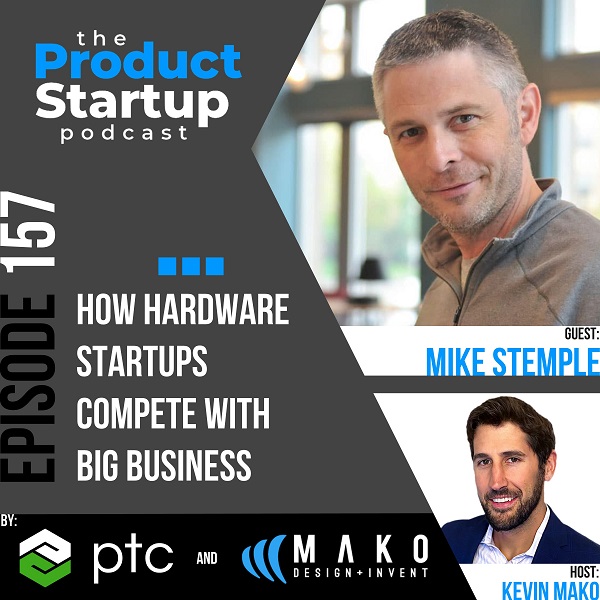
Guest: Mike Stemple, author of Innovating Innovation, repeat product entrepreneur, and advisor to Fortune 500 companies on entrepreneurial innovation.
Host: Kevin Mako, founder of Product Startup and the leading expert in hardware startup consulting. A hardware entrepreneur since 1999, Kevin has advised more than 1,500 founders and built and scaled MAKO Invent through its acquisition by TriMech in 2024.
Episode Overview
Mike Stemple explains why product development tools, specialist firms, and available talent give focused startups a real competitive opening. He discusses speed, customer listening, investment of time and resources, execution during difficult markets, proven versus novel ideas, and staying focused through acquisition opportunities.
What You’ll Learn in This Episode
- The tools and techniques for product development have become more accessible and widespread, enabling greater democratization of the industry.
- In recent years, there has been a surge in product design firms that specialize in supporting and guiding physical product startups, thereby mitigating risks and improving their chances of success.
- Instead of seeking novel ideas, many companies are doubling down on existing, proven strategies to drive innovation.
- To achieve success in hardware product development, it is essential to invest time, talent, and resources into the venture.
- The process of developing and bringing a product to market has become faster and more streamlined than ever before.
- Some of the most successful ideas in history have been born during times of economic downturn, highlighting the potential for innovation in challenging times.
- Talented individuals from large corporations are increasingly leaving to start their own entrepreneurial ventures.
- During an acquisition, it is crucial to stay focused on the primary objective.
- To achieve success in business, it is essential to adopt an opportunity-based mindset rather than one rooted in fear.
- Scarcity and recession can fuel innovation, leading to the creation of groundbreaking products.
- It is crucial to develop big ideas professionally and to ensure that they are built to a high standard.
- Once a product is in production and has attracted some customers, licensing or white-labeling can be an effective means of scaling the venture.
- Do not be deterred from pitching your product to larger corporations, as this can be a valuable means of growing your business.
- The minimum viable product (MVP) is a crucial aspect of product development and an effective way to ensure quality in the first production run.
- Products should evolve over time based on feedback, ensuring that they continue to meet customers’ needs and expectations.
- Building a relationship with customers over time is essential for maintaining their loyalty and engagement with your brand and products.
- The creation of intellectual property is a proven investment strategy for entrepreneurs, and now is an excellent time to start investing in this area.
Episode transcript
This transcript is provided for accessibility and reference. Download the SRT transcript.
Read the full episode transcript
Kevin Mako: Hello, product innovators. Today we learn from a serial product entrepreneur and bestselling innovation author on how hardware startups can compete with big product companies.
Narrator: You're listening to the Product Startup Podcast, a show to learn from top leaders in product development, prototyping, manufacturing, product selling, and everything in between.
Narrator: Hosted by Kevin Mako, the leading expert on product development for physical product startups, sponsored
Narrator: by PTC's two best in class 3D CAD product development software solutions Onshape
Narrator: and Creo, and produced by Mako Design + Invent, the original firm providing world-class consumer products.
Narrator: product development services tailored specifically to startups, small manufacturers, and inventors.
Kevin Mako: Welcome back, everyone. Today, I'm very excited to introduce Mike Stemple to the show. Mike is the author of Innovating Innovation, a number one bestseller.
Kevin Mako: He also founded multiple consumer product startups, including Skin at Raps, and since then, original raps, which sold to
Kevin Mako: 3M. In addition to his own hardware ventures, he's also consulted a number of Fortune 500 product companies on how to be more entrepreneurial.
Kevin Mako: Today, Mike is going to share some valuable knowledge on how inventors, startups, small manufacturers can beat big big corporations when
Kevin Mako: developing a new product by being faster, more nimble, listening to customer feedback, and much
Mike Stemple: more. Now on to the episode.
Kevin Mako: Hey, Mike, welcome to the show.
Kevin Mako: Thanks for having me. I'm excited to talk to you. Well, excited today to talk about how hardware startups can compete, especially in today's market
Kevin Mako: with big corporations and everything that goes into that. You've obviously done it. Major success,
Kevin Mako: both on the startup side, but you've also worked with many of these top leaders, top executives from some of the biggest hardware companies in the world on innovation.
Kevin Mako: So you've seen it from both lenses. First and foremost, congratulations as well on the big book that you released,
Mike Stemple: Innovating Innovation.
Kevin Mako: Thank you. It was a fun one to write. Well, how did you get to the point that you are at today?
Mike Stemple: Give us a bit of a run back through time. Yeah, let me start at the beginning. I'm ex-military. I write out of high school. It was a combat medic in the military. I did really
Mike Stemple: well. They kicked me out, asked me to go get my medical degree as a civilian and come back in. I got
Mike Stemple: through my senior year of college when I was in a car accident and caved in my skull in the car
Mike Stemple: accident. I lost both my military and my medical career, blink of an eye. But it was actually an amazing thing that happened to me. I hit the art center of my brain.
Mike Stemple: And within six months, I became a well-known and famous artist in Colorado where I grew up and see some of my artwork behind me. And I became a famous sports artist.
Mike Stemple: I painted all these large murals of pro athletes and and started my journey of working with large brands to create intellectual property. It started out as an artist.
Mike Stemple: Around that time, the internet was kicking into high gear, and I fell in love with coding.
Mike Stemple: I taught myself to code and wrote some software and got my first company as an entrepreneur funded in 2000. The first three failed spectacularly.
Mike Stemple: But I learned a lot in those failures. And then my fourth company was one called Skinnet, stickers of cell phones on iPods. It was very early in the space.
Mike Stemple: There was no such thing as a photo upload or a product configurator or a designer in 2004. So we launched one of the first of those. And that company was profitable from day one.
Mike Stemple: I tapped into this amazing trend of personalization and changing the look of consumer electronics to fit the uniqueness of the individual.
Mike Stemple: Having worked with a lot of pro teams in the past as an artist, I figured out that if I got a licenses and offered the licensed content printed on a custom cut
Mike Stemple: skin for consumer electronics, that would just take off like crazy and it did. So Skinnet is still in business to this day. I'm very proud of that, what 15, 16 years later.
Mike Stemple: I exited early on and left and created another company in the same space of personalization, but I did it for cars. So it's a company called Original Apps.
Mike Stemple: We built technology that allow people to personalize their cars during the manufacturing process and roll it into the
Mike Stemple: financing. We grew so fast and got so many big names for Ford, Chevy, Volkswagen, all the big names you can think of. The 3M came in and bought that company. And so that was my
Mike Stemple: first foray into marrying the power of the internet with the power of a physically custom design product. So having two successes, I was like hungry for the third, had some more
Mike Stemple: failures, launched a company called Massaro, which was a hardware company, a pure play hardware company, Bluetooth Low Energy, one of the first companies to launch in that space.
Mike Stemple: It was venture-backed from the start from early on, and that two failed spectacularly. And then around that time,
Mike Stemple: people started asking me questions about large businesses that I had worked with previously. I started asking me, you know a lot about the startup space.
Mike Stemple: Entrepreneurs are really starting to eat into our bottom line, we would love to have you come into our business and train our executives
Mike Stemple: and how to think and act more entrepreneurial. And so for the last decade or so, I've been a
Mike Stemple: corporate entrepreneur in residence where I embed into large multinationals and help their senior
Mike Stemple: leadership team better understand what's happening in the startup community and how they can
Kevin Mako: better compete against the startups that are eating on their margins. It's very interesting that you mentioned that these big executives at these Fortune 500 hardware companies
Kevin Mako: are looking to you to figure out why startups are eating away at their business. Because I can tell you from the product
Kevin Mako: development world in the startup space at macro design, most of the hardware startups are thinking,
Kevin Mako: well, how can I ever compete with these massive companies out there and their huge R&D and innovation departments? How will I ever be the next big player?
Kevin Mako: But that has changed dramatically, especially over the last few years. And you're now seeing this as an aggressive agenda at the corporate level.
Kevin Mako: But the reason is, is because startups have such a competitive advantage. And that's what I want to talk to you about today. How can our hardware startups that are
Kevin Mako: listening here on the show get that competitive advantage, compete with the big boys, and then eventually likely get bought out by those very same players for a very good ticket
Kevin Mako: at the end of the day, if it's done right. First and foremost, talk about what's happening in
Kevin Mako: the industry right now at the corporate level about cutting innovation and focusing more on
Kevin Mako: acquisition or focusing even more on just their existing stuff that works and why that's such an opportunity.
Mike Stemple: It's never been a better time to be an entrepreneur launching a physical products company, period.
Mike Stemple: There's so much democratization of the tools and the techniques and it's just easier than it was even five years ago or 10 years ago.
Mike Stemple: And companies like yourself are making it even less risk adverse. The success ratio is increasing by companies like makeo.
Mike Stemple: And I think when you compare that to what's happening in corporate, It's the opposite. It's becoming more risky. It's becoming more difficult, becoming more problematic.
Mike Stemple: And I've traced it back to psychology. One of the stories I love to tell is one of the multinationals I worked with.
Mike Stemple: Two people in marketing came up with an idea for a new product, pitched it, got shut down. It was an adjacent space that the company didn't want to pursue.
Mike Stemple: Those two individuals quit, launched the idea as entrepreneurs and were wildly successful and ended up being acquired by Megacorp's competitor.
Mike Stemple: And I was there as an entrepreneur in residence. So I saw the whole thing happen. from the inside.
Mike Stemple: And I always thought that was fascinating, because you would think that the corporation would have seen the trend, would have believed in the trend, and would have had the time,
Mike Stemple: talent, and treasure, big three T's that any idea needs to be successful. They would have had the time to pursue it.
Mike Stemple: They have unlimited budgets to be able to throw out it, and they have the most
Mike Stemple: amazingly intellectual individuals working for them, so they think, that they should be able to capitalize that, but they can.
Mike Stemple: And the reason why is the psychology within a large business is not the same as of psychology and a startup that you might have brilliant people with resources in time,
Mike Stemple: but they have it in such abundance that they're not able to execute effectively and compete at the same pace that a startup can do it.
Mike Stemple: There's this hierarchy in corporations of how decisions get made. And what's fascinating is I've seen a brilliant, billion dollar idea, go through the
Mike Stemple: corporate hierarchy process. And as it's going through the process, it gets trimmed. Not an additive process. It's trimmed.
Mike Stemple: This is too risky. I don't understand this. Executive A says, I don't think this is the right trend. Any billion-dollar idea by the time it gets to approval is a much
Mike Stemple: smaller, most weaker idea in the entrepreneurial space that I come from. It's the exact opposite. It's an additive process. Here's my idea.
Mike Stemple: You bring in teammates and everyone starts adding onto it, making it bigger and bigger and bigger. They see the world as infinitely large and in the corporate
Mike Stemple: where they see it is how do we make this as risk adverse as possible. I think that's why most
Mike Stemple: entrepreneurs that I mentor now, when I talk to them about building a physical products company, don't ignore but heavily discount your megacorps around the globe as competitors.
Mike Stemple: The flip side of that is, that's the innovation. There's also a team within every megacorp called strategy, to usually
Mike Stemple: run by a chief strategy officer who's in charge of acquisitions. Their job is to play the chess board for the company.
Mike Stemple: So they look out into the future and try to guess what companies they need to acquire and how to snap them together with other initiatives to be able to move
Kevin Mako: the company forward and usually gain in revenue. Very powerful stuff. It's amazing that you're seeing kind of like this double-edged
Kevin Mako: sword. First of all, innovation just isn't happening nearly to the degree at the corporate level than it is at the startup level. At least the trend is occurring in that direction.
Kevin Mako: Things are changing. More innovation happening at the startup level. Less innovation happening at the corporate level. However,
Kevin Mako: on the flip side, it's a nice relationship because corporations are now considering spending more money on acquiring those startup innovations, less money on
Kevin Mako: internal R&D. So it's a win-win for both the startup and the corporation itself, whereas the startup finds the innovation. They hustle,
Kevin Mako: they get it done. Most important, that means getting it to market. They want to see a provable track record of the product actually being sold to the market.
Kevin Mako: Doesn't have to be big because the corporation can do that. They have all the channels to lever up what you have. But what they do
Kevin Mako: want to see is, did you prove that people are out there that, A, love the product. So you designed a great product that's producible.
Kevin Mako: B, did they buy it? Did they actually whip out their credit card and say, yes, I will pay this price tag for that product? And of course, at the end of it,
Kevin Mako: the holy grail is, did they leave you a good review? Did they love the product? Which is very easy
Kevin Mako: to do in the early phases, go out and hustle every single customer that loved your product and get them to write a review about you. Many of them will, right?
Kevin Mako: Especially the early adopters. So you're seeing this market trend happening. Mike, how is that being compounded in value by the recession that's occurring
Kevin Mako: right now? You're a big advocate of using the recession to lever basically
Mike Stemple: the future success of your business end of your life. How do you see the recession playing into what you're talking about here today?
Mike Stemple: Well, historically, more billion dollar megacorps are at their genesis at the creation stage are created in recessions than in good time.
Mike Stemple: The reason why is scarcity breeds creativity. It's one of my big quotes I tell people. The more scarce of resource, more scarce of time, talent, and treasure that you have,
Mike Stemple: it unlocks something magical in the human mind that creates amazingly brilliant ideas.
Mike Stemple: It's not the abundance of resources or the abundance of time. Think about it. If you have every research report on your industry and you have
Mike Stemple: all these people willing to step in and be talent, and you have unlimited funds, there's just too much variability for you to come up with a brilliant idea.
Mike Stemple: you'll actually pick the wrong competition and lead to mediocrity, which is corporate innovation 101 is most of the ideas are just mediocre. They're really small.
Mike Stemple: They're risk adverse versus inspiring. So they're uninspired. But scarcity breeds creativity. And so the entrepreneur by the very nature has scarcity.
Mike Stemple: And this is why the most brilliant ideas are created in scarce economic environment. What's interesting is scarce economic environments have a high talent
Mike Stemple: availability. A lot of people get laid off. A lot of people are looking for the next gigs. A lot of people want side hustles.
Mike Stemple: A lot of people want to join a team and not be a victim of a recession ever again. They want to control their own destiny.
Mike Stemple: And so there's this abundance of talent that's willing to work with you that in good times you just can't tap into. And I think that's a very interesting role.
Mike Stemple: The other piece is from the finance side, when you have to deal with scarce, fiscal, the money that
Mike Stemple: you would use to develop a product, you get very creative on how you form relationships. to be able to get access to capital.
Mike Stemple: And one of those things is like what you do for a living is prove out the idea earlier on to a point where it's more viable.
Mike Stemple: So the risk mitigation without idea.
Mike Stemple: So take a big idea and make sure it's manufacturable or make it possible. That actually increases chances of funding, especially in a scarce environment.
Mike Stemple: Weak ideas that are put together with popsicle sticks and duct tape will not get funding over the next two to three years. You just need
Mike Stemple: professional ideas that are invested in by the entrepreneur that can then lead to angel funding and then go down that curve.
Mike Stemple: The other piece is large corporations are stepping down lower and lower lower and lower in the acquisitions pile. Corporations are now looking for better cap tables or
Mike Stemple: better investment opportunities at the lower stage. One of the strategies I pursued, and if you take
Mike Stemple: Skinnet and original apps, my two big companies I created, I created manufacturing technology. I created at a product, I can go to skinnet.com and see kind of what I did.
Mike Stemple: But the majority of Skinnet's revenue and original apps was white label technology. I actually took my product,
Mike Stemple: my infrastructure, whole thing, and allowed larger brands, corporate brands, like HP, Dell, T-Mobile Sprint, Verizon, all kinds of the MP3 players and stuff that were in
Mike Stemple: the late 2000s. All the licenses, Disney, they all launched their own stores that were powered by Skinnet, be able to market and promote to their customer.
Mike Stemple: This is an easy way over the next three years. If you have an amazing product and you can put a bigger brand or a license on top of it,
Kevin Mako: that brand or a license, Megacorp or the license, will market and promote it to their audience. It's a great way to fund your business in a recession while still moving your
Kevin Mako: revenue down the field. That's brilliant. And I think the key there is you had created a great technology that you'd already been in production with.
Kevin Mako: So you could prove the two things we talked about earlier. A, you had a great product. It was rinse and repeat. So people had it.
Kevin Mako: B, your clients are willing to pay for it and they loved it. You took that combination and said, okay, I've got this great concept that is now being produced
Kevin Mako: and being bought in a small way. You've got this major customer reach. Let's partner up together and make it happen.
Kevin Mako: And that's one of the big fallacies as well that hardware startups have to keep in mind is licensing or these big partnerships don't happen early.
Kevin Mako: And I love how you mentioned that, Mike, you've got to prove you've got a quality product that people want, even just in a small way, before you're getting those big partnerships,
Kevin Mako: which then come down the road. So the key to really any hardware startup is get your product into production. That is the key.
Kevin Mako: But ensure that it's, A, a good quality product, but B, it's rinse and repeat. Again, not at high volume. And that's the thing that sometimes scares some folks away.
Kevin Mako: You can look at it, and I'm a big proponent, especially these days, of short run manufacturing, 100 to 500 units of a product. The margins aren't going to be great there.
Kevin Mako: But you're not looking for margins with your first or second or even third production run. You're looking to prove the model so that you can get access to these incredible
Kevin Mako: partnership or sales or distribution opportunities that will open up to you once you prove that
Mike Stemple: some people liked it, the few that you were able to access, and they whipped out their credit
Mike Stemple: card and bought it. And like I say, the Holy Grail is at the end of the day, they also wrote a good review about it, ideally publicly online.
Mike Stemple: Yes. And the build on that, I mean, one of the big things I saw back in the Skinett days is we did a lot with licensing. So I got every major pro sports league, Marvel, Disney.
Mike Stemple: You name it, you can go to Skinett and see all the licenses are still there. Never discount the power of a small little startup by putting a license
Mike Stemple: or partnering with a megacorp, the halo effect that that has in your small level startup. Your small little startup now, when you're partnered with HP or Dell, suddenly is much
Mike Stemple: larger in perception with the consumer.
Mike Stemple: So that's one of the reasons why I think Skin is still in business today is our licensing strategy to be able to tap into affinity.
Mike Stemple: So people are really passionate about sports teams. And so they want their phones to have the Denver Broncos on it, for example. It's awesome when it says powered by your brand.
Mike Stemple: So your brand now elevates the same level as Disney with a consumer. It's a strategy that I'm surprised more, smaller companies don't tap into the power of
Mike Stemple: the credibility of a license or the credibility of white labeling for a big company or powering a big company.
Mike Stemple: One of the fallacies, I think, in the startup community is we need to build a brand. So we have to focus all of our marketing efforts on our own brand and SBOS.
Mike Stemple: I still think that's somewhat important, but not to the point. you're missing low-hanging fruit by partnering with a large entity that's going to expose you to
Mike Stemple: their millions of customers. Startup founders get caught up under the vanity of their startup and not the business of their startup.
Mike Stemple: Business of your startups to create an amazing product to consumers love and get into their hands as quickly as possible. Now, if a megacorp can help you with that,
Mike Stemple: awesome. Want to know what happens when you do partner with a megacart and you're starting to make their
Mike Stemple: money? They're going to pay really, really attention and start thinking about how they could use it with other brands that they work with or other ways they can use it.
Mike Stemple: And you get put onto their acquisition schedule. One of the things I always mentor new founders on is don't be paralyzed by some megacorp stealing your idea.
Mike Stemple: In fact, go pitch them your idea. Their internal innovation team is not going to
Kevin Mako: be able to pull it together within a year. It just won't. And so they'll be on this chief strategy
Kevin Mako: officers and their team's radar as a potential acquisition target for you over time or maybe even a possible investment. That's amazing.
Kevin Mako: And I love how you mentioned that you don't have to go big, And one of the big things that we always really advocate here, especially as a new hardware startup,
Kevin Mako: especially if this is your first time developing a new product, is just focus on your getting to that point you're at your first few hundred units.
Kevin Mako: That really is an incredible milestone, a monumental milestone for any hardware startup. So many of them don't even get there because they focus on other things.
Kevin Mako: They're worried too much about, like you said, building an actual brand image as opposed to just getting a product out there into market, that they lose sight of that core goal.
Kevin Mako: It should be a few hundred units into users' hands. And at that point, you will have learned so much about how you might be able to scale after that.
Kevin Mako: So if you spend a whole bunch of time and effort in the product ideation phase or in the prototyping phase
Kevin Mako: or in the manufacturing phase, thinking about scale and how to really grow the business and
Kevin Mako: build this great brand empire, all of that might be a complete waste when, like you mentioned,
Kevin Mako: the situation might come where Megacorp knocks on your door and you white label to them and that becomes a new business model. You have no brand anymore.
Kevin Mako: Or maybe it is a collaboration with somebody like a Disney or whatever else. But the key is focus on those first few hundred units. There's a twofold advantage to that as well.
Kevin Mako: If you focus really on just getting your first units made and out there, the other thing that will allow you to do is to get some really
Kevin Mako: strong customer feedback about your product itself. So not only are you opening all these
Kevin Mako: sales doors and all these different business opportunities and partnerships on the sales side,
Kevin Mako: but on the development side, you're going to get a ton of incredible feedback on A, how to make your product better, but also B, what might you add to it that could
Kevin Mako: improve it beyond what it is today? So it's not just the problems of the product, but it's also the opportunities of the
Mike Stemple: product. So much of that won't be there until you actually get those units into real customers' hands and start achieving that feedback.
Mike Stemple: And that's really the holy grail of when things really can take off. If you've done that well, if you built a great product. Agreed 100% of it.
Mike Stemple: The only caveat I would even add is they focus too much on too many features and the consumer just wants to fall in love with your brand and follow in love with the
Mike Stemple: product. And they want to go on the journey of helping make it better on version two,
Kevin Mako: three and four. That's why most people stay on an iPhone is they kind of like the new features, the new journey there. And you feel like they're part of the game.
Kevin Mako: Most people are late to market because they're trying to create the perfect product and not the product the market is willing to accept.
Kevin Mako: I love how you mentioned feature creep because that is certainly the easiest way to keep your product a reasonably cost effective to develop,
Kevin Mako: but also to ensure that what you release is of a reasonable quality for marketability or for that interest. Feature creep is super costly.
Kevin Mako: Every time you add a feature, you're basically creating a new product. You add a handle onto the side. You add an LED, you pair it with an app,
Kevin Mako: whatever it might be that's enhancing the core functionality of the original invention idea. you have to look at it as its own R&D plan, its own design, engineering,
Kevin Mako: prototyping, et cetera. And in fact, the more features that you add to a product, the more interacting scenarios that
Kevin Mako: occur, potentially causing all these amplifications of problems, even within other features that those features are interacting with.
Kevin Mako: So really looking at feature creep, understanding what Mike's talking about here is keep the product simple, ensure that it's of a reasonable quality level, build it right,
Kevin Mako: build something that people appreciate, but allow them the user or your customer. And bigger customers potentially could be a part of that.
Mike Stemple: This could be the big corporations or whatever else that could be your much larger customers, allow them to interact with your first and second versions of the product,
Mike Stemple: provide the feedback that makes the perfect product to build a great business around. It all comes back to that feedback, Luke. Yeah.
Mike Stemple: I mean, we talk about MVP's minimum viable products, both in software and hardware.
Mike Stemple: You know, the bare minimum of value that you can offer a consumer to get some results back, right? So MVP. And a lot of entrepreneurs have this.
Mike Stemple: psychology about lessening their vision of what they think the perfect product should be.
Mike Stemple: And what they don't understand is the consumers now have been trained to not just buy a product for the value as the day, but invest in a product that's going to take them
Mike Stemple: on a journey over the coming years. So you're buying a 10-year relationship, 20-year relationship. I mean, I'm on an
Mike Stemple: Apple thing and I'm on a 30-year lifetime value with that customer. And what they want to do is believe the soul of the product that you create.
Mike Stemple: Entrepreneur is really good at putting a soul under the product. It's usually with the founders, values, and ideas. There's just so much, and that's why I love
Mike Stemple: startup products over corporate products, is they just have this vibrancy to them. It's the product themselves and the packaging, the unwrapping experience, shopping experience.
Mike Stemple: Everything around it is just so intimate. It has a soul. And corporate, Megacorp puts out soulless products that were committee-based
Mike Stemple: that were trimmed down to what the market researchers that's a big five consulting firm told them would sell well. Consumers can tell the difference. But don't rob your consumer,
Mike Stemple: from the opportunity of having a relationship, a multi-date relationship with your product. This might be risky, but don't sleep with your customer on the first date.
Mike Stemple: Give them a reason to go on multiple dates with you over time, and that's the feature release over time. Allow them to fall in love with your brand over time by delighting
Mike Stemple: them with new things. Whatever that looks like, every product's a little bit different. Don't discount the psychology, a positive psychology, of people discovering and
Mike Stemple: rediscovering their affinity with your brand and your product. Don't rob them with that. Most people try to put way too much. And that comes from our insecurities as entrepreneurs.
Mike Stemple: We think that if it's scarce and it doesn't have a lot of features and all of the stuff, it's not valuable. And that's just wrong.
Mike Stemple: One of the slides in my corporate deck is I show what the consumer wants was a knife, a steak knife, and what Megacorp builds is a Swiss army knife.
Mike Stemple: Because it goes through all these different departments and every fiefdom in a megacorp wants to add on their little features and stuff or trim down things.
Mike Stemple: And all the customer wants is a knife that's going to cut. And that's what startups do is we go to an iteration process to deliver perfect market fit.
Kevin Mako: We don't add on extra things based upon some political motivation to make it relevant to executive acts. We don't care.
Kevin Mako: We don't have that abundance of time, talent, and treasure. The takeaway that I always tell people was don't rob the opportunity to date your consumer.
Kevin Mako: Don't rob them from the money. Powerful. And I want to tie that into the value that you mentioned, especially now that we're in the recession.
Kevin Mako: You've got some pretty strong opinions about the value of investing
Mike Stemple: in intellectual property, especially during a recession. Talk a bit about that and especially about the fear-based versus opportunity-based mentality
Mike Stemple: that you should convert yourself to, especially in downturns like the recession we're in right now.
Mike Stemple: Yeah, so I'm a serial entrepreneur, right? So I started with an art career, and I still do art to this day.
Mike Stemple: It led into a tech entrepreneur career that's led it now into me publishing books. and guest speaking and putting on workshops and training people on how to think and act better
Mike Stemple: as an entrepreneur. My whole investment strategy, my whole life has paid off well. It has been a
Mike Stemple: belief that the only thing I can trust and control is the intellectual property that I can develop. IP, intellectual property, is something novel, something new
Mike Stemple: to the world, something that's valuable. And my portfolio strategy from a fiscal point of view is always the double down on intellectual property.
Mike Stemple: If I lose a client, I double down on creating more intellectual property, whether it's like I just launched a book or putting out free content to people.
Mike Stemple: Like when COVID started, I turned all my online courses on how to build a startup to free on UDEMI. You want to take my course.
Mike Stemple: There are four of them on Udeme that you can take for free now. And so I always am giving away free content. I'm always trying to create intellectual property.
Mike Stemple: And it is the best investment joint, especially in a recession. Go look at your 401k and tell me if that was a good investment over the last five years. Probably not.
Mike Stemple: Real estate's cratering or too expensive to get into. I don't care what cryptos created. There's no good investments other than intellectual property.
Mike Stemple: So the people who are making money right now and are going to make money over the next five years are people who are investing in their own self-created intellectual property.
Mike Stemple: And there is a ton of angel investors that I know, I know VCs that are lowering down their thresholds to get into novel and interesting intellectual property that has opportunity
Mike Stemple: to be exited, that has value to somebody else, whether that's an acquisition or a partnership,
Mike Stemple: merger, there's just a ton of different ways intellectual property can be monetized. Me personally, I think now is the time for you to look at your personal family investment
Mike Stemple: strategy and just ask a question. Do you believe more in yourself and your ability to create novel intellectual property
Mike Stemple: and control it and know exactly how the money is being spent and invested over time? Or are you going to keep on investing in things that historically are cratering at
Mike Stemple: an accelerating pace? Whether that's real estate, stock market, crypto.
Mike Stemple: It just all seems very speculative right now compared to the control you can have as an entrepreneur of creating the next new, the next great product that the world needs.
Mike Stemple: We're not going to stop as a species innovating. And one of the quotes I tell everyone, innovation is the root of all of society's else. I don't care what topic it is.
Mike Stemple: Innovation at its root, you can trace all those problems back because we innovated and created into the new technology and then it was corrupted or bastardized or politicized.
Mike Stemple: But innovation is also the savior of humanity. We have some wicked hard problems that people need to invent and create. If you think big businesses is doing it, they're not.
Mike Stemple: They're building politicized, cut down,
Mike Stemple: horrible, committee-based ideas.
Kevin Mako: The problems that are facing society, the problems we as entrepreneurs have to create, the problems that we need to solve are only going to come from us. It's not going to
Kevin Mako: come from anybody else.
Kevin Mako: Government's not going to save us. Big business is not going to save us. It is up to the individual decide that now I'm going to invest to myself and create an luxury
Kevin Mako: property that's going to change the world.
Kevin Mako: Mike, that is incredibly powerful stuff. Entrepreneurs, you heard it here. It's up to you to create those innovations of the future, both for the world
Kevin Mako: and for yourself and what better investment than investing in yourself in a technology that you
Kevin Mako: control, especially if you're at the very early stages of a hardware product or of any, product idea or any invention in general, you've got to look at that as an investment,
Kevin Mako: not as a cost pace. And that is the key difference to your psychology in and around creating value for the
Kevin Mako: world. It will require an investment. It doesn't just happen automatically. And that's what obviously we're talking about here on the show today.
Kevin Mako: And it's so powerful. And Mike, you've done it time and time again. And here we are in the middle of a recession, which is the key time to be
Kevin Mako: looking at these opportunities so that when we come out of the recession at some point, which always
Kevin Mako: happens, always has, always will, there will be a day where we come out of this recession and there'll be another boom. You want your product to be front and center of that.
Kevin Mako: You want it to be done, vetted, proven, improved. So you can start taking advantage of those partnerships or those
Kevin Mako: opportunities to scale or those sales channels, whatever it might be.
Mike Stemple: That can happen very quickly if you've built a strong foundation around your intellectual property when things are
Mike Stemple: calm, when you're behind the scenes, when you're building and creating this intellectual property that Mike was talking about.
Mike Stemple: Mike, I want to talk about one last thing before we go. You mentioned your book. Talk a bit about how that helps with innovation and where people can get a copy.
Mike Stemple: It's called innovating innovation. This is it cover. Why corporate innovation struggles in the age of the entrepreneur.
Mike Stemple: So it was written for corporate innovation teams being in LA very, very bare all their problems. And there's a lot of them. I think it's a valuable read as an entrepreneur
Mike Stemple: to read because it'll help you sleep better at night if you're worried about megacorps coming and stealing your idea and executing them. For sure, it will help you sleep better.
Mike Stemple: I'm very critical of big companies and their innovation efforts. None of the people themselves, some of the most
Mike Stemple: amazing, talented people I've ever worked with are in these big innovation teams. I lay bare the problem
Mike Stemple: that most big companies have is they just don't allow their people to think and act entrepreneurial and the entrepreneurial way is the way of the future.
Mike Stemple: It can move faster with the same tools. 10 years ago was very difficult to manufacture a product.
Mike Stemple: I mean, you would go to a big manufacturing plant in China and you say, yeah, I want to run, you know, 100 to 500. And they would just roll their eyes and you just couldn't get in.
Mike Stemple: But companies like yours have been able to pioneer and get products to the point where they're going to be built right and they're built for manufacturing ability and they're
Mike Stemple: built with a lot of the risks taking out. And so larger manufacturers now are open to the idea of doing lower runs because it's just
Mike Stemple: more efficient for them to place a lot of bets with a lot of startups. You see exactly what I'm seeing when I'm experiencing is the way of the future is entrepreneurial.
Mike Stemple: It is not corporate. And these big corporations are shifting their innovation budgets around to an
Mike Stemple: acquisition strategy of success in the marketplace versus an in-house creating the next new. When I think that's just fascinating if you think about it.
Mike Stemple: And if you look at the big announcements of companies that have been acquired and who's acquiring them, you can see that strategy is playing out.
Mike Stemple: Startups are being acquired earlier in their life with less of a footprint of success.
Mike Stemple: Because corporate innovation cannot innovate. And so I'm trying to help corporates understand that. And acquiring a startup is a problematic process for most corporations.
Kevin Mako: And so that's one of the big areas that I'm kind of pioneering is if a company has an entrepreneur and residence, corporate entrepreneur and residence on staff,
Kevin Mako: they can help this acquisition process much more effectively. So if any of that interests you or go check out my book, Innovating innovation. I think it's six bucks on Amazon.
Kevin Mako: If you don't have money, I know it's a tough time out there. You can just email me at Mike and Inspirer or Mike at, It's stemple.com, either one.
Kevin Mako: I can inspire with an arrethian, someone who inspires. And I'll make sure you to get a copy. Mike, that's very generous of you. Much appreciated for all your words of wisdom
Kevin Mako: today. As always, I'll put all the links below to anyone that wants to click through as well. Mike, thanks again for your words of wisdom today.
Kevin Mako: Appreciate you being on the show. It was a great time. I really enjoyed it and I'm really impressed with that you've built. Thank you. And we'll talk soon.
Narrator: Thanks for tuning in to this episode of the Product Startup Podcast. If you found some value in the
Narrator: show, please do us a huge favor and leave us a quick five-star review. If you have any guest suggestions or anything else feel free to reach out to us anytime at our email
Narrator: podcast at MakoDesign.com that's podcast at MakoDesign.com this show is hosted by Kevin Mako North America's leading expert on product development for fiscal
Narrator: product startups huge thanks to our sponsors ptc and their two best-in-class 3D CAD product development software solutions Onshape and creo and Mako Design and
Narrator: invent the original firm providing world-class consumer product development services tailored specifically to startups small manufacturers and inventors
Narrator: Thanks for joining and see you next time.
Competitive Strategy for Hardware Founders
Use Startup Speed Where Big Companies Are Slow
Work directly with Kevin Mako to identify the customer problem, market gap, product advantage, decision speed, validation loop, and focused roadmap that can let a smaller company compete intelligently.
Kevin can help you turn limited resources into sharper priorities, coordinate the right specialists, and connect product development with manufacturing, funding, marketing, sales, and strategic partnership options.
Request a Competitive Strategy Call
Tell Kevin who dominates the market, what customers still dislike, and where your startup can move or learn faster.