
Listen Now
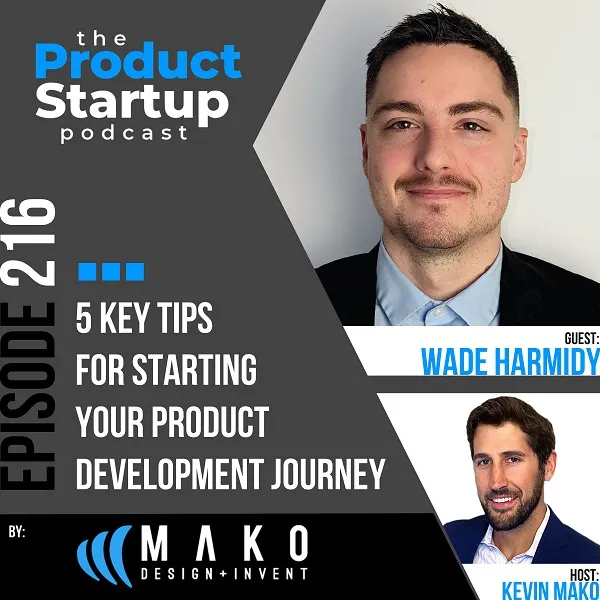
Guest: Wade Harmidy, Operations & Project Manager at TriMech Design Solutions (formerly MAKO).
Host: Kevin Mako, founder of Product Startup and the leading expert in hardware startup consulting. A hardware entrepreneur since 1999, Kevin has advised more than 1,500 founders and built and scaled MAKO Invent through its acquisition by TriMech in 2024.
Episode Overview
Wade Harmidy outlines five foundations for a stronger product development journey. The discussion covers writing a concise product vision, defining the end user, bringing tangible reference material, limiting the first version to core functionality, and planning realistic milestones without cutting critical corners.
What You’ll Learn in This Episode
- What are the core factors that dictate how your product journey will go?
- What is the Six Sigma Black Belt certification?
- Having a definitive vision for what your invention is going to achieve or what problem it is solving is integral.
- The clearer your vision is in the initial stages, the more likely it is that an experienced team will be able to help you realize your vision.
- Write down your product vision!
- Shoot for fewer words than more words. In only a few sentences, someone should understand what your product does.
- Have something tangible to bring to the product engineering firm. You don’t need to be an artist or have advanced sketching skills! Just get the idea down.
- Make sure to consider the end user and what your product accomplishes for them.
- How do you want the end user to use your product?
- MVP design is a key tenet that streamlines the product development process and minimizes cost.
- Keep your design focused on the core functionality of the product!
- MVP design plays largely off of lean manufacturing principles.
- When you have fewer features to focus on, you can make sure each is developed to the highest standard.
- Start small to start, wedge yourself into the target market, and then build from there.
- Setting realistic deadlines is incredibly important!
- You need to give your product design team enough time for research, ideation, concept and industrial design, and iteration.
- Cutting corners often leads to failure!
- Plan for the big picture and all of the key milestones you need to hit.
Episode transcript
This transcript is provided for accessibility and reference. Download the SRT transcript.
Read the full episode transcript
Kevin Mako: Hello, product innovators. Today we learn five big tips for hardware startups beginning the product development journey from a Six Sigma certified product design manager.
Kevin Mako: This is the Product Startup Podcast, a show to learn from top leaders in hardware product development, prototyping, manufacturing, product selling, and everything in between.
Kevin Mako: Hosted by Kevin Mako, the leading expert on product development for hardware startups, and produced by Mako Design.
Kevin Mako: Welcome back, everyone. I'm very excited to introduce Wade Harmidy to the show.
Kevin Mako: Wade is one of the project managers at MAKO Design + Invent, working with dozens of hardware startups each year.
Kevin Mako: He has an honors bachelor of science, postgraduate certificate in quality assurance,
Kevin Mako: and a Six Sigma Black Belt certification for project management.
Kevin Mako: Today, Wade will share valuable knowledge for inventors, startups, and small manufacturers on the five key things that can be done when beginning the journey of product development to ensure your new product turns into a successful product business.
Kevin Mako: Now, on to the episode.
Kevin Mako: This show is produced by Mako Design, the original.
Kevin Mako: firm providing end-to-end consumer product development services tailored specifically to hardware
Kevin Mako: startups, small manufacturers, and inventors. Take your product from idea to store shelves at MakoDesign.com.
Kevin Mako: Now on to the episode. Hey, Wade, welcome to the show.
Wade Harmidy: Thanks so much for having me, Kevin. Really appreciate it.
Kevin Mako: Well, we're looking forward today to talk to you
Kevin Mako: about your five major tips that you have for a hardware startup, an inventor, somebody who's going through
Kevin Mako: the starting phases of professionally designing and developing their product to get
Kevin Mako: it to manufacturing. These are the things that you as a hardware startup can do for free.
Kevin Mako: These are things that can really help exponentially increase the probability of success in the
Kevin Mako: development and even the business in and around the product that you're trying to create,
Kevin Mako: which is hopefully why you're creating the product to get it to market and build a legacy.
Kevin Mako: So today we're talking to Wade about that. Wade, Wade, obviously, gets to deal with dozens and
Kevin Mako: dozens and dozens of inventors that are going through this very journey.
Kevin Mako: and over the years, you've got to see really what are those few things that can help
Kevin Mako: at the early phases to really change the odds for those inventors and for those startups as they
Kevin Mako: start into the development process to get their product designed, prototyped into manufacturing
Kevin Mako: and, of course, onto the market. Before we jump into all that fun stuff, Wade, I want to talk to you
Kevin Mako: a bit about some of your experience and some of your education in the past. You've got the dual
Kevin Mako: degrees, the diploma. You've also got the degree. And then you subsequently went on.
Kevin Mako: to do your Six Sigma Black Belt in project management. I really want to talk about that
Kevin Mako: and how that applies to what you're doing today because that's an impressive certification. And it's
Kevin Mako: one that really elevates somebody to such a high level of project management and professionalism.
Wade Harmidy: Absolutely. Thank you so much, Kevin. Yeah, the Six Sigma Black Belt is a certification that
Wade Harmidy: really came to life in the 1980s with Motorola and understanding how to
Wade Harmidy: reduce the amount of defects or issues in any sort of process. So this can be applied
Wade Harmidy: from manufacturing computer chips all the way to project management and managing operations within any
Wade Harmidy: sort of business. So it's really a widespread doctrine that can help hone in on all of these small
Wade Harmidy: details to make a really great project and really improve any process. Yeah, it's great stuff.
Kevin Mako: It's fun always looking at those things, a perpetual improvement as well and just constantly improving the craft of what you do every day, but then also looking at the big picture, looking at both. What can we change today that makes a difference? And then what can we plan for sometimes up to years in advance to really bring out the best in everybody? And when it comes to our applications, how do you bring the best out of the inventors, of the products, of the designers and engineers that are working on it on the team that surrounds that and continuing to do that over time.
Kevin Mako: today, let's jump into the details about those five tips, way that you've put together.
Kevin Mako: Just kick it off with what's tip number one? I know they're not in any particular order,
Kevin Mako: but start with number one. And we'll just have a bit of a conversation around those and go from there.
Wade Harmidy: Awesome. Yeah, so these aren't in any particular order, but five really key things to keep in mind when you
Wade Harmidy: are getting into product development. The first one here is having a clear product vision. So having a
Wade Harmidy: definitive product vision for what your invention is going to achieve or what problem
Wade Harmidy: it's solving is very important when considering developing a product. You want to understand all
Wade Harmidy: of the features, how it's going to achieve these features. And this can also be aided when
Wade Harmidy: working with an experienced design team that can help with some of the more complex details that
Wade Harmidy: a lot of inventors may not necessarily know right off the bat, you know, advanced material science,
Wade Harmidy: engineering, industrial design, complex electronics. The more clear your vision is in the initial
Wade Harmidy: phases and understanding your product in what it's achieving, the more a experienced team is going
Wade Harmidy: to be able to help you achieve your vision for your product. Yeah, that's great. It's interesting
Kevin Mako: because if you talk to as we do a first-time inventor, a startup, typically that person has been
Kevin Mako: thinking about their product for a long time. Some people, it's been years. Others, it's
Kevin Mako: something that's more recent, but no matter what way you slice it, by the time they make the decision
Kevin Mako: to say, okay, I'm going to take this thing to market. I want to do something with it. I'm not just going to let
Kevin Mako: sit idly buy, be on the shelves in my brain and never come to life when I've identified some sort
Kevin Mako: of amazing opportunity in the world, either solving a pain point or creating an opportunity for
Kevin Mako: your end user. But what's interesting is as a result of that, typically it's difficult to
Kevin Mako: to communicate that in a very clear and concise way to your design team or to any member's
Kevin Mako: number of stakeholders. So one of the easiest things that you can do as a startup is just
Kevin Mako: write down a really clear vision. Do it on a word process or Google Docs, whatever it might be
Kevin Mako: so that you've actually got the ability to edit and tweak and refine it. You sleep on it.
Kevin Mako: You tweak it up a bit more. Shoot for less words than more words. And really try and just
Kevin Mako: define very clearly in two or three sentences what your product does.
Kevin Mako: You should be able to show somebody those two or three sentences and they know almost immediately and definitively the value that you've created.
Kevin Mako: If it takes you minutes or even a whole phone call in order to explain why or how the product works or the end use or all of these sorts of things, then you probably don't have a complicated product as much as you might think.
Kevin Mako: You just have a challenge in really articulating and describing the initial first version of how that product works.
Kevin Mako: So that's such a powerful one, such an easy thing that anyone could do as well.
Kevin Mako: And then what we found, especially if you do this thing over time, you put these things on paper,
Kevin Mako: you will be exponentially better off describing that down the road, even if you have no professional
Kevin Mako: training whatsoever, even if you've never really gone through this exercise before, just write it down,
Kevin Mako: take it through, and you'll probably have a clear vision after a couple of days or even a few days
Kevin Mako: of tweaking, modifying, thinking through that clear vision.
Wade Harmidy: Absolutely. And one thing that can also help and is, you know, really,
Wade Harmidy: simple is just having a simple sketch of your product, an idea of about what it looks
Wade Harmidy: like, and that can really help understand what features it has and how it's going to accomplish those
Wade Harmidy: features. You know, even if you're not a great drawer, it always helps to have something to start off
Wade Harmidy: with. And then a great design firm can always help you bring home the aesthetic to something
Wade Harmidy: really world class. Yeah, I mean, that's great. The sketch on a napkin thing.
Kevin Mako: is real. We get those. And I'd much rather have a sketch on an appkin than somebody that
Kevin Mako: it never has even tried to hand sketch their product out. Drawing skill doesn't matter. As you said,
Kevin Mako: Wade, just getting it onto paper so that you can kind of visualize. Now, a lot of people think about it
Kevin Mako: and say, well, look, I'm not a designer. So I don't know exactly how this thing should look or feel.
Kevin Mako: That's not really the purpose of the sketch. The sketch really is just to get your vision,
Kevin Mako: your idea of how this thing should operate or be onto paper. You can sketch a number of times.
Kevin Mako: If you don't like your first sketch, do another one. Don't go crazy on this. Because, of course, yes,
Kevin Mako: as you mentioned, that's what your design team's for. Eventually, they're going to take whatever
Kevin Mako: rough sketch you give them and put it into something great. But the first thing's first is you've just
Kevin Mako: got to get your ideas down on paper. And you'd be surprised how much really starts to come out of that,
Kevin Mako: how much you start thinking through these features when you just get it on paper. So from there,
Wade Harmidy: Wade, let's jump into number two. Awesome. Number two is considering the
Wade Harmidy: end user and what it accomplishes for them. So throughout any project, it really is extremely
Wade Harmidy: important to consider the user and the market. Who the target market is, how are they going to use
Wade Harmidy: their product, and how that relates to your product development moving forward here. If you keep
Wade Harmidy: the user and the product in mind and how the product is going to be utilized, that can help dictate
Wade Harmidy: some of the smaller details as you move forward into the next phases. Having an idea of what
Wade Harmidy: target market is important, but not necessary, but a good thing to keep in mind.
Kevin Mako: Yeah, it's a good point, Wade, especially the end user functionality of the product. So kind of
Kevin Mako: tying into number one that we talked about before, if you've got really clear vision, the next step
Kevin Mako: is to articulate very clearly, again, write it down two to three sentences, ideally also a sketch.
Kevin Mako: we talked about before, show how somebody uses this and say how somebody uses this on paper,
Kevin Mako: really clearly articulate what is the use case. If you got clear product vision on what the product is,
Kevin Mako: and then you also very clearly can say, this is how someone uses it and this is the benefit that they
Kevin Mako: get or the pain point that they've avoided, that is more clear than I would say probably 80%
Kevin Mako: of the product pitches that we see. Because again, you've got that that double
Kevin Mako: edge sword there. What's the product? How does it work? And if you can really clearly articulate that,
Kevin Mako: then even if somebody isn't 100% clear based on your product vision, by the time you actually show them
Kevin Mako: a use case, it should totally seal up that description, really make it easy to understand the value you
Wade Harmidy: are trying to create the vision that you see for your own product. Absolutely. And there are a lot
Wade Harmidy: of details that can really be refined as you go into your actual product design phases.
Wade Harmidy: those may not be completely necessary to identify at the very start of your product development process.
Wade Harmidy: As a lot of the tenured industrial designers are going to be able to make those really detailed, refined tweaks to your product design on how it's going to be used.
Wade Harmidy: But having a general idea and understanding of how someone is actually going to use the product is really key in having something that's going to work well.
Wade Harmidy: and do really great once you get it to market.
Kevin Mako: Yep, love that. Yeah, that's great way. Very powerful. All right, let's keep going. What's number three?
Wade Harmidy: Number three is understanding MVP design for your first version. So MVP design is minimum viable product.
Wade Harmidy: And this is a very key tenant to keep in mind when having a smooth product design for a startup.
Wade Harmidy: Keeping the design focused on the core functionality and features,
Wade Harmidy: allows for a swifter, less expensive, less resource-intensive development process,
Wade Harmidy: and also to hit the market faster. A lot of features that you may want to include on the initial design
Wade Harmidy: can always be pushed back for a 2.0 product to ensure that you maintain an MVP design
Wade Harmidy: and have a very swift and effective push through the design phase to get to the end manufacturing goal.
Wade Harmidy: A design team can help with all sorts of choices during this, during the design process, and allow for MVP design to become a core feature of your design process.
Wade Harmidy: MVP design was actually coined by Eric Rice in a book called the Lean Startup in 2011.
Wade Harmidy: This helped transform startup product development, encompassing MVP design into what we now know today.
Wade Harmidy: This has really been adapted.
Wade Harmidy: from lean principles and lead manufacturing, which goes back to my 6 Sigma background.
Wade Harmidy: You know, all of this is really focused on reducing waste, reducing inefficiency,
Wade Harmidy: streamlining processes, and making sure that you don't waste any time on offshoots or focusing on small
Wade Harmidy: details. And this is a philosophy that has been used by a lot of top companies, different types of companies
Wade Harmidy: from electronics manufacturers to law firms to design firms. And it really can help
Wade Harmidy: streamline processes to reduce waste and keep things quick.
Kevin Mako: That's so powerful because, and I'm glad you brought this one up in particular, we talk a lot
Kevin Mako: about MVP on the show. We've got the concept smart, minimum viable product at Mako Design,
Kevin Mako: which we have worked on for many, many years, making sure that not only do you,
Kevin Mako: have that MVP in terms of features, but you do it, especially for a hardware product,
Kevin Mako: in an ultra-high-quality way. So reduce the amount of features that you're planning for your first
Kevin Mako: version. But of those lesser features that you have, make sure you do those to a world-class standard.
Kevin Mako: And that's all the way through to it, including manufacturing. It's super important, especially
Kevin Mako: for a hardware startup. But the big picture here is, especially as a hardware startup,
Kevin Mako: you do have limited resources. And so much of the textbook theory out there talks about
Kevin Mako: all sorts of different to sign methodologies and et cetera to explore. Well, that works
Kevin Mako: great if you're a Fortune 500 company and can spend years doing this and millions, if not
Kevin Mako: tens of millions of millions of dollars in that R&D process. But as a startup, with an invention
Kevin Mako: idea, so you've got this like golden nugget that you figured out. As a startup, you want to come in
Kevin Mako: and tip of the spear style, poke your way into the market in a very aggressive,
Kevin Mako: of high quality manner with, again, your stripped down very core feature to a very specific
Kevin Mako: audience, going back to what you said, Wade, in terms of understanding who your customer is.
Kevin Mako: Looking at that now paired with MVP, understanding your product vision and focusing on MVP,
Kevin Mako: as well as understanding who that customer is, you can really find a very specific, maybe a sub-nitch
Kevin Mako: of your existing target audience that you're thinking that you'll eventually go after.
Kevin Mako: But focus small to start, wedge yourself into the market with a great high-quality product that is
Kevin Mako: more specific or more tailored to that target demographic. And then once you're in,
Kevin Mako: now you can grow and scale in many different ways. So I'm even looking further downstream. You're
Kevin Mako: talking about before you even start development, but that leads all the way up to and including
Kevin Mako: manufacturing and sales. You can target that market better. And then once you start selling to that market,
Kevin Mako: they're going to give you feedback onto maybe what your 2.0 should have. Or maybe what you have is
Kevin Mako: great. Or maybe what you have, because it's a worldwide market, would take you years to saturate.
Kevin Mako: So you just focus on selling more of that.
Kevin Mako: in earning the returns from that, or maybe reinvesting some of the returns into whatever
Kevin Mako: that version 2.0 or accessory or something else that maybe you didn't even think about
Kevin Mako: is going to have. So if you can focus on MVP all the way back to the beginning, before you even
Kevin Mako: start design and development, as you're drafting your idea of the product vision is your number one,
Kevin Mako: as you're drafting your idea for your ideal customer, which is your number two, that all plays into
Kevin Mako: having great minimum viable product. But of course, in hardware, big important thing, very different
Kevin Mako: than software, very different than a lot of other industries. You cannot sacrifice quality.
Kevin Mako: You have to make it world class, but that's okay if you stay very focused and strip down that feature
Kevin Mako: set and identify a really great target market from there. So let's keep going. What's number four?
Wade Harmidy: Just one more point on MVP design. I think having a clear understanding of your product as an MVP product
Wade Harmidy: before you get started can also really help understand some of the previous things that we
Wade Harmidy: talked about, like having a clear vision and looking at the big picture. A lot of the most successful
Wade Harmidy: startup product development products that I have worked on have MVP design as one of the core
Wade Harmidy: driving factors for those projects. MVP design is extremely important. Yeah, that's great. I mean,
Kevin Mako: the reality is what does MVP?
Kevin Mako: me and especially as a product developer, we're telling you as a design firm to spend less money with your design firm. Keep it lean. Keep it focus. Get to production with your first version at a lower cost. It's quicker. All the things that Wade mentioned in terms of the benefits of MVP. And then scale from there when you have some money coming in or potentially bigger investors that have come in. Whatever the case is, once you're in the market, it changes everything for a hardware startup. So your goal as the founder, as the visionary, is to really do everything you can do to get a world,
Kevin Mako: product to market. So MVP, again, is so important.
Kevin Mako: Wade, what's number four?
Wade Harmidy: Number four is setting realistic timelines. So this one is extremely critical and proceeds all the way
Wade Harmidy: through the development process into manufacturing and into further manufacturing and marketing efforts
Wade Harmidy: beyond. So it's really critical to consider that design takes time. You know, design timelines are put
Wade Harmidy: there for a reason and good design is usually never rushed design. So that's a really
Wade Harmidy: key thing to keep in mind. And when you're considering any sort of a design phase going from initial concept
Wade Harmidy: design to prototyping into manufacturing, a lot of these phases are laid out very specifically with
Wade Harmidy: defined timelines because there's a lot of things that we need to consider when developing a product.
Wade Harmidy: you need the right time for the proper amount of research, ideation, concept, and
Wade Harmidy: industrial design to take place and form your product into the vision that you want it to be.
Wade Harmidy: You know, a lot of people have the idea that maybe they can skip phases or rush things along during
Wade Harmidy: their product development cycle.
Wade Harmidy: This is a huge mistake and is often very tempting.
Wade Harmidy: But keeping a lot of the tenets of keeping things lean.
Wade Harmidy: MVP design and really refining your overall vision for your product
Wade Harmidy: lifecycle in terms of development can really reduce a lot of time, money and effort down the line
Wade Harmidy: because you're going to reduce a lot of the mistakes that are going to happen during the big ticket
Wade Harmidy: items like manufacturing and beyond. So well put, Wade, I appreciate it. I mean, there's nothing wrong with
Kevin Mako: being a hustler and trying to go at something 100% and being super motivated and
Kevin Mako: trying to do as much as you can in as quick of a timeline as you can. But there's a point there
Kevin Mako: where if you push back beyond hustling and doing your best into the realm of cutting corners in order
Kevin Mako: to achieve speed, that's really what it all comes down to. Most of the startup failures that I see in
Kevin Mako: the hardware space almost always, almost exclusively come down to very obvious.
Kevin Mako: and very significant corners that have been cut or attempted to have been cut.
Kevin Mako: And if you skip those steps, key critical milestones, key critical data engineering, testing,
Kevin Mako: certification, pre-production, production, production itself, if any of those pieces, and of course,
Kevin Mako: dozens of sub-derived pieces of each of those elements, if any of those get kind of glazed over or
Kevin Mako: skipped in the idea of saving money or saving time, it comes back to bite you five times harder
Kevin Mako: or down the road. And you're missing out on some opportunity. The other beauty of doing this
Kevin Mako: as well, we're not just talking about pain points, but we're talking about opportunity as well,
Kevin Mako: allowing the correct processes to take place to make sure that the product is world-class.
Kevin Mako: What does world-class mean? It doesn't just mean you put a badge on it. It means you've gone through
Kevin Mako: the efforts beyond what the norm is in order to create something that is truly great at the end
Kevin Mako: of the day, which is for a hardware startup, it's a minimum bar. If your product is not great,
Kevin Mako: don't even bother starting the process. If that's not your goal to have a great product,
Kevin Mako: now great doesn't mean feature rich, great means of the stripped down MVP product that
Kevin Mako: you have, making sure that the quality, the reliability, the focus, the use case on that
Kevin Mako: simpler version, let's call it, or your starter version or your first version, that has done extremely
Wade Harmidy: well. If you do that, it's a ticket to success. If you do that well. Absolutely. And just ensuring
Wade Harmidy: that your expectations and understanding of the design timelines are realistic and
Wade Harmidy: align with whomever you're working for with the design is really important for not only having
Wade Harmidy: an understanding of the process for yourself, but also having a successful design,
Wade Harmidy: being able to take the time to accomplish all of the details and do all of the things
Wade Harmidy: that you had mentioned there. Wait, let's wrap it all up. What's number five?
Wade Harmidy: Number five, we're talking big picture, planning for the big picture. So throughout all of these
Wade Harmidy: points, we have really kept a larger scope of what product design is and how we're going to prepare for
Wade Harmidy: these things. But having an idea of what the entire big picture looks like from the very beginning
Wade Harmidy: can really help you understand and have a great product development lifecycle.
Wade Harmidy: moving forward here. So, you know, we all know developing a product is a huge endeavor
Wade Harmidy: and understanding all of the phases of development and post-development support are critical for
Wade Harmidy: having a successful project. As much as you can plan for these things in a head and research and
Wade Harmidy: utilize different resources such as this podcast to have a better understanding can really
Wade Harmidy: have a great effect on your overall project.
Wade Harmidy: You know, a world.
Wade Harmidy: class design firm will always consider things like design for manufacturing, considering
Wade Harmidy: manufacturing materials and intertwining all of the industrial design within the process. So a lot of
Wade Harmidy: these things are maintained within the design life cycle, but they can also be planned ahead of
Wade Harmidy: time during the initial phases. Planning a lot of the key milestones that you're going to be
Wade Harmidy: working with, like patenting, project funding.
Wade Harmidy: how and where you are planning to sell the product. All of this can help you keep
Wade Harmidy: tight timelines and reduce any sort of bumps in the road when you're focusing on all the small
Wade Harmidy: details. This also ensures that you see your project out to the end if you have a big picture understanding
Wade Harmidy: of your project and all of the key milestones that need to be hit. Love it.
Kevin Mako: That's powerful. One of
Kevin Mako: the first things I talk about with hardware startups when I get on the phone with them is
Kevin Mako: what is the end game? What are you trying to do with this as a business? Of course, I love design and that's
Kevin Mako: what clients are coming to us for. They're coming to us to design a great world-class product. But what I want to
Kevin Mako: know is after we do that, what happens next? And we, of course, help them through those processes as well. It's a
Kevin Mako: big part of the design model. We don't want to just do design, engineering, prototyping, and manufacturing.
Kevin Mako: We want to make sure that you do all these other pieces to both launch, grow, and scale to be
Kevin Mako: eventually an empire in one way or another. Whether you decide at the end to sell the product
Kevin Mako: business or the IP or eventually as you're growing in sales to license it out or join brands
Kevin Mako: to have somebody else do it or to hire under you and have other people run the business or you
Kevin Mako: build it and scale it yourself and just focus on the cash flow of growing the product manufacturing
Kevin Mako: business. To me, the specific goals or desires aren't as important as the fact that you have one.
Kevin Mako: And not necessarily you've picked exactly how you plan specifically to sell or whatever
Kevin Mako: else, but you've at least got some vision to what you actually want to do.
Kevin Mako: Different people have different goals. Some people are building products as a hobby.
Kevin Mako: It's just totally a side business. We'll always be a side business. And that's the goal. And that's
Kevin Mako: okay. You have to identify then, okay, as a hobby business, how do you plan to eventually launch
Kevin Mako: and scale that business? And how do you plan to monetize it at the end? And then there's others
Kevin Mako: on the far end of this factor in the state, no, you know what, this is my life.
Kevin Mako: I love this thing. I want to eventually quit my job, go at this thing full time, and build
Kevin Mako: an empire, a multi-product brand over time. Okay. That's great too. Now we can work backwards from
Kevin Mako: those ideas or anything in the middle of those things and figure out all the way back to the initial
Kevin Mako: design and ideation. How are we going to design, build, engineer that product in order to fulfill
Kevin Mako: that vision at the end of the road? And that's key. So I'm glad you wrapped it up with that way.
Kevin Mako: Great way to finish off the episode. Thanks again for joining us. I know we're at the top of the hour here
Kevin Mako: for the actual podcast recording. And I'll let you get back to all the inventors
Kevin Mako: and projects that you're working with right now. But again, thanks for being on the show and appreciate
Kevin Mako: all these words with them with the five tips for what you as a hardware startup can be thinking
Kevin Mako: about before and as you're getting into the process of developing your first hardware product.
Wade Harmidy: Thank you so much for having me, Kevin. Really appreciate the opportunity and hope this
Wade Harmidy: was informative to anyone who listened and looking forward to working on your projects in the near
Wade Harmidy: future.
Kevin Mako: Much appreciated, Wade. Thanks and take care.
Kevin Mako: Thanks for tuning in to this episode of the Product Startup Podcast.
Kevin Mako: If you found some value in the show, please do us a huge favor and hit the like button and subscribe.
Kevin Mako: If you have any questions, guest suggestions, or anything else, feel free to reach out to us anytime at
Kevin Mako: our email, podcast at MakoDesign.com. This show is hosted by Kevin Mako,
Kevin Mako: North America's leading expert on product development for hardware startups, and the podcast is produced by Mako Design.
Kevin Mako: The original firm providing end-to-end consumer product development services tailored specifically
Kevin Mako: to hardware startups, small manufacturers, and inventors. Take your product from idea to store shelves
Kevin Mako: at MakoDesign.com. That's M-A-K-O-Design.com. Thanks for joining and see you again soon.
Product Development Planning
Start Your Product Journey With a Stronger Roadmap
Have an idea but need a practical path forward? Work directly with Kevin to clarify the customer problem, product vision, MVP scope, requirements, budget priorities, milestones, risks, and the sequence of decisions that should come before major development spending.
Kevin can advise you on how to brief and evaluate industrial design, engineering, prototyping, manufacturing, and IP professionals, and help you identify appropriate resources when there is a fit.
Request a Product Roadmap Call
Tell Kevin what your product should accomplish, what you have completed, and the next decision you need to make.