
Listen Now
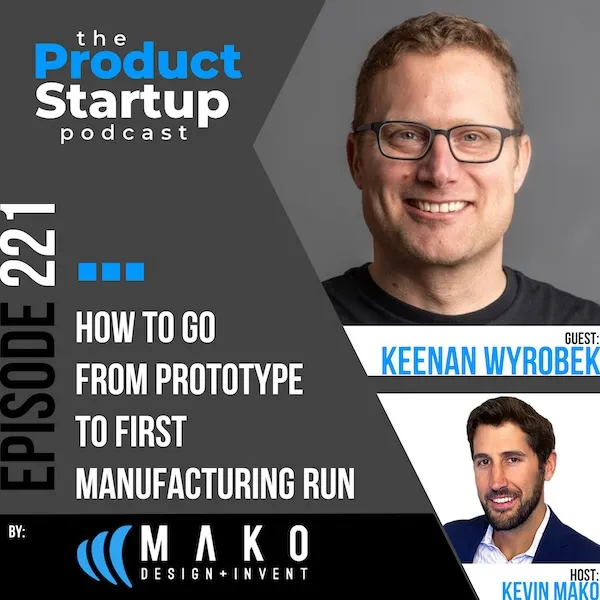
Guest: Keenan Wyrobek, Co-Founder & CTO of Zipline.
Host: Kevin Mako, founder of Product Startup and the leading expert in hardware startup consulting. A hardware entrepreneur since 1999, Kevin has advised more than 1,500 founders and built and scaled MAKO Invent through its acquisition by TriMech in 2024.
Episode Overview
Keenan Wyrobek explains what must be complete before design for manufacturing begins and why repeated prototyping protects the first production run. He covers manufacturing design packages, supplier collaboration, product reliability, customer feedback, and iteration between production runs.
What You’ll Learn in This Episode
- Ensure your product is well-designed and has been prototyped numerous times before going into the production stage.
- Design for manufacturing is all about hitting optimizations and maximizing manufacturability for each individual component.
- The final prototype/architectural design phase is what comes before and must be completed before commencing detailed manufacturing design.
- Don’t change aspects of the product design once you have begun DFM, the design is done at that point!
- Create at least more than 3 prototypes to make sure you have industriously iterated on everything that matters.
- You are not done prototyping until you are perfectly happy with your design, and it perfectly aligns with your vision for your product.
- Manufacturing design is the stage where you start working closely with your manufacturing vendors.
- Make sure you have a strong manufacturing design package to provide your vendors with that includes the CAD files, 2D line drawings, 3D renderings with product use callouts, and the final prototype itself.
- Product reliability is critical, so make sure you have a strong relationship with your manufacturing vendors!
- Reliability is never as easy as you think.
- Include the customer in the DFM process, as they will identify reliability issues you may have never identified.
- Iterative development should be conducted between manufacturing runs to perfect your product.
Episode transcript
This transcript is provided for accessibility and reference. Download the SRT transcript.
Read the full episode transcript
Kevin Mako: Hello, product innovators. Today, we learn how to go from final prototype to your first manufacturing run from the founder of what was a hardware startup but now has 1,100 staff.
Kevin Mako: This is the Product Startup Podcast, a show to learn from top leaders in hardware product development, prototyping, manufacturing, product selling, and everything in between.
Kevin Mako: Hosted by Kevin Mako, the leading expert on product development for hardware startups. Welcome back, everyone. I'm very excited to introduce Keenan Wyrobek. Keenan has been in the manufacturing industry for over 20 years and 10 years ago was the founder of Zipline, an autonomous drone delivery company that now has 1,100 employees and has raised hundreds of millions of dollars in funding for his hardware product vision. Today, Keenan will share valuable knowledge from inventors, startups and small manufacturers on what the design for manufacturing
Kevin Mako: Phase is, how to prepare your product development and prototyping for DFM, and how to ensure you transition from final prototype to first manufacturing run the right way for success.
Kevin Mako: Now, onto the episode. This show is produced by Mako Design, the original firm providing end-to-end consumer product development services tailored specifically to hardware startups, small manufacturers, and inventors. Take your product from idea to store shelves at MakoDesign.com.
Kevin Mako: Now, onto the episode. Hey, Keenan, welcome to the show.
Keenan Wyrobek: Hey, great to be here.
Kevin Mako: Well, we're excited today to talk to you about that step between you're finished kind of the design and engineering and prototyping phases, but now you're moving on to your first production run. There's lots of little things to consider, and it's an often overlooked little piece of the puzzle on your route to manufacturing and the glory of selling your first products to the market.
Kevin Mako: Before we jump into all that, I want to talk a bit about your history. Obviously with Zipline now, you guys are a well-known drone delivery brand. You have got these autonomous drones flying all over the world now.
Kevin Mako: I think you're crossing the 1 million deliveries mark. It's incredible what you've done and the amount of design, engineering, prototyping, and manufacturing efforts that go into that.
Kevin Mako: So before we get into all the details and best practices to new hardware startups about how they transitioned from prototyping into manufacturing, just give us a bit of backstory of how you became the success story that you are today.
Keenan Wyrobek: Yeah. So, I mean, I started, you know, well, 40 years ago, taking everything apart I could possibly get my hands on. I think like probably many of you all listening to this, I think a lot of us in hardware got started that way.
Keenan Wyrobek: You know, my career, the first sort of decade of my career was going back and forth between product design and robotics. And I think that led to Zipline, which we started 10 years ago now, which of course is bringing those two things together.
Keenan Wyrobek: My favorite definition of robotic technology is technology you don't notice because just in the background behind this magical delivery experience that enables health systems around the world, enables goods delivery around the world as well as food delivery.
Kevin Mako: Amazing. And that's a great story. And I think everybody listening also can appreciate the fact that we all want our packages delivered faster. So we love what you're working on, but it's also very complex technology and it takes a lot of work. It takes a lot of vision. And obviously as a leader, you've got to see this unfold from the ideation all the way through to now your millionth delivery. Let's talk a bit about that transition point from prototyping going into
Kevin Mako: Manufacturing. That's a critical point. And the more complicated your product, arguably the more complex that phase is going to be. So let's just talk broad strokes. First and foremost, what's the difference between ideation and prototyping versus design for manufacturing engineering to actually get to production? Yeah. So I always think about this working backwards.
Keenan Wyrobek: So that last step, design for production, that's where you're crafting each part to be manufacturable, right? You're really refining the details so that you're going to hit your. For us, our reliability matters a ton. There's not much margin in the system. So every piece, every part is optimized to the nth degree. So the step that comes before that, that we think of as basically what we call the architecture freeze. As in the design, it's done, right? I explain it a bunch of different ways. Like if you're standing 10 feet back,
Keenan Wyrobek: You don't notice the difference anymore, right, between that product when you finished that architecture iteration phase to then go into that detail design phase. And the magic of this is really about like, don't start detail design because you can't iterate more in detail design around the architecture. And if you try, you're going to throw away a ton of money. This is where are the successful companies that have really gotten this right. And we really try to learn from that. In that architecture phase, you should be doing gazillions of prototypes, right? Like if
Keenan Wyrobek: People are like, I did three prototype cycles. It's like, no, no. You just started, right. It's so cheap to prototype these days. You should be iterating a ton on everything that matters. It could be like mechanisms. It could be the physical integration. It could be every single user touch point used to be iterated on like crazy to the point when you're done, you're just like, this is it, this product. If I could just make a bunch of these, you know, I'd be happy, right? Because that's what you're about to do in detail design or design for production that comes next.
Kevin Mako: That's such useful advice, especially with the prototyping phase is that you want to make sure that that phase is done, done well, and the product is really what you envision for how you see it going to market and that product market fit is there. So of course, now I love how you've made the delineation going forward into the actual DFM. You are not making design changes at this point. You're not making product improvements at this point.you're not changing product market
Kevin Mako: Fit at this point. At this point, your job is to design a product to be reproduced in volume. And that means design for manufacturing, not changing the ideation in almost any way.
Kevin Mako: And that's a really important thing, I think, for a lot of hardware startups to double down on in their mind is the fact that too many people try and push forward changes or iterations or ideas into manufacturing itself. And of course, the further you push it forward, the exponentially more expensive those changes and those iterations become. So you want it, like you said, get it all sorted out in the prototyping phase so that you're absolutely ready with a final product to then go into that manufacturing phase. So describe that
Kevin Mako: Design for manufacturing phase, you know, what it is and what's important in that phase.
Keenan Wyrobek: Yeah. So the most important piece of this is you're going really deep with your vendor partners who are going to make your parts or your contract manufacturer may be assembling the whole thing for you. And the advice I got that I just live by now, I got this advice early in my career.
Keenan Wyrobek: And I just live by it at this point, which is if you don't know your vendors' kids' names, you don't know your vendor's well enough, you don't have a deep enough relationship with your vendors to succeed in this phase. Because this phase is challenging, right?
Keenan Wyrobek: When you're a startup, you have no credibility, right, like vendors are taking a flyer on you and there's gonna be challenges in this face, some that you're gonna provide.
Kevin Mako: Inevitably, there's going to be something that you got wrong,
Keenan Wyrobek: You gotta tweak a tool or whatever it is and you may need to ask your vendor to do that in a big hurry without even necessarily paying for it, right? You're going to ask favors of your vendor in many different ways. The vendor will have other surprises, right.
Keenan Wyrobek: They may get a contract with some other customer that's just big and lucrative and you need your vendor not to deprioritize you. To be clear, that's happened to me many times. And, you know, if you don't have that deep relationship with them, you're just not going to get through those challenges together.
Keenan Wyrobek: And knowing the names of the kids of your vendors is one metric. I think another way to just actualize this is just like, ifyou're not living with your vendors, you're probably doing it wrong.
Keenan Wyrobek: You know, I encourage folks to do their detail design at the vendor, like literally, like sit there and be like, hey, can I borrow a desk? And start working if you're designing something for injection molding, right? Just do your mold flow in the room with them. You're going to learn so much about how they think, what their values are, what their cost structures are, how their business really works. And you're going build that relationship you need with them to get through the bumps that are coming.
Kevin Mako: That's really powerful advice. One of the things about design for perspective, we have always recommend to our clients as you're transitioning into that production standpoint is go visit the factory. And you're taking it one step further, say not only visit the factory, but bring along your design engineers, your lead design engineers whoever, whether it's yourselves, whether somebody you contract to do or whether it was a staff member on your team, have them work side by side on those detailed manufacturing designs. That can get a bit
Kevin Mako: Expensive as a hardware startup. But of course, the more complex your product is probably the more important it is you to have at least elements of that of this co design process built in with your manufacturing engineers. If you look at it the other way as well, one of the big mistakes we see is that somebody takes, say, a final design, hands it to the factory engineers, and then hope it all goes well. But one of the other key things is don't leave your original designers in the dark on what
Kevin Mako: Your manufacturing designers and vice versa. Don't have your manufacturing designers in the dark on what your original prototype designers or concept designers were envisioning. Those two people need to work closely together. So if you're going into manufacturing, make sure the same designers and engineers that you are utilizing through, especially that late stage engineering and prototyping is working very closely with those production engineers because inevitably there is going to be miscommunication if you put up essentially a stone wall between those two groups.
Keenan Wyrobek: Exactly. And the vendors that I've had great success with, their engineers love it when you show up and work with them because so often they do get this stuff thrown over the wall that they then have to try to deliver on without the context of that collaboration.
Keenan Wyrobek: And so they they often struggle to be successful in that context but if you if you literally work together on it like they feel valued and they're going to have really valuable input uh that will will reduce costs improve reliability and make your product better because you know they know things about how to make those parts that you really benefit from
Kevin Mako: As a design engineer absolutely and there's so many tools now that allow that collaboration to take place if you don't have the luxury of being able to actually fly over and sit side by side we'll do the next best thing screen share you can collaborate on CAD design files you can collaborate part by part through a variety of different methods and techniques and pieces of software if you're well planned as well and you give them we call it a design manufacturing pack so you've got all of the things from your final prototype put in specification and this isn't just
Kevin Mako: The CAD file it's a CAD file 2d line drawings just in case they need it you've also got all of the 3d renderings with callouts for how the thing works I know they're producing parts but why not have your production engineers understand deeply how the actual product works, why those parts go together the way they do and what the end purpose of the actual
Keenan Wyrobek: Product is.
Kevin Mako: The more they understand it, the easier it will be for them to make small little micro decisions that you may not be thinking about or even your design team might not be thinking about that they need to in order to do the best manufacturing for your product.
Kevin Mako: And in addition to that, then I actually want to send them that final prototype and have that to be physically in their hands so that we can review it together collaboratively with the thing on their desk as they're doing those adjustments to the actual CAD file.
Kevin Mako: So if you give them this whole pack of all the necessary information that they may or may not need, but have it all in there being accessible, then that increases the ability for you to communicate even remotely on those small bits and pieces as you continue the development from there.
Kevin Mako: Exactly.
Keenan Wyrobek: And maybe I'm going to go back to something we touched on a little earlier in the conversation around basically the importance of not changing your design when you start this phase of detailed design or design for manufacturing. And if you start from the very beginning of that, at the very beginning of your architectural phase, now you have a good chance of getting that confidence that's required at the end of that prototyping phase to start detailed design between prototype and design for manufacturing.
Kevin Mako: Yeah, I think the big key is know that the more you push forward design changes, the more expensive it gets. And that becomes even more expensive as let's say you're in production, your customers get the product and there's some sort of issue that you could have addressed much earlier on in the process. I want to talk to you as well about any other kind of tips that you see in working with manufacturing or manufacturing engineers that have helped you, maybe not even just with
Kevin Mako: Your first production run, but as you've scaled with these producers as well. Oh, great question.
Keenan Wyrobek: Zipline, we have a challenge I wouldn't wish on my worst enemy, which is the complexity we have plus the ridiculously tight margins we have, right? So in a lot of safety-critical systems, you talk about safety margins in like x factors of five or 10, but with aircraft, usually your x factors, your margins on your loads and your designs are more like 1.5, which means you have to be really right, right?
Keenan Wyrobek: You have to do a lot of testing. And inevitably what that means is in that detail design phase, you're dialing in things about those parts way longer than your vendors would like you to be to actually achieve those margins, right.
Keenan Wyrobek: It's one thing to think you have them and then you build the parts, you test the parts and then you realize you don't have them and you got to go iterate. And this again comes back to that deep relationship with the vendor. You know, the vendors would call it like late stage resets that are killing, you know, driving them crazy.
Keenan Wyrobek: But if you have those relationships, you actually have a prayer of getting through that process successfully. And that's incredibly important. At the end of the day, even if you don't have the ridiculous sort of safety challenge that we have at Zipline, you're going to have reliability goals, right?
Keenan Wyrobek: And your product being reliable is going to be important to either the economics of your product or just your customers loving and raving about your product. And reliability is never as easy as you think, right? Especially if you're doing something new, your customers will find ways to break your product that you didn't imagine. And you're going to want to dial that stuff in. And again, that comes back to those deep relationships being in place that'll then enable you to work through those issues, even sometimes after you're in production.
Kevin Mako: That's great. Having those relationships is key. And then that allows you to iterate because in between production runs, you have that time where ideally you're not making a major change, but maybe it's a small or minor change. They're identified by any number one of the stakeholders, including possibly the great relationship that you have with your vendor.
Kevin Mako: Maybe it's them that realize between production runs, we can tweak this or change that or swap out this material. And we think this will perform better. But of course, you've got that opportunity to listen to your customers. Customers are now using the product, their idea, like you said, identifying things that you may never have been able to find out. Now, you know, so you work with the relationship that you have with your producer to seal up those things and go into your next production run. So you increase the reliability of the product and a whole number of other factors
Kevin Mako: As well. You know, before I let you go, just talk a bit more about Zipline and where people can go to find out more about this amazing new technology that may be getting them packages faster than ever before.
Keenan Wyrobek: Sure. So I'll give you the one minute version of sort of where we've been these last 10 years. So for eight years now, we've been operating a platform we call Platform One. Picture a large RC aircraft. And this is this is great for delivering from a metro area out to surrounding countryside. And it does so by flying like, you know, it looks like a little RC plane flies out, floats a package to the ground. And we've done, you know, we just crossed a million
Keenan Wyrobek: Deliveries doing this. Today, we fly the equivalent of four times the equator of the earth every single day with this platform making deliveries around the world. And later this year, we're launching a new platform we're incredibly excited about. That platform, as you can imagine, to deliver, it takes some room, you a couple parking spots worth of room to float a package to the ground. Picture a cake box with a paper parachute on it. Our new platform enables incredibly precise delivery with this thing we call a droid. And I'll just leave that as a little
Keenan Wyrobek: Bit of a teaser. You can find out more at our website at flyzipline.com about how this new platform delivers incredibly precisely in a way that really optimizes for safety and is so quiet you won't even notice it. Anyway, I'm incredibly excited about this being the way we get our packages in this incredibly magical way going forward. Keenan, that's great. And I'll put the links below.
Kevin Mako: So if anyone wants to click through, they can check out the website site and see what you guys are doing. Thanks again for all your words of wisdom on going from that final prototyping into your actual manufacturing phases for a first-time hardware startup. Keenan, thanks again, and we will talk to you soon. Yeah, great speaking with you, Kevin.
Kevin Mako: Thanks. Take care. Thanks for tuning in to this episode of the Product Startup Podcast. If you found some value in the show, please do us a huge favor and hit the like button and subscribe. If you have any questions, guest suggestions, or anything else, feel free to reach out to us anytime at our email, podcast@MakoDesign.com.
Kevin Mako: This show is hosted by Kevin Mako, North America's leading expert on product development for hardware startups. And the podcast is produced by Mako Design, the original firm providing end-to-end consumer product development services tailored specifically to hardware startups, small manufacturers, and inventors. Take your product from idea to store shelves
Kevin Mako: At MakoDesign.com that's M-A-K-O Design dot com. Thanks for joining and see you again soon
Manufacturing Readiness for Product Founders
Move From Prototype to Production With a Clearer Plan
Preparing for DFM or your first manufacturing run? Work directly with Kevin to pressure-test prototype readiness, product requirements, manufacturing documentation, supplier selection, costing, quality priorities, and the sequence from final prototype to production.
Kevin can help you spot strategic gaps early, prepare stronger questions for technical partners and vendors, and connect with appropriate specialists when there is a fit.
Request a Manufacturing Strategy Call
Tell Kevin what you are building, your current prototype stage, and the manufacturing decision in front of you.