
Listen Now
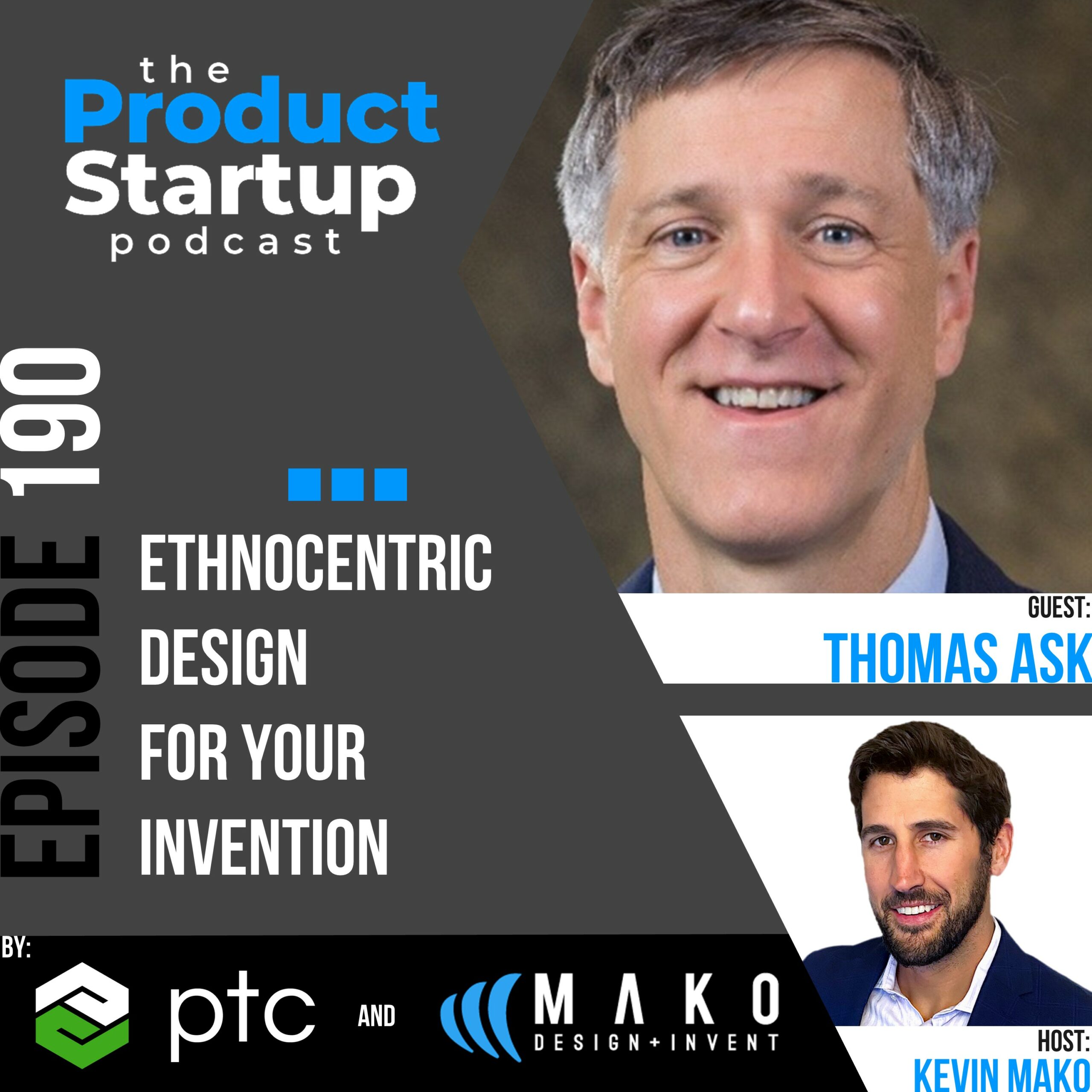
Guest: Thomas Ask, Professor of Industrial Design at Penn College, with more than three decades of hardware product development experience.
Host: Kevin Mako, founder of Product Startup and the leading expert in hardware startup consulting. A hardware entrepreneur since 1999, Kevin has advised more than 1,500 founders and built and scaled MAKO Invent through its acquisition by TriMech in 2024.
Episode Overview
Thomas Ask explains why inventing begins with understanding the person a product is for. He covers customer interviews, empathy, observation, cultural consensus research, evidence-led ideation, and the feedback needed to remove founder ego from important design decisions.
What You’ll Learn in This Episode
- What is ethnocentric design and how can it support invention realization?
- Inventing something is about inventing something for someone.
- A lot of design and invention is led by ego, but you should take out the ego to ensure your product resonates with your target audience.
- Use data to identify common problems.
- Develop empathy for the user and figure out what is going on in their life.
- Interview your customer or prospective customer types.
- What are formal ethnographic techniques?
- The typical process should be understanding the user, then ideation, and then feedback collection.
- Ideation is where you create ideas to match and infuse them into what you have learned from your customers.
- Cultural consensus questionnaires are a great tool.
- First, ensure your end customers are the correct people.
- Many people don’t want radical change from traditional methods, even if it is better.
- If it doesn’t work well and it is not intuitive, people will not use it.
- A dynamic feedback loop ensures success.
Episode transcript
This transcript is provided for accessibility and reference. Download the SRT transcript.
Read the full episode transcript
Kevin Mako: Hello, product innovators. Today we learn from a PhD in industrial design on the importance and process for designing your invention to meet customer needs.
Kevin Mako: Welcome back, everyone. Today, I'm very excited to introduce Thomas Ask to the show. Thomas is a professor of industrial design at Penn College, sister school to Penn State.
Kevin Mako: He's been in the hardware product development world for over 30 years, has also helped build two hardware startups and has achieved his PhD in industrial design.
Kevin Mako: Today, Thomas is going to share some valuable knowledge for inventors, startups, and small manufacturers,
Kevin Mako: on what ethnocentric design is, why it is valuable for a hardware startup, and the process to ensure you do a great job at getting inside the mind of your customers so that you can
Kevin Mako: best achieve both design and sales of your invention product. Now, on to the episode.
Kevin Mako: Hi, Thomas. Welcome to the show. Hi, Kevin. Good to be with you. We're excited to talk to you today about designing for others. So how do you actually invent
Kevin Mako: something with the intent of selling to your actual end buyers? There's quite a connection between the idea that you have yourself and what the customers actually want to buy.
Kevin Mako: So how do you put yourselves into their shoes? Now, before we get into all of that, just give us a bit of a backstory of how you got
Thomas Ask: to be the success story that you are today. Well, Kevin, I've been involved with a couple startups in the past, and I studied mechanical
Thomas Ask: engineering at the University of Illinois and got my D.E. license some years later and went on for my doctorate. And I've always had a passion for inventing and designing things.
Thomas Ask: It's really where my heart is. The days have gone by, I've gotten more and more into teaching. So now I serve as a professor of industrial. industrial design here at Penn College.
Thomas Ask: I do consulting, do a lot of design work, and love it just as much
Kevin Mako: now as I did 30 years ago. Amazing. That's a great story. And you've got your doctorate in industrial
Thomas Ask: design. That's amazing as well.
Kevin Mako: Well, in the academic world, there's motivators for that.
Kevin Mako: Great. Well, let's talk a bit about this subject and around ethnocentric design. Give us a bit
Thomas Ask: of a definition of what this is. Well, this is looking at design as deriving from other people's
Thomas Ask: interest. So most of us have a passion for designing things that we want. We'd like to
Thomas Ask: to invent things. We like to create something from nothing to work in the void and love the idea of what lies over the horizon.
Thomas Ask: But there's another element to that, namely, how do you design for other people who think a lot differently than you do? And how do you extract that kind of
Thomas Ask: information? What do you do with it? How do you sort of fit your own creative insights into other people's interests?
Thomas Ask: And this applies most specifically to people in different cultures or people who are demographically quite different than you. So if you're designing for an 85-year-old
Thomas Ask: woman, you've got to think like an 85-year-old woman. If you're designing for a four-year-old boy, you've got to think like a four-year-old boy.
Thomas Ask: And that's sort of this ethnographically based
Kevin Mako: design pursuit that I research here and that we actively do in our design projects. You said something interesting to me before the show. You said there's a difference between
Kevin Mako: inventing something and inventing something for somebody.
Thomas Ask: Talk a bit about that and how that fits into all this. Yeah, exactly. It probably deals with a deeper issue with pride and ego. So often,
Thomas Ask: and creating a business, and I've been through a couple startups, and when you have your name on a business, there's a lot on the line. And you want to express yourself.
Thomas Ask: It's almost an artistic thing. You want to say, hey, here's my idea. You guys have to love it. Well, when you're designing for someone else, you're repressing that.
Thomas Ask: You're subordinating those concerns for the concerns of others. And there's a scientific way to do that. So if you're designing for someone who
Thomas Ask: loves something that you hate, loves a color that you hate, whatever those issues are, you have to say, okay, this is what they want.
Thomas Ask: And the way you do it technically, and this sounds really anti-creative, anti-inventive, is you look at data, you look at information. So if I ask you,
Thomas Ask: Kevin, what's your favorite vacation activity? And it turns out to be curling the thing with the ice or some kind of activity that have zero interest.
Thomas Ask: Well, I have to say, all right, I've got to get into your mind and figure out why do you like this activity? What motivates you? What problems do you see
Thomas Ask: in it? What problems can I solve? And that's ethnography. It's studying other people. And we're really good at it. We know how to do this stuff from childhood.
Thomas Ask: We layer a couple of techniques in with that and you get this really powerful tool saying this person over there, this is what they want.
Thomas Ask: These are problems that they face that no one's ever addressed. These are issues that rise up in their life that they don't know how to solve. And I can deal with this.
Kevin Mako: I can solve their problem. And there's a lot of that out there. That's very powerful, especially when you're looking at your core innovation, because most of the time, there's
Kevin Mako: many different possible use case scenarios. There's many avatars for potential and customers. So if you can look at it,
Kevin Mako: the different variety of options, you can start to explore and put yourself in the mind of
Kevin Mako: potentially your best and highest use buyer, somebody who's really going to be attracted to that core innovation that you have.
Kevin Mako: So even before you're developing the product, if you can figure out who that demographic is, then allow yourself to put yourself in the shoes of that
Kevin Mako: person to try and build a great product around that. You talk a lot about the process around this type of design.
Kevin Mako: Walk us through that process, especially as an inventor, whether technical or non-technical. What are you trying to think through as you're applying your invention idea to that
Thomas Ask: end user and thinking about them first? Yeah, that's a very broad question. And, you know,
Thomas Ask: it's interesting. For people that are listening now, they're trying to do this professionally. Like, this isn't a hobby.
Thomas Ask: You're trying to make something that has value in the market. And that whole notion of commerce is really attractive. So it's very different than the fine arts.
Thomas Ask: We don't just make beautiful things. We make things that work and that help people. So you have some cases, like one example. That was a big question.
Thomas Ask: But just one example that might illustrate this is prone's disease. I've dealt with some different medical issues where people have issues that I don't have
Thomas Ask: and for me to design something for them, I really have to understand what works for them, what they're
Thomas Ask: dealing with. And so the very first step to your question is developing a level of empathy for the
Thomas Ask: user, the person you're designing for in this case, in the case of an individual or a group of individuals, what is going on in their life? What is their concern?
Thomas Ask: And you do this with sort of formal ethnographic technique. So again, to your question, it often starts with identifying a problem or
Thomas Ask: a population that has a distinctive issue and then asking them questions. So it's interviewing them. It's like we're doing here. It's doing questionnaires. It's doing observations.
Thomas Ask: So as Margaret Mead famously said, what people say and what people do are very different. So I can say that I never eat junk food,
Thomas Ask: but when you look into my garbage can, you'll see lots of junk food wrappers in there. So the data says, no, you know what?
Thomas Ask: At 10 o'clock at night, he's going out and having a candy bar. He doesn't admit to it, but that's what's happening. So it's getting this raw data because especially in some arenas,
Thomas Ask: people don't want to talk about things. They have certain problems that they just don't want to talk about
Thomas Ask: or things that they've accommodated that they don't necessarily need to accommodate. Humans are really good at solving our own problems.
Thomas Ask: But if an inventor can get in there and say, oh, wait a second, this works really well. Like I was just talking to a lady today. She said, the thing I hate the most
Thomas Ask: about handbags is when I have to slide past a zipper. She just doesn't like the tactile feel and the way of her rings get caught. I don't know these things.
Thomas Ask: So the only way I can find these things is to ask those kinds of questions. So that's the first step. And then the second step,
Thomas Ask: I mean, in a simple way, is ideation, you know, idea generation. That's the inventing part.
Thomas Ask: It's the part we all love, creating all these really cool ideas and trying to infuse those with the things you've learned from ethnographic study, from asking people questions
Thomas Ask: and watching how they actually behave. And then you get feedback on that. So you show people a bunch of things.
Thomas Ask: In fact, I've taken kind of embarrassing a way, I've taken foam models, you know, kind of simple models in a five-gallon bucket and poured it on the conference room table
Thomas Ask: at a corporate meeting. And these are kind of simple models. But people love that stuff because they pick them up and they experiment with them
Thomas Ask: And it's all very real because so often we sit there and jab around and on or we even make sketches, but people really want to touch and feel things.
Kevin Mako: That's part of that ideation and feedback too. That's great. That's great three-step process as well. And that is kind of the standard process that
Kevin Mako: if executed well, can almost ensure and derisks the success of your product because you're utilizing
Kevin Mako: your customer feedback to ensure that you're matching what they actually want. I want to dig into that a little bit deeper.
Kevin Mako: When you're in that questioning phase and when you're working with a prospective customer
Kevin Mako: or prospective customer type, somebody who may be either a wholesale buyer or actually an end customer,
Kevin Mako: what are the types of questions that you're trying to get out of these individuals? Are there any other kind of processes or frameworks that you like to use to build out that Q
Kevin Mako: &A model to get
Thomas Ask: the best information back to feed into your design or invention? That's actually a really big
Thomas Ask: question. Formally, it starts with something called a cultural consensus questionnaire,
Thomas Ask: namely, is a person I'm talking to really have a valid position in this arena? So if you're talking
Thomas Ask: about, say, diabetes and you talk to somebody without diabetes, well, that's in useless data.
Thomas Ask: So you want to know who you're talking to and make sure they're actually the stakeholders.
Thomas Ask: And then moving on from that, the way I do it is normally some kind of questionnaire that's sort of structured. I ask certain questions. And yeah, what are those questions?
Thomas Ask: Well, it varies depending on the nature of the beast. So it's hard to get sort of the formulaic answer to that. It is very much talk about some design.
Thomas Ask: What do you like about what you're using now? What don't you like? And then very quickly layering that with observing how they're behaving. Because you can see little
Thomas Ask: ticks where people are making a movement or doing something. And here I'm talking about modifying something instead of the brand new design, which is what many of us love.
Thomas Ask: But you see them doing things. You go, well, you know, if we changed how this was set up, they would do it a better way. So it's questioning and observation.
Thomas Ask: And actually, as a follow-up, the feedback loop is important. One of the really surprising examples I have in my work was designing this fishing boat. And I was
Thomas Ask: dealing with people, well, Malaysians. And they looked at my drawings. And I didn't learn until I was
Thomas Ask: into this process that some of the people thought what I was proposing was to make a boat out of metal instead of wood.
Thomas Ask: So they didn't like the design because they thought it was metal, even though it wasn't metal, because metal sinks.
Thomas Ask: And in some countries, they don't have a coast guard. If you have a metal boat and it breaks apart, which they do, then you have no life raft. I thought that was a
Thomas Ask: really interesting example, because the way I presented it as a drawing, they inferred things that weren't in there. So that's an example, sort of cultural identification.
Thomas Ask: We take things for granted, like, you know, we've got life reservers or we've got some inflatable stuff that will save us,
Kevin Mako: but that's not true in all cultures. Yeah, it's pretty amazing because they actually dislike the
Kevin Mako: design of your product because they thought it was out of metal, not because they actually dislike the design. Exactly. So it's interesting.
Kevin Mako: I guess as you drill down into the reason why they disliked it, you could start to discover maybe the underlying issues that were essentially
Kevin Mako: clouding the overall genius of the actual design that you're presenting. Yeah, that's very well said, Kevin. I like those words.
Thomas Ask: So how did it end up working out after that? that? Well, I used a different way of presenting things. I didn't use drawings. They used models, actually, to communicate.
Thomas Ask: So I was dealing with translators and written forms. And this went on for many months. I ended up using models, though. I mean, the continuation of that story is there are many
Thomas Ask: people that don't want radical changes from tradition. And in the case of fishing boat design,
Thomas Ask: that was part of it as well, that you'll be super careful when you design something that people depend upon for their lives. That was how that ended up.
Kevin Mako: It was kind of in the middle of the road, not too radical. I remember Elon Musk mentioning that he couldn't make his car design too crazy
Kevin Mako: or too futuristic because market would just walk away. So we had to play this delicate balance between the features he wanted and the modern technologies and
Kevin Mako: tools he wanted and traditional car design, how to keep it kind of hand in hand. Although I have a feeling the regulator has had a lot to do with that conversation.
Kevin Mako: But that's the reality. If you move too fast past the goalpost, even if it's better, more beneficial, you have to bring in that human factor and that human value.
Kevin Mako: And that's where the feedback loop can be so powerful, really understanding that the innovation that you are creating is better, but also realistic.
Kevin Mako: Would they buy this particular thing? And that's the key question. You mentioned it at the beginning of this conversation. You mentioned the concept of commercialization.
Kevin Mako: That really is what almost all inventors that are serious about their product and trying to commercialize it is trying to do.
Kevin Mako: You're trying to change the world by getting your actual product manufactured to market.
Kevin Mako: So you've got to factor in a number of different possible layers, not just how great your invention is, but all these different human factors that.
Kevin Mako: that weigh into decision making if they're going to purchase it or not at the end of the day,
Thomas Ask: which really is what it's all about when you get that product to market. Yeah, absolutely. We call these kind of mechanistic elements of things that make things work.
Thomas Ask: And if it doesn't work well and if it's not intuitive, people won't buy it and nobody reads user manuals. And we're really smart.
Thomas Ask: So we want to be able to look at something and figure it out. We don't want to be educated and how to use it necessarily.
Thomas Ask: So that sort of intuitive grasp of a design is really important. And invention is tough in a general way because especially at the consumer level, it's such a saturated arena.
Thomas Ask: I think as inventing can grow in certain arenas, a medical is a big one, but other areas, too, areas that are resistant to complex solutions. So entryways for an inventor, I think,
Thomas Ask: can be dealing with complex designs because it scares the amateurs. And also areas that aren't looked at very much.
Thomas Ask: And even these sort of outlined demographics, as I mentioned, old people, or pets, I have people that got involved with the pet industry in ways I couldn't imagine. And pet
Thomas Ask: training, there's all these outlayers. If you try to design, and I have people in my world that design board games.
Thomas Ask: And that's really good because that's a moving target. They have a certain life and then they move on.
Kevin Mako: That's more designed than invention, but that's really saturated. Well, you've mentioned a lot of good things here, a lot of different actual design tips and tactics.
Kevin Mako: Is there anything else that can help emerging startups in developing this process and thinking about
Thomas Ask: ethnocentric design that we've left out? In response to that, the key is to truly empathize
Thomas Ask: with the user, the people you're trying to address and not in a cursory way. In other words,
Thomas Ask: it's what I've seen a lot of, it's very easy for people to say people at a certain age think this way or people from this country think this way. That's often not correct.
Thomas Ask: And there's a lot of crossover between populations. So for ethnocentric design that's rooted in ethnography, you're trying to
Thomas Ask: really focus on a specific group and meet their needs really well and not get confused by kind of all the noise around you.
Thomas Ask: Like, because often we go into inventing thinking this is the answer. I have the answer here it is. And it's only like you mentioned before, the feedback loop and a real dynamic
Thomas Ask: feedback loop and one that truly is a feedback loop, not just here it is. What do you think? Thank you by. But let's talk about this.
Thomas Ask: What do you think? Let's see your ideas. Let's sketch them out. Let's carve them in clay, which is something I like to do. Let's kind of play this out. And people really love that.
Kevin Mako: And at the end of the day, you end up with a better invention. I love that you mentioned kind of a couple times some of the fringe or niche industries can be powerful. And that is
Kevin Mako: really a good advice for hardware startups because it's tough to compete with the mass market in the beginning with the first version of your product.
Kevin Mako: Now, there's no issue in trying to conquer the world and absolutely get there. But keep in mind, you've got to start somewhere. So you've come up with your core innovation.
Kevin Mako: And if you don't feature creep like crazy and really try and address one specific market and do a really good job at it. And of course, you know you're doing a good
Kevin Mako: job if you've followed these principles of understanding your customer very deeply, a specific subgroup of your customer even better, then you can target them with a very well
Kevin Mako: -made, high-quality product that specifically targets that audience and really only that audience, at least in the
Kevin Mako: beginning. As you start to grow as a brand, you can continue to elicit feedback from more
Kevin Mako: potential customer groups and expand your product offering into more and more basically market share over time. But it's difficult to do in the beginning.
Kevin Mako: So it should be comfortable for hardware startups that you can spend less, be more targeted, ensure that the money that you are spending
Kevin Mako: is building a quality product that's easy to manufacture that is reliable in production and of course is simple to use and reliable for the actual end user. And through that,
Kevin Mako: process, you're going to have an easier time actually capturing that market because it's easier to market and target to as well, because it's more specific.
Kevin Mako: It's more niche. It's more targeted. So if you follow that approach, definitely continue that feedback loop to expand the brand to eventually capture the mass market.
Thomas Ask: But you've got to think as a hardware startup, where do you start? Yeah, absolutely. That's the case. There's so many examples of that. We've dealt with like construction.
Thomas Ask: If you look at construction workers and all the strange problems they deal with and how ingenious they are at solving them.
Thomas Ask: If you can get into that space and present them some stuff, they love it. they want quality too. So like I said, medical construction. If you can say to a brick layer,
Thomas Ask: hey, this will trace mountain stone on your brick. It will scribe it in. And here's a whole system to chisel things in just a precise way or drywall or whatever.
Thomas Ask: There's just really wide-ranging needs that don't get addressed. You think of the people that don't really have a voice. And
Thomas Ask: I'm not talking about that in any kind of political way. But children, basically. If you're six, you don't have any say in what kind of toys that are presented to you.
Thomas Ask: Someone's giving them to you and who are those stakeholders. Well, it's probably mom and dad, the grandparents. They're the ones
Thomas Ask: often buying the toy, so you've got to market to them. So that's why all these toys are educational when a six-year-old just wants to have fun.
Thomas Ask: They don't want to be educated all the time. So, you know, you have this kind of dynamic as well. And then you have senior citizens that have a hard
Thomas Ask: time opening the refrigerator door or, you know, or grabbing a fork and they don't want to lose their independence or the sense of the values that they had.
Thomas Ask: If something is easy for a specific demographic to use, they have arthritis and they need some special forks and knives and things, you can still make them beautiful.
Thomas Ask: I had a project once. This was interesting. I was kind of the unique one. It was for quadriplegics who were incontinent. Well, the design I was replacing had no
Thomas Ask: consideration with human dignity, I'll say. Just because people are dealing with an issue doesn't mean they don't want to fit in with a general population.
Thomas Ask: And how do you know that stuff? Well, that's beyond this sort of just making it work, this kind of mechanistic stuff. This goes into the whole arena of
Thomas Ask: people's pride and their dignity and their values and how they want to surround themselves with physical things that reflect themselves that they can take pride in.
Thomas Ask: That's an outer layer. Because usually, at least for me, when I think of inventing something, it's solving a problem. And the more complicated, the better.
Thomas Ask: And if I solve a problem, I'm there, well, you're not all the way there. You know, you've got to layer on these other issues that is where this sort of ethnocentric, where you say,
Thomas Ask: you know what, that color is an unlucky color in that culture. That's the common one. You know, you're not going to paint it white or that number.
Thomas Ask: You know, some areas, you're paying extra
Kevin Mako: money for certain numbers to be on your cell phone. And I think that's really fascinating.
Kevin Mako: Well, much appreciated for you joining us on the podcast today and bringing up this subject, ethnocentric design. It's a very interesting topic.
Kevin Mako: And really elements of this applies to any new innovation, any new invention. How much or how little obviously differs by the type of product. But it's
Kevin Mako: something everybody with all their products, anybody can think about and apply to the design of their
Kevin Mako: product or even to the ideation and feedback of their products, no matter what you're developing
Thomas Ask: for any market out there.
Kevin Mako: So thanks again. Appreciate you being on the show today. Thank you, Kevin. It was a
Narrator: pleasure talking to you. Thanks, Tom, take care.
Narrator: Thanks for tuning in to this episode of the product startup podcast. If you found some value in the show, please do us a huge favor and leave us a quick five-star review.
Narrator: If you have any questions, guest suggestions, or anything else, feel free to reach out to us any time at our email, podcast and MakoDesign.com. That's podcast at MakoDesign.com.
Narrator: This show is hosted by Kevin Mako, North America's leading expert on product development for physical product startups.
Narrator: Huge thanks to our sponsors, PTC, and their two best-in-class 3-D-Cat product development software solutions Onshape and Creo, Mako, design, and invent. The original
Narrator: firm providing world-class consumer product development services tailored specifically to startups, small manufacturers, and inventors. Thanks for joining and see you next time.
Customer Insight Strategy for Product Founders
Design Around the Customer, Not the Assumption
Work directly with Kevin Mako to define who the product is for, what must be learned, which assumptions are riskiest, and how customer insight should influence features, form, positioning, pricing, and validation.
Kevin can help you structure practical research and turn what you learn into a clearer brief for design, engineering, prototyping, marketing, and launch partners.
Request a Customer Insight Call
Tell Kevin who you believe the customer is, what you have learned so far, and the assumption you most need to test.