
Listen Now
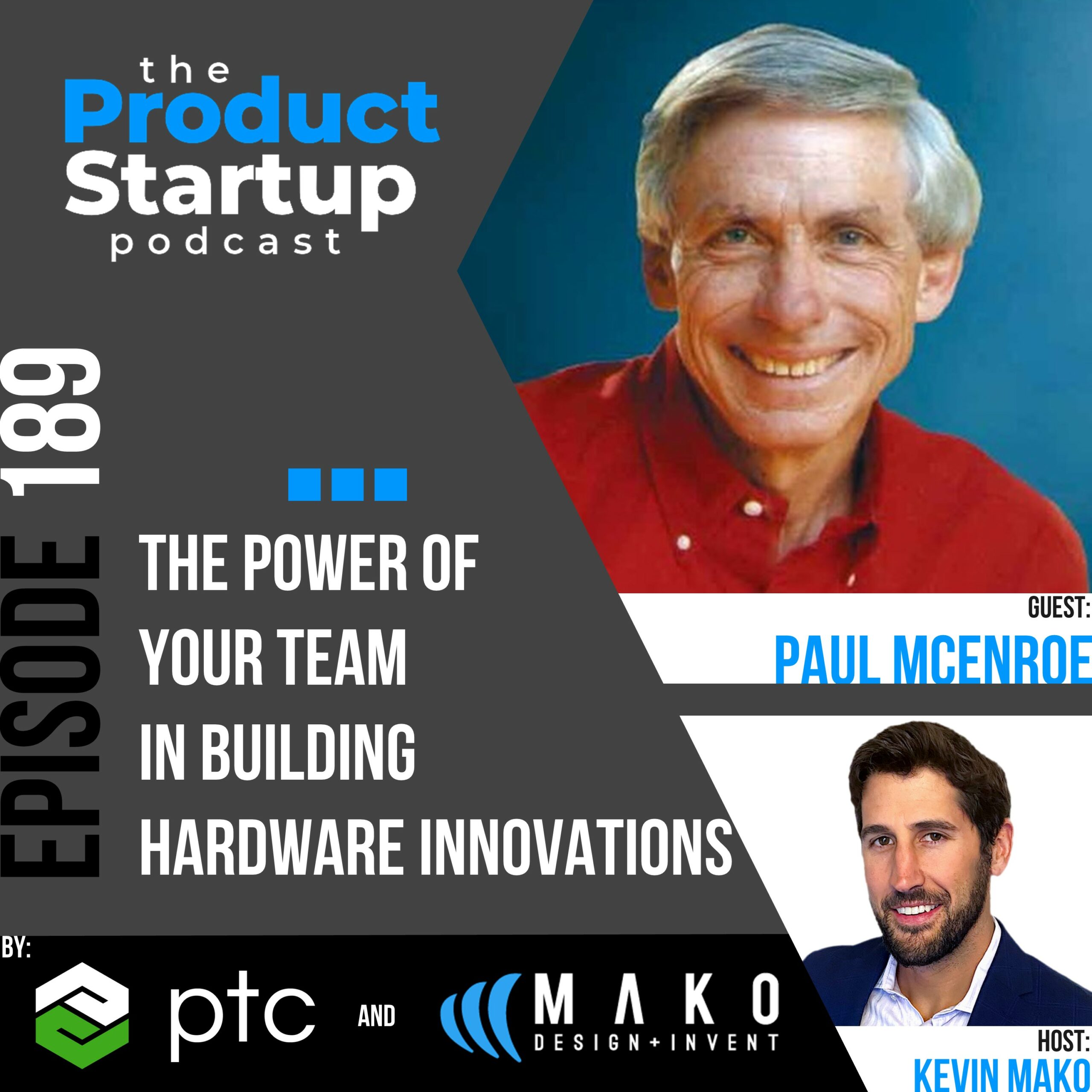
Guest: Paul McEnroe, the IBM leader behind the development of UPC barcodes and a veteran hardware engineering executive.
Host: Kevin Mako, founder of Product Startup and the leading expert in hardware startup consulting. A hardware entrepreneur since 1999, Kevin has advised more than 1,500 founders and built and scaled MAKO Invent through its acquisition by TriMech in 2024.
Episode Overview
Paul McEnroe draws on the creation of the UPC barcode and decades of hardware leadership to explain how innovation teams succeed. He discusses complementary expertise, a clear whole-company goal, open communication, stakeholder alignment, and the patience required to move a major idea into the market.
What You’ll Learn in This Episode
- When you see someone who has a huge part of the market, and they aren’t doing it well, you know there is lots of opportunity for new innovation.
- Innovation and execution does not happen overnight, it can take years to get it built, then to market, then to scale.
- The power of team in building a new hardware product is exceptional.
- Ensure you have a great technical team in building a hardware product, especially as a hardware.
- Have experience in fields that you do not have yourself.
- What do you want to do with your product, and how does that bring about a team?
- Each team member can not be focusing just on themselves, they need to recognize the power of the whole.
- What do you want others to do?
- Communicate openly in both directions.
- Individual Skills, Whole goal, and communication.
- You have your people, the designers and engineers in the shop,
- Explain it in simple terms to people who have the money or are buying the product.
- To improve your business communication among your team, learn some of the skills of a college debate team.
- Put your mind in the place of the person you are communicating with, not just your own perspective.
- Ensure that everyone on your team is in full understanding.
- Help out the quieter people in the room, as their insight is potentially just as important.
- Make yourself, as the leader, as available as can be.
- If someone comes up with an issue, do not let it bubble up, especially interpersonal issues.
Episode transcript
This transcript is provided for accessibility and reference. Download the SRT transcript.
Read the full episode transcript
Kevin Mako: Hello, product innovators. Today we learn from an inventor of one of the world's most widely used products
Kevin Mako: on how to build a great team to ensure the success of your hardware product development process.
Narrator: You're listening to the Product Startup podcast, a show to learn from top leaders in product development, prototyping, manufacturing, product selling, and everything in between.
Narrator: Hosted by Kevin Mako, the leading expert on product development for physical product startups, sponsored by PTC's two best-in-class 3D CAD product development software solutions,
Narrator: Onshape, and Creo, and produced by Mako Design + Invent, the original firm, providing world-class consumer product development services tailored specifically to startups,
Narrator: small manufacturers, and inventors.
Kevin Mako: Welcome back, everyone. Today, I'm very excited to introduce Paul McKenro to the show. Paul is the creator, developer, and leader behind UPC barcodes.
Kevin Mako: The work he did is still the standard over 50 years later on almost all products worldwide.
Kevin Mako: Since then, he's been the head of engineering and eventually president for hardware companies and sits on a number of boards and educational institutions.
Kevin Mako: Today, Paul is going to share some valuable knowledge for inventors, startups, and small manufacturers on the type of team you need to build for your hardware product,
Kevin Mako: how to manage that team and how to ensure smooth communication so that your team can make sure your new hardware product is a big success. Now on the episode.
Kevin Mako: Hi, Paul, welcome to the show. Thank you. We're very excited to have you on the show today to talk about teamwork, the importance and team.
Kevin Mako: You're one of the pioneers of a great technology that's still widely used by the entire world today. Every single person out there has used a UPC code.
Kevin Mako: And you are the pioneer of that UPC code back in your IBM days many years ago, which has been the standard basis since 1973.
Kevin Mako: So before we get into the importance of teamwork for a hardware startup, I know you've been involved in lots
Kevin Mako: of things as chief engineer, as well as working up to president of hardware companies and sitting on a variety of boards and universities and you name it, but are now retired as a
Kevin Mako: cowboy on the ranch. So give us the backstory.
Paul McEnroe: How did you get to the success story that you are today? I was working at IBM and I had been there for nine years and I worked in a lot of different.
Paul McEnroe: technologies, scanners, and other things related to the connection of the human being to the computer. It's mostly that kind of thing.
Paul McEnroe: Printers, displays, scanners, all of that kind of thing. And all hardware, by the way.
Paul McEnroe: And so then one day, nine years later, an executive of IBM guy who later became the president of IBM, came into my office and said, Paul, we want you to act like a
Paul McEnroe: startup guy and start us up in a new business area, ancillary to computers, not specifically
Paul McEnroe: computers. And the reason for that was the CEO of IBM at the time was worried there wasn't enough growth in computers itself.
Paul McEnroe: And he wanted to get something adjacent to computers to broaden the scope. He tried to buy companies at Silicon Valley and that failed because they found everybody would
Paul McEnroe: quit the next day because they didn't want the white shirts and the blue suits and all that kind of stuff, the culture of IBM. So I got to start that.
Paul McEnroe: I proposed going into point of sale because I could see they needed item identification. There was one competitor that, that own 95% of the market.
Paul McEnroe: And when you see somebody that owns a lot, they've got an obsolete product. And by the way, their product was almost unchanged in 100 years.
Paul McEnroe: It was NCR National Cash Register, and they had these big old iron cash registers. I thought, gee, we can do a lot better.
Paul McEnroe: We can use modern technology to build a PC-like thing. This was a decade before the PC, but we could do something like that.
Paul McEnroe: And we can build a scanner because that's what I've been doing for 10 years before, almost. So they gave me to go ahead. I proposed an amount of money.
Paul McEnroe: Actually, it was just 300,000 the first year, a million dollars to second year, three million dollars to the third year. They gave me the money and said, okay, you get the start.
Paul McEnroe: We'll paint a fence around you so you can do like a startup inside IBM. So I went about finding a team of people to help me with that.
Paul McEnroe: They wanted me to go to North Carolina to do it from California. I did that. I found a team of people. Interestingly enough, that people were considered kind of
Paul McEnroe: hard to manage because they were very senior people. They made good salaries. They weren't the managerial type.
Paul McEnroe: They were more individual contributor type person, but there were several of them and they were bright. And I picked a group of them, six to be total.
Paul McEnroe: Two of them were communications engineers. A third person was very good at printing and had also done a lot of bit of work in
Paul McEnroe: coding for telephone signals going across signal lines. So he knew about error correction, error detection and that kind of thing.
Paul McEnroe: Then a couple of others have more general experience with manufacturing and engineering management. So that was the team that we put together. It worked out
Paul McEnroe: very well. I think the fact that we got the right team and we got started at the right time and technologies that we needed were becoming available, such as
Paul McEnroe: the laser, low power laser for the light source, all that brought it together and enabled us to put together not just
Paul McEnroe: a barcode, but a system solution of everything from scanners to magnetics to optical sources, many of which used new technologies.
Paul McEnroe: That was kind of how we got started and went down the path. Then it wasn't something overnight. It took us. That was 1969. Our code was selected by
Paul McEnroe: the selection committee from a group of seven finalists, which came from 14 total selections. That happened in 73.
Paul McEnroe: So it took us four years to get it selected and then another year to get it to the market. And then another five years before it reached any volume. So it took
Kevin Mako: It took a decade before it really hit. Wow, that's amazing. And obviously, it hit big. And now it is the standard for barcodes, which is incredible.
Kevin Mako: So let's dive deeper into the actual team selection and the importance of it. You've written a book and many other things in terms of teamwork and the importance of a team.
Kevin Mako: So I want to break down that process. And you can reference a story from IBM or just general information as a whole.
Kevin Mako: But why is it so important to create a great team and how do you put together a great team? And then how do you work with that team?
Paul McEnroe: That's what I want to break down on today's podcast. Yeah. Well, developing something in the way of a new hardware device or something like that, you obviously
Paul McEnroe: need somebody on the team who either is an expert in technology or knows how to access expertise in
Paul McEnroe: that technology because you've got to be aware of what technologies exist that could best produce the product for you.
Paul McEnroe: If you don't, somebody else will come up with that and they'll have a better product that you do. So I was fortunate that I had the opportunity to pick people who had already been
Paul McEnroe: successful to some degree. I was in my early 30s at the time and they were in their 40s and mid 40s, several of them.
Paul McEnroe: They had experience in some of the fields that I did not have experience in and that was very helpful. And then you've got to get them working together. You've got to get them
Paul McEnroe: to realize it isn't about the individual thing that each one is going to do, but it's going to be the whole product that several of you are going to be able to pull together.
Paul McEnroe: And then you have to be willing to not try to do everything yourself. If some things on the periphery, you have to say, okay, we're going to go contract that out.
Paul McEnroe: We're going to go get somebody else to do that. In our case, by the time we finished all those years later, I had development programs going in something like
Paul McEnroe: six or eight different laboratories in four or five countries in three continents. So, I mean, it turned out to be a broad input.
Paul McEnroe: You have to keep everybody aware of what the end goal is. If you have people who are very quiet, which you often do, because sometimes the real inventive types are
Paul McEnroe: very quiet and they don't want to talk. You've got to talk for them. You've got to sit down and go over with them what they're thinking is and how and then get the whole group
Paul McEnroe: involved in that. That's very, very critical. If you have a thing such as we had, you're scanning bars and you
Paul McEnroe: got to come up with how the bars are and how you lay them down and how you get them to be smaller and all of that. But that's just one part of it.
Paul McEnroe: And you have yourself and a couple of other people myself and two other guys that mostly worked on that. After you read the thing, how do you send it to the back room?
Paul McEnroe: How do you look up the price? How do you do automatic reordering? You need computer experts. You need communications experts. And then the recording capability wasn't sufficiently
Paul McEnroe: good. So then you need a recording expert. Well, we had most of those, but some we had to go for the recording. I'm familiar with doing that in a project earlier.
Paul McEnroe: And I went back to the people that I had known and called them up and will you help us with this? Yes. And so we farmed that out. I was familiar with the technology.
Paul McEnroe: That's very important. You have to know what you can do, but I didn't have the time to go do it. And so we got other people to help us with that.
Paul McEnroe: So communication, as you can see, you're talking to your own people. You got your own people talking to their peers in your own shop. And then you've got to
Paul McEnroe: talk to the rest of the world. And of course, not least of all, you've got to be able to explain it in simple terms to people that have the money.
Paul McEnroe: In this case, it was IBM executives. And they're mostly
Kevin Mako: from sales and finance. They don't know anything about engineering. There's a lot of amazing things that you brought up there.
Kevin Mako: And I like that you've packaged into essentially three key things. Individual skills, of course, that's a given. You need to have the technological abilities with your
Kevin Mako: team to execute on the innovation that you're bringing to market. But when you have that, you really need
Kevin Mako: to centralize your team around that common goal, make sure they aren't just siloed in their
Kevin Mako: individual roles that they're working well together to achieve the end goal output, which brings
Kevin Mako: it all together in communication, which is the third angle that you've discussed there.
Kevin Mako: If you can really communicate, then it ensures that you have the individual skill sets and that they're focused on the overall goal.
Kevin Mako: And you're able to pull that together to create at the end of the day a great product. I like how you tied that all into one final layer, which is you need
Kevin Mako: to simplify it for the money folks, which is as a hardware startup, quite common, quite often,
Kevin Mako: not just the people with money, but it's other stakeholders as well, including your end customer or prospective buyers or other relevant stakeholders to your
Kevin Mako: product development journey. You're deep in the weeds on design and engineering, but remember at the end of the day, you've got to change people's lives through your product.
Kevin Mako: How are you doing that? And sometimes you get so caught up being in the weeds that you forget about that big
Kevin Mako: picture, which is again, something that you highlighted, got to always bring it back around
Kevin Mako: to the big picture and ensure that everybody's individual skills are leading up to that big picture.
Kevin Mako: So let's talk about communication a bit because that really is the catalyst between all these different elements of a great team.
Kevin Mako: What are some of the tips and tricks that you have to ensure
Paul McEnroe: that communication is the best it can be amongst hardware startup team? Yeah, I have to say that one of the
Paul McEnroe: things I think helped me the most, people ask me, well, what was the best important course you took in college and everything?
Paul McEnroe: Took a lot of engineering course, a lot of math course, a lot of physical courses that they were all necessary. But the captain of the high school and university debate teams
Paul McEnroe: when I went to college and when I went to high school and, you know, they give you a topic and
Paul McEnroe: you got to stand up and they don't tell you until five minutes before whether you're going to be on the positive side or the negative side.
Paul McEnroe: You got to be able to do either one. You got to stand up on your feet and think and talk. I think that was the biggest help for me. And when I was trying to
Paul McEnroe: explain this, how the systems worked and so on and so forth, IBM executives and they're better than most. But a lot of venture capitalists are in the same boat.
Paul McEnroe: For example, I developed a thing called the token ring. I was trying to explain that and I had some help and other people were trying
Paul McEnroe: explain it and I was looking at the executive we were explaining it to and he said oh a ring you mean it rings like a telephone and no no no that's not what we meant we bet it was
Paul McEnroe: a ring around in a circle like a ring around a racetrack or something you know because it was a communication system based on a loop it is
Paul McEnroe: really important for you to put your own mind in the place of the person you're talking to try to think, okay, what's his background or her background?
Paul McEnroe: What are they thinking I'm saying? And then say it in such a way that they can understand it. That's one of the critical things. And it's even
Paul McEnroe: true in the technical world, because sometimes the people that you're talking to in your own shop,
Paul McEnroe: they're more detailed in understanding a particular technology than you are. And so they might mean something differently than you're interpreting.
Paul McEnroe: Maybe I'm the one that's thinking about ringing a phone instead of a loop when somebody's describing something more complex to me.
Paul McEnroe: So you put yourself in the shoes of who you're talking to and what that context is. And when you're conducting meetings of your team, you know, look at the different people and
Paul McEnroe: see, are they following this? Do they understand it all? Is this good? Or do we need to lay it out in more detail or less detail, we're boring them to death?
Paul McEnroe: Put yourself in the other people's shoes
Kevin Mako: and in the group's shoes when these meetings are going on. That's powerful stuff.
Kevin Mako: And I know you mentioned it earlier as well, but it's something you and I have talked about before the show,
Kevin Mako: too, is the importance of really bringing out maybe some of the quieter voices as well. Just because somebody's being quiet doesn't mean that they might not see something that's
Kevin Mako: just as important to someone that's loud. That's leaning into the different personality types. And it's your job as the leader of that ship, as the head of command there
Kevin Mako: to ensure that you're pulling out and extracting value from all of the different stakeholders in that media.
Kevin Mako: or in that room or in that group, whether it be in an actual physical meeting itself,
Kevin Mako: or whether it's just different stakeholders weighing in over the course of a week on the direction
Paul McEnroe: or insight or information on a particular project. Yeah, you might have the Einstein in the room and he's reticent to speak up because you may not
Paul McEnroe: be terribly articulate in the same sense. You don't want him going back to his office and saying, oh, I knew how to solve that problem,
Kevin Mako: but I didn't get a chance to say it until that there's some other engineer who communicates with and that happens. Absolutely. And same with communication clarity, right?
Kevin Mako: Some people may struggle more than others in articulating exactly what they mean. So again, it's your job as the leader to make sure that you really understand
Kevin Mako: what they are trying to get across if the communication is their strong suit. That doesn't really matter to the project.
Kevin Mako: What matters is their intelligence, their insight, their problem solving, their opportunity identification. Doesn't really matter their communication skill.
Kevin Mako: And you should be able to work with all different types of skill sets when it comes to communication to really
Kevin Mako: they extract the information you want, the best that you can. Absolutely. Are there any other tips and tricks that you find in managing the team, especially as it grows
Paul McEnroe: or as it's starting to develop into a more mature standpoint in the flow of product development? Well, you just have to make yourself totally available. That's another thing.
Paul McEnroe: Sometimes leaders, they seem too busy. They're very formal. You've got to write me a note. You've got to schedule a meeting.
Paul McEnroe: You know, if you have a crisis, it's nice if people can just call you up. Hey, hey, Paul, you know, nobody gets it, but there's a problem here. Or can I have five minutes with you?
Paul McEnroe: You just have to make yourself very available to your team, to everybody in the team, so that you're talking whenever you need to talk.
Paul McEnroe: If somebody comes up with an issue, don't let it boil for a long time, particularly interpersonal issues. One person and another person don't get along.
Paul McEnroe: Got a jungle fighter with another person, especially if one is more senior than the other, than the junior person who may have the best idea, doesn't get a chance to bring it out.
Paul McEnroe: and he can be hit over the head with a sledgehammer by the more senior guy in the group.
Kevin Mako: So you have to make yourself available from everybody. Lots of amazing notes there. I took quite a few myself today.
Paul McEnroe: Just talk a little bit about the book that you have coming out. Talk a bit about that book. I just found out last night you can pre-order it, but it'll be September the 19th
Paul McEnroe: that finally it would be available on Amazon and Barnes & Noble and so on. I started to write a memoir and my family told me the part of the memoir that I wrote that
Paul McEnroe: talked about the barcode was really the thing that was so interesting to so many people. I kind of went in and I took a lot of stuff out.
Paul McEnroe: It was about other things and so on. So it's a book primarily about the barcode, but it tells a lot of personal stories. It tells about the
Paul McEnroe: individuals and the people, how it came to be. And there's an awful lot of people who are very famous in history that are written about in the book.
Paul McEnroe: And I think one of the things it tells is how to operate inside a corporation and get something new and different, started up,
Paul McEnroe: that's very different than what that company have been doing all along, how to get different organizations to work together.
Paul McEnroe: That's one of the things that it's in the book. And I'll say there are two things that your audience might be interested in. One is the main part of the book,
Paul McEnroe: which is a little over 150 pages. And that's the story I just told you about. But then I put an appendix in.
Paul McEnroe: And the appendix is the technology, the technical detailed discussion for the people
Paul McEnroe: that want to see the equations and why this code is better than the other codes. And I actually wrote that in 1971.
Paul McEnroe: So, I mean, it is the original. It is unmodified. We just reprinted it as an appendix to the book.
Paul McEnroe: It's 40 pages long, but there's a lot of graphs and charts and so on in it. So if you have technical people that want to see why was this code better than the others and what's
Paul McEnroe: different about it, readability and reliability and so on and so forth. So the book has got that technical appendix in.
Paul McEnroe: But for everybody else who is a lay person and just wants to read about what happened, why it happened, what are the stories and talk about the people and how to do it
Kevin Mako: in another company, that's the main body of the book. And that's easily understood and read by everybody. That's great.
Kevin Mako: And I believe it's called the barcode, how a team created one of the world's most ubiquitous technologies. That's going to be coming out basically everywhere via Silicon
Kevin Mako: Valley Press. I saw in any case, I'll put the link to the pre-order in the show notes. If anyone and wants to check it out.
Kevin Mako: Very cool that you put that appendix in so you could get inside the mind of the genius and see how these technologies actually unraveled. In any case, Paul, much appreciated
Kevin Mako: for all your words of wisdom today on how to build a great team for a hardware product. Thanks again. I enjoyed it. Thank you. Thanks, Paul, and we'll talk again soon. Take care.
Narrator: Thanks for tuning in to this episode of the Product Startup podcast. If you found some value in the show, please do us a huge favor and leave us a quick five-star review.
Narrator: If you have any questions, guest suggestions, or anything else, feel free to reach out to us anytime at our email, podcast at MakoDesign.com.
Narrator: That's podcast at MakoDesign.com. This show is hosted by Kevin Mako, North America's leading expert on product development for physical product startups.
Narrator: Huge thanks to our sponsors, PTC, and their two best-in-class 3-D-Cat product development software solutions Onshape in Creole, and Mako Design + Invent.
Narrator: The original firm providing world-class consumer product development services tailored specifically to startups, small manufacturers and inventors.
Narrator: Thanks for joining and see you next time.
Hardware Team Strategy for Founders
Build the Team Your Product Actually Needs
Work directly with Kevin Mako to map the expertise, leadership, advisors, partners, and communication structure needed for your product’s next stage, without overbuilding the team too early.
Kevin can help you clarify responsibilities, close capability gaps, improve stakeholder alignment, and connect with trusted specialists across product, engineering, prototyping, manufacturing, funding, marketing, and sales.
Request a Hardware Team Strategy Call
Tell Kevin what you are building, who is involved today, and the capability or communication gap slowing progress.