
Listen Now
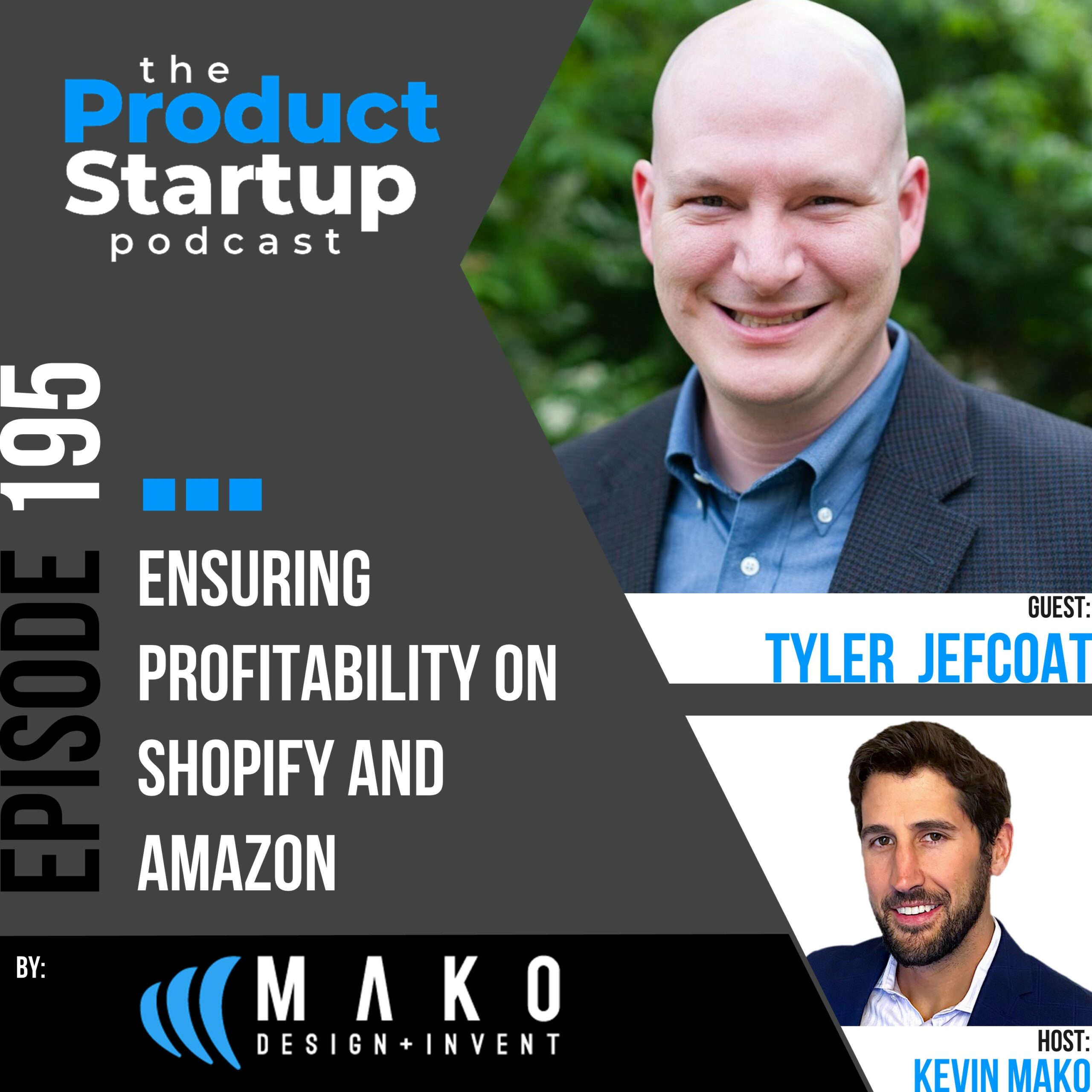
Guest: Tyler Jefcoat, Founder of Seller Accountant, with experience behind nine figures in Amazon sales and nine figures in exits.
Host: Kevin Mako, founder of Product Startup and the leading expert in hardware startup consulting. A hardware entrepreneur since 1999, Kevin has advised more than 1,500 founders and built and scaled MAKO Invent through its acquisition by TriMech in 2024.
Episode Overview
Tyler Jefcoat compares the strengths and tradeoffs of selling through Shopify, Amazon, and other marketplaces. He explains how product type, customer access, pricing, advertising, logistics, and a full view of costs determine whether growing online sales actually creates profit.
What You’ll Learn in This Episode
- What is Direct-to-consumer selling?
- How to funnel your customers from various platforms.
- Proven marketplace strategies to get customers to your shopping cart.
- Shopify vs Amazon/Ebay.
- Well-designed, differentiated products sell very well on Shopify.
- A direct connection to many customers that have a number of problems solved.
- Have your own website and drive Shopify to your website.
- Tips to make a profit on Amazon.
- Staple products are typically better suited to Amazon.
- Develop a comprehensive product design strategy to ensure product sales success.
- Which community is important for a customer buying something online?
- It’s okay to be the type of product that fits your brand.
- Amazon fees are high, they take a lot of fees for each sale.
- Amazon logistics (pick, pack, delivery) also have fees
- Marketing on Amazon also has fees.
- COGS is the leading indicator for how well you can market your product
- The more margin, the more freedom you have to build an audience through advertising.
- The less margin, the more you have to be efficient for getting the product to move.
- 20% to 25% net margin is a very viable product. 30% is big for scaling. 15% is dead.
- Know that your accounting is giving you real-time information on the profitability of your hardware product sales.
- Each of your sales channels needs to be profitable.
- Each product you have needs to be profitable.
Episode transcript
This transcript is provided for accessibility and reference. Download the SRT transcript.
Read the full episode transcript
Kevin Mako: Hello, product innovators. Today we learn how you can be very profitable selling directly to consumers from an expert
Kevin Mako: behind the scenes of hundreds of Amazon and Shopify product brands.
Narrator: This is the Product Startup Podcast, a show to learn from top leaders in hardware product development, prototyping, manufacturing, product selling, and everything in between.
Narrator: Hosted by Kevin Mako, the leading expert on product development for hardware startups.
Kevin Mako: Welcome back, everyone. I'm eager to introduce Tyler Jefcoat to the show. Tyler is the founder of Seller Accountant, which helps Amazon.
Kevin Mako: Amazon sellers achieve maximum profitability through bookkeeping and CFO services. He has been behind nine figures in Amazon sales and nine figures in exits,
Kevin Mako: and that's after he founded a company himself that grew to 120 employees before being acquired.
Kevin Mako: Today, Tyler's going to share some valuable knowledge for inventors, startups, and small manufacturers
Kevin Mako: on what direct-to-consumer-selling online is, the pros and cons of Shopify versus Amazon and eBay,
Kevin Mako: and the keys to success when scaling sales through direct-to-consumer-selling online. Now on to the episode.
Narrator: This show is produced by MakoDesign, the original firm providing end-to-end consumer product development services tailored specifically to hardware
Narrator: startups, small manufacturers, and inventors. Take your product from idea to store shelves at MakoDesign.com. Now on to the episode.
Kevin Mako: Hey, Tyler, welcome to the show.
Kevin Mako: Thanks, Kevin. Appreciate you having me. Really excited today to talk to you about selling on Shopify and Amazon. This is direct-to-consumer selling for new hardware innovations.
Kevin Mako: How do you get that invention idea? Finally, either in pre-production or in production, you're ready to sell and you want to sell directly to your end buyer.
Kevin Mako: There's a number of different avenues to do that. And today we're going to break all of that down and really get into the details of like which actual
Kevin Mako: platform is best for your type of product. What are some of the pros and cons? Most important, how do you remain profitable?
Kevin Mako: Before we get into all of that, Tyler, just give us a bit of a backstory to how you got to be the
Tyler Jefcoat: big success that you are now. Thanks, Kevin again for having me. So I'm an accountant by trade and I worked at a bank for a while. So it's kind of like, almost.
Tyler Jefcoat: like go to an AA meeting, like once a banker, always a banker. You're going to be recovering the rest of your life, right? But I started a
Tyler Jefcoat: healthcare company out of grad school in 2012. We had a pretty good run, zero to 100 employees in four years. And I had the chance to sell that company at the end of 2017.
Tyler Jefcoat: My wife does not like living in big cities. And so it was time to start another company because we're staying in this cute little college town called Athens, Georgia, where UGA is.
Tyler Jefcoat: And so seller accountant is my second venture where my team does bookkeeping. And I serve as the CFO for a big pile of brands that
Kevin Mako: selling their products online. Amazing. That's great. Super relevant to today's topic and why I was
Kevin Mako: really excited to bring you on the show because you get to see a lot of what happens. You see what's
Kevin Mako: successful and what's not successful, all trickling down to the profitability, which is a core requirement for the survival of any scaling hardware brand.
Kevin Mako: So let's talk big picture and then we'll drill down into the details and best practices. What is direct to consumer sales for a new
Tyler Jefcoat: hardware product? Here's where I think about this. If I have the ability to attract my own customer and sell my product through my website. I consider that to be direct consumer.
Tyler Jefcoat: So, you know, I could have a TikTok strategy or an Instagram strategy or a YouTube strategy, but it generally funnels my customer to a shopping cart.
Tyler Jefcoat: The most popular shopping cart in the world right now is a company called Shopify. And I consummate that sale by them pulling the trigger and paying me. I ship them
Tyler Jefcoat: the product. Everyone's happy. That's different than a marketplace strategy. When you think about old school eBay or now Amazon's, obviously, the million pound gorilla in the room.
Tyler Jefcoat: And so in both of those models, I'm designing and developing a product. I want that product to end up in my customer's hands.
Tyler Jefcoat: But I'm either responsible for getting the customer myself, which is true direct to consumer. I've got to market. Or I'm going to leverage Amazon huge pile of buyers.
Tyler Jefcoat: Right. I'm going to use their marketplace. Now, I still have to pay Amazon ad dollars. It's just a very different marketing strategy.
Kevin Mako: That's great. Very helpful. And I want to break down both of those. Let's talk about the Shopify platform, how it works.
Kevin Mako: And then let's switch over, talk about the Amazon, eBay market. place, essentially, how that works. And then we'll dive into both and figure out really what's best
Kevin Mako: for your product to venture into this concept of direct selling online
Tyler Jefcoat: for a new hardware and innovation. Yeah, so the way I think of our most successful customers, Kevin here at seller
Tyler Jefcoat: accountant, that are killing it on Shopify, have a really well-designed, differentiated product. So I actually think about the kinds of things that your team does.
Tyler Jefcoat: Like, your team will step in, design a truly new product. It really solves a problem that hasn't been solved before or solves it in a different way.
Tyler Jefcoat: And so there is a direct connection to a pile of customers that really want this problem solved. And so if that's your product, if you're the kind of product that really is
Tyler Jefcoat: kind of got, it has a unique edge to it. It isn't just a Me Too product. Then my ability or your ability to hang my own website.
Tyler Jefcoat: You know, I'm going to have my own real estate and then drive traffic to that real estate. Shopify's the real estate is going to give me the ability to really be
Tyler Jefcoat: successful and I can be really profitable. And then just the flip side of that, Kevin, is if my product is a little bit more of a commodity.
Tyler Jefcoat: And I don't mean that in an ugly way. It just means I'm really just selling a staple that's simple. It's okay to sell a pen. It's okay to sell a coffee mug that isn't different.
Tyler Jefcoat: I just need to understand that people are very unlikely to search for my website, go to Tyler Jefcoat.com and purchase a coffee mug. They're just not going to do it. And so I'm
Tyler Jefcoat: going to need a marketplace to bring buyers. Almost think about like a flea market. I need somebody to
Tyler Jefcoat: bring the buyers into the room so that I can sell my more commoditized product. And so
Tyler Jefcoat: So at Seller Accountant, what's really important for us is to make sure that our product strategy aligns with how they're selling the products.
Tyler Jefcoat: If you have a commodity, you're going to waste a lot of money trying to sell it on Shopify. If you have a really well-engineered kind of intellectual property-backed
Tyler Jefcoat: product, guess what? I want to try to own my customer, Kevin, so that I can capture more of the margin, you know, that kind of thing.
Kevin Mako: That's so powerful. And it's really, until you're in the industry, until you really understand that, it's hard to truly differentiate
Kevin Mako: between those two and understand which is better for you. And typically as a hardware startup, you don't have the resource.
Kevin Mako: necessarily to try everything and especially to try everything and do it to a global standard.
Kevin Mako: So you really have to pick your lane, at least to get in the door and A, B, test, figure out how that works and figure out how to do that really well.
Kevin Mako: I really like the fact that you've identified the uniqueness of essentially building your own website and your brands. Just as a reminder to those
Kevin Mako: folks who don't fully understand how Shopify works, it's basically a cart, a plugin for your own website. So it works more in the back end.
Kevin Mako: Or they also do have like a quasi functionality where they they will kind of provide a website for you and plug into their Shopify back end. But for most
Kevin Mako: intensive purposes, you imagine you're building your own website, making a cool website with an even better product and driving people to it.
Kevin Mako: And then Shopify is handling, let's call it the infrastructure to allow those transactions occur. Now, why is that so important? Well, that's important
Kevin Mako: because that website is an asset. And that's something that you brought up as well. If you can bring
Kevin Mako: your customers in, and especially if it's a unique, it has new feature set that's solving someone's pain point or it's addressing an opportunity for them. they become very loyal.
Kevin Mako: Well, loyal fans are more likely to seek you out and find your website and then become essentially a member,
Kevin Mako: whether they just follow your website, whether they actually sign up for a newsletter, whether they become a customer. These are members of your overall community.
Kevin Mako: And there's all kinds of different layers that you can do to build community around that.
Kevin Mako: But that is so powerful to a new innovation because you control that and start bringing value to the community through your product.
Kevin Mako: And the community in and itself becomes a major value points as well for that brand.
Tyler Jefcoat: I completely agree. And you said something really powerful there, Kevin, this idea of a, Whose community matters, right?
Tyler Jefcoat: The idea of a brand is really just which community or which tribe is the deciding factor on a customer buying something.
Tyler Jefcoat: And if I have that more unique product that does kind of attract a certain person, the 39-and-a-half-year-old guys that live in Georgia that love chess and play guitar
Tyler Jefcoat: or whatever, like whoever, like my avatar, I love this product. Then if you send me an email with a new offering, I'm going to come to you to buy it.
Tyler Jefcoat: But what we realize is that some products are really hard to create that kind of customer, like, loyalty around.
Tyler Jefcoat: and that's okay. Those are the kind of products that need to be on a marketplace like an Amazon.com focused in any of the core niches, direct to consumer or marketplace.
Tyler Jefcoat: Just don't try to do both
Kevin Mako: poorly. Really, that's the problem. That's great advice. Now, let's talk about profitability,
Kevin Mako: which is the core to really any scaling business, especially a hardware product business. If you truly want to become a large enterprise and to really grow your sales and become a
Kevin Mako: huge brand, you must be profitable. That's a key ingredient, at least in time, maybe not necessarily in the beginning. And there's lots of ways to grow to profitability.
Kevin Mako: But it is important that profitability is an eventual target and a very important target that you try and hit. So let's talk
Kevin Mako: about profitability on each platform, whatever one you want to start with. Oh, this is a good
Tyler Jefcoat: question. So Amazon fees, you guys have probably heard of these, but fees on Amazon are high.
Tyler Jefcoat: If you sell a product on Amazon.com, most categories, this can be a 15% commission. Amazon just gets paid to facilitate the transaction. Thank you for helping us sell the product.
Tyler Jefcoat: But most of our clients at Seller Accountant also use Amazon to ship the product. So there's an additional charge for the pick pack delivery. And this is really important, guys.
Tyler Jefcoat: My budget for marketing my product is directly related to how heavy the cost of goods sold is. Let me give you an example of this. And this will apply to Shopify and
Tyler Jefcoat: Amazon. If I'm selling a product for $100, right, if it only cost me $20 to buy and secure that product
Tyler Jefcoat: in the form of inventory, I'm going to have a larger budget to advertise or drive traffic to that listing than if I have a $50 cost of goods sold and I can only sell it for $100.
Tyler Jefcoat: In other words, the amount of the pie left over after my COGS. So that's the accounting jargon for cost of goods sold. The amount of the pie
Tyler Jefcoat: left over directly impacts how much I can afford to spend on ads. And as a rule of thumb, the more
Tyler Jefcoat: margin I have, the more freedom I have to go direct to consumer and try to build my own social media
Tyler Jefcoat: audience and try to drive traffic to my own real estate in the form of my Shopify site. The less margin I have, the more I'm going to need to be crazy efficient.
Tyler Jefcoat: And to be honest with you, Amazon's more efficient than anybody else at getting product to move. And so we complain about this all the time,
Tyler Jefcoat: about, oh, Amazon fees and Amazon fees this and that, Kevin. But the reality is that Amazon delivers the eyeballs that are going to pull the trigger.
Tyler Jefcoat: And so almost every product can work on Amazon, but only like a small percentage of products can work on Shopify.
Kevin Mako: That's kind of what I've found. Yeah, it's very interesting. And obviously there's examples that break the rule in either
Kevin Mako: direction. But the reality is that if you look at your product, it probably, at least for an initial offering, fits into one of those two categories.
Tyler Jefcoat: Yeah. And just to give you maybe one more kind of statistic to chew on. If I can have a 20 to 25% profit margin after advertising,
Tyler Jefcoat: after my cost of goods sold, after any marketplace fees, after my shipping, like a true margin of 20 to 25%, then I have a viable product.
Tyler Jefcoat: If it's closer to 30%, I have a scalable product. If it's below 15%, I have a dead product. And so I think as you guys kind of look at your actual accounting,
Tyler Jefcoat: what is the actual revenue minus the actual cost of goods sold shipping, marketplace, fees. What is that percentage?
Tyler Jefcoat: And I think really that's something that's crucial for these brand owners. By the way, I'm in awe of this, Kevin.
Tyler Jefcoat: What you guys do, the creative side of this, like, I love building businesses, but I'm not a terribly creative person. I mean, for crying out loud, I'm an accountant, right? Like,
Tyler Jefcoat: we like love numbers and stuff. But like what you guys do is like create the future and value for
Tyler Jefcoat: customers. What our team does is come in and says, okay, Tomit, let's make sure that the economics of that picture makes sense at scale.
Tyler Jefcoat: You alluded to this earlier, but profit is the price of admission for you to continue solving problems for your customer.
Kevin Mako: There's a really powerful intersection there and something that's amazing for, especially innovative hardware startups.
Kevin Mako: The reality is if you're making a new product with new IP that you, Tyler alluded to for, there's a tremendous amount of new value, essentially a premium that you can charge.
Kevin Mako: You are something special. So at least for your must-have buyers or your wealthy buyers or your early adopter buyers,
Kevin Mako: you can look at margin as something that's relatively easy to obtain, especially if you have some good innovation.
Kevin Mako: Again, if you're solving a pain point or you're creating opportunity, and it's something that these people can't get elsewhere, which
Kevin Mako: is ideally your innovation has something to it that is unique, that is powerful. You get to charge a premium. What does that premium do? It gets you margins.
Kevin Mako: What do margins do as Tyler addressed? If you have good margins, you can have an incredibly successful and scalable business.
Kevin Mako: So as an inventor, I always encourage you, especially as you're releasing the product, you can have sales and discounts to move volume, but typically you should be pricing high.
Kevin Mako: You should be premium. You should be special. You should be unique in all these categories. And because your product is,
Kevin Mako: fitting that. Especially if it's a newly designed product, it's modern and sexy and is made to 2023 standards, then it is a high-end product.
Kevin Mako: Thus, price it at a higher point so that you have those marks because once you have margins, that gives you a tremendous amount of scale. If you
Kevin Mako: don't have margins, that's a big problem. So use that as your real advantage as a hard bar startup with really core innovation. That's how you can get out of the gate swinging.
Kevin Mako: Couldn't agree more. Good point. Okay, Tyler, just before I let you go, what are a couple last nuggets of information that can
Kevin Mako: help people and then direct consumer advertising, profitability, any of the above.
Tyler Jefcoat: So Kevin, if I talk to somebody at a conference and they're excited to talk about the sales of their business, but they get a little
Tyler Jefcoat: bit quiet when you start asking about profitability, what normally is true is that they don't know for sure whether they're making money.
Tyler Jefcoat: So I can give you a couple of nuggets. I'll give you three here. One is you need to know for sure what that gross profit margin is after your fees and stuff. And that kind
Tyler Jefcoat: goes back to bookkeeping. It's a really unsexy thing to talk about. But make sure that your accounting is giving
Tyler Jefcoat: you real information because for those of us who are really optimistic entrepreneur types and I
Tyler Jefcoat: would count myself as one of those, I'm going to always be very bullish on the future. Things will
Tyler Jefcoat: work out unless there's data in front of me that tells me otherwise. So that's the first thing. You've got to have decent books.
Tyler Jefcoat: The second thing is make sure that I grade each of my channels. If I'm selling on Amazon and on Shopify and I have a B2B business, each of those channels
Tyler Jefcoat: need to be responsible for generating profit. And then the third thing is that each product needs to be responsible for profit.
Tyler Jefcoat: So I can't tell you how many of our clients invented, designed, launched a really cool product.
Tyler Jefcoat: And then they launched the green one, the purple one, the blue one, the pink one, the
Tyler Jefcoat: green. You know, like all these variations only to realize we're losing money on eight of these
Tyler Jefcoat: 10. Let's pare it back to the two that are working and not waste the resources. That's powerful
Kevin Mako: advice. And I'd say on the flip side as well, as a hardware entrepreneur, know that probably your initial sales aren't going to be that profitable.
Kevin Mako: But it's core to understand that it's trending in the right direction. And if you're doing this stuff and you have the correct accounting data, you can
Kevin Mako: start to identify the trends. So if you are providing a sale and you're understandably,
Kevin Mako: let's say breaking even because you want to just start moving volume or your initial manufacturing
Kevin Mako: cost is on the higher side because you've only produced a small amount of units, that's okay.
Kevin Mako: But you need to know how that's trending and factoring into the eventual plan. Because again,
Kevin Mako: the goal is at some point, you need to start traversing into that profitability matrix. And then as
Kevin Mako: you're into that profitability zone, let's call it, you need to increase that. Get it to 30 Because when you hit 30%, that means you have tremendous statistical correlation
Kevin Mako: to the likelihood of massive scale enterprise level growth in any case. So if you can trickle that back to your early stage numbers, get out of the gate swinging, do
Kevin Mako: what you have to do to get early adopters. But as you start to grow and scale, improve your profitability. And I can tell you from the backside on the manufacturing side.
Kevin Mako: On the manufacturing side, we do this at macro design, we go through layers of manufacturing, starting with short run, which is going to be fairly expensive per unit.
Kevin Mako: Then we go into full scale manufacturing. And then we go to what we call cost down scale up manufacturing. And that's a level of
Kevin Mako: where because we've now got volume, maybe thousands or even tens of thousands of units, we can put a tremendous amount of effort into testing a whole bunch of different ways to
Kevin Mako: reduce the cost of manufacturing without sacrificing key quality or feature sets of the actual
Kevin Mako: product. When you do that, it substantially increases that profitability gap. You also have economies of
Kevin Mako: scale. So not only do you have engineering and costing down a better production run to reduce your
Kevin Mako: actual unit cost, you have more bargaining power with every single stage in the supply chain. So both
Kevin Mako: those together, hopefully at that point in time, which is when you're actually starting to grow
Kevin Mako: pretty substantially in terms of sales volume, that profitability is really what becomes incredibly powerful to the equity valuation of your business or using that to reinvest
Kevin Mako: into future growth or expanded products or whatever you want to do to expand the business quickly.
Tyler Jefcoat: I could not agree more. You guys need to hit rewind on the show about 30 seconds and listen to that again. That's spot on, Kevin.
Kevin Mako: Well said. Very much appreciated, Tyler. And thanks again for all your words of wisdom today. We're at the top of the episode here. So thanks. And we'll talk to you soon.
Tyler Jefcoat: Cheers. Thanks, Tyler. Take care.
Narrator: Thanks for tuning in to this episode of the Product Startup Podcast. If you found some value in the show, please do us a huge favor and hit the like button and subscribe.
Narrator: If you have any questions, guest suggestions, or anything else, feel free to reach out to us anytime at our email, podcast at MakoDesign.com.
Narrator: This show is hosted by Kevin Mako, North America's leading expert on product development for hardware startups.
Narrator: And the podcast is produced by Mako Design, the original firm providing end-to-end
Narrator: consumer product development services tailored specifically to hardware startups, small manufacturers, and inventors. Take your product from idea to store shelves at Mako-design
Narrator: .com. That's M-A-K-O Design dot com. Thanks for joining and see you again soon.
eCommerce Profit Strategy for Product Founders
Scale Sales Without Losing the Margin
Work directly with Kevin Mako to pressure-test your Shopify and Amazon strategy, including channel fit, pricing, acquisition costs, fulfillment, returns, inventory, cash flow, customer ownership, and contribution margin.
Kevin can help you identify which growth levers strengthen the business, which ones only inflate revenue, and how product, marketing, and operating decisions should work together.
Request an eCommerce Profitability Call
Tell Kevin your channels, price, margin, and the point where growth is no longer translating into profit.