
Listen Now
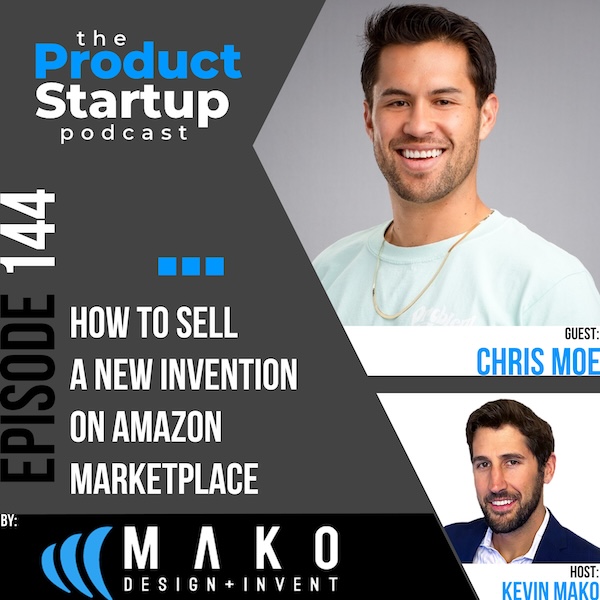
Guest: Chris Moe, Co-Founder of Cartograph, a digital marketing agency supporting more than $150 million in annual client sales on Amazon.
Host: Kevin Mako, founder of Product Startup and the leading expert in hardware startup consulting. A hardware entrepreneur since 1999, Kevin has advised more than 1,500 founders and built and scaled MAKO Invent through its acquisition by TriMech in 2024.
Episode Overview
Chris Moe explains how Amazon can help an emerging product reach customers, provided the launch is timed around real product and market readiness. He covers listings, messaging, pricing, cash constraints, customer feedback, algorithms, advertising, reviews, and why a low-price strategy often works against inventors.
What You’ll Learn in This Episode
- How does Amazon work for selling a new invention hardware product?
- Using Amazon to sell products is very seller-friendly.
- Make sure that you are ready to launch, and make sure that the timing is right.
- Have the first wave of product market fit.
- A lot of the time, product negative feedback may just be messaging, not even a flaw of the product.
- Pricing is a “triangulation exercise”.
- If you are cashflow constrained, make sure you price at the right price.
- Taking a low-price strategy likely doesn’t make sense for an inventor on Amazon.
- How does Amazon actually work?
- How to launch the product, including product listing, pricing, competition, and timing.
- How to scale.
- Amazon Marketplace for inventors, hardware startups, and small emerging manufacturing brands.
- Fulfillment by Amazon Network (this is how you get that Amazon Prime Badge)
- The difference between standard shipping size, and oversize shipping size.
- Invest back another 20% or so into advertising on the platform.
- How the Amazon algorithm works
- Paid ads on Amazon
- Amazon reviews, along with content (the Moat on Amazon).
Episode transcript
This transcript is provided for accessibility and reference. Download the SRT transcript.
Read the full episode transcript
Kevin Mako: Hello, product innovators. Today we learned from the co-founder of one of the world's largest Amazon agencies on how to launch
Kevin Mako: and scale your hardware product on Amazon Marketplace.
Narrator: You're listening to the Product Startup Podcast, the show that helps bring your product idea to life by chatting with successful inventors,
Narrator: product developers, manufacturers, and hardware industry professionals. Our goal here is to get to the bottom of what makes a product successful, from initial
Narrator: idea to getting your product on store shell, We're taking you step by step to build a functional product and scale your product business.
Narrator: Hosted by Kevin Mako, one of North America's leading experts on hardware development for small product businesses. Now, onto the show.
Kevin Mako: Welcome back, everyone. Today I'm very excited to introduce Chris Moe to the show.
Kevin Mako: Chris is the co-founder of Cartagraph, a digital marketing agency with over $150 million of client sales per year on Amazon.
Kevin Mako: They have grown a number of CPG brands from zero to millions of dollars in sales. them in just a few months. Today, Chris is going to share some valuable knowledge in how
Kevin Mako: inventors, startups, and small manufacturers can understand what Amazon marketplace is, how to launch
Kevin Mako: your new hardware product on Amazon, and how to understand the algorithms and marketing avenues to increase your Amazon sales. Now on to the episode.
Kevin Mako: Hey, Chris, welcome to the show.
Kevin Mako: Hey, Kevin. Thanks for having me. So I'd like to have you on today. Talk about launching a new hardware product on
Kevin Mako: Amazon. I noticed that last time we talked a couple of days ago, you're in a hotel. You just came from
Chris Moe: the Food Expo. Yeah, that's right. It was Expo East. Philly where most emerging food brands will display their new releases and just a chance to meet
Kevin Mako: a lot of the different players in the industry. Amazing. And you've got a tremendous amount of experience. You've worked with tons of great
Kevin Mako: brands, not only getting them onto Amazon, but also just heavily amplifying it. So they're doing millions of dollars in sales on there.
Kevin Mako: Before we get to the tips and tricks for launching and scaling a new product on Amazon, just give us a bit of a background. How'd you get to where you are today?
Chris Moe: Sure. So prior to Cartagraph, I worked at McKinsey for about five years, did a wide range
Chris Moe: of consulting, pricing, digital pricing, distribution, as well as a fair amount of education work.
Chris Moe: And in between, spent a little bit of time in finance, my structure credit hedge fund, where I picked up some side clients in merging consumer products companies.
Chris Moe: And then my co-founder, John, he had built the first Amazon team at GE in their consumer electronics division. So very relevant to this audience.
Chris Moe: And built that into a really big business selling tens of millions of maybe not so sophisticated hardware, but a lot of light bulbs and extension cords and smart switches, which is
Chris Moe: and so forth. And then he called me up, had a real passion for better for your foods, and said, hey, Chris, you know something about consulting, right?
Chris Moe: And Cardograph was born. And so now, about five years on, you manage about $150 million in retail revenue per year. Some of our
Chris Moe: bigger stories, we launched Lily's Chocolets from Zero that exited for about 300 million. We launched Birch Benders from Zero that exited for about 300 million. Last year,
Chris Moe: had the largest grocery launch on Amazon with Magic Spoon cereal that sells over a million dollars a month.
Chris Moe: And I'd say probably by now we've launched about 50 million dollar businesses on Amazon. Wow. Amazing. Yeah, a lot of food and Bev, but not unfamiliar
Chris Moe: with hardware. And, you know, there's actually a fair amount of similarities and the difficulty
Kevin Mako: of production and sourcing. Well, Amazon is a big deal. There's a lot of different ways to sell a new product, especially as a hardware startup.
Kevin Mako: You look at all of these options. You can sell on Kickstarter, Indiegogo. You can sell on Amazon. You can sell direct to consumer through your own
Kevin Mako: website, you could sell to wholesalers, retailers, distributors, etc. Amazon's a big one, though, and it's obviously become bigger over the years.
Kevin Mako: And it's something that, although most people know what Amazon is, not a lot of people, especially as an early stage hardware startup or a first-time
Kevin Mako: startup, not a lot of people know really how it works. How do you actually get your product in front of an audience and then bigger picture? How do you actually do that well?
Kevin Mako: So let's start looking at the top of the funnel here. How does a hardware startup look at Amazon as a service or a platform?
Kevin Mako: and what do they do just to get on it and get the bowl rolling? Then we'll get into how to actually
Chris Moe: launch and do it well. Sure. So let's start really big picture. What is Amazon? Hopefully you've heard about Amazon.
Chris Moe: If you haven't, guy named Beau Burnham wrote a really nice song about founder, Jeff Bezos. Amazon is the everything store online. It's the largest internet marketplace
Chris Moe: for selling consumer goods. And so some stats about Amazon, probably about at least
Chris Moe: the third of households are prime subscribers on Amazon, which means they pay over $1,000 a month to get free shipping on all the products.
Chris Moe: It's also where the majority of consumers start product research on the internet. So more people, when they're looking for a product, will go to Amazon
Chris Moe: and type in what they're looking for than even Google. As a seller, it's actually extremely seller-friendly. It's a marketplace.
Chris Moe: You can make an account, sign up for a professional account, It's like 40 bucks a month. From there, you can list your products and the journey begins.
Kevin Mako: You can start getting to sell. It's amazing because it's one of those things that people think might potentially be a lot harder than it really is,
Kevin Mako: at least to get it on the platform. But it really isn't. Think about from Amazon's perspective, they want new, innovative, great products on their platform.
Kevin Mako: That's what helps them generate more revenue and get the right product in front of the right buyers more often.
Kevin Mako: So it is friendly to new and emerging brands, especially stuff that's really value. to specific demographics.
Kevin Mako: So just setting up an account is really the first step, but I want to go deeper into that. Setting up an account is obviously easy. But how do we actually launch a product
Kevin Mako: well? How do we make it a success when we go to Amazon and kick that
Chris Moe: off? Sure. So I think the first thing when launching on Amazon, when we talk to brands, is making sure that you're ready for it and that the time is right.
Chris Moe: So a few things that we always say is, one, just timing. you always suggest that you've got a pretty good sense of consumer feedback that you have
Chris Moe: like at least a first wave of product market fit because what you don't want to do is one
Chris Moe: get a bunch of bad feedback and oftentimes the feedback is just in messaging it's not even product quality you promised a and you gave b and that can be a huge barrier on amazon
Chris Moe: that's one make sure your product's in the market a little bit and you have a good sense of how to describe it and
Chris Moe: that consumers are responding well to it the other is thinking through your product positioning on Amazon. A lot of the time we think of this as a pricing.
Chris Moe: We think of pricing as a triangulation exercise. We want to first try by net margin on the channel, making sure you account for all
Chris Moe: of the Amazon costs, including promotion and advertising costs, that you're net profitable
Chris Moe: on the channel. Then you want to consider pricing on other channels. If you're selling it on
Chris Moe: your own website, if it's on another retailer, how are you going to price relative to that?
Chris Moe: And then finally, and one of the more important ones is consider competitive pricing on Amazon.
Chris Moe: Because your product positioning and differentiation, Amazon's ultimately like a huge comparison shopping website.
Chris Moe: And so long-term competitiveness on the channel means that your little square with your product on it needs to at least capture some of the clicks
Chris Moe: next to the square of your competitors. So really thinking through a year from now when we have thousands of reviews, are
Chris Moe: we going to be positioned in a way to knock off products by some of the major
Kevin Mako: OEMs in a all the different hardware categories. That's a great overview. I want to dig into some of those things a little bit more.
Kevin Mako: For instance, if we're looking at Amazon and trying to consider a pricing strategy, let's assume we've done what you said. We have a little bit of product understanding.
Kevin Mako: Maybe we've sold a few hundred units already. We got some feedback. We're confident both in our product. And like you said, in the messaging of the product.
Kevin Mako: So it's two obviously critical variables in order to sell any product. So we've got those and we want to get on it.
Kevin Mako: Most people, at least most hardware startups that are listening to the show, they're in the game developing this thing because they've come up with something that's better than
Kevin Mako: the composition or better than an alternative option or it's just some kind of innovation or pain point
Kevin Mako: solver. They've created an invention that has some sort of increased inherent value. So when you're
Kevin Mako: looking at pricing that, do you try and price it up a bit because it has that increased value from another competitive option at least to start?
Kevin Mako: Do you want to try and match it and hope to get more volume? Or are there other considerations that you look at in terms of pricing something with a new
Kevin Mako: innovation, not just a driver to the bottom, but something actually has value as
Chris Moe: most new inventions do, or at least are trying to achieve to. You're getting at one of my favorite topics, which is
Chris Moe: pricing. So I'm going to give you the very unsatisfying answer of it depends, but let me talk through some of the considerations of how I'd think about it.
Chris Moe: A lot of it actually has to do with capital intensity and what kind of money that you have. If you are going to be cash flow constrained,
Chris Moe: then you need to set your pricing at a place that make sure that when you get cashed back from Amazon, you're able to pay for future runs of your product.
Chris Moe: And so that often ends up being the driver for a lot of emerging businesses. Like the capital markets right now are a little bit tight.
Chris Moe: And so you can take a really aggressive strategy. And indeed, actually, some of the really advanced Amazon sellers, what they'll do is
Chris Moe: they'll take a very low price strategy to begin. And that helps them just get established on the platform, get exposure to a lot of consumers build up their moat on Amazon.
Chris Moe: We can talk about how to build a moat on Amazon and what that is. That can be the first strategy. Another positioning that we do with a lot of clients,
Chris Moe: if you're just starting out, you have a lot of flexibility, right? Because you say, it's blue sky. I can price it above, below, and we actually work with mostly premium
Chris Moe: products. We rarely try to take a low price strategy on Amazon just because there's probably always somebody who's willing to do it
Chris Moe: cheaper. Economics 101 race to the bottom that they talked about in school, you actually see it play out on Amazon.
Chris Moe: If there's products that get super popular, somebody is clean cheating it, taking cost out, and making it lower cost. And so what I would do is try to price it that respects
Chris Moe: your differentiation, try to price in a way that respects your innovation, tell a really good
Kevin Mako: story, and command that margin. Make sure that you're creating a business, that long term, you're going to make some money.
Kevin Mako: I think that's incredibly important, especially as a hardware a startup. It's nice to hear from you on the sales side that that strategy still works, especially in a
Kevin Mako: place like Amazon, which is so data driven, both on the reseller side, but also on Amazon side as well.
Kevin Mako: So it's competitive. Even if you've got an innovation that has some sort of unique feature that
Kevin Mako: nobody else has, you're still competing against some other product that somebody might want to buy
Kevin Mako: that's relevant to yours or just the option of not buying anything at all. So despite it being
Kevin Mako: competitive, it's nice to hear that there's still room to price in the value that you've created
Kevin Mako: because that's very important, especially as an emerging hardware startup, and you mentioned it, you hit the nail on the head, which is cash flow.
Kevin Mako: You want to be able to be sure that you're able to produce the product, continue to grow your business as there's many more expenses than simply gross margin.
Kevin Mako: Something I want to talk about, speaking of gross margin is, can you explain
Chris Moe: a bit how Amazon takes their cuts and the different actual options to selling through Amazon?
Chris Moe: Sure. So pricing on Amazon, there's basically two sides of the house on Amazon, and one that's going to be most relevant for emerging brands.
Chris Moe: So there's what they call the first party channel or vendor central.
Chris Moe: That operates like a conventional wholesale relationship, a physical retailer. You set an invoice cost, the issue of purchase order every Monday, you ship the product in.
Chris Moe: Generally speaking, that is not possible to get on anymore unless you're a very mature business.
Chris Moe: And what they say is do $10 million of sales on Amazon on the marketplace side and then we might invite you to the one one side. So I'm going to put that one aside and focus on the
Chris Moe: marketplace side, which is the third party selling channel, or what they call seller central. And so the rough breakdown of the P&L on a
Chris Moe: unit basis on Amazon is as follows. So you set your retail price. Amazon will always take a 15% cut. It's called their referral fee. That's just like
Chris Moe: a flat fee for selling on Amazon. Then, of course, you need to subtract out your cogs, your landed cost of goods.
Chris Moe: Then you're going to be shipping using Amazon's fulfillment by Amazon network or the FBA network, which is Amazon's, I'm going to be U.S. focus, more than 50 fulfillment centers
Chris Moe: all across the U.S. And this is how you get that prime badge on Amazon plus one or two day shipping, which makes an enormous difference in terms of performance of your listing.
Chris Moe: So in 99% of cases, you're going to want to be in that channel. Generally speaking, the price of FBA,
Chris Moe: it's a fixed fee based upon the weight and cube of your product. So hardware, you're actually in a really good spot in some cases. If you're a small,
Chris Moe: lighter weight product, you're going to pay three to five bucks, probably to ship it in a day anywhere in the US, which is incredible.
Chris Moe: We talk about like accomplishments of like modern technology and business to be able to move something like that. If you get larger, it can get up to 10, 15 bucks.
Chris Moe: Amazon can do oversized products actually pretty affordably. I'd say the key thing
Chris Moe: to note if you're thinking about selling on Amazon is there's actually this very specific sized tier, which where you go from standard to oversized.
Chris Moe: And that's being in the cube of getting super technical here, 18 by 14 by 8 inches for longest, middle, and shortest side. So you need
Chris Moe: to be below that and you can go into standards here. Otherwise, not only do your costs go up a lot per unit, but also the fulfillment network is really constrained.
Chris Moe: So your ship speed and your freight costs will go up a lot. Just want to throw that nugget out there. After shipping, we generally
Chris Moe: recommend you reinvest another 20% or so into advertising. And then there's the remainder, which I'd call the other costs. Returns and refunds, a couple percent.
Chris Moe: If you have a subscription component, budget in a couple percent for that, storage fees and freight in a percent or two.
Chris Moe: And then we like to account for the warehouse cost for you to get the product from your
Chris Moe: warehouse prepared for the freight shipment to Amazon, which is usually a few cents per unit. All in all, that other bucket, I'd say about 10%.
Chris Moe: To recap it from the top, 10% other, I'm going bottom to top, 10% other, 20% adds
Kevin Mako: 3 to 5 bucks in shipping if you're a small unit, and then 15 % for Amazon's referral fee, and then finally your cost of goods.
Kevin Mako: That was a really good tactical series of advice pieces there, Chris. I appreciate it because you've broken it down to make it easy to understand how
Kevin Mako: Amazon works within the marketplace setting. I want to ask you about the advertising piece that you mentioned, that 20%, is that
Chris Moe: referring to advertising back onto the Amazon platform specifically or advertising on other platforms to feed into your Amazon store?
Kevin Mako: We are talking ads on Amazon to make sure that your product gets exposure on Amazon, that people are able to find it. I'll be to explain why we do that and how Amazon works.
Kevin Mako: Yeah, talk a bit about the ads because I'm curious about that as well. You obviously see them popping up all the time now as a shopper on Amazon. You mentioned that
Chris Moe: it's key to reinvest that money back into it when you're making sales. How does the advertising platform work on Amazon specifically?
Chris Moe: Before I even talk about ads, let's just talk about how Amazon the algorithm works and the
Chris Moe: website works because it's pretty complex, but I think to like an engineer's mind, it's actually really elegant. So Amazon is a giant stack rank of
Chris Moe: daily unit velocity. And so if you look on Amazon, every single product and you can actually see the rank on
Chris Moe: every product page is ranked in terms of how many units they ship per day. And what that rank determines is how much free traffic Amazon.
Chris Moe: sends you. And so the free traffic is in the form of Amazon has to fill all of their pages, right? You go to their homepage, there's stuff there.
Chris Moe: You go to other product pages. There's other stuff around it. You get emails. Say, once you look at this, you're shopping in this category.
Chris Moe: So Amazon cascades that free inventory, organized by relevance by category to the products
Chris Moe: that have the rank, the stack rank by daily unit. So it's super, super simple and super elegant. And if you can keep that framework in mind, everything in Amazon feeds that.
Chris Moe: So when it comes to advertising, you're doing two things. One is you're trying to just get one-off sales and you can like calculate the one-off
Chris Moe: pro forma P&L of that individual sale, which is like ad cost and revenue.
Chris Moe: But you're also buying sales rate because every unit that checks out gets you up in the ranking.
Chris Moe: And so the philosophy that we use with ads is we're trying to as inexpensively as possible find the cheapest ad that you can get to get you're up
Chris Moe: in sales rank and get more of that free traffic. And that's what true ROI on Amazon is. Some people call it the flywheel. And so what I
Chris Moe: talked to about with my team is something we used to take from the junk bond world, which is there's no
Kevin Mako: such thing as a bad ad, just a bad ad price. And so take anything that you can get, that converts.
Kevin Mako: And eventually that sales rank will get you up and get you some more traffic. Is this what creates some what of a snowball effect?
Kevin Mako: As your ads are starting to work, your organic starts to work and they start compounding against each other and growing and growing to the point where you start
Chris Moe: hitting that, I guess the goal eventually, kind of like Google, you want to be ranked one on the first page of organic.
Chris Moe: Your goal on Amazon is you want to be on the upper left-hand corner for your key search terms for your specific product category. Right, right. That's exactly right. In the Amazon
Chris Moe: world, a lot of people call it the flywheel is that snowball effect. And the interesting thing is
Chris Moe: Google's like reasonably one-dimensional, but there's actually a lot of different places on Amazon that
Chris Moe: are like premium placements, like every search term you try to get to the top of it. On category pages, you try to get to the top of it.
Chris Moe: So there's actually a second dimension to this. I like to describe it as what's a moat on Amazon and what makes that feedback loop actually closed loop.
Chris Moe: And so that's your reviews and your content. And actually content will go back to the beginning of like pricing strategy as well. But let's talk about the moat.
Chris Moe: So what the moat is is how do you make your sales rank sticky? We talk about we're always trying to climb up in sales rank.
Chris Moe: Your sales rank dictates that you get more traffic and that loop happens. But the interesting thing is the amount that you convert
Chris Moe: on the free traffic is the feedback loop, right? Because if you get units from that traffic, then you continue to climb. So if you
Chris Moe: don't convert, you actually aren't getting long-term ROI. You're just getting short-term ROI. And that's why it's super important to build reviews and
Chris Moe: then in some category of subscriptions,
Chris Moe: because that's actually the mode. Because some people will think, okay, why don't we just like
Chris Moe: send a ton of traffic to Amazon, blow it up in the first month, we'll jump to the top, it'll be great. That happens. You get all this free traffic.
Chris Moe: You don't have any reviews or you have a very small number. You're not going to stick. And so you'll naturally decay. So that's why
Kevin Mako: reviews is your moat that keeps you up there. And then also makes it when people attack you or like
Kevin Mako: people have traffic of their own next to yours, you retain a lot of those clicks and retain your salesman. That's extremely helpful.
Chris Moe: Now, for those out there that think this might be a bit daunting. Obviously, it might help to bring an agency on board. So talk a bit about what you do
Chris Moe: at Cartagraph to help new brands and emerging brands really hit a home run on Amazon.
Chris Moe: Sure. So we're a full service Amazon agency. We work across the entire value chain on Amazon. So we'll help you from assortment, pricing, supply chain
Kevin Mako: design, kidding and freight and getting the product to Amazon.
Chris Moe: And then we'll run the entire digital side as well, which is helping you develop content and run all of your advertising on Amazon and increasingly a little bit off Amazon
Kevin Mako: that might direct Amazon as well. And what's your website for folks that want to learn more about what you guys do? Sure. It's go cartograph.com.
Chris Moe: That's like cartography without the why or carto graph.
Chris Moe: And as always, I'll put the links in the show notes below so anybody can click through. Chris, thanks again for your words of wisdom today on the show, extremely helpful and look
Chris Moe: forward to talking with you again. Thanks, Kevin.
Narrator: Thanks for tuning in to this episode of the product startup. podcast, the show that teaches you what it really takes to bring your product to market and turn it
Narrator: into a big success. This podcast series is brought to you by Mako Design + Invent, the original
Narrator: and leading firm in North America to provide global caliber in-to-end physical consumer product
Narrator: development to startups, inventors, and small product business clients. If you're looking for
Narrator: product development help on your invention, head over to MakoDesign.com. That's M-A.A.
Narrator: K-K-O-design.com for a free consultation from one of Mako Design's four design studios from coast to coast.
Narrator: Thanks for listening and see you next time.
Amazon Launch Strategy for Product Founders
Get the Product and Economics Ready Before Launch
Work directly with Kevin Mako to pressure-test your product-market fit, Amazon timing, positioning, listing, pricing, reviews, advertising, inventory, cash flow, and contribution margin before the launch creates expensive lessons.
Kevin can help you connect marketplace execution with product quality, manufacturing, customer feedback, brand growth, and the other channels that may matter after Amazon proves demand.
Request an Amazon Launch Strategy Call
Tell Kevin what you plan to sell, what has been validated, and the Amazon decision you need to get right.