
Listen Now
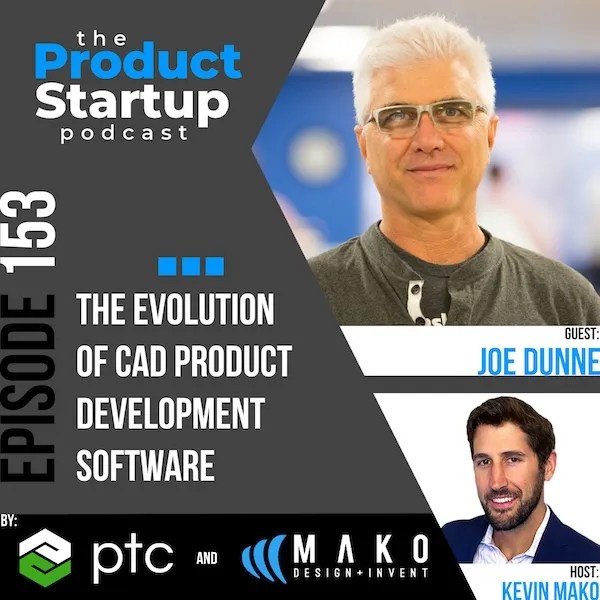
Guest: Joe Dunne, Director of Partnerships at PTC, former mechanical engineer, and early SolidWorks team member.
Host: Kevin Mako, founder of Product Startup and the leading expert in hardware startup consulting. A hardware entrepreneur since 1999, Kevin has advised more than 1,500 founders and built and scaled MAKO Invent through its acquisition by TriMech in 2024.
Episode Overview
Joe Dunne traces the evolution of CAD from early desktop systems and 3D parametric modeling to cloud-based product development platforms. He explains how modern collaboration, integrations, community tools, and more iterative workflows can improve speed, efficiency, communication, and product quality from concept through production.
What You’ll Learn in This Episode
- The evolution of Computer-Aided Design (CAD) software
- The advent of 3D parametric modeling in the 1990s
- The move to 3D marked a significant shift, allowing for more iterative design processes that improved early concept design.
- Identifying individuals to collaborate with
- Current CAD software has advanced through cloud-based technology
- The future of CAD lies in its integrations, made possible by the cloud-based architecture of the core software
- This results in the development of products with increased efficiency, faster speeds, and fewer resources, from design to production
- CAD design technology is now a community of integrated app developers building upon the core CAD technology host
- Bringing your product to market and testing it is crucial.
- Today, design options offer more flexibility than ever before.
Episode transcript
This transcript is provided for accessibility and reference. Download the SRT transcript.
Read the full episode transcript
Kevin Mako: Hello, product innovators. Today we learn from one of the foremost CAD software pioneers on the evolution of computer -aided design software for developing new hardware products.
Narrator: You're listening to the Product Startup Podcast, a show to learn from top leaders in product development, prototyping, manufacturing, product selling, and everything in between.
Narrator: Hosted by Kevin Mako, the leading expert on product development for physical product startups, sponsored
Narrator: by PTC's two best-in-class 3D CAD product development software solutions Onshape and Creo, and produced by Mako Design + Invent, the original firm providing world-class,
Narrator: consumer product development services tailored specifically to startups small manufacturers and inventors
Kevin Mako: welcome back everyone today i'm very excited to introduce Joe Dunne to the show joe's the director of partnerships at ptc the firm behind Onshape and creo before this he
Kevin Mako: worked for solid work since the early days of the software starting with them back in 1995 and before that was a mechanical engineer today
Kevin Mako: joe is going to share some valuable knowledge from inventors startups and small manufacturers on how CAD software has evolved since the 1980s, what the best in class software
Kevin Mako: is doing today for you and how the software is evolving in real time to best support getting new hardware products to market faster, cheaper, and better than ever.
Kevin Mako: Now on to the episode.
Kevin Mako: Hey, Joe, welcome to the show.
Kevin Mako: Kevin, it's a pleasure to be here. Excited to have you on today to talk about the advancements in CAD design tools.
Kevin Mako: Everything about new physical product development comes down to the actual CAD design of design, engineering, prototyping, manufacturing, and all of that, and it all comes
Kevin Mako: into the software.
Kevin Mako: And that's involved incredibly. You've been involved with CAD design software since the 80s, over 30 years of working with it. And of course, more than 20 years working with the
Kevin Mako: biggest names in the game, including still to today. So Joe, give us a bit of a background.
Joe Dunne: How did you get to where you are today?
Joe Dunne: Well, thanks. You know, like I said to you earlier, you know, I look at my picture and yes, it has been a long time with the white hair. But I realized over
Joe Dunne: the time, started off a mechanical engineering student, you know, going and getting my ME degree.
Joe Dunne: And I picked Emmy because I didn't know what I wanted to do as a kid, but I saw the brochure from USC that had this picture of a guy using CAD.
Joe Dunne: So I picked ME over electrical engineering or anything else because I knew CAD look cool, right? Even during school, I was probably driving
Joe Dunne: my professor's nuts because I was turning in lab work and all this stuff. Instead of drawing
Joe Dunne: things by hand with sketches, I was using AutoCAD and printing things out in a dot matrix printer
Joe Dunne: and stuff. But, you know, definitely back then, CAD was certainly my focus. If you think about at that time, it was literally automated drafting.
Joe Dunne: It was 2D drafting on a computer. You know, using PCs on Microsoft DOS, but that's all I was doing, right? That was the state of the art.
Joe Dunne: Instead of doing things by hand on Vellum and erase with a big eraser and rulers, you're going to do it on the computer. And that was good. It was definitely a breakthrough.
Joe Dunne: I did a little stint after graduation of some design engineering. I was at a startup for a printer. And then I work for an aerospace instrumentation company. But what I really
Joe Dunne: learned quickly was I didn't know what I was doing for sure. But I was good at one thing is even at those companies, I was using CAD a lot. I was just obsessed with it.
Joe Dunne: So that was clearly where my path was career was. And I went from that particular moment in time, we're talking to early 90s. Pro engineer had just come out.
Joe Dunne: And I remember bringing these sales guys into my company and giving them the show me what your product can do. You know, as a kid, they're showing me this.
Joe Dunne: And there was like, I think, SDRC. So we're going from at that point from a 2D drafting application, which maybe some people had to now this concept of 3D parametric modeling.
Joe Dunne: Now, honestly, proe revolutionized this market with this concept of, you know, feature-based parametric design.
Joe Dunne: That means that anyone designing something could make a change and everything would automatically update, right? You could iterate. It was a huge change.
Joe Dunne: It really made things better. But you're very expensive.
Joe Dunne: It was running on some very esoteric mini-computer units workstation. So it was certainly not for everybody.
Joe Dunne: it was upper echelon types of companies that could use this 3D modeling. And then to the normal people, for the normal companies and the vast majority of startups for
Joe Dunne: sure and everybody, you were probably relegated to AutoC or creating things by hand still for 2D.
Joe Dunne: Which came to shove, I wound up getting a job at one of these companies for computer vision. So I started at Computer Vision, which was yet another product competitor to and
Joe Dunne: SDRC and all the others. While I was at Computer Vision for a few years, they acquired a company called Premis.
Joe Dunne: and premise was a software engineering sketchpad, engineering 2D product created by a gentleman named John Hirstick.
Joe Dunne: Sorry for all the history, but I'm just trying to slowly get into this. But at that time, I met John and this whole team, and these guys were just hot.
Joe Dunne: I mean, they just knew how they had them out there, stay of the art, building new stuff.
Joe Dunne: And I knew when I was at computer vision, they were the guys I kind of hooked my wagon to, right? And I was working with them all the time and getting to know them.
Joe Dunne: And let's just say, as startup, you're talking about a bunch of young guys out of MIT, who started a software company, it got acquired by a bigger company.
Joe Dunne: It didn't last that long. I think they wanted to innovate. I think they wanted to try new things. They wanted to break down and disrupt the market a bit.
Joe Dunne: So a couple of years after that, John left with a few people and started a company called SolidWorks. So I quickly followed.
Joe Dunne: I was chasing him and everything. He can tell you stories about how I accidentally ran into him at coffee shops, you know. But I knew I wanted to join his company.
Joe Dunne: And I wound up joining very early before we shipped SolidWorks. So it was 1994, I think, was the time.
Joe Dunne: And what we did there was really, really interesting because you had ProE, which was a really capable, high-end mechanical engineering tool.
Joe Dunne: If you could afford it, great tool. And then there was a lot of people that had 2D AutoCAD that was just doing 2D drafting out
Joe Dunne: there and managing that for their manufacturing purposes. And then there were still a lot of people that didn't use anything.
Joe Dunne: They were still on paper and vellum and all the old school stuff. So when we started and introduced SolidWorks, I won't say that we really didn't.
Joe Dunne: anything new from a product perspective, but we made it so that it was available to everybody,
Joe Dunne: right? You had this product that did, we used to say 80% of the functionality for 20% of the cost. No one wanted to admit that.
Joe Dunne: But let's be honest, that really was the idea. So I was traveling all over the place, living in Boston, living in California, but lots and lots of customer
Joe Dunne: presentations, going to startups, going to manufacturing companies and showing them the software.
Joe Dunne: And when I would show up with a computer, a laptop and start showing them 3D modeling, their jaws would always drop open half the time.
Joe Dunne: They just didn't believe, you know, that that could be done. You passed forward 20 years after we've been working on solvers for a long time. And we started to see a lot of
Joe Dunne: issues that we wish we could solve, right? We wanted to make a product better for a certain market segment, for certain use cases, for certain things.
Joe Dunne: We decided to start a new company called on ship. And that's kind of where we're at today, right? I think as you go through the evolution, by the way,
Joe Dunne: you know, the many computer units workstations are gone. Everybody uses a PC for their software. But you are downloading and installing software today, which is great for the 90s,
Joe Dunne: great for the 2000s, but I live next to a university and no student that I know even knows what downloading and installing software means, right?
Joe Dunne: They just log in and use everything. Every other industry other than this one wouldn't even be batting an eye on this concept of, you know, let's just call it cloud-based software.
Joe Dunne: So we decided that, you know, we needed to start with a blank sheet of paper. The problems we're solving are you shouldn't have to worry about your hardware, right? Who cares
Joe Dunne: what kind of hardware you're running on. You could use some very inexpensive piece of hardware like a Chromebook,
Joe Dunne: or you could have a very expensive Windows PC or Mac, Linux, mobile devices. We don't care. The software should just work on those, and it does.
Joe Dunne: And that's important because especially if you're starting from scratch as a startup, if you have to worry about your hardware, if you have to worry about what computers you have,
Joe Dunne: you have to worry about installing all this stuff and license in it, and then, oh, I don't have the right driver. And then forget about all the IT security issues.
Joe Dunne: and am I following best practices or am I going to get broken into is my data vulnerable? I mean, I can go on and on and on about all the problems that are solved by a modern
Joe Dunne: architecture, right? We're not moving files around you. The inspiration for us, a big one actually, was Google Docs.
Joe Dunne: The first time I used it where I worked with somebody else, where we were both working in the same document, at the same time, I wasn't using comments, I
Joe Dunne: wasn't sending someone over a file hoping that their email and that they had the right version could open it. but we were just simultaneously editing in that document.
Joe Dunne: It was a light bulb in that it just worked. It really cut down on so much potential for mistakes, just productivity, just getting things done.
Joe Dunne: Everyone knew they were on the right version, et cetera. And that's kind of where we're at with OnShay. If you're going to look at CAD today, you're designing a product,
Joe Dunne: and you're fortunate enough not to have already invested in some older software, you can take and say, all right, what am I going to use to be the most productive?
Joe Dunne: I think there's no question that having something that you can do, just literally in five minutes or less, create an account, putting a little bit of information
Joe Dunne: and start using in production immediately.
Kevin Mako: It's crazy. It represents a radical change from what most people use today in this market. Yeah, and it was very disruptive. I remember Onshape
Kevin Mako: coming on boards. We were early adopters and trialing it out. And the beauty was just log in, plug and play. And that was essentially the model.
Kevin Mako: You basically took the Google Docs model to CAD software to enable designers to very quickly, iteratively, collaboratively design products.
Kevin Mako: And of course, now it's a major software house. I think you guys have over 2 million users on the program, which is unreal.
Kevin Mako: It's amazing to hear your story because you're part of the original pioneering team that disrupted the CAD industry from 2D to 3D back with SolidWorks.
Kevin Mako: And now you've redisrupted the industry again, going from a download software model to a modern cloud based software via Onshape.
Kevin Mako: It's an incredible story over the years how the evolution of CAD software has come from where it is and where it's going. What I want to talk today about on the show
Kevin Mako: too is how it's actually evolving now because cloud-based software, I mean, that's great. You guys did it and you did a really good job and it's a phenomenal software package.
Kevin Mako: But looking forward, there's a lot of major benefits that are happening to designers, hardware startups, people who are
Kevin Mako: re-visiting their design, prototyping, manufacturing that comes in and around the CAD software,
Kevin Mako: you guys now, because of this architecture you've used to build this, have the ability to do all kinds of integrations and third-party things.
Kevin Mako: I want to talk to you about those and how
Joe Dunne: that's the next major evolution in CAD development software to make it cheaper, better, faster to create new products and new innovations.
Joe Dunne: For sure. I mean, I think everyone used to look at this as, you know, CAD. And then if you wanted, let's just say you have manufacturing needs,
Joe Dunne: well, that's CAM and you go to the CAM industry and grab all your CAM stuff. And everything would have its own segmented, isolated type of application that may or
Joe Dunne: may or may and I even work together. There's also some companies that would try to do it all themselves, which is also problematic.
Joe Dunne: If you wanted to buy an engineering product that offered everything, what is it, Jack of All Trades, Master of None? I mean, there's pros and cons to all that.
Joe Dunne: So what's changed from when we used to use AutoCAD, 2D, great, I can create a drawing, to Today, everyone needs to do a lot more, right?
Joe Dunne: Your company is responsible for much more not only coming up with design, but you're coming up with the cost, you're coming up with
Joe Dunne: the manufacturing processes, you're manufacturing it, you're getting this all done faster with fewer people. Everything, it's just streamlined, more efficiency.
Joe Dunne: We would not have a successful business if we didn't think about this problem from day one of what we're going to do. And so we always call Onshape. Onshape is a platform.
Joe Dunne: It's a platform as much as it is a product. It's a platform because we built it with an API, a restful API, kind of a standard modern way of building software.
Joe Dunne: But we also did this in a way that I think is a little bit different, but we use the API. You know, one thing we always talk about is dog food.
Joe Dunne: The inside story that I've seen with every, probably not just CAD, a lot of software products and industries is that
Joe Dunne: things like an API and things like, you know, the platform, they kind of take a backseat towards the product.
Joe Dunne: What I've seen over 30 years with lots of products is that you build your product and then you say, oh, now how are we going to create an API for this product that the third
Joe Dunne: party guys can use two years later? And the third party ecosystem is typically one reb behind or the developers aren't. There's a lag.
Joe Dunne: It's kind of a second class citizen type of approach. And what that means is just that you don't quite have as good of experience, I think, is the way
Joe Dunne: to put it when you start talking about products that work together. So we use our API internally as part of our product, and we test it and we rely on it.
Joe Dunne: So as we introduced Onshape, which was very different, we also introduced, we knew we couldn't just come out with CAD, right? We couldn't just do parts assemblies and drawings.
Joe Dunne: It's not enough. That's not what the market wants. How are you going to do data management?
Joe Dunne: There's probably the biggest single thing in OnShap that people look at and go, holy cow, is that what would typically be PDM with a vault and this
Joe Dunne: whole complicated process in the past, it's built in nonchip. It's in our DNA of everything about it understands.
Joe Dunne: We understand what versioning and making sure you're on the right version of your product and there's a release process that's built into it.
Joe Dunne: And then we also have to have a ability of people to do the manufacturing,
Joe Dunne: the analysis, the visualization for the rendering. And our strategy was an open platform, the API to do it.
Joe Dunne: And the third piece that really is important, what might not seem it is the business model, right, the e-commerce side of it, because if we can't get them to be successful,
Joe Dunne: as partners, it doesn't make any sense. So what we did is an app store. You know, it's not
Joe Dunne: revolutionary or software industry in general, but in this market or manufacturing, app stores don't really exist.
Joe Dunne: And so in Onshape, there is an app store. It's modeled after Apple or Google take your pick on which one you want to choose, but you as a user can use our
Joe Dunne: stuff that we offer. We're offering more and more in our product that helps you get things done. But you also
Joe Dunne: have choices that we encourage you to say, if you don't like the analysis that we offer, we have simulation and OnShade, okay, and it's very good, it's innovative, but you might
Joe Dunne: want to use something different or find a different tool. You can go to the App Store and one click,
Joe Dunne: literally, you see what you want, you find it, you look at the ratings, you look at the comments,
Joe Dunne: you click on that button. That functionality of that product, that third-party development or something like that is now available to you in OnShade.
Joe Dunne: You know, the benefit is it's low friction, just like we described, all you have to do is create a username and password and using OnShed.
Joe Dunne: it, all the third-party ecosystem is the same way.
Kevin Mako: Every application in our app store is it just like using an app on the phone. I mean, it really is the same. You go to the app store, you find it, you use it.
Kevin Mako: It's the same thing in our system. It's pretty amazing that you're not just creating this great CAD software that designers can
Kevin Mako: use to get to market faster, more efficiently with a better product and a lot. You're building a software platform that is essentially a community
Kevin Mako: that has the ability to evolve. And I find that very powerful, especially running a design firm, that
Kevin Mako: we can start to increase all of these different utilizations, these other vendors, these ideas, these creative concepts, things that help improve the design process
Kevin Mako: in many ways, not just from your starting package, but over time and not just from your company, but from all these different designers and creatives that are
Kevin Mako: putting these, as you call them, apps onto the platform. And that kind of community around software is very powerful.
Kevin Mako: really what it comes down to at the end of the day, whether you're a hardware startup or founder, whether you're a designer, whether you're in the product spaces, you want the
Kevin Mako: best product possible in an efficient way.
Kevin Mako: And as you mentioned, actually with less people involved because you're cutting out elements potentially in software or in human resources that aren't
Kevin Mako: necessary anymore to get the same result. And that's incredibly powerful, especially when it comes to hardware startups who are on a budget.
Kevin Mako: The whole goal with a hardware startup is to try and get a new innovative product to market and to be a success with that.
Kevin Mako: So the more efficient that you can be in smoothing that pathway from idea all the way
Kevin Mako: through to production, the exponentially higher the success rate of the startup to either get to market and realize what didn't work and adjust and improve using all
Kevin Mako: these different tools
Joe Dunne: or get to market with a home run because you had so many tools able to build that up to a world class product out of the gate.
Joe Dunne: Either way, no matter what you look at it, it's because. becoming exponentially cheaper, faster to come up from that core idea all the way through to that manufactured product.
Joe Dunne: You know, the interesting thing, Kevin, is, you know, you mentioned like getting the product to market and stuff.
Joe Dunne: And so part of my job, I got probably one of the best jobs in the industry right now, right? And so I get to see all these entrepreneurs who have, not only our customers, I get
Joe Dunne: to work with a lot of our customers doing new things and innovation, but I'm working with software startups.
Joe Dunne: If you've got a new idea today and you think that it's relevant for the mechanical engineering or, you know, engineering space, you know, where I get to see.
Joe Dunne: what they're working on and these ideas, you know, what I always tell them, people can spend a lot of time trying to create the perfect product and finding out
Joe Dunne: what the minimal, viable, viable functionality is, and they will get into analysis, paralysis. It's one of the worst things in the world, right?
Joe Dunne: Well, they'll spend forever trying to decide what they want to go to market with. You got to get your product to market. And you got tested. We did it with on-shape.
Joe Dunne: We had a lot of premise, a lot of ideas, a lot of things we think we're going to work.
Kevin Mako: But what we have now and what we tried in 2017, there's been some changes. You don't know until you see what customers tell you.
Joe Dunne: The same is, if you look at our ecosystem, it goes through the same dynamics as any startup. They are startups. They just happen to be in the software industry.
Joe Dunne: And it's all helping hardware startups emerge with all these little software packages that just make it easier, faster, better to production.
Joe Dunne: Your choice in the past was to get the equivalent of a Unix workstation with some big monolithic expenses software that nobody could ever afford, let alone learn.
Joe Dunne: You know, the learning curve, and I won't name drop, but those products are still around. You know, you're going to spend two years learning those products.
Kevin Mako: And now it's, you don't have to buy everything all at once. You don't have to implement it all at once. You can bring it in as you need it.
Kevin Mako: You can also decide that you don't need that anymore too. You have a lot more flexibility on your particular needs at a particular moment.
Kevin Mako: Joe, much appreciated for an overview of where the industry was and where it's going.
Kevin Mako: Appreciate you coming on and giving your words of wisdom to emerging hardware startups and scale ups here today. My pleasure.
Narrator: Thanks. Thanks for tuning in to this episode of the Product Startup podcast. If you found some value in the show, please do us a huge favor and leave us a quick five-star review.
Narrator: If you have any questions, guest suggestions, or anything else, feel free to reach out to us anytime at our email, podcast at MakoDesign.com. That's podcast at MakoDesign.com.
Narrator: This show is hosted by Kevin Mako. North America is a leading expert on product development for physical product startups.
Narrator: Huge thanks to our sponsors, PTC, and their two best-in-class 3D CAD product development software solutions, Onshape and Creo, and Mako Design + Invent.
Narrator: The original firm providing world-class consumer product development services tailored specifically to startups, small manufacturers, and inventors.
Narrator: Thanks for joining and see you next time.
CAD Workflow Strategy for Product Founders
Choose a Development Workflow That Can Grow With the Product
Work directly with Kevin Mako to clarify what your CAD workflow must support across concept design, engineering, revision control, stakeholder review, prototyping, supplier communication, and manufacturing handoff.
Kevin can help you ask better questions of technical partners, evaluate process tradeoffs, and keep tool choices subordinate to the evidence and outcomes your startup needs.
Request a CAD Workflow Strategy Call
Tell Kevin what stage the product is in, who needs access to the work, and where the current workflow is creating friction.