
Listen Now
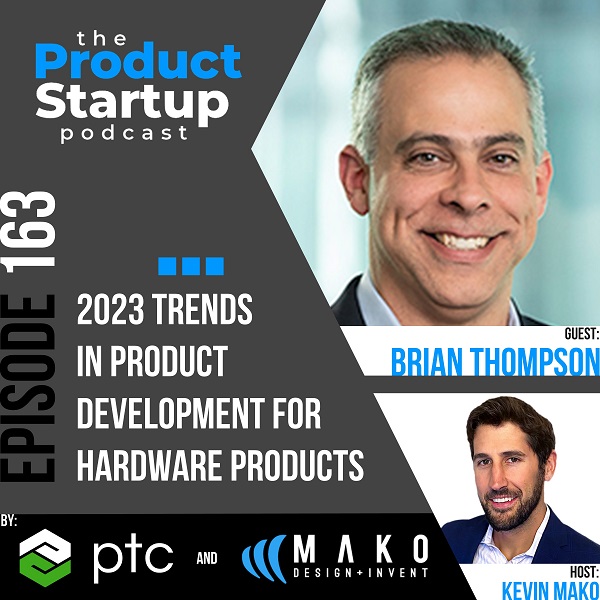
Guest: Brian Thompson, Head of CREO at PTC, with three decades of experience across CAD design engineering and product development software.
Host: Kevin Mako, founder of Product Startup and the leading expert in hardware startup consulting. A hardware entrepreneur since 1999, Kevin has advised more than 1,500 founders and built and scaled MAKO Invent through its acquisition by TriMech in 2024.
Episode Overview
Brian Thompson examines three hardware development trends highlighted in 2023: accessible design simulation, earlier manufacturing consideration, and additive manufacturing for short and medium production runs. He also explains how cloud-based CAD and better evaluation tools support faster iteration and stronger product quality.
What You’ll Learn in This Episode
- In the design process, digital simulation is gaining more importance as a tool.
- Advancements in technology have made it easier for non-experts to perform digital simulations within CAD design.
- Incorporating CAD simulations earlier in the design process allows for faster identification and resolution of potential issues.
- Utilizing simulations in design provides more opportunities for exploring different design alternatives.
- Manufacturers are increasingly investing in integrating manufacturing considerations into the design process.
- CAD software now provides a wider range of tools for evaluating designs and prototypes.
- The three primary design steps are idea design, prototype and functional design, and design for manufacturing, in that order.
- New software tools make it easier to progress through these steps and improve overall design quality.
- Additive manufacturing is increasingly being used for short-run production.
- The feedback from the first batch of parts produced through additive manufacturing presents a valuable opportunity for improvement.
- Startups should plan on using additive manufacturing to reduce risk during their first production run.
- It is important to design with additive manufacturing in mind and with a plan to transition to full-scale manufacturing as the business grows.
- Equity should be a key consideration throughout the design and manufacturing process.
Episode transcript
This transcript is provided for accessibility and reference. Download the SRT transcript.
Read the full episode transcript
Kevin Mako: Hello, product innovators. Today we learn what the 2023 emerging trends in hardware product development are from a
Kevin Mako: 30-year industry veteran who has both developed hundreds of products and built product development tools.
Narrator: You're listening to the Product Startup Podcast, a show to learn from top leaders in product development, product selling, and everything in between.
Narrator: Hosted by Kevin Mako, the leading expert on product development for physical product startups, sponsored
Narrator: by PTC's two best-in-class 3D CAD product development software solutions, Onshape, and Creo, and produced by Mako Design + Invent.
Narrator: The original firm providing world-class consumer product development services tailored specifically to startups, small manufacturers, and inventors.
Kevin Mako: Welcome back, everyone. Today, I'm very excited to introduce Brian Thompson to the show. Brian is the head of Creo CAD software for PTC.
Kevin Mako: He spent the first 16 years of his career doing CAD design engineering for hundreds of products, many of which are still in production today.
Kevin Mako: Then the last 14 years building CAD software solutions to allow designers to make better hardware products.
Kevin Mako: Today, Brian is going to share some valuable knowledge for inventors, startups, and small
Kevin Mako: manufacturers and what the three main product development trends are for 2020, which include using
Kevin Mako: design simulations, designing earlier for manufacturing, and using additive manufacturing for a short run or medium term production run. Now on to the episode.
Kevin Mako: Hey, Brian, welcome to the show. Thank you. Glad to
Kevin Mako: to be here. Kevin, appreciate it. Thank you. I'm excited today to talk about the trends that are emerging in product development for consumer products in 2023.
Kevin Mako: A lot's changing and at fast pace and a lot of really good things are happening, especially for hardware startups in the software, the development,
Kevin Mako: the design for manufacturing, basically all kinds of things are happening to make it easier
Kevin Mako: for somebody with an idea to go from that idea through development and into producing their own new product and building their own new product brand. Before we jump into all that,
Kevin Mako: give us a bit of a history because you've been involved for 30 years in product development in CAD software design, both of those fields at a very high level.
Kevin Mako: Talk a bit about your history
Brian Thompson: from then until now. Yeah, I appreciate it, Kevin. It has been an interesting time here. I've been a PTC only about 14 years, and I don't know how well the gray hair
Brian Thompson: is coming through on the podcast here, but you can tell I haven't been out of college 14 years. I spent the first 16 years
Brian Thompson: in my career, actually an industry as a product development guy, mechanical engineering background,
Brian Thompson: worked at four or five different companies, developed a lot of new products over that timeframe. For your audience, just understand I have many, many, many
Brian Thompson: drawings that I actually built, into production, and a lot of them are still in production today, even though I haven't been in
Brian Thompson: industry for a decade and a half, and got excited about product management at some point in time.
Brian Thompson: I worked in semiconductor capital equipment industry for a little while, and product managers in that industry are very, very technical. So they brought an engineer into that role.
Brian Thompson: They tend to be business and marketing people. And actually, it turns out that product managers at PTC are also very technically inclined. All the product managers on my team now,
Brian Thompson: as I run the Creocad business here at PTC, I'm the general manager of that business. All my product managers are engineers.
Brian Thompson: So I grew up as a product manager, PTC, and I've been a PTC now 14 years, and I've been doing this job running the CAD business now in my eighth year,
Brian Thompson: almost seven and a half years I've been doing that. So great to be on here. I appreciate you, give me a chance to talk with my background because actually for this audience,
Kevin Mako: I think it's super irrelevant. Especially as we're looking at these trends that are coming forward. Yeah. CAD software, it's the foundation for how all products are made.
Kevin Mako: They're made through 3D CAD design. I mean, I set the design firm, this is pretty much all we do all day is design and engineer and prototype products using CAD software.
Kevin Mako: Obviously, Onshape and Creo. And for those who don't know, interesting tidbit, Creo is the rebrand of ProE, which is a major brand.
Kevin Mako: And you guys basically just took the ProE brand,
Brian Thompson: rebranded it to Creo about 10 years ago. Yep, that's right. It's neck and neck now in terms of brand recognition on the internet. Pro Engineer, it's such a strong brand,
Brian Thompson: really wanted to make sure the market understood. We're headed in a new bold direction with the CAD technology. And it's been a success. I will say that.
Brian Thompson: But I think the marketing team within PTC felt the most pain. trying to get that brand recognition of a new brand with pro engineer having such a strong brand in the
Brian Thompson: past. Ultimately, I think we're happy we did it. Many, many, many, many customers that have been
Brian Thompson: around the market for a long time still think of proe in the back of their mind. And everybody needs to know that the core engine of pro engineer is there inside PREO.
Brian Thompson: It's still the same technology
Kevin Mako: under the hood that's been, I would say, significantly advanced since we rebranded.
Kevin Mako: Yeah, amazing. And then you took a lot of that technology, learnings, et cetera, from CAD and then created the cloud-based Onshape as well, which is a phenomenal software.
Kevin Mako: package that essentially is cloud-based CAD design between teams or individually or whatever else,
Brian Thompson: right? Yeah, I would say, to be clear, we acquired the Onshape business a few years ago and merge the minds of some pretty, some pretty heady folks.
Brian Thompson: You know, we talk about someone like John Hirstick, who's an absolute Titan in the CAD world. He now works for PTC and has now for three and a half years.
Brian Thompson: And that was been a major, major deal for us because he's injected a lot of really, really customer-centric and now cloud-centric thinking and how to develop CAD products.
Brian Thompson: And we'll talk a little bit at the end about what's next for us here at PTC after we talk about some
Brian Thompson: trends. But one of the major things is John's influence and helping us all think differently about how
Brian Thompson: CAD will work and how CAD will exist on the cloud and how that will help engineers do a better
Kevin Mako: job as well. So that's very, very exciting development for us. Amazing. And I think a lot of that relates to the trends we're talking about today. So there's three
Kevin Mako: big trends we're going to talk about. And I'm not going to spoil it. Brian, why don't we start with
Kevin Mako: number one, and we'll talk through those to get to the three of them. And then at the end,
Kevin Mako: we can talk about some exciting things that are coming up in a big event that's coming up in May
Brian Thompson: as well. Yeah, hardware startups are going to want to know. Absolutely. Absolutely. So I would say the first one, I would say, for sure, the first one is simulation.
Brian Thompson: Or I should say the adoption of simulation earlier and earlier and more pervasively throughout the design process. And I would say the big change
Brian Thompson: in the last few years with simulation has been advances in the technology that are making
Brian Thompson: simulation so much easier to work with as a new person just trying to adopt simulation
Brian Thompson: who just understands the basic physics of how simulation is supposed to work. The technologies
Brian Thompson: are advancing to the point where you no longer have to be an expert with how to manipulate loads and boundary conditions to not get, divide by zero problems in your meshing or in
Brian Thompson: your solving. It's really, really amazing how far the technology has come in the last, I would say, five years. And we noticed this happening in the market.
Brian Thompson: We partnered with Ansis to try to get their technology in the hands of the everyday design engineer. And it's been a massive, massive success.
Brian Thompson: And so it really is a technology that has been underutilized early in the design process. But the fact of the matter is, the earlier you use it, the more likely you are to catch,
Brian Thompson: I'll just say assumptions that you made in the design early on that are, you know, wrong.
Brian Thompson: Design engineers make gut assumptions on the designs all the time that are well-intentioned, but end up driving too much cost, driving sort of a quality challenge into the design
Brian Thompson: very early on. And the early you can catch those things, the more cost effective, it will be to take them out.
Kevin Mako: And using simulation early in the design process is a big deal there to improve that. That's so powerful.
Kevin Mako: I can tell you from the design from angle, our industrial designers, mechanical engineers, electronic engineers, no matter what way you look at it, we were big early adopters.
Kevin Mako: Well, before COVID and all that, we were super cloud-based. And we were, of course, early adopters on digital simulations.
Kevin Mako: Because what that does is that helps you vet out all kinds of theories, both problems and opportunities. And the more tools that we have available to us as designers,
Kevin Mako: the easier it is for us to make a better quality product on a lower budget. That's really what it comes down to, and speed to market, of course.
Kevin Mako: So you can do a whole bunch of things digitally, which you had to in prior years do physically. You had to actually build the thing and test it. Well, there's so much
Kevin Mako: now we can do digitally. What that does is that really improves the quality, not just the prototyping
Kevin Mako: process, but as we evolve from prototyping to vet out everything into manufacturing. And that's
Kevin Mako: where it's extremely helpful to have these digital tools available so that we can really test out all these different, as you call it.
Kevin Mako: I love it. Engineering theories on the actual technology,
Brian Thompson: really to figure out how to build a better product earlier in the development process. Yeah, I totally agree.
Brian Thompson: One of the benefits of using simulation early and often that's not talked about as often is the fact that if you are really good at applying simulation early in the design
Brian Thompson: process, you have the opportunity to explore a much broader solution space. You can explore many, many, many more design alternatives.
Brian Thompson: If you can rapidly apply simulation to your designs and get feedback on whether those designs are helping you get in the right direction or not, and that is changing the game.
Brian Thompson: We find a lot of customers are willing to invest in simulation, not just because they know it will drive better quality and not just because they know it will help them avoid
Brian Thompson: costly prototypes, but also because we know, I think this is particularly relevant for startups, we know it'll help customers get to the best product to meet
Brian Thompson: their customers' needs, much more efficiently than if they don't use simulation, right? If you're just doing test break,
Brian Thompson: you're just not going to evaluate as many, any alternatives as you will if you're doing all
Brian Thompson: that digitally. And that is, I would say less hidden today, but that has been an often hidden benefit
Brian Thompson: of simulation is just how many different design variations can you evaluate? Well, you know,
Brian Thompson: the better and better the simulation gets, the more of them you can evaluate in really the same
Kevin Mako: amount of time. Yeah, absolutely. And that's why I like looking at it both as like pain points and opportunities. Definitely. You have a nice healthy balance of that.
Kevin Mako: And it allows you to also So put better effort, even into the prototyping process, you could be more focused.
Kevin Mako: So in the prototyping process, you no longer have to, like, put, let's say, 20 different unknowns into it. 15 of the unknowns you can figure out digitally.
Kevin Mako: The last five, let's say, are the ones that you really focus on. So we're going to build and we're going to test for those things because the other ones we already figured out.
Kevin Mako: So even as you go through your prototyping process, first of all, you'll cut the number of prototypes down significantly.
Kevin Mako: So rather than have to do five or 10 of them, maybe you have to do two or three now.
Kevin Mako: And then second, in addition to that, you're much more focused in those prototypes, which brings
Kevin Mako: back to what you're saying, Brian, it's not just problem solving, but it's also opportunities. So within those prototypes, you can really harness the evaluation of those things and
Kevin Mako: then migrate those learnings into the subsequent prototype or into production, which leads to the second piece, I think, which is very powerful.
Kevin Mako: How do we actually flow this through all the way to production?
Brian Thompson: And how does that lead into a trend you're seeing for 2023? It's a great tie-in to the second topic here.
Brian Thompson: And I think that it would be useful to understand a little bit of history here. I think for a long time, 3D CAD tools had integrated within
Brian Thompson: them, I would say suboptimal technologies to help with design for particular manufacturing processes, whether it's designing something for injection molding purposes or designing
Brian Thompson: something to be bent up and sheet metal or maybe designing something to be machined or just turned or what have you.
Brian Thompson: And as a result, companies still had the freedom to make what I would call point solution decisions.
Brian Thompson: they might pick a technology to say do their NC tool paths, their machining tool paths that isn't directly tied to the CAD. And that can work and that's great.
Brian Thompson: But the fact of the matter is, if you're going to evolve the design over time, or you're going to create derivative designs,
Brian Thompson: every time you make a evolution of an existing design or make a derivative design from an existing
Brian Thompson: design, if your design for manufacturing process technology is not tied intimately to your CAD environment, it will create a bottleneck in the process.
Brian Thompson: I call it context switching. You're context switching from the design tool to the manufacturing tool, and you lose a
Brian Thompson: lot of efficiency because you end up redoing at least a lot of thinking or physical work in the environments.
Brian Thompson: And what we're finding is the technologies in CAD tools are catching up and getting more and more sophisticated to the point where customers are re
Brian Thompson: -looking at it because they're saying, I can pretty much do what I want in the technology.
Brian Thompson: Let's say, again, for machining, just to use an example, I can pretty much do what I want in the technology to help me set up the tool paths in the CAD tool.
Brian Thompson: And when you add in the benefit of the fact that now tool paths are associatively tied to the core design,
Brian Thompson: and as I evolve or make derivative designs of that core design, I get extremely efficient updates to the downstream manufacturing process information.
Brian Thompson: Now you have a huge, huge win. It might not seem like a big deal for someone doing the design for the first time. I get that.
Brian Thompson: But today's startup is tomorrow's, hey, let's make the next. next evolution of this existing design. Let's make a derivative design now that we've got customers
Brian Thompson: feedback. And as soon as that starts happening, you will love the fact that you closely tied
Brian Thompson: the manufacturing team to the engineering team did all that in one design process because the
Kevin Mako: handoff efficiency is huge if you're doing it together. Absolutely. That's so powerful. Even in the
Kevin Mako: prototyping phase, but as you migrate into production, the more intelligence you have in the CAD software that looks forward, the easier each of those subsequent steps is.
Kevin Mako: And that's one of the big misconceptions with design of a new product, especially for a new hardware startup that's never been through the product design process before.
Kevin Mako: They look at it and they say, okay, well, I've got the design or I've got this idea. Let's start at the idea phase. They have this brilliant idea for this new gadget and then
Kevin Mako: they either work with a design firm or if they're designing themselves, they come up with this nice CAD that shows the features. But that's the first part of it.
Kevin Mako: The first part is showing the CAD with the features and the vision that you have. The next part is actually figuring out how that works.
Kevin Mako: That's the hardcore detailed underlying engineering. And that's the first misconception.
Kevin Mako: First misconception is, well, if I have a design file, I'm just ready to produce. Well, no, you actually need to figure out how that works. And that's the details in engineering.
Kevin Mako: But then this is the bigger misconception. A lot of people, even if they understand that, okay, of course, you have to do some
Kevin Mako: detailed engineering on mechanical engineering and the industrial design elements that integrate with
Kevin Mako: the mechanical engineering, the electronic engineering that puts all this together if you have electronics
Kevin Mako: in your product. Know that that's like you're vetting of the workability of the product. But the next big step is manufactureability.
Kevin Mako: And there's a big knowledge transition that happens between a functional, let's say fully functional engineering drawing, even fully functional
Kevin Mako: prototype. This thing works well, looks perfect, the way I want it. Excellent. Know that now you actually have to figure out how to produce that.
Kevin Mako: Well, how do we make that process of going through those three steps easier? And this is exactly what Brian's talking about today. You start with
Kevin Mako: obviously your design and your vision. That's very important. But you start integrating manufacturing logic as you go into the prototyping and engineering phase. Oh, absolutely.
Kevin Mako: And then even more and more manufacturing logic as you're going, but before you're going into production so that as you migrate into production, it's, again, not seamless, but
Kevin Mako: relatively seamless, right? It's a few last hurdles, as opposed to having to constantly loop back and rework the entire design to get to the next phase.
Kevin Mako: And that's how you can move through those one, two, three steps. But that's also a big thing that really hardware startups need to understand is looking forward,
Kevin Mako: if you're at that idea phase, know that each of those three has a whole bunch of detailed design and engineering that goes into them.
Kevin Mako: And the earlier that you can bring in logic and tools and et cetera that can help carry you
Brian Thompson: through to that end state, the easier it will actually be to get to that final state of really producible product. No doubt. And it's a very good tieback to the first topic, right?
Brian Thompson: You can introduce sort of, I would say, functional problems in your design early without using simulation to test whether or not your design is going to meet its function.
Brian Thompson: where you can also introduce design for manufacturing problems into your design early without testing that for manufacturability with the manufacturing experts and using
Brian Thompson: systems tied to your CAD in order to assess the manufacturingability of the design early as well. Both types of design issues, everybody makes these kinds of mistakes.
Brian Thompson: That's why it's called product development. You don't just show up with a production ready design on day one. Both types of issues are costly to address.
Brian Thompson: Whether you have a late stage functional problem that you uncover in prototype testing that you could have caught with simulation, or you have a late stage,
Brian Thompson: high cost driving
Brian Thompson: manufacturability problem that you uncover when you're finally starting to tool up your design, both are very costly things to fix once the design is very mature.
Brian Thompson: So getting that insight early in the design process and having a better connection into manufacturing is really important
Kevin Mako: for a lot of the same reasons as it was to apply simulation early in design process from our first topic. Absolutely.
Kevin Mako: I know that those costs only get bigger and bigger and bigger. So that yes, whatever your cost is to rework the design or the prototype or put a little bit of
Kevin Mako: effort into those simulations, whatever that might be is a fraction of what the cost is to discover those defects later. And even worse, as you go to market, that's where it's
Kevin Mako: super expensive because now it's not just a physical cost of fixing it, but it's a brand reputation
Kevin Mako: cost. And all the other costs that can go along with those elements of failure. It's interesting because at macro design, we were startups.
Kevin Mako: And one of the things about startups is that for the most part, us as a design firm, have to produce the products that we design.
Kevin Mako: So we were kind of forced into it early, like years and years ago, we were forced into this
Kevin Mako: concept early. We couldn't just come up with these like blue sky ideas and get the client to say, wow, that's amazing, looks nice.
Kevin Mako: We had to bring in more and more manufacturing knowledge in earlier into the process. And that's what I really love about what you guys are doing at PTC, whether it's
Kevin Mako: Onshape or Creo, whatever else. You're giving us as designers the tools to be able to look at some of
Kevin Mako: those challenges, even in the early design phase or into rough prototyping or test prototyping or whatever
Kevin Mako: else, we can start addressing some of these problems earlier than before so that the client has
Kevin Mako: the power to make the decision on whether they want to develop further and solve the problem,
Kevin Mako: or maybe it's not that important of a feature and they can save it for their next version.
Kevin Mako: And having that ability to really be collaborative and interactive earlier in the process,
Kevin Mako: understanding what the outcome is in production has been very valuable, both as a design firm,
Kevin Mako: but most importantly, to the customers, to the clients that are trying to launch these successful new products. And all of that comes down to the tools and the technology.
Brian Thompson: in the actual CAD software for us to run that simulation work. Yeah, absolutely. It's interesting. I love the focus on startups that you have, but hopefully
Brian Thompson: won't be surprised that when I talk to companies that have been PTC customers for 30 years, they're actually doing the same thing.
Brian Thompson: They're actually challenging themselves in the same way because they've actually made a lot of these same decisions and are rethinking them and trying
Brian Thompson: to use simulation more and trying to do design for manufacturing, better right there in the CAD tools. So it's interesting how the problems are really the same,
Brian Thompson: you are a $100 billion company or a startup. It really is the same. Yeah, you might have a different scale. But when you talk to the design engineering managers,
Brian Thompson: they would not recognize a difference in the value of this conversation at all, whether they're at a huge company or at a startup.
Brian Thompson: I guess at an existing company with an existing revenue stream, there are different pressures, right? And there's a startup that's just trying to make.
Brian Thompson: I don't want to minimize that.
Kevin Mako: But in terms of like pure engineering challenges as a release of these trends, it's almost exactly the same conversation.
Kevin Mako: Well, I want to talk about, too, moving forward one step further. because the first two things we talked about actually lead into this concept of additive manufacturing.
Kevin Mako: And this is something that you talk about is the third kind of major trend. I want to look at additive and what you see in terms of value for new products
Brian Thompson: getting to market, both on the design side, but also on the feedback loop. Yeah, it's pretty wild because we've been watching very, very carefully.
Brian Thompson: I would say we're on our sixth major release with significant enhancements as it relates to added manufacturing.
Brian Thompson: So we're on our six or seventh year, depending on what you count when we start a development,
Brian Thompson: where we started to realize additive manufacturing is beginning to make the transition from simply a tool for prototyping to a tool that can potentially be used to make
Brian Thompson: early production or even reasonable scale production parts. And it's still moving very, very fast. And for all of us
Brian Thompson: that are in the CAD design development world, it's a challenge to keep up. Because the market is still very, very specialized.
Brian Thompson: Different tool vendors that build additive manufacturing equipment are focusing on slightly different value ads as it relates to the type of material that they're expert in,
Brian Thompson: the type of process that they're expert in, and it's still a pretty segmented market.
Brian Thompson: But the fact of the matter is, everybody recognizes the opportunity that additive is starting to make the leap into something that is, at the very least, mid-volume manufacturing
Brian Thompson: ready to like production parts and certainly ready for very, very high quality early prototype feedback loops.
Brian Thompson: That is a fact. And so we have to give the tools to take advantage of that to the design engineer right there in the core CAD environment.
Brian Thompson: If we don't, then we're going to create the same kind of disconnect to other manufacturing processes as we do to additive manufacturing. Like we want to try
Brian Thompson: to make sure there's not a lot of context switching when you're getting your part ready for additive manufacturing. In the startup space, we see, I would say, a higher
Brian Thompson: proportion of use of it for early prototypes and early feedback. And that's a good thing because the parts are getting so good and so
Brian Thompson: high quality that the type of feedback you're getting is so close to what you would get with what we would call more traditional manufacturing processes to make those parts.
Brian Thompson: I see it as a huge opportunity. But depending upon what your early volumes are, you might be able to stay there for a little
Brian Thompson: while as you continue to build knowledge and get feedback in customers before you really commit to tooling. It's a really, really remarkable trend.
Kevin Mako: Things move very fast. You have to pay very close attention, but we see it as continuing to grow. That's amazing. And it's something that's
Kevin Mako: really useful for a startup, especially getting those first few units. There's always that dreaded move
Kevin Mako: from you finish all your design, you've nailed it, you've even figured out all your design for manufacturing engineering.
Kevin Mako: Let's say you're at the very end state of all your hard work and you want to go into production. Well, there's production tooling costs and production costs and setup and all the
Kevin Mako: Yes. And there's a lot of work that goes into that. But this is a beautiful little bridge between the end of your design state and
Kevin Mako: the beginning of your, let's call it, hardcore mass manufacturing. This is where you can go to market faster, cheaper, lower units and
Kevin Mako: get real users to give you feedback. And that is really, in my opinion, the true value. I look at those first production runs.
Kevin Mako: And especially for a startup, it's not something that you want to make money off or even consider
Kevin Mako: it. If you're selling 100 or 200 units, the goal there isn't to be super profitable. And that's to start giving you money.
Kevin Mako: The goal for that is to amplify the equity value of your business. And you're doing that by getting real value from customers to tell you precisely
Kevin Mako: what is working, what is not working, and what you might want to add. And that's where it gives you a tremendous amount of
Kevin Mako: confidence. It significantly reduces the risk of the big cost of going to tool up to do a thousand, 10,000, 50,000 units.
Kevin Mako: What better technology than additive, which is historically, of course, that's thought of as 3D printing. And that's really what most the average person thinks about. But it's
Kevin Mako: so much more advanced than that now because the 3D printing abilities, let's call it, are so much more advanced in terms of the accuracy, the quality, the ability to mimic real
Kevin Mako: production parts that you can get like you said, Brian, I like how you mentioned the word very close feedback to what your
Kevin Mako: product would be to make you so much easier to essentially be a commercial success. Because after that
Kevin Mako: feedback, when you've got 100 or 200 people of which, you know, a whole bunch of them have given
Kevin Mako: that feedback, imagine the amount of confidence you can go with towards an investor to say we
Kevin Mako: release a small amount, people whipped out their credit card to pay this, here's the feedback they gave
Kevin Mako: us, here's exactly how we're planning to incorporate that feedback and potentially based on those
Kevin Mako: users, here's some bigger buyers that are now interested as a result of those first few products. You can be worth 10 or 50 times the value at that point, then
Kevin Mako: you were even with a good
Brian Thompson: prototype, ready to go to your perceived first idea for what you plan to do in production.
Brian Thompson: Great point. Knowing what I see our customers doing with additive manufacturing, I would say,
Brian Thompson: if it were me in a startup role, I would for sure plan on leveraging additive manufacturing
Brian Thompson: to basically defer some of the risk that you're talking about early in the process of delivering your product at some scale to the market to try to get feedback.
Brian Thompson: I would say plan on it, if you can. That doesn't mean buying additive manufacturing equipment. There are bureaus out there
Brian Thompson: that will help you with this, with printing those parts, really high quality. And the amount
Brian Thompson: of commitment you have to make from a tooling point of view is so much lower. It's really worth
Brian Thompson: it. I would plan on it and you can use the CAD tools and the variation capabilities and CAD tools
Brian Thompson: to design a part that's intended to be added to manufacturing with an eye towards, say, five-axis machining or an eye towards casting.
Brian Thompson: You can do that if you use the tools in a mature way. And if they were me in that role, knowing what I know now and what I see customers doing, I would definitely
Brian Thompson: plan on that kind of multi-step transition just because of the type of risk it
Kevin Mako: helps you defer. Right. It's a super, super way to go with early production introduction. Yep, absolutely, Brian. Appreciate your words of wisdom there.
Brian Thompson: Now, let us know, I know there's a big event coming up. Tell us more about what that is and how startups can learn from it.
Brian Thompson: We're really excited to finally be bringing back to the market our annual user event. It's called LiveWorks.
Brian Thompson: This year, it's happening May 15th through 18th. And as a startup, if you happen to be based in the Northeast and you can get here in person,
Brian Thompson: I highly recommend you come. We have a very aggressive goal, and I don't want to call out my marketing team. Let's say between 5,000 and 10,000 people live at the event, at the
Brian Thompson: Boston Convention Center right here in Seaport in Boston, but we're also going to have a significant online present. You could be anywhere in the world in a startup.
Brian Thompson: You could see all the keynotes. You can find everything you'd want to know about all the PTC's premier products, whether it's
Brian Thompson: Creo, windshield, Onshape, some of the newer products who just acquired like CodeBeamer or even our service max service-based solution.
Brian Thompson: it is a really, really fantastic event, no matter what part of the product development process you are in, you can learn something.
Brian Thompson: But for startups, hey, getting the latest, greatest information about what's happening with Creo and Anche. If you're really into CAD, you can get that at LiveWorks. You can get
Brian Thompson: just by participating online, but you're going to get even more by talking to the experts face-to-face
Kevin Mako: if you can somehow make it here, particularly if you're in the Northeast, if you can make it to Boston for those days. So I would really, really recommend it. Yeah, that's amazing.
Kevin Mako: LiveWorks 2023. And of course, I'll put the links to LiveWorks 2023 in the episode notes below. So anybody who wants to click through, you can just do that there.
Brian Thompson: Brian, thanks so much again for all your words of wisdom today on the trends that are happening in 20203 in product development.
Kevin Mako: Looking forward to talking to you again soon. Yeah, I appreciate it, Kevin. Thanks for having me on. It was a great time. And looking forward to seeing this podcast come on.
Kevin Mako: I think it's going to be awesome. Thanks, Brian. Take care.
Narrator: Thanks for tuning into this episode of the Product Startup Podcast. If you found some value in the show, please do us a huge favor and leave us a quick five-star review.
Narrator: If you have any questions, guest suggestions, or anything else, feel free to reach out to us anytime at our email, podcast at MakoDesign.com. That's podcast at MakoDesign.com.
Narrator: This show is hosted by Kevin Mako. North America's leading expert on product development for physical product startups. Huge thanks to our sponsors, PTC,
Narrator: and their two best-in-class 3D CAD product development software solutions, Onshape, and Creo, and Mako Design + Invent.
Narrator: The original firm providing world-class consumer product development services tailored specifically to startups, small manufacturers and inventors.
Narrator: Thanks for joining and see you next time.
Product Development Process Strategy for Founders
Bring Risk-Reducing Tools Into the Plan Earlier
Work directly with Kevin Mako to identify where simulation, manufacturing input, additive production, and cloud collaboration can create useful evidence earlier in your hardware roadmap.
Kevin can help you sequence these decisions, prepare for specialist conversations, and keep new tools aligned with product value, cost, quality, timing, and manufacturing goals.
Request a Development Process Strategy Call
Tell Kevin what stage the product is at and where earlier evidence would save the most time, cost, or uncertainty.