
Listen Now
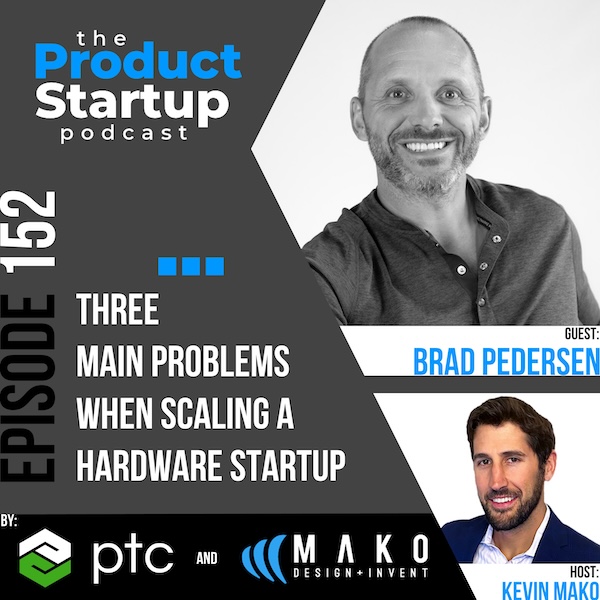
Guest: Brad Pedersen, Co-Founder at Pela and Founder of Lomi, a hardware product that raised nearly $10 million through crowdfunding.
Host: Kevin Mako, founder of Product Startup and the leading expert in hardware startup consulting. A hardware entrepreneur since 1999, Kevin has advised more than 1,500 founders and built and scaled MAKO Invent through its acquisition by TriMech in 2024.
Episode Overview
Brad Pedersen frames the central scaling challenge around people, processes, and capital. He explains the transition from generalists to specialists, the founder’s risk of becoming a bottleneck, the need to reinvent operating systems as growth changes, and why product-market fit is only the beginning of building a scalable company.
What You’ll Learn in This Episode
- People, Processes, and Capital
- The growth trajectory is both a blessing and a challenge.
- To scale effectively, you must continuously evaluate and reinvent the three primary areas that often lead to scaling failures.
- Finding product market fit is a crucial step, but to ensure sustained success, you need to focus on your people, who are the biggest lever.
- The progression should be from generalists to specialists.
- Annual single-digit growth is acceptable, but quarterly double-digit growth is preferable.
- Avoid becoming a constraint to everything.
- Efficient processes maximize the potential of your people.
- A successful hardware startup requires a smart founder, a compelling idea, a unique marketing plan, a talented team, and effective execution.
- Hire individuals who possess more expertise and skills than you, even if it means paying them more, especially in the early stages.
- Secure the necessary capital to reach your minimum viable product (MVP).
- Do not let the pursuit of perfection hold back progress.
- The approach should be: build, assess, and improve.
- Consider selling directly to consumers.
Episode transcript
This transcript is provided for accessibility and reference. Download the SRT transcript.
Read the full episode transcript
Kevin Mako: Hello, product innovators. Today we learn from a developer and distributor of thousands of products on how to avoid the three main problems facing a new scaling hardware startup.
Narrator: You're listening to the Product Startup podcast, a show to learn from top leaders in product development, prototyping, manufacturing, product selling, and everything in between.
Narrator: Hosted by Kevin Mako, the leading expert on product development for physical product startups,
Narrator: sponsored by PTC's two best in class 3D CAD product development software solutions Onshape and Creo,
Narrator: and produced by Mako Design + Invent, the original firm providing world-class consumer product development
Narrator: services tailored specifically to startups, small manufacturers, and inventors.
Kevin Mako: Welcome back, everyone. Today I'm very excited to introduce Brad Pedersen to the show.
Kevin Mako: Brad is the founder of the hardware product, Lomi, which raised almost $10 million in crowdfunding in his most recent hit success.
Kevin Mako: In his earlier years, he developed many new products and also distributed thousands of other hardware products all over the world, mostly in the toy and sports product fields.
Kevin Mako: Today, Brad is going to share some valuable knowledge in how inventor startups and small manufacturers can learn what the
Kevin Mako: three most important elements of an emerging hardware startup are, how to avoid key pitfalls around each of those three areas, and how to scale your product to become the next
Kevin Mako: big hit invention success. Now, on to the episode.
Kevin Mako: Hey, Brad, welcome to the show. Kevin, great to be here.
Kevin Mako: Looking forward to our conversation. I'm excited today to talk about scaling a new hardware business. You have a tremendous amount of experience in this.
Kevin Mako: Obviously, you've worked with literally thousands of different products, both on a distribution side and also on the innovation and manufacturing side.
Kevin Mako: And of course, you had the absolute massive home run with Lomi product, hitting almost $10 million in crowdfunding worldwide.
Kevin Mako: So we're here today to talk about what to look out for. What are some of the problems and pain points as you grow a hardware business.
Kevin Mako: So whether you're an inventor and you've got that new idea or whether you've got the product in production and you're looking to scale, this is really important
Kevin Mako: topic to look forward to identify some of those pain points and how to avoid them from somebody who has been very successful with growing massive brands in the past
Kevin Mako: and continues to do so today. Brad, why don't you just give us a bit of a background? You've been doing this for, I think, almost 27 years you mentioned.
Brad Pedersen: How did you get to where you are today? Yeah, thanks, Kevin. I know we have a limited amount of time today. So I'm going to try and distill
Brad Pedersen: this to a quick introduction as possible. So I'm currently the co-founder and chairman of Pila.
Brad Pedersen: And Pila is a waste innovation company that's committed to creating a waste for future because we believe garbage is optional.
Brad Pedersen: And as such, we create products with the end of life solution designed into the beginning. And as you mentioned, we're the creators of Lomi, which is the world's first
Brad Pedersen: smart waste appliance that really magically turns organic waste into soil while you sleep. But before we go down that path, I want to talk a little about the history, because for
Brad Pedersen: about 27 years in my life, I was the real Santa Claus. I made kids toys. And of course, because I'm from Canada, I'm a toy maker from the north.
Brad Pedersen: So I can claim official title of being the real Santa Claus.
Brad Pedersen: And during my time, I went from being a toy distributor into a toy developer, manufacturer.
Brad Pedersen: Over the course of my life, we have shipped tens of thousands of products. And, you know, I've literally shipped billions of pieces of plastic around the planet, all
Brad Pedersen: putting smiles on kids faces. That was the goal and intent, but it was also part of the reason why I became the
Brad Pedersen: co-founder of Pila and focused on Lomi because it was a part of my recompense that I was looking at ways that we could do things smarter and better and less wasteful.
Kevin Mako: So that gives you a quick history in my background. That's amazing. And today we're talking about scaling up a hardware business.
Kevin Mako: So we got to the point where we're in production or we've been producing for a little bit and we really want to grow and scale.
Kevin Mako: Now, you've gone through this process many times, and especially obviously with this most recent venture. There's three main things that you like to talk about,
Kevin Mako: people's systems and cash. Why don't you walk through those three one by one. We'll spend a few minutes on each and how a new emerging hardware startup can avoid some
Kevin Mako: of the pitfalls and become
Brad Pedersen: a major hardware success startup story. Yeah. So just for some context in my first toy venture back in 2006, we were growing rapidly.
Brad Pedersen: We were building incredible scale. We had all kinds of sort of accolades within industry because of our growth. And at the time, I felt like a rock star
Brad Pedersen: in terms of that, the success of that business. But that business ultimately went into distress because
Brad Pedersen: we grew up too quickly and we tried to salvage it and eventually it went bankrupt. So the reason I say that is because we don't tend to learn very well from success.
Brad Pedersen: We learn a ton from failing and becoming a failure. And in this case, because that business failed, I took a whole bunch of lessons from
Brad Pedersen: it. And the key lesson is, well, how did we break it? What happened along the way? And through
Brad Pedersen: reflection, what we went through in terms of scaling this thing and is ultimately capitulating the
Brad Pedersen: company is that there were three areas that we were not actively reinventing in order to properly scale a company.
Brad Pedersen: And as you pointed out, that is your people, your systems and your cash. Because if you're scaling a company, if you're growing something, you're ultimately stressing it.
Brad Pedersen: You know, growth is a sort of double-edged sword. You need to grow because I don't believe there's stasis that you're designed to grow.
Brad Pedersen: So it's a part of who we are. But if you're not reinventing yourself, if you're not shedding your skin as a snake would to grow into its new skin,
Brad Pedersen: you're ultimately working in the past and you will lack the capacity and capabilities that you're going to need for the future.
Brad Pedersen: And as we said, it's your people, your systems and ultimately your cash resources to be able to make it happen. So happy to dive into each one if you want to or
Kevin Mako: however you want to go through the conversation.
Brad Pedersen: Yeah, let's do it. Let's start with people. Got it. Okay. It's not lost on me that everything starts from small beginnings. You know,
Brad Pedersen: a giant oak tree was an egg corn at one point in time. So all of my ventures until Pila have been
Brad Pedersen: bootstrap stories where you're starting with a limited amount of resources, including yourself. In fact, you probably are the main resource.
Brad Pedersen: You're the one, you know, burn the midnight oil,
Brad Pedersen: multitasking and are a consummate generalist. You have to be good at pretty much everything. Not good at it, but competent.
Brad Pedersen: You can actually get through the day and do everything from empty the garages to filling spreadsheets to actually doing some design work, maybe even working
Brad Pedersen: on a CNC machine and then ultimately making sure that you're building a customer base as well. So as you build momentum and success and cash flow, the
Brad Pedersen: first thing you want to start thinking about is what do you need to be sustainably scalable?
Brad Pedersen: When you get product market fit, how are you going to be able to turn that product market fit into something that's enduring that ultimately goes the distance?
Brad Pedersen: And I would tell you your number one resource and ability to do it is people because it's the
Brad Pedersen: ultimate lever. The idea being is that you're going to start off as a generalist and you're
Brad Pedersen: going to hire generalists. But over time, you're going to migrate from being generalists to specialists. And inventing your people is something that I would
Brad Pedersen: say depends on the speed of growth. Like if you're doing sort of single digit growth, this is probably something you can consider bi-annually or annually.
Brad Pedersen: If you're double-digit growth, this is something you're thinking about probably quarterly. And if you're triple-digit growth, which I've had before,
Brad Pedersen: of being a part of a few enterprises like that, that's something that you are continually updating
Kevin Mako: and upgrading, is to find the right people to help you achieve your vision and mission. That's amazing. It's dear to my heart.
Kevin Mako: I know from the early days of bootstrapping macro design, when there's just a couple of designers and myself working out of a condo in the early days back in the early 2000s,
Kevin Mako: I was doing everything from sales to bookkeeping, to marketing, to client relationship, to project management, you name it. And, of course, as you scale, your own personal role.
Kevin Mako: role really is the first and the most important to develop over time. And it changes rapidly. So I really
Kevin Mako: like how you brought that up as you're almost your own biggest bottleneck to start because you are the generalist, especially as the founder, the owner, the pioneer of this thing.
Kevin Mako: You are taking on a lot of roles to start. But know that you have to constantly reinvent yourself and grow with the company
Kevin Mako: because you yourself will become more and more of a specialist over time. I know looking at it now, or 30 plus people, offices all over the place.
Kevin Mako: I couldn't possibly do the same type of work that I did back in my early 20s now that I'm at my late 30s. It really changes what you actually do on a day-to-day basis enormously.
Kevin Mako: And if you didn't have the willpower to grow as a person, that's the first major step to then, of course, helping your team grow as individuals, which is the next big
Brad Pedersen: part of the equation.
Brad Pedersen: 100%. Yeah, you can't give what you don't have first. There is no stasis. You're either green and growing or ripe and rotting. 100% you need to give yourself.
Brad Pedersen: This idea that when you're on an airplane, they tell you put your auction mask on first before putting on your kids from oxygen masks. Well, it's just like that in life too.
Brad Pedersen: You want to grow yourself and your team's capabilities. And then I think you just teased on a little bit is that often founders become their own worst enemy
Brad Pedersen: because they don't know how to get out of their own way. They become, I call it the Wizard of Oz syndrome.
Brad Pedersen: They become good at a bunch of things and they ultimately become the bottleneck for everything and no decision can be made without them having input. That is not scalable.
Brad Pedersen: Short term, we get it. You got to be that person who's doing the scrappy startup stuff.
Brad Pedersen: But if your business is not sustainable, scalable, sellable, then ultimately you don't have a business, you're self-employed, right? That's something that you're just doing.
Brad Pedersen: It's a job you've created for yourself. And that's fine. But ultimately, if you want to build an enduring company, it's about using people to help leverage your time.
Brad Pedersen: And I think Dan Sullivan says it best. He says, if you're a founder thinking of like a 2x growth, then probably you don't need to go hire people. You can just work twice as hard.
Brad Pedersen: And you're young and you have energetic. You can do that. So stop thinking 2x. and start thinking 10x, because within your mind, you can't actually comprehend what it's going to
Brad Pedersen: take for you physically to 10x your efforts. And it's going to force you the discipline of actually going in and finding a way to grow your people.
Brad Pedersen: And then ultimately, the second piece, which is your systems, because your systems are what keep the people working. Right. So this is where people
Brad Pedersen: are singing from the same song sheet. You're taking drag out of your system because you have
Brad Pedersen: conductive and orchestra, which is what you should be as the founder, is keeping all the instruments moving in synchronization that creates beautiful music.
Brad Pedersen: And that's ultimately what your job is that the founder is to do. So if you have the team, now how do you keep the team singing from that same song sheet?
Brad Pedersen: And the systems you start with are not the same systems that will work for you going forward. Particularly as you add complexity, we have offices in Hong Kong and Guangzhou,
Brad Pedersen: different time zones. We've got designers that are on the East Coast, in the West Coast. We have some team members in Europe. There's no way you can use a similar system.
Brad Pedersen: system that you were working on when you're all in one office and still run an effective organization where you have geography and complexity like that.
Brad Pedersen: And in fact, when I think back to my 2006 experience where I crash and burn that company, ultimately what failed us was a system integration. We put an ERP system in place.
Brad Pedersen: Well, let's say that it exposed the problems we had because we had a botched implementation. We got junk data. It's like people working on the wrong things.
Brad Pedersen: And when all the information finally settled at the bottom, we realized we were outside of our covenants to the bank and they put us into special loans.
Brad Pedersen: So the importance of having systems that actually give you good data, good information, measuring the right things, what are the right KPIs? And we're not talking vanity
Brad Pedersen: metrics. They're saying goes, you know, top lines vanity, bottom line sanity, and cash flow is
Brad Pedersen: reality. So make sure that your systems are giving you really clear information allows you to
Kevin Mako: make intelligent decisions about the future of your business. And systems are one of those things that you should be looking at starting before you need them.
Kevin Mako: I'm a major tech nerd. guy. And I loved cloud computing. So one of the first things we did before it was necessary when we were
Kevin Mako: still working on spreadsheets and Google Docs, which is a great first step, by the way. If you're a new startup, just start by writing it down. That's step number one.
Kevin Mako: Write down your just basic processes. What happens when you try and make a sale? What are you doing with the brand vision? What is your future plan?
Kevin Mako: You can start putting all these little things into categories. That's actually the start of your processes and systems. And they will grow and refine over time. But if you don't
Kevin Mako: write them down, you don't have any systems. So that's the first step. Get a Google spreadsheet. or Word doc, whatever it might be, get some of your basic systems started
Kevin Mako: before you actually need them. Because what you'll find is as you start to grow, it will be harder and harder to implement those systems if you didn't already start those.
Kevin Mako: One of the things I did very early, which was a huge change to allowing us to scale relatively easily, was building in cloud software earlier than we
Kevin Mako: need it. This is everything from your CRM system, your customer relationship management system. So who are you talking to? Who's in your sales pipeline, etc.?
Kevin Mako: etc. Also your project management system. Well, that's delivering on the actual projects that you're
Kevin Mako: doing. Because we started those early, what we were able to do over time was slowly and incrementally
Kevin Mako: increase the quality, the accuracy, the overall greatness of those systems, as opposed to
Kevin Mako: being stuck at a certain roadblock and then having to put it all in place overnight, which is very difficult to do.
Brad Pedersen: So the earlier you start, the easier it becomes and you don't have to start big out of the gate. 100%. Yeah, I couldn't agree more. And both
Brad Pedersen: execution. You know, I get asked about founders often, what does it take to build a successful startup? And I tell them there's basically four key ingredients.
Brad Pedersen: First is a smart founder with a great idea. Okay, that's table stakes. You have to be that person. The second is a marketing plan that's different, not better.
Brad Pedersen: Why different? Well, when you're doing category design, which is something we are pretty passionate about in terms of creating new categories, being first in the
Brad Pedersen: consumer's mind, that the leading brand will own 76% of the value that market. So if you're ever comparing yourself to something else that you're better than, then
Brad Pedersen: you're actually only ever competing on the remaining 24% that's left on that market. So if we want to create something
Brad Pedersen: enduring and valuable, it's about building something different, not better.
Brad Pedersen: And for more info on that, I encourage you get your listeners to go to the category parts because they're incredibly
Brad Pedersen: gifted at being able to walk people through that whole experience of building category design. So talk about it again, found with an idea, a different strategy.
Brad Pedersen: Third is a team, right? We were talking about the importance of people. And the team you started with is likened on the team you're going to finish with.
Brad Pedersen: It's importance about thinking about it as a high performing team. If you haven't seen it yet, I highly recommend on Netflix, Last Dance, Michael
Brad Pedersen: Jordan's story of legacy and dynasty of the Bulls. What I think you need to think about as a founder is that that's the way you should be trying to build a team.
Brad Pedersen: He held as teams at such a high standard. Anybody who was on the court was expected to perform at their highest level or they were off the court.
Brad Pedersen: Like literally like he heckles off the court. And so I think it's just about thinking about it that way, that we're in a team sport.
Brad Pedersen: You are fighting for a championship, so you should have the right people on your team. And then finally, the fourth piece, execution, which comes back to the systems.
Brad Pedersen: If you don't have the systems, having the right team mates won't really matter all that much.
Kevin Mako: Because you're not empowering them to actually be productive and, again, to create the exponential outcome of having a really talented team.
Kevin Mako: I love that you keep bringing up people in team because a magic thing will happen as you start to bring different team members on.
Kevin Mako: And in the early stages, it could be as simple as bringing on the right partner. It could be just you inventing this great hardware product and you feel that you're weak at
Kevin Mako: marketing. So you bring on somebody who's talented at marketing. What that highlights is the fact that
Kevin Mako: if you are a generalist when you start, which everybody is when you're starting your innovation,
Kevin Mako: not only will you find that you're able to free up time because now you have somebody else or
Kevin Mako: multiple people that are doing those various roles, but you can look to attract people who are significantly better than you at each of those individual roles.
Kevin Mako: So not only are you scaling the size of your organization, but you're actually scaling the quality of output at the same time.
Brad Pedersen: And that really creates this powerful snowball effect as you start to grow and scale as a hardware firm. I learned this lesson in the hard way too.
Brad Pedersen: I kind of refer to the Wizard of Oz syndrome where initially it's empowering because you know everything. People come to you. Like, oh, I got the
Brad Pedersen: answers. And then it really becomes disability as you build your business out. And so I think the most
Brad Pedersen: intimidating thing for me was actually going out and hiring people that were smarter than me at that respective discipline. Because within all of us, you had a superpower.
Brad Pedersen: And as a CEO founder, quite frankly, there's just a handful of things you should be thinking about. But you're thinking
Brad Pedersen: about the overall health of the organization, but you shouldn't be amazing at everything. So hiring
Brad Pedersen: folks that are better than you and maybe even paying them more than you're paying yourself may seem like a silly idea at first. My feeling is super intimidating.
Brad Pedersen: But trust me, for the value you will create in your enterprise and your ability to scale, it is a game changer.
Brad Pedersen: It literally, before I left the toy business back in 2012, I kind of came to this realization
Brad Pedersen: through the school hard knocks again that I was in my own way and I need to go hire better
Brad Pedersen: people. And when I did hire those better people, it was super intimidating for us because I'm
Brad Pedersen: sitting in this room where I was no longer the smartest person in the room, but I was the
Brad Pedersen: smartest person in room because I realized I had to surround myself with people that were better than me and their respective disciplines.
Brad Pedersen: People who are better at operations, finance, marketing, product development, sales.
Brad Pedersen: I can do all of it a little bit, but there was way better support people
Kevin Mako: and my job was then to keep them focused on the right initiatives and giving them the resources to be successful.
Kevin Mako: Powerful stuff. Now, if you've managed to get great people on board and you've
Brad Pedersen: been building great systems to optimize, best optimize those people and keep people guided. That leads to the third thing, which is cash. Yes.
Brad Pedersen: So I already kind of teased out this idea that, you know, top lines vanity, bottom line sanity, cash flows reality.
Brad Pedersen: Look, I think part of the problem is our culture today is inundated with these stories of people raising ridiculous amounts of cash and getting these crazy valuations,
Brad Pedersen: although I think that there's a general sobering happening at this moment in time. All of my experience prior to PILA has been bootstrapping.
Brad Pedersen: So that is the scrappy startup mentality that is being very creative to figure things out
Brad Pedersen: because I didn't walk into my ventures with like a boatload of cash to be able to scale them. So as I think about your job as a CEO is to ensure that resources
Brad Pedersen: are available to enable your idea. Probably development in general is expensive. There's nothing super cheap about it.
Brad Pedersen: So it's about how do you be smart and scrappy and ensure that you can get. your product funded and your idea funded. I've got a ton of different ideas and experiences that I've
Brad Pedersen: used, but I've done everything from friends and family money to real estate that I've mortgaged to be able to get cash flow.
Brad Pedersen: It's doing it in ways that is allowing me to get to my MVP, my minimum vile product. And what we say is progress. Perfection is the enemy progress. Progress is what we want
Brad Pedersen: to be thinking about. Sort of an lean startup mentality, build, measure, learn, build, measure, learn.
Brad Pedersen: I mean, even with the crowdfunding campaign that we did for LOMI, it was a way for us to test the viability of the market to get a sense of what is the appetite for it.
Brad Pedersen: I would just say that some quick ideas that I think are really helpful from founders is that small nuances that we started selling F-OB-only.
Brad Pedersen: We would make the product, we'd go and sell the product out to our customers.
Brad Pedersen: Then we'd ship it direct from Asia and not have to worry about, you know, the storing and the inventory that.
Brad Pedersen: But the point is, is that as the founder, you're responsible and sure that you've got the right-around and reason.
Brad Pedersen: your cash is going to break continually because if you're growing a business, this is that double-edged sword that it takes cash to build businesses.
Brad Pedersen: And there's all kinds of ways to create negative cash cycles to try and be more efficient with cash. But the thing I've learned
Kevin Mako: about financing cash in general, it is more of a creative versus a creative skill than anything else. It seems logical, but it's much more creativity.
Kevin Mako: Well, I appreciate you bringing that up. Cash is king. It's important to keep cash going to float the boat. And look at it as well as a lot
Kevin Mako: Hardware startups don't have super wealthy founders or pockets that are able to fund it all the way up and including scale.
Kevin Mako: In fact, arguably, most hardware startups develop in stages. So your job as the founders to figure out what is the next stage. How can I get to that next stage efficiently
Kevin Mako: and then use the results of that stage to get to the next one and so on, right? You start with design,
Kevin Mako: maybe raise an angel round, get to production, now maybe raise a scaling round, start to scale,
Kevin Mako: and then maybe you're looking at bigger venture capital or private equity or whatever else it is if you're trying to get to the big leagues. That's one option.
Kevin Mako: If you have a product that you can clearly get to production and get pre-orders or like you were saying, maybe FOB shipping, it is possible
Kevin Mako: occasionally to use cash flow from actual buyers to grow your business too. So you have to look at all these different avenues and figure out what's best for you.
Kevin Mako: Just have the comfort knowing that it does happen in stepping stones. And it's not always entirely on the founder to financially support a product,
Kevin Mako: especially into scaling as it becomes a multi-million dollar venture. At some point, you will likely need to raise around, even if it's just a float,
Kevin Mako: the differences like you mentioned from 60 to 90 days credit that's owed by a retail buyer before they actually pay you after the product landed at their door.
Kevin Mako: But remember, cash is king. And like a number of things we talked about on this show, the more you can think about
Brad Pedersen: this in advance, the better. The better you can plan for this ahead of time, the easier it's going to be when it comes to those challenges in the road. 100%. Yeah.
Brad Pedersen: And again, I would say that similar sequence in terms of thinking about your people in your systems is that, you know, if you're single digit, this is probably annual by annual,
Brad Pedersen: double digit, quarterly.
Kevin Mako: And if you're growing a triple digit, which is a lot of growth and it's a lot of strain the company, it's something you're going to continually be doing. And it's called growing
Kevin Mako: pains for a reason, right?
Brad Pedersen: As you grow, there are pains that happen with that growth. And that's some of the excitement of it as a founder, but that's also something you need to look out for.
Brad Pedersen: 100%. Gila has been a venture-backed company. And so I've been with the business since the seed round. We just completed our series B along the way we did an A and A2.
Brad Pedersen: So it's been a fascinating journey. And it's exactly to your point. I kind of liken it to climbing a mountain. You get on the
Brad Pedersen: process, it's not you go from top to bottom right away. You get to different stage points and then assess
Kevin Mako: from there what your needs are to get to the next stage. But ultimately, your North Star is to reach
Kevin Mako: the top. You're going to need different things along the way to be able to achieve that mission. Brad, so much appreciate for all the words of wisdom today.
Brad Pedersen: Excellent episode. And we'll have to get you back on to talk about these things again. Thanks so much, Kevin. We really appreciate being here
Narrator: today. Thanks, Brad. Take care. Thanks for tuning in to this episode of the product startup podcast.
Narrator: If you found some value in the show, please do us a huge favor and leave us a quick five-star review.
Narrator: If you have any questions, guest suggestions or anything else, feel free to reach out to us anytime at our email, podcast at MakoDesign.com. That's podcast at MakoDesign.com.
Narrator: This show is hosted by Kevin Mako, North America's leading expert on product development for physical product startups. Huge thanks to our sponsors, PTC.
Narrator: and their two best in-in-class 3D CAD product development software solutions Onshape and Creo. Mako Design + Invent.
Narrator: The original firm providing world-class consumer product development services tailored specifically to startups, small manufacturers, and inventors.
Narrator: Thanks for joining and see you next time.
Hardware Scale Strategy for Founders
Fix the Constraint Before Growth Makes It Worse
Work directly with Kevin Mako to identify whether people, processes, capital, product, manufacturing, inventory, or go-to-market is the real constraint on your next stage of hardware growth.
Kevin can help you set priorities, build a practical sequence, clarify roles, prepare funding needs, and connect with the right specialists without creating a larger organization than the business can support.
Request a Hardware Scale Strategy Call
Tell Kevin what is growing, what is breaking, and the constraint you believe is holding the company back.