
Listen Now
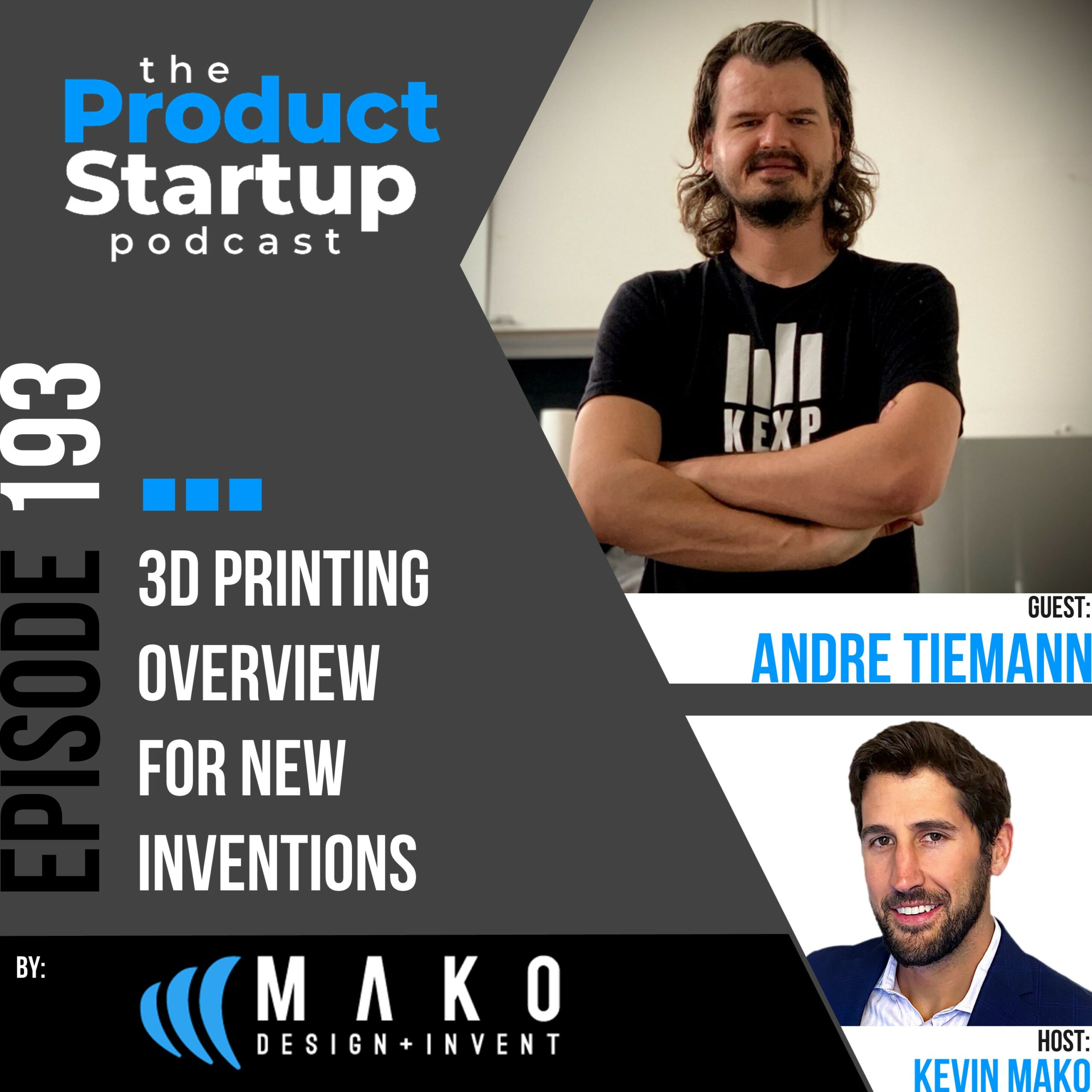
Guest: Andre Tiemann, Director of Production at Hot Pop Factory, a studio focused on 3D printing, laser work, and small-scale product manufacturing.
Host: Kevin Mako, founder of Product Startup and the leading expert in hardware startup consulting. A hardware entrepreneur since 1999, Kevin has advised more than 1,500 founders and built and scaled MAKO Invent through its acquisition by TriMech in 2024.
Episode Overview
Andre Tiemann gives founders a practical overview of FDM, SLA, SLS, and multi-material 3D printing. He explains how additive manufacturing supports rough concept exploration, functional engineering prototypes, customer feedback, and selected low-volume production applications.
What You’ll Learn in This Episode
- 3D printing is a layering additive method.
- The majority of 3D printing involves plastic printing, with Fused Deposition Modeling (FDM) being a common technique.
- Stereolithography (SLA) is a resin-based 3D printing process.
- Selective Laser Sintering (SLS) uses lasers to sinter powder, creating 3D printed parts.
- Multi-material printing allows for versatility in materials.
- Initially, ABS was the primary material, but now there are numerous material options available.
- Three key phases in utilizing 3D printing for new hardware product development: 1) Rough ideation of design, 2) Engineering prototyping and, 3) Short-run low-volume hardware manufacturing for new inventions.
- Short-run manufacturing provides an opportunity to alleviate uncertainty and ensure project success through customer feedback.
Episode transcript
This transcript is provided for accessibility and reference. Download the SRT transcript.
Read the full episode transcript
Kevin Mako: Hello, product innovators. Today we learn from one of the top names in 3D printing on how additive prototyping and short-run manufacturing can help hardware startups.
Narrator: You're listening to the Product Startup podcast, a show to learn from top leaders in product development, product selling, and everything in between.
Narrator: Hosted by Kevin Mako, the leading expert on product development for physical product startups, sponsored by PTC's two best in class 3D CAD product software solutions Onshape
Narrator: and Creo, and produced by Mako Design + Invent, the original firm providing world-class consumer product.
Kevin Mako: development services tailored specifically to startups small manufacturers and inventors welcome back everyone today
Kevin Mako: i'm very excited to introduce Andre Tiemann into the show andre is the director of production at Hot Pop Factory one of the leading 3d printing laser cutting and etching and short run
Kevin Mako: low volume consumer product manufacturing companies in the country today Andre is going to share some valuable knowledge from
Kevin Mako: vendors startups and small manufacturers on what 3d printing is the different types of 3d printing
Kevin Mako: the different 3d printed materials and how 3d printing can be useful at three key key stages in a hardware startup product development journey. Now on the episode.
Kevin Mako: Hey, Andre, welcome to the show. Hey, Kevin. Nice chatting. Well, we're excited today to have you on to talk about 3D printing, especially
Kevin Mako: in the world of product development for hardware startups. What is 3D printing and how does it apply to a new invention?
Kevin Mako: How does it apply to an invention potentially even going through all the rounds of iteration through prototyping and possibly even to short run production?
Kevin Mako: But before we get into all the elements of additive manufacturing through 3D printing. Just give us a bit of a background. How did
Andre Tiemann: you get to being the big success story that you are today? Well, for myself, it started, I think in 2011, I actually worked out a traditional print shop and they had in their head
Andre Tiemann: office a big 3D printer and they had a display box at the shop that I was at with 3D prints. And I was kind of like, what are these things?
Andre Tiemann: I'd never even formally heard about 3D printing as like a manufacturing process. So I became curious. And then I started looking into something called the rep rep, which is like a
Andre Tiemann: do-it-yourself, a 3D printer that you can just buy the parts and essentially build a 3D printer is open source, new at the time.
Andre Tiemann: And throughout the next year, so myself and a friend of mine, we put the printer together in the evenings after hours. And then I always say January 1st,
Andre Tiemann: 2012, I launched the machine for the first day and I printed my very first 3D print. And it was rugged. It was not very high quality, but at the same time, it was amazing. Because
Andre Tiemann: out came this piece of plastic that we designed.
Kevin Mako: And there it was. It was an incredible feeling. That's amazing. You built your own 3D printer. That's how you got into the space of 3D printing.
Kevin Mako: Give us a bit of a background of how you got to be running as a director of production for Hopop Factory, printing all kinds of parts and low volume production
Andre Tiemann: units and all that sort of stuff for people all over the world now. Shortly after that, I just kind of was in the maker community and kind of like delved into 3D printing.
Andre Tiemann: And I sort of just became a huge passion of mine. I couldn't think of anything else. So I started a very small company where I had a few
Andre Tiemann: 3D printers at the time, just kind of like desktop printers. And it was okay. This was around 2013.
Andre Tiemann: As time went on, I realized it wasn't something that was ready for it. That being said, I started working in 2014 for another established 3D print house.
Andre Tiemann: And then I've just been employed since then at different 3D printing companies. And I've gone through the ropes, different processes,
Andre Tiemann: different materials. And then starting with Hot Pop Factory at different times during that period,
Kevin Mako: I've been working with them for the last year and a bit on a full-time basis. And it's been great. Amazing.
Kevin Mako: And obviously we've done less of work with you guys in a variety of different capacities. So it's great having one of the best 3D printing experts in the country now on the podcast
Kevin Mako: to talk about what 3D printing is. So let's dive into it. Let's start at a very base level. Explain what additive manufacturing is, particularly around 3D
Andre Tiemann: printing plastics. Yeah, for sure. Like it's essentially an additive process where you have a machine, a computer controlled machine that deposits material one layer at a time.
Andre Tiemann: Sometimes people would liken it to a hot glue gun kind of. of just going back and forth, back and forth, and building and building, and building.
Andre Tiemann: And then there's a CAD model is inputted by something called Gcode. It's like coordinates, essentially, where it tells the machine to go here, to go there, to go there,
Kevin Mako: repeated it millions of times over and over, and eventually you'll have a part. That's amazing.
Kevin Mako: And the key to that, of course, it all comes down to the foundational CAD, the 3D CAD software that actually gives you the 3D dimensions of that particular part.
Kevin Mako: That then has to be interpreted by software and by experts like yourselves to then run into these
Kevin Mako: machines to print it essentially layer by layer, and that's what gives you the parts. Talk a bit about the types of materials that you're using and the different types
Kevin Mako: of 3D printing
Andre Tiemann: machines that are out there for doing different types of parts. Sure, yeah.
Andre Tiemann: There are so many different types of 3D printers, and I keep hearing stories of people like, oh, you can 3D print houses and this and that.
Andre Tiemann: And while it's true, I think majority of the printing, there are a few different processes.
Andre Tiemann: There's a plastic printing process called FDM, which it's a variety of different plastics.
Andre Tiemann: Rubber-like materials, then there is something called SLA, which is a resin-based process.
Andre Tiemann: You can do more engineering grade materials, castable materials, softer materials, the different short values, like the list goes on and on and on.
Andre Tiemann: So from a product development perspective, there's like the gambit of what you can print silicones or even like being introduced.
Andre Tiemann: And then like SLS is a different process, which uses a laser centered powder to create 3D printed parts. The list kind of goes on and on and on.
Andre Tiemann: There's polyjet printing, which is a cool kind of like inkjet type process where you can do multi-materials, so you can blend softer materials and harder materials in one print go.
Andre Tiemann: I used to say that one of the things in 3D printing that has to develop is the materials.
Andre Tiemann: And as the time goes on, I've seen so many innovations that even 10 years ago, what we have at our
Kevin Mako: fingertips is at a much more affordable rate. It's mind-boggling. Well, that's amazing because it's happening on both levels.
Kevin Mako: Not only are more technologies, more materials, more options available, but it is becoming more realistic and cost-effective. That's particularly interesting.
Kevin Mako: And I do want to talk about it a bit towards the end of the episode about additive manufacturing, specifically around short run production, low volume production for parts.
Kevin Mako: But a lot of that is because of these prototype or one-off machines essentially that learn the
Kevin Mako: technologies and over time evolved to become reasonably cost effective, at least for a trial run of a new product.
Kevin Mako: So talking about some of those machines, I appreciate kind of the run through, identify the different materials. In the beginning, of course, it was just basically plastic.
Kevin Mako: And that was the origination of essentially 3D printing. But now we have all kinds of different actual materials that we are able to
Kevin Mako: essentially mimic of what actually comes out of an typical injection molded facility at the end of the road. But now we can pretty much do it all.
Kevin Mako: Talk about some of those core materials and how those have come to fruition as
Andre Tiemann: of today as opposed to really what it was in the early days of 3D printing. Yeah.
Andre Tiemann: I mean, in the early days, going back to the plastic printers, ABS was almost the only material that was available.
Andre Tiemann: And then there are different PLA, PetG, which is like pop bottles are made of PetG for example.
Andre Tiemann: so there's more flexibility, but that was sort of what you had available for a long, long, long time. In that range, there are TPUs, which are rubber materials, but then going into
Andre Tiemann: kind of short run production, there's metal printing that exists nowadays, where the durability is there where it was never there before.
Andre Tiemann: Nylons, castable materials, there are super high strength materials. We use a material called rigid 10K, which is an industrial strength material that is
Andre Tiemann: basically as strong as most injection molded parts, for sure. They're like wood-like materials. Depending on the
Andre Tiemann: process. With laser centering, there's nylon, which can produce very, very intricate parts without
Andre Tiemann: the use of support material, which is something that 3D printers need for the most part. Any need that you
Andre Tiemann: have, a 3D printer can replicate for the most part, clear parts, all sorts of different colors,
Kevin Mako: of course. It's a really cool technology. That's amazing. So many different options. And if you're listening and your hardware startup, what does that mean for you?
Kevin Mako: Well, this means that you have a tremendous amount of physical materials to test, validate, ideate your product before you even
Kevin Mako: get to production and then potentially even including at least short run or low volume manufacturing as well. I want to break those down.
Kevin Mako: From a design and development perspective, we really see kind of three key areas that 3D printing is very useful for a hardware startup. One is in the ideation phase.
Kevin Mako: This is like early, early research, just messing around and trying to figure out what even is the product that you want to create.
Kevin Mako: So there's a lot of value there and we can dive into it. Second is the actual design and engineering of the product. So once you really know what you want
Kevin Mako: to design, you've done a really good job of the CAD model. Now, how do you validate that from a
Kevin Mako: physical engineering perspective to make sure that it works and functions the way you want? And then finally is short run production.
Kevin Mako: And we've mentioned that a few times on the show. It's a very promising field, especially for hardware startups, a way to get to market faster without
Kevin Mako: the typical upfront cost of tooling, molds, etc. that come on full scale manufacturing. There's almost a stepping stone nowadays where you can use a number of these technologies
Kevin Mako: in order to actually make a short version of your product. Let's break it down to the first part of that, which is ideation and vetting out the product.
Kevin Mako: What do you like seeing in the 3D space, Andre, that inventors can be doing to just
Andre Tiemann: muck about and figure out their product, just in the early ideation and research phases?
Andre Tiemann: It really depends on where they're coming from if they have any experience in 3D CAD or if they only have an idea, like a napkin drawing.
Andre Tiemann: we sometimes say in the industry where they can present us their idea and then we can kind of like translate that into a reality.
Andre Tiemann: It usually does start off with a basic sort of prototype where 3D printing is amazing because if you had a ready to go CAD file, you can have a rough prototype
Andre Tiemann: in the low hundreds in terms of dollar value and where that would not have been possible like years ago. This oftentimes gets you, you know, fit and function, proof of concept
Andre Tiemann: in a lot of ways. It allows for if something does go wrong, you can just kind of like start over, print again for like a
Andre Tiemann: few hundred dollars as like a baseline instead of having to invest thousands and thousands on a mold
Kevin Mako: that can take months to get to you and come back that iteration is amazing you could do multiple
Kevin Mako: iterations of a product if you're not quite sure a lot of the time we'll do that especially around
Kevin Mako: organic shapes or fit and feel form and function that sort of stuff where you really want to try a bunch
Kevin Mako: of different avenues but you're not really sure in the CAD model which is best we'll print out a handful of
Kevin Mako: them touch them feel them hand them around to various stakeholders and try and vet out which one seems to make most sense.
Kevin Mako: A lot of the time when you translate CAD over to the physical world, a lot of answers are presented in the early design phase, saving you tens of thousands of dollars in
Kevin Mako: development down the road. Just by some early ideation and research, a lot of the times we'll call
Kevin Mako: it a rough or a mock prototype, 3D printed prototype, a variety of terms you can use for, but the point being, it's quick, iterative, relatively inexpensive, rough
Kevin Mako: parts. It can even just be a section of a prototype or a certain piece that you're trying to validate or vet through. Starting
Kevin Mako: there, understanding that in depth physically, putting that back into your CAD design or any of
Kevin Mako: the research or understanding or derivations from that back into the CAD so that you can move now into, to be the hardcore engineering and more detailed prototyping.
Kevin Mako: So let's jump into that. After you've, let's say, roughly validated, you've used some basic 3D printing methods to vet out the design of your product.
Kevin Mako: Now you want to really start working on reliability,
Kevin Mako: robustness, function, those hardcore engineering feats to get the product ready for
Kevin Mako: manufacturing. Now we can start to use a whole bunch of different 3D printing methods, many of which you've talked about before to really start validating the quality of the
Andre Tiemann: product before we even start working on the manufacturing of it. I often say it depends how far along you are with
Andre Tiemann: the prototype. The next level is you are entering much higher precision, much higher surface quality,
Andre Tiemann: and then if you're playing with the materials that are trying to mimic manufacture green materials, you have access to those materials.
Andre Tiemann: The next level, the output is essentially the same surface quality, the same strength. The precision is there, which is absolutely critical when you're
Andre Tiemann: trying to develop a product because you can't have something that's one thing in software and
Kevin Mako: then another thing when it comes out in the actual physical piece. And that's an important stepping stone for sure.
Kevin Mako: That's powerful. And especially for a design and engineering team, the ability to essentially mimic manufactured products in one unit intervals
Kevin Mako: is so powerful for vetting out the quality of that product in eventual manufacturing. In fact, it's a requirement. If you haven't gone
Kevin Mako: through detailed rounds of engineering prototyping before you're taking a product to production,
Kevin Mako: it's going to be exponentially more costly for you because you're going to discover those errors
Kevin Mako: or you're going to miss those opportunities that you would have had in the prototyping phase and now you push that forward to a much more expensive phase, which is manufacturing,
Kevin Mako: a phase which is also much more difficult to fix, to change, to iterate on at the point you got to manufacturing, you should be done your iteration.
Kevin Mako: In fact, when we're presenting manufacturers with the product, we want that thing to be as well vetted out as possible via prototyping methods
Kevin Mako: so that the manufacturer is focusing on what they do best, which is rinse and repeat parts. They're not in the game of designing products.
Kevin Mako: They are in the game of low volume, high quality parts. So you want them focused on what they're great at and you want the product to be the best
Kevin Mako: product can be when you present it to them. Now, not to say you can't bring in manufacturing logic in advance to help you with your prototyping?
Kevin Mako: Absolutely. Remember, the goal of these engineering prototypes is to try and mimic eventual production units, but you don't want to do it the other
Kevin Mako: way around. You don't want to be bringing a roughed up product to a manufacturer and hope they fill in all the gaps for you to fix all those problems.
Kevin Mako: In fact, that's the very horror stories that you do hear in product development. If people try and skip key prototyping steps, they end up learning
Kevin Mako: the hard way and finding out not only is a huge waste of massive amounts of money, but you
Kevin Mako: generally lose months and months of time that could have been far expedited by doing it in the proper order.
Kevin Mako: Now, to the final phase I'd like to talk to you about, and that is short run, low-volume manufacturing.
Kevin Mako: Obviously something that Hop Pop Factory is involved on a number of products, especially those with plastics or relatively simple metals or a variety of other parts, which can be
Kevin Mako: replicated in additive or even other short-run methodologies.
Andre Tiemann: Talk a bit about short-run manufacturing, especially for consumer products these days. Short-run manufacturing is something that definitely was not
Andre Tiemann: around in the same capacity as far as 3D printing is concerned more than five years ago. The way I see it is the prototyping stage is like you do one-offs, one, two, three, four,
Andre Tiemann: until you get to exactly what you want. But if you want to produce, for example, 50 units to 500 units as like a stretch, there was never
Andre Tiemann: any sort of production method in place other than the traditional manufacturing where you had to spend a lot of upfront cost to get you those like units.
Andre Tiemann: So there's like this whole new world of small run manufacturing. This allows for if you're testing a market, you don't know exactly what. the sales are going to be.
Andre Tiemann: There are Kickstarter, all those type of things where there's like uncertainty. And do we have the capacity? Do we have the sales to invest in like 50,000 units right off the bat?
Andre Tiemann: Short run manufacturing kind of allows for that. And with the different 3D print processes, technologies out there, it's like we're getting there. Price has come down.
Kevin Mako: Speed has gone up. Materials, science has advanced so far that every year that goes by, it's incredible.
Kevin Mako: Yeah, it's so powerful for new hardware products, especially for hardware startups, because it really does fill that historical gap between your
Kevin Mako: final prototype and your big first production run. There's this gap in the middle of short volume, low volume production.
Kevin Mako: And it's amazing because of the variety of materials that have been opened up that we talked about earlier on the show here, it's allowed so many different parts to actually
Kevin Mako: be made in low volume. It may not necessarily be 100% of your product. But even if 80% of your
Kevin Mako: product had been done in short run and 20% of it, you may require, say, that one mold for,
Kevin Mako: it's still going to be a fraction of the upfront cost as if you jump straight into manufacturing.
Kevin Mako: I love how you mentioned the customer angle as well, the market validation, because the real beauty here is that not only are you validating out the market, making
Kevin Mako: sure the customer likes it, incorporating their feedback, getting another chance to maybe make some final tweaks before
Kevin Mako: you go into full scale manufacturing, but you're also vetting out the quality of the product as well. So if there are those final ultra fine-tuned details or some weird
Kevin Mako: use cases that only become discoverable when you have units in customers' hands, well, those can start to bubble up to the
Kevin Mako: surface before you invest the big bucks in the big production run down the road. And if you follow this process, you're really de-risking product developing.
Kevin Mako: You're almost ensuring the success of your product because you're validating on the market front and making those adjustments and you're fixing any
Kevin Mako: of the actual mechanical sides on the back end to ensure that your production is smooth. Well, that's a great hardware startup.
Kevin Mako: And if you can continue to grow that over time with that sort of a customer feedback loop, it almost inevitably will lead to a greater and greater success,
Andre Tiemann: more profitability and a better product market fit over time. That's how you build an empire out of a hardware startup. No, I agree completely.
Kevin Mako: Yeah. It saves a little money today and then save a lot of money tomorrow and then learn along the way. It's a really cool process. Andre, much appreciated
Kevin Mako: for all your words of wisdom. Before I let you go, just talk a little bit about Hot Pop Factory and the website
Andre Tiemann: that's people can go to learn more about what you do. Yeah, yeah. Well, it's hophopfactory. We specialize in 3D printing, laser cutting as well and design services.
Andre Tiemann: We do a lot of market-based promotions work, lots of prototyping projects, awards. It's kind of whatever any customer that comes to us
Andre Tiemann: that has an idea, like we can try to make it work for them. We have in-house design teams. We have a lot of machines to work with both laser cutting and 3D printing.
Andre Tiemann: There's very limited outsourcing that's going on.
Kevin Mako: And it's just a really cool space to work in the amount of projects that we've realized over the years. It's something special. Yeah, you guys have been amazing.
Kevin Mako: I know you do a lot of parts and also short run production for macro design. So it's always much appreciated and great to see
Kevin Mako: just a never-ending growth of machines, equipment, shop space, all that sort of stuff. As always, I will put the link in the show notes below.
Kevin Mako: So if anyone wants to check out Hop Pop Factory and learn more about 3D printing, laser cutting, short run production, whatever else, you can click
Kevin Mako: through. Andre, thanks again for joining us today. We'll talk again soon. Awesome. Yeah, good chatting.
Narrator: Thanks, Andrew. Take care. Thanks for tuning into this episode of the product startup podcast. If you found
Narrator: some value in the show, please do us a huge favor and leave us a quick five-star review. If you have any
Narrator: questions, guest suggestions, or anything else, feel free to reach out to us anytime at our email, podcast at MakoDesign.com. That's podcast at MakoDesign.com.
Narrator: This show is hosted by Kevin Mako, North America's leading expert on product development for physical product
Narrator: startups. Huge thanks to our sponsors, PTC, and their two best-in-class 3D CAD product development software solutions, Onshape, and Creo, and Mako Design + Invent.
Narrator: The original firm providing world-class consumer product development services tailored specifically to startups, small manufacturers and inventors.
Narrator: Thanks for joining and see you next time.
Prototype Strategy for Product Founders
Use 3D Printing at the Right Stage
Work directly with Kevin Mako to determine what each prototype must prove, where 3D printing fits, what level of fidelity is justified, and how to sequence feedback before investing in more advanced development or production.
Kevin can help you prepare the right questions for design, engineering, prototyping, testing, and manufacturing partners so each build reduces risk and moves the product forward.
Request a Prototype Strategy Call
Tell Kevin what you are building, what the next prototype must prove, and where your current plan feels uncertain.