
Listen Now
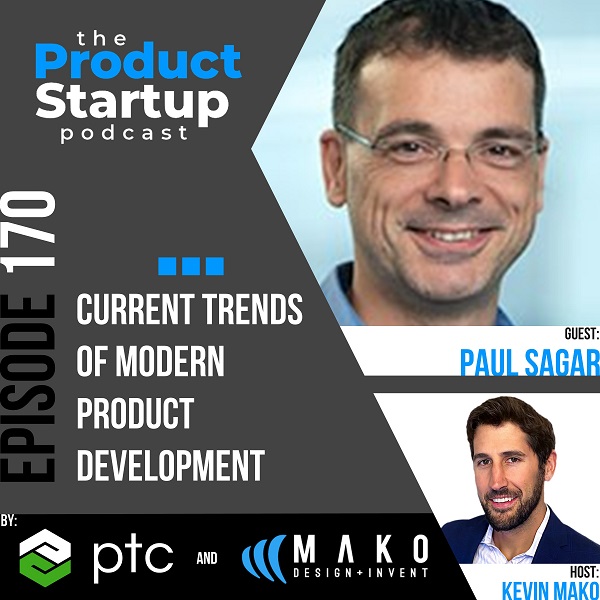
Guest: Paul Sagar, Vice President of Product Management for PTC’s CREO product line and a former design engineer.
Host: Kevin Mako, founder of Product Startup and the leading expert in hardware startup consulting. A hardware entrepreneur since 1999, Kevin has advised more than 1,500 founders and built and scaled MAKO Invent through its acquisition by TriMech in 2024.
Episode Overview
Paul Sagar explores shifts in materials, product architecture, and the tools used to create hardware. He discusses composite materials, lightweight strength, sustainability, electrification, closer coordination between mechanical and electronic disciplines, additive manufacturing, and the role of modern CAD platforms.
What You’ll Learn in This Episode
- The use of composite materials and design offers numerous benefits.
- More and more consumer product brands are integrating high-quality, costly composite materials into relatively straightforward products.
- Composite materials provide greater design flexibility while maintaining strength and quality with their lightweight properties.
- Incorporating composites into hardware product design can lead to increased sustainability.
- Historically, composites have been costly to purchase and manufacture, but accessibility is improving.
- With low-volume production capital costs being low, new product startup brands can focus on quality while producing in smaller quantities.
- The electrification of products is already underway and is a fundamental aspect of modern design.
- Design must increasingly incorporate electronics and electrification, with a focus on collaboration between electronics and mechanical engineering.
- Additive manufacturing is rapidly evolving, particularly in production design.
- While additive manufacturing was initially used for rapid prototyping, it is now commonly used for final part design, especially for first manufacturing runs.
- Short-run additive manufacturing offers advantages in terms of up-front capital costs and increased design options.
- Additive manufacturing facilitates faster production while maintaining quality and reducing up-front costs.
Episode transcript
This transcript is provided for accessibility and reference. Download the SRT transcript.
Read the full episode transcript
Kevin Mako: Hello, product innovators. Today we learn from a 30-year veteran in the product engineering and CAD software industry on the current trends in hardware product development.
Narrator: You're listening to the Product Startup Podcast, a show to learn from top leaders in product development, product development, and everything in between.
Narrator: Hosted by Kevin Mako, the leading expert on product development for physical product startups,
Narrator: sponsored by PTC's two best-in-class 3D CAD product development software solutions Onshape and Creo,
Narrator: and produced by Mako Design + Invent, the original firm providing world-class consumer product
Narrator: development services tailored specifically to startups, small manufacturers, and inventors.
Kevin Mako: Welcome back, everyone. Today I'm very excited to introduce Paul Sagar to the show. Paul is the vice president of product management for the Creo software line at PTC.
Kevin Mako: Paul started as a design engineer, then spent the last. 25 years building CAD software for PTC to best match the needs of hardware design teams.
Kevin Mako: Today, Paul is going to share some valuable knowledge for inventors startups and small manufacturers
Kevin Mako: on what the latest trends in new product development are for hardware startups, including
Kevin Mako: best practices and composite materials, the electrification of products and additive manufacturing for first manufacturing runs. Now, on to the episode.
Paul Sagar: Hi, Paul. Welcome to the show.
Kevin Mako: Hi, Kevin. Thank you. Thank you for having me. Well, very excited to have you on the show today to talk about the trends that you're seeing in modern hardware development in 2023.
Kevin Mako: Before we get into that, I was just with some of your colleagues filming the Make 48 TV show that had me as a judge for season six just flew in from Kansas City.
Kevin Mako: We had a number of folks there from the OnShap team, which is obviously part of Creo and the PTC parent company.
Paul Sagar: So good to see you guys all over the place. Yeah, we are. It's good that you're able to go to the event. It's a good event. I know our OnShake division focuses on that area.
Paul Sagar: So good that you were able to go and attend.
Kevin Mako: It must have been fun being a judge there. It's fun, but it's also very difficult because you have the tough decision at the end of the day of who wins the grand prize.
Kevin Mako: So that's the hardest part. But you know what? Everything leading up to that? Yeah, absolutely. Fantastic.
Kevin Mako: Amazing innovation and just an all-around fantastic TV show. I think they're now on PBS and Roku on this old house channel. We actually had the host from this old house
Kevin Mako: was on the show as one of the other judges, which is great to see. So in any case, let's talk about product development and emerging trends.
Kevin Mako: Before we jump into that, just give us a bit of the 30-year history that you've had in the product development and development CAD software world helping
Paul Sagar: startups and big corporations develop the next hardware products. Okay, I've been around, and I probably
Paul Sagar: shouldn't say this because I'll age myself, but I've been in the industry for over 30 years. I, straight out of university, I worked as a design engineer for a
Paul Sagar: company actually in the UK at the time. And I probably worked in the industry for four, five -ish years before getting
Paul Sagar: very deeply involved in CAD, right? And I like the idea of CAD. I like the value and benefits
Paul Sagar: that CAD can bring to streamline the design process, etc. So I ended up changing career path,
Paul Sagar: if you like, from being a design engineer to actually moving to a software company that developed CAD software. And that software company was PTC.
Paul Sagar: So I've been at PTC now for 25-ish years. And my role right now is one of, I work in product management. I run the Creo product management
Paul Sagar: team. And so what that enables me to do and why I like the role so much, I spend a lot of time
Paul Sagar: working very, very closely with a very broad spectrum of customers. Those can be customers from
Paul Sagar: the very, very large enterprises out there, billion dollar companies that are building anything
Paul Sagar: from electronic products to vehicles to earth movers, et cetera. We cover the full spectrum.
Paul Sagar: But at the same time, I also spend time with the emerging customers out there,
Kevin Mako: the startup customers, make that idea a reality. What a great person to talk about emerging trends, because you get to see it happening on all levels right now in real time.
Kevin Mako: So let's talk about some of those trends. We've got a handful of key trends that you've identified.
Paul Sagar: Why don't you start with the first in composite design? Yeah, so composite design is an interesting one. Composites have been around for many, many, many years.
Paul Sagar: On the one end of the spectrum, you can look at it and say, well, the boat that I have is made out of fiberglass. That's composites.
Paul Sagar: On the other hand, if you move into the aerospace industry, for years, they've been building products out of carbon fiber.
Paul Sagar: And the same in the motorsport industry, building them out of carbon fiber. So it's not really an emerging technology from that. It's been around at the long time.
Paul Sagar: What I will say, though, is we're seeing more and more of our customers looking to adopt and use composites in their products.
Paul Sagar: So it's no longer just the remit of the aerospace industry or the motorsport industry or the yacht boat industry. It's really going
Paul Sagar: across the spectrum where everybody is looking to take advantage of the benefits and value that composites can bring, right?
Paul Sagar: Composites really allow you to build your product as you want to build it and optimize your product.
Paul Sagar: You know, you can now define material characteristics and behavior of a design by varying the different types
Paul Sagar: of fabrics you're putting in, the location of those fabrics, the orientation of those fabrics. And so it allows you to design a product that at the same time
Paul Sagar: is extremely strong. Maybe in other areas is extremely energy absorbent, but at the same time is extremely lightweight.
Paul Sagar: And if something is extremely lightweight, that is another reason why companies are looking into it, because it really helps us address sustainability
Paul Sagar: issues out there. You know, we're all looking to try and reduce the carbon footprint, the impact of our products on the environment.
Paul Sagar: And if we can build lighterweight products, that means they're going to consume less energy while they're being transported, et cetera. So a lot of companies are looking,
Paul Sagar: again at composites to change their product design process. I'll also add into that as well.
Paul Sagar: Composites are something that depending upon what composite you're using, composite materials themselves can be quite expensive to buy.
Paul Sagar: Carbon fibre fabric is reasonably expensive. It's also something that is fairly manual in building.
Paul Sagar: However, because of that, it's also something that is perfect for people that are just starting up with designs because the cost to build low volume
Paul Sagar: is low. And so if you're going to go and introduce a new product and the volume of that new product
Paul Sagar: is somewhat low, you can focus on let's build it with composites. We can do the manual layup of that. The tooling for it is very, very cheap, right?
Paul Sagar: You don't really need much more than foam and some filler and you've pretty quickly built yourself a tool to go and lay your carbon fiber onto.
Paul Sagar: So it enables customers really to get into that market quickly, produce a product that is
Paul Sagar: extremely lightweight, extremely high quality, solving their engineering needs, but in a cost-effective way.
Paul Sagar: Consequently, from a creo standpoint, I'll say because we're seeing this change in the market, we're heavily investing in providing tools for
Paul Sagar: composite design. For years, there's been tools inside a CAD system for designing sheet metal products, designing injection molded products.
Paul Sagar: Now you're going to have tools inside Creo for designing composites where you can design each individual piece of fabric, specify exactly where
Paul Sagar: that piece of fabric goes in your design, have visibility and control over all of the multiple layers of fabric, have the ability to go
Paul Sagar: and simulate that, taking into account all of the fabrics, right? Being able to know that, you know, I've designed it this way.
Paul Sagar: Is it actually going to interact and work in that way? And so being able to do structural analysis on it, et cetera. And then not only that, but when it comes to
Paul Sagar: manufacturability, bear in mind with composites, these are sheets of fabric, right? It's cloth that you're laying over.
Paul Sagar: And so as I'm draping it over, is it going to drape correctly? So we can simulate how it's going to drape. We can flatten that fabric so that you've then got a pattern
Paul Sagar: to go and cut out. And then finally, on the back end, when it comes to manufacturing, you want to be able to have detailed information of what's the process step you go through.
Paul Sagar: Some of these parts might have hundreds of layers of fabric. Well, what order do you put them in? How do you lay them down?
Paul Sagar: Where do they go? So all of that information will be defined entirely inside Creo with the common user interface.
Paul Sagar: So customers that design sheet metal parts today will be very familiar with how to
Kevin Mako: work with the tool and expand into composite areas as well. This is really powerful information, especially for hardware startups, because something that
Kevin Mako: we advocate heavily at the design firm, and I talk about it a lot on the podcast, whether
Kevin Mako: we're working with customers at macrodesign on their first project, or whether we're talking about a brand releasing a new high-end version of a product or even just the first
Kevin Mako: time for a fairly unique product. It doesn't matter which category you fit into those. Quality is of paramount importance, especially as a new brand and especially as
Kevin Mako: a hardware startup. up. So composites are a big part of the higher quality spectrum. As you mentioned, they've typically been higher cost materials.
Kevin Mako: But as you talked about, there's significant engineering benefits to these materials. So as a hardware startup, very rarely are you focus on making
Kevin Mako: the cheapest product because almost all the listeners on the show that are working on a
Kevin Mako: hardware product or have a product idea or are developing the next version of something or a new unique product. There's innovation in there.
Kevin Mako: And you're selling, at least in the infancy of the product. In the early days of a product, you're selling that innovation to your customers. You're not
Kevin Mako: selling the cheapest version of something. That's what happens as your product matures. You start costing it down,
Kevin Mako: both with economies of scale and also engineering costing down to really get that to the lowest possible cost over time, many years most often. So here we're focusing on quality.
Kevin Mako: So the fact that Creo is building in those product development tools and the CAD software makes it so much easier for us as the design
Kevin Mako: house to be designing in these quality metrics, not just an ideation and conceptualization,
Kevin Mako: but as you mentioned, carrying it through to the actual manufacturing of the product, which is really the core value of any good product design.
Kevin Mako: You can design the best product in the world, but you need to be absolutely certain. You figured out also how to manufacture it reliably and at a quality
Kevin Mako: level. And composites is such a great material choice for some of those things, let alone the fact that the tooling cost can be significantly less expensive to tool up the
Kevin Mako: exact same part in carbon fiber than that identical part in an injection mold because you need a really intense steel mold assembly for making the plastic part.
Kevin Mako: Whereas you mentioned, you can use a lot more soft tooling techniques to make carbon fiber parts, especially at low volume, which is where almost every hardware startup starts.
Kevin Mako: Starts at low volume, works your way up to medium, large, and then scales into maturity after that. So I really appreciate you bringing that to board because I think that
Kevin Mako: fits very well with best practices in 2023 for general product design, especially with focusing on quality.
Kevin Mako: Let's move on to electrification, which is happening all over the world. I've talked about
Kevin Mako: it quite a few times on keynotes and on the show that in the next 20 to 30 years, every single product you see around you is going to have a computer chip in it.
Kevin Mako: And many of the products that are typically combustion engine or whatnot are going to be electrified. So this is the electrification of the planet.
Kevin Mako: Whether you love it or hate it, this is the inevitable reality of what's happening right now. All products are being redesigned.
Kevin Mako: This is the next emergence of innovation and creativity. It started obviously big picture in the home with things like the nest thermostat, but it's trickling
Kevin Mako: down to smaller and smaller and simpler products. So eventually everything is going to be connected.
Kevin Mako: So talk a bit about what's happening from your perspective and what you're seeing in that field and how the
Paul Sagar: tools are being developed to support that. A couple of points here. So Creo as a whole for many, many years has had a very large
Paul Sagar: market share of the internal combustion engine space out there in the market, whether it be in the automotive space, the truck space,
Paul Sagar: the construction equipment space, the lawnmower space, anything that has an internal combustion engine, a large percentage of those have always been developed inside
Paul Sagar: Creo. And so as we see the market changing, whether it be for sustainability reasons or other reasons, what we are seeing
Paul Sagar: is a shift away from internal combustion engine and shift more towards electrification. You walk
Paul Sagar: into your local hardware store now, you can no longer really buy a lawnmower with, a gasoline engine, right?
Paul Sagar: It's now all electric, 40 volt, 24 volt, whatever it is, lawnmowers. So everything is moving towards that way. In addition to that, the microchip, the electronic
Paul Sagar: space is growing as well. When we look at things like IoT, how the internet of things is moving, is evolving.
Paul Sagar: There's more and more electronics that are put into more and more products on an ongoing basis. So you've got both the change or shift from internal computers.
Paul Sagar: combustion engine to electrification, and you've got the expansion of internet of things, fundamentally resulting in a design need to have a
Paul Sagar: greater focus on electrification. And even at electrification level, that really is split into kind of two fundamental areas, both of which overlap.
Paul Sagar: The first one is, as we start introducing more circuit boards, electronics into your design,
Paul Sagar: you need as a mechanical engineer to be able to work more effectively and collaborate more easily with an electrical engineer.
Paul Sagar: The software used by electrical engineers is very different to the software that's used by mechanical engineers, but you still want to be able to collaborate.
Paul Sagar: You want to be able to improve that design process. You want to be able to take advantage of the
Paul Sagar: information that the electrical engineer is doing and integrate that into the CAD system. So there's a continued evolution of that space, whether
Paul Sagar: it be evolution from just improved collaboration between the two, being able to share things like the board layout, the solder masks, the pace masks, etc.
Paul Sagar: On the other aspect is more about the connectivity of those. You build a series of circuit boards. Fundamentally, you've got to connect those circuit boards.
Paul Sagar: You've got to connect your switch gear. You've got to connect your batteries, your inverters,
Paul Sagar: et cetera. And so at some level, you've got to have a system model that says, I've got a battery that connects to a switch that connects to a light bulb in simple sense.
Paul Sagar: And so then when you've got that schematic defined out, you've then got to, in 3D, define where all those cables go. What are
Paul Sagar: all those cables? How do they connect? What are the connectors? Where am I going to tie the cables down? How am I going to define my bundles?
Paul Sagar: And fundamentally, then once I've built all that, you've got to manufacture it. So you've now got a big three-dimensional harness that you've built. How do you go manufacture that?
Paul Sagar: You've got to have tools to be able to go and flatten that harness out, lay it down so that you can go through the manufacturing process, typically, which
Paul Sagar: is a pinboard type approach of laying those cables out to go manufacturing. And so from a CAD
Paul Sagar: perspective, from a Creo perspective, we're seeing a greater focus on that need to build out
Paul Sagar: those rich set of capabilities to really define or improve the ECAD collaboration and improve the
Paul Sagar: design process of defining those routed systems, those cables going through your design, and doing that in a collaborative way as well.
Paul Sagar: As more and more detail is needed, more and more subsystems are being put into designs, there's a greater need for multiple
Paul Sagar: engineers to be able to work on that design simultaneously. It's electrical systems were relatively simple for the most part. and you could have one engineer working on it.
Kevin Mako: Now, there's a greater need to have multiple engineers working on that design at the same time. That's very powerful stuff.
Kevin Mako: And I can tell you, in the early days, 10 to 15 years ago, when we were designing consumer electronics products, primarily you would do one before the other.
Kevin Mako: You'd either start with the electronics breadboard and then build it into a PCB set. And once it's all finished, now we pass it over to the mechanical engineers to essentially
Kevin Mako: wrap it or enclose it, depending on the product. Sometimes you start the other way around. But it was typically a very linear design process.
Kevin Mako: I teach in the Masters of Engineering Level 2. And historically, if you look at old industrial design, mechanical engineering, electronic engineering
Kevin Mako: textbooks, there's a lot of linear development that's occurring in the actual product space.
Kevin Mako: Nowadays, it's almost always happening, not just in tandem, but collaboratively. And it's very necessary.
Kevin Mako: We really appreciate the tools that you offer because that allows our various designers and engineers, not just one ID, ME, and EE working together.
Kevin Mako: But it could be multiple versions of each of those that have different. specific skill sets working collaboratively together to make the best and most optimized design.
Kevin Mako: That requires weekly integration and collaboration, not linear development, very little amount of linear and a large amount of collaborative.
Kevin Mako: That really yields a world class product in terms of product quality at the end of the day. And of course, without the tools that allow that very
Kevin Mako: smooth, interactive development, it wouldn't be possible for us to do that, especially when you have folks working sometimes in different locations.
Kevin Mako: Sometimes you have clients at different locations.
Paul Sagar: There's a lot of different things that require a centralized tool to manage all that. Absolutely. It's something that, again, at PTC, we're very market driven.
Paul Sagar: We focus on what is happening in the market, understanding what our customers are doing. And so consequently, we drive the roadmap of the product based on that.
Paul Sagar: You know, we talk about collaboration there. You know, one of the things as an example that we've added in Crea 10, our latest iteration of the software,
Paul Sagar: is the ability to now design as I'm designing a harness, say, well, hang on a minute, this harness is maybe getting a bit too big.
Paul Sagar: And I need some additional help in designing this. So what I'm actually going to do is split this harness into two. And, you know, all of the logical information
Paul Sagar: will exist in those harnesses. But now that means somebody else can go and work on half of the harness. I can continue working on the bit I'm on.
Paul Sagar: When we're done, I can then have the ability to merge it back into one to go manufacture it. Or, you know, another use case might be.
Paul Sagar: where I've designed a harness, but I realize there's a piece of the harness here that really makes up a subsystem.
Paul Sagar: And I would like to be able to take that piece of the harness and reuse it on a different design. So now what I'm able to do is split it. But when I split it, actually take
Paul Sagar: all the logical information with it, all of the connectors, all of the schematic that drove it through and move that to a completely different design.
Paul Sagar: As companies start to evolve, they want to get more involved in logical information, more involved in
Kevin Mako: design reuse. This really fosters that capability. If we've completed the design and engineering phase, and now we're moving forward
Kevin Mako: into actually producing the product, talk a bit about what you're seeing in that transition from finalized design for manufacturing. So you've finished all your prototyping.
Kevin Mako: You've tested and tested and retested it. So you've got the perfect product. You're ready for production now.
Kevin Mako: What are you seeing in the product development world that is helping smooth that
Paul Sagar: transition from final design into their first short run manufacturing or low volume manufacturing run. It's a good question.
Paul Sagar: So I'm going to say here that there's a lot of movement that we're seeing in the manufacturing space. I would say that probably the obvious one is things like additive
Paul Sagar: manufacturing. 20 years ago, maybe not even 20 years ago, 10 years ago, if we were having this
Paul Sagar: conversation, we would all sit here and say, oh, yeah, additive manufacturing, that's just for rapid prototyping, et cetera, et cetera. What we're seeing now is a significant.
Paul Sagar: shift towards the use of additive manufacturing for final part design. Either the final product
Paul Sagar: and the final product might be the product that we ship or the final product might be enabling me to rapidly create complex tools and jigs and
Paul Sagar: be able to produce them more effectively quicker and potentially cheaper. And so in particular for if we take the idea of
Paul Sagar: tooling, the cost delta and the speed delta between being able to create, create a injection molded tool.
Paul Sagar: If I make it out of steel, it might take me 10 weeks, 12 weeks to go and get it produced and it might cost me $100,000, let's say, I'll pull numbers out of my
Paul Sagar: head. But I can potentially achieve the same thing with additive manufacturing. I can go and do an additive manufactured tool that can add additional value.
Paul Sagar: I'm not restricted to having linear cooling channels inside my tool, right? I can build complex cooling channels that follow the contours
Paul Sagar: of my shape, I can build that directly into the tool, and I can additive manufacturing, right, and whether I'm additive manufacturing it out of some high-grade plastic or
Paul Sagar: metal, whatever it is. But the point is, I can actually produce it in probably a 24-hour period, and it's going to be
Paul Sagar: significantly cheaper than the $100,000 metal tool that I machined. And so it allows me,
Paul Sagar: when I get to that final production, to quickly come up with my tools, get to production quicker.
Paul Sagar: Now, maybe eventually I will go and do a final solid tool, but maybe for the first 10,000
Paul Sagar: items or 50,000 items, I'm happy just with an additively manufactured tool and the benefit that that provides.
Paul Sagar: So we're certainly seeing a significant move towards there for that area. And then from a final part design, again, we're also seeing more and more companies
Paul Sagar: looking at additive manufacturing there, again, because of primarily the benefit that additive
Paul Sagar: manufacture provides around the optimization of parts. The fact that you can build very, very complex
Paul Sagar: parts that are optimized, whether it be to reduce the weight, to achieve certain stresses,
Paul Sagar: yield stresses, et cetera, meet certain engineering requirements by introducing and taking advantages
Paul Sagar: of very, very complex lattice structures, things that you can't manufacture with traditional techniques. You know, an example of that might be things like the introduction of
Paul Sagar: oxetic lattices. Oxetic lattices that we're actually just introducing into the latest version of Creo, they provide a unique material characteristic,
Paul Sagar: right? They actually possess a negative quasson ratio. What that fundamentally means is with a typical material,
Paul Sagar: if I put a load on the material from the top, the material's going to bulge out. If you use oxetic lattices, as you put a load on the top of the material, the material
Paul Sagar: or the part will actually squash in. And so it's a unique characteristic that is actually hugely beneficial
Paul Sagar: in scenarios of impact absorption or crash testing. We've got companies out there that are looking to leverage this for designing crash helmet, being able
Paul Sagar: to build in that impact absorption capability directly into the helmet, but not only design it, also then be able
Paul Sagar: to quickly and easily manufacture it. And again, taking advantage of additive manufacturing
Paul Sagar: the speed at which you can manufacture the products, the quality that you can achieve with
Paul Sagar: them, and then having the ability to design in all of the corresponding support structures that
Paul Sagar: may be needed, connecting that back with traditional manufacturing as well. If you're building
Paul Sagar: your designs, 3D printing your designs, you've got your support structures on them. You
Paul Sagar: obviously need to then go and do some post-processing operations to remove the support structures or maybe drill some additional holes.
Paul Sagar: So being able to connect and define the process of designing the additive manufactured part,
Paul Sagar: additively manufacturing it, and then doing CNC operations on that additively manufactured part to go and finish it off for final part design.
Paul Sagar: So we're seeing a big move towards that.
Kevin Mako: And consequently, we're putting a lot of effort into expanding the breadth of capability and support we have that.
Kevin Mako: Well, I really appreciate that you mentioned the increased capabilities because I think when
Kevin Mako: a lot of people look at short run manufacturing, there's just starting to see the benefits of especially for a hardware startup doing your first production run in that way.
Kevin Mako: Most importantly, just to reduce initial tooling costs because there really is very little setup and tooling costs when you're doing additive.
Kevin Mako: Of course, your unit cost likely is going to be higher. But at small volume, that's really not an issue for a hardware startup, especially because you're
Kevin Mako: usually using your first production run to validate the market to get feedback to improve the product before you potentially spend a lot more money on serious tooling at
Kevin Mako: volume later. But the fact that you've brought in that added capability that you've got new design and
Kevin Mako: engineering capabilities as a result of it too, that is really a relatively new emergence and fairly forward concept because that can really enable improvements to
Kevin Mako: the design that may not be available in traditional manufacturing or other benefits that allow the designers to really hit
Kevin Mako: the nail on the head to whatever the customer's true vision was that might have been restricted historically because of manufacturing deficiencies.
Kevin Mako: I think that's one of the things, especially as a hardware startup, but most people don't understand is traditional manufacturing has a lot of rules.
Kevin Mako: There's a lot of rules in terms of what you can actually design. And when you look around your room, you see all these different products, most people
Kevin Mako: who are new to product development, just assume anything could be made. But that's absolutely not the case.
Kevin Mako: Everything that you see around has gone through very complicated design for manufacturing processes that have figured out how to allow the use case to be what it needs to be for
Kevin Mako: the end customer, but also allow the design to be built in a way that could be manufactured with traditional parts.
Kevin Mako: An additive is adding every year more and more capabilities to expanding the ability for what designers can actually create.
Paul Sagar: Paul, before I let you go, just give us some more information about where people can learn more about Creo software. Yeah, okay. So to find out more
Paul Sagar: about what Creo is the breadth of capability we have, I'd suggest going to ptc.com slash creo. That's our default location.
Paul Sagar: That'll give you all of the information we need about Creo. We're about to launch our next release of software, Creo 10. It'll be coming out in the April time frame,
Paul Sagar: where we've got a huge amount of new capability added across the board to address some of the
Paul Sagar: topics we talked about today, plus many, many other topics improving users' overall productivity.
Paul Sagar: Creo as a whole is a CAD solution that covers everything from initial concept design through
Paul Sagar: detailed design, fully integrated with simulation, whether you're looking to do structural, thermal, modal, fluid simulation, optimization.
Paul Sagar: We've got built-in generative design capabilities, so allowing the software and AI to be able to design optimal parts for you is an integral part
Paul Sagar: of the design. And then moving out into the back end, if you like, of the process, which is the manufacturing.
Paul Sagar: You know, we've got full breadth of capabilities for two and a half axis, up to five-axis simultaneous, high-speed machining, as well as two -to-four-axis turning,
Paul Sagar: as well as multitask machining capability built in, not to mention the additive manufacturing capabilities I talked about earlier as well.
Paul Sagar: So it's a very, very full spectrum of capabilities that many, many companies out there leverage and use across the board, irrespective of the
Paul Sagar: vertical you're in, i.e. the type of product you're making, or the size of business you are. We've
Paul Sagar: got companies out there that consist of two or three or four engineers and we've got other companies out there that have thousands of engineers and they use exactly
Paul Sagar: the same software in Creo to solve their problems because fundamentally in a lot of cases the engineering
Paul Sagar: problems are the same irrespective of the size of business you are and so that's why we
Kevin Mako: believe a single solution that covers that entire spectrum is the right way to go but again to find out more go to ptc.com slash creo take a look
Narrator: Thanks, Paul. And as always, I'll put the links directly in the show notes below so anyone can just click through to them as well.
Narrator: Paul, thanks so much for all your words of wisdom today talking about emerging design trends in modern product development. No problem. Thank you for having me.
Narrator: Thanks and talk soon. Bye-bye. Thanks for tuning in to this episode of the product startup podcast.
Narrator: If you found some value in the show, please do us a huge favor and leave us a quick five-star review.
Narrator: If you have any questions, guest suggestions or anything else, feel free to reach out to us anytime at our email, podcast at MakoDesign.com. That's podcast at M-A. A.k.0.com.
Narrator: This show is hosted by Kevin Mako. North America's leading expert on product development for physical product startups.
Narrator: Huge thanks to our sponsors, PTC, and their two best in class 3D CAD product development software solutions Onshape and Creo. Mako Design + Invent. The original firm
Narrator: providing world-class consumer product development services tailored specifically to startups, small manufacturers and inventors. Thanks for joining and see you next time.
Modern Product Development Strategy for Founders
Use New Tools Without Adding the Wrong Complexity
Work directly with Kevin Mako to evaluate how materials, electronics, additive methods, cloud collaboration, and modern development tools fit your customer value, risk profile, budget, and roadmap.
Kevin can help you choose priorities, sequence specialist input, and keep technology decisions connected to manufacturability, cost, quality, funding, and launch timing.
Request a Product Development Strategy Call
Tell Kevin what you are building, the technology choices in front of you, and where the roadmap is becoming too complex.