
Listen Now
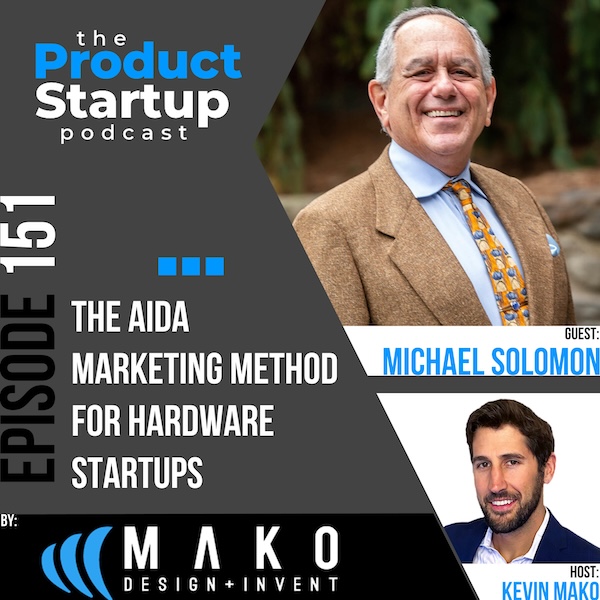
Guest: Michael Solomon, Marketing Professor at Saint Joseph’s University, Forbes contributor, and author of more than 30 books.
Host: Kevin Mako, founder of Product Startup and the leading expert in hardware startup consulting. A hardware entrepreneur since 1999, Kevin has advised more than 1,500 founders and built and scaled MAKO Invent through its acquisition by TriMech in 2024.
Episode Overview
Michael Solomon breaks the marketing journey into attention, interest, desire, and action. He explains why customers buy benefits rather than a list of attributes, how novelty must stay relevant, why simple messaging matters, and how founders can guide a prospect from first awareness toward a purchase.
What You’ll Learn in This Episode
- The AIDA Model encompasses 4 stages: Attention, Interest, Desire, and Action.
- Marketing success does not happen instantly.
- Marketing can be visualized as a funnel.
- In marketing, customers buy benefits rather than just the attributes of a product.
- To find a solution, focus on the problem.
- In product design and marketing, simplicity is key.
- Attention is crucial in marketing and requires both novelty and relevance.
- Clearly communicate your hardware message.
- In an age of information overload, you need to make your messaging stand out to grab attention.
- Having a consumer interested in your physical product is a great accomplishment, so put a lot of value on it.
- Consumers are always looking to minimize their risk when making a purchase.
- A Unique Selling Proposition (USP) is what sets you apart from the competition and is based more on benefits than features.
- The Interest stage is cognitive, while Desire is emotional.
- To evoke desire, show customers what impact your product will have on their lives.
- Consider your ad a life makeover for the customer.
- Early adopter customers play an important role in marketing.
- The 80/20 rule applies to revenue.
- The call to action may involve a feedback loop.
- It takes several touchpoints to make a sale.
- Invest in customer relationships to drive long-term sales.
- Consider the value of a customer beyond just their first purchase.
- Acquiring a new customer is 7 times more expensive than selling to a prior customer.
Episode transcript
This transcript is provided for accessibility and reference. Download the SRT transcript.
Read the full episode transcript
Kevin Mako: Hello, product innovators. Today we learned from a professor of marketing for 40 years on the attention, interest, desire,
Kevin Mako: and action marketing method for physical consumer products.
Narrator: You're listening to the Product Startup Podcast, the show that helps bring your product idea to life by chatting with successful inventors,
Narrator: product developers, and hardware industry professionals. Our goal here is to get to the bottom of what makes a product successful, from initial
Narrator: idea to getting your product on store shelves. We're taking you step by step to build a functional product and scale your product business.
Narrator: Hosted by Kevin Mako, one of North America's leading experts on hardware development for small product businesses. Now, on to the show.
Kevin Mako: Welcome back, everyone. Today I'm very excited to introduce Michael Solomon to the show. Michael is a marketing professor at St. Joseph's University.
Kevin Mako: He has written over 30 books and teaches the Engage Marketing course on Teachable. He's also a fellow writer with me at Forbes magazine.
Kevin Mako: Today, Michael is going to share some valuable knowledge from vendor startups and small manufacturers on what the AIDA marketing method is, how to understand each step
Kevin Mako: of the marketing funnel, and how to best ensure you convert potential customers into product sales. Now, on the episode.
Kevin Mako: Hey, Michael, welcome to the show. Hi, Kevin.
Kevin Mako: Thanks so much for having me on. Well, it's great having you on. I know you're a fellow Forbes contributor, and most impressed you've been teaching as a professor
Kevin Mako: of marketing at St.
Michael Solomon: Joseph's University for over 15 years. Yes, yes. I've been a marketing professor for, I hate to say, close to 40 years.
Michael Solomon: And the last 16 or so have been at St.
Kevin Mako: Joseph's, yeah, but I've kicked around at other universities as well. Well, you're the perfect person to talk today about engaging a customer as a
Kevin Mako: hardware startup or as a hardware company that's scaling their physical products. The big question is, how do I sell more units or how do I sell my first unit?
Kevin Mako: So one of the biggest considerations is your customer. Your customer is one who actually purchases the product at the end of the day.
Kevin Mako: So I want to go in depth today about the whole concept around the AIDA model, four stages of attention, interest, desire, and action.
Kevin Mako: Going through each of those spending a few minutes on each best practices for how hardware startups can utilize this fundamental marketing principle to accelerate their business.
Kevin Mako: Of course, you also write the course on this thing. You are somebody who has a course that people can actually sign up for it to go into depth in it.
Kevin Mako: And we'll talk about that as well. But let's drill into it today. Kick it off first and foremost.
Michael Solomon: What is the AIDA model? And how does it work? Well, it's sometimes the simplest things are the most effective.
Michael Solomon: And sometimes even the oldest things are better than the younger things that I like to think anyway. The AIDA model, and I based my course and my approach on this, it's been
Michael Solomon: around for many years. Students have advertising learned it on their first day of class. But basically, the reason that I use it that I find it so valuable as kind
Michael Solomon: of an organizing principle for my work on engagement is that it reminds us that Rome wasn't built in a day.
Michael Solomon: and your product launch won't be built in a day either. Because from the consumer's perspective, people go through a series
Michael Solomon: of stages when they're trying to decide about buying something new. So if you have your brand new widget out there, of course, you're so excited about it.
Michael Solomon: You've been living with it for a while. You know everything about it. And you think, well, if I just put this in front of someone else, they'll be excited about it too.
Michael Solomon: But we know that that's usually not the case because we go through a series of stages.
Michael Solomon: where we get more and more engaged or involved in the purchase if we stick with it.
Michael Solomon: Remember that lots of people are, just like, say, an email funnel, lots of people are going to be dropping out at each stage.
Michael Solomon: So you're going to start with a relatively large number of potential prospects. But of course, at the end of the process, only a small percentage of those will actually
Michael Solomon: buy your new product. However, those people are extremely valuable to you. That's a great start.
Michael Solomon: So it reminds us that, number one, not everybody's going to buy what you are selling. And number two, the people who are going to buy it are not going to do so overnight.
Michael Solomon: Very, very rarely. They're going to go through this process where, and the acronym spells this out, attention,
Michael Solomon: just getting their attention, just getting them to look up from their phone or their tablet
Michael Solomon: or whatever in their lab or whatever and just be aware that there's something new out there. Now, the problem is that just being aware of something doesn't mean that we want it.
Michael Solomon: However, if it peaks our interest, then we move to that next stage of interest. And then hopefully we can move through that process.
Michael Solomon: One of the other things that this reminds us about, and this is so important for your audience, Kevin, I can't begin to emphasize this enough.
Michael Solomon: The biggest mistake that people make is that they sell attributes when customers are buying benefits.
Michael Solomon: This is marketing 101, but what I find is that sometimes when I work with even very sophisticated
Michael Solomon: companies, they tend to lose sight of this, you know, especially if you're some kind of hardware that you're creating, you focus a lot on the features, you know, you focus
Michael Solomon: a lot on the design or the capabilities of your product, which you should. The problem is that customers don't really care about that too much.
Michael Solomon: What they care about is how is this product going to make my life better today or solve a problem for me? And so sometimes the best solution is a totally different
Michael Solomon: solution, not just a new and improved solution. So people are not going to really be impressed. But
Michael Solomon: most people, what they want is a solution because every time we buy something, it's a solution to a problem.
Michael Solomon: That's why we purchase because we have a problem. Now, that problem may be really minor, like, oh, I ran out of milk. I've got to get more.
Michael Solomon: Or it could be a huge problem. Like, why can't I get anyone to go out on a date with me? It could be any number of things. But
Michael Solomon: in each case, once we become aware of that problem, then we go through this problem -solving process where we try to identify solutions.
Michael Solomon: And those solutions are based around the benefits, not the attributes. I know among inventors and so on, it can be kind of a space race,
Michael Solomon: I guess, to see who can build in the most number of permutations or cute features and so on. And that may give you a lot
Michael Solomon: of thrill as an inventor, but as someone who has to use the product, what we
Kevin Mako: often find is that the simpler, the better. I like that you mentioned that. Three really heavy hitting things that you focused on here.
Kevin Mako: First of all, marketing, it's a funnel. And that's where this AIDA model comes into place, attention, interest, desire, and then action in that order.
Kevin Mako: And they drop out at each level of the funnel. So you really have to look at, especially your first customers within that matrix of the funnel.
Kevin Mako: You've also mentioned, though, selling the benefits instead of the features. At every stage of that model, this should be front of mind. As a
Kevin Mako: marketer, as an inventor, is anybody who's trying to sell their product, looking at the benefits of what you're selling, not just the features.
Kevin Mako: And that's particularly difficult. We see it countless times where we're designing and developing products for clients. They get so in the weeds
Kevin Mako: with your product, which you should in the development phase. That's great. It's amazing.
Kevin Mako: The engineers, the industrial designers and the inventors are all working together to create this magnificent product.
Kevin Mako: But at the end of the day, your customers are a very different person than you as an inventor. You've spent a year or more working on this thing.
Kevin Mako: getting this thing to production, you are really interested in these magic moments that you have, these crazy innovations that you discovered throughout the path.
Kevin Mako: But the reality is at the end of the day, that product is there just to solve a problem. And usually it's only one or two problems,
Kevin Mako: which brings me to the third thing that you mentioned. I love how you packed all these together. Simplicity. We have the slogan of Mako Design called brilliantly simple design.
Kevin Mako: The reason is, especially as a hardware startup, is just significantly easier and better, not just
Kevin Mako: from a development perspective, but also from a sales and marketing perspective, which is your arm, to sell a simple product. Should be high quality, but simple.
Kevin Mako: And that's really the key because when you came up with your invention idea, you probably only had one or two key benefits or features that you identified, which is the pain point.
Kevin Mako: You found that opportunity. So try and limit what we call feature creep to try and create all these bells and whistles,
Kevin Mako: because as we're hearing it right now from Michael, who's on the forefront of the marketing side, it doesn't actually help you sell product, especially as
Kevin Mako: a startup. You're not trying to capture the entire market segment out of the gate. You're trying to just get the ball rolling on your hardware startup.
Kevin Mako: So you're absolutely not going to be able to hit global penetration within a few months. But what you might be able to do is be able to hit heavy on that one or two
Kevin Mako: key features, clarify your marketing message with simplicity, and they go to market with a great,
Kevin Mako: simple product that has less defects, less returns, less warranty issues, better quality all that because you focused on core innovation.
Kevin Mako: So I love that you pack those three things together.
Michael Solomon: Michael, to move on from this point, let's go to each in a little bit of detail, starting with
Michael Solomon: attention and some of the best tips and tricks that you've got in and around attention.
Michael Solomon: Well, believe it or not, attention is probably the most important part of the model in some way because it's so hard to get these days.
Michael Solomon: And we're all aware that we're being bombarded by messages. Everybody wants to sell us something or do something for us or change our lives. By some
Michael Solomon: estimates, the average person today in the U.S. or in Western Europe is exposed to close to
Michael Solomon: 5,000 commercial messages every day, 5 ,000. Now, obviously, we're not aware of most of those.
Michael Solomon: We could probably remember five that we saw today. And that's where the problem is, because there's so much competition and there's so much clutter going on in the messaging
Michael Solomon: environment. Just getting someone's attention is a major victory. And so there are.
Michael Solomon: certain techniques that you can use, certain tactics that you can use just to get yourself noticed. And most of them revolve around two things.
Michael Solomon: The first would be novelty. That is, there's something different. There's a contrast between what you are messaging about and everything else that's
Michael Solomon: around you. It's kind of like a color ad in the middle of black and white newspaper or something like that. Whatever's different, our brains tend to notice.
Michael Solomon: And the other thing is relevant. Our poor overwork brains are trying to decide which messages to let through, we tend to filter in terms of relevance.
Michael Solomon: That is, does the message resonate with something that we're trying to do? Again, a problem that we're trying to solve. And as a reminder, your product should be solving a
Michael Solomon: problem. And you were talking about that, you know, simple message. If you make that simple message clear that, hey, we think you have a problem.
Michael Solomon: And guess what? We can make your life easier. Again, no one's going to buy the product based on that promise. But maybe the
Michael Solomon: they're going to tune in and say, well, you know, maybe I should sort of pay attention to this message and put these others to the side.
Michael Solomon: So really, the basic structure of the message. And sometimes, like I say, at the nuts and bolts level, it can be as simple as using a different
Michael Solomon: font compared to everything that's around you on a website or something like that. But we know that people are distracted.
Michael Solomon: We know that they are overwhelmed by this, what we call a sensory overload where there's just too much information out there.
Michael Solomon: And what happens is that we're kind of like a deer in the headlights. When we get bombarded with that much information, essentially we freeze
Michael Solomon: and we often try to move on because it's just too much. So imagine when you're trying to get people
Michael Solomon: interested in your new gadget, imagine that it's like walking into a Costco or something like that where there's thousands and thousands of products on the shelves.
Michael Solomon: And each one is screaming for your attention, at least for a few milliseconds as you roll down the aisle, right? What is it about
Michael Solomon: your product that is going to make someone just take a look at it? And again, I need to emphasize,
Michael Solomon: it's not about understanding how it works, but rather, is it something that I even want to pay attention to?
Michael Solomon: And so many messages are lost in that initial wave there. We don't really realize that because our brains are just tuning that stuff out.
Michael Solomon: But these days, do you think about a tsunami of 5,000 messages,
Kevin Mako: let's say, rolling in, what is it about those few that are going to actually stick in your mind? That's what you want to understand.
Kevin Mako: And I imagine that's why simplicity is so important because essentially what you're trying to do at every stage of the funnel is push people to the next step.
Kevin Mako: So with attention, you're just trying to literally get their eyeballs focusing on it or their ears hearing it or something. They've got to see this thing.
Kevin Mako: So you somehow think of a way to jump out of them. That's step one.
Michael Solomon: But if your message is extremely clear to the benefit you're providing, that helps push you into the next phase, which is interest.
Michael Solomon: So let's talk about interest in the value of that funnel phase. Having an interested consumer is that's the holy grail in a sense, right?
Michael Solomon: When we're interested, what that means is we want to know more. So what we do is once we start to get engaged with something, our brains now are going to
Michael Solomon: start to focus a bit more on it. And we're going to kind of ask ourselves now, we don't do it consciously, but we're going to ask ourselves, where can I find out more about
Michael Solomon: this? You know, remember, every purchase has a risk involved. Every new purchase has a risk involved, whether it's buying a carton of milk that might have turned.
Michael Solomon: We always are concerned that we're going to make a choice that is going to work out badly for us, either financially or socially or even physically if it makes us sick.
Michael Solomon: So we're always looking to minimize risk. And the way we do that is by focusing attention on accumulating more information about that
Michael Solomon: purchase. And so, you know, in the old days, that might mean knocking on your neighbor's door and saying, hey, I'm thinking about buying X. I know that you have one.
Michael Solomon: What do you think? Of course, today we're doing that online and we're getting the opinions for better or worse of thousands of people, right? But all of that is about
Michael Solomon: what we call external information search.
Michael Solomon: And basically at that level, what you're doing is you're trying to compile a short list. And there's that funnel again, Kevin. You're trying to compile a
Michael Solomon: short list of contenders because after all, nobody really, we might start out with a list of, let's say, 10 possible brands.
Michael Solomon: Let's say I'm looking for a new car, right? I might start out with 10 car models. But by the time I get down to where I'm really serious, I'm probably not choosing among 10
Michael Solomon: because I've probably eliminated six or seven of those for some reason, whether valid or not.
Michael Solomon: And so a lot of this process of building interest is being sure that your option is in that set
Michael Solomon: that people wind up with at the end, not at the beginning, but at the end. And that means that you
Michael Solomon: want not only be noticed because that was in the first step, but now you also have to kind of qualify
Michael Solomon: your entry by showing people that in fact it could be the solution. Again, no one's going to decide at this point that it is the solution.
Michael Solomon: But if I've got my set of 10 cars and I now narrow it down to three cars, each one of those is probably a viable option for me. And then I'm going to
Michael Solomon: get really into the weeds in terms of looking at the pros and cons of each option. And sometimes
Michael Solomon: we do this literally where we might write on a piece of paper, what are the pros and cons? But most of the time, we're just kind of doing it in our heads.
Michael Solomon: But nonetheless, rest assured that we're doing it. So, again, at the interest stage, remember, we're losing a lot of people because we might
Michael Solomon: get awareness just because someone says, well, that's an interesting message. Once they look at it, they realize it's not something that's relevant to them.
Michael Solomon: They're going to drop out. So of that group that's now remaining, we want to make sure that we are one of their top contenders.
Michael Solomon: And now, as they get into the real decision-making process, they are able to articulate the pros and cons of each option.
Michael Solomon: And again, that's where that simplicity comes in, right? Because if you've got 10 different ways that you're different from your competitor
Michael Solomon: or you claim, people are going to have a lot of trouble making sense of that.
Kevin Mako: If there's one really important way that you're different from options B and C, then that makes it much easier for people to make a very simple decision.
Kevin Mako: analysis paralysis is a big problem in marketing, especially in new hardware products, especially if you're trying to put so many features into it. The other thing that happens
Kevin Mako: with a significantly large amount of features is that all it takes is for somebody to
Kevin Mako: believe that one of your features that you've claimed is not in fact true or they don't believe in it or they don't like the way it's stated.
Kevin Mako: And even though they might have loved the product, love the core functionality, loved some of the other things about it, you've given them
Kevin Mako: 10 reasons now, as opposed to one or two, to invalidate the purchase, which comes back to the risk element that you talked about.
Kevin Mako: That's why it's very dangerous to advertise too many things. The beautiful thing about this tactfully, in this day and age, especially with the internet
Kevin Mako: era, is there's many different ways to engage and validate your audience, whether it's email
Kevin Mako: marketing, whether it's the way that you're advertising to them, whether it's remarketing through digital advertising tools.
Kevin Mako: If they're interested in this product in this way, then re-serve than these types of ads, which are helping them understand the product better, or whether it's
Kevin Mako: because you're only selling a few units, maybe it's at a trade show or something else, you in person are able to help move them through to the next level.
Kevin Mako: It could be on the store shelves via your packaging. There's many different ways that this happens in the marketing world, but I think it comes
Kevin Mako: down to what Michael's saying, clarity, which means simple and following this step of funnels and also not being afraid to lose people along the way.
Kevin Mako: You will never capture your entire potential audience,
Michael Solomon: especially that got your attention, but that's okay. You've got impressions that now funnel down into interest and then move into desire.
Michael Solomon: And this is obviously where we start to push them into a purchase position. So talk a bit about desire. Right. Well, before I do, let me just add at the
Michael Solomon: interest stage, again, sometimes it's kind of like old wine and new bottles, but it's still valid. There is an old idea in marketing called the USP, the unique selling proposition.
Michael Solomon: What is the one thing that sets you apart from the competition? And so I say, you know, to people who are watching this, what is your USP?
Michael Solomon: And again, to your point, Kevin, if they list 10 things, they're not getting it. So the USP is based more on benefits than attributes.
Michael Solomon: And the benefit may be, this is going to change my life because X, right? Not because of the following 10 reasons, but the following one or maybe
Michael Solomon: two. And if you believe that it can change your life in some way, large or small, that's where we move into the third stage of desire, of
Michael Solomon: building desire. Now, desire means that in the interest stage, we're mostly focused on cognitive things. In other words, beliefs that we have, knowledge that we have.
Michael Solomon: But we all know that knowledge doesn't sell products. I think we all know this. What sells products? Emotions sell product.
Michael Solomon: Once we have kind of qualified our entry into this race now, what we have to do is focus more on the emotional side.
Michael Solomon: And that's where these intangibles become incredibly important. So building desire for a product.
Michael Solomon: Now, when we talk about desire, we might think about someone who's just craving a fancy sports car or some luxury product or something like that.
Michael Solomon: But the fact is that we can also desire the types of products your audience makes, right? We can desire them because they are filling a role in our life.
Michael Solomon: And that role may be to make us look more competent or to make my family safer or whatever that goal may be.
Michael Solomon: If you can layer on that emotional component and especially to, show people how they will feel when this product is doing what
Michael Solomon: it's supposed to do, that's when you have a big advantage over your competition. Because again, as people might think that a product works really well, but if they don't love
Michael Solomon: it, they're not attracted to it. And this is where design comes in as well, you know, in terms of the color palette that you
Michael Solomon: use, shapes and so on, all of those things are bundling into something that hopefully we are going to come to desire.
Michael Solomon: So again, desire in this case, it doesn't mean like, you know, I, you know, I, you know, I desire a date with Lady Gaga.
Michael Solomon: It means that that product potentially could really fill in a kind of a gap in my life and therefore it's something that's very, very important to me. We all know that the more
Michael Solomon: important a goal is, the harder you're going to work to attain it, right? And the more relevant it is to you, the harder you're going to work.
Michael Solomon: So, you know, it's one thing if I say, well, I should probably lose five pounds. You know, if my wife says, you really need to lose five pounds, I'm probably going to
Michael Solomon: work a lot harder to lose that five pounds than if it just comes from me, right? And so what we want to do
Michael Solomon: is to create this condition where people understand, and it's not about misrepresenting what you're doing, because we're assuming that you have identified a real gap, right?
Michael Solomon: Now most of the challenge is showing people what's going to happen in their lives if they use your product and now they're going to rectify that problem.
Michael Solomon: So to the extent that you can get the person, the customer, to visualize what their life will be like, then you're going to be in much better
Michael Solomon: shape. So if you think about what I tell my students is, I don't have an exact number, but, you know, my guess is that 80 % or so
Michael Solomon: of all advertisements follow a very simple formula, which is kind of like a makeover. In other words,
Michael Solomon: what you have is, this is you as you are now. This is you as you could be. And if it's important
Michael Solomon: to you to get from where you are now to where you could be, you've got to find a way to get. there. And the bridge that you can use to get there is my product.
Michael Solomon: So if you think about a lot of ads, either explicitly or just implied, they show the customer in the before condition where their
Michael Solomon: life is not as good as it could be for whatever reason.
Kevin Mako: And then they show a happy, smiley person doing whatever. And the message is, if you want to get from here to here, use our brand and you will
Kevin Mako: attain that goal that you have. There's a really easy way that I think a lot of hardware startups especially can use to figure out what
Kevin Mako: the actual desire is from their customers, we're a big believer of the feedback loop, especially with your first production run, especially if
Kevin Mako: you're doing a short production run, maybe 200 to 500 units, you're getting them out to a series of initial customers that you're solving their paypoint.
Kevin Mako: They've paid for this thing. Look at what their feedback is. And if you're unsure about that, take a look at maybe some competitors or some alternative products.
Kevin Mako: Look at the Amazon reviews. Look at some of the deep thought four reviews that were put on there. And you will start to see people who took their time to
Kevin Mako: write a review about this product. And ideally, it's your product, but let's look at it, whether it's yours or competitors, and look at what they've written about how it's changed
Kevin Mako: their life. It could be something very simple, like a toilet paper holder. And they say, this thing is amazing. I had such a problem with my old toilet paper holder.
Kevin Mako: Now with this new one, it's quick release and whatever, it tells me this or that. Whatever the features are, you see this
Kevin Mako: passion ignite naturally to the point where somebody was actually willing to go online. spend their time to write a review about that product.
Kevin Mako: So if you're not sure about what exactly is hitting the deep strings heart of your customer, go look at some of your reviews.
Kevin Mako: If you don't have reviews yet, get a few products into people's hands and get the review directly from them. Call them.
Kevin Mako: Because if you're only dealing with 30 or 40 products out there, if you've just started selling, it's very easy as the founder to reach out to each and every one of them.
Kevin Mako: Now, some of them aren't going to give you the time of the day, but I can tell you
Michael Solomon: those where your product did solve that pain point, did really make them passionate about whatever
Michael Solomon: you did for almost for sure those people are going to give you the time of day and they're going
Michael Solomon: to love it. And then you can use what they said to help you market this passion in the future for your product. Yeah, that's a great insight.
Michael Solomon: And it underscores the importance of testimonials of one kind or another, whether it's Amazon reviews or ideally something on your website where you've got testimonials, et cetera.
Michael Solomon: But it also reminds us of the overlooked importance of those early adopters. They're not just providing an initial revenue stream to help you to break even
Michael Solomon: or something. They are probably the best asset that you have. And they are usually overlooked.
Michael Solomon: People are so eager to expand their market that they don't, you know, they're always looking at
Michael Solomon: the next customer, but they are ignoring the ones that they've already got. And again, another tried and true principle of marketing the so-called 80-20 rule.
Michael Solomon: 80% of your revenues are accounted for by 20% of your customers, not set in stone. own those numbers, but it's a great reminder that those early adopters, in
Michael Solomon: terms of passion level, as you say, they've taken a risk by going to this new product anytime we buy something new
Kevin Mako: is a risk. And so if they've taken that risk and it has paid off
Michael Solomon: for them, not only are they happy campers, but they are going to be the most eager to share that news with other people, and that's how that market grows.
Michael Solomon: Let's move on to the final phase of action. Well, action's pretty straightforward you know usually it's do they buy it but it doesn't have to be that of course because
Michael Solomon: again this Ada model we might find this recycling over and over again so the call to action maybe click on a link to get more information it's not necessarily to
Michael Solomon: make a purchase and again that's a reminder that this is an elongated process you're not going to get people to click on the
Kevin Mako: buy me link right away and so sometimes what you want to do is that call to action at the end might be
Kevin Mako: to cycle back to the interest stage to get more information so that someone can feel really more
Michael Solomon: secure about their purchase that's very interesting actually you're creating a feedback loop if you don't
Michael Solomon: think they're quite yet ready for the purchase action you're going to modify that action to essentially rinse and repeat to increase the amount of people moving from the interest
Michael Solomon: into the desire and thus eventually into the purchase case i've been told i don't know if this is true or not but people in sales have
Kevin Mako: told me that on average, it takes about six or seven touches with the customer to make a sale. That might be a bit high.
Kevin Mako: I don't know, but it's pretty rare to make a sale in the first contact. It's going to be a process. That's a big message here. When you look at your
Kevin Mako: marketing, understand that it's not just a quick instant conversion to a sale. And I think especially
Kevin Mako: if you look at new companies that are looking to sell on Kickstarter or Indie GoGo or direct
Kevin Mako: to customers through Shopify or whatever else, they get a little bit too eager about the features or benefits or sellability of a product and they forget that it's a process.
Kevin Mako: So it's not just going to take a quick ad and all of a sudden they spin into a sale, not frequency, or even if it does,
Kevin Mako: know that there's a huge amount, your biggest amount of sales is going to happen in that secondary phase where you're properly creating enough interest and enough desire
Kevin Mako: so that that middle segment of, let's call it, potentially interested customers, actually convert into a sale. And that is a big part of the overall sales process.
Kevin Mako: That's why remarketing is so popular, upselling is so popular, because these things understand that if you spend a little bit more
Kevin Mako: time with a customer, you're going to heavily increase the amount of customers that actually move to that person's position.
Kevin Mako: It's much more efficient spend on your ad dollars or your efforts or your time or whatever it is, whatever efforts that are going into your marketing through this actual process.
Kevin Mako: So think of it as a process and know that It's very valuable work because you are building a Rolodex of brand champions.
Kevin Mako: You are building a huge list of customers who are getting increasingly more engaged in your product
Kevin Mako: to the point where even if some of those have enough interest, enough desire, but they're not actually going to purchase. Maybe it's just not right for them.
Michael Solomon: They can't afford it or there's some other reason at this time it's not right for them. They may actually become brand champions to other people who might buy it.
Michael Solomon: So that's where the snowball effect occurs if you're willing to put the work into engaging
Michael Solomon: with your audience over a long-term basis, not just looking for that quick conversion sale. Again, you need to have the luxury of a somewhat long-term orientation.
Michael Solomon: If you only have 10 days to sell this product and then you're done, well, we have other problems there, you know. But for most
Michael Solomon: people, again, it can be frustrating because the money isn't coming in right away, but you're investing in a deeper relationship.
Michael Solomon: And it's also good in many cases to think about customer lifetime value, which a lot of companies are starting to talk more about now. So that customer's
Michael Solomon: value to you is not just in that first sale, but rather, how much are they going to buy from you over the course of a lifetime? Yours or theirs.
Michael Solomon: Assuming that you might have other related products that will be coming down the pipeline, every time that you do that, by some estimates, it's seven times
Michael Solomon: more expensive to attract a new customer than to keep an
Kevin Mako: old one. And yet many companies, we lose sight of that because what we want to be able to say is, you know, we went from 50 users to a thousand
Kevin Mako: users in a month. What we tend to do is to ignore those 50 users that we initially had that
Michael Solomon: were essentially responsible for our success. That's a lot of great insight there. And obviously,
Michael Solomon: we've just touched the tip of the iceberg to the whole conversation around the various verticals of this marketing methodology. You do a course on this. Talk a bit more about
Michael Solomon: kind of the course deep dives into all of this stuff. Yes, I launched this course not long ago. It's on the Teachable Platform.
Michael Solomon: It's called Engage How to Turn Jaded Customers into Brand Fanatics.
Michael Solomon: And it's about six hours of content looking at engagement strategies at each of these levels in the ATA model.
Michael Solomon: And a lot of it's based on actual research, prior research that's been done both by academics and also in business.
Michael Solomon: That helps us to understand what are the things that are going to appeal to people, what works, etc.
Michael Solomon: And so what I do in the course is to walk students through each of those four stages of the ATA model.
Michael Solomon: And in each stage, I actually focus on three different paths to engagement because there's more than one. There's always more than one.
Michael Solomon: The first and most obvious is the product itself. And there's many things you can do when we've talked about or at least touched on some of those.
Michael Solomon: But in addition to the product itself, there's two other elements. One is the message, which we also talked about briefly, the way that that product and it's been,
Michael Solomon: benefits are being communicated, where, who is getting the message, etc. And the third factor, which is maybe a little less obvious, but it's very important, is the situation
Michael Solomon: or the environment in which that message is received. And what's going on in that environment, whether it's a website
Michael Solomon: or whether it's a bricks or mortar store, really subtle changes to what's going on around. You can make a huge difference.
Michael Solomon: To use a simple example, if you walk into a bricks and mortar store, even something as subtle as the temperature in that store has an impact on whether you want to stay, right?
Michael Solomon: If it's really stuffy or if it's really freezing or something for some reason or really crowded, maybe you can't wait to get out of there. So we know that there are a lot
Michael Solomon: of cues going on in the environment that influence how engaged people will be, but we tend to ignore those.
Michael Solomon: What I try to do is to cover all three of those paths. So that's a total of 12, right?
Kevin Mako: I've got four levels, the ATA model, within each one. We talk about the product, the message, and the situation.
Kevin Mako: This is relevant to people who are really selling anything, because at the end of the day,
Kevin Mako: whether you're selling hardware or democracy, again, you're talking about benefits rather than attributes.
Kevin Mako: Well, Michael, much appreciated for that. I will put the links to the show and your LinkedIn profile and such as well, so anyone can just click through below.
Kevin Mako: Much appreciated it again for you being on the show today. Thanks again, Michael.
Michael Solomon: Oh, thank you, Kevin. Always a pleasure.
Narrator: Thanks for tuning in to this episode of the Product Startup Podcast,
Narrator: the show that teaches you what it really takes to bring your product to market and turn it into a big success.
Narrator: This podcast series is brought to you by Mako Design + Invent, the original and leading firm in North America to provide global caliber
Narrator: in-to-in physical consumer product development to startups, inventors, and small product business clients.
Narrator: If you're looking for product development help on your invention, head over to Mako -design.com.
Narrator: That's M-A-K-O Design dot com for a free consultation from one of Mako-designs for design studios from coast to coast.
Narrator: Thanks for listening and see you next time.
Marketing Funnel Strategy for Product Founders
Find the Weakest Step Between Attention and Purchase
Work directly with Kevin Mako to map how your product earns attention, builds interest, creates desire, and makes action easy across ads, content, landing pages, marketplaces, retail, and sales conversations.
Kevin can help you sharpen the benefit story, remove unnecessary complexity, choose the right proof, and connect funnel improvements to product, pricing, channel, and unit-economics decisions.
Request a Marketing Funnel Strategy Call
Tell Kevin what you sell, where prospects enter, and the stage where the most potential customers disappear.