
Listen Now
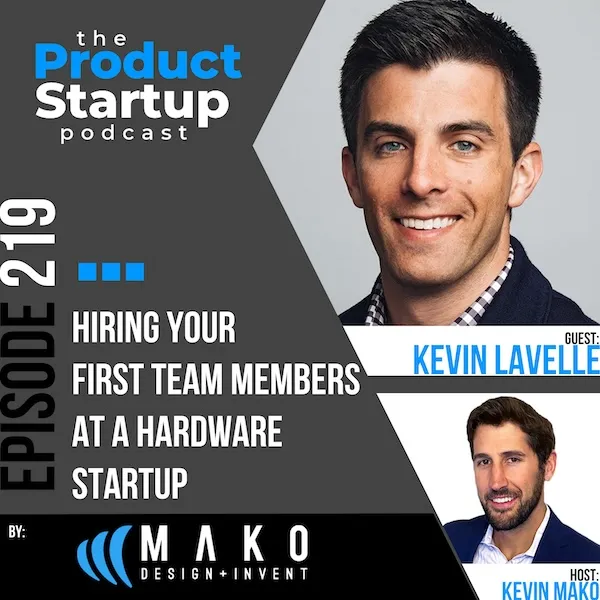
Guest: Kevin Lavelle, CEO & Co-Founder of Mizzen+Main and Harbor.
Host: Kevin Mako, founder of Product Startup and the leading expert in hardware startup consulting. A hardware entrepreneur since 1999, Kevin has advised more than 1,500 founders and built and scaled MAKO Invent through its acquisition by TriMech in 2024.
Episode Overview
Kevin Lavelle explains why the first hires at a hardware startup must be able to make decisions, move quickly, and work without big-company support systems. He also covers integrity, startup fit, trial engagements, compensation expectations, product quality, and controlling feature creep.
What You’ll Learn in This Episode
- What foremost principles are the most important to prioritize when hiring?
- Can your potential hire survive in a fast-paced entrepreneurial environment?
- People from large organizations aren’t typically great fits for early-stage hardware startup businesses. This is because they are not accustomed to the structure and requirements.
- Can this hire operate without a team and conduct decision-making on their own?
- Get to know a potential hire beyond just one interview. You can even consider hiring them on a contract basis before you hire them as a full-time employee.
- Does your potential hire fundamentally understand what they are getting into in joining a hardware startup?
- Startup new hires need to understand that they may not be monetarily rewarded for the full scope of their capabilities now, so they will get more down the road.
- Knowledge gained on the job is an intangible benefit of working for a startup that can also outweigh the compensation.
- Never sacrifice your quality when developing a hardware product!
- Avoid feature creep in early-stage startups!
Episode transcript
This transcript is provided for accessibility and reference. Download the SRT transcript.
Read the full episode transcript
Kevin Mako: Hello, product innovators. Today we learned tips on what to look for in your first hires at a hardware startup from a two-time founder with hundreds of millions of dollars in sales.
Kevin Mako: This is the Product Startup Podcast, a show to learn from top leaders in hardware product development, prototyping, manufacturing, product selling, and everything in between.
Kevin Mako: Hosted by Kevin Mako, the leading expert on product development for hardware startups.
Kevin Mako: Welcome back, everyone. I'm very excited to introduce Kevin Lavelle to the show.
Kevin Mako: Kevin is the founder of Mizzen + Main, a consumer product company,
Kevin Mako: is sold via hundreds of outlets and even has 10 of their own retail stores, doing hundreds of millions of dollars in sales since inception.
Kevin Mako: He has now founded Harbor, a pediatric device startup that just raised $3.7 million in seed funding as well.
Kevin Mako: Today, Kevin will share valuable knowledge for inventors, startups and small manufacturers on the type of personality that you need to look for in your first hires at a new hardware startup, the types of characteristics that matter and that don't, and why quality is so important in hiring.
Kevin Mako: Now, on to the episode.
Kevin Mako: This show is produced by Mako Design.
Kevin Mako: The original firm providing end-to-end consumer product development services tailored specifically to hardware startups, small manufacturers, and inventors.
Kevin Mako: Take your product from idea to store shelves at MakoDesign.com.
Kevin Mako: Now on to the episode.
Kevin Mako: Hey, Kevin, welcome to the show.
Kevin Lavelle: Thanks so much. I'm glad to be able to talk with you. Thank you.
Kevin Mako: We're excited today to have you on to talk about early hiring.
Kevin Mako: It's something that every hardware startup, hopefully, is thinking about at some point in their journey.
Kevin Mako: even if you're just in the ideation phase or you're in the development phase or you're just launching to market.
Kevin Mako: At some point, you're going to grow from being a one or two-person team to hopefully a full-stack team.
Kevin Mako: And one of the most important things in that journey is the hiring.
Kevin Mako: How are you actually bringing on the right team members that will help grow your brand to the next level?
Kevin Mako: Turning it from a product startup into an actual product business with real employees.
Kevin Mako: So what better person today to talk about?
Kevin Mako: You're now on your second venture, your first venture, Mizzen + Main.
Kevin Mako: was a huge success, hundreds of millions of dollars in sales all over the world. You've got
Kevin Mako: 10 retail locations. So before we get into the meat and potatoes of today's conversation,
Kevin Mako: just give us a quick backstory of how you got to the success story that you are today.
Kevin Lavelle: I don't know that I'm at the success story yet, but we've been very fortunate. It's been a great ride.
Kevin Lavelle: The short version there is, I grew up playing golf. I'm wearing one of our golf polos now.
Kevin Lavelle: I watch performance polos take over on the golf course. And when I was a college intern in D.C.,
Kevin Lavelle: which taught me I never wanted.
Kevin Lavelle: to work in politics, but I was there. I watched a congressional staffer run into a building
Kevin Lavelle: soaked in sweat. I wondered why had no one ever made a dress shirt out of performance fabrics before.
Kevin Lavelle: Thought about the idea for years, finally decided, I've got to give this thing a shot. We launched the
Kevin Lavelle: world's first performance fabric dress shirt in 2012. We'll talk about some of those early days later in
Kevin Lavelle: this discussion. But out of the gate, it was doing everything I could to get every sale, one sale at
Kevin Lavelle: a time, and then tens and then hundreds and then thousands. And that's a long early grind. But
Kevin Lavelle: learned a lot through that process. Ultimately, we've had a great run. We had L Catterton invest in
Kevin Lavelle: us. They're the world's largest consumer retail private equity firm. We've gotten some really
Kevin Lavelle: incredible partnerships, guys like Phil Mickelson, JJ Watt, and others. The business is still going,
Kevin Lavelle: still going strong, but I've decided to launch a new startup, a pediatric telehealth startup,
Kevin Lavelle: building a better baby monitor. It's called Harbor. And it's based on my own experience,
Kevin Lavelle: that similar aha moment where something happened. I said, why isn't this better? And I decided to go out
Kevin Lavelle: and build that better thing. I woke up one morning.
Kevin Lavelle: And my son's Nanit app on my iPhone, it's a Wi-Fi baby camera that runs an app on
Kevin Lavelle: your phone. The Nanit app had just crashed. There was no audio coming through. So I ran up to his
Kevin Lavelle: room. Thankfully, he was just fine. But then I learned you can't rely on these app-based systems on your
Kevin Lavelle: phone to be a baby monitor. So we'll talk more about it. But ultimately, that's the problem that I
Kevin Lavelle: wanted to solve. And now we're building, I think, something even bigger than that, which is a wrap-around
Kevin Lavelle: kind of pediatric and early childhood wellness overall telehealth company.
Kevin Mako: Amazing. Both these stories started.
Kevin Mako: from that aha moment of just a pain point that you saw in your own life, which is so akin to so many
Kevin Mako: inventors out there. I know many, many people listening to the show have that same thing that was
Kevin Mako: the spark for their product idea. But it's also important if you're listening to the show and you haven't
Kevin Mako: had that idea yet, just keep your eyes open. Keep looking at the pain points that you're having
Kevin Mako: in your personal life because I have interviewed on the show. And obviously macro design has worked with
Kevin Mako: hundreds and hundreds and hundreds of people who the spark to their product invention, the big
Kevin Mako: success story that ended up coming out was just that.
Kevin Mako: personal pain point either at work or in somebody that they're close to or at home.
Kevin Mako: And that's the beginning of so many ideas. So I want to learn from you today, Kevin,
Kevin Mako: really what some of those growth initiatives were that helped you scale. Today is an important
Kevin Mako: episode for those who are considering to not only launch a product, but launch and grow an empire.
Kevin Mako: While that transition, there's a lot to go through. And today's topic is about hiring. So Kevin,
Kevin Mako: just talk big picture. Walk us through what's important when thinking about hiring. You're
Kevin Mako: very first staff members to help grow and scale your new hardware product business.
Kevin Lavelle: I think I'm going to just say like table stakes is they have integrity. They have relevant overall experience,
Kevin Lavelle: especially if it's a first hire, they're going to be doing something very specific. So moving aside
Kevin Lavelle: some just the very basic table stakes that anyone should consider when hiring. I'll talk about maybe
Kevin Lavelle: some of the principles that I think are most relevant in no particular order in a startup. I think I would
Kevin Lavelle: always, I say no particular order, but I would always start with, could this person succeed
Kevin Lavelle: in the unbelievably dynamic, uncertain, and fast-paced world of a startup? And in so many startups,
Kevin Lavelle: you want to get somebody that's been there before because you want their experience to come help
Kevin Lavelle: you in those earliest of days. My experience has generally been people from large, very large
Kevin Lavelle: organizations always, but generally from large organizations are not the right fit for the
Kevin Lavelle: earliest, earliest stages. Because in a startup, a day is like a week in a big company.
Kevin Lavelle: A week is like maybe even a quarter in a big company. And a month is basically a year. And it sounds
Kevin Lavelle: funny and cliche to say it, but the speed at which you have to make decisions is unlike anything most
Kevin Lavelle: people have ever experienced. And that cuts both ways. The need to move quickly to survive, but also
Kevin Lavelle: the consequences of decisions tend to be so much smaller that people.
Kevin Lavelle: People from large organizations just aren't used to saying, okay, let's just go with it.
Kevin Lavelle: And then we'll iterate or pivot if we have to. Because if you go through all the processes that you
Kevin Lavelle: normally do in a large organization to make every decision in the small organization,
Kevin Lavelle: you'll never even get off the ground. It's just fundamentally not possible. And so it's not to say
Kevin Lavelle: no one could ever transition from large to the earliest startup employee. So if that is the case
Kevin Lavelle: that you feel like they could, I would really dig into what in their personality gives you the confidence
Kevin Lavelle: to bring them on board for the most critical hire you'll make in the company's, you know,
Kevin Lavelle: tenure. Are there things that demonstrate their ability to handle change? Are there things in their
Kevin Lavelle: history or resume that show that they can operate without a team, that they can operate without a
Kevin Lavelle: decision maker approving or helping guide those decisions? There's a lot of different ways you can look for
Kevin Lavelle: that. That would be the first thing that I would start with. The second thing would be some measure
Kevin Lavelle: of get to know them in some capacity for more.
Kevin Lavelle: more than an interview. And so a lot of the earliest hires at my second startup harbor,
Kevin Lavelle: we have worked with on a contract basis for either a couple weeks or in many cases, a couple of
Kevin Lavelle: months where they were doing some freelance for us on the side. And so we really got to know each other.
Kevin Lavelle: And if you can do that, that is just the best way to hire because somebody could be the perfect fit
Kevin Lavelle: for the role that you want to hire for, but you guys just don't mesh. And the way that you want
Kevin Lavelle: to operate the business just doesn't align with how they make decisions.
Kevin Mako: So,
Kevin Lavelle: Those would be the first two things. And then the third thing would be, do they understand fundamentally
Kevin Lavelle: what they're getting into? And so I've seen some people say, I really want to go work for a startup.
Kevin Lavelle: And then they say, you know, I want my all in cash comp in year one to be $400,000. Great. You are
Kevin Lavelle: 100% not a fit for this startup because you have no idea what sort of tradeoffs and types of things
Kevin Lavelle: are going to be required for this role. And you really can never negotiate someone down successfully from
Kevin Lavelle: a $400,000 kind of opening compensation ask.
Kevin Lavelle: because that's just so far removed from the reality of that first type of higher role.
Kevin Lavelle: And they need to understand that what they're buying into is the upside rather than, well,
Kevin Lavelle: you have to pay me what I'm worth right now. And that, to me, is the biggest flag for they're not going to
Kevin Lavelle: have the right frame of reference for what these decisions require. And as a corollary, I'm talking to
Kevin Lavelle: a bunch of prospective kind of ambassadors and celebrity investors and others. And some of them say,
Kevin Lavelle: well, if you want to work with me or their agent, if you want to work with this person,
Kevin Lavelle: And, you know, they're going to need at least seven figures a year in cash compensation.
Kevin Lavelle: Like, okay, well, then you're not a good ambassador for a startup at this stage because that tradeoff
Kevin Lavelle: doesn't work. So that's actually a really easy and great thing to know up front. But hopefully those
Kevin Lavelle: are our three first good kickoffs for framing for that first hire.
Kevin Mako: That's so powerful. Finding the right fit for the job, especially in the entrepreneurial venture.
Kevin Mako: I love how you keep coming back to that startup attitude because the reality is you don't have
Kevin Mako: the budgets to the big corporations. So you're not trying to compete with them toe to toe on.
Kevin Mako: the precise figures, especially when we're talking about cash compensation. It's all about the
Kevin Mako: upside. A big part of that upside is that it's kind of your job as well as the entrepreneur to sell them
Kevin Mako: in a way. They've got to believe in what you're doing because the reality of almost any startup is that
Kevin Mako: you are getting paid less now in order to be part of a ride in which you will do significantly better
Kevin Lavelle: than your peers by just going and getting a fluffy corporate job. The other thing I just want to add to that
Kevin Lavelle: in terms of the, you know, being a part of a ride. I've seen a lot of
Kevin Lavelle: I'll call it takedowns on Twitter where early employees took a bunch of equity and they got totally
Kevin Lavelle: hosed because it didn't work. And there are some prognosticators on Twitter that say basically working for
Kevin Lavelle: a startup is a bad trade and anyone should just go take more money at a more secure job. If the only reason
Kevin Lavelle: you're going to work for a startup is because you think your equity is going to be worth $10 million and
Kevin Lavelle: you're willing to make that trade, it's probably not the right voice also. If you are going to work for a
Kevin Lavelle: startup, sure, take a bet on yourself and say I want to be a part of an upside. I'm ready for it. But also
Kevin Lavelle: So the ability to learn and grow and extend your skill set, no, you should be compensated
Kevin Lavelle: for it. I'm not saying go do work for free or take a 90% haircut on your compensation,
Kevin Lavelle: but the intangible benefit of the speed and breadth of responsibility that you can get,
Kevin Lavelle: there is no greater example of this than myself. Before I started Mizzen + Main,
Kevin Lavelle: I'd never even interviewed someone, let alone hired them, managed to P&L, and then I never
Kevin Lavelle: done any of that. But I called myself a CEO and I was off to the races.
Kevin Lavelle: Every single thing I did was brand new. And I was able to go from no P&L experience, no
Kevin Lavelle: managerial experience, nothing, to running ultimately a multimillion dollar company because of what a
Kevin Lavelle: startup affords you the chance to do. And so I saw folks, some of the best hires I ever had, had no
Kevin Lavelle: college degree. They had no real, you know, robust resume, but they came in and they proved they could
Kevin Lavelle: outwork and outsmart and out hustle, every one around them. And they rose to a point where they got
Kevin Lavelle: hired away to a role that they never would have gotten before because those other companies
Kevin Lavelle: needed to see those proof points. And when you can say, I took the business, I was a part of the
Kevin Lavelle: business from here to here, and here are the 10 things that I personally did, that's really hard
Kevin Lavelle: to do at a larger organization. You can claim credit. But if you're one of 10,000 employees,
Kevin Lavelle: it's really hard to say that, like, you materially move the needle for the top line or the bottom
Kevin Lavelle: line of the organization.
Kevin Mako: Well, that comes back to what you're talking about. Even when you're first
Kevin Mako: hire, does this person have the ability to do a lot of work? Are they a get stuff done type of
Kevin Mako: person or is a kind of a massive delegator, thinker, this sort of stuff, which is very akin to big
Kevin Mako: corporate, lots of meetings, very little action. As you said, you know, weeks turn into months that turn into
Kevin Mako: years. So at a startup, you don't have that luxury. Things need to be getting done every single
Kevin Mako: day. So if you can prove that you're that type of person that has the grit, the integrity, as well as
Kevin Mako: the intelligence to hustle and move on these things quickly, make action.
Kevin Mako: actual actions happen, you're going to be much further ahead. And the learning, what better
Kevin Mako: place to learn, especially as somebody who's maybe looking to change career or early in their
Kevin Mako: career, whatever else. Startup was an incredible place. Now, I see it with countless startups,
Kevin Mako: clients of ours or just other groups that I'm a part of. And there's really no machine that moves
Kevin Mako: nearly as fast as somebody who is, especially with leadership like you had, Kevin, where you were in
Kevin Mako: it 110%. You're looking to make moves very quickly. You're looking to conquer a market.
Kevin Mako: you're moving at the speed of light. So everybody who then joins around you is going to be doing
Kevin Mako: a very similar thing, moving quick and getting things done.
Kevin Lavelle: 100%. And I will follow that great kind of encapsulation with somewhat of a contradiction
Kevin Lavelle: immediately in my advice, which is the biggest change that I've made from my experience at Mizzen + Main
Kevin Lavelle: to harbor. And part of it is the nature of what we're building is hiring experienced people.
Kevin Lavelle: And I don't mean big, big, big comfort.
Kevin Lavelle: people who say, oh, I've seen everything and I've done it before. But people with the relevant
Kevin Lavelle: experience required to be successful. And so very specifically with Mizzen + Main, I sort of tinkered
Kevin Lavelle: around. I found a seamstress. I called fabric companies. I found people to make me a pattern. And I sort
Kevin Lavelle: of hacked together the prototype and the first thousand shirts myself and paid for it myself. And my job
Kevin Lavelle: was to then go out there and sell the shirts. And I learned how to sell and how to get our product in
Kevin Lavelle: and blah, blah, blah, blah, blah. I didn't hire anybody from the end of the end of the
Kevin Lavelle: for I think at least four years, maybe five. And part of it was I couldn't afford to hire
Kevin Lavelle: anybody for a long time, but then also everyone from the industry either told me my idea was stupid or were
Kevin Lavelle: so dismissive of our existence that I wasn't having a conversation trying to get them to come in
Kevin Lavelle: and help us. Now, I certainly didn't talk to everybody in the industry, but my conversations were
Kevin Lavelle: largely, not only do you not have a chance, like, you're an idiot for trying. With Harbor, we're
Kevin Lavelle: building very advanced electronics and very robust systems. We have to be at the leading
Kevin Lavelle: edge of cybersecurity. This is an incredibly sophisticated electrical engineering, industrial design,
Kevin Lavelle: mechanical engineering, software, firmware, cybersecurity. And so with Harbor, we have nine people
Kevin Lavelle: on our team and we just launched the wait list for our product. I have been working on this idea
Kevin Lavelle: directly for over two years. And my co-founder and I, who's the technical side of the business,
Kevin Lavelle: have been building this company for 18 months. We have probably 1T people on contract from
Kevin Lavelle: one hour a month to 40 hours a week because the number of people with expertise is so high. And so I do want
Kevin Lavelle: to just be careful to say, like, don't askew anyone that has experience or big company resume because
Kevin Lavelle: there's no way they could survive in a startup. There is a balance. And depending on the needs of the product you're
Kevin Lavelle: building, the technical requirements in some cases, you just fundamentally cannot skimp on.
Kevin Mako: Yeah, especially in hardware. I mean, we talk a lot about it on.
Kevin Mako: the show, you can condense your feature sets, but never sacrifice quality of your feature sets.
Kevin Mako: Hardware is expected to be a five-star Amazon reviewed product. Even if you're a new brand,
Kevin Mako: the market is looking for top-tier quality. Therefore, you really have to at least make sure
Kevin Mako: that you're hitting certain key minimum milestones with top-level expertise. Otherwise, don't even
Kevin Mako: start. So it's kind of all or nothing in terms of quality. But, of course, as a startup,
Kevin Mako: what you can sacrifice is your feature creep. You can always.
Kevin Mako: always save certain things for a version 2.0. And that's been addressed quite a bit, especially
Kevin Mako: when you're coming into a complex consumer electronics products. You've got to be very sophisticated
Kevin Mako: about what your first offering is, be very targeted, be very niche, be very specialized, very good
Kevin Mako: at what you do and that limited skill set. And I love how you said, like you've really packed a lot
Kevin Mako: of design engineering, et cetera, into it in the early phases before you even launched to make sure
Kevin Mako: that you're launching with that world-class quality right out of the gate from day one.
Kevin Lavelle: Yeah, absolutely.
Kevin Lavelle: Because anything less is you're sacrificing the entire company.
Kevin Lavelle: And, you know, I think an important lesson, and though it's not hardware, I think a very
Kevin Lavelle: important example of this is I don't know what version of Uber I tried, but I remember the very
Kevin Lavelle: first version of Uber that I tried is like ancient technology compared to what Uber is today.
Kevin Lavelle: But if they didn't do that, they had no chance to do anything else. Hardware you can't iterate
Kevin Lavelle: obviously nearly as quickly. But I think it's important, the lesson that you said is feature
Kevin Lavelle: creep, what do you have to have to create value for the customer? And if you do that
Kevin Lavelle: materially better than anyone else, then you have a chance to continue to grow and add things. And
Kevin Lavelle: for us, there is the minimum hardware feature requirements. And then we have made some system design
Kevin Lavelle: choices and some product selection choices on the guts of the product to allow us to expand in a huge
Kevin Lavelle: huge way from a software perspective over time. So we nail the hardware with that foresight in mind
Kevin Lavelle: for what do we need to future proof against for the years ahead. So we don't have to keep
Kevin Lavelle: iterating new pieces of hardware. But all of the growth in features will come on the software side.
Kevin Lavelle: Our launch version will be everything you need in a baby monitor. But then we have a roadmap of two
Kevin Lavelle: years of features that we will release later. Because if we tried to do all of that at once,
Kevin Lavelle: we would never launch. And when it comes to something as expensive and complex as hardware,
Kevin Lavelle: you do have to get that first product out in the world to have license to be able to do everything
Kevin Lavelle: else.
Kevin Mako: Kevin, thanks so much for your words of wisdom. Just before I let you go,
Kevin Lavelle: what is the website to Harbor? Harbor.com. And all of our socials are at Harbor Sleep. And then
Kevin Lavelle: I'm on X at Kevin S. Lavelle. Thanks, Kevin. Appreciate it. And I'll put the links in the show notes below
Kevin Mako: for anyone that wants to click through. Thanks again for your words of wisdom today on hiring and getting
Kevin Mako: your first product to market. Some of the concepts around feature creep, really important.
Kevin Mako: And you know, it all ties in. Hiring feature creep, product development. It's all
Kevin Mako: kind of nestled together very tightly. So I appreciate you bring those things to light and how that
Kevin Mako: even affects your hiring decisions as you hire your first employee for a hardware startup. Thanks,
Kevin Lavelle: Kevin. Thank you. Appreciate the opportunity. Thanks. Thanks. And take care.
Kevin Mako: Thanks for tuning into this episode of the Product Startup Podcast. If you found some value in the
Kevin Mako: show, please do us a huge favor and hit the like button and subscribe. If you have any questions,
Kevin Mako: guest suggestions, or anything else, feel free to reach out to us anytime at our email, podcast@makodesign.com.
Kevin Mako: This show is hosted by Kevin Mako, North America's leading expert on product development for hardware startups, and the podcast is produced by Mako Design, the original firm providing end-to-end consumer product development services tailored specifically to hardware startups, small manufacturers, and inventors. Take your product from idea to store shelves at MakoDesign.com. That's M-A-K-O-Design.com. Thanks for joining and see you again soon.
Hardware Startup Team Strategy
Make Your First Hires With Greater Confidence
Building the first team around your product? Work directly with Kevin to clarify which roles to hire first, what each person must own, how to screen for startup fit, when contractors make sense, and how hiring choices connect to product quality, roadmap, and cash runway.
Kevin can help you build a practical hiring sequence that matches the stage of the product and the decisions your founding team cannot keep carrying alone.
Request a Startup Hiring Strategy Call
Tell Kevin your current team, product stage, and the role or capability you are considering next.