
Listen Now
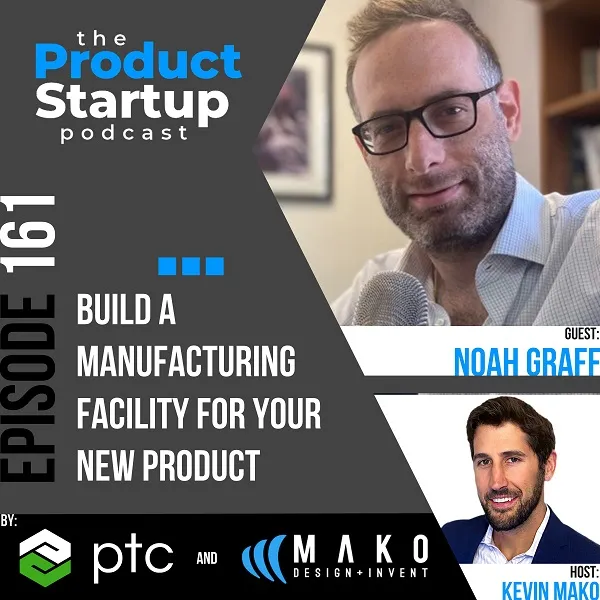
Guest: Noah Graff, Vice President of Graff-Pinkert Machinery and host of Swarfcast, a podcast about machining and manufacturing equipment.
Host: Kevin Mako, founder of Product Startup and the leading expert in hardware startup consulting. A hardware entrepreneur since 1999, Kevin has advised more than 1,500 founders and built and scaled MAKO Invent through its acquisition by TriMech in 2024.
Episode Overview
Noah Graff explains what founders should consider before bringing production equipment in-house. He covers machine capability, used equipment, supplier support, learning through production, local manufacturing, capacity utilization, producing for other customers, and the added control that comes with owning part of the process.
What You’ll Learn in This Episode
- Producing equipment for manufacturing products.
- More hardware startups are inquiring about purchasing machinery than ever before.
- Using machinery to manufacture other products can reduce the cost of acquiring the equipment, allowing for dual use: one for your own product and one for other products.
- Utilizing machinery to learn how to improve your manufacturing process and product quality.
- Knowing the calibre of machine that you need based on the part that you need is key.
- Prioritize finding a machinery supplier with excellent support services to meet your needs.
- Reshoring is becoming more prevalent as product startups aim to produce more goods domestically.
- Manufacturing your own product provides greater control over the final product.
Episode transcript
This transcript is provided for accessibility and reference. Download the SRT transcript.
Read the full episode transcript
Kevin Mako: Hello, product innovators. Today we learn from the Vice President of an international manufacturing equipment dealer on why startups should consider
Kevin Mako: building your own production facility to manufacture your new or scaling product product.
Narrator: You're listening to the Product Startup. You're listening to the top leaders in product development, product selling, and everything in between.
Narrator: hosted by Kevin Mako, the leading expert on product development for physical product startups,
Narrator: sponsored by PTC's two best-in-class 3D CAD product development software solutions Onshape and
Narrator: Creo, and produced by Mako Design + Invent, the original firm providing world-class consumer
Narrator: product development services tailored specifically to startups, small manufacturers, and inventors.
Kevin Mako: Welcome back, everyone. Today I'm excited to introduce Noah Graff to the show.
Kevin Mako: Noah's vice president at Graff-Pinkert, an 80-year-old manufacturing machinery dealer that buys and sells used equipment all over the world with a central warehouse in the USA.
Kevin Mako: NOAA is also the host of the Swarfcast podcast, a show all about manufacturing machinery and tool machining. Today, NOAA is going to
Kevin Mako: share some valuable knowledge in how inventors, startups, and small manufacturers can consider starting
Kevin Mako: your own production facility locally to produce your product and what to think about when buying used manufacturing or equipment for your own production facility.
Kevin Mako: Now, on to the episode.
Noah Graff: I know, welcome to the show.
Noah Graff: Oh, thank you for having me. It's really an honor and it's nice to be
Kevin Mako: on somebody else's podcast for once. Well, it's nice to have you on the show. I know you run your own podcast in and around the industry and what we're talking about
Kevin Mako: today, especially in around machining and setting up your own manufacturing. I'm very excited to talk to you about that today, not just because you have the podcast,
Kevin Mako: but also you've been in this business. I mean, your grandfather started this business 80 years ago, buying and selling manufacturing equipment around the world.
Kevin Mako: So what I'm really eager to talk to you about today is how startups can think about potentially setting up their own manufacturing operation, either potentially for when they
Kevin Mako: start to produce their new product,
Kevin Mako: or as they start to scale it, or as they want to start putting maybe elements of their product manufacturing locally at home.
Kevin Mako: So you've been buying and selling equipment for a long time, obviously part of the podcast as well. Excited to talk to you about that today, but just give us a bit of a history.
Noah Graff: How did you get to the point where you are at now? You know, my grandfather, he had a used machine tool business started around 80 years ago.
Noah Graff: And then my father and my uncle went into the business. And I always had it in the back of my mind, maybe I would go in.
Noah Graff: But then I went to college, was a film major, came out. My father, he had started a magazine about the machining industry.
Noah Graff: It was called Today's Machining World. And I'm out of college and this is like 2005.
Noah Graff: And he's like, hey, broadband is coming. You can make videos of our stories and you can go and use your skills and whatever. And he was just a little bit ahead
Noah Graff: of his time. But I decided, all right, I'm going to try this. So I went into the journalism business and
Noah Graff: And of course, videos didn't catch on for another couple years, but I started editing and writing about precision machining industry.
Noah Graff: Then a couple years later, print was dying, and we said, all right, let's just take the whole thing online and I'll try the machinery business or
Noah Graff: the treasure hunting business, as I like to call it. So started that about 10 years ago.
Noah Graff: We buy and sell mainly turning equipment around the world, turning equipment for metalwork. primarily these machines are called screw machines.
Noah Graff: So they make all the cylindrical products, metal products that go into aerospace, medical, ammunition, anything where you got round
Noah Graff: parts, they're made on screw machines. Some of them are kind of new CNC machines and some of them are actually old, 50, 60, 70 years old.
Noah Graff: People are still using those machines
Kevin Mako: and those are some of the ones we actually specialize in. Yeah, that's amazing. You're still buying and selling machinery that's 60, 70 years old.
Kevin Mako: And a lot of that actually comes into best practices for setting up your own manufacturing operation. Now, talk to us a bit about a hardware
Kevin Mako: startup actually building their own facility and what you can be thinking about in terms of the actual machinery that goes behind making your own manufacturing operation.
Noah Graff: That is a really good question. You know, I run into a lot of startup lately. In fact, this last year, I think more startups
Noah Graff: have contacted us about machines than we've ever seen, which is really a wonderful thing to see. Some people come in and they're like, yeah, I want something new.
Noah Graff: I want something newish. It's got to be five years old or younger, you know, and other people are a little bit more open-minded.
Noah Graff: Sometimes you start talking about prices with people and then they start becoming even more open-minded. I think, you know, it all comes down to the right application.
Noah Graff: Do you need to make hundreds of thousands of parts? Do you need to make a hundred parts of
Kevin Mako: at a time. That's one thing to look at. Something I'm curious about in terms of the people that have been calling you.
Kevin Mako: It's a really interesting fact that you mentioned that more hardware startups are calling you about machinery to set up their own production operation. Have you got
Kevin Mako: any intel as to why there are more startups now looking to
Noah Graff: set up their own facility locally? I think lately maybe people feel like you could have your garage. You could have one machine in
Noah Graff: your garage, maybe you pay 20 grand for a machine and fix it up. And it's possible to make certain
Kevin Mako: kinds of things. So you're finding that like micromanufacturing of smaller things is more common now than maybe it was even a few years ago.
Kevin Mako: More people are kind of getting into the actual
Noah Graff: small product manufacturing space looking to start small and grow their way up from there. I think so. I mean, there are certain niches. There are certain places.
Noah Graff: Some are easier to get into than others. I've found some of the startups. I know one startup, you know, they came in thinking
Noah Graff: they were going to make medical parts and they bought all this really expensive equipment. And they ended up having to make gun parts.
Noah Graff: People say they're in the shoot them up, sew them up, business. It also makes me think of sometimes people who have their own product. One thing they do is
Noah Graff: they like to buy machines that they can also run product for other people in addition to the thing they're making for themselves.
Kevin Mako: That's another way to sort of insulate yourself. That's a very interesting analysis there that it gives you more opportunities potentially for revenue.
Kevin Mako: So if you're starting your product, you really want to build a local manufacturing hub or whatever else, realize that you don't just need to focus on your product, but you
Kevin Mako: may actually be providing a service for other products as well to maybe dilute some of the early stage costs while you're building your product brand until the point where maybe
Kevin Mako: you can use the whole facility or the whole piece of machinery for, you know, all the time on your product, but maybe it's a way to kind of have your cake and eat it too.
Noah Graff: It's a really interesting other way to look at it. Well, as you say, what you were saying, like sort of micro-manufacturer, if you're making
Noah Graff: your own product, you're probably not going to have that many widgets you're going to actually have to make. So you may have all this excess capacity right there.
Noah Graff: And you could take that and start making parts for other people, too, and get a hell of a lot more return on your investment.
Noah Graff: You know, two interviews ago, probably your listeners would like it. We interviewed a guy on our podcast who's in the luxury watch making business.
Noah Graff: And this guy, he sells watches for $70,000.
Noah Graff: And it's interesting how he's approached his equipment. We first met him because he bought a Swiss CNC screw machine from us.
Noah Graff: He paid like $15,000 for it. And he was going to learn using that machine. And then he went out and bought a brand new one, which probably cost them about $300,000.
Noah Graff: So that's another thing to think about. It's good perhaps to start small, just know just because something is more expensive and brand new.
Noah Graff: It doesn't mean that it's going to do any better for your part than if
Kevin Mako: it's a little bit older. That's a good piece of advice there too. It's looking at really what you need, the cost and benefits.
Kevin Mako: And I imagine you help a lot with those decision-making criteria with somebody who's looking to set up manufacturing operation. They're buying the machine from you.
Kevin Mako: You can work with them to say, is it really necessary to have the newest and latest and greatest machine?
Noah Graff: Or is your partner going to be well served by this 30-year-old machine? that's a fraction of the cost. A fraction, literally a fraction.
Noah Graff: You might be able to buy a machine for $10,000 or somebody might be doing the same part for $100,000.
Noah Graff: And if you're good at knowing exactly where to go to find it, what exactly you need, that's a big piece of it.
Noah Graff: Another thing people will say to me sometimes, all right, what brand of machine should I buy? And they'll be choosing between, like, again, like Swiss CNC machines.
Noah Graff: Those are the ones we specialize in with the CNC. So there's like Citizen, there's Star, there's Sugami, there's Tornos. And I'm like, look, they're all good.
Noah Graff: Machine Tools is almost like a religion. Everybody has their one thing and their people only want to run that one thing.
Noah Graff: But if you don't know what you want, just look at who's going to give you the best support. Look at who's in your area, ask around to people, and that
Noah Graff: is going to really serve you in
Kevin Mako: the end because it's really all about who's going to help you. They're all making pretty decent stuff. That's support. That's a big one. After sale, support, pre-sale.
Kevin Mako: support, that's a big deal, even setting it up, right? How do you actually operate this machinery?
Kevin Mako: There's something else you noted in there that I like, not only can you improve the manufacturing
Kevin Mako: of your product by having your own machinery and your own equipment, but you may actually improve the product itself.
Kevin Mako: You actually find this relationship between the product and the machinery that's used to make it. That relationship sometimes can have very profound end user benefits and
Kevin Mako: features of the actual product itself, all because of the things that you can
Noah Graff: learn while you're working with that piece of machinery on your own product? That's really interesting. So you're saying that
Noah Graff: by doing your own in-house manufacturing, you are going to make a better product. There's a good chance
Noah Graff: you could make a better product than outsourcing the machining because while
Kevin Mako: you're making it, you're going to really understand your product better.
Noah Graff: Well, you mentioned learning and that's what queues me on. I think of it from a design.
Kevin Mako: That's a very astute observation there. Well, another question I'd be curious to you about as well is in regards to local manufacturing. Have you found that people are
Kevin Mako: buying more machinery now than before? Like in 2023, are people looking to potentially put more of their
Kevin Mako: production operations here locally in Canada or the USA? Or are they doing it for other reasons when you see
Kevin Mako: some of these kind of people that, even the startups you mentioned that historically don't buy as much
Noah Graff: machinery or any machinery now are starting to get into the idea of doing their own manufacturing operation locally? Well, absolutely. you are seeing the reshorring.
Noah Graff: Before it was a lot of anecdotal evidence. Ah, the stuff is coming back. Like, now you really do hear about people. I'm not quoting any more jobs. And I only want people
Noah Graff: in the United States to do my stuff because there's just too many problems with the logistics or the material.
Noah Graff: You are seeing a lot more at home. And I think you're seeing kind of what you were saying before about people want control of their product.
Noah Graff: I think that does come right. back to the equipment. A lot of these people, these inventions, their products, they're like their baby. So they want everything at home.
Noah Graff: We interviewed a guy in Wisconsin. He had his own product. He makes vaporizers for smoking various types of flour. And they're just these incredible
Noah Graff: colors and he anodizes them. And the guy comes to me and he is like, I want to make the greatest product ever.
Noah Graff: And he was so obsessed with the machines. He tells me in the interview, I'm going to buy these German Swiss machines.
Noah Graff: And I was like, you know, I don't think you really need that machine for what you're doing. And he's like, no, I want them to be the greatest parts ever.
Noah Graff: And I need to buy the greatest piece of engineering in the world ever. And he went and he bought these machines. They're a customer. I don't want to say exactly what they were.
Noah Graff: But he paid a couple hundred thousand dollars too much for these machines. The customer service ended up being rather so-so.
Noah Graff: And he ended up getting rid of them and buying cheaper machines. But he was so seduced by this reputation, oh, these
Noah Graff: are, this is European manufacturer. And these are the most expensive. So these must be the best. And then after that, he realized, all right, first he needed to
Noah Graff: let go and find out what the best service was nearby. And then he needed to realize it's just because something has the reputation for being the greatest ever,
Noah Graff: doesn't mean it is the right weapon for the job. I just talked to a gun manufacturer before this interview.
Kevin Mako: Maybe that's why my mind is on weapons.
Kevin Mako: Talk to me a bit about valuations as well, because one of the things that I've seen, especially in a hardware startup, is as a product out in the industry,
Kevin Mako: you have a certain amount of value, right? This new IP that you've created, the sales that you're generating, as a startup that's going to be low on the sales side,
Kevin Mako: but as it grows, it becomes more valuable, almost exponentially. Now, if you pair that with the fact that you actually produce your own product in-house,
Kevin Mako: Not only do you have intellectual property from the product itself, but you have intellectual property from your manufacturing operation.
Noah Graff: And that inherently has compounding value to the overall organization too. Yeah, both the control of it and as I said before, they're going to bring in
Noah Graff: this machine to make their product. And then they're going to pay for that machine by having excess capacity that they could start making products for somebody else.
Noah Graff: You buy a machine for $100,000 to make your own product. And then you easily get that money back.
Kevin Mako: without even having to sell that much of your own product because you're making other people's stuff.
Kevin Mako: It's a great way to reduce the risk or at least reduce the nervousness about making such a commitment because obviously this is capital. It's a capital expense.
Kevin Mako: You've got to come up with money in advance to buy this machinery to set up your operation. And there's going to be a lag in time before you
Kevin Mako: actually get that paid back via the products you're putting to market. Noah, can you talk a bit
Noah Graff: about your podcast and what are some of the things that you're talking about on the podcast in and around the machining world? Sure. Yeah. The podcast is called Swarf
Noah Graff: That's S-W-A-R-F-C-A-S-T. Swarf is like the chips and oil and grime
Noah Graff: that goes down in the belly of these screw machines. We interviewed a guy. He's using technology that's like 100 years old,
Noah Graff: and some of the machines are brand new. You know, he just bought one from Germany. It's called a Kern machine to make these watches. You know, he paid $600,000 for one machine.
Noah Graff: And then another machine is like 100 years old. literally. One of the secrets we have in machinery business, you have a long conversation with
Noah Graff: somebody, you never know what they're going to say. Something's going to resonate with you.
Noah Graff: You'll come into a shop looking for one machine and then you'll ask them, so what are you looking for? And it turns out you have something way better.
Noah Graff: That was just what came to mind when I was going to be on this show. I saw it's inventors. You guys are observing everything. The thing with
Noah Graff: machinery business, we don't exactly know what's going to happen, but your ears and your eyes are out and
Noah Graff: you're paying attention and you're observing, sometimes amazing things will happen. That's my
Kevin Mako: advice. Keep an open mind and look for serendipity. Noah, thanks for all your words of wisdom on the show
Narrator: today and we look forward to talk to you again. Thank you. Take care of it. Thanks for tuning in to this episode of the Product Startup Podcast.
Narrator: If you found some value in the show, please do us a huge favor and leave us a quick five-star review. If you have any questions, guest suggestions, or anything
Narrator: else, feel free to reach out to us anytime at our email, podcast at MakoDesign.com. That's podcast at MakoDesign.com. This show is hosted by Kevin Mako.
Narrator: North America is a leading expert on product development for physical product startups. Huge thanks to our sponsors, PTC, and their two best in class 3D CAD product development
Narrator: software solutions Onshape and Creo and Mako Design + Invent. The original firm providing world-class consumer product development services tailored specifically to startups,
Narrator: small manufacturers, and inventors. Thanks for joining and see you next time.
Manufacturing Footprint Strategy for Founders
Know the Business Case Before You Buy the Machine
Work directly with Kevin Mako to evaluate whether in-house production fits your volumes, process, quality needs, capital, staffing, facility, utilization, supplier options, and long-term product strategy.
Kevin can help you compare local, contract, hybrid, and owned-production paths, prepare stronger equipment and supplier questions, and stage the decision around real demand and cash flow.
Request a Manufacturing Footprint Call
Tell Kevin what you plan to produce, your expected volume, and why owning part of manufacturing is under consideration.