
Listen Now
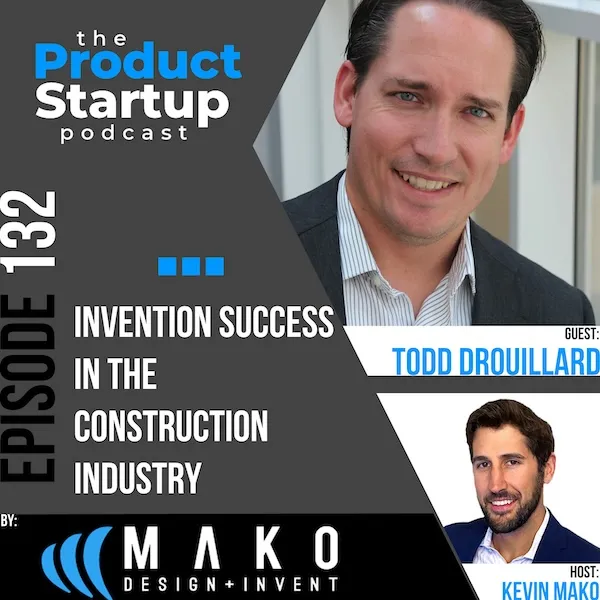
Guest: Todd Drouillard, Science and Technology Business Leader at HED.
Host: Kevin Mako, founder of Product Startup and the leading expert in hardware startup consulting. A hardware entrepreneur since 1999, Kevin has advised more than 1,500 founders and built and scaled MAKO Invent through its acquisition by TriMech in 2024.
How Construction Inventions Earn Market Adoption
Todd Drouillard explains how construction inventions win adoption by reducing risk, improving reliability, simplifying installation, and proving business value. The discussion also covers product strategy, commercialization, supplier planning, partnerships, and the decisions that help a construction innovation move forward.
What You’ll Learn in This Episode
- Warehousing innovation is becoming increasingly important to the success of a scaling hardware product business.
- Construction inventions and innovations are happening very quickly in new building design, fabrication, and maintenance.
- How do you get your construction product into the market to get into new or renovated buildings?
- Less labor, more product. This is prefabrication, and there is a lot of room for new construction inventions in this space.
- Product manufacturing and architecture are merging
- To pitch your construction innovation, show that it reduces risk, increases quality, is more reliable, and is easy to install.
- A big advantage when designing your product is to either make it easy to work with other products or include what used to be multiple products into one
- There are lots of problems on a construction site, solve them with your construction inventions.
Episode transcript
This transcript is provided for accessibility and reference. Download the SRT transcript.
Read the full episode transcript
Kevin Mako: Hello, product innovators. Today we learn from a 25-year architect for product facilities on construction inventions
Kevin Mako: and the changing product distribution landscape for small product businesses.
Narrator: You're listening to the Product Startup Podcast, the show that helps bring your product idea to life by chatting with successful inventors,
Narrator: product developers, and hardware industry professionals. Our goal here is to get to the bottom of what makes a product successful, from initial
Narrator: idea to getting your product on store shelves. We're taking you step by step to build a functional product and scale your product business.
Narrator: Hosted by Kevin Mako, one of North America's leading experts on hardware development for small product businesses. Now, onto the show.
Kevin Mako: Welcome back, everyone. Today, I'm very excited to introduce Todd Drouillard to the show. Todd is a science and technology business leader at HED, which is one of the world's
Kevin Mako: leading architecture firms for manufacturing, warehousing, and distribution center buildings.
Kevin Mako: Todd has been in the architecture business for 25 years, has his master's in architecture,
Kevin Mako: is an AIA director, and is on the Construction Code Commission Board of Directors in Michigan.
Kevin Mako: Today, Todd is going to share some valuable knowledge in how inventors, startups, and small manufacturers are changing the way they move products to their end customers, and what
Kevin Mako: inventors with construction-related inventions can do to succeed in getting their innovations to market. Now, on to the episode.
Kevin Mako: Hey, Todd, welcome to the show. Hey, very good to be here. Well, we're excited to have you on today.
Kevin Mako: You work for one of the leading architecture firms in the world, a massive national brand that builds a lot of the manufacturing houses, a lot of hardware startups end up producing
Kevin Mako: in, whether they're going to fully produce their product onshore or whether they're going to do assembly onshore or maybe even their own just warehousing here locally in either
Kevin Mako: the U.S. or Canada. You are the guys who actually design an engineer and then help actually fabricate and build this.
Kevin Mako: So you get to see a lot of what's happening, not just within innovations and construction, but also what's happening in the industry in general.
Kevin Mako: And I want to talk about both of those things with you today. But first and foremost, give us a bit of a background.
Todd Drouillard: How did you get to where you are today? Give us a bit of a background on the 25 years you've been in architecture. Sure. Sure. Well,
Todd Drouillard: surprisingly, I've wanted to be like an architect since I was 10. I was always like interested in how things went, you know, were built and put together.
Todd Drouillard: You know, you started to draw floor plans at 10. It's kind of strange. You know, people started to look at you. Like, what's going on? So I decided to pursue a career
Todd Drouillard: and to be like an architect, and I really didn't know what was kind of the big part of it until I got into the league industry 25 years ago.
Todd Drouillard: I kind of moved more towards the management side, but really focusing on the manufacturing. And really my strong suit has been designing
Todd Drouillard: the buildings that people build products and it could be like anything. So really designing the infrastructure in the buildings that support the creation for
Todd Drouillard: multiple companies. So like our firm is HED. We're headquarters in Detroit, which is,
Kevin Mako: is a huge manufacturing hub, but we have like offices around the country. And we're just glad to be here and glad to talk to you.
Kevin Mako: Oh, it's great stuff. You get to see a lot of what's going on because you're on some of these big picture projects that are looking 10, 20, 30 years into the future.
Kevin Mako: So what are you seeing today in the industry, especially when it comes to kind of warehousing,
Todd Drouillard: product manufacturing, product distribution for mass manufactured physical consumer products? Sure. Really the big trend that we've seen lately is in the manufacturing
Todd Drouillard: warehousing. And it's not so much where the products are made. It's where the products are stored.
Todd Drouillard: And one of the things that I think we've kind of hit during the pre-pandemic and turn this time is the realization that you could sit at home and
Todd Drouillard: within a day, the products like at your doorstep. I mean, it just kind of blows your way. Something that used to take maybe weeks or days or or even months is happening so quickly.
Todd Drouillard: So we've been seeing a large like uptick on last mile shipment. And these aren't just your normal like warehouses with like racks.
Todd Drouillard: they have like automatic stored retrieval, you know, it's amazing. They're becoming highly
Todd Drouillard: technical like buildings, not sure, you know, like a warehouse, it's dark. Nobody wants to work
Todd Drouillard: there. They're starting to put some architecture to the projects themselves, but more importantly
Kevin Mako: is what goes on inside the building. That's the big piece of it. That's interesting. The
Kevin Mako: buildings are obviously getting smarter, but they're also getting more humane, more enjoyable, more of a combination between a office with
Todd Drouillard: a cultural identity and a hardcore warehouse. Somewhere in the middle is like this new kind of super warehouse, I guess.
Todd Drouillard: Yeah, and I'm sure anybody could drive around and see near any like airport hub. You'll like start to see these giant like blood buildings just pop up.
Todd Drouillard: And it's funny because the way that the buildings are built are actually kind of like it's interesting itself. they have a lot of these mass produced projects are mass or
Todd Drouillard: mostly built like offsite and then shipped to the site. Wall panels, trusses, they're all built like offsite and then placed in there so
Todd Drouillard: much that when we design these buildings kind of like in a 3D like environment, those 3D models are actually used to fabricate the inside parts.
Todd Drouillard: So we're becoming a little more leaner, a little more cleaner, really with the design. But back to your point about making the buildings more like energy efficient, we're putting.
Todd Drouillard: and things like skylights because, hey, you know what, the people that want to work there actually do enjoy seeing the daylight.
Todd Drouillard: So really the warehousing piece of it has really changed. I mean, it's like I've seen a big change in the last 15 years. It's been completely different.
Kevin Mako: If you were to walk into like a building 15 years ago to now, it's drastically more advanced. It's cleaner. It's a better like space.
Kevin Mako: Absolutely. And it's amazing how that is really applying to even a hardware startup today because you have to think about this moving forward.
Kevin Mako: The model for getting your product to your customer is changing. Of course, now, first and foremost, everybody thinks, yes, Amazon Prime.
Kevin Mako: That is the go-to thought, but it's beyond just Amazon, right?
Kevin Mako: That's who obviously pioneered this concept of either same day or very quick shipping.
Kevin Mako: It started as two-day, first free shipping, then two-day, now same day, and now they're even experimenting with like two-hour, four-hour shipping in certain regions.
Kevin Mako: Yeah, it's getting really fast. But it's applicable to multiple different ways of executing beyond Amazon.
Kevin Mako: There's a lot of people now that are selling direct to consumer.
Kevin Mako: And as we're seeing more and more of those people are realizing that, okay, if you're going to sell direct to consumer
Kevin Mako: and you're not actually fulfilling through the Amazon platform, you have to think of these logistics yourself.
Kevin Mako: Now, it may not necessarily mean as a hardware startup that you're going to be building buildings across the country from coast to coast.
Kevin Mako: But you might be working with a partner who does do that. There's brokers. leverage their skills to then apply to your model so that together you can replicate
Kevin Mako: that quick shipping, that warehousing, that return, all the things, all the benefits that you're
Todd Drouillard: looking for in your hardware startup product, but on a national scale and basically at the consumer's doorstep in at least some of the major urban centers. You're correct.
Todd Drouillard: And we've actually been contacted by quite a few real estate. I don't call them like brokers or developers who there are now startups of startups that
Todd Drouillard: actually are wanting to build these warehouses for the exact thing, to have multiple levels of what a product inside of that warehouse and to be able to get
Todd Drouillard: that to the consumer within a time frame or even to store shelves as well. I mean, we have to think about that too. That, you know, stock on store shelves is still a big deal.
Todd Drouillard: But to get it direct to the consumer, that's a whole other logistical challenge, right? You know, and how do you do that, like, effectively? And where do you put the buildings?
Todd Drouillard: There's a lot of thought that gets prod into, you know, where the building's at, where the site is, how far is, you know, the demographics or the user groups.
Todd Drouillard: And then there's tiers, too. So you have larger ones. And then you have these smaller, I want to say, they're more of a regional or maybe subsized ones that may only stock
Kevin Mako: maybe a third of the product compared to the large ones that may be out by the airports and some of the major hubs.
Kevin Mako: That's interesting because the reality is as a startup, if you're selling directly through your website or if you've got any involvement at all of your, whether it's,
Kevin Mako: It could be on both sides, the supply side or the actual sales and distribution side. But either way, customers more and more are going to demand that
Kevin Mako: real-time touch. They're going to demand the Amazon feel. I'm sure we all know it. You go to buy something.
Kevin Mako: Maybe you click an ad on Instagram or whatever else, and it takes you to a website.
Kevin Mako: All of a sudden, the website, it's got some, you know, six to eight-week shipping window and whatever else. Well, what's the first thing you do?
Kevin Mako: You pop over to Amazon and you see if you can get it in two days off of prime, right?
Kevin Mako: So, and of course, now if you're selling on Amazon, you're going to have to pay for those premiums. And that's only one sale strategy of many that an emerging startup can have.
Kevin Mako: So it's important to actually look at these options, especially as you're scaling the business or as you're planning
Kevin Mako: your scale of the business to try and figure out if you're selling multiple different ways. And by the way, this doesn't have to be direct to consumer.
Kevin Mako: This could also be B to be, right? Making sure that you have batches of product to sell to maybe some of your bigger buyers or bigger wholesalers or bigger distributors.
Kevin Mako: it doesn't just have to be direct to the end consumer, like the Amazon style. So it's important to look at these things early and recognize, okay, how is your business
Kevin Mako: fit into the distribution model? Because usually, especially as a hardware startup, the last thing on your mind is how you're going to actually move product around.
Kevin Mako: But you will find out very quickly when the demand starts to come, that's when you
Todd Drouillard: will have wished you had to start it a little bit early, planned a little bit more ahead on how you're actually going to plan to get product into those buyers' hands. me. Correct.
Todd Drouillard: And how do you go from something small to coast to coast? That's, I think, the biggest
Todd Drouillard: piece of it, you know, because there's a lot of times known in my past that products were like
Todd Drouillard: available in a certain like area, but they weren't available, let's say, in like the Midwest.
Todd Drouillard: And what I've seen is there's kind of like a sense, the emergence, like up these larger warehousing, it seems like products are more available across the board.
Todd Drouillard: But it's been kind of this feeling that we want it now and I want it fast. And how else do you, do you, do you,
Todd Drouillard: to do that without storing them in a big warehouse and having it ready for you. And then there's the
Kevin Mako: whole thing about how the website works with how you click and what pops up first. It's things that are like available.
Kevin Mako: Right. That's a funny part about that. So let's flip the script a bit because something
Kevin Mako: else that you're seeing obviously being an architecture for a long time is a lot of construction innovations, especially inventions, tools, gadgets, mass manufactured
Kevin Mako: products. It's changing almost as quick as the warehouse networks are changing that we just talked about, but the actual innovations
Kevin Mako: as you're designing and building and creating these facilities, because as you said, in the beginning of the discussion, they're becoming this more kind of hybrid environment.
Kevin Mako: They're unique. And of course, what makes them unique is all the little bits that go into it. I know we have a lot of listeners that have come up with products that are building
Kevin Mako: materials, building tools, interesting things that are related to trade or to tracking people. There's a whole massive
Kevin Mako: of infrastructure, mass manufactured consumer products that are being innovated at a crazy
Kevin Mako: rate. So I wanted to ask you, Todd, what are you seeing in terms of the innovation in that space?
Kevin Mako: How can people who have construction innovations, construction inventions, how can they
Todd Drouillard: get their product to market and do a great job of getting into that market? And how do you,
Todd Drouillard: as an architect, find out who those players are, or how do those players find you, or how does that
Todd Drouillard: work? When I started out in my career, we used to have these large books and they were made by this company called Sweets. And there were these big green large books.
Todd Drouillard: And inside suites would be all the products for a building. It could be handling washing dispensers to sinks, to, you know,
Todd Drouillard: the countertops, to like anything you could think about that goes into a building. The problem was,
Todd Drouillard: and later on, is the minute that the books would get shipped to the office, they were like obsolete.
Todd Drouillard: You know, so all these products in there you look and they were like, you know, like older models. So and the problem was they were all made by major companies who had to pay.
Todd Drouillard: to have their products in a sweets book. Fast forward and now, you know, the number one probably the biggest way to get product out right now is website searches.
Todd Drouillard: But the other part about that is the construction industry as a whole has been screaming towards less labor, more product.
Todd Drouillard: So in the sense of being able to build a product offsite and have it shipped to the construction site. So like anything that you can possibly think of
Todd Drouillard: of being prefabricated, it's been like a factory, walls, door like assemblies all the way down to like duck work, the piping, all of that can be prefabbed like offsite
Todd Drouillard: and shipped to the construction site. One because of labor costs have gone up so much. And, you know,
Todd Drouillard: to be honest, from a construction site, it's safer to build in a warehouse than it is to build on a construction site. You have weather problems, you have wind.
Todd Drouillard: It could be a multiple things. Heat that could be affecting the construction team. So the things that we've seen is a lot more prefabrication and shipping like on sites.
Todd Drouillard: Wall panels are a great example. In the past, concrete wall panels were built on site, building
Todd Drouillard: like on forms, and then they would tilt the product up, like on through the building,
Todd Drouillard: but you can just imagine that, you know, if the weather is too cold or too hot, the concrete is not as good. So currently the way to go is to build the panels, like in a control,
Todd Drouillard: like environment, like a plant, build the panels. You can mass produce them, build them hours and hours, stack them, store them,
Todd Drouillard: have them ship like on site, like on time, literally like as a truck is pulled up, you know, it's lifted in place and the next truck comes up, it's up in place.
Todd Drouillard: So not only like is it quicker, it's safer. It's, you know, so you can apply this to like multiple things. So a lot of like our buildings are built in layers.
Todd Drouillard: You know, you have your wall panels, you have your stud. You have your like insulation. You have your wallboard. You know, it's all a part of a part of a piece.
Todd Drouillard: And when you start to put those together, sometimes things don't fit primarily. So if you could prefabricate things like that and just have them ship like on site, it really makes
Kevin Mako: for a better product like in the end. Doing things like 3D BIM and then putting those into the fabrication
Kevin Mako: software to build these parts, it just makes it all the better. This is where industrial design
Kevin Mako: or product development and manufacturing is started to merge with architecture and construction because more and more construction is becoming a manufactured
Kevin Mako: process. I love how you mention it, that more and more things are being made off-site and control facilities. That is the essence of manufacturing.
Kevin Mako: They're essentially ordering these parts, and those parts more so than ever before are plugging and playing into the facility. And it could be big things like walls.
Kevin Mako: It could be very tiny things like switches or whatever else, right? No matter what way you look at it, the concept is the more plug and play, the easier it is to fabricate,
Kevin Mako: the less labor-intense it is, the more successful your product is going to be. So what I would say for everybody who's listening that has innovation or an invention
Kevin Mako: in the construction space is to think about that market trend that's happening. If you can convince somebody like Todd, the architect, that your product is going to save
Kevin Mako: time and therefore money and be a better quality and more reliable and easier to put together, those are huge winning factors to promote your new innovation, to get your
Kevin Mako: new innovation in front of and being used by more and more people. And I imagine, Todd, this must happen to you guys at the organization all the time.
Kevin Mako: People are kind of pitching their latest and greatest inventions in the construction space. And then you have a process that you go through to vet them.
Kevin Mako: And as they become more and more useful, you use them more often. What have you seen some of the more successful pitches do?
Todd Drouillard: How do they get to folks like you or who are the people that they need to approach? Or what's just some actionable ways that somebody with a great innovation, a new product
Todd Drouillard: or whatever else that we've been talking about here can actually start spreading that into the market. market. Being a architect and having a lot of risk and projects,
Todd Drouillard: any way we could make things simpler, right? Like I mentioned how a wall is put together. Well, let's talk about roofing.
Todd Drouillard: The number one cause of problems that we tend to have in the construction like an industry is roofing. Roofing and like roof leaks.
Todd Drouillard: And if you go back to the problems, the root causes for roof leaks, it always happens at it's not where the product's flat or where it's on a slope or
Todd Drouillard: roof. It's always where two things meet. And typically those two things meet were never figured out except like in the field. It's something that's always done.
Todd Drouillard: In our terms, we flash it up, turn the corners and we show a really nice detail like in our plans. While we go out to the field, that detail does not look exactly like you drew it.
Todd Drouillard: And you understand whoever was doing the roofing like installation could have been in 100 degree heat. He's doing the best job he possibly could do he or she.
Todd Drouillard: Fast forward to a factory. If you could pre-build any one of those parts in like a factory, have it tested, completed, quality
Todd Drouillard: controlled, and then ship like on site, my job is a lot easier because there's less risk.
Todd Drouillard: I'm not going to get the callback from my client that they're a fleet, that there's a problem because I know that something was done.
Todd Drouillard: So when a product comes into our like office or into like a breath of work, when something's pitched like that, we know your problems and we have a solution.
Todd Drouillard: Here's a solution. It could be like anything. It could be mechanical equipment. It could be door hardware.
Todd Drouillard: Like anything that's another great example is, don't you mention hardware, but let me kind of move that towards door hardware itself.
Todd Drouillard: Door hardware for an architect is a nightmare.
Todd Drouillard: All the parts. So the problem is you may have three different products going into one door system.
Todd Drouillard: You know, if think about things like card readers or like access control, you may have a lock. And then the hinges are made by this other person.
Kevin Mako: And then a door. And then a door. is made by something else, they all have to fit together. If one piece is off, it doesn't work.
Kevin Mako: So coming up with a solution that is kind of a one door hardware piece, all of it in one piece would be ideal.
Kevin Mako: I guess in conjunction with that, if you are designing something to integrate with other products, make it work as seamlessly as possible with those products. Correct.
Kevin Mako: Right. Yeah. And try and make it work with as many products as you can or to make it, again,
Kevin Mako: And ease of installation, ease for the architect to actually put into the design, no on-site
Kevin Mako: customization required, which I guess is a major pain point because that's a variable you can't control and will change from worker to worker hour to hour to site to
Todd Drouillard: site, everything. So that's some really good actionable advice. Do you have any other advice just before I let you go here as we run out on time on emerging
Todd Drouillard: hardware startups, especially people with construction innovations or ideas, things that you'd like to share that can help them be more successful in their business?
Todd Drouillard: Yeah, you know, it's just really trying to find a need. Where's the problem? I've been a big fan of if you can find a problem, create a solution to fix it.
Todd Drouillard: And I think for anybody in the construction like the industry is just go out to any construction site and see some of the waste and some of the hardships that
Kevin Mako: actually go on. Of course, being in the industry, we hear some good things, but we also hear some things that have, you know, not gone so well.
Kevin Mako: So we try to innovate as much as we can and we get better with time. And I think that products will too. So really the key point of that is find a problem and find a
Kevin Mako: solution. I love that you mentioned that on the job site. There's still a lot of waste, meaning there's a lot of opportunity.
Kevin Mako: And I think that's what we're talking about today with all the innovations that are happening with the way that the world is changing, with how warehousing
Kevin Mako: is happening top down, that's creating new ways to design and engineer products that you deal with, which is the manufacturing buildings or the distribution buildings.
Kevin Mako: But that means that there's going to be lots of innovations. There's lots of cracks. There's lots of things that are missing.
Kevin Mako: There's lots of opportunities that are there for the inventors and the construction innovation ideators out there to come up with to solve those pain points, to reduce that
Kevin Mako: waste, to increase the ease of access and insulation, to increase the quality, identify those problems, talk to folks
Kevin Mako: that are running into those issues, find something that fixes that. And when you do, that can create a great new product that could last a long time.
Todd Drouillard: Absolutely. I'm 100% on board. Todd, really great talking to you. Thanks for all your words of wisdom. And if somebody wants to learn more about what
Todd Drouillard: you guys are doing, and if they're interested in either building their own facility or looking at an approach for a national player to be coast to coast, how do they reach
Todd Drouillard: out to you and your organization? Sure. The first way to go is to check our website, which is www.h.h.d.
Kevin Mako: design. Go ahead and look, we have a great website. It's up to date. It has a lot of our leaders from each one of our offices.
Todd Drouillard: And then if you want to reach to me, or to anybody else in my organization, we do check our emails and we do check her voicemails. That's a good thing.
Todd Drouillard: Even when we're on vacation, unfortunately.
Todd Drouillard: Much appreciated. And as always, I'll put all those links in the show notes below. So you can click through there.
Todd Drouillard: And Todd, thanks again for being on the show and sharing your words of wisdom. Take care of that. Absolutely. Thank you. Bye. Bye.
Narrator: Thanks for tuning in to this episode of the Product Startup Podcast, the show that teaches you what it really takes to bring your product to market and turn
Narrator: it into a big success. This podcast series is brought to you by Mako Design + Invent, the original and leading
Narrator: firm in North America to provide global caliber in-to-end physical consumer product development to startups, inventors, and small product business clients.
Narrator: If you're looking for product development help on your invention, head over to MakoDesign.com. That's M-A-K-O Design dot com.
Narrator: For a free consultation from one of Mako Design's Ford Design Studios from coast to coast. Thanks for listening and see you next time.
Bring a Construction Product to Market
Build a Stronger Path From Construction Idea to Adoption
Construction buyers need more than novelty. Product Startup can help you sharpen the value proposition, identify the right stakeholders, plan validation, and prepare a credible route into projects and channels.
Work directly with Kevin Mako, the leading expert in hardware startup consulting, on product strategy, commercialization, supplier planning, partnerships, and the decisions that help a construction innovation move forward.
Discuss My Construction Product
A focused strategy call on how construction inventions earn market adoption, tailored to your product, stage, and commercial goals.