
Listen Now
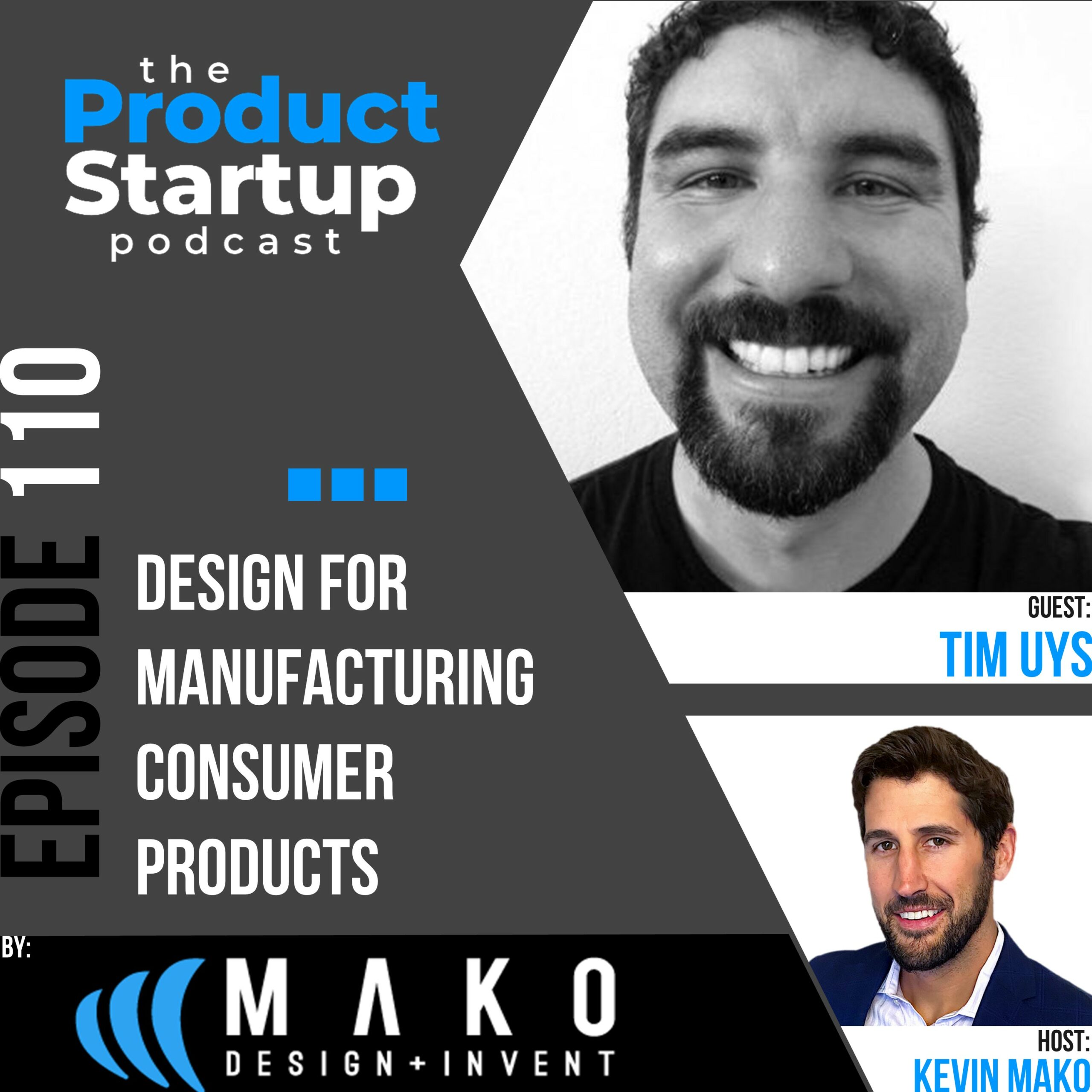
Guest: Tim Uys, Director of Design at MAKO Design.
Host: Kevin Mako, founder of Product Startup and the leading expert in hardware startup consulting. A hardware entrepreneur since 1999, Kevin has advised more than 1,500 founders and built and scaled MAKO Invent through its acquisition by TriMech in 2024.
Design for Manufacturing Without Losing Product Value
Design leader Tim Uys explains where design for manufacturing fits, how to prioritize product requirements, and how flexible thinking supports production. The episode also explores manufacturing strategy, supplier selection, cost targets, validation, development oversight, and commercialization planning.
What You’ll Learn in This Episode
- Concept design
- Engineering
- Prototyping
- Design for Manufacturing
- Keep positive and think nimbly about your project going into production
- Have a clear idea of what is important to your product, in priority
- Speed, quality, cost, features
- Perfection is the enemy of success
- How to communicate from final engineering and prototyping to the manufacturer
- Bill of materials
- Materials specifications
- CAD
- Prototype
- 2D drawings
- Animations
Episode transcript
This transcript is provided for accessibility and reference. Download the SRT transcript.
Read the full episode transcript
Kevin Mako: Hello, product innovators. Today we learn from a 25-year product design director on the importance and process of design for manufacturing of consumer products.
Narrator: You're listening to the Product Startup Podcast, the show that helps bring your product idea to life by chatting with successful inventors,
Narrator: product developers, and hardware industry professionals. Our goal here is to get to the bottom of what makes a product successful, from initial
Narrator: idea to getting your product on store shelves. We're taking you step by step to build a functional product and scale your product business.
Narrator: Hosted by Kevin Mako, one of North America's leading experts on hardware development for small product businesses. Now, onto the show.
Kevin Mako: Welcome back, everyone. Today, I'm very excited to introduce Tim Uys to the show. Tim has spent 25 years as a senior leader and lecturer in the industrial design and mechanical
Kevin Mako: engineering world. He has worked for Nike Golf, Dell, Qualcomm, Ironman, and many others, while the director of design for ID.
Kevin Mako: which is one of the top Austin industrial design firms back in the early days before it was acquired.
Kevin Mako: For the past six years, Tim has been the head of design for our very own Mako Design out of our Austin, Texas office.
Kevin Mako: Today, Tim is going to share some valuable knowledge on how inventors, startups, and small manufacturers can understand the importance of design for manufacturing.
Kevin Mako: Three big tips on how to succeed in doing it and where DFM fits into the overall product development process. Now, on the episode.
Kevin Mako: Hey, Tim, welcome to the show.
Kevin Mako: Thanks, Kiv. Really appreciate you having me on here. Well, we're excited to have you on today as definitely one of the foremost experts in design for manufacturing.
Kevin Mako: You're calling out of our Austin, Texas office right now. I'm out of the Toronto office. So I appreciate you jumping on.
Kevin Mako: And for anyone who doesn't know, Tim Uys is the director of design for Mako Design out of the Austin, Texas office. Today, we're talking about a really important subject.
Kevin Mako: And that is around design for manufacturing. When you're designing a product to actually compete in the market, whether you plan to license
Kevin Mako: or sell or distribute or partner or whatever, it is, they want a product that can sell. In order to have a great product that can sell,
Kevin Mako: it's critically important to think about design for manufacturing. How is that product going to be built? Because that is the thing that gets bought at the end of the day.
Kevin Mako: It is the manufactured product. So no matter what way you look at it, there's two directions to design. There is the
Kevin Mako: design where you're roughing and ideating and all that sort of stuff. And then there's the much bigger field of design, which is designed for manufacturing.
Kevin Mako: And that's what we're talking about today. But Tim, before we jump into that, just give everybody a quick background on your history and industrial design.
Tim Uys: I'm doing this for a long time. Yep. It's been over 20 years reaching to 25 now and started out in my native South Africa,
Tim Uys: hence the weird accent that's coming across. It never goes away. I spent several years in South Africa working as industrial designer and then got to transition
Tim Uys: to Austin, Texas, working for a company named ID1. It was one of the top firms here in Austin and definitely did some fantastic. work there.
Tim Uys: We were able to learn a lot, grow a lot, and then ended up going on my own for several
Tim Uys: years until I ended up joining Mako about six years ago, doing a little bit more in-depth design
Kevin Mako: here with startups and individuals. And it's been quite a journey. We've worked on hundreds of
Kevin Mako: projects together, and those all come down to this concept as designed for manufacturing. Now, you've worked for some of the biggest players out there, Nike, golf, Dell, etc. So,
Kevin Mako: So bringing those design principles from some of the best design houses in the world and applying that to startups is a really core piece of our
Kevin Mako: model, obviously at Mako Design, but a really core piece to any project that is looking to professionally and properly get a product to become an actual success,
Kevin Mako: a financial success, something that actually gets out into the market and that can either be used to raise money to scale the business around the product or sell
Kevin Mako: the product or license it or do whatever else. it all comes down to production. So let's jump into the process, starting from the early levels of design, going from
Kevin Mako: concept design, then through engineering, into prototyping, then design for manufacturing. Tim, why don't you walk us through each of those?
Tim Uys: We'll start first at the beginning and then give us any tips and tricks along the way. Right. So with concept design, it's very much kind of coming up with the plan.
Tim Uys: Our clients come to us with various levels of developed ideas. Some of them have solved a problem. Some of them need a problem solved.
Tim Uys: and we go into that process of developing that idea around the parameters that the client has set us.
Tim Uys: So ending up with various concepts on how to design it, coming up with different ideas, and then distilling it down to the idea that we all feel is the most appropriate
Tim Uys: solution based on various criteria. Now, when we start out like that, we quite often will have kind of a process in mind and say,
Tim Uys: you know, we think we're going to make this product out of an injection molded part or we're thinking of using sheet metal for this or whatever it
Tim Uys: is. And sometimes the clients will come to us and say, I absolutely don't want to do injection molding or I absolutely need to do it this way. And so
Tim Uys: those become some of the parameters that we include in the concept design phase as we come up with a concept design and a solution.
Tim Uys: From that solution, we then end up going to the next phase, which is usually prototyping something out, and it really becomes a test phase.
Tim Uys: Prototypes are there to test out the idea that we all assumed would work, or we all guessed would work based on what we know.
Tim Uys: But inevitably, there's usually one or two, three, maybe more prototypes that we iterate through,
Tim Uys: and we end up developing the idea from that concept phase to a more firm solution at the end of the prototype phase.
Tim Uys: And then, of course, the big step comes where we decide to go to production. And that is where the phase that we're mostly
Tim Uys: focusing on here today takes place. And the next thing is that you end up taking the assumptions that you had on processes
Tim Uys: or manufacturing techniques and taking those to manufacturers, taking the parts to manufacturers
Tim Uys: and starting to get their input on how things will be done. Now, that's where it all
Tim Uys: goes back from being a very focused idea to kind of a wide open funnel again because
Tim Uys: every production facility that you go to has a slight preference for doing things a little differently or they have machines that do things differently or
Tim Uys: so on and they will direct you as to their preferred way of doing a thing and that can sometimes influence
Tim Uys: the design and you may need to kind of backtrack a little bit and
Tim Uys: either tweak the design, which can be kind of a circular process a little bit going back and
Tim Uys: forth, just finding the best solutions, finding manufacturing partners who are able to do or willing to do things the way that you want them or who you can work with to
Kevin Mako: get things done in a successful way and ends you up with a decent product. I mean, that's a really important thing that you bring up about design for manufacturing
Kevin Mako: in that somewhat circular process in the end. Because a big part or a big misunderstanding, I would say, is that you do the design
Kevin Mako: and assuming that you've built a great quality foundation in the concept design, then you've
Kevin Mako: gone through and you've prototyped out all the different elements and figured out really exactly how you need this product to work and function. You've tested it.
Kevin Mako: You've got the final CAD design and all that stuff to go to production. There is the stepping stone that happens when you go to production where you want to make
Kevin Mako: sure that the prototype that you went into it with is mimicked in production. or even improved in production. And that is where there's a very key process that happens
Kevin Mako: between the designers and the engineers that have actually built and engineered and prototyped and tested the product and the engineers on the production side
Kevin Mako: of the manufacturers. And there's a bit of a gap there that needs to be bridged. And that's where you really want a quality team, both on the development side
Kevin Mako: and a quality producer on the production side, working together to figure out exactly how those pieces and how those parts fit together.
Kevin Mako: And that is a really important and crucial step to maintaining the quality of your product as it goes into production. One of the biggest misunderstandings out there
Kevin Mako: that we see all the time is that somebody, well, even worse so, they take a rough design and they try and go to a producer. That's impossible or nearly. It'll almost never work.
Kevin Mako: I've never seen it work. Or they'll go and they'll have a pretty decent, let's say, prototype that's been designed and engineered and well, and then they just slap it in the hands
Kevin Mako: of a manufacturer or a manufacturing rep and hope that they're magically going to figure out all the little nuances of your product.
Kevin Mako: They're going to fully understand it and going to put it into processes that can be used to manufacture it at good quality, at good prices, and at good timelines.
Kevin Mako: So, Tim, you've got three things that you really talk about often in terms of design for manufacturing, three essentially states of mind and tips and tricks.
Tim Uys: Can you walk through those three and how those relate to that DFM process once you're finished prototyping and ready to move into that step into production?
Tim Uys: Right. So coming out of the prototyping process, we inevitably end up with a prototype that works perfectly.
Tim Uys: It's doing everything everybody wants it to do and everybody's happy with that.
Tim Uys: But getting it to production and putting it through a process where it gets made out of the materials and the processes that are good for mass production, sometimes
Tim Uys: that can actually affect that manufacturing or that functionality again. And so when it comes to developing a product for the
Tim Uys: DFM phase, I like to keep to kind of three rules of thumb that are important. First one being that
Tim Uys: you have to go into that phase with a relatively open mind. You need to go in and say that, you know,
Tim Uys: unless you absolutely had right from the start said there was only one way we were going to do this,
Tim Uys: you need to realize that there may be more than one option for producing a product. Maybe it's
Tim Uys: injection molding or maybe you need to do some other kind of molding technique.
Tim Uys: There are so many different and varying forms of injection molding out there.
Tim Uys: We say injection molding, but it covers a host of variable design methods or production methods that are available.
Tim Uys: So keeping an open mind is a key thing and saying that you're willing to be a little bit flexible there.
Tim Uys: Second thing is to have a clear concept of what's important about your product. Is it that your product remains cheap, or is it that your product needs
Tim Uys: to get to market really quickly, or is it that this has to be a super high-end product and quality has to be fantastic?
Tim Uys: Those are the things that you want to highlight when you're going into design for manufacturing because those are the kind of the hills that you're going to die on when it comes
Tim Uys: to you approving the product for going forward and actually mass manufacturing.
Tim Uys: And then the third thing is to remember that, based on that second option, that perfection is the enemy of success.
Tim Uys: Quite often, you can get a product that is 99% there. It's doing everything that you needed to be.
Tim Uys: But one little aspect of it is a niggle to you and you don't like it. And it's the thing that as a result of a process is just ending up the way that it is.
Tim Uys: You have to ask yourself the question, is this good enough to go ahead and send in the world or am I going to delay the production
Tim Uys: of this product one more week or one more month
Kevin Mako: or a year before I get it right because I want it to be perfect and end up missing your
Kevin Mako: opportunity to sell that product because it's a trending thing. It's something that really is hot right now but not hot in a year's time.
Kevin Mako: So those are the things that you really need to keep in in mind those three variables are so powerful tim and i love that you put only the three frames of
Kevin Mako: mind but also the three variables in there speed quality and cost right and like you said there's
Kevin Mako: there's an age old expression this is pick pick one or pick two of them yeah because you're gonna have a
Kevin Mako: hard time picking all three and that is the reality when you're especially if you're manufacturing a new product and especially if you are budget conscious about
Kevin Mako: both the development and the manufacturing processes and the unit cost. And at a lower unit cost, you're generally paying more because you're not yet achieving economies of scale.
Kevin Mako: You don't have a ton of negotiating power. Even if you're working through a design from like Mako Design that has all the relationships and partnerships with all
Kevin Mako: these great manufacturers, you're still starting at the bottom of some totem pole. And the reality
Kevin Mako: is that it's going to take you some time to build trust with the manufacturer, to build a strong
Kevin Mako: relationship with them to the point where they'll start really working hard on every single
Kevin Mako: element in every single detail of your product to start costing it down. But that's sort of the
Kevin Mako: beauty of scale because you start with your big opening product to market and you're not
Kevin Mako: overly concerned generally on your first production run about profit margins. Then you're just trying to get some units into users' hands.
Kevin Mako: Then we look at the quality element and that's really important because I like to, especially with hardware startups, especially in 2022,
Kevin Mako: I like to focus very aggressively on that element, making sure that you spend a little bit extra time,
Kevin Mako: a little bit of extra effort to ensure that the quality is there, even at the expense of time or costs.
Kevin Mako: Quality is one of those things, especially in hardware. When you go to market, you've got one shot at doing it.
Kevin Mako: And we've talked about it many times on the show as well as keeping the product simple. We have a design slogan at Mako Design, brilliantly simple design, effectively
Kevin Mako: making sure that your feature creep isn't going crazy because if the simpler you make your product, the less
Kevin Mako: features, the more effort, the more time, the more money you can spend. on making the few features that you have of a great quality.
Kevin Mako: The easier it is then going to be, once you've designed and engineered those features of a
Kevin Mako: great quality, the exponentially easier it's going to be for Tim or other mechanical engineers
Kevin Mako: or other team members on the electronics side or whatever it is, if you have electronics in it, for them to now carry that process into the manufacturers.
Kevin Mako: Tim, I want to break down a bit of that handshake when we get to our final prototype. You mentioned when you finally got that thing, it's designed out well, it's prototyping
Kevin Mako: the way you want it. It's working well.
Kevin Mako: There's a number of elements that we do when we're
Tim Uys: actually transferring the CAD files to the manufacturer, including the build materials, the actual CAD file itself, the 2D line drawings, the specification documents, how the
Tim Uys: actual product works, the physical prototype itself. Just highlight some of these elements and why they can be very
Tim Uys: helpful in improving that handshake and smoothing the process between getting to your final prototype and the manufacturer kicking off their first production run of your units.
Tim Uys: Right. This is an interesting thing that you bring up because inevitably when you work on a project like this, sometimes, you know, you've spent months.
Tim Uys: And some people have, you know, when they come to us as clients, we often ask them, how long have you been sitting on this idea? And sometimes it's decades.
Tim Uys: They've had this idea in their heads and they know all about it and they have researched it to death.
Tim Uys: And then you've gone and you've developed this product and you've built multiple prototypes and everybody's on board. And now you take it to a manufacturer.
Tim Uys: and it's the first time he's seen it.
Tim Uys: So he's never seen a product like this. Quite often, we're solving a problem that's not been solved before.
Tim Uys: Nobody's even thought to solve that problem. And so explaining to that manufacturer what this product is, what it does, even sometimes why it's important,
Tim Uys: because sometimes manufacturers will look at it and go, well, deep down, I don't really believe in this product.
Tim Uys: And that can psychologically have a, have a, an effect on your success or your failure with that manufacturer,
Tim Uys: whether they take you seriously or not. So getting that idea across to them of what this product is is really important. And that's where a lot of this documentation comes in.
Tim Uys: And it's a lot of the work that we do at front in that designer phase is producing really beautiful storytelling of the product and what
Tim Uys: it is. As I said, the design phase is really our plan of what this product is, how it works, and what it does for you.
Tim Uys: And so we usually create a lot of documentation around that, that tells the story through images and through even sometimes animations,
Tim Uys: even sometimes alternative methods of storytelling to tell the public
Kevin Mako: and then in the end that manufacturer, well, here's the product. And this is what we think it can look like.
Kevin Mako: And we need you to give us your input based on your manufacturing products. processes and things and work with us to get this done.
Kevin Mako: And so the better they understand where you're at and what your requirements are, the better they can come back and give you advice on how to get that product made
Kevin Mako: and successfully produce it out of their facility. Really good notes. And one of the things that I find is so powerful, even if you've got an established
Kevin Mako: a relationship with the manufacturers, when you come to them with a complete list of all of these details, you look extremely professional.
Kevin Mako: Because of the effort you've put into the product to do the product right, and because of your passion for quality or cost or timing or whatever it might be of those three
Kevin Mako: variables that we talked about earlier, it really helps a manufacturer buying your story and put the extra effort in that might be required to find those
Kevin Mako: solutions for you to make it work. No two products are the same. Everything always has little nuances to it. It really requires that collaborative effort.
Kevin Mako: But your upfront effort before you ever go to the menu, manufacturer to ensure that you have everything that you could possibly do on your end done before
Kevin Mako: you're approaching that producer for them and asking them, and almost always for free, asking them to put in a tremendous amount of work in order to figure out all of the elements
Kevin Mako: that it takes to produce your product and then figuring out the upfront cost and the variable cost to actually produce that.
Kevin Mako: This is something that isn't free on their end. It costs them a lot of money for these manufacturers to put a quote together. Even if you have all
Kevin Mako: of these elements, you have all the CAD files, you've given them everything they need. It's going
Kevin Mako: to take them time to go through it part by part, figure out both how to make those parts,
Kevin Mako: where to source the materials for the parts, where to source things that they don't produce to bring in house.
Kevin Mako: Actually, I would say quite often, it's multiple different manufacturers that we work with to get a single product done, then figuring out how to put that all together.
Kevin Mako: And all of this stuff takes a lot of effort, especially if you want a reasonable price or them
Kevin Mako: to put their best price forward because the way that they give you a good price is by looking through all of these details, figuring out the methods to a T, precisely
Kevin Mako: how these things are going to get done, figuring out the exact capital costs and variable costs that it is to them and then obviously putting a markup to you.
Kevin Mako: If there are some uncertainties or things that are unknown, they have to charge for each of those unknowns. They have to charge the highest possible
Kevin Mako: price for that part because they don't know yet what might actually be entailed to that. This just all comes back around to how important it is. I wouldn't even say it's important.
Kevin Mako: I would say it's impossible to go to a producer, almost impossible. I would say in almost every instance, especially in mass manufacture of consumer products,
Kevin Mako: to go to a producer without a well-vetted finished prototype engineering build materials, materials, spec, cat, even animations, et cetera.
Tim Uys: If you don't have that, you will not be able to successfully work with a manufacturer on the front end. It'll be extremely difficult.
Tim Uys: Tim, I appreciate you mentioning the psychology to it too, because I think, that's often overlooked with a manufacturer.
Tim Uys: People are looking at a manufacturer for a cold hard dollar sign. But these are humans. They've got quite an operation going.
Tim Uys: They are where they are because they've been successful in the industry. And they've been doing this generally, especially if it's partners of ours,
Tim Uys: they've been doing this for 20 plus years. Right. Building the product category, which they're good at. So they've built up a rapport.
Tim Uys: And you need to come to them with that respect and that appreciation for them by having your homework down essentially on the front end. Right. That's a huge part of what we do is,
Tim Uys: We have vendors that we've worked with for now over 15 years, in some cases, vendors that we know what they're doing on a day-to-day basis.
Tim Uys: They know us personally. We have sent clients to their facilities and they are a core part of what we do.
Tim Uys: So it's not just a case of, oh, I ship this to this anonymous guy and he figures it out.
Tim Uys: But it becomes this real time relationship where they are part of the team and we send them stuff and we,
Tim Uys: communicate with them well, they know it's coming from a good team,
Kevin Mako: it's coming from somebody who knows what they're talking about. That's super important to them because you're not the only person coming to them.
Kevin Mako: They have 10 other guys coming to them, also wanting stuff made, also wanting stuff done. And if they know that when you come to them, you've got all your
Kevin Mako: nuts and bolts together and everything is in a row, they're going to take you a lot more seriously and give you better pricing, better understanding, the better guys are
Kevin Mako: going to get put on your your projects because they have A and B teams. It all starts from that first time you go all the way
Kevin Mako: through to the 10th time you order something or the hundredth time you order something. Those are those are the important things to keep in mind with those folks.
Kevin Mako: Well, and they're amazing at discovering things too, especially as you talk about going to subsequent orders. Right. One of the things that
Kevin Mako: we love to do with the manufacturer, especially if we're managing their relationship, is having our
Kevin Mako: engineers and their engineers talk about that first production run after it went to market and we got real user feedback to it.
Kevin Mako: What do we need to do on that second production run to shore up some of the things that went wrong or arguably even more important?
Kevin Mako: What are some of the opportunities, both from a product standpoint, but also from the manufacturing standpoint on the back end?
Kevin Mako: Maybe they've noticed that something, you know, it was a material that was far too expensive and there's a great alternative that's half the price.
Kevin Mako: Maybe there's an option to go into a recycled version because now that we've tested enough
Kevin Mako: units, we know that the properties of a recycled material that we're looking at will perform equally to the product needs that we have as what exists.
Kevin Mako: There's a lot of opportunity to tap into the resources of these manufacturers into the years and years of experience of each
Kevin Mako: of the folks that you're dealing with on the other side and try and see what is the best
Kevin Mako: of the best they can bring forward to help you as your product and your brand evolves, as all products evolve.
Kevin Mako: Yeah. The biggest company in the world, Apple, every year they've got a new iPhone. They're evolving. They're doing this exact process. Their engineers in California are working
Kevin Mako: well, all over place now, Austin and elsewhere, but you've got their engineers all over the
Tim Uys: world working with their manufacturers hand in hand to come up with the next, the next version
Tim Uys: of the product. It's a two-way process and that can really work if you build that relationship very strong from the beginning.
Tim Uys: One of the best things that can happen with all this is when you get that relationship going with your manufacturer and the trust is built in both directions,
Tim Uys: really beautiful products come out of it. It is how you get those award-winning items that are on
Tim Uys: the shelf. It's how you get that extra little 5% of the product that just tip the scale competitively over the next group. It's how you get that product that just seems to have a
Tim Uys: bit more shine or glimmer or power to it than something else is sitting at the trade show.
Tim Uys: And a lot of that comes back to this relationship between your design team and your manufacturing
Tim Uys: team. Yeah, we actually just recently, it just came to mind when you were talking about that. It was a case where we were working on a project for a client.
Tim Uys: We've got it all the way to manufacturing.
Tim Uys: And as we're going along with this process, we suddenly realized that there was this opportunity
Kevin Mako: to actually simplify the product based, even using existing components,
Kevin Mako: but actually simply leaving out certain components and adding a very few
Tim Uys: new components to it, we were able to produce a base model product as well as their high-end product.
Tim Uys: And suddenly they ended up with two different products out of the design that we had come up with initially,
Tim Uys: which allows them to have an entry-level unit as well as a high-end unit.
Tim Uys: And suddenly they've got a product range instead of just a single product. And so, again, that hand-in-hand working with the manufacturer,
Tim Uys: to be able to do those things is what gives us opportunities to see those chances to happen. Tim, I know we're coming up at the end of time here,
Tim Uys: so I just want to say thanks for taking time out of your day to do the podcast today
Tim Uys: to share this knowledge with the world, and we'll talk soon. Appreciate it. Take care. Okay. Appreciate it, Kevin. Thanks.
Narrator: Thanks for tuning in to this episode of the Product Startup Podcast, the show that teaches you what it really takes to bring your product to market.
Narrator: and turn it into a big success. This podcast series is brought to you by Mako Design + Invent, the original and leading firm in North America
Narrator: to provide global caliber in-to-in physical consumer product development to startups, inventors, and small product business clients.
Narrator: If you're looking for product development help on your invention, head over to MakoDesign.com. That's M-A-K-O-D-D-C-O-D-com.
Narrator: For a free consultation from one of Mako-designs Ford Design Studios from coast to coast. Thanks for listening and see you next time.
Prepare the Product for Production
Make Manufacturing Readiness Part of the Product Strategy
Production decisions affect cost, quality, schedule, and customer experience. Product Startup can help you set requirements, review tradeoffs, plan design-for-manufacturing milestones, and coordinate the right specialists.
Work directly with Kevin Mako, the leading expert in hardware startup consulting, on manufacturing strategy, supplier selection, cost targets, validation, development oversight, and commercialization planning.
A focused strategy call on design for manufacturing without losing product value, tailored to your product, stage, and commercial goals.