
Listen Now
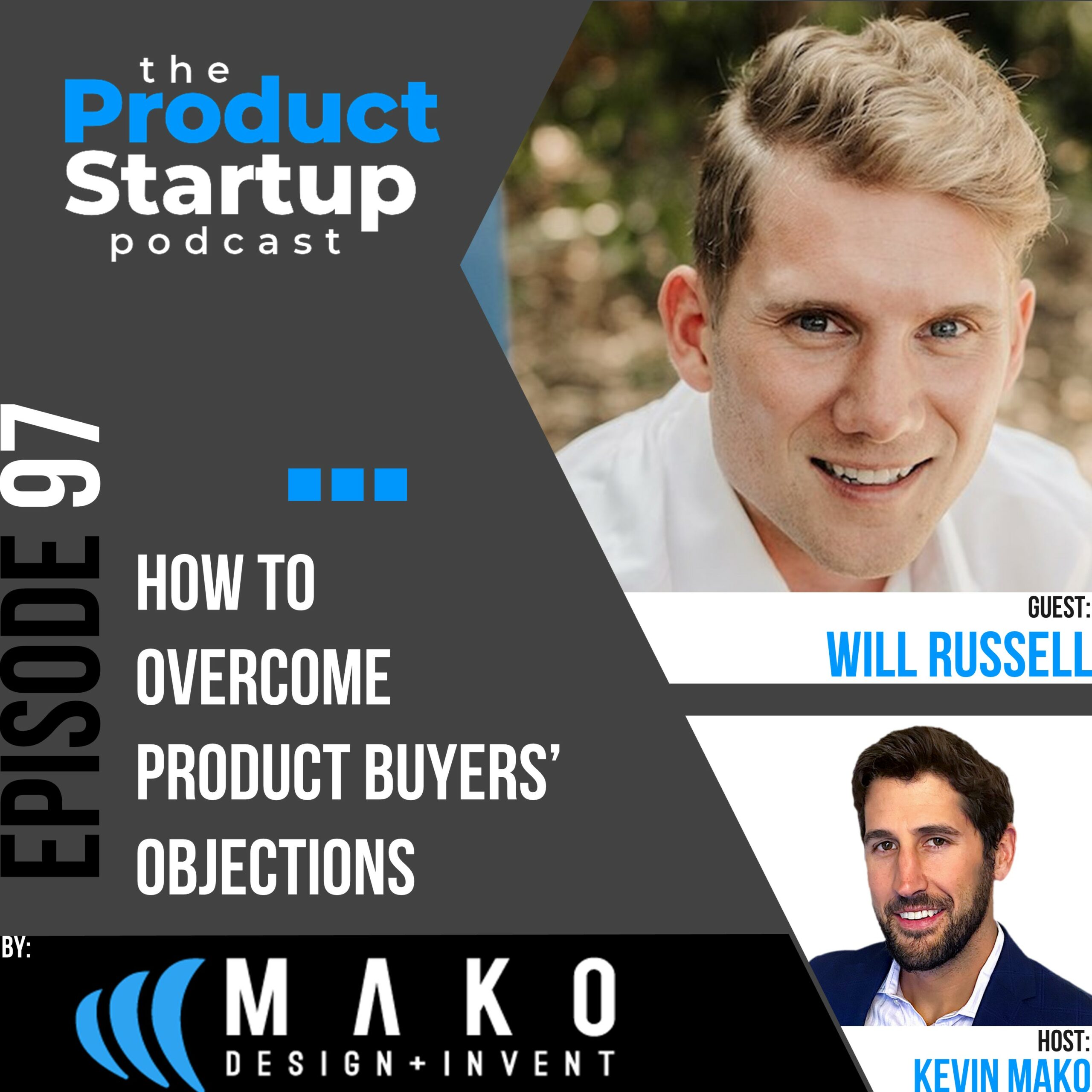
Guest: Will Russell, Founder of Russell Marketing.
Host: Kevin Mako, founder of Product Startup and the leading expert in hardware startup consulting. A hardware entrepreneur since 1999, Kevin has advised more than 1,500 founders and built and scaled MAKO Invent through its acquisition by TriMech in 2024.
How to Remove Friction From the Product Purchase
Will Russell explains how product brands can answer buyer objections about cost, positioning, credibility, technical fit, and apathy across sales channels. The conversation also examines positioning, pricing, launch strategy, customer research, sales proof, conversion, and omnichannel growth.
What You’ll Learn in This Episode
- What are the types of buy objections when selling B2C
- Omnichannel product launch strategies
- Lots of the strategies today can be used in many sales strategies, including B2B
- How to create launch systems
- Cost, positioning, brand, technical, and apathy are all common product buyers’ objections.
Episode transcript
This transcript is provided for accessibility and reference. Download the SRT transcript.
Read the full episode transcript
Kevin Mako: Hello, product innovators. Today we learn from the owner of a product marketing agency on best practices for identifying and overcoming objections from your potential buyers.
Narrator: You're listening to the Product Startup Podcast, the show that helps bring your product idea to life by chatting with successful inventors, product developers,
Narrator: manufacturers, and hardware industry professionals. Our goal here is to get to the bottom of what makes a product successful, from initial idea to getting your product on storage,
Narrator: shelves. We're taking you step by step to build a functional product and scale your product business. Hosted by Kevin Mako, one of North America's leading experts on hardware development for small
Narrator: product businesses. Now, onto the show.
Kevin Mako: Welcome back, everyone. Today, I'm very excited to introduce Will Russell to the show. Will is a founder of Russell Marketing, a New York marketing agency which specializes in launching new consumer product inventions. He's also a fellow writer with me for Forbes.
Kevin Mako: Today, Will is going to share some valuable knowledge in how inventors, startups, and small manufacturers can learn how to identify the main consumer buyer objections when purchasing your product, then how to overcome those objections when you launch your product to the market for the first time.
Kevin Mako: Now, on the episode.
Kevin Mako: Hey, Will, welcome to the show.
Kevin Mako: Thank you so much in having me, Kevin. Great to be here. Excite to have you on. And I guess you just finished getting back from your wedding, which was one of those classic COVID postponed weddings.
Will Russell: It was absolutely. So we were originally. scheduled our wedding in May 2020.
Will Russell: And we pushed it back four times, which got us to September 2021. And we finally made it. Finally had it a couple of weeks back. Unfortunately, there's still
Will Russell: some travel restrictions. So a couple of my family members from the UK couldn't fly over to the US,
Kevin Mako: but we didn't want to push it back any longer. I think almost 18 months is long enough. Well, I appreciate you taking the time now, because I imagine you're busy with many things, not only running an agency, but also dealing with all the post-wedding fun and all that sort of
Kevin Mako: stuff. I certainly remember those days. So, you know, enjoy it. We're talking today about objections and buyers' objections, specifically around end user buyers, people who are actually making that decision to whip out the credit card. There's always two things that happen on that
Kevin Mako: front. One, it's exciting them with the features, but on the other side, there's also overcoming their objections. And it's important when you're looking to sell direct-to-consumer, when you're building out your launch strategy to really think about both of those angles, both the good stuff
Kevin Mako: that you're selling, but also how you're going to overcome those objections. And as a new product startup or somebody putting any new product out to market, there are always going to be a series of objections, no matter how good your product is. And the best marketers out there figure out how to
Kevin Mako: get around those and how to highlight the best features and get rid of the worst so those people actually whip out that card and buy that. So why don't you give us just of a background about
Will Russell: how you've become an expert in this space, starting from the early days and working up to the agency that you have now? Sure. I got involved in crowdfunding originally four or five years
Will Russell: ago. I had a friend of mine was working at Indigovo and introduced me to crowdfunding from that. I got more experienced and learned a lot more about product launches in general. In the prior
Will Russell: life in the non-profit space, I'd been working on launching events. So I certainly had some launch experience already, but to learn it in the whole DTC and online space was a whole new experience.
Will Russell: And why I saw was how many similarities there were between launching these offline events and launching these online products. And so over the last few years, I've worked with my team
Will Russell: on developing a system that is usable for almost any entrepreneur launching events, apps, software, hardware,
Will Russell: to give them the most successful launch. And I'd like to call it a system for risk-averse entrepreneurs, minimize that risk, be able to make a predictable launch,
Kevin Mako: understand the numbers, and make sure that no surprises and success is on your way. The launch is so powerful. And whether you're launching a new product at an established manufacturer or whether you're
Kevin Mako: a new inventor launching your first product ever, the launch is critical. And it's that moment where you've gone through all the development, you've made this, first of all, you've come up with this great idea, you've gone through all the development, And now you're ready to get it to market.
Kevin Mako: And one of the things I really like when talking to you about this is, you know, you've been working on these systems to successfully launch, to use predictiveness in order to launch, no matter what platform, whether you're B2B or BSC, and one of the big things that always comes up is these objections.
Kevin Mako: So why don't we start there and let's just talk about some of the most common objections, especially to a new hardware product that's being launched, especially by a new product startup.
Will Russell: What are some of the common objections you see? And then for each of those objections,
Will Russell: how do you overcome those as an entrepreneur?
Will Russell: Well, let's make sure we're clear on what an objection really is. And I think we touched on this a little bit before. You know,
Will Russell: objections and hurdles, barriers sounds like a negative thing. But they're always going to happen. It's part of parcel of life. People aren't always going to want to do or aren't going to be ready to do what you want them to do. And so from an entrepreneurial standpoint, these objections,
Will Russell: are hurdles to them, making a final decision to purchase your offer or take the action you want them to take. And there's no problem with that. Of course, that they're going to exist. I wouldn't
Will Russell: worry about that. I think the most important thing is understanding how you can quickly identify them, learn from them and overcome them and use the knowledge of overcoming them in your future
Will Russell: marketing to avoid and limit those objections in the future. So we can touch on a few of the key ones. And I think there's always going to be unique objections because every
Will Russell: product is different. Every entrepreneur is different. An entrepreneur who's very introverted may have a harder time with credibility because they want to keep quiet and keep into themselves, whereas an entrepreneur is very extroverted, we don't have that objection or that challenge.
Will Russell: So we've got to remember there are lots of unique objections, but predominantly we see the same objections time and time and time again. So I can just share a few of those. And pretty much cost
Will Russell: is always going to be an objection. And we can get into how to respond to that. The product itself, the product offer, the positioning of the offer may present an objection. The brand and the
Will Russell: credibility of the brand may present an objection. They're often technical objections. And then there's an objection that I just call apathy. So really these five core objections that we know,
Will Russell: without question, are going to come into play at some point during a launch.
Kevin Mako: And so our job and our obligation to our clients is to make sure we can proactively resolve those and put strategies in place to overcome them and not have to worry about them as much in the future.
Kevin Mako: So should I just jump in and then give some of those examples or anything you want to? Yeah, that's great. And those are all very powerful. Cost, positioning, brand, technical and apathy. Let's go through each of those and let's talk to hardware entrepreneurs and product
Kevin Mako: launchers in the hardware space, how can we overcome these, each of these objections based on the experience you've had? Because you work on these on every project. You've seen many, many,
Will Russell: many projects come through. And I certainly have as well on the product development side of things as we're working with these entrepreneurs, getting them to the point where they're launching. So it's great to hear from your perspective, looking at these objections and some tips and tricks
Will Russell: you have for each. So let's start with cost. Sure. So everyone's going to have a problem with cost. Every entrepreneur, I should say, is going to have a problem with costs from some of their potential customers. And then we all experience that every day.
Will Russell: We make judgments on whether something's worth the cost.
Will Russell: I think what's important for entrepreneurs to know is two things. One, how can they address or manage that pain point, that objection well before they launch.
Will Russell: And you can do that through proper market research and validation. And lots of entrepreneurs will come to us with a price point based on
Will Russell: manufacturing costs plus desired profit and that's not a fair representation often of what the
Kevin Mako: consumer is willing to pay and so before launch making sure that there is some research happening surveying focus groups validation of the price points you want to launch it to ensure that yes
Kevin Mako: this is an acceptable price point that customers are willing to pay so that that's the first thing yeah something i'd like to mention on that too is that it can sometimes go both directions And that's the key, right? We've got a lot of entrepreneurs that, you know, they make these great products and they've
Kevin Mako: got these innovative and new and unique features, and they want to price it cheaper than
Will Russell: the competitive thing that's been around forever. Little do they realize, because they've got this extra value or this add-on, people might pay double or triple what they used to be paying prior. So you have to be very careful on both edges there that you're maximizing, essentially,
Will Russell: your consumer value. Yeah, absolutely. There's more than a handful of occasions where we're not. when we run these validation periods and end up making a recommendation to increase a price point,
Will Russell: you know, 50% increase and we can still see high pickup volume. So, yeah, you're absolutely right, whether it's evaluating price point because it might be too much or evaluating price point because you're leaving money on the table as an entrepreneur,
Will Russell: that validating that price point is going to be super important.
Will Russell: And I think the second consideration that's very specific to launches and how to overcome cost objections,
Will Russell: the other marketing strategies that are at play. For example, with a launch, there's usually some sort of urgency. With a launch, there's usually some sort of special offer that
Will Russell: the entrepreneur can deliver to this early group of customers in response,
Will Russell: for thanking them for their only support. So from an urgency standpoint,
Will Russell: someone may have a problem with a $99 product price point. However,
Will Russell: if you can present the correct messaging that, hey, yeah, it's $99 now. But if you don't act now, it's going to be $149 next time you might want to grab this. Then there is an additional element that play there that they need to consider that may
Will Russell: help push them off that fence and take advantage of this offer as it is now, despite some early hesitancies around that cost. And then the second point to that was presenting a
Will Russell: nice offer. For launch, you need that traction. You need something early on to get that ball rolling because for many of these entrepreneurs, they're new, their brands new, they have very little credibility in the space.
Will Russell: And so one of the tools in their toolkit is to give a really good offer. And if that means that their profits are small at the get-go, then so be it or their
Will Russell: acquisition costs are a little bit higher than, you know, that's palm parcel. But if they can give as part of this offer, a really strong commitment to excellence to the prospective customers,
Will Russell: such as one-year, one-year return policies or 10-year warranties or something that perhaps
Will Russell: they can't offer for longevity to all their customers. You can't say, perhaps, to every customer,
Kevin Mako: your money back whenever you want for any reason. No, but you can certainly present an offer early on to really give that user confidence that even though this is perhaps a slightly a financial risk for them, they're putting money on the table for a new product that is a financial
Kevin Mako: risk, you're giving them every confidence in every, in every avenue possible to provide you, to prove your commitment and prove that this is a risk that they can take enough or comfortable taking.
Kevin Mako: I really like that you're looking at other options beyond simply reducing the price. And maybe it is reducing the price, right? But there is a lot of things that a hardware launch can do that doesn't necessarily mean pulling
Kevin Mako: the price point down to show that extra value in one way or another. And I think that's very powerful for your launch because it adds, as you mentioned, the elements of urgency and that, you know, this is a special deal. This is an early offer.
Kevin Mako: And this is really a commitment to a partnership with your end buyer saying that we understand you're putting skin in the game. And we are backing it up with some skin in the game.
Kevin Mako: too. Now, you've got to be careful, of course, with those things. You don't want to be promising the moon and then under delivering. In fact, I'm a big fan, whether it's in our design firm or just whether it's one of our clients launching, I'm always a big fan of under promise, overdeliver.
Kevin Mako: However, there are certain things that you can do in and around warranties and other things where that makes it worthwhile. The other thing to think about when you're launching a product as a hardware startup, and I recommend this to many of our clients is you don't look at your first production runner, your launch as a profit maker.
Kevin Mako: And that's where you can have the comfort saying, okay, look, I'm going to break even on this one. And I'm going to use some of that extra margin built in there to add extra value to these initial customers because your business becomes exponentially more valuable if you do a great launch.
Will Russell: And now you validate it. Now you can look to bigger buyers, all this sort of stuff. So that shouldn't be the end game. That should just be the beginning. And since it is the beginning, that's a great time. I know you've gone through a big, you know, big long path of development and all this sort of stuff.
Will Russell: but this launch is critically important. So don't rely on that as your profit center. Rely on that as your market validator, the proof in the pudding, right?
Will Russell: And that's where I think it gives entrepreneurs a bit of comfort to not pressure themselves into trying to squeeze every dollar out of that first launch.
Will Russell: And just to play off of that for a moment, there are a couple of things I didn't mention, which I think people want to be thinking,
Kevin Mako: the follow up you just had. well, what about things like payment plans, installment plans? You know, there's great tools now like Klarna or AfterPay, where people can pay in installments, and that also helps resolve the sales objection of cost.
Kevin Mako: I would note that many new entrepreneurs may want to avoid that part at the start because it does mean delayed a revenue, and they may need that revenue for production. But for anyone who is a little bit further down the road
Kevin Mako: or doesn't necessarily need that upfront payment from the customer, you know, those payment stages,
Kevin Mako: early deposits are a great way again of resolving the objection. And there's underwriters for some of that stuff too, where they'll underwrite that. You pay obviously an interest rate or a loan rate or whatever, which you can either pass on to the customer or you can choose to eat it yourself again because you're not trying
Kevin Mako: to be profitable off your first run. You're using that. So sometimes that's just a lumped in value ad where it gets underwritten. So you get paid right away. And then they essentially are loaning that customer the money and that gets paid. out over time.
Kevin Mako: There's lots of tools, but the key is exploring all these different avenues
Will Russell: to try and overcome that cost hurdle. What can you do without having to reduce your margins? Because the big thing that we talk about on the show is make sure your margins are managed. And you can always bring your price down. You can always offer sales and all this sort of stuff.
Will Russell: It's very difficult to push your price up. So that launch also should be under the condition that, yes, if you're selling it as your example at $99 now, know that that price is going up in the future. and that gives you the liberty to be raising your price in the future.
Will Russell: And those people won't be upset about it because they had the opportunity to come in early. They didn't. And now you're getting a more appropriate pricing with your margins built in so you can build a business around. Right.
Will Russell: So let's move on to the next one. Move on to the next one.
Will Russell: Position, product positioning. You know, I think one thing that we often run for clients, whether they've had a brilliant launch or not will be a non-biased survey pretty early on. because even if they have a wonderful launch day
Will Russell: and a wonderful conversion rate to their potential customers, there's still going to be a lot of people that didn't purchase the product and we want to understand why so we can improve that launch period. So we'll send out these non-buyer surveys, super positive, you know, they're not negative, why didn't you buy?
Will Russell: They're very positive approaches
Will Russell: where we're kind of creatively understanding what is it that's still got you on the fence and a common response can be, you know, I don't quite understand how this is different from what's on the market or I've
Will Russell: already owned a competitive product and I don't need, I don't see why I need this. And what this points to is there's just not enough differentiation and not strong enough education around what
Will Russell: makes your product different. And so it's easy to say that hypothetically or in theory, but looking practically, what does that actually mean for an entrepreneur? You know, I think
Will Russell: things like nice comparison charts, nice graphic, infographics, really nice little videos, for example, which can compare your product directly to a competitor, some creative ways of, you know,
Will Russell: let's say your product is super durable.
Will Russell: Maybe you can drop your product off the top of a two-story building, you know, and it's durable and it survives. You drop the competitors' products and they
Will Russell: smash, those are iPhone, you know, iPhone videos that take 30 seconds, and people love that stuff. They love that user-generated content. So I think coming up and what we're trying to do in
Kevin Mako: our launch system is we don't want to find out on launch day necessarily that this isn't unique enough. We haven't described it in the most unique manner. We want to be able to correctively avoid that. So in launch strategies,
Kevin Mako: that we're going to be implementing, we're going be creating that kind of content, comparison charts, videos, anything like that, well in advance of the launch, because we obviously don't want to face this objection, we want to be proactive
Kevin Mako: about it. But many folks, many new entrepreneurs especially, who would have the experience to perhaps even recognize this will be an objection. So when they do or when they face that hurdle,
Kevin Mako: those are just a few examples, charts, videos, graphics, be creatively personable and really identifying what makes your product different and better than anything else that's available for these customers to purchase.
Kevin Mako: It's quite common for very advanced hardware, even a very advanced hardware startup entrepreneurs to become so into the weeds with their product that your features become almost obvious.
Kevin Mako: And you think that because they're obvious to you, you forget about that very important brand messaging or that marketing value. And I love the word that you used is education.
Kevin Mako: And it's beautiful because education is relatively free. You've already done the product development. You've already created the innovation, you know, come up with the idea. You've made the product. Now the now really the key is education. And that's one of the things that a lot of hardware entrepreneurs struggle with.
Kevin Mako: I would say the vast majority struggle with because you've been so deep in the weeds, you really need to step outside and assume you've never seen this thing before. You don't understand anything about it, why it works, why it benefits.
Kevin Mako: And then within a very short period of time, your elevator pitch is something we hear all the time. That one sentence, what really differentiates your product and then back it up with real evidence?
Will Russell: And like you said, it could be something like user content, user generated video. It's very easy to do stuff that you can shoot yourself and just put it up there to help explain. It could be charts, scripts. There's a lot of different ways to do it. The key is to really understand.
Will Russell: And the best part of how you're doing it, Will, which I appreciate is through real feedback from real, either potential or even existing customers or customers who were going to purchase but didn't getting that real world feedback to double check
Will Russell: you as the entrepreneur. Are you sure you're on the right path? And are you sure you're not missing out on some easy, easy low hanging fruit key messaging that could be the thing that that jumps over
Will Russell: this massive pain point for many other customers out there? And it's really easy, clean, quick stuff to do as long as you're willing to open your mind to how the end user is looking at it for
Will Russell: the first time and then open your mind to that feedback that's coming in to understand and use that feedback as ammunition to overcome that hurdle going forward. Right. And in addition to directly asking the customers, which is of course important,
Will Russell: I think when you talk about features, you talk about the fact that a product is solving a problem. And when we, as entrepreneurs, when we look at how we want to position a product, we focus a lot on that. We can look at how other
Will Russell: brand are doing it, how some competitors are doing it. But I think when you look at things through that lens of what problem are I solving for the customer,
Will Russell: you may miss some other bits and pieces. However, when you're thinking from an objection standpoint, go back and check that product page of your competitor or that other brand and how they position their product on their homepage
Will Russell: because there will be things there that I think you'll notice now through an objection lens and you see anything, oh, I see now that image or that graphic, or that paragraph and that video, that's not necessarily there to promote features or benefits.
Will Russell: That's there solely to resolve objections preemptively. So this isn't something as much as, you know, it might be creative to stand up on a building and drop something off the top. That's fun. I love it when you see things like that done,
Will Russell: but you don't have to be super creative to do this. There's likely many, many, many brands, many comparable products and websites that you can look at that are doing this already and you can learn from. So that's always the first place.
Will Russell: We're going to look in our research for any product is, how's everyone else doing it? What can we learn from them and what can we build on? Smart. I like it. Let's move on to brand. This is particularly relevant. I think this is the most important one for new entrepreneurs.
Will Russell: Brand is all about credibility. Do I trust this brand? Google review, Amazon reviews, testimonials, whatever it might be.
Will Russell: When you're a new entrepreneur with a new product, and a new company, you have zero credibility. Now, even perhaps you're a doctor when you're launching an innovative medical product. Yes, you have credibility in that respect, but you don't necessarily have credibility to the consumer.
Will Russell: People don't necessarily trust you as an entrepreneur as someone who can manage a budget, create a product, work with a manufacturer, and so on and so on. So I think this is the biggest area
Will Russell: where new entrepreneurs launching a product can excel or really suffer from and fail to overcome. So in this example, in the example of credibility,
Will Russell: there's a few things we really try and do in our launches. Number one is we touch on what credibility does it do. So yes, if the entrepreneur is a doctor, obviously we want to make that a key piece of the message
Will Russell: and make sure that's crystal clear that they know what they're talking about when it comes to this particular technology or scientific technology. second thing is transparency so i think what big brands can do we have a lot of people come to us and
Will Russell: we always ask in our early onboarding you know what brands do you like what brand designs do you like and so on and we often see apple you know those kind of folks and apple doesn't need necessarily
Will Russell: transparency but if you're an early stage entrepreneur people will trust through transparency we trust Apple because we know Apple's legit. They have credibility because of who they are. We don't
Will Russell: necessarily need direct contact to Tim Cook to purchase an iPhone. If you're launching a new product, the direct contact to that founder is a massive, massive credibility boost because it gives
Will Russell: that consumer the confidence, the faith, they see a real person behind this project. This isn't just a computer screen. This isn't just something they're buying on an e-commerce platform. They're helping
Will Russell: Kevin, they're helping Will, they're helping the founders behind this project, they know the founders behind this project, they trust the founders behind this project, and that can frankly
Will Russell: be more important to a launch than actually having a really good product, because especially with a product launch, people don't have the product yet. We don't know if it's a really good product. You know, as a marketing agency, we place trust in our clients, and the client
Kevin Mako: obviously believes they've got the best product in the world, otherwise they shouldn't be investing their time and energy to do it. But the consumer has no idea. They just see the campaign page, the sales page, whatnot.
Kevin Mako: So because they can't have the credibility of the product, what they can have is the credibility of the founder, the founding team, the people behind the launch. And we've had campaigns where, in my opinion,
Kevin Mako: the backers, the customers, the supporters have put their money down and bought that product as much for the personality behind the founder than the actual product itself.
Kevin Mako: And that's massive. And we see the complete reverse. Like I mentioned at the start today, you know, introvert entrepreneurs, it can be challenging to get their face out there,
Kevin Mako: do live Q&A sessions and whatnot. And we see that in the data because that's a big loss of credibility. So I think in addition to, like I said, kind of any credibility they do have in their particular space, great transparency,
Kevin Mako: even more important. And then the third one I'll just touch on is minimize risk. We've already talked about this, but you can get credibility by minimizing risk, whether it's warranties, discounts,
Kevin Mako: promises, money-back guarantees, whatever they care, free trials, whatever it might be, that's your way, especially early on of getting that credibility. And at a time, as your brain grows and you get those great reviews coming in, you get those advocates behind your company,
Kevin Mako: the other credibility, the brand credibility will come naturally, and you can start reducing these other bits and pieces. you've had to put in place early on.
Kevin Mako: Well, those are three powerful elements to brand credibility. And what I love about them is they're all relatively easy to do. Right. You know, the hard part is building the product.
Kevin Mako: But things like being the face behind the company, whether you're an introvert or an extrovert,
Kevin Mako: it's just showing that transparency. We talked about, you know, reducing the burden on yourself or the stress on yourself as an entrepreneur. Well, again, that's one of those easy things to understand that even if you're an introverted entrepreneur or,
Kevin Mako: you don't like being on camera or you don't like, you know, getting onto social media and saying things. That can almost help you. I've seen numerous, very introverted individuals just talk about who they are and what and the product they're building behind it. And because you can tell
Kevin Mako: they're maybe a bit shy, this isn't, their field of expertise isn't being a pro on the camera. They're not this expert with salesperson. That almost builds additional trust. So, you know,
Kevin Mako: one of the things you didn't say there was be, you know, big flashy and, you know, show you're spending huge amounts of money in any way, realistically, other than probably on actually making a great product. But the rest of it, especially in this day and age with that,
Will Russell: when it comes to transparency, it's just being real with your audience. And how much easier is it to just turn around with the camera, talk about the truth of what's going on with yourself, with the product, with what you're at in development. There's no stress. You don't have to spin it.
Will Russell: You don't have to be some sort of expert in creating this sort of stuff. Just be real with your audience and that you're hearing it right here from will and you've heard it for me i know before on the show to the listeners but just being real with your audience and being being a good person and just being
Will Russell: transparent with what you're doing in the process is the way to win as of 2021 maybe it's different depending on the product or the error or whatever else but right now what a great time to be in the product business when you know one of the big tickets to success is just being real with your
Will Russell: audience well how easy is that to be right just have to say the truth don't think about it don't overthink it, especially,
Will Russell: and just get it out there and start advertising yourself and your message and your product to those folks as part of it. And that's why I think it's really important for the audience to understand, too. It doesn't matter what walk of life. You don't have to be a doctor,
Kevin Mako: but although if you are, use that stuff to your advantage. Anything that you can put into your advantage that helps build that credibility, do that. But the first thing is first, and we talk about
Will Russell: it on the show before, is put yourself behind your product, show that you stand behind it. And you're not hiding behind some, you know, corporate name or some brand or, you know, even
Will Russell: some fancy salesperson, that at least at a minimum, a minimum, you're willing to get on camera and say, I am so and so. And this is why I came up with this product. This is what gave me the idea for it. And here's what I'm doing to make this product great so that I can bring it
Will Russell: to, you know, thousands of people around the world. And that is very powerful stuff, especially as a startup. All of this stuff is relatively inexpensive to do. Yeah. I mean, the transparency is It's incredibly inexpensive, just being yourself and being out there.
Will Russell: And to add to what you just said there,
Will Russell: I think what transparency gives you as well, which is especially important for new early stage entrepreneurs, is goodwill. So you're going to face problems, manufacturing problems, production problems. It's just going to happen. And they may be delays.
Will Russell: There may be problems that if you haven't got as a company, your processes in place, your customer service stuff set up, maybe there's emails that fall through the gaps and you miss them and complaints you don't quite see or there's always going to be problems.
Will Russell: And if you can present yourself and be transparent and authentic,
Will Russell: you're going to build that relationship that, whether it's to buy the product a week from now or to trust you in your production run four months from now based on delays and COVID delays, of course, havoc for everyone. And I can promise you that the entrepreneurs that were truthful
Kevin Mako: and honest and up front a year and a half ago with their customers have probably been managed to,
Kevin Mako: survive these manufacturing production challenges over the last year and a half with their customers because of that goodwill that they built very early on by simply being authentic. That's a good point. It's a good add-on.
Kevin Mako: Let's go quickly over technical and then we'll finish off with apathy. Sure. Technical is a bit of a unique one, given that it's not necessarily related to the product. However,
Kevin Mako: it's something we see over and over and over again in launches. And so it's something that I think is important to proactively check on and try and manage.
Kevin Mako: And that's just a technical issue at some point in your marketing. And it can be quite honestly as simple as just last week. We had a client.
Kevin Mako: They're doing pre-order on their website. And the website went out of stock. For some reason, it was a bug. It was an accident. It shouldn't have done it.
Kevin Mako: and we noticed it maybe 24, 36 hours later because we were seeing in the ad data, hey, this looks fun, something's going on. But that's just a stupid technical issue, which needs to be cautious.
Kevin Mako: But other things, you know, if you're running, for the folks that have listened to the other episodes on this podcast, if they're running these kind of lead generation pre-launched funnels,
Will Russell: something as simple as people writing their email address as wrong or adding the wrong credit card permission. These are all things that will happen. And whatever you can do to preemptively address
Will Russell: that, show the customer how the crystal clear the journey. This is what you need to do. Step one, step two, step three, step four. Go through your own sales journey on a mobile device,
Will Russell: on a computer, in many different ways from different locations. Just make sure that it looks good and works well. And there's no ludicrous hurdle that's going to pull all your hard work.
Will Russell: and send all your homework down the drain, like an out-of-stock sign being presented on a page or it shouldn't be. Yeah, and a lot of this comes down to trust, right? If somebody's on your website and they're trying to place an order for it,
Will Russell: or maybe it's just an email you put that you've got a bunch of spelling errors or your pictures formatted incorrectly or whatnot, these are things where they say, well, if something easy like this is broken,
Will Russell: then, you know, I'm losing trust that the product, which is much more difficult than this to design and engineer and get to production. Well, I'm not sure if I have the faith anymore that that's going to perform the way that they say it's going to perform if these
Will Russell: easy things aren't being overcome. And again, this is free stuff that you can do yourself. Just test your stuff out. Test your contact forms. Test out your landing pages. Test out your social media. Take a quick look. When you launch something on social media, it doesn't look right.
Will Russell: And you know, everyone's going to make mistakes from time to time. Big companies do it. So it's going to happen at the entrepreneurship level. But the point is, it's not all over the place and that you're quick to react and you've done really what you can
Will Russell: within a reasonable amount of time to be able to suss out the big problems at least first and yes and then slowly ironing out the smaller ones over time. But again, it's just coming back
Will Russell: to that trust element, doing what you can to not give people a reason to avoid buying your product that has nothing to do with your product itself because how unfortunate is that, right?
Kevin Mako: Get that stuff cleared out. And, you know, if it's something that you can't do yourself or you know, if it is more tech savvy, just get the right people on board, right? And just make sure that you've got those folks on board who know how to solve those small pain points and those
Kevin Mako: obvious problems, let's say, before they become bigger problems. Right, indeed, yeah. And so the last one for you here, so apathy, apathy is a more challenging one, certainly because
Kevin Mako: there's only so much you can do if someone just doesn't care anymore. But I will point to a couple of strategies that you can have in your back pocket to try and resolve that and that will happen people will sign up forget they signed up losing just buy another product whatever the case may be
Kevin Mako: but a couple of things to consider number one is during that launch period like we spoke about
Kevin Mako: earlier there are some launch tactics such as urgency scarcity and bonuses early kind of incentives in your offers that will get someone who may be a little apathetic or on the
Kevin Mako: fence to take that action now rather than later. Not everyone, not every brand and your brand in six months or a year once you grow and start building out your e-commerce, you're probably
Kevin Mako: not going to be able to run these big incentives because it just won't make sense for the longevity of the business. But right now in the launch period you can. So really consider what are these
Kevin Mako: leverages you can use to get someone to take that action and no longer have their apathy. But then also,
Kevin Mako: some people just won't.
Will Russell: Some people just don't want the product right now, and that's fine. What we're going to do is we're going to make sure that we're going to keep them engaged, keep up that transparency, that credibility, that bond and relationship you have with them. Because what we do see time and time again,
Will Russell: when we launch a product, let's say they have a 30-day launch period and we see 6% of their potential customers convert, we know that within the next six months that will double, because we see it over and over and over again. So just because they're not buying now,
Will Russell: it doesn't mean they're not going to buy in the future. So for those that are on the fence, for those that are displaying apathy, if they're not, you know, if you're trying all these incentives and offers and scarcity tactics and they're still not taking you up on it, consider, okay, well, it might not happen now,
Will Russell: but how can we build towards inverting them in three months' time?
Kevin Mako: Show them the product being created, show them the product shipping to our earlier supporters, give them the credibility, and re-engage them further down the line when they may be in a better position to make that decision. Yeah, because those are people who are already interested in your product.
Kevin Mako: Two of the things I always think about when it comes to the sales process for new products, when you're looking at apathy, is time. Generally, the more time that goes on from the point when somebody says they're interested, the point they actually make a purchase, the more time, the less likely they are to actually
Kevin Mako: make a sale. And that that's just a natural human nature. You know, they get excited and that excitement fades and momentum. And momentum is the only thing that you can really do to overcome time.
Kevin Mako: And that really kind of leads into what you said about, well, even if they're not an early adopter, an early purchaser, don't waste those leads.
Kevin Mako: Those are people who were interested and maybe with enough momentum could overcome the time factor because they've learned things or even proved, you know, overcome many of these obstacles we talked about on the on this chat today.
Kevin Mako: And that's where it's important to look at your funnel as, you know, multi-layered. You've got those immediate buyers, but those immediate buyers in many circumstances aren't your primary buyer group, your primary primary bar group, so secondary buyers that take momentum over a
Kevin Mako: substantial period of time. And the momentum outpowers the time. So their loss of interest
Will Russell: over time is overcome by the increased excitement because of this momentum that you're giving them. So every week, they're getting more and more excited about it as opposed to losing interest. And really, all that comes down to is just regular communication and transparent communication
Will Russell: and just easy updates, the stuff that you mentioned earlier. It's generally stuff you can do relatively easily for free, and that really engages your audience and make sure that you have these multiple tiers or multiple buckets of buyers and potential future buyers
Will Russell: off of every campaign that you run, right, to keep that momentum growing. Right, and I think what, from our standpoint as a marketing agency,
Kevin Mako: what we want to draw the conclusion out there is the return. You know, we see a lot of clients spend a lot of money on their pre-launch to build up these audiences, they have a great launch. But what we know, because we have the data and history to see,
Will Russell: is that if you raise $100,000 from the pre-launch list or $200,000 for your pre-launch list in that launch period,
Kevin Mako: that can, and likely will, as long as everything, you don't do anything crazy, double in the following six months.
Will Russell: And so the return of investment, maybe it was four times, is now eight times. And so when they're looking at their, they're modeling out their launches, they're looking at their margins, understanding their budgets, thinking slightly longer term
Will Russell: and understanding that long-term return of that early work is critical and obviously shows the value of the marketing we're putting in.
Will Russell: Yeah, the last thing I'd want to leave off on this is the fact that we're talking a lot about launch today and overcoming objections so that you can get real buyers purchasing your product, but know that a lot of the things, both that you're learning here, a lot of the
Will Russell: clients or potential clients of the database that you're building can be used in the future for growing the business as well, which is really what you're talking about here. We talk about people who are considering buying later, but also as you grow in your sales
Will Russell: funnel pipeline, for instance, if you're started and now go from a launch with direct to consumer, and now you're going to use that merit of that launch to now go direct to B to B, to potentially the wholesalers, retailers,
Will Russell: distributors, et cetera, you can use a lot of the learnings here, a lot of the strategies, a lot of the momentum there to start working on your next sales channels to really scale up the business from your first launch. Right. Yeah, absolutely.
Will Russell: I mean, it's a lot of it is really talking about, like you said, there's more value to that launch, which again, comes back to the original theory. Don't worry so much about cash flow on your first launch. Don't worry about being profitable on your first launch. Just make it a good
Will Russell: first launch because the value that happens there is going to far away the minor cash flow value that happen, both in equity of your company, what your company, your product's actually worth for somebody to actually purchase you or acquire you, and in terms of these intangibles,
Will Russell: such as the learning, etc., that you're going to use to then leverage to your next, you know, and bigger sales channels. Yeah, absolutely. And we've done a nice circle there, back to what we were talking about at the start with it goes to cash flow.
Will Russell: Indeed, as you say, as you say, Kevin, these learnings going to go a long way, both from a cash fee standpoint, but also for the first time entrepreneur,
Will Russell: they're going to face these objections for the first time. And so what I can do in these conversations is present them and try and give you strategies to be proactive about that and preemptively address them. But as I said, right at the start, there's going to be ones that I don't talk about. There's going to be ones
Will Russell: unique to you. And as soon as you see them,
Will Russell: you're going to be in a position to learn from them, resolve them, and then implement those resolutions proactively and preemptively down the road.
Will Russell: Well, I know you've got a great agency that helps a lot of customers with launching in a variety of different channels. You're kind of an Omni Channel launch strategy marketing company. What's the website that folks can reach out to? And of course, as always, I'll put all the
Will Russell: links into the episode notes as well. Sure. You can find us at rustlemarketing.com. Russellmarketing.com and check out the launch system the structures we use in some of our previous projects. Well, much appreciated for having you on the show
Will Russell: and sharing these words of wisdoms today about objections. Thank you. Thanks so much, Kevin. Bye-bye.
Narrator: Thanks for tuning in to this episode of the Product Startup Podcast, the show that teaches you what it really takes to bring your product to market and turn it into a big success. This podcast series is brought to you by
Narrator: Mako Design + Invent, the original and leading firm in North America to provide global caliber in-to-end physical consumer product development to startups, inventors, and small product business clients.
Narrator: If you're looking for product development help on your invention, head over to Mako-design.com. That's m-a-k-o-design.com for a free consultation from one of Mako Design's Ford Design Studios from coast to coast.
Narrator: Thanks for listening and see you next time.
Find the Real Reason Buyers Hesitate
Turn Product Objections Into a Stronger Offer
Objections reveal where the product, positioning, proof, or customer journey is weak. Product Startup can help you diagnose those gaps and prioritize the tests that improve conversion.
Work directly with Kevin Mako, the leading expert in hardware startup consulting, on positioning, pricing, launch strategy, customer research, sales proof, conversion, and omnichannel growth.
A focused strategy call on how to remove friction from the product purchase, tailored to your product, stage, and commercial goals.