
Listen Now
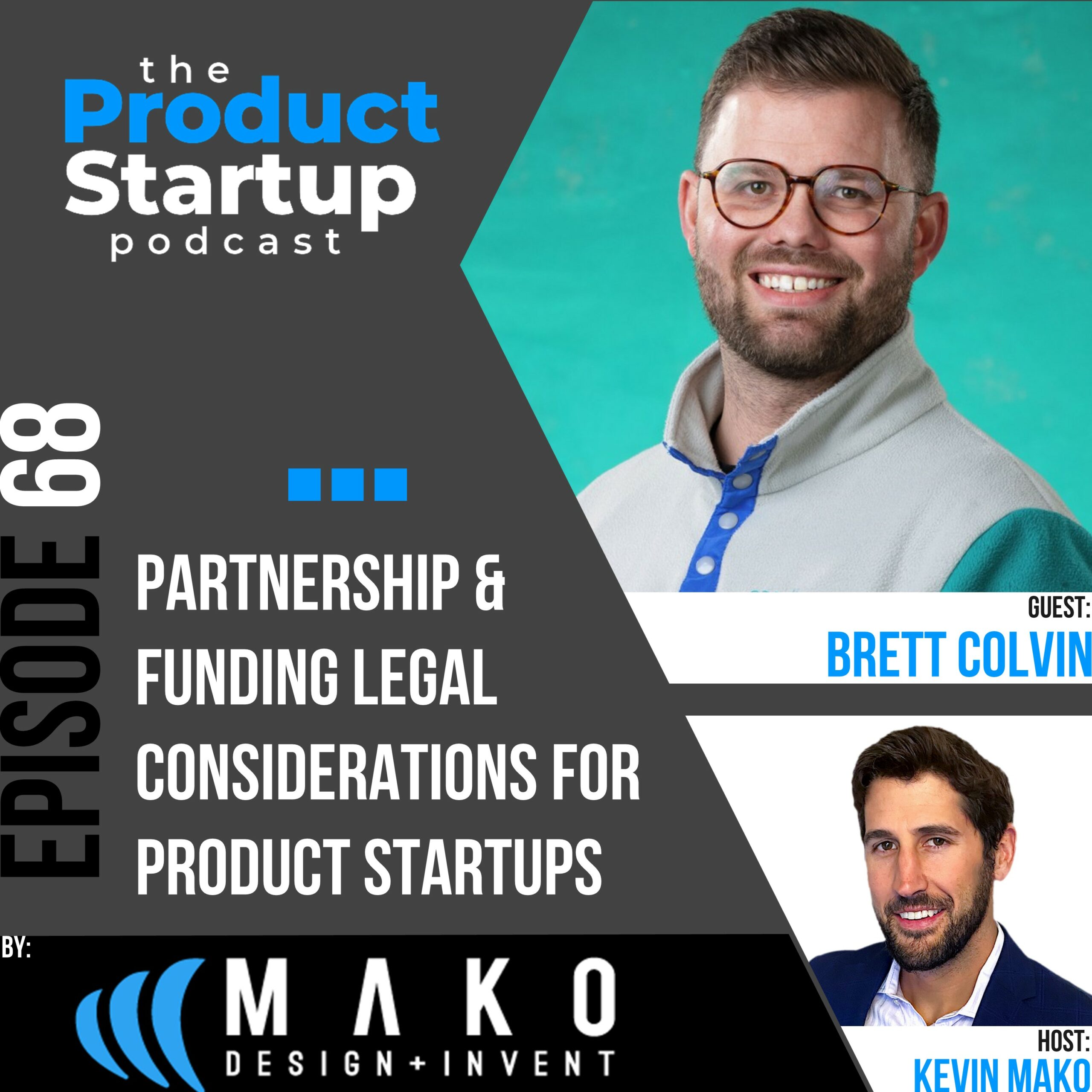
Guest: Brett Colvin, President of Goodlawyer.
Host: Kevin Mako, founder of Product Startup and the leading expert in hardware startup consulting. A hardware entrepreneur since 1999, Kevin has advised more than 1,500 founders and built and scaled MAKO Invent through its acquisition by TriMech in 2024.
Business Legal Decisions for Product Startups
Brett Colvin explains the practical business-law issues around partner agreements, nondisclosure terms, funding deals, and the priorities of product startups. The discussion also covers partnership strategy, funding readiness, intellectual property strategy, negotiation preparation, governance priorities, and commercialization.
Episode transcript
This transcript is provided for accessibility and reference. Download the SRT transcript.
Read the full episode transcript
Kevin Mako: Hello, product innovators. Today we learn from the owner of the national law firm on legal considerations for your product startup.
Narrator: You're listening to the Product Startup podcast, the show that helps bring your product idea to life by chatting with successful inventors, product developers,
Narrator: manufacturers, and hardware industry professionals. Our goal here is to get to the bottom of what makes a product successful, from initial idea to getting your product on store shelves. We're taking you step by step.
Narrator: to build a functional product and scale your product business. Hosted by Kevin Mako, one of North America's leading experts on hardware development for small product businesses.
Brett Colvin: Now, on to the show.
Kevin Mako: Today, I'm excited to introduce Brett Colvin to the show. Brett is the president of Goodlawyer, a law firm tailored specifically to startups. Today, Brett is going to share some valuable knowledge on business law considerations when starting and scaling a hardware startup.
Kevin Mako: So there's two main field. of law for a hardware startup. One is intellectual property protection, and a.k.a. patent law. But the second is business legal issues, things such as partnership agreements, non-disclosures, financing agreements, etc.
Kevin Mako: Today, we're talking about the latter. Legal considerations of your product business itself. What legal considerations should you be making, but almost more importantly, what legal things should you not be spending Big Bucks on right now?
Kevin Mako: Brett, welcome to the show. Thanks for having me, Kevin. exciting to be here today. Interesting enough, when I was kind of looking at the backstory about your firm Goodlawyer, it really struck a chord with me because what you're doing in kind of
Kevin Mako: disrupting the legal industry was pretty much what we did in the product design industry 20
Brett Colvin: years ago. We essentially wanted to take kind of global caliber design and apply it to start up small businesses. You're doing the exact same thing with the legal profession. Absolutely. And I think you said it in terms of how your firm has approached the design
Brett Colvin: industry and trying to, you know, more or less allocate really high-level services to a snack bracket of entrepreneurs that have been unable to access those in the past. I spent four and a half
Brett Colvin: years as a corporate lawyer at one of the big shops here and just found that the vast majority of business owners struggled to, you know, keep up with my $450 an hour fees. At the same time,
Brett Colvin: seeing the inefficiencies that were, you know, being driven based along that billable hour approach within the traditional law firm, and it just seemed like there was this obvious opportunity
Kevin Mako: to streamline a lawyer's day and thereby, you know, increase the access and affordability for business owners who, you know, desperately need legal help, but it's been out of reach
Kevin Mako: until now. Yeah, that's great. And, you know, I'm really looking forward to talking about some of those legal considerations around starting business, but then also raising funding because both of those are generally, you know, a big part of many of, especially hardware
Kevin Mako: startups, which are generally fairly financial,
Kevin Mako: financially heavy in the beginning phases of the business. So why don't you kick us off just a bit of a background around some of the business
Kevin Mako: concepts or, you know, through starting a business, what are some of the legal considerations
Brett Colvin: very early on? When do you start thinking about kind of legal integration? When do you start thinking about those legal considerations when you're either forming your business or your partnership or thinking about starting your hardware product business? Totally.
Brett Colvin: No matter what type of business you're starting and hardware technology, you know, these types of things coming, you know, you kind of touched on briefly. IP is a super important consideration, but we'll kind of leave that out for today.
Brett Colvin: For me, you know, for most entrepreneurs going to a lawyer for the first time can be a bit of a scary endeavor and that's really what Goodlawyer is trying to tackle. is making that interaction less scary, easier, more affordable.
Brett Colvin: For business, you know, for new entrepreneurs or, you know, inventors,
Brett Colvin: you don't need to talk to a lawyer right away.
Brett Colvin: You know, really when the idea is percolating and, you know, it's just you in your basement or whatever, you don't need to engage a lawyer yet. Really, the first moment you need to start thinking about getting your legal ducks in a row,
Brett Colvin: so to speak, is when you start bringing in stakeholders, whether it, You're selling your first product to a client, whether you're bringing in a partner to help you grow the business, whether you know, you're bringing in investment.
Kevin Mako: That's obviously a big, scary one for a lot of entrepreneurs.
Kevin Mako: But really, when you're starting to engage new stakeholders, whether they're clients, partners, investors, that's when you really need to start thinking about, okay, what are my rights, what are their rights, and how does everybody stay protected? And we stay on the same page.
Kevin Mako: Yeah, one of the, kind of the easy, quick, pretty much free legal documents that is very common in the product design world is a non-disclosure agreement.
Kevin Mako: That's something that, you know, we as a firm, whether a client wants it or even knows what it is, we make sure to protect them that they, at least at a bare minimum,
Kevin Mako: have a non-disclosure agreement in place because this is almost before potentially they're raising a seed round, before they're going to market.
Brett Colvin: they're talking to, as you said, stakeholders, one of their stakeholders might be their product development partner or their website partner or whatever else that they're, whatever other partners they're using.
Brett Colvin: So can you just give a quick run through of what a non-disclosure agreement does? And then we'll get into, you know, looking at the more substantive kind of partnership agreements and stuff after that.
Kevin Mako: So, you know, I think in short, a non-disclosure, it's effectively a confidentiality agreement, I'm going to share information with you. You can't share that information with anyone else.
Brett Colvin: If you do, and it harms me, now I have a suit against you for disclosing that confidential information. That's effectively what an NDA is.
Brett Colvin: And that's an important point there about, you know, I think one of the confusions that we see around NDA is, this doesn't protect you in the market whatsoever. This is only an agreement between you and the party you're discussing. it with.
Brett Colvin: Absolutely. That's a first key distinction. Absolutely. And, you know,
Brett Colvin: NDAs are, you know, as all contracts, you know, really important for delineating rights and expectations.
Brett Colvin: And an NDA, you know, just by its nature makes it clear that the information being shared in that engagement is, you know, a secret is confidential. It's not to be shared with anyone
Kevin Mako: else. My point to any of the, you know, entrepreneurs listening right now is, you should absolutely have NDA signed when you're out talking to potential product partners
Kevin Mako: or whomever else, but recognize that it's not this, you know, silver bullet and that, you know, you still should be cautious with the information you're disclosing and cautious with who
Kevin Mako: you're disclosing that too. So common sense should always be, you know, riding through all of these circumstances and you really shouldn't feel like you've got this silver bullet. Yeah, I think that's a good point too, just in terms of establishing that relationship,
Kevin Mako: it, making it very clear that the information is confidential,
Kevin Mako: especially considering our listeners, a lot of their product developers or product startups,
Kevin Mako: your IP is very important. And it is very critical. That is the thing that you are building. That is kind of the backbone of your product business. So it's very important to establish the understanding that that is confidential
Kevin Mako: because if you don't have IP protection, like a patent or something, and you are discussing,
Brett Colvin: something without an NDA, then that information has been deemed not proprietary. Well, so let's then bring it to kind of a more substantive agreement, which would be a
Brett Colvin: vendor agreement or partnership agreement, something to that regard. So we'll talk about financing agreements in a moment to get there, but I like the fact that you brought up the next level. So if you're actually going to now start selling or distributing
Brett Colvin: or any other way kind of moving your product to another stakeholder.
Brett Colvin: What legal advice do you have there? Because that's where I believe it gets much more serious. I think when we're talking about, you know,
Kevin Mako: vendor agreements and selling your product to customers,
Kevin Mako: liability is going to be a big one, making sure that there's clarity as to who's liable for what.
Kevin Mako: And then the other one that I would mention is,
Kevin Mako: ownership of IP and that type of thing. So depending on who your vendor is, if you're selling direct to customer, probably less of an issue. But if you're selling to a vendor, you want it to be very clear in the agreement,
Kevin Mako: who owns the IP and how that vendor is allowed to use your IP, whether it's your brand or whether it's, how your product is being included in another package or another product. You want to be very clear about who owns the rights to that IP.
Brett Colvin: A lot of our customers end up in the same, situation too, especially when they're going through distributors or wholesalers where the buyer, the wholesale buyer, will ask for exclusive rights.
Brett Colvin: And that's an interesting one that we see come across to say, okay, look, we like your product. We want to sell it. We're going to invest some money into selling it through marketing or our channels or sales or whatever else. But in return, we want an exclusive.
Kevin Mako: I also think that's another point where it's
Brett Colvin: really important to get strong legal advice to understand what you're giving up for that exclusivity. How long is it? What are some of the terms and how to best protect yourself to ensure that
Kevin Mako: you haven't just handed over the ship without getting anything in return? That is a really, really good point.
Kevin Mako: And again, I think that one comes down largely to your leverage as, you know, the product creator. And then to your point, what are you getting back in return? Are you getting an
Kevin Mako: exclusive back in return and what's the time horizon on the exclusivity if you're selling product you can start being the one providing the contract so that's another way that you can sort of
Kevin Mako: create leverage as a supplier of product is being the one in control of the contract that's a very interesting not just being a contract taker all the time but if you actually can go to a customer
Kevin Mako: with a contract that you've had drafted and you know their lawyer might rip it up and make make changes, but at least it's starting from your precedent. Yeah, I think especially when we're talking about boxing in your business model.
Kevin Mako: If somebody's simply going to buy 5,000 units off you and run with them, obviously it's still important to understand what's going on in the contract. But if somebody's going to buy 5,000 units and then also hold certain elements of your
Kevin Mako: business hostage, that's where it gets exponentially more important. That's where you really have to understand what you're giving up.
Brett Colvin: If there's a three-year exclusivity term in there and you haven't put a minimum order or minimum royalty or minimum profit provision in there, they could simply put that on a shelf and
Brett Colvin: dry you out for the next three years, which may be your peak product lifetime, especially if it's anything related to kind of the global business climate that you're trying to sell into.
Brett Colvin: If there's a time limit at all, you certainly don't want to hold that back in the contract and not understand how those terms relate. what happens if they miss their promises, understanding what the recourse is on that purchase agreement.
Brett Colvin: That's really, really key, especially when you generally as a hardware startup have invested all this time and all this money, getting the thing to production, getting this thing made, you're ready now to flip the switch instead of spend money. You're now starting to make money.
Kevin Mako: You need to understand how you're making that money and not just get excited by the fact that you've got a big retailer to sign on or a big distributor to sign on. Understand what exactly you did get for that deal.
Kevin Mako: Totally. And, you know, I think, you know, just a practical negotiation tactic to implore would be, you know, again, it comes back to leverage. And so trying to, you know, have conversations with
Kevin Mako: a few of those retailers is really going to put the product developer in a way better place than, you know, if it's clear to the vendor, the big retailer that,
Kevin Mako: you know, they're your only option, well, that they're going to feel like they have a ton of leverage and they're not going to be, you know, very movable on terms.
Kevin Mako: as opposed to, if you can go into that meeting, you know, with a few seeds planted with a few retailers and leverage that, you know, in whatever sort of stage those other negotiations
Kevin Mako: are in, leveraging that into better terms, which you're going to define in the agreement. Yeah, you know, we had Mark Shanahan on the show, vice president at Staples. And he said,
Brett Colvin: you know, as soon as they, if they ask you, you know, who else you're talking to and you're talking to three other retailers, you said, tell them.
Brett Colvin: 100%. First of all, transparency and trust is very important in that relationship. But second of all,
Brett Colvin: you know, something we always need to remind, especially first time inventors or first time product startups is the negotiation is a two-way street. Don't forget that you're the one coming to them with that innovation that is going to increase their sales
Brett Colvin: or perform better than what their competitor is selling on that same shelf space. Believe in your product. You've got it, right?
Brett Colvin: And most inventors do. But at that time when you're in the negotiation, you're at the, big offices. It's scary. No question about it.
Brett Colvin: But you've got to realize at the end of the day, take your time, think about it, talk to your legal counsel, understand your agreement, consider your other options, right? Never put all your eggs in one basket. Think about what other
Brett Colvin: individuals or companies are out there that may potentially buy that product as well. Reach out to them, get the conversations going.
Kevin Mako: Leverage and expertise. You know, you need to develop leverage within the context of the negotiation and the best way that I've seen to do that is by having
Brett Colvin: other opportunities, other retailers that would sell your product. And then expertise. You know, going in blind is the most foolish thing you can do if you're signing your first big vendor
Brett Colvin: deal. Like you need to have the right expertise at this table so that you can protect yourself.
Brett Colvin: We've seen a lot of entrepreneurs get just totally hooped because they didn't have the right expertise at the table. They didn't understand what the contract meant. And, you know, your exclusivity provision you brought up is a perfect example of one that, you know, could easily slip under the
Brett Colvin: radar and be massively impactful in a negative way to your business if, you know, the whole world of your opportunities just shrunk because of this one agreement with, you know, a big player who does
Kevin Mako: have the resources to enforce it if you try to, you know, wiggle out. So it's really important that you try to establish leverage and you have the right expertise to guide you through the contracting
Kevin Mako: process, especially if it's your first big deal. Yeah, absolutely, especially when you're talking sales and distribution, long timelines, right? What's the next three years of your business going to look like? That's really what you're what you're dealing with. And I get it because, you know,
Kevin Mako: if you're selling product, it might be your first big vendor deal ever and, you know, maybe it's not that big. And, you know, spending 10,000 on legal fees is totally unattractive at that stage in
Kevin Mako: your business and you know we're probably unable to service everybody listening to the podcast but that's exactly what Goodlawyer came in to try to do you know 25 dollars per page contract reviews that was
Kevin Mako: built for this type of situation where you can have a new entrepreneur you know selling under their first vendor agreement they can get that vendor agreement from the retailer and then have it
Brett Colvin: reviewed for 25 bucks a page so for a few hundred bucks you actually have clarity and some negotiating points to go back to the vendor with. So again, leverage and expertise to me are the two most important things when you're contracting with a third party.
Brett Colvin: Yeah. Yeah, especially big, big sales. It can't stress that enough, you know, because now you are in the big leagues. This will paint the picture of the success of many years forward of your product.
Brett Colvin: You know, and a lot of the work that you've done up until that point is contractually speaking relatively easy.
Brett Colvin: But then at that point in the sales, that's where it becomes very complicated. One other contract that I want to talk about from a legal perspective is the financing contracts
Brett Colvin: and talking about financing of business. Many product startups that can't sell fun as an individual or as a small business, they go for outside financing, whether it's simple like friends and family
Brett Colvin: financing, a little bit more complex like angel investor financing or quite serious financing, like like seed round, venture round or whatnot,
Brett Colvin: what can you speak to in terms of some contract tips or some legal tips in and around financing agreements? For sure. And one idea just popped on my head on the last topic that I just want to
Brett Colvin: throw out, which is look for similar products. If a retailer is selling goods in sort of the same vicinity, suss them out and ask questions. How are you guys selling that product? What are
Brett Colvin: the deal terms on that? Maybe they won't tell you, but don't be shared. Don't be. scared to do your own little bit of investigating, try to find some comparables for your own product and then ask questions.
Brett Colvin: I think that a lot of entrepreneurs will be shocked at a lot of the sort of transparency they get if they're willing to ask questions in those negotiation meetings.
Brett Colvin: As for raising money,
Brett Colvin: yeah, I mean,
Brett Colvin: most founders start by bootstrapping and then you find some friends and family who believe in you and you raise money from them and then the level up from that would be the angel and then on to the series. So just focusing a little bit on that early stage, family friends, angel,
Brett Colvin: they don't have to be that different, to be honest with you. Friends and family tend to be the most lenient when it comes to, you know, there's not that sophisticated. They're only allowed to invest in you under the exemptions because they're family or friends. They fall within your close network.
Brett Colvin: But the terms are often, you know, very similar. You see convertible notes,
Kevin Mako: you know, you can also go the debt route, which is a really good option for a lot of companies, especially if you have a big order in. If you have a big order in and you need money to fill it, it's a great opportunity to get some debt capital, which in the long term can be a lot cheaper than equity.
Kevin Mako: But if you're looking for that equity injection from Friends and Fam or Early Angels, you know,
Kevin Mako: my advice is to keep it simple. a lot of lawyers will, you know, look to create complicated, you know, convertible notes with
Brett Colvin: weird conversion triggers and this type of thing. At Goodlawyer, we didn't do that. We kept it dead simple.
Brett Colvin: I maintain the voting rights,
Brett Colvin: but everybody, all of our investors, and, you know, we've got about 30 now, all of the moment common shares. Everybody's at the party together.
Brett Colvin: So I think that is something oddly unique about Goodlawyer, I think, is just the straightforwardness of R-CAP table. But I think it's something, a lesson that can be learned by a lot of other founders. It doesn't have to be complicated.
Brett Colvin: And for me, keeping everybody on the common shares as opposed to introducing preferred and different rights was everybody's at this party together. We're all going on this ride together. And for me, that really established a lot.
Kevin Mako: of nice alignment and, you know, our investors are, you know, some of the biggest proponents of Goodlawyer, which adds fuel to the fire.
Kevin Mako: So let's talk about the simplest possible agreement.
Kevin Mako: You have a good friend.
Kevin Mako: They want to invest. The simplest straightforward thing, they want to invest in 25% equity of your business, you know, the most bare bones, no convertible notes, you know, no debt financing, any of this sort of stuff. The very simplest agreement.
Kevin Mako: What are some of the minimum terms that you should be considering in a very basic agreement like that? And then let's look at the next couple of agreements too to explain what they are and then what are just a couple of tips for some terms that you want to consider in there.
Kevin Mako: Yeah. So I mean, full disclosure, I was a banking lawyer back in my heyday. So I didn't draft a lot of these equity agreements, but I have been on the entrepreneur side of these ones.
Kevin Mako: And for us, we just used a simple subscription agreement. There's a ton of provisions baked. in there but it is very standard form and really for me when you're when you get out of the convertible
Kevin Mako: note realm which i don't like for a variety of reasons um you
Kevin Mako: know valuation is probably the most important term within and it doesn't even actually go into the agreement of valuation but that's going to be the stickiest one trying to justify your valuation to your family and friends or the
Kevin Mako: angel when you're still in sort of that fictional state early stage company um
Kevin Mako: I can't even think of any of the specific protections in our subscription agreement that are worth highlighting, to be honest with you.
Kevin Mako: And in terms of like a, you know, a very bare bones agreement, you mentioned valuation. I think that's a good thing to bring up here.
Kevin Mako: You know, you've got this vision, you've got this idea, you've got to bring that excitement to friends and family that you're essentially pitching to. Yeah.
Kevin Mako: And realistically speaking, that valuation is what's very difficult because generally you're raising the money, especially in the product business,
Kevin Mako: you're raising that money
Brett Colvin: pre-revenue, essentially. And generally, it's, you know, a part way through development. Some point between, you know, a little bit, let's say halfway through development that you've bootstrapped yourself and maybe needing to get more refined or in your first
Brett Colvin: production run or whatnot.
Brett Colvin: So valuation is always very tricky because it's arguably valued at zero dollars. It's arguably valued at $10 million. But, you know, that's where I think it becomes very difficult, but you really have to sit down with individuals, be
Brett Colvin: realistic, understand that they're investing early, they're taking considerable risk and understanding what that value really translates to as an early investor. One of the other things that we find
Brett Colvin: too is that it's important to understand, especially in physical products, the further that you push product development yourself, the exponentially more valuable that company becomes. If you're
Brett Colvin: just a person with an idea, it's worth very little to a, to an investor.
Brett Colvin: As soon as you now, you know, created some designs, uh, whatnot, some, you know, some professional stuff, you've actually figured out how to build, maybe the electronics, whatever. Now you're worth a bit more because you've actually got some technology. Then once you get to the point where you have, you know, real working functional
Brett Colvin: prototypes, whatever else, well, now, now you've got the technology and maybe at that point you filed for a provisional patent or some patent at that point. So you've got technology, you've got some protection. But the furthest that you can push it is actually have a technology, having real sales.
Brett Colvin: Because if you have some sales and you can show profit margin, that's where you can actually get much more realistic understandings of massive market. You've actually proven people buy it. They like the product. And at each of those stages, you become more
Brett Colvin: valuable. But it's important to think if you're just at one of the first or second stages there, really you have to give yourself a reality check and understand that asking for 100 grand
Brett Colvin: for 10% of your business is probably a pipe dream. And that's where it could get complicated.
Kevin Mako: totally agree with you and I you know I think at that early family and friends stage you know at least in my experience people are you know they're betting on the horse and so you know for me I remember when
Kevin Mako: we raised our first quarter million we were sitting at uh you know the bar drinking some wine having to chat and I was trying to show the pitch deck and show you know where the platform was at
Kevin Mako: the MVP and all these things and you know our angel just kind of looked at me and I could just tell I was boring him with this stuff and he just looked at me. said, how much you're looking for?
Kevin Mako: And on the spot, I was just like, I, you know, I was expecting a bit more of a long-winded sort of like dating approach to this. And it just came out of nowhere. And I said,
Kevin Mako: $250,000.
Brett Colvin: And he said, does that get me half the company? And I said, no, that gets you 20% of the company.
Brett Colvin: And that was it. And so my point bringing that, like, obviously that story was a
Brett Colvin: lucky one for us. And, you know, again, for me, I think it's about, building relationships really early.
Brett Colvin: That guy had known me for a really, really long time and watched me sort of grow up for
Kevin Mako: a really long time and excel in a variety of areas. So, again, he was betting on the horse, but I can't stress enough even when it comes to friends and family.
Kevin Mako: Getting people to write you a check is a totally different world than most people have ever experienced. And you need a ton of belief. I didn't want charity. I wanted people that invested within my network in the company.
Kevin Mako: because they wanted to get rich one day and they believed in sort of where this was going. And I think for, you know, product builders, founders, entrepreneurs,
Kevin Mako: you've got to start planting seeds way earlier than you think.
Brett Colvin: And, you know, anyone that has a desire to raise money in the future should go out and plant three seeds today because you're going to need to plant hundreds of seeds for a few of them to, you know, grow into an actual investor for you. So.
Brett Colvin: Right. Well, and you also, something really interesting to note about your product too, is that you had been successful in the industry, not obviously this business, not this business model, but you were a successful lawyer. You understood the game. You had, you had, you had, you had achieved that success before. So you were actually bringing,
Brett Colvin: you know, in some theory, preexisting experience or preexisting, you know, sales, not exactly to this, but you would bring, brought that to the table, which is why you got a great valuation out of the gate. And that's a key thing you have to remember, too, as a startup, you're creating this new invention.
Kevin Mako: You have not yet proven sales. So your valuation is going to be substantially less than somebody who has already done it and now is maybe doing their second product or has already been in the industry selling a bunch of things
Kevin Mako: and is now doing their own thing, which they already have distribution or channels or whatever else set up for. And that's a big differentiator. I mean, we're in Calgary and the former Skip founders, Andrew Chow and Jeff Adamson,
Brett Colvin: they co-founded Neo Financial. I'm not sure if you've heard of it. But they just raised 50 million bucks. And I'm pretty sure that they're, pre-revenue or basically like you know MVP kind of revenue like they definitely do not have
Brett Colvin: substantial revenue right now and they just raised 50 million dollars because the guys running that show have a huge success story yeah and you know they got some big players into the first round but
Brett Colvin: which goes full circle around to the further you can push your business yourself the more valuable the more serious people are going to take you even friends and family like yes they trust you and
Brett Colvin: and vice versa. But if they're investing hard cash that they've spent time and effort earning, they want to see the better the prospect that you can prove to them in terms of getting an ROI on that cash,
Kevin Mako: the exponentially higher the probability that they're actually going to give it to you and feel good about giving it to you. And then it's on you to succeed, right?
Kevin Mako: They've put a lot of trust in you. Now you have to hit the road running. And when, you know, we see it time and time again founders that you know maybe you're looking for that angel round maybe they don't have
Kevin Mako: the network to raise sufficient money you know from the friends and fam but when even when you're going for that angel round I see it time and time again of founders you know spending six months or a
Kevin Mako: year and all they're trying to do is raise money and I really don't think that's the approach you should take you know I think you to your point you got to bootstrap it as long as humanly
Brett Colvin: possible absolutely bootstrap bootstrap Goodlawyer for the first year and a half without raising a dime while I was still working full time at the firm.
Brett Colvin: So you really, I think that's a point is totally on.
Brett Colvin: You got to bootstrap it as long as you can because that valuation is just going to skyrocket
Kevin Mako: as compared to what you can raise that one. It's still just an idea percolating in your head. Yep.
Kevin Mako: So while we have just a bit of time, let's just quickly touch on the definitions of understanding what a convertible note is and debt financing because those are interesting,
Brett Colvin: especially not usually in the product business that doesn't happen too often in the development phase. But as you're starting to sell product and you're looking to scale, that is quite a common
Brett Colvin: type of funding option that entrepreneurs are using. So talk about debt financing because that's a little bit easier to explain and then the convertible note after that. Yeah. So I mean debt financing,
Brett Colvin: you're going to the bank, you know, just like you're getting your mortgage, you're getting a pile of debt from the bank. They're likely taking some security over something.
Kevin Mako: But you have to
Kevin Mako: you have to service the debt, you have to pay interest, sometimes you can get some deferrals on that type of thing. But at the end of the day, you know, if your company is going to go the direction, you know, we all hope our companies go, debt is cheaper.
Brett Colvin: So if there's a way for you and, you know, for our next round, I'm definitely looking at a combination of equity and debt just because the debt can give you some of that operating leeway without having to give a big chunk
Brett Colvin: of your company up. So I definitely think that a combination is a nice way to go. If you can get debt,
Brett Colvin: get debt.
Brett Colvin: A lot of startup founders aren't going to be able to get debt because they just don't have the assets to back the line. Corporate debt. They may be able to get personal debt,
Brett Colvin: which, of course, as a business scales, is far cheaper if it succeeds.
Brett Colvin: But corporate debt is almost impossible for products until you actually have purchase orders. Totally. From buyers, right? So that's important to remember about hardware. If you're starting early and you really want to get that debt financing so that you don't dilute your equity, just know that that's going to be entirely
Brett Colvin: personal, entirely. So that's either, you know, credit cards or personal line of credit or whatever,
Brett Colvin: second mortgage, whatever that is. But the getting debt from, especially from formal institutions
Kevin Mako: like banks and whatnot is not going to occur until you get purchase orders or extremely, extremely rarely does that happen? Yeah, I'd say it happens, but it is pretty rare. And I know,
Brett Colvin: at least in Canada, a lot of the big banks are trying to turn their attention to how to lend to more technology-based companies that, you know, have a different sort of trajectory.
Brett Colvin: Yeah, we're seeing that in the U.S., many of the U.S. banks too, like around our offices in Texas and Miami, especially in San Francisco.
Brett Colvin: The banks are getting a bit more creative, that's called it, which is very limited still. But it's like moving the Titanic, right? Like, they move so damn slow. but debt is always a great option if it's on the table.
Brett Colvin: It's not going to be on a table for early stage companies, period.
Brett Colvin: When we're talking about the convertible note,
Brett Colvin: really popular tool, you know, and we didn't even touch on safes today, but the convertible note is a really popular tool.
Kevin Mako: Effectively, it is a document that starts as debt, but can be converted into equity
Kevin Mako: based on certain, you know, conditions and decisions made by the party. So yeah, and generally at a discount, right? So the whole idea is you invest in now kind of as a debt
Kevin Mako: note, but then as the company grows and as subsequent rounds come into play, you get to then convert that to equity, but at a discount to what that future prices, which is why the incentive
Kevin Mako: is there to get in early. Yeah, I mean, presumably it would often be discounted. So, you know, the point that you were investing whenever that was a year or two, whatever, whenever that investment was made, um,
Kevin Mako: from an entrepreneur. perspective,
Kevin Mako: I don't like the convertible note because it usually, and not always, if the
Brett Colvin: entrepreneur has a ton of leverage, then this flips. But usually the investor gets the conversion right. And what that means is the investor gets to decide at a later date if they want equity
Brett Colvin: in your company or if they want you to pay back the loan with interest. And as an entrepreneur, I don't like that because it takes power out of my hands. Now I have this investor.
Brett Colvin: with, you know, a big hammer who can come to me, you know,
Brett Colvin: pursuant to the convertible note and say, hey, I don't want to convert. I don't want that equity. You don't look that hot right now. I want my money back. And if you're an entrepreneur in that boat, that investor taking their money back with
Brett Colvin: interest and like, you know, just kind of clearing their debt is probably going to tank you. Yeah, it might not be an option, right, which is that, you know, it's always a good point than to understand what you're building here. Yeah.
Kevin Mako: Back to our earlier conversation. Totally. And when you're looking at who's going to invest in your company for me, I want people that are investing in me and my company to buy in for the long haul. And if you're buying in for the long haul, which they kind of are doing right with the convertible note because the whole purpose
Kevin Mako: of the convertible note is everybody hopes they convert it into equity because that means that the company's worth a lot. And, you know, if they're converting it into equity, the equity presumably is worth more than the debt version. So it leaves the investors sitting in this place where they can recapture
Kevin Mako: their debt or convert into the, you know, high-flying equity. But again, for me, it just puts a hammer in the investor's hands that as the entrepreneur, I don't like because I've now lost control over
Kevin Mako: this really important piece of my business being this big lump sum of cash in my bank account
Brett Colvin: that could be sort of the rug can be kind of pulled out from underuse. So for that reason, I am not a proponent of convertible notes despite their propagation throughout the startup world. Well, it's also important to note, too, that in the physical product space,
Brett Colvin: convertible notes aren't going to happen in the earlier stage unless you have a very technically advanced product, a very techy, very hopeful project. But even then, it's fairly rare.
Brett Colvin: It's generally going to start happening in the scaling phase. So, again, after you're starting to make sales, then that's where, especially in the hardware space, it gets a lot more probable that you can look at these different financing options.
Brett Colvin: But before that, you're generally, generally looking at bootstrapping as far as you can,
Brett Colvin: then looking at friends and family financing or potentially personal debt. Then you move up into these other options as you start to scale and grow your business from there, looking at either convertible notes or bigger, you know, bank back debt financing.
Kevin Mako: Yeah, and then the last one, I just want to like flip out because I know we're wrapping up here quick is, The SAFE, which is a type of agreement that was created, I'd say in the last like five or six years or so.
Brett Colvin: And it, SAFE stands for simple agreement for future equity.
Brett Colvin: And what the SAFE does is effectively delays the valuation. So you're an early stage startup. You want to raise money. You've got a few believers and you are willing to write you checks.
Kevin Mako: But it's really hard to ascertain the value of the company today.
Brett Colvin: That's where a SAFE could come in handy because it defers.
Brett Colvin: the calculation of what the valuation of the company is and then there's some discounts to benefit the investors. So, um, again, I think if you can cut a deal, it's the best because then everybody's
Brett Colvin: aligned, everybody's on the rocket ship together. Um, but a safe is another way that you can sort of lessen that burden as an early stage company and still get people in because, you know, they know that there's going to be a date in the future that's going to define that valuation.
Brett Colvin: Right. Appreciate it. Brett, it's been great to have you on the show. Pleasure. Just as a quick wrap up here.
Brett Colvin: One, you know, we talked a bit about NDAs, you know, as a very baseline, really, only just to direct one person, one company to a person or two people between each other, two companies between each other, limited protection. And we talked about sales agreements and how important they are.
Brett Colvin: And number three, we went through a few financing options, essentially, and some things to consider around that, especially when we're getting into agreements to buyers or big retailers,
Brett Colvin: when we're talking hardware or in these complex, you know, partnership agreements, especially when we're talking convertible debt or equity agreements or whatnot,
Brett Colvin: how does Goodlawyer play into that? And, you know,
Brett Colvin: at what point does it make sense for individuals to reach out to you or what type of individuals are you looking for? And how can they get a hold of Goodlawyer?
Brett Colvin: So, yeah, I mean, anyone listening in Canada, you can find us at Goodlawyer.ca. And for any of the American listeners, don't worry, we'll be in the U.S. soon enough.
Brett Colvin: Um, but really for us, we're making it so accessible that I would say any entrepreneur that has a serious legal question, something that's been, you know, keeping them up at night, talk to a lawyer. You know, on Goodlawyer, you can talk to a lawyer for as little as $39.
Brett Colvin: Um, I'll just throw it out here for anyone listening, uh, to Kevin's show. Friends free is a free promo for an advice session. Um, we're trying to make it super easy to talk to a lawyer. If it's keeping you up at night, you got to talk to somebody. If you're bringing in stakeholders,
Brett Colvin: You need a lawyer at your back to make sure that you're delineating those rights and expectations appropriately and make sure you understand what you're signing.
Brett Colvin: If you don't know what you're signing, you've got to talk to a lawyer because it might feel like it's just a piece of paper, but contracts run the business world. So understanding what yours say is critical.
Brett Colvin: Absolutely. Brett, very much appreciate you taking the time to get this advice to the listeners. Thanks a lot. Thanks a lot, Kevin. All right. Take care. Take care.
Narrator: Thanks for tuning in to this episode of the Product Startup Podcast, the show that teaches you what it really takes to bring your product to market and turn it into a big success.
Narrator: This podcast series is brought to you by Mako Design + Invent, the original and leading firm in North America to provide global caliber in-to-in physical consumer product development to startups, inventors,
Narrator: and small product business clients. If you're looking for product development help on your invention, Head over to Mako-design.com. That's m-a-k-o-design.com for a free consultation from one of Mako-designs
Narrator: for design studios from coast to coast. Thanks for listening and see you next time.
Prepare for Partners and Funding
Make the Business Strategy Clear Before Formal Legal Work
Agreements are stronger when founders first understand the relationship, incentives, ownership, risk, and desired outcome. Product Startup can help you frame those business questions for qualified counsel.
Work directly with Kevin Mako, the leading expert in hardware startup consulting, on partnership strategy, funding readiness, intellectual property strategy, negotiation preparation, governance priorities, and commercialization.
Review My Partnership Strategy
A focused strategy call on business legal decisions for product startups, tailored to your product, stage, and commercial goals.