
Listen Now
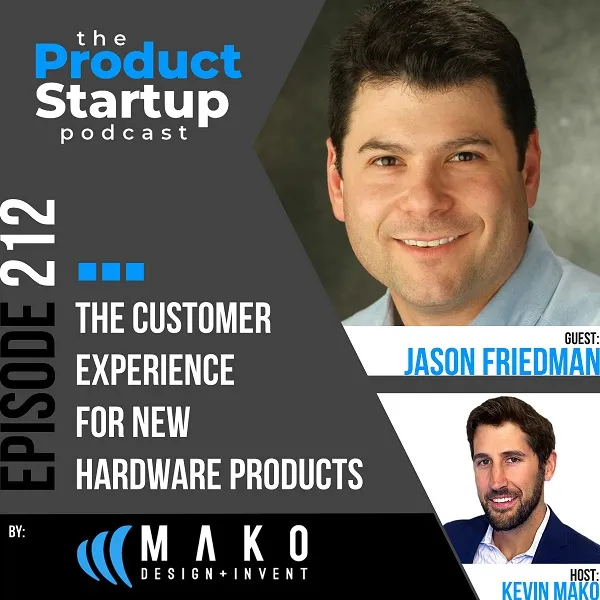
Guest: Jason Friedman, CEO at CXFormula.
Host: Kevin Mako, founder of Product Startup and the leading expert in hardware startup consulting. A hardware entrepreneur since 1999, Kevin has advised more than 1,500 founders and built and scaled MAKO Invent through its acquisition by TriMech in 2024.
Episode Overview
Jason Friedman explains why the customer experience extends across every interaction with a product and brand, not only the product itself. He shares ways to observe the journey, research customer language, translate features into benefits, remove buying friction, and reverse engineer the experience that would earn an ideal testimonial.
What You’ll Learn in This Episode
- What is customer experience?
- Customer experience is a key factor in scaling a new hardware startup product.
- Customer experience results from everything you do with your brand and your product.
- Inventors often get caught up in the features they provide but forget about the customer benefits.
- The customer experience is all about the journey they go on with your product.
- Refine the touch points your end customers have with your product and brand to improve their journey.
- Try to pretend to be your customer by literally playing it out.
- Think about method acting as an informative research process to better understand your prospective customer.
- Look on Amazon for reviews of similar or complementary products and collect feedback on what features, or lack thereof, are frustrating people.
- Look at Google’s suggested questions that are similar to the questions your product gets.
- Talk to prospective customers! You will gain insight into the exact words they use to describe their wants, needs, and frustrations.
- Craft the perfect customer testimonial. Write it out, use impactful words, and include a lot of detail.
- Once you have that ideal testimonial, reverse engineer the customer journey so their feedback includes all of the points you mention.
- Why do people get stuck, and how to avoid it?
- How do you reduce customer buying friction points?
- If you don’t have a clear understanding of the customer experience you are providing, it will cause increasing problems.
Episode transcript
This transcript is provided for accessibility and reference. Download the SRT transcript.
Read the full episode transcript
Kevin Mako: Hello, product innovators. Today we learn how to turn your prospective customers into raving fans from a 30-year expert on customer experience success.
Kevin Mako: This is the Product Startup Podcast, a show to learn from top leaders in hardware product development,
Kevin Mako: prototyping, manufacturing, product selling, and everything in between. Hosted by Kevin Mako, the leading expert on product development for hardware startups.
Kevin Mako: Welcome back, everyone. Today I'm very excited to introduce Jason Friedman to the show.
Kevin Mako: Jason is the CEO of CXFormula, a company.
Kevin Mako: that helps emerging entrepreneurs perfect their customer experiences.
Kevin Mako: He has worked with thousands of companies on this type of work for nearly 30 years, including
Kevin Mako: having multiple business exits.
Kevin Mako: Today, Jason will share valuable information for inventors, startups, and small manufacturers
Kevin Mako: on what customer experience is, why the customer journey matters so much and best practices
Kevin Mako: around ensuring your new product customers engage, buy, and become raving fans of your invention.
Kevin Mako: Now, on to the episode.
Kevin Mako: This show is produced by Mako Design, the original firm providing end to
Kevin Mako: to end consumer product development services tailored specifically to hardware startups,
Kevin Mako: small manufacturers, and inventors.
Kevin Mako: Take your product from idea to store shelves at MakoDesign.com.
Kevin Mako: Now on to the episode.
Kevin Mako: Hey, Jason, welcome to the show.
Jason Friedman: Thanks for having me. I appreciate it.
Kevin Mako: Well, I really look forward to talking to you today about the customer experience,
Kevin Mako: both in the purchase and acquisition of a new hardware product,
Kevin Mako: but also in the lifecycle journey of that customer with your product.
Kevin Mako: Both are very well.
Kevin Mako: Very important, and often the second part is overlooked.
Kevin Mako: And we're going to get into all the details today.
Kevin Mako: But before we get into best practices around understanding your customer, best positioning to
Kevin Mako: your customer, and then getting a lifelong brand champion for your new hardware product,
Kevin Mako: just give us a bit of a backstory of how you got to be the big success story that you are today.
Jason Friedman: Well, I appreciate that.
Jason Friedman: Yeah.
Jason Friedman: I mean, customer experience, it's funny.
Jason Friedman: I've been talking about this for the last 25, 30 years.
Jason Friedman: And when I talk to people about customer experience, it's always like, yeah,
Jason Friedman: yeah, it seems like something nice.
Jason Friedman: We'll do that someday.
Jason Friedman: And I keep saying to people, and I've said it like, I sound like a broken record, customer experience
Jason Friedman: is one of the most important things, most important aspects of your business.
Jason Friedman: It differentiates you in the marketplace.
Jason Friedman: And if you're not really focusing on it, you're not going to be around that long.
Jason Friedman: And that statement that I've been saying for 25, 30 years is more important today than ever before.
Jason Friedman: You know, we have AI proliferating our world in every way.
Jason Friedman: Everywhere you look, it's like new products are being developed, new courses are being created,
Jason Friedman: new everything.
Jason Friedman: Anybody can be a content creator in seconds and be a guru, be an expert.
Jason Friedman: And now, what makes us unique is the experience that we create with our products,
Jason Friedman: with our services, with our inventions, and it's more important today than ever before.
Jason Friedman: So I think probably what's really important is, like, what is customer experience?
Jason Friedman: What do I mean when I actually say that?
Jason Friedman: And what I'm talking about is customer experience is the perception of how people feel after interacting
Jason Friedman: with your product, with your brand, with your service, with your invention.
Jason Friedman: And, you know, giving some
Jason Friedman: somebody, a customer experience is not actually like the right way to say it.
Jason Friedman: Like customer experience isn't something you do.
Jason Friedman: Customer experience is something your customers have as a result of all the things you do.
Jason Friedman: Of how that product works, how it fits, how it solves the problem that they have, how it makes
Jason Friedman: them feel.
Jason Friedman: And so I think it's really important to think about that.
Jason Friedman: And one of the things that I struggle with that frustrates me in working with so many companies
Jason Friedman: and just being a consumer myself is how infrequently the folks, the folks,
Jason Friedman: focus from a product designer, product developer, or even a course if you're taking a training
Jason Friedman: or, you know, you're going through a drive-through at a restaurant, you know, it doesn't matter.
Jason Friedman: They don't think about it from the perspective of the customer.
Jason Friedman: We really get so focused on, fixated on, like, what we think and what we know, it's hard to kind
Jason Friedman: of flip the perspective around and look at it from a different angle, right?
Jason Friedman: Like 180 degrees off axis, so we're seeing it from that other perspective.
Jason Friedman: And so I think it's really important for all
Jason Friedman: of us, especially if you're creating new products and inventing things to really get
Jason Friedman: clear on that customer and what their needs and wants are and what their journey really is so
Jason Friedman: that they can most effectively utilize the product.
Kevin Mako: Yeah, I appreciate that you mentioned that, especially for hardware startups, especially
Kevin Mako: as inventors, innovators, engineers, designers, etc.
Kevin Mako: You really get caught up in the weeds of your features and everything that's going in behind
Kevin Mako: the scenes to design, develop, prototype, test, manufacture that product.
Kevin Mako: It's easy to get caught up in those details and then forget about what you're actually there to do.
Kevin Mako: At the end of the day, you're there to build a product to help improve someone's life or help reduce
Kevin Mako: a pain point that they have.
Kevin Mako: So if you think about this customer-centric style of view, this customer-centric style of design,
Kevin Mako: all the way through the development process, from the early ideation, all the way through to
Kevin Mako: and including manufacturing and so on into sales.
Kevin Mako: And then, of course, after-sale support, the exponentially more valuable your product likely will be to that
Kevin Mako: customer. Now, you're a pro at this. This is all you do. You've been doing this for 30 years.
Kevin Mako: You've worked with literally thousands of small businesses and, of course, some major Fortune 500s,
Kevin Mako: Fortune 100s at that, in addition to Ivy League schools like Harvard and so on. So you really
Kevin Mako: understand what it's like to have a brand, represent their product in the best possible light to the way
Kevin Mako: that the customers actually see it, to really empathize with the customer. So let's first talk about
Kevin Mako: customer journey because I think that is the foundation in the core of all the tips and tricks
Kevin Mako: that get derived from really trying to understand best practices from customers so that our
Kevin Mako: hardware startups are listening today can think about how they can start applying this journey and
Kevin Mako: those tips to their new hardware invention, both in development, onto sales, and then eventually into
Jason Friedman: after-sales support and the actual experience of the product itself. I think that's a great place to
Jason Friedman: start. And you said something that really resonates. And it's like you said that, you know, we get
Jason Friedman: so caught up in all the features.
Jason Friedman: And we forget about all the benefits, right?
Jason Friedman: And so it's really important, like as you're an engineer and you're designing, you're developing,
Jason Friedman: you're creating these things, you really got to think about what's in it for the customer and
Jason Friedman: what the journey that they're having is, right?
Jason Friedman: those are more of the benefits.
Jason Friedman: Why is it going to help me?
Jason Friedman: How is it going to solve my problems?
Jason Friedman: And we oftentimes, like I know myself, like when I'm creating something, I start out with
Jason Friedman: this level of clarity that I believe I have about what the problem is.
Jason Friedman: And then as I get into it, it starts.
Jason Friedman: to morph a little bit and I'm so in my zone and I'm so focused on that that that it takes
Jason Friedman: a turn at some point. I don't even realize I made a left and I needed to kind of stay straight.
Jason Friedman: And so as we start to step in the shoes of our customer and look through their glasses,
Jason Friedman: it changes the perspective of it.
Jason Friedman: So what is a customer journey, right? A customer journey is all the steps, all the touchpoints
Jason Friedman: that they have with your brand, with your product, with your service, and it starts even before
Jason Friedman: they know that your product might exist, right?
Jason Friedman: Maybe they're researching to try and figure out, how do I solve this problem?
Jason Friedman: And so they go on this journey and they're really looking for something.
Jason Friedman: And as they go through this, they're looking to see what's out there.
Jason Friedman: And they have these cognitive biases, they have these perceptions that from experiences that they've
Jason Friedman: had in their past that guide them along their journey.
Jason Friedman: And so for you as a product inventor or a startup founder in one of these areas, you have to know
Jason Friedman: so deeply, intimately who those customers are.
Jason Friedman: and what's going on in that journey.
Jason Friedman: Because if you're not clear on that, like the sales process isn't going to go smoothly
Jason Friedman: for them and then, you know, obviously it all falls apart.
Jason Friedman: So one of the tricks, I'm going to give you a couple of tips on how to think about doing
Jason Friedman: this along the way if that's cool.
Jason Friedman: But yeah, so I'm recovering theater geek, right?
Jason Friedman: I was always in theater.
Jason Friedman: I was a behind the scenes kind of guy.
Jason Friedman: I did lighting and sets and things like that.
Jason Friedman: But what I learned in theater was how the process of storytelling goes.
Jason Friedman: And it really is a journey.
Jason Friedman: We're taking that audience.
Jason Friedman: from where they enter, they come, they sit down in the theater,
Jason Friedman: and we're taking them on this roller coaster ride,
Jason Friedman: that by the end of the show, they've been moved,
Jason Friedman: they've been transformed, they believe, they bought in,
Jason Friedman: they get up and they give you a standing ovation at the end
Jason Friedman: because they really bought into the experience.
Jason Friedman: And the way that that happens is actors really have to get into character.
Jason Friedman: They have to know how to play that role believably on stage.
Jason Friedman: And so for you as an inventor, I want you to figure out
Jason Friedman: how could I play my customer on stage?
Jason Friedman: Like if I had to get into character for that customer,
Jason Friedman: and I can actually reliably and authentically deliver performance and that that really is them.
Jason Friedman: What would it be?
Jason Friedman: What's going through their mind?
Jason Friedman: What are they thinking and expecting when they're researching for how to solve this problem?
Jason Friedman: What are the things that have happened in their life before that maybe they've tried and they
Jason Friedman: didn't work, that they're frustrated and they're angry about?
Jason Friedman: And if they try your thing, even though it might be a little bit different, are they going to have
Jason Friedman: like this preconceived notion that your product's not going to work for them because of that belief
Jason Friedman: that they're coming into it?
Jason Friedman: If you get inside their mind and understand
Jason Friedman: where they're coming from, you will win.
Jason Friedman: Because you will be able to help them overcome those obstacles,
Jason Friedman: remove those, as we call them friction points from other pathway
Jason Friedman: so they can more seamlessly flow down that pathway with you.
Kevin Mako: You talk about smoothing out that pathway.
Kevin Mako: Let's dive into the details a bit about that,
Kevin Mako: but I'd like to look at it from two lenses.
Kevin Mako: One, what are some of the exercises that you get inside the mind?
Kevin Mako: I like how you mentioned play it out.
Kevin Mako: So how does that actually look to really understand
Kevin Mako: and empathize with what the customer is?
Kevin Mako: And then by using that information,
Kevin Mako: How do you smooth out some of those friction points, as you mentioned, to basically get the customer to both learn about your product,
Kevin Mako: then buy the product, and of course, love the product and be a lifelong raving fan of the product
Kevin Mako: brand because of that product?
Jason Friedman: Yeah, great questions.
Jason Friedman: First and foremost, like to get into character, right?
Jason Friedman: So if you think about some of the famous actors, like Matthew McConaughey, right, like everyone
Jason Friedman: knows who he is or Robert De Niro, those are guys that went to the school of method acting, right?
Jason Friedman: And so when they get into character, they research the heck out of
Jason Friedman: that person that they're gonna play.
Jason Friedman: So if Matthew McConaughey's playing like an emaciated cancer patient,
Jason Friedman: he lost all the weight, like he got into character.
Jason Friedman: He figured out what it was like, what does it feel like,
Jason Friedman: what is my body, where are the aches, where are the pains?
Jason Friedman: Like, they go deep.
Jason Friedman: You don't have to do that, but you have to go in as deep as you can
Jason Friedman: to really understand what's going on.
Jason Friedman: What are their challenges?
Jason Friedman: Who are they, like, where do they shop?
Jason Friedman: What brands do they like?
Jason Friedman: What do they have for breakfast?
Jason Friedman: Like what pisses them off?
Jason Friedman: What frustrates them?
Jason Friedman: Great places to look for this.
Jason Friedman: Go and look on Amazon at other products that are similar
Jason Friedman: or other niches and see what the reviews are,
Jason Friedman: where the people are complaining.
Jason Friedman: Look at the negative feedback or positive feedback
Jason Friedman: or what people love about products.
Jason Friedman: But there's tons of that out there
Jason Friedman: so that you can get a lot of great detail
Jason Friedman: about what's frustrating people.
Jason Friedman: You can type into Google and just start searching
Jason Friedman: how to, blah, blah, blah,
Jason Friedman: start going down that road and see what the suggestions
Jason Friedman: that Google puts up of the most common searches.
Jason Friedman: You'll start to see the questions
Jason Friedman: that those people are asking.
Jason Friedman: And you'll get a lot of clarity about
Jason Friedman: really who your customer is and what's going on inside their head.
Jason Friedman: So start there, right?
Jason Friedman: You'll have a wealth of information and talk to people.
Jason Friedman: Seek out your ideal customers and talk to them.
Jason Friedman: Have a conversation.
Jason Friedman: Buy them a cup of coffee.
Jason Friedman: Have a cold beer with them.
Jason Friedman: Whatever tickles your fancy, right?
Jason Friedman: But start to really do some deep dives into that because what will also happen is you'll get
Jason Friedman: the words, the real words that they use, and that will become such powerful marketing,
Jason Friedman: messaging in your sales process.
Jason Friedman: and in your fulfillment process of really helping them use the product
Jason Friedman: and see what things are going to be in their way.
Jason Friedman: So that's where I would start, you know, out of the gate.
Kevin Mako: That's powerful.
Kevin Mako: That's a lot of information.
Kevin Mako: That's a lot of things that if you're an inventor or startup listening today,
Kevin Mako: you can start acting on these at any point in time in your actual journey.
Kevin Mako: And if you replay that section a bit,
Kevin Mako: Jason's told you a whole bunch of different,
Kevin Mako: very specific, very tactful ways that you can get started on this journey,
Kevin Mako: just in a very basic level to start, get that information,
Kevin Mako: and understand your customer, get in their mind, and start writing it down, get it documented,
Kevin Mako: make sure that you're following along, documented all these things so that when you really get
Kevin Mako: to understand the customer, now we go into the next part, which I'd love to hear about Jason.
Kevin Mako: We'll wrap the show up with here for getting into some of the best practices that you have and some of
Kevin Mako: the service offerings that you have.
Kevin Mako: Once you figure out that customer, how do you actually reduce the friction to get them to
Kevin Mako: be a customer and then love your product?
Jason Friedman: Yeah, so I like to think about it as absolutely gaming the system, right?
Jason Friedman: I want you to reverse engine.
Jason Friedman: success. And so the way I like to do this is I like to create what's called an ideal customer
Jason Friedman: script. I want you to actually write the perfect customer testimonial. Like they just use your product
Jason Friedman: and it did everything that they can imagine. I want you to write with lots of juicy adjectives and
Jason Friedman: lots of great words. What are they telling somebody about that product? Like, oh my gosh,
Jason Friedman: Kevin, I just bought your product and it was amazing. Like when I was looking for this,
Jason Friedman: I was like, there's nothing out there that's of quality. But then I found your product. And I started
Jason Friedman: reading the reviews and people were talking about blah blah blah blah I knew I had to try it.
Jason Friedman: I couldn't wait for the product like hit my doorstep. And when it did, I ripped the box open.
Jason Friedman: I got the product and oh my God, like it was immediately magical. Like whatever they're going to say,
Jason Friedman: right? Write what that is and get details. Like imagine it. Make it up. What you know about your
Jason Friedman: customer and you know about your product. Marry that together. Once you've kind of figured out what
Jason Friedman: that ideal testimonial or raving fan statement would be, then we're going to
Jason Friedman: reverse engineer? How do we put things along that journey that are going to help them to say those
Jason Friedman: words? How do we take things out of the way that are happening right now that might be stopping them
Jason Friedman: from actually taking action and using the product? How do we take things out of the way that are
Jason Friedman: confusing them? How do we make it less confusing? How do we set their expectations right from the start
Jason Friedman: as to what the process looks like and what they have to do? How do they get the value and the results
Jason Friedman: from that? And so if you start at the end, you write that script, then you reverse engineer all the
Jason Friedman: little steps along the way, they will more than likely say those words and feel compelled to actually
Jason Friedman: start leaving positive reviews for you because they were so wowed by the experience.
Kevin Mako: That's such a great strategy. Love it. And I know that you do a lot of this work right now. Talk a bit
Kevin Mako: bit about what CXFormula is doing, helping emerging startups go through this very journey and make sure
Kevin Mako: that they get it done right.
Jason Friedman: Absolutely.
Jason Friedman: Thanks for that.
Jason Friedman: You know, so we have a program that we call the kinetic customer formula.
Jason Friedman: And the premise is this, you have prospects with potential.
Jason Friedman: If you go back to physics class in the old days, there's two types of energy.
Jason Friedman: Potential energy, which is energy that has the ability or the potential to do work, but it's
Jason Friedman: stagnant.
Jason Friedman: And then there's kinetic energy.
Jason Friedman: That's energy in motion.
Jason Friedman: That's doing the work.
Jason Friedman: We want to take these prospects with potential and turn them into active, engaged, action-taking,
Jason Friedman: raving fans, people who rave about your products and services, people who renew their
Jason Friedman: subscriptions and their memberships, maybe for your fulfillment products, people that return
Jason Friedman: to you to buy more of your products, and people who recruit others to try out your products.
Jason Friedman: We call that the R4 ideal.
Jason Friedman: That's the ideal result.
Jason Friedman: Rave, return, renew, and recruit.
Jason Friedman: And so when you go through our program, we teach you how to go deeper into the minds of your
Jason Friedman: customer like we started today.
Jason Friedman: We go through that whole reverse engineering process, and we go through all the different things.
Jason Friedman: There's four key factors that you really have to get clear on to engineer that customer
Jason Friedman: journey and turn it from a journey.
Jason Friedman: that's passive into a pathway that's active.
Jason Friedman: That's like a water slide that's just kind of flowing them down the journey so that they get to
Jason Friedman: that ideal result.
Jason Friedman: And so we're proud to have, you know, been working with entrepreneurs, like you said earlier, thousands
Jason Friedman: of entrepreneurs over the years.
Jason Friedman: This is the newest and latest, greatest version of our program.
Jason Friedman: It's probably the thing that we're the most proud of.
Jason Friedman: If you're interested to check it out, you can always go to our website, cxformula.com, and
Jason Friedman: learn more about that.
Jason Friedman: But Kevin, I also want to give your audience a special gift of a strategy,
Jason Friedman: that is going to kind of blow their mind around how to think about this and a tactic that they can
Jason Friedman: actually execute on this strategy right away.
Jason Friedman: And so I'm not going to tell you what it is.
Jason Friedman: This is like the dangling carrot, right?
Jason Friedman: If you want it, you got to go check it out.
Jason Friedman: Just go to gift.cfarmula.com slash mako and download it.
Jason Friedman: It's free.
Jason Friedman: There's no strings attached.
Jason Friedman: All I ask is that if you download it, actually open it up.
Jason Friedman: Take the five minutes and read through it.
Jason Friedman: And if you think it's pretty cool, show you.
Jason Friedman: shoot me an email and just tell me what you thought.
Jason Friedman: Like you'll literally, my email address is in there.
Jason Friedman: You'll email me directly.
Jason Friedman: I'll write back to you.
Jason Friedman: I just want to know what you think and how you might use it.
Jason Friedman: And if you think it sucks, tell me that too.
Jason Friedman: I want to know.
Jason Friedman: I want all the feedback I can get.
Jason Friedman: But it's a gift for you for listening to this episode and, you know, being a fan of Kevin's.
Jason Friedman: Like I'm super excited that I was able to be here and share some of these insights.
Kevin Mako: Jason, much appreciated for that.
Kevin Mako: And for anyone listening in, I'll also put the link directly to that below.
Kevin Mako: So you can just click through, download that free info.
Kevin Mako: and use it to learn about some of the more advanced strategies about some of what we talked about today.
Kevin Mako: And more, Jason, which appreciate it for having you on the show and look forward to talking again soon.
Jason Friedman: Yeah, I love to, man.
Jason Friedman: Thank you so much.
Kevin Mako: Thanks.
Kevin Mako: Take care.
Kevin Mako: Thanks for tuning in to this episode of the Product Startup Podcast.
Kevin Mako: If you found some value in the show, please do us a huge favor and hit the like button and subscribe.
Kevin Mako: If you have any questions, guest suggestions, or anything else, feel free to reach out to us anytime at our email,
Kevin Mako: podcast at MakoDesign.com.
Kevin Mako: This show is hosted by Kevin Mako, North America's leading expert on product development for hardware
Kevin Mako: startups, and the podcast is produced by Mako Design, the original firm providing
Kevin Mako: end-to-end consumer product development services tailored specifically to hardware
Kevin Mako: startups, small manufacturers, and inventors.
Kevin Mako: Take your product from idea to store shelves at MakoDesign.com.
Kevin Mako: That's M-A-K-O-Design.com.
Jason Friedman: Thanks for joining and see you again.
Jason Friedman: soon.
Customer Experience Strategy for Product Brands
Turn Every Customer Touchpoint Into an Advantage
Want customers to understand, buy, use, and recommend your product more easily? Work directly with Kevin to map the journey from discovery through purchase, unboxing, use, support, and referral, then prioritize the messaging, product, and go-to-market decisions that reduce friction.
Kevin can help turn customer language and feedback into a focused roadmap for positioning, onboarding, product priorities, sales materials, and launch execution.
Request a Customer Experience Strategy Call
Tell Kevin where customers encounter your product and which part of the journey needs to work better.