
Listen Now
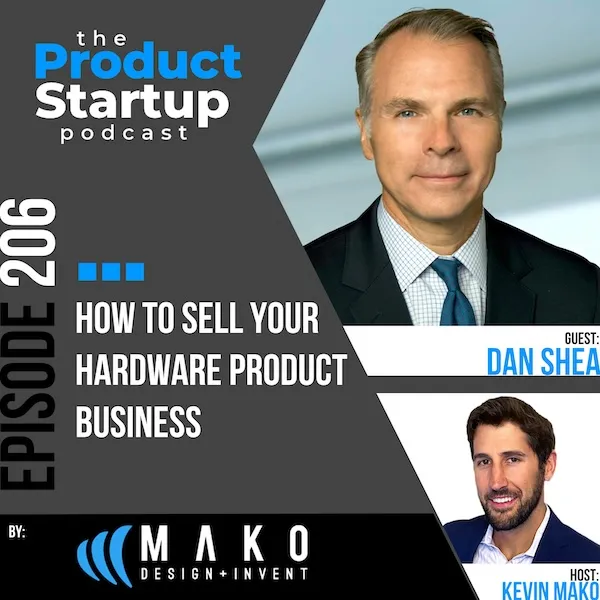
Guest: Dan Shea, Managing Director of Objective, Investment Banking and Valuation, with more than 30 years of manufacturing-sector M&A experience.
Host: Kevin Mako, founder of Product Startup and the leading expert in hardware startup consulting. A hardware entrepreneur since 1999, Kevin has advised more than 1,500 founders and built and scaled MAKO Invent through its acquisition by TriMech in 2024.
Episode Overview
Dan Shea explains why founders should think about business value long before they intend to sell. The conversation connects quality products, customer-driven innovation, strong margins, a growing product family, and a repeatable culture of innovation to the qualities strategic buyers value.
What You’ll Learn in This Episode
- Value to the customer is value for the customer.
- Start with the end in mind.
- Big companies are spending less money on R&D and more money on acquisition.
- There are a lot of advantages to creating a hardware startup, and corporate teams are looking for startups that are finding those opportunities that they missed.
- Most innovation is happening at small companies despite large companies getting most of the press.
- Innovating every year based on changing customer needs is critical!
- Use quality product design and a family of products as a core foundation.
- Businesses typically start with one product.
- Innovation doesn’t stop when your first product is built.
- Create your first product properly, and you create massive institutional value.
- Think about what the company has done throughout its history and what that likely means it can do in the future.
- Build a culture of innovation from the moment you conceive your hardware startup to maximize the valuation of a future sale.
- Charge more for your product as you are innovating, this ensures profitability, and margin is critical to product business buyers.
- Overnight successes are usually backed by 10 years in the making.
- Reflect on what buyers of hardware product businesses get excited about.
- Focus on building great, high-quality products, that is the most important part of a hardware business.
- Find ways to get the word out about your product using modest methods to drive early sales.
- With a global marketplace, there are lots of ways to sell to multiple pools of people, even with a very niche hardware product.
Episode transcript
This transcript is provided for accessibility and reference. Download the SRT transcript.
Read the full episode transcript
Kevin Mako: Hello, product innovators. Today we learn how to prepare to sell your hardware product business
Kevin Mako: from a 30-year investment banker in the manufacturing industry. This is the Product Startup Podcast, a show to learn
Kevin Mako: from top leaders in hardware product development, prototyping, manufacturing, product selling, and everything in
Kevin Mako: between. Hosted by Kevin Mako, the leading expert on product development for hardware startups.
Kevin Mako: Welcome back, everyone. I'm very excited to introduce Dan Shea to the show.
Kevin Mako: Dan is the managing director of Objective, Investment Banking and Valuation.
Kevin Mako: He's been doing mergers and acquisitions deals as an investment banker in the manufacturing sector for over 30 years.
Kevin Mako: Today, Dan will share some valuable knowledge for inventors, startups as well-manufactures on thinking about the value of your product and product business well before a sale,
Kevin Mako: focusing on quality product and customer needs and adding innovation to increase the valuation of your product for an eventual exit sale.
Kevin Mako: Now, on to the episode.
Kevin Mako: This show is produced by Mako Design, the original firm providing end-to-end consumer product development services,
Kevin Mako: tailored specifically to hardware startups, small manufacturers, and inventors.
Kevin Mako: Take your product from idea to store shelves at MakoDesign.com. Now on to the episode.
Kevin Mako: Hey, Dan, welcome to the show.
Dan Shea: Glad to be here.
Kevin Mako: Well, excited today to talk to you about building value for a potential exit for a
Kevin Mako: hardware startup. How does a hardware startup, even in the early days, and as they're developing the product,
Kevin Mako: getting to market, and more importantly, as they're starting to scale the business,
Kevin Mako: what do they start thinking about in terms of the value that they're providing to the world that a
Kevin Mako: potential buyer of their actual product business might be looking for at the end of the tunnel?
Kevin Mako: Before we get into all of that, exciting stuff, just give us a bit of a history of how you got to be
Kevin Mako: the success story that you are today.
Dan Shea: Yeah, thank you so much. So I've been an investment banker for over 30 years, and what that means for me
Dan Shea: is helping entrepreneurs sell their businesses. And these businesses can range in value from 10 million
Dan Shea: into over 300 million is kind of like the two endposts of my experience over 30 some years.
Dan Shea: Primarily work with manufacturers, and oftentimes those manufacturers have a branded product,
Dan Shea: a highly designed engineered product, oftentimes a consumer product, like a lot of the folks
Dan Shea: you work with Kevin. And also I work with engineering services companies that help companies
Dan Shea: design those products, a very valuable piece of the puzzle there.
Dan Shea: And so I'm really excited to talk about with you how those folks can build value for the customer.
Dan Shea: And that translates into value for themselves as they scale their business and ultimately as they think
Dan Shea: to exit. You know, you've heard the saying start with the end in mind.
Dan Shea: Not every entrepreneur starts with the idea that I'm going to build something that I'm going to sell.
Dan Shea: But over time and probably early on, that does enter their thinking.
Dan Shea: And so we like to help people start to really focus on how they're going to.
Dan Shea: they can build value that's conveyable to a buyer at a high valuation.
Kevin Mako: That's great. And this is a really powerful subject because a big trend that I've noticing
Kevin Mako: and talking with a lot of the big corporate folks as well is that big companies are investing
Kevin Mako: less in R&D and more in the acquisition of the next hot thing typically that's coming to market
Kevin Mako: from startups. They're looking to see, okay, what can we grab out there?
Kevin Mako: Somebody who's seeing the innovation that our R&D team didn't see. They've released something
Kevin Mako: quickly, typically because they're nimble, they're fast, or they're just more creative, or a whole number of
Kevin Mako: reasons that hardware entrepreneurs have an advantage over big corporate in many ways,
Kevin Mako: and then leveraging their existing networks to make massive scale. So it's a good deal for both
Kevin Mako: parties. And it's something that we see a lot of, especially like many of the customers at Mako,
Kevin Mako: even as they're starting to get early traction, it's interesting to see those companies start knocking
Kevin Mako: at the door earlier and earlier than ever before historically. So it's at a really good time now,
Kevin Mako: as we're looking forward to say, as a hardware startup, know that.
Kevin Mako: that it's not just about cash flow. As you build cash flow, you're building equity and equity is
Kevin Mako: translatable into value for a probably much larger entity that can really leverage the amazing product
Kevin Mako: innovation group of products or whatever else that you've created, let alone additional value like
Kevin Mako: brand IP, et cetera. So I love the fact that so much of this is happening in the industry, and that's
Kevin Mako: why I really wanted to get you on to talk about this today, just even at a minimum to start planting
Kevin Mako: the seeds into hardware entrepreneurs as to how they can truly build that value and then obviously
Kevin Mako: translate that into a bigger, better sale.
Kevin Mako: down the road. So let's start, you know, early on and big picture here. Let's just look at what do you mean
Dan Shea: by building value in a hardware startup? So large companies, mid-sized companies, any company,
Dan Shea: they don't have a lock on all the insights. They really don't. And oftentimes, it sizes their enemy,
Dan Shea: frankly, because, you know, they have big organizations and it's hard to turn a big
Dan Shea: organization on a dime when a great idea comes up. So oftentimes in the corporate development,
Dan Shea: departments, which are my counterparts in a transaction. They're the finance-oriented people
Dan Shea: that look for opportunities to buy, whether it's a product line or an actual company,
Dan Shea: they're constantly doing this calculation, make versus buy. Can we make it or should we
Dan Shea: buy it? And oftentimes, they can't even make something that looks great in the marketplace because
Dan Shea: smart entrepreneurs have protected their technology. You can't even reverse engineer it because
Dan Shea: you violate patent or a patent pending. It's a little easier if it's a little easier if it's
Dan Shea: just know-how, but proprietary know-how is proprietary. So these large corporations
Dan Shea: got on our door all the time and say, what have you got in this particular area of the economy?
Dan Shea: So I would say to you that in the majority of the businesses in this country are small companies,
Dan Shea: that's where all the innovation happens, despite the fact that large companies get all the press.
Dan Shea: So, you know, I would say to you that keep coming up with those great ideas, but be calculating about
Dan Shea: it. When you have a great idea, make sure as you develop it, make sure you're checking
Dan Shea: yourself and make sure that there's a large addressable market. And make sure it's something
Dan Shea: customers want, need and value. Take a look at the competition, see who the competition is out
Dan Shea: there. And is your product truly an innovation? Kevin, you probably are familiar with the Blue
Dan Shea: Ocean strategy. Have you heard of that? Harvard business would do. I had a client, and this is kind of
Dan Shea: jumping ahead, so forgive me, and we can always go back.
Dan Shea: But I saw this in many of my clients, and one in particular that worked so well.
Dan Shea: They consulted with folks like yourself, but they also had an in-house team, and their whole
Dan Shea: job was to try and come up with innovations in a really mundane industry where the consumer might
Dan Shea: sit back and say, there's no innovation happening in this. It's a building products company, right?
Dan Shea: What else can you do with building products? They innovated every year and came up with these great
Dan Shea: products based on what the installers needed to build houses, build buildings and what
Dan Shea: have you. And they would come up with these great products, test it with the consumer, which was the
Dan Shea: worker at the construction site. And if it was a great idea that saved the worker time or money
Dan Shea: and the install of this particular family of products, they would finalize the product and they would
Dan Shea: put a living fence patent around it. And they built their business on chunks of products.
Dan Shea: And because of that, they had a portfolio of highly engineered, highly designed products for the building products industry that buyers were salivating over.
Dan Shea: Buyers, meaning not the customer, but buyers of the business, were salivating over because this business was rock solid.
Dan Shea: It was built based on product design, protected product design, and it was based on a family of products.
Dan Shea: So the breadth of this company was, and the foundation of this company was rock solid.
Dan Shea: So something that's a product.
Dan Shea: think about, I know a lot of your listeners are earlier stage, you know, but it starts
Dan Shea: with one product. But be mindful of the fact that that product probably can become part of a family
Dan Shea: of products. And you build a family of products and you continue to innovate. Innovation doesn't stop
Dan Shea: once that initial product is built. That's where it starts. And then you build on that. And I can assure
Dan Shea: you that when you do that properly, you're creating institutional value that's conveyable to
Dan Shea: a buyer when your great entrepreneurs decide that they need to take some chips off the table.
Kevin Mako: That's powerful advice. And something that's really special in there that you mentioned is the fact that
Kevin Mako: this company was innovating based on their customer feedback. And that's something that as a hardware
Kevin Mako: startup, if you're looking to build this portfolio of products or evolve your product or have multiple
Kevin Mako: lines of a similar one or accessories or whatever it might be, it's called some related family suite of
Kevin Mako: products. First of all, as an inventor and an innovator, you've already come up with the first idea. So
Kevin Mako: the probability that you're going to continue to come up with ideas only accelerates as you get more
Kevin Mako: customers and more feedback and more stakeholders and engagement, whether it's investors or
Kevin Mako: designers or whatever else, the ideas are going to become more frequent. And the value of those ideas
Kevin Mako: are going to be more and more known to you as you evolve the business. So you can start as a hardware
Kevin Mako: startup. The second thing I find, which is amazing, which ties to the first that you mentioned
Kevin Mako: is you can start with the first product. And then over time, you're going to evolve that into either
Kevin Mako: or a family product or additional markets or whatever else, but you can grow from your customers
Kevin Mako: and from better information as you scale up, as you get more money to scale up, whether it's
Kevin Mako: on revenue and investors or whatever else. And as you're doing that, you're creating a tremendous
Kevin Mako: amount of equity. In fact, you use the word kind of like institutional interest. This is where you've
Kevin Mako: got the bigger, more serious buyers looking at these new hardware innovations to see what makes
Kevin Mako: sense for either their clients or if they're a company themselves for their own portfolio of product
Kevin Mako: to see how they can leverage it.
Dan Shea: Yeah. So fast forward to the time when you're thinking of selling. Buyers will look at the business and
Dan Shea: say, let's take a look at the history and what the company has done. That is some evidence of what
Dan Shea: it's capable of doing. But make no mistake, a buyer doesn't buy a business based on what it's done
Dan Shea: in the past. If they buy it based on what they can do with it post-close. So when you're building
Dan Shea: your organization, think about building a culture of innovation. It's not just one product
Dan Shea: or a family of products like we say. Is there a team of people that are
Dan Shea: thinking about innovating? Are they consulting with firms like yours, Kevin, in such a way that
Dan Shea: they're partnering to constantly think about ways to innovate in ways that the customer will
Dan Shea: appreciate and pay for and pay for at a price that allows you to be profitable. Profitable, and I would
Dan Shea: submit to you if you're constantly thinking about the blue ocean strategy, you're innovating in the blue
Dan Shea: ocean, not the red ocean, where there's a lot of competition. It's the blue ocean that's the head of everybody
Dan Shea: and you can charge more for that product, charge relative your cost. And in those cases,
Dan Shea: you build a business that is not only durable in terms of innovation in products, but margin.
Dan Shea: You know, many industries have typical or average margin. So buyers look at that. They look at the
Dan Shea: margin of your business and compare it to the industry and say, these people are either doing something special
Dan Shea: or they're not doing something special enough based on where you sit within your field of focus. So there's a lot
Dan Shea: to it, but the good news is nothing happens overnight. You know, you've probably heard
Dan Shea: the saying, overnight success, 10 years in the making. So entrepreneurs out there,
Dan Shea: you're going to make a billion decisions between startup to when you exit. Just have these broad
Dan Shea: themes in mind, these themes of innovation, constant innovation, building a culture around
Dan Shea: innovation, looking to what the customer really wants. And as I was preparing to speak with you
Dan Shea: today, Kevin. I was thinking about what buyers get excited about, buyers of businesses,
Dan Shea: and they get excited about the people who work there, they get excited about the customer list.
Dan Shea: That's why some websites, ours does, yours does, have your customers on there.
Dan Shea: Buyers get excited about who you're able to serve. They get excited about your geography,
Dan Shea: your brand, your name, all these things. But I would submit to you that perhaps the most important
Dan Shea: things is your products, because those are really tangible. You can convey those to buyers,
Dan Shea: They now own the products. They own your designs. They own the markets you serve. And what can
Dan Shea: they do with those to go forward? So think about leaving some ups for the buyer by building a foundation
Dan Shea: of growth through product innovation. And as a hardware startup, that's something inevitably you're going
Kevin Mako: to do because you're limited on budget, time, scope, history, etc. There's a lot of things
Kevin Mako: that even if you do a really good job of a product launch, you're only capturing a certain piece of the market.
Kevin Mako: So a company that's been in the space for 2050, 100 years.
Kevin Mako: is going to look at that and say, wow, look at what you've achieved as a startup in a
Kevin Mako: relatively short period of time, even if it's a few years. It's still small in the grand
Kevin Mako: scheme of big corporations especially. So look at what you've done there. Imagine if you had
Kevin Mako: the scale and breadth of a large corporate buyer behind executing on increasing iterations and versions
Kevin Mako: of that, which I guess is why it's so important. You mentioned looking at the company's history
Kevin Mako: and seeing, okay, you went to market, then what did you do? How did you improve your product?
Kevin Mako: How did you listen to your customer? How did you come up with?
Kevin Mako: with an accessory or the next version of the product. They're looking for the way that the company actually
Kevin Mako: operates and, of course, a great product at the end of the day. So if you have an amazing product,
Kevin Mako: but you're also a firm that's continuing to innovate, that gets a buyer really excited. Like,
Kevin Mako: you're adding compounding value on top of the product itself. But of course, the product is the
Dan Shea: foundation of most hardware product businesses. It's interesting. Maybe the term to be used is
Dan Shea: institutionalize innovation. If you can institutionalize that in your organization, and most people
Dan Shea: have more than one employee. And you've got a small team when you're starting out. The other thing
Dan Shea: that I've seen in my client base, when I speak to them, you know, granted, it's at the tail end of it,
Dan Shea: but, you know, I've spoken with my clients and say, how did you start 30 some years ago? And they figured
Dan Shea: out a way to get the word out about their product through very modest means, but effective means. There's
Dan Shea: trade shows out there. There's the old cold calling and just getting in front of decision makers with your
Dan Shea: product innovation. And that's the way you start. But I think that, you know, in this day and age,
Dan Shea: to actually get the reach you want, it costs money. So I think, I remember back to MBA school,
Dan Shea: actually BBA school, when the professor said, you can go broke by growing. I'm like,
Dan Shea: what do you mean? You're growing. Well, you know, it costs money to kind of get the word out there
Dan Shea: through marketing and building proud of prototypes and all of that stuff. So I think that that should be a
Dan Shea: part of the puzzle, too. How do you finance your innovation?
Dan Shea: So that could be a topic for another day, but I really think that that's an important element
Dan Shea: because there are many great ideas out there. You just want to make sure the market knows about.
Kevin Mako: Absolutely. Getting to market is key. And the nice thing about today is that you have a global
Kevin Mako: market. So especially if you have a hyper-specific niche product, it's really never been easier than now
Kevin Mako: to get a very, very specific product out to that market. And if you've done a really good job with
Kevin Mako: product, as you said, build a great product, then word will spread easier. And you look for those.
Kevin Mako: modest methods forward to spread. So how can you stretch the marketing dollar further to allow your
Kevin Mako: customers to start being brand advocates for you and get your product to more eyeballs that is very
Kevin Mako: specific to a certain pain point or opportunity that you've created with product? Most little companies
Dan Shea: are global companies in the hardware products space. Yep, absolutely. The need is not germane
Dan Shea: to just one geography. It's a big world out there. Now, the last company I sold was last month,
Dan Shea: then they had operations in Hong Kong, the Netherlands, in the U.S. And they sold their products
Dan Shea: globally. They're an engineered component company in the flow meter space. And it's a big market out there
Kevin Mako: and you might as well attack it. Well, that's the blue ocean, right? So get out there, go to that blue ocean,
Kevin Mako: which is the relatively untapped market because you're creating an innovation. You're somewhat
Kevin Mako: creating an industry or vertical. Even if it's an existing market, you have a new version or a new
Kevin Mako: solution to that market. And therefore, that is the blue ocean theory, right? And continuing to
Kevin Mako: innovate is a big part of that theory. So don't just plant your stake in the ground. Plant the
Kevin Mako: stake in the ground to grow. Do something great with it. Dan, before I let you go, I just want to talk a bit
Kevin Mako: about what you do for helping these companies as they get to that size. How do you help them actually
Kevin Mako: go through that exit processes? They've made the decision at least to start looking into the potential
Kevin Mako: of selling the equity that they have built over these years. Boy, it's a very involved
Dan Shea: process. And, you know, rare is the case that we're introduced to a company when all the ducks are
Dan Shea: lined up and it's time to just hit go and start a sale process. So we find ourselves investing a lot
Dan Shea: of time, sharing a lot of time, helping businesses think about the things we're talking about today.
Dan Shea: Maybe they're further on, but some of the issues are very evident in diversification of customers.
Dan Shea: The diversification of product. If you have a product that's bound to launch, it doesn't make sense to wait until
Dan Shea: gets traction so you can get paid for that product. There's a lot of stuff that goes on. And then there's
Dan Shea: stuff unrelated to products. It's really more, do you have your corporate books and records in order?
Dan Shea: Do you have your accounting? Do you have your legal structure all sewn up? Do you have your people
Dan Shea: in the right seats on the bus? A lot of that stuff. So that happens before the transaction. And we just
Dan Shea: consult people on that. We don't ask for any money. You just try to help them get ready. When it's time to actually
Dan Shea: sell, we make a market for the business. That's our job. And this is a very specialized
Dan Shea: process because it's done in a confidential and quick manner. It's not like selling your shares in
Dan Shea: Apple or Microsoft. You can't call up your broker and sell them. You have to make a market. So we work
Dan Shea: to prepare offering materials that describe the business and enough specificity that a buyer can
Dan Shea: start to assign a price to it without even visiting the facility.
Dan Shea: or talking to the owners. We spent a lot of time working to identify who we think the likely
Dan Shea: buyers will be on a global basis. Like we talked a few minutes again, most businesses, even little
Dan Shea: businesses have some global element to them. And oftentimes that translates into buyers that might be
Dan Shea: overseas that would be interested in a U.S. business or vice versa. So we spent a lot of time doing
Dan Shea: that. And then once we're ready to go, you've got your offering materials together. You've got your
Dan Shea: buyers list together, we reach out to those buyers in a confidential way, get them to sign
Dan Shea: NDA, share the materials, and then create an auction environment. And that is a really tricky thing.
Dan Shea: As you think about it, all your listeners are thinking, boy, my business is complicated. We might get an
Dan Shea: offer, but they're not going to close until they understand our business in its entirety.
Kevin Mako: Well,
Dan Shea: very true. It's called due diligence. So we facilitate that due diligence, educating a group of buyers to the point
Dan Shea: where they get to the end where they're like, yeah, we know enough that you can rely on our
Dan Shea: purchase price, and here it is. And then we help our buyer, our client pick the buyer that not only
Dan Shea: presents the best economics, but other things that are important to entrepreneurs. Fit, legacy,
Dan Shea: what's going to happen with the people. Do I as the entrepreneur stay on or do I leave? Can I keep
Dan Shea: some money in the business to enjoy the proverbial second bite at the apple when some big private
Dan Shea: equity firm buys it and you know they're going to triple the value of the equity in a short
Dan Shea: period of time. Why wouldn't I want to participate in that? I can help in that as the selling
Dan Shea: entrepreneur. So we create this confidential market and it takes six, seven months to fully execute
Dan Shea: from start to cash in the bank. And we work with, you know, the other advisors to the company,
Dan Shea: the accountants, the lawyers, the insurance providers, and all banner of consultant that may be
Dan Shea: necessary at and around a transaction. And what's the name and the website of that just for the
Dan Shea: listeners? Oh, well, my partners are going to be mad at me. I haven't even mentioned that.
Dan Shea: Our firm is objective capital partners. We're based in California. And our website is objective
Dan Shea: IBV, investment banking and valuation, ibv.com, objective ibv.com. And we've been in business
Dan Shea: for 17 years. And almost all that we do is sell companies for entrepreneurs like you're
Dan Shea: listeners are like they're going to be as they develop their business to the point where it's
Dan Shea: time to think about, if not just a financial exit and an entire exit. Can I say one more thing?
Dan Shea: Yeah, go for it.
Dan Shea: Faster than your entrepreneurs think. The average age of our client is shifting younger and younger.
Dan Shea: It's really surprising to me, but, you know, they can build incredible value early on and then they
Dan Shea: become serial entrepreneurs. They do a deal and then they build another business and then another. And
Dan Shea: And so it's an exciting time to be in the entrepreneurial orbit here in the United States.
Kevin Mako: Yeah, definitely an exciting time. Dan, thanks again for your words of wisdom. And as always,
Kevin Mako: I'll put the links below to anyone else to click through. They can click on the web links there.
Kevin Mako: Dan, appreciate you being on the show. Look forward to talking to you again soon.
Kevin Mako: Thank you, sir. Thanks, Dan. Take care.
Kevin Mako: Thanks for tuning in to this episode of the Product Startup Podcast.
Kevin Mako: If you found some value in the show, please do us a huge favor and hit the like button and subscribe.
Kevin Mako: If you have any questions,
Kevin Mako: guest suggestions or anything else, feel free to reach out to us anytime at our email,
Kevin Mako: podcast at MakoDesign.com. This show is hosted by Kevin Mako, North America's leading expert on product
Kevin Mako: development for hardware startups. And the podcast is produced by Mako Design, the original firm
Kevin Mako: providing end-to-end consumer product development services tailored specifically to hardware startups,
Kevin Mako: small manufacturers, and inventors. Take your product from idea to store shelves at MakoDesign.com. That's
Kevin Mako: m-a-o-design.com.
Kevin Mako: Thanks for joining and see you again soon.
Value-Building Strategy for Hardware Founders
Build a Hardware Business Buyers Will Value
Work directly with Kevin Mako to pressure-test the product, margin, innovation, customer, channel, and operational decisions that shape the long-term value of your hardware business.
Whether an exit is years away or only one possible path, Kevin can help you prioritize the milestones, product roadmap, market evidence, and strategic relationships that make the company stronger today.
Request a Business Value Strategy Call
Tell Kevin what you sell, your current traction, and the value-building decision you need to make next.