
Listen Now
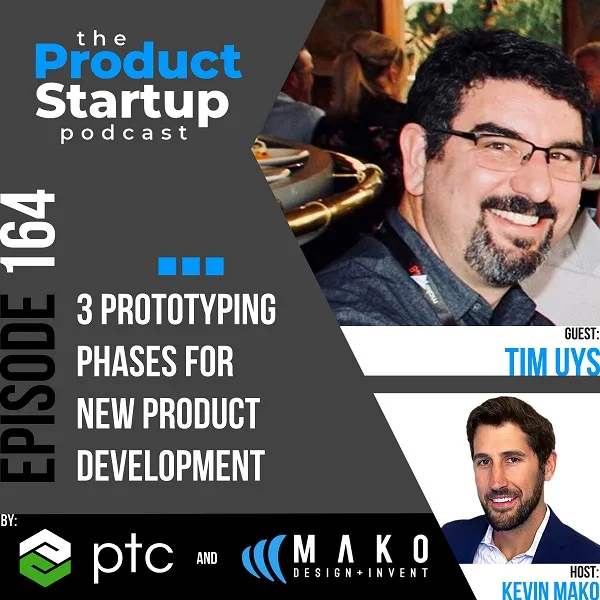
Guest: Tim Uys, Director of Design at TriMech Design Solutions, with 25 years of industrial and mechanical design engineering experience.
Host: Kevin Mako, founder of Product Startup and the leading expert in hardware startup consulting. A hardware entrepreneur since 1999, Kevin has advised more than 1,500 founders and built and scaled MAKO Invent through its acquisition by TriMech in 2024.
Episode Overview
Tim Uys explains a practical progression through rough mockups, mechanical or functional prototypes, and refined pre-production builds. He covers what each phase should test, why early parts should stay simple, how multiple components can advance together, and why problems are cheaper to solve before manufacturing.
What You’ll Learn in This Episode
- Mock Prototype / Rough Prototype
- The cost of parts and iterations is relatively low for mock prototypes.
- Prioritize the major aspects of the product rather than minor details when developing the first prototype.
- Utilize a series of rough prototypes or prototype parts to test multiple elements simultaneously.
- Mechanical / Functional Prototype
- The prototype parts can be developed either in tandem or linearly.
- Advanced parts are used in mechanical test prototypes to closely resemble the final production mechanics.
- It is worth the cost to solve problems during the prototyping stage.
- Proper prototyping is essential before proceeding to production.
- Developing mechanical features that accurately represent the final manufactured product is valuable in perfecting mechanical design elements.
- Refined / Presentation Prototype
- Hardware startups use final prototypes for marketing and manufacturing purposes.
- Manufacturers require a fully vetted product before taking on a project.
- Iteration is a critical aspect of product development.
Episode transcript
This transcript is provided for accessibility and reference. Download the SRT transcript.
Read the full episode transcript
Kevin Mako: Hello, product innovators. Today we learn from a 25-year product design director on the three key phases of prototyping and developing a new hardware product.
Narrator: You're listening to the Product Startup Podcast, a show to learn from top leaders in product development, prototyping, manufacturing, product selling, and everything in between.
Narrator: Hosted by Kevin Mako, the leading expert on product development for physical product startups, sponsored
Narrator: by PTC's two best-in-class, 3D CAD product development software solutions, Onshape
Narrator: , and Creo, and produced by Mako Design + Invent, the original firm providing world-class consumer,
Narrator: product development services tailored specifically to startups, small manufacturers, and inventors.
Kevin Mako: Welcome back, everyone. Today I'm very excited to introduce Tim Uys to the show. Tim has spent 25 years as a senior designer, leader, and lecturer in the industrial design
Kevin Mako: and mechanical design engineering world. He's done projects for Nike, Golf, Dell, Qualcomm,
Kevin Mako: Ironman, and many others while the director designed for ID1, which is one of the top Austin design firms back in the early days before it was acquired.
Kevin Mako: For the past eight years, Tim has been the head of design for our very own macro design and invent out of our Austin, Texas office.
Kevin Mako: Today, Tim is going to share some valuable knowledge in how inventor, startups, and small manufacturers can understand what each of the key three types of prototypes are, the order
Kevin Mako: of those prototypes, and the importance of each of those phases of new product prototyping in order to manufacture a great and successful hardware product. Now, on to the episode.
Kevin Mako: Hey, Tim, welcome back to the show. Thanks, Kiv. It's good to be on again. Been an avid listener, and it's glad to be able to contribute
Kevin Mako: a little bit again.
Kevin Mako: Well, last time we were talking about design for manufacturing, that transition from when you're through all that prototyping and engineering and into production.
Kevin Mako: labor-intensive, a lot of work that goes into those phases, but there's a particular strategy in terms of doing prototyping well to ensure that you've got a great product
Kevin Mako: at the end of the day that's also manufacturable. And a lot of that happens within these prototyping phases.
Kevin Mako: Before we get into the three prototyping phases for a new product development project, just give
Tim Uys: us a bit of a background, Tim, of how you got to where you are today. Okay, thanks, my background started back in South Africa, started studying engineering,
Tim Uys: but then after a couple years transitioned to industrial design as my focus and I completed a degree in industrial design
Tim Uys: there and then went to work for one of the top firms in the country where we designed back then we still had home phones and satellite decoder boxes and
Tim Uys: all kinds of interesting little bits and bobs that worked with the mining industry and so on. I then later moved to the US to
Tim Uys: Austin area where I joined a firm called ID-1 and we did consulting work for individuals and for
Tim Uys: Fortune 50s, worked for companies like Dell on their server designs and laptops and all kinds of other interesting projects.
Tim Uys: And then I climbed the ladder there and slowly moved to the top of that. Finally left there and started my own design consultancy, which
Tim Uys: I ran very successfully for several years and then did work for companies like Nike, Golf and some of the other bigger players
Tim Uys: in the industry, but did a lot of great work with smaller startups and did a lot of trackers and
Tim Uys: electronic devices and so on that needed both function and they had to look good or they had
Tim Uys: to be very small or they had to do something special that was the new thing. From there, I joined macro design and been here now for almost eight
Tim Uys: years. It's been a good run and we've done so many projects we do in the hundreds of projects in the year here at
Tim Uys: Mako and when it comes to figuring out how to most efficiently get a project from the concept
Tim Uys: phase through to production we have learned a lot of good lessons and so I'm
Kevin Mako: hoping I can share some of that with you that's great Tim an amazing history almost 25 years in industrial design and
Kevin Mako: mechanical design for physical mass manufacturer consumer products almost all new ideas or concepts or iterations of new products.
Kevin Mako: And so much of the work that goes into that comes into these phases of engineering and prototyping. We've got our three key types of prototypes,
Kevin Mako: a mock prototype, a mechanical prototype, and then a final prototype. And this is before we actually get into production, into a production sample.
Kevin Mako: So let's look at these three prototypes individually and just talk a bit about the pros and cons and any tips and tricks you have for anybody who's
Kevin Mako: developing their own prototypes or working with a firm to develop their prototypes or thinking about prototyping their invention or their product idea as they try and get through
Kevin Mako: that path to production. So let's go back to the mock prototype otherwise thought of as a rough prototype or a 3D printed prototype.
Kevin Mako: Tim, walk us through that and we'll talk a bit about
Tim Uys: tips and tricks along the way. Yeah, certainly. So when we get to the mock prototype is usually after we have kind of settled all the pretty sketches and the renderings and
Tim Uys: things and we've kind of decided that, yes, this is how we think a product could work, how it could be made, how it functionally could work.
Tim Uys: But then as we get into that world, ergonomics and the reality of the world starts to press in on that design. And that's where we transition to actual
Tim Uys: prototype. So mock prototyping, where we perhaps use something like a 3D printer, very rapid ways
Tim Uys: of iterating prototypes and form, we can go out and make a model of that product.
Tim Uys: Either to evaluate form or to evaluate ergonomics, you know, the height that something sits,
Tim Uys: for instance, maybe it's a push cart or it's a joystick or it's something that human has to interact with.
Tim Uys: Instead of worrying about every little detail, every nut and bolt, at that point we just want to make sure that we have the general dimensions of
Tim Uys: the thing correct and that all the most basic functionality has been met in terms of ergonomics. So for that, the rough prototypes
Tim Uys: and what we'd call a model are very useful. We can even have a series of these with a little change here or a change there.
Tim Uys: And by iterating and changing that rapidly, we can achieve the most appropriate form or the most appropriate dimensions or geometry that we need
Tim Uys: before we get into the weeds of materials and all kinds of mechanics and things that have to make things actuate and all that kind of thing.
Tim Uys: So we kind of flush out the basics with that initial.
Kevin Mako: mock prototype. I love how you mentioned that you're looking at potentially, first of all,
Kevin Mako: iterations of this, because it's really inexpensive to create at least the parts behind a mock prototype. And that's the purpose.
Kevin Mako: You want to flush out some of these big ideas, whether it's form or fit or function or size or even basic mechanics, basic theory around certain things. If you've
Kevin Mako: got electronic products, you may be looking at enclosure sizes or other things that are related to how the electronics fit in.
Kevin Mako: If it's non-electronics, then you're looking at a lot of different elements in a fairly rough and crude manner. And that is a big picture idea and very valuable,
Kevin Mako: especially when you factor in the idea, Tim, of not focusing too much on the details. The trouble is if you go too deep into the weeds on the details, but you're missing some
Kevin Mako: bigger picture functionality or size or ergonomic issue, then you have to redo all of those tiny details over and over again.
Kevin Mako: So it's core to look at the prototyping process is a pyramid, essentially. Your foundational piece is derived from hopefully really good CAD. And I like how you mention that
Kevin Mako: as well, Tim. When you get into mock prototyping, ideally, you've really well designed and engineered,
Kevin Mako: at least your theoretical CAD, but your theoretical CAD, ideally, that should have a lot of concept
Kevin Mako: and engineering and thought behind how you're actually going to not only use the product and the functions of it, but how it'll actually be produced in the end.
Kevin Mako: When you have a really well flushed out CAD design, then you move comfortably into, let's call it this bigger picture thinking on this first mock prototype, potentially,
Kevin Mako: iterative if you want to try a variety of different things, but not focusing too much on the weeds and in the details.
Kevin Mako: And that really has tremendous cost savings if done appropriately and done the right way to especially a hardware startup that may only be able to afford
Kevin Mako: to go through a couple of iterations. You want to be very strategic on starting big picture and working your way up. It's like the foundation of the house.
Kevin Mako: You want to have a really well crafted design, then a really well built foundation and frame of the house before you start figuring out the details of the windows as an example.
Kevin Mako: And that is even more important in hardware when it is a new product. There's new ideas, even if it's just combining existing technology, that's
Kevin Mako: going to create new environments and new forms of physics and engineering that'll have to get
Kevin Mako: sorted out. So unlike a house, which can be built via a textbook, everything in building a house is well engineered into a textbook.
Kevin Mako: When it comes to hardware products, much of it is in the textbook, but also much of it isn't because there's always unique facets to any new and innovative
Tim Uys: of hardware products, especially in mass manufactured consumer products. Right. And so often some of those things get flushed out as we work on those prototypes.
Tim Uys: We learn new things. We see new things. Unfortunately, I think it's kind of in the tech industry, we're not used to seeing that whole prototyping phase.
Tim Uys: A product just kind of appears on the market. And there it is. It's perfectly figured out and everything is great.
Tim Uys: But you don't realize that there's this constant rinse and repeat thing that has been done maybe for years before that product actually arrived on the market.
Tim Uys: market. And this is where it starts is with this initial basic prototyping. Some of the more extreme cases that we've seen just in recent history is SpaceX with their
Tim Uys: starship down in Texas launching repeated rockets and crashing them and exploding them all over the place. And everybody's thinking, are these people crazy?
Tim Uys: They're blowing up millions of dollars. But the rate of learning was so quick by doing and trying and then learning from. And within three or four iterations of
Tim Uys: that flying, they're landing a thing that before that had been considered impossible. So it's
Tim Uys: definitely a case of this rent and repeat thing, but in that repeating, you're learning from
Tim Uys: that previous stage and you're applying it to the product to make it better every time. And so this mock prototype is such a fundamental thing on starting that prototyping
Tim Uys: process to get people into that, to help them to understand what they need to be looking for. There are numerous things
Tim Uys: that can pop up during a stage like this that push you in a whole other direction sometimes
Tim Uys: and maybe tell you that you need to go back to the drawing board and come up with a different solution because the practicality of it isn't there.
Kevin Mako: The beauty here is that the earlier that you can discover these mistakes, the exponentially cheaper it is, even if you have to redo another prototype and it costs money
Kevin Mako: to re-engineer and refix that part, that's going to be exponentially cheaper than as you're much further down,
Kevin Mako: not only just the development path, but even into production and so on into the market. The further you get down into getting that product into users' hands, the exponentially more
Kevin Mako: expensive mistakes become. So it's better to try and do your best to flush out many of these early mistakes early on.
Kevin Mako: Fail fast, fail often, figure out those mistakes, get over those hurdles and create an amazing product. But it's also not just failures. And that's what's really interesting
Kevin Mako: that I've seen hundreds and hundreds and hundreds of mock prototypes in customers' hands. The engineers love looking for failures and breaking them.
Kevin Mako: The designers like Tim and mechanical engineers, electronic engineers, they love getting those first prototypes and breaking them because that's where
Kevin Mako: you're finding your weak points or the things that you don't like or the things that are awkward or whatever the problem is, maybe things that you didn't even see.
Kevin Mako: Now, though, is the other side. When the client gets those or potential users take a look at these things, a lot of the time there's a
Kevin Mako: benefit. The benefit is identifying opportunities that you might not have seen beforehand.
Kevin Mako: So those opportunities when you actually can hold and physically see this thing. Sometimes it comes from an investor.
Kevin Mako: Sometimes it comes from someone that's actually testing the product or looking at it with you. Sometimes it's a potential end customer that might be involved in the process.
Kevin Mako: Most often it's actually the innovator themselves. When they get the real thing, they realize
Kevin Mako: that there's some different things that could happen here, both in preventing problems, but also in addressing opportunities. So that gives you much better information.
Kevin Mako: as you drive into the next step. And that's when you get really serious about detailing in the mechanical engineering phase.
Kevin Mako: So, Tim, talk about that next mechanical or functional prototype and how that applies to
Tim Uys: the next step forward from a mock prototype. Right. This is where we, as I say, the tire starts to meet the road. It's the more functional prototyping that we do.
Tim Uys: And sometimes this may not be the full prototype. So, for instance, there may be an aspect to the product that has.
Tim Uys: a very big mechanical risk. And when I say risk, it just means it's an unknown. It's part of
Tim Uys: the design that we haven't fully flushed out or we aren't 100% sure how exactly the geometry
Tim Uys: would work. We have kind of an idea that it would work, but you need to still figure it out.
Tim Uys: And so instead of necessarily building an entire prototype just so that you can test out whether this slider works or whether this loading mechanism works or whatever it
Tim Uys: is, you only do a little bit of work on that aspect of it, you can break it down into smaller pieces and then
Tim Uys: allow those pieces to be tested and the function to be worked out on them or the geometry to be
Tim Uys: worked out so that they almost can be modularly then brought back into the fold and then repeated or worked it on as a whole.
Tim Uys: That is also a way in which we keep the cost of the prototyping lower by just working smart in that sense and applying prototyping where we need to
Kevin Mako: instead of just broad strokes, just building stuff. Tim, that's a great point that you brought up about the micro prototypes or subpart prototypes
Kevin Mako: because a lot of the time when you're looking at a new product, the difficulties may only be in one piece or two pieces.
Kevin Mako: So if you can be smart and tactical about what you're actually building or what you're testing throughout your prototyping process, you can significantly reduce the overall cost.
Kevin Mako: And this even goes back to the mock prototype. You don't necessarily need to spin up and iterate a number of different mock prototypes. You may just do, for example, the handle.
Kevin Mako: of the product because you're really trying to find the perfect grip that feels just right in
Kevin Mako: your hand for this new racket or whatever you've got that you're making. And that's where if you can break down these pieces and look at sub prototypes, which can sometimes happen
Kevin Mako: in tandem or in linear. So it's maybe the handle is being addressed before we actually start
Kevin Mako: working on the mechanics or can actually be done in tandem, whereas we're working on the mechanics internally.
Kevin Mako: And we're also figuring out five different handles and trying to figure out via rough prototyping, which is the best handle. But in terms of the internal mechanics, we're really
Kevin Mako: doing hardcore, much more detailed mechanical engineering to perfect those internal
Tim Uys: mechanics just to save overall time to market. Right. Sometimes, as you say, there, the one is not necessarily going to affect the other.
Tim Uys: So figuring out the mechanics on this little item over here versus figuring out the ergonomics on something over there, those things can run in parallel. And in the
Tim Uys: end, there's going to be a marriage of the two, which will take a little bit of time. But if you've got this one figured out and this one figured out.
Tim Uys: Putting them together generally is not that much of a big deal.
Kevin Mako: And then you kind of solved those issues individually, but overall you've got a better product. I think it's important, too, to talk about the increased complexity or
Kevin Mako: part difficulty when it comes to mechanical design. Because when you're looking at mock or rough prototypes, you're generally using fairly quick prototype
Kevin Mako: methods. So if it's plastics, you're using additive. If it's metal, you may just be manually having things laser cut out of sheet metal or whatever else.
Kevin Mako: to try and mimic a rough prototype, generally low cost methods of making parts. When you get into mechanical and you're actually trying to make something work, a lot of the time
Kevin Mako: you're going to need certain parts at least that are a bit more advanced so you can truly try and start testing how the mechanical functionality of the actual manufactured
Kevin Mako: product at the end is going to work in manufacturing. So talk a bit about those parts and maybe some of the actual tools and technology around
Kevin Mako: those type of parts that are different maybe than a mock more additive type,
Tim Uys: manufacturing process for those prototypes. Yes. Now, that's a huge one because we typically would select the process according to what we're trying to achieve, right?
Tim Uys: So as you say, you know, when it comes to mock prototypes and all I need is a form and it needs to be pretty accurate,
Tim Uys: but, you know, if it was off by half a millimeter or something, it's not going to be the end of the world in terms of that.
Tim Uys: It's easy to use something like a 3D printer, specifically we're talking about FDM, which is a fused deposition modeling. It looks a little bit like a cake
Tim Uys: extruder, but just extrudes plastic instead of icing. And that just builds up in layers and layers build your product. And here you have a very good representation of the form.
Tim Uys: But when we start talking about mechanical products that in some cases need to have a one-tenth of a millimeter
Tim Uys: accuracy, then we start looking at processes like CNC machining where we're milling or even
Tim Uys: using what they call EDM, which is basically spark eroding the shape out of metal, we can get
Tim Uys: super high definition and super accurate parts that will last better as well. The other problem
Tim Uys: that we have with some of these materials, you could go to better 3D printing solutions such as
Tim Uys: SLA and some of the other solutions that are out there, all additive, all very cost-effective,
Tim Uys: but the plastics and materials they use in some case, especially if you're trying to represent metal part to do a job. They may not live up to the strength. And so you tend to
Tim Uys: to sometimes get into more accurate and more detailed engineering prototypes that actually use
Tim Uys: the real material or they may be made out of aluminum or even steel and actually cut out
Tim Uys: using a CNC mill to be highly accurate and to do the job that you intended them to do very
Tim Uys: accurately. So from that perspective, we have a very large range of different processes that we can
Tim Uys: use, but we generally apply them to achieve the best results because sometimes, as I said,
Tim Uys: something may not be strong enough or it may not be accurate enough done this way or that way to actually prove that an idea works. You made it out of plastic.
Tim Uys: It may work once or twice, literally once or twice, and then it breaks. So you never get the real data of how well does this work? Does this work over time? Do things wear out?
Tim Uys: That kind of thing. When it comes to mechanical prototyping. It can be a very broad range of technologies used and that also translates to a broad range of cost.
Tim Uys: It could be super cheap to do depending on what you're prototyping or the price could get up there. But in the end, you're actually solving the problem. We do get a lot of people
Tim Uys: that after they see the nice drawings and renderings and they've had that first markup prototype,
Tim Uys: they go, okay, well, let's go to production and kind of are going, well, you know, there's still a whole bunch of mystery that we don't really know is going to work.
Tim Uys: Based on our experience, we can say that it'll probably work 90%. We're very sure that it'll work, but until you've actually put all the nuts and bolts together, you don't know.
Tim Uys: And so that's where these mechanical,
Kevin Mako: more detailed prototypes come in to prove that out. Well, that's a really good point you bring up,
Kevin Mako: Tim, about manufacturing, and especially in the mechanical prototype phase, this is extremely valuable to vet out these detailed mechanics because, as we mentioned
Kevin Mako: before, it just gets exponentially more expensive as you get into manufacturing. And not only that, you can't take
Kevin Mako: a design that's not really well vetted out to any reputable manufacturing operation and hope that they're going to solve all these little problems.
Kevin Mako: Their job is to rinse and repeat parts that are as high a quality as possible at as cheap a price of possible. Their job is not to figure
Kevin Mako: out all the details of your design metrics that you are supposed to have done. So that's why this
Kevin Mako: importance of the, especially the mechanical prototyping phase is so key, especially if your product even has a slight bit of unique feature sets to it that are mechanical or
Kevin Mako: electrical in nature that really require testing. That has to happen here. And you want to best mimic the actual performance of a production part.
Kevin Mako: That's how you're obtaining the best value from your prototype. It's figuring out as closely as possible how to build that machine and then test it out. and see what it does.
Kevin Mako: The beauty of today, and really every year, the amount of tools and technology and materials that we're able to use in this mechanical prototyping phase, every
Kevin Mako: year gets substantially better than the year before. We're even looking at how even just additive metals, 3D printing
Kevin Mako: in that cake layering method that tends talking about in metals is becoming more refined,
Kevin Mako: more accurate, less issues with the actual materials, and generally better cost and quicker turnaround. So the amount of tools now that are available, even to five years ago,
Kevin Mako: is tremendous. It gives actually us as design and engineers a lot of materials to be able to make those tests earlier to break things faster and to find solutions for
Kevin Mako: a more cost-effective way by having all these different technologies. The other thing that I find is very valuable with
Kevin Mako: this too, especially when it comes to prototyping is from a design firm's perspective, you've got
Kevin Mako: to have a lot of different vendors with a lot of different capabilities that you've used generally for many years so that you can truly figure out which parts closely
Kevin Mako: mimic the part you're trying to produce. It's quite often that we're going to use five or six different vendors for
Kevin Mako: different types of materials and parts to get the result that we want so that we can best test that prototype or that product.
Kevin Mako: And that's where it really takes some time and generally libraries and experience and working with a number of different materials vendors so you can
Kevin Mako: get the engineers to have the correct materials in their hands to be able to test
Tim Uys: those features to ensure that you're making a great product at the end of the day. That's right. The other thing,
Tim Uys: it's definitely a case of when it comes to that prototyping into that next step of refined prototypes is where you've taken everything you've learned from your previous prototypes,
Tim Uys: you've put it into a relatively well-working product and then put it out there in the world and start seeing how people relate to it.
Tim Uys: And sometimes you get the most surprising feedback at that point, which can confirm for you that you've got it right and people get it. Or minor tweaks will solve the issue.
Tim Uys: So that's a huge value right. there again. There's always these data points.
Kevin Mako: How can we get more and more information? All these kinds of things are very valuable. Well, let's talk about the specifics of jumping into a refined
Kevin Mako: prototype. You finish the mechanical elements and you're happy with that. Now, it might be done
Kevin Mako: in one mechanical prototype and everything's working, but usually there's certain elements of it, either like we talked about before, problems or opportunities.
Kevin Mako: Hopefully at that point, it's really detailed and fine tuning. So at this point, you've got a really well-fleshed out product. You've built the
Kevin Mako: parts to actually test the mechanics. You've got the mock prototype, which gave you the features and aesthetics. Those start to come together in this refined prototype.
Kevin Mako: The refined prototype is generally built from the learnings and the theories from the mechanical prototype, but with some
Kevin Mako: key differences, primarily in aesthetics, but also in that fine detailed tweaking that's required to
Kevin Mako: really perfect the product because that usually is the product that most hardware startups in one way or another are actually going to market with.
Kevin Mako: They're actually going to park it not necessarily with the eventual production units. They're going to market usually as like either pre-sales
Kevin Mako: via crowdfunding or Kickstarter or even pre-interest or letter of intents from retailers or distributors or wholesalers. It might even be investors.
Kevin Mako: So using that as your kind of like final pre-production product to go to investors. So talk about some of those key differences going from
Tim Uys: mechanical and into refined, especially as we're talking about aesthetics and workability. Right.
Tim Uys: Going from mechanical into refined is you get to the point where you take those mechanics that you've now figured out and perhaps some of the ergonomic stuff that you'd figured
Tim Uys: out, you marry those things together into this product that is following the guidelines of the original design document down the
Tim Uys: path of the mock prototypes and the figuring out. And now next you have kind of this complete thing where you're starting to put it
Tim Uys: together, maybe even starting to figure out some assembly procedures and things for the next step, which is production.
Tim Uys: This is where you're actually building a prototype that you can start talking to production companies about and start getting their input on.
Tim Uys: And we do, in some cases, get input earlier on, but every project is so different that
Tim Uys: you have to kind of tailor your approach to that project and decide what the best solution is going to be for that thing.
Tim Uys: Now, in some cases, we'll get early input from. production company. But in many cases, it's a case of designing the product and then getting to
Tim Uys: talk to a production facility and start talking to them about how are we going to make this product.
Tim Uys: Now, if you have things kind of figured out, and I just recently had this experience with a very
Tim Uys: complex prototype where we had to do a lot of mechanical figuring out. We had built two very big prototypes. And we went to a production facility.
Tim Uys: The first time they looked at the renderings and images that I had sent them. They said, really, this is too big for us. We're not really interested in working on this project.
Tim Uys: But we kept the conversation going and they had not understood that we had actually built two prototypes already and we had figured out the mechanics.
Tim Uys: We had actually done the legwork on the actual product to where it literally looked like a production sample standing there.
Tim Uys: And when we showed them the videos that we had of testing the thing. And the photographs and the CAD that we had done, they immediately, they said,
Tim Uys: oh, wow, now this is a whole other ballgame. You've already figured out mechanics that we were going to struggle with or that we thought we would have had to struggle through.
Tim Uys: Now we get it. We can understand what you're presenting to us now instead of, well, here's a big problem and you need to solve it.
Tim Uys: All they need to do now is apply their expertise in manufacturing to that design and to that mechanical development that we've done. And we know that
Tim Uys: the principles that we're presenting or we're suggesting, they all work because they've been proven out in the prototype phases.
Tim Uys: So this made the difference between finding a fantastic production facility or not because we had a client to understand the importance of making a good prototype
Tim Uys: and following through on that process.
Kevin Mako: So it was a huge win and literally made the difference between success and failure. Yeah, that's so powerful. And it's really largely a misconception,
Kevin Mako: especially for first-time product developers, understanding that an idea can't be produced,
Kevin Mako: even further along a design can't be produced, and even further along quasi-working prototype can't be produced.
Kevin Mako: It's only when you have really well-engineered, well-designed products that have been tested, tweaked, refined, tested, tweaked, refined to a point where it's working well,
Kevin Mako: the function is what you want it to be, and it's essentially figured out from an engineering perspective, from end to end. That is when you are ready to produce. not any sooner.
Kevin Mako: That's really something that is, especially for somebody who's done it the first time, is difficult to understand because if you go back to the house example, you can look
Kevin Mako: at a drawing of a house, a 3D CAD drawing of a house. And because everything is specked out in a textbook to the penny, you can actually get a cost of that house because
Kevin Mako: it's all been done before. But when you're talking about a new product and you're going to a manufacturer, even if they're
Kevin Mako: experiencing the type of product that you're doing, your product is innovative. It's new. As a hardware startup, there are pieces of your product that are proprietary.
Kevin Mako: Otherwise, you wouldn't be in space, right? You've come up to some innovation. That innovation and the details in there is where the complexity lies.
Kevin Mako: So if you could figure out that product, you're building a tremendous amount of intellectual property value, but then you're also presenting something that a serious manufacturer
Kevin Mako: who is going to give you good pricing and good product quality at good timelines will take on because it is competitive.
Kevin Mako: And keep in mind from the manufacturing perspective as well, manufacturers, first of all, they're busy. Second of all, they don't make any money off a new product in the beginning.
Kevin Mako: It takes them a lot of time and effort. They have to not only believe in the product, you have to make their job reasonable enough
Kevin Mako: that they're not stretching outside the boundaries of what they do, which is making parts in order to help you out.
Kevin Mako: So if you can bring them that complete package, as Tim was explained in that very complicated
Kevin Mako: product, that is something where if you could describe it all to them and let them focus on what they're good at, then see the vision of the product itself.
Kevin Mako: that's where you can get a really good relationship of a factory that's going to help you get over that
Kevin Mako: first hurdle of getting into your first production run and then scaling it from there. But so much of that comes down to the prototyping.
Kevin Mako: And especially if we look at this final refined prototype, not only are mechanics now well vetted out. They've been tested in the mechanical. They've been tweaked and refined.
Kevin Mako: So now they're into this refined or final presentation prototype, not just on a mechanical side, but also a visual side.
Kevin Mako: Keep in mind, we've got so many technologies now to make things look really sexy. Look like they, are a manufactured part, finishes that are, really it's difficult to tell the
Kevin Mako: difference between external finish of a very advanced prototype today as to a manufactured part. So we're using that
Kevin Mako: to describe all elements of the product now, which is why it's not only valuable from a sales
Kevin Mako: perspective, because it's a brilliant product to be used in marketing and sales and investor
Kevin Mako: raising. But on the backside, we want to use that same prototype with the manufacturers. So the manufacturers are getting the 2D callouts, all of the actual design callouts
Kevin Mako: of functionality so they truly understand the product and how it's used. In addition to, of course, all the proper CAD files
Kevin Mako: in various formats, depending on what they actually use, depending on the type of part that they have, and the actual prototype so they can see it, feel it, touch it, use it.
Kevin Mako: That whole package together allows for a phenomenal relationship going into production. That cuts out so many of the horror stories of the difficulties that go into production.
Tim Uys: If you just design an engineer a product properly, with the intent of having a good production partner at the end of the development cycle.
Tim Uys: Yeah, and you kind of touch on it there, Kiv, one of the things that people don't always get about being innovative,
Tim Uys: there are plenty of companies out there that can make a plastic housing and put an electronic circuit board into it. That's easy.
Tim Uys: But so many of our inventors and innovators and startups come to us with products that are,
Tim Uys: I don't want to do them a disservice by calling them a Frankenstein product, but they are made from
Tim Uys: one thing with something completely different added that gives them the intrinsic value. And because they are that, you struggle to find manufacturing companies who can help you
Tim Uys: because these guys that you're going to are used to making plastic housings with circuit boards in them and now you're asking them to add something completely out of the blue.
Tim Uys: The more information that you have with your prototype, the easier it is for you to convince these different companies that what you're proposing is not that crazy.
Tim Uys: Because the whole point of your innovation is that typically nobody has thought of it or nobody is thought to apply it.
Tim Uys: And so when you come up with the idea or you present the idea, you look like the crazy one. But if you present a great prototype that's working and doing what you say,
Tim Uys: you're almost making your case right there. And there's no argument in it. It's just here it is.
Kevin Mako: And this is what we need to achieve. So it makes it a lot easier later on discussing all those things in production.
Kevin Mako: I think it's worth mentioning too that we've been going even one step further on this and actually bringing in manufacturers earlier in the prototyping process. So at macro design,
Kevin Mako: we've actually got kind of a funneled approach where as we're getting into the mechanical prototype, we're actually starting to weigh in not only our own manufacturing engineering
Kevin Mako: expertise internally, but external manufacturing expertise as well to look at some of the key
Kevin Mako: components or maybe the unique components and try and understand that not only are we designing
Kevin Mako: something to work, but we're designing something to work that can also be produced at the end of the day. There's a lot of restrictions on what you can manufacture.
Kevin Mako: As a normal consumer, if you look around your room, you see lots of things and you assume that, well, any design, any idea can be made. That's actually not true at all.
Kevin Mako: There are a ton of restrictions in the engineering space, particularly around mass manufacturing, when you're trying to make a thousand or more units of
Kevin Mako: something. You've got all kinds of restrictions at play. So if you can actually start identifying some of those
Kevin Mako: restrictions within your design so that you're not only designing a great product to work well,
Kevin Mako: and then you're testing it through that mechanical prototype, but you're weighing in manufacturing intelligence through that process.
Kevin Mako: Now, as we move forward into refined prototyping or pre-production prototyping, we are also bringing in more and more manufacturing expertise, possibly even
Kevin Mako: manufactured parts, possibly even quasi-tooled or mimic-tooled parts, to make sure that that final
Kevin Mako: prototype not only has got all the details sorted out and all the testing done, but that we've also
Kevin Mako: figured out a transition point to how we're going to then carry that through and into actual manufacturing.
Kevin Mako: Now, not to say that there's absolutely no work as you go into manufacturing. Of course, at that point, there's last minute tweaks. And if there's a shortage of one part,
Kevin Mako: we have to look at another. So there can be some speed bumps along the ways you get to production. But what this is doing by having a bit of a pyramid approach about thinking about
Kevin Mako: production more and more as you're getting closer to production in your actual design process,
Tim Uys: it significantly cuts down the amount of extra work or rework that is required to get you into
Tim Uys: production faster, cheaper, and at the end of the day, better quality work. Definitely. I think that's one of the key things when it comes to our manufacturing partners as well
Tim Uys: is being able to communicate very clearly with them. And as I said, I think a prototype is essential to communicating that idea to them.
Tim Uys: When it comes to our manufacturing partners, we have some great partners that are able to help us with that.
Kevin Mako: And also, they like to see prototypes. They like to work with prototyping and iteration in order to get the best product for our clients. I think that's a really important
Kevin Mako: thing that you brought up there, the concept of the manufactured sample. And that's really, let's call it the last prototype before you're actually doing your full production run.
Kevin Mako: This is really key to also review and analyze, because that's kind of like the first unit, either quasi off the line or actually off the production line that they've set up for
Kevin Mako: you. That's the unit they're going to send to you, if you've agreed to this in advance, which we always
Kevin Mako: recommend. We want to get that first unit off the line before they produce the other 500,000, 2,000 units.
Kevin Mako: We want to take that sample and make sure that it closely reprecates all the form and features, the reliability, etc.
Kevin Mako: that we had in our final refined development prototype. We want to make sure that that matches or exceeds potentially. And that's where you generally
Kevin Mako: want to bring your design for them in kind of one last time to make sure that those things are all in
Kevin Mako: order before you're hitting the big green button to say, go ahead with that production run and press out those thousand units.
Kevin Mako: Because those thousand units, once they're done, they're done. And that's what you're shipping to your customer. And it's far too costly to redo them. So you really want to be
Kevin Mako: double checking that sample and all the elements of that sample as it comes out. And arguably,
Kevin Mako: this is where you can even look at that kind of intermediary phase, which we do talk about a bunch,
Kevin Mako: is where you do a short-run production, which is 50 to, say, 250 units, depending on the thing.
Kevin Mako: There's exceptions to that, but look at it as a short-run production where you might not use all of the actual manufactured technologies that you would for large-scale production.
Kevin Mako: So there's a lower upfront cost, but a higher unit cost, but it allows you to get a certain
Kevin Mako: amount of these units out there to the real world, or at least to test groups at a minimum, or at least to test users at a minimum, to really beat the product up, test.
Kevin Mako: the heck out of it and see what really is working or not working before you're paying the big bucks for that steel tooling to then do the thousands of units.
Kevin Mako: So keep in mind that this whole concept of iterative development that we've been talking about today, all the way from the rough
Kevin Mako: prototype, all the way to production, it actually can continue on if you're a really kind of modern progressive hardware design firm or a hardware startup.
Kevin Mako: It can continue as you iterated your product. No longer are companies building products that are intended to have a shelf plan of 10
Kevin Mako: years, meaning you're not going to change the product for the next 10 years. Historically, that's how it was done.
Kevin Mako: You design, engineer, build this thing, and you cut all the tooling, and in 10 years, you'll revisit the design. Right. And obviously, the variance of that, but not anymore.
Tim Uys: Not anymore. It's all about iterative design, and that can really help you improve the product iteratively over the course of the emergence of your hardware scale up.
Tim Uys: Right. Even in that regard, when it comes to production, production is not set as you scale up.
Tim Uys: there'll be more tooling and more things and, you know, in order to drive your costs down, things will change.
Tim Uys: So iteration is just constant in the product development world. There's never a place where you really just say, this is it, unless you literally had a one part
Tim Uys: thing that is the be all and end all of that thing forever. Even then, you're probably going to still be ramping up
Tim Uys: your tooling to more cavities and different processes to make it cheaper so that you can sell it to the entire world.
Kevin Mako: It's very unlikely that you'll ever have a product that is just one and done
Tim Uys: and nothing changes on it. So that's where prototyping and production samples and things come in.
Kevin Mako: Tim, thanks so much for all your words of wisdom today, and we look forward to talking to you again. It's a great pleasure to be here, Kev, and looking forward to that next time.
Kevin Mako: Thanks, Tim. Take care.
Narrator: Thanks for tuning in to this episode of the Product Startup Podcast. If you found some value in the show, please do us a huge favor and leave us a quick five-star review.
Narrator: If you have any questions, guest suggestions, or anything else, feel free to reach out to us anytime at our email, podcast at MakoDesign.com. That's podcast at MakoDesign.com.
Narrator: This show is hosted by Kevin Mako. North America's leading expert on product development for physical product startups. Huge thanks to our sponsors, PTC,
Narrator: and their two best-in-class 3D CAD product development software solutions Onshape and Creo, and Mako Design + Invent.
Narrator: The original firm providing world-class consumer product development services tailored specifically to startups, small manufacturers, and inventors.
Narrator: Thanks for joining and see you next time.
Prototype Planning for Product Founders
Make Every Prototype Answer a Specific Question
Work directly with Kevin Mako to define the purpose, fidelity, sequence, budget, test criteria, and decision gate for each prototype before you commission the next build.
Kevin can help you avoid overbuilding too early, prepare stronger briefs for prototyping partners, and connect what you learn to design, engineering, testing, funding, and manufacturing readiness.
Request a Prototype Planning Call
Tell Kevin what your current prototype proves, what it does not prove, and the next risk you need to retire.