
Listen Now
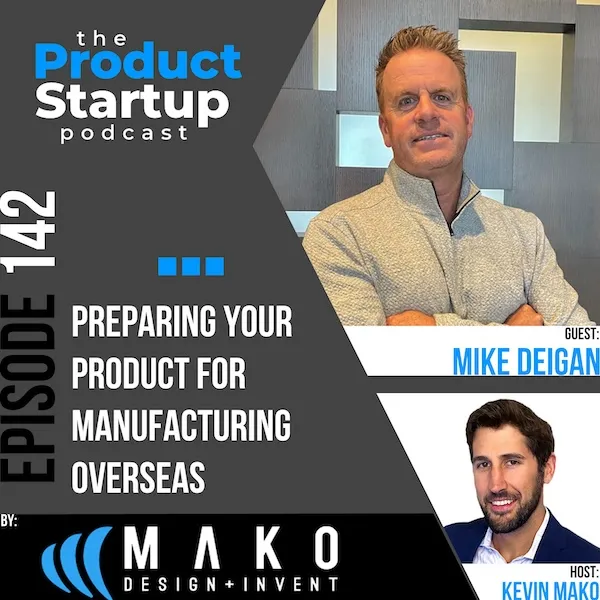
Guest: Mike Deigan, Vice President of Global Link Sourcing, with 25 years of product consulting and overseas manufacturing sourcing experience.
Host: Kevin Mako, founder of Product Startup and the leading expert in hardware startup consulting. A hardware entrepreneur since 1999, Kevin has advised more than 1,500 founders and built and scaled MAKO Invent through its acquisition by TriMech in 2024.
Episode Overview
Mike Deigan explains what must be resolved before an overseas factory can quote and produce a new hardware product reliably. He covers concept design versus design for manufacturing, complete production information, direct sourcing versus agency support, supplier verification, logistics, communication, and responding when problems arise.
What You’ll Learn in This Episode
- How to optimally prepare your product to work with overseas manufacturing rather than a local manufacturer.
- Concept design versus design for manufacturing.
- How to develop a design that you can truly go to production with.
- Going direct versus through a sourcing company when securing an overseas manufacturer.
- Significance of logistics, time, finding a real factory, and the financial benefits.
- The problems with finding a manufacturing partner through Alibaba or similar platforms.
- Strategies for rectifying issues with a manufacturer.
Episode transcript
This transcript is provided for accessibility and reference. Download the SRT transcript.
Read the full episode transcript
Kevin Mako: Hello, product innovators. Today we learn from a big overseas sourcing company on how to prepare your hardware product for manufacturing.
Narrator: You're listening to the Product Startup Podcast, the show that helps bring your product idea to life by chatting with successful inventors,
Narrator: product developers, manufacturers, and hardware industry professionals. Our goal here is to get to the bottom of what makes a product successful, from initial
Narrator: idea to getting your product on store shelves. We're taking you step by step. to build a functional product and scale your product business.
Narrator: Hosted by Kevin Mako, one of North America's leading experts on hardware development for small product businesses.
Narrator: Now, on to the show.
Kevin Mako: Welcome back, everyone. Today I'm very excited to introduce Mike Deigan to the show. Mike is vice president at Global Link Sourcing.
Kevin Mako: He has been working for 10 years on sourcing products overseas and consulting on products for 15 years before that.
Kevin Mako: Global Link has helped with manufacturing well over 100 products for hardware. companies leading to tens of millions of their source products selling around the world.
Kevin Mako: Today, Mike is going to share some valuable knowledge on inventors, startups, and small manufacturers can understand how to prepare your products development to get it ready for
Kevin Mako: presentation to overseas manufacturing partners and the pros and cons between sourcing through an agency and sourcing direct with the manufacturer in China and elsewhere.
Kevin Mako: Now, on to the episode.
Kevin Mako: Hey, Mike, welcome to the show. Thanks for having me. More excited to have you on today. I know you're bouncing around hotels. I guess you're in Utah
Kevin Mako: right now on the road doing manufacturing, sourcing sales, working
Mike Deigan: with various companies to get their products made overseas. Exactly. Yeah, I spend a lot of time on the road. I'm a bit old school like that. I still like the face-to-face meeting.
Mike Deigan: Since the pandemic, I think that's gone away. And I think
Kevin Mako: it's really important still to be out there face-to-face with people. Well, and you've been doing this for over 25 years.
Kevin Mako: Before we jump into it, just give us a history of how you got to sourcing literally well over
Mike Deigan: 100 products in the consumer product space in your career. Globally sourcing, which is who I worked for started nearly 20 years ago by our CEO, Jean Lucané.
Mike Deigan: We really started simple. And it was a very small company. And we really started more in the packaging space than we do in small
Mike Deigan: electronics. And as you know, every small electronic product comes in great packaging. If you're
Mike Deigan: going to spend $40, $50, $100, it better come in a nice looking box, right? So we really focused on that early on. I came on at about 10 years later.
Mike Deigan: And we were at a point where we were really doing a great job for several large companies. I like to tell this story. One of them was
Mike Deigan: SC Johnson, and we were doing some packaging, some other products for them. And they actually were having a problem finding a factory that could handle the volume in China for
Mike Deigan: a small electronic device. And they came to us. It was quite a phone call that we weren't expecting. Let's just put it that way. And they said, hey, can you help out?
Mike Deigan: And by this point, we had a footprint in China. We had people there that worked for us. They helped with sourcing great factories, project management, and quality
Mike Deigan: control. So we had those pieces in place. We went out and identified five factories for them, and they chose one.
Mike Deigan: And we managed that relationship with the manufacturer for several years and produced literally millions and millions of these devices for them. And it made us realize in a hurry
Mike Deigan: that with the right partners, we can look and begin this small device manufacturing for electronics. And that really opened up a new division for us, if you will.
Mike Deigan: So since then, we've grown rapidly,
Kevin Mako: countless numbers of companies here in the U.S. and Canada. That's incredible. It takes a lot of work to get a product into production. And that's what we're
Kevin Mako: going to talk about today. There's a big myth with a lot of really early stage inventors and ideas where they think, okay, I've got this great idea.
Kevin Mako: I'm just going to take it over to a factory and get it manufactured. And of course, you very quickly learn that it doesn't work like that. So then you take the next step.
Kevin Mako: You say, well, I'm going to get it designed. And they start design and then hope to go to production. But the reality is it doesn't even nearly start there.
Kevin Mako: To produce, you need a great, well thought out, try tested true product that's been prototyped and beat up and ready to go in every different way for the producer to make a
Kevin Mako: great product. So from your perspective, I want to understand from you what it takes to bring a great product, a new product to you so that you can do your best
Mike Deigan: work and sourcing a great factory to actually produce this. It's a topic I love to talk about. So this is great. The number one thing that we deal with
Mike Deigan: when people come to us and say, hey, can you help us make X, whatever that is, is having a design that we can truly use to go manufacture with.
Mike Deigan: I can't tell you how many people have done the work. They've taken it from the napkin and they've hired a designer and their product looks great,
Mike Deigan: but that designer really didn't know anything about the tooling involved in order to make it work
Mike Deigan: or the electronics inside and the footprint related to the electronics that have to go inside that device. And so now we're designing around the outside and the inside at
Mike Deigan: the same time and it's clunky and it just never works well. So then we have to bring in another design firm that designs for manufacturing.
Mike Deigan: to help that out because the last thing you want to do is go to a factory in China or whatever, wherever you're offshoring it too and have them do that work for you.
Mike Deigan: They're great at being told what to do. They'll do a great job with it. They're not great at the creative side of things.
Mike Deigan: So whatever you want to create and whatever you want to have your product do, all of that needs to be
Kevin Mako: mapped out and ready for manufacturing before you take it to the factory. That's a really interesting point too, because I find a lot of folks have a bit of a misunderstanding of
Kevin Mako: what the differences between engineering and creativity are and assume that, okay, well, I've got a pretty good, let's say visual or industrial design flushed out.
Kevin Mako: It's just the look and feel of the product. No, it's exactly what I want. Just manufacture it. But there's a lot of creativity that actually
Kevin Mako: goes into how you manufacture it and how it's engineered. That is probably the bulk of the work. All we do at macro design is generally designed for manufacturing.
Kevin Mako: That's it. And one, of the big fallacies there is that you could just design something that looks pretty and all of a sudden run it to a manufacturer.
Kevin Mako: Well, it doesn't work if you're actually intending to produce in the long run. So on the flip side, what you have to do is look at everything from an engineering standpoint.
Kevin Mako: In addition to a functionality standpoint, you find that perfect intersection right in the middle where
Kevin Mako: you've got the function you want, but also the underlying engineering for how it's going to work. And in addition, how it's actually going to be manufactured.
Kevin Mako: That's a big piece of the puzzle. And that's where arguably, I would say, 80% of the
Kevin Mako: the actual design and engineering hours go into, 20% goes into the conceptualization and the feature sets and the visualization.
Kevin Mako: 80% goes into that prototyping, engineering, breaking it, repeat, rinse that process until you've ironed through all of, like you say, the creative elements
Kevin Mako: and, of course,
Mike Deigan: the engineering elements to make a manufacturable product. Yeah. Actually, I was on a call today with the client. They decided to move forward on a new product.
Mike Deigan: And they said, you know, we'll have some conceptual designs ready to go for you in the next few weeks. And I said, well, time out here. You don't
Mike Deigan: even know what the engine inside this unit looks like in order to make it do what you want it to do. You know, what is that circuit board footprint?
Mike Deigan: What is the, all of the electrical components footprint that needs to go inside, the rechargeable battery, all those things have to be figured out and at least
Mike Deigan: mapped out to some extent to where we at least have it somewhat of a size to begin with before
Kevin Mako: you can come to me with a design cart before the horse, right? You were mentioning something too before the call, I thought it was very interesting.
Kevin Mako: You get a lot of folks that are in a rush and they say, look, I've got this, you know, half cobbled together thing.
Kevin Mako: I can't finish prototyping and engineering it and doing all the proper things because I'm in a Russian and you just get to market.
Kevin Mako: And you were talking to somebody that knows a game, has been in it for a while, has tried that a number of times. But this time finally said, okay, I've got the concept.
Kevin Mako: I'm going to give myself until 2024, which from today's date is well over a year and change just to get to that start of the manufacturing point.
Kevin Mako: So finally, after trying and succeeding over time, time, but through a lot of failure, they figured out that it does take time to properly design
Mike Deigan: engineer prototype and prepare a product for the production standpoint. If I told you how much this client has spent on air freight to get their product here fast because
Mike Deigan: they don't plan ahead and they wind up doing everything in a hurry, you'd probably fall out of your chair. When I came on board, they were already doing some manufacturing.
Mike Deigan: We came in and really helped educate them on the process and realistic time tables. And it's taken years literally to get the people inside
Mike Deigan: that company to realize that you can't bring a product to market in nine months and expect it to do well. It's a year minimum, usually year and a half, sometimes two years.
Mike Deigan: You hit on a point I want to hit on is that testing is something that everybody wants to blow by and just get it to market.
Mike Deigan: There's so many things, but all of that can be ironed out if you give yourself enough time
Kevin Mako: to do the product the right way. It's something especially in hardware, you can't bug fix it after. There's no patch fix to update your software.
Kevin Mako: So people get caught up with this whole concept of MVP, which is minimum viable product. I believe it's a great concept for hardware, just spun in a slightly different light.
Kevin Mako: In the software world, the reason MVP kind of got a bad name to it is because it meant get whatever basic and poorly done thing you can out to market and then
Kevin Mako: tweak and fix and refine over time. It's a place to basically race to the end. Again, well, you can do that in software because you can patch things and fix things in real-time
Kevin Mako: life as opposed to hardware, which is when you sell that thing, you tool up and you sell that thing, you cannot fix it. It's in the client's hands. They've paid for it.
Kevin Mako: And that is the final object. So what we always try and focus on, especially for a new product, is keeping the first design
Kevin Mako: of the original product that's going to go to market relatively simple so that you can put a lot
Kevin Mako: of time on design, engineering, and prototyping, rinse and repeat of a. simpler products so that when you go to tool, when you're working with bike care and they're trying
Kevin Mako: to find the best factories, they're going to be able to build a great product at a reasonable price
Kevin Mako: with a smaller number of parts leading to less defects, less warranty issues and are going to be a product that's easier to sell because it's more specific.
Kevin Mako: From there, you can think about all these extra features and benefits. But quality and hardware is tough to achieve as it is.
Mike Deigan: If you add more features, you exponentially increase the complexity of that. 100% and you lengthen out so many factors to it. Most people get into manufacturing and they think
Mike Deigan: they know what they want and maybe they've designed it to a certain extent. You use the term feature creep a lot, which I think is a fantastic term.
Mike Deigan: But the engineering involved, especially if they haven't done it on the front end, the engineering for five features versus one or two could take six
Mike Deigan: months to figure out and time is money and people want to get their product out. So now not only
Mike Deigan: do you have the issue of this process being drawn out, but people saying, hey, I need to get
Mike Deigan: it to market. So then what do they do from the prototyping and testing phase? You know, they skip through
Kevin Mako: it. It's a recipe for a disaster. You know, the beauty about hardware, too, is so much of the value of this time that you're putting into
Kevin Mako: is creating a tremendous amount of equity in your product business. Time in product development is there for a reason.
Kevin Mako: If people are working on the product, discovering problems, finding opportunities, ironing out the kinks, creating something that is truly great, not just mediocre.
Kevin Mako: That greatness is, arguably worth 10 or 100 times more than what mediocre is, especially in Harper for the things
Kevin Mako: we talked about, because a poor quality product simply will not succeed in this day and age.
Kevin Mako: So if you do spend the time and the effort and of course the money, and it's tough, it is a bit of a grind. It's more of a marathon than a sprint.
Kevin Mako: But if you spend the time to do it right from the onset and follow the correct set of processes, not only does it make it easier to go to
Kevin Mako: production, but you're going to have a far better product at the end. And it's much easier to raise funding. Let's say money is a difficulty.
Kevin Mako: It's much easier to raise funding. It's much with a high quality simple product that's in market than a very feature rich product that's still
Mike Deigan: halfway through prototyping because you can't afford to get something so complicated to a production state. Yeah, two points on that.
Mike Deigan: One, back to the features and those things. I don't know if you see this. I certainly see this where people think they have a great idea and they've thought about
Mike Deigan: this so much and they've added these features to their product. But it's a great idea to them and they're very close to it, and they can't see the pitfalls that may be there from
Mike Deigan: the consumer standpoint. And so when you utilize a design team that gets it right and understands the consumer and how the consumer is going to react with this device,
Mike Deigan: you really get that feedback early on. When I see people that have these great ideas and they go direct to manufacturing themselves,
Mike Deigan: how many of those do you see fail, unfortunately? Because it's just their idea they didn't really want any other input or ask for any other input.
Mike Deigan: And we give input if asked from a manufacturing side.
Kevin Mako: I think they can bring so much to the table to avoid those issues. Yeah. And I want to talk tactically about the actual process as well because it's critical
Kevin Mako: that you have the right people doing the right thing along a design process. For your typical mass manufactured physical consumer electronic product, it takes anywhere
Kevin Mako: between six people if it does not have electronics to up to 10 people if it has electronics with unique specific skill sets, at least here at macro design, to get.
Kevin Mako: a product from that initial sketch on a napkin through all the steps of design, engineering,
Kevin Mako: breadboarding the electronics, the circuit design, the firmware programming, the materials engineering,
Kevin Mako: the prototype engineering, the manufacturing engineering, and then the final specification documents.
Kevin Mako: If it's got electronics, like I say, about 10 people without it, you're probably around 5 or 6 people.
Kevin Mako: Now, that's just in the design and development portion getting you to that pre-production state. You don't want to be wasting a manufacturer's time with skill sets
Kevin Mako: that are not related specifically to the production of parts at the best quality and at the lowest price possible.
Kevin Mako: What we want to do at the end of doing all the design for manufacturing functionality is have a very clearly defined set of processes.
Kevin Mako: We want to have, of course, 3D CAD file, not just in raw format, but also in any format that they might have within their possible production facility.
Kevin Mako: We want to have the 2D line drawings called out for the certain facilities that still only work on 2D drawings or certain parts that it's easier to do in that format.
Kevin Mako: We want to have functionality callouts through design rendering. So they understand very clearly how the product actually works and why the parts go together the way they do.
Kevin Mako: We want our materials specifications, our bill of materials with each individual unique part, how that actually goes in and what projected material. Because when we have
Kevin Mako: these five pieces of documentation ready for the factory, what we want to do when talking to a team like
Kevin Mako: yours, Mike, or the engineers that are on your squad or the engineers from the manufacturers themselves,
Kevin Mako: we want to be spending time figuring out the best way to manufacture each one of those parts. Because if we are wasting most of our conversations and our efforts on design ideas
Kevin Mako: and tweakings and bug fixes. We're not going to spend any time on the incredible value that you and the engineering team can provide
Mike Deigan: on costing down those parts and ensuring they're the best quality possible. You mentioned exactly the point that popped in my head while you're saying all that is the cost.
Mike Deigan: There's no way a factory is going to be able to give you a hard cost on anything without great engineer drawings with all of the callouts that you mentioned. It's just impossible.
Mike Deigan: They're going to guess. they're going to have the heck out of that price to make sure they cover themselves.
Mike Deigan: And then still on top of that, they're probably going to come back and say, hey, by the way, this is more expensive than we thought it was going to be.
Mike Deigan: Or this tooling is going to be more complicated than we thought it was going to be because they didn't know coming into it because it was poorly designed to begin with.
Mike Deigan: So everybody wants to find out what my cost is going to be.
Kevin Mako: But without a great starting point from the design, you're not going to find out what that is. You're not going to get an accurate price anyway. That's a really good point, Mike.
Kevin Mako: And I want to talk about one thing before we. let you go here in terms of sourcing direct from China versus using sourcing agencies and
Kevin Mako: the pros and cons to each of those because that's also one of the things that I see quite often is
Kevin Mako: even if somebody does all the work to get the proper designs done, goes through all the engineering
Kevin Mako: and prototyping, has their final spec documentation, get this connotation that, oh, you know what,
Kevin Mako: I'm just going to pop on to Ali Bub, I saw somebody that does something similar and get this done
Kevin Mako: or I'm just going to fly over to China to a trade show and hope that I nail it. Obviously, from your perspective, and of course, Mars, it doesn't work like that.
Kevin Mako: It's extremely difficult to roll the dice like that. But I want to hear from your perspective, being in the sourcing world
Mike Deigan: for quite a few years, what are the pros and cons that you see from your end? I never am surprised when
Mike Deigan: someone says to me, oh, I went on Alibaba and it looks like I can have my product made for X because there's 15 manufacturers on there that do something similar.
Mike Deigan: And they even emailed me right away and on and on. And the first thing I always say is, are you dealing with a trade? company, or are you dealing with an actual manufacturer?
Mike Deigan: And how do you know? And I can tell you countless stories about trading companies and all the disasters there. But that's the first place
Mike Deigan: that you have to start is identifying a true manufacturer. Once you do that, all of the things that
Mike Deigan: go into qualifying a factory, we look at China and we grade factories on an A to a D scale. And we
Mike Deigan: only work with A and maybe a few B plus if we have to, factories, because if this is a product that
Mike Deigan: needs to go into a target or it's going to have a Disney character on it or whatever it is,
Mike Deigan: all of the certifications and inspections that have to happen for those companies, you have to be able pass that. So that's going to happen in an A and a B factory.
Mike Deigan: You don't know what you're getting on on Alibaba. It could be a C and a D factory. And most of them are, unfortunately. You get into the quality control piece of it.
Mike Deigan: Once you get into manufacturing, most people have no idea the quality control of a manufacturer, and especially if it's your first product, and what things to look for.
Mike Deigan: And if you're not a part of that, helping create that quality control process, you're missing out. And they're going to send you a QC report
Mike Deigan: that has all A's on it and everything's going to be fantastic. One of the things that I say this a lot to people that want to source themselves. And of course, it's what we do.
Mike Deigan: And it's easy for me to talk against sourcing yourself. But at the end of the day, you're going to spend so much time.
Mike Deigan: You're going to be on calls at 9, 10, 11 o'clock at night because of the time zone.
Mike Deigan: You're going to have the language barriers and you're going to have all of the things that you spend time on. And let's say that you do get a great product delivered.
Mike Deigan: And if you've done your homework, you absolutely can. But let's say you do.
Mike Deigan: How much time have you spent on that that you could have spent on your business? You're working in your business instead of on your business.
Mike Deigan: You could have been selling or marketing or hiring more staff to do the right things. Because at the end of the day, it's going to take you hundreds of hours.
Mike Deigan: in order to get a product made. And that's where our team kind of comes in. A, we've know what factories to go to with certain products.
Kevin Mako: B, we won't work with a factory unless they allow RQC people in
Mike Deigan: to make sure it's done right from the beginning. Yeah, that's physically in the factory itself, boots on the ground there too, which is a big difference. Absolutely. Absolutely.
Mike Deigan: And we project and handhold these projects with our project managers from beginning to end. And whether it's nightly or weekly phone calls to make sure things. are on track.
Mike Deigan: On top of that, if you're going to source it yourself, then there's two more points I want to dig in on is the logistics of it. Now you get to work on either hiring someone
Mike Deigan: to get it here for you or dealing with all that yourself. And the last thing that most people don't realize is the financial side of it.
Mike Deigan: So if you're going to go source something yourself, typically it's going to be 30% down to start the project. And then when that project is ready
Mike Deigan: to ship, you're going to pay in full before it leaves port in China or Vietnam or wherever it's coming from. And now with the shipping climate that we all get to live in now,
Mike Deigan: eight weeks to get it unloaded at the dock, and then however long it takes to get it to you or your warehouse, and then it has to get out to market.
Mike Deigan: So think about that. Eight weeks from when you paid the bill, let's give it another three weeks to get it to you. If you're selling
Mike Deigan: it to Target, they're going to want to pay you on 90-day terms. So you may not see your dollars back for six months.
Mike Deigan: And that's something that sourcing company like ourselves really help our clients
Kevin Mako: out on. And that's sometimes that's the biggest reason they choose us. At least they say so because we can help stretch their dollars out a little bit.
Kevin Mako: You guys are also one of the bigger sourcing companies. So you have that financial ability to kind of float those differences as well. Not all
Kevin Mako: sourcing companies do do that as a value on. So I appreciate that highlight. I think one of the big
Kevin Mako: things too that you mentioned, but you glazed over it pretty quickly, is being able to simply discover what is truly a factory versus a
Kevin Mako: whole layered effect of traders and whole. wholesalers and distributors and sub-traders. The stuff that you see on Alibaba primarily is multiple
Kevin Mako: layers, six, seven, eight layers deep from actual factory themselves. These are also people who basically are just resellers of products.
Kevin Mako: So what happens is when you reach out to these folks, in general, of course, there's obsessions to the rule. But when you reach out to them, you're talking
Kevin Mako: to somebody who sells, and probably at a very low level, somebody very low level at an organization that is multiple layers back from the actual factory.
Kevin Mako: That organization is buying from some wholesale or that's buying from a factory distributor that's buying from like a factory conglomerate,
Kevin Mako: that's buying from the factory themselves. So what happens when you call them is they get excited and
Kevin Mako: they say, well, I might be able to get a nice commission here, a payout. Of course, they call their boss who calls their boss's boss and so on.
Kevin Mako: Everybody's trying to get a 10 or 15% cut along the way. Not only is it a financial issue, because now you've got five or six layers of people,
Kevin Mako: each taking a percentage cut on top of each other. On top of that, you've got this crazy communication
Kevin Mako: barrier because you've got to have this communication chain going back and forth up and down every time you are sending something back and forth.
Kevin Mako: So obviously as you get more advanced in sourcing, you can find your way. But it takes a long time to go from just a first time sourcing person trying to find a new factory.
Kevin Mako: In addition, you've got generally for any kind of mass manufactured consumer part, especially if it's got electronics in it, you've got multiple different factories
Kevin Mako: that you're going to need to collaborate with a lot of the time. So it further complicates this massive
Kevin Mako: interactive web, much easier just to send it to the experts who know who the folks are, who have pre-vetted these facilities, who know how to talk directly to the general manager
Kevin Mako: or even the executive or even sometimes ownership level of these factories, let those past
Mike Deigan: relationships of these people work in your favor as an inventor getting your first product off the line because it's their hundredth time doing it on the sourcing side.
Mike Deigan: Absolutely. And digging in on that a little bit more. I'll tell a quick little funny story. So our CEO was in China and back
Mike Deigan: when we could go, we were there five, six, seven times a year. And he was there. And there was a project
Mike Deigan: that we're working on that we couldn't find within our normal factory realm. We couldn't find someone for us. So we reached out to a new factory.
Mike Deigan: And we had a little inkling that that was a training company, tried to do as much background on it. And we wound up saying, hey, we're going to come over.
Mike Deigan: Can you just take us to your factory? And we'd like to inspect it. So they're driving down the road. And we've got the quote unquote factory rep in the front seat with our
Mike Deigan: Chinese driver driving. And And he doesn't know how to get to the factory because he doesn't work at the factory. He doesn't work for the factory.
Mike Deigan: He's never been to the factory before. And he's calling someone asking for directions and hoping that us guys in the back who don't speak the language don't know what's going on.
Mike Deigan: Of course, our driver told us exactly what's going on. But you mentioned those layers. There's so many layers from a trading company standpoint.
Mike Deigan: And the other thing to that is that if you do have success getting your product domain, it happens to be through a trading company.
Mike Deigan: And I've had conversation with people multiple times where they've had success for container number one and container number two. And then container number three comes and they
Mike Deigan: open it up and there's an issue with the product. And it's because what that trading company does is
Mike Deigan: every time you reorder, they put every part out for bid that they possibly can. And they're going to
Mike Deigan: choose the cheapest factory to work with for components, for packaging, whatever it may be.
Mike Deigan: And people don't understand why that third order or that fourth order comes in completely different than what it did before. Which brings me to my last little point.
Mike Deigan: And when you do have an issue, there's not a lot that you can do. If you open up a container that you've already paid for four months previous and there's
Mike Deigan: an issue, there's not a lot of recourse. They're going to say, hey, we'll make it up on your next order. For small startups and small companies, there may not be a next order.
Mike Deigan: This may be something that ruins you. So using sourcing companies that are based in the United States or Canada, the onus is on them to deliver a good product.
Kevin Mako: And when you pay your bill to the sourcing company, if it's not right, it's on the sourcing company to go make that right. So it creates some safety there in that relationship.
Kevin Mako: Yeah, very powerful. I think for almost all startups or even scale-ups in the hardware space, this really isn't something that you should be tackling yourself.
Kevin Mako: As we heard Mike say, one of their big clients is S.C. Johnson. They have dozens or even hundreds, potentially, a bunch on the ground themselves in China.
Kevin Mako: And they are still utilizing subject matter experts within specific manufacturing sectors to do this work for them.
Kevin Mako: So as a startup, I can assure you that this point in the game, even nearly to the number of resources and experience required to generally self-produce.
Kevin Mako: So it's a heck of a lot easier. And hopefully if you're working with a company on the design side like macro design or some other
Kevin Mako: reputable organization, they can help you with connecting with these sorts of folks that know the subject matter expertise within the product they're designing for production.
Kevin Mako: And that's a big difference in the design world too. Traditionally, industrial design primarily is visual ideation design.
Kevin Mako: very rarely is it design for manufacturing. That generally happens later or with the company's internal division or whatever else.
Kevin Mako: So that's why you've got to be very careful as well. When you're working with your design and engineering partner, make sure you have those six to
Kevin Mako: 10 people on the team that you're working with. Obviously, it's not six to 10 people working full
Kevin Mako: time, but you need all of that expertise weighed in at some point or another throughout the project
Kevin Mako: between design, engineering, multiple rounds of prototyping, pre-production, specking, and then managing the production engineering process in the end.
Kevin Mako: If you're producing a product, for the first time. It's important that you have all these things and then make sure that you
Kevin Mako: are working with somebody like Mike's firm so that you can smooth out that manufacturing process in the end because that's where you start to make money.
Kevin Mako: In that regards, Mike, just before I let you
Mike Deigan: go, for folks that are interesting in doing their production sourcing with you, where can they go to learn more and how can they get in touch with you on LinkedIn or whatnot?
Mike Deigan: Mike D-E-I-G-A-N and on LinkedIn, Mike at globallinksourcing.com. GlobalLink is our company. You can find a lot of information, of course, on our website.
Mike Deigan: Reach out. I'd love to chat. And here's the thing. I know you guys are very collaborative in this way. We're always happy to help when it comes to, if it's
Mike Deigan: something that we don't manufacture, that we're not good at manufacturing. But we've been doing this
Kevin Mako: long enough to where we probably know somebody that does or we know a factory that does. So we're
Mike Deigan: happy to help out because all that goodness comes back around usually. Mike, much appreciated for your words of wisdom today. Thanks for being on the show.
Mike Deigan: We'll talk again soon. So much fun. Thanks for chatting with me. Thanks, thanks, Mike. Take care.
Narrator: Thanks for tuning in to this episode of the Product Startup Podcast, the show that teaches you what it really takes to bring your product to market and
Narrator: turn it into a big success. This podcast series is brought to you by Mako Design + Invent,
Narrator: the original and leading firm in North America to provide global caliber in -to-end physical consumer product development to startups, inventors,
Narrator: and small product business clients. If you're looking for product development help on your invention, over to MakoDesign.com.
Narrator: That's ma-k-o-design.com for a free consultation from one of Mako Design's four design studios from coast to coast.
Narrator: Thanks for listening and see you next time.
Overseas Manufacturing Readiness Strategy
Prepare the Product Before You Ask the Factory to Produce It
Work directly with Kevin Mako to review your design for manufacturing status, documentation, quality expectations, target costs, volumes, logistics, supplier criteria, communication plan, and readiness for overseas quotes.
Kevin can help you compare direct and agency-led sourcing, identify unresolved risks, prepare better supplier questions, and keep manufacturing decisions connected to cash flow, timing, and market demand.
Request an Overseas Manufacturing Call
Tell Kevin what is ready for production, what is still changing, and the sourcing or supplier decision you need to make.