
Listen Now
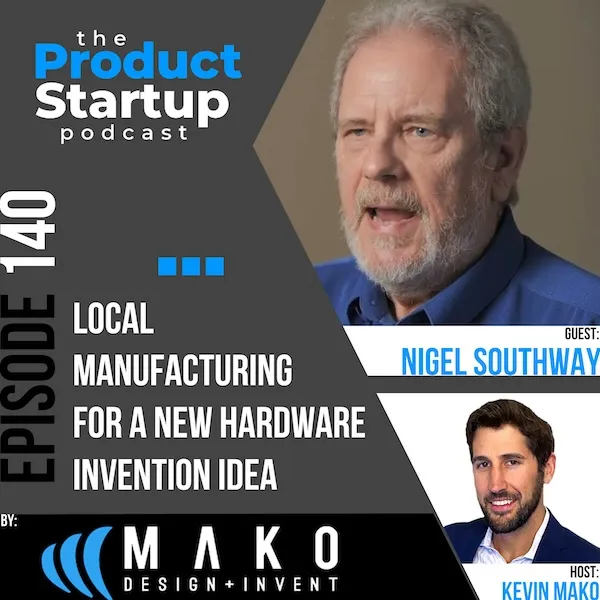
Guest: Nigel Southway, author of Take Back Manufacturing and Lean Manufacturing, with 55 years of experience in the manufacturing sector.
Host: Kevin Mako, founder of Product Startup and the leading expert in hardware startup consulting. A hardware entrepreneur since 1999, Kevin has advised more than 1,500 founders and built and scaled MAKO Invent through its acquisition by TriMech in 2024.
Episode Overview
Nigel Southway explains why founders should compare local and overseas manufacturing with a full cost and risk model rather than assumptions. He covers short-run production, enabling technology, control, communication, community impact, reshoring, and the circumstances where a modest unit-cost premium may create broader business value.
What You’ll Learn in This Episode
- Look at local vs offshore carefully
- Run the numbers of manufacturing
- Benefits of on-shore manufacturing
- Technology that is enabling local manufacturing for new physical products
- Short run manufacturing
- Take back manufacturing: Political, Educational, and Technology
- The difference, on average, is only about 10%
Episode transcript
This transcript is provided for accessibility and reference. Download the SRT transcript.
Read the full episode transcript
Kevin Mako: Hello, product innovators. Today we learn from a two-time manufacturing author on bringing back manufacturing for hardware startups.
Narrator: You're listening to the Product Startup Podcast, the show that helps bring your product idea to life by chatting with successful inventors,
Narrator: product developers, and hardware industry professionals. Our goal here is to get to the bottom of what makes a product successful, from initial
Narrator: idea to getting your product on store shelves. We're taking you step by step to build. a functional product and scale your product business hosted
Narrator: by Kevin Mako, one of North America's leading experts on hardware development for small product businesses. Now, on to the show.
Kevin Mako: Welcome back, everyone. Today, I'm very excited to introduce Nigel Southway to the show. Nigel is the author of two books.
Kevin Mako: The most recent is called Take Back Manufacturing, and his original was called Lean Manufacturing back in 1992.
Kevin Mako: He has spent 55 years in the manufacturing space. also the chair of the chapter of Society of Manufacturing Engineers, which I was also part of, starting over 10 years ago.
Kevin Mako: Today, Nigel is going to share some valuable knowledge in how inventors, startups, and small manufacturers can decide between offshore and onshore manufacturing, what the
Kevin Mako: pros and cons are for each choice, explain short-run manufacturing for new products, and how we can bring back manufacturing to local communities. Now, on to the episode.
Kevin Mako: Hey, Nigel, welcome to the show. Great. Thanks for having me. Very excited to talk to you about local manufacturing for new invention ideas today. It's great to see you again.
Kevin Mako: It's been over 10 years since I last saw you. You invited me into the Society of Manufacturing Engineers to give a talk. And I've seen you do talks there. Great work that you do.
Kevin Mako: You've been in the industry for 55 years, starting in aerospace. Amazing. I may be all, but I'm still vital.
Kevin Mako: Well, and of course, you're the author of the big book that just came out, Take Back Manufacturing, which is a great topic.
Kevin Mako: but it's really key, I think, for startups, inventors, scale-ups, anybody in the hardware industry
Kevin Mako: that's looking to develop product and sell it in North America, this is key because we're talking
Kevin Mako: about actually starting to produce your product locally, possibly even continuing to produce your product locally and some of the pros and cons around that.
Kevin Mako: So we'll dig into that today. First and foremost, give us a bit of your background from 55 years ago to today. How did you get to
Nigel Southway: where you are now? Well, you can tell by my accident. I wasn't born in Canada. I grew up in Bristol,
Nigel Southway: of England and I was an apprentice from the age of 16 at the British Aerospace Corporation.
Nigel Southway: So I worked on Concord and communication satellites and I came to Canada actually to work in the aerospace industry in about the late 70s.
Nigel Southway: As a senior engineer, I had already worked on various programs. And I worked on the Annex Sea satellites, communication satellites for Canada
Nigel Southway: and then also the some components for the space shuttle arm, for the manipulator arm for the space shuttle. And then I moved to Motorola.
Nigel Southway: And I think the most important part in the 1980s, I was at Motorola as a director of manufacturing engineering. So I'm a manufacturing engineer.
Nigel Southway: We were doing a lot of stuff in electronics then that was different. This is the sort of decade where manufacturing changed from batch to just in time and one-offs
Nigel Southway: and a lot of new technology and concepts. And I was in the room when Six Sigma was invented. It was exciting times in the 80s to be in corporation like that.
Nigel Southway: And then I escaped as a consultant with two guys from Hewlett-Packard, and we started our consulting practice talking about what became lean manufacturing.
Nigel Southway: and then I wrote a book in 92 on Lean Manufacturing, which is an old book that's out there. So this is my second book.
Nigel Southway: But having had a very, very exciting career as a consultant, I was in China for actually five years moving product to China.
Nigel Southway: I came back and was horrified, but I'd been part of to see the hollowing out of our manufacturing base.
Nigel Southway: We got together in the Society of Manufacturing Engineering chapter and talked it up and decided that we should take it back. And so that was a genesis for Take Back Manufacturing.
Nigel Southway: So this book is really a collection of thoughts and ideas from 2011 onwards. And that's where we met, Kevin, in that chapter meeting. Yeah, that's right. And so that's my history.
Nigel Southway: I've had a great time in manufacturing. I've done a lot of new products. I've launched a lot of new technologies into manufacturing as a manufacturing engineer.
Nigel Southway: It's disappointing that we've lost so much ground in manufacturing locally. And quite frankly, we need it back if we're going to be competitive in new products
Nigel Southway: because you need a strong manufacturing base and all of the infrastructure that goes with. it if you're going to incubate new products properly.
Nigel Southway: You can make anything work, but that's not really the best choice. Yeah, you can add new technology for rapid prototyping, but TBM is about
Nigel Southway: putting back our manufacturing base and having the right to own products in
Kevin Mako: our backyard. It's great to see that there's so much technology that is enabling some of this capabilities,
Kevin Mako: not only of doing the design, engineering and prototyping, but getting into short batch manufacturing
Nigel Southway: and then even beyond to actual sustainable, profitable manufacturing. Yeah, it's very mobile. I mean, manufacturing is mobile, services are mobile, new technology is mobile.
Nigel Southway: It's a question of whether you want to continue to globalize your thoughts, whether you want to have a localized capability to produce your products. I mean, we've all done it.
Nigel Southway: We've all gone offshore for manufacturing. It does work, but is there a better way and is there a better way for our economics?
Nigel Southway: Is it better for the next generation to have an integrated economy of manufacturing
Kevin Mako: resources and services. That's my take. And this is where it's critical, especially as a new hardware developer, somebody's
Kevin Mako: about to take that leap from you finished all your engineering, you've gone through your
Kevin Mako: prototyping rounds, you've got a great product you're ready to produce, to carefully consider what options are better for you.
Kevin Mako: Is offshore the right option, is onshore the right option, or potentially a hybrid between those two? And one of the things that is quite common
Kevin Mako: in this day and age is most people automatically assume that offshore is the de facto,
Kevin Mako: methodology without even taking the time to look carefully at the numbers, which is something
Nigel Southway: you're a big proponent of. In the book, I described the science of supply chains and why long supply chains are
Nigel Southway: wasteful and non-lean and why short supply chains are better. Obviously, that's what the book's about. It's not just we need manufacturing back.
Nigel Southway: I didn't call it welcome back manufacturing. I called it take back manufacturing for a reason. So what you've got to do is say, okay, we get it.
Nigel Southway: We understand the long supply chains are more wasteful. how do we participate with that? You look at the technologies today. There is a lot of technology
Nigel Southway: for rapid prototyping, 3D printing, computerization of the design process helps you with that.
Nigel Southway: But after you got the product developed and made a prototype one-off somehow, how do you commercialize it? How do you get all the parts and supply together and become competitive?
Nigel Southway: How do you make sure you can make the product work without into the market, without a lot of inventory, a lot of lead time, and with all the things that go wrong with a long
Nigel Southway: supply chain? Wouldn't it be better if you run the numbers and prove to yourself, question yourself as to whether you should go offshore by running the numbers.
Nigel Southway: There's plenty of tools out there to take a look at the supply chain. Plus, don't assume that the only supply chain available is offshore. In the next probably five
Nigel Southway: years, there'll be a lot of capability in some sectors for localizing manufacturing. It's like don't assume offshore is the only answer.
Nigel Southway: Don't assume that it's the cheapest way to go. Things are changing. The U.S. are aggressively pursuing reshoring. Canada slur at it, which are
Nigel Southway: I'll talk about in the book, but the hope is that in the next generation of product, probably five years, you would be probably enjoying at least your first two years of production
Nigel Southway: locally and only going offshore, not because you need cheaper manufacturing, but because your product's selling in that market. That's the point.
Nigel Southway: You may go offshore for a different reason. You want to localize manufacturing in their country.
Kevin Mako: That's a good reason for going offshore to be close to the customer.
Kevin Mako: Well, let's talk about some of those pros and cons, particularly the cost, because a lot of people in they're looking at manufacturing, they focus so aggressively on unit cost.
Kevin Mako: One dollar versus a dollar 50. Okay, I want the dollar unit offshore. But there's a lot of hidden costs, both direct and
Kevin Mako: indirect, that aren't considered by a new manufacturer when doing this debate between offshore and onshore. What are some of those tactical indirect costs that
Kevin Mako: you should really be factoring into your calculation? And we can then talk about some of the benefits down the road because there's
Kevin Mako: also some not only direct but indirect benefits of localizing too.
Nigel Southway: So let's start with the cost. then we'll move on to benefits. Okay, historically, the buyer would have looked at the price, the acquisition price from the supplier.
Nigel Southway: But when you add up the transportation costs, the tariffs, the support costs, the inventory costs,
Nigel Southway: just the general issues with adding more inventory because you've got to because of the long lead times. And also the confidence that our supply chain is secure and reliable.
Nigel Southway: When you put that into a math model, which we've got, we've got balanced sourcing models that we mentioned in the book.
Nigel Southway: I introduce you to some people that are good at this stuff by showing some examples. When you run those numbers, it doesn't make sense to go offshore for quite a few commodities.
Nigel Southway: And so that's the message. You must run the numbers. You must embrace the options because if you've got a product with a low labor content,
Nigel Southway: and by the way, if you do industry 4.0, if industry 4.0 is undertaken, the labor content will go down.
Nigel Southway: Therefore, the interest in going to a low-cost labor country diminishes. there's no percentage anymore and going offshore because if you're chasing low labor cost
Nigel Southway: and you've already eliminated it with automation, why would you do that? So when you run these numbers and factor in industry 4.0 into your calculations, as we have
Nigel Southway: done, that's why TBM is going to make sense because the future holds no barrier for reshoring.
Kevin Mako: And those are fairly direct costs. These are costs you probably have to put on your balance sheet. Yeah, absolutely.
Kevin Mako: So then you also have to think there are some indirect costs as well. There are complexities with dealing with offshore in a number of different ways.
Kevin Mako: Just even factor in, think of parts replacements. If something goes wrong with one element of your product, how long is it going to take you to
Kevin Mako: fix that issue, to change those items, to modify that?
Nigel Southway: What other issues are unforeseen things do you deal with? What legal issues do you deal with? We've gone offshore. I was at the other end of a long pipeline.
Kevin Mako: I was in Shanghai for five years. I flew parts.
Nigel Southway: It cost a fortune, but we got the parts to the customer. Yeah, we've done it many times too. We've all done it.
Nigel Southway: We've had to work all kinds of hours and pay extra for a premium build offshore. The Chinese love that. They make money doing that stuff.
Nigel Southway: So no problem with doing offshore. It can be done. But it's expensive and it will continue to get expensive. You have to fly people out.
Kevin Mako: You have to talk in a different language. You're in a different time zone. It goes on and on. The other thing, too, is that those costs over time are also
Kevin Mako: rising because as a global network gets tighter and as more is getting shipped, what is happening in China in particular
Kevin Mako: is that the labor costs that used to be fairly inexpensive continue to creep up over and over. So what may start as advantageous by a few percent actually starts over
Kevin Mako: time tilting the scale, but by then you're too heavily invested. You've already got that in place.
Kevin Mako: So now it's actually becoming in a direct cost basis, more expensive, potentially overseas
Kevin Mako: if those costs are rising continually, whereas local and onshore could have actually been a better
Nigel Southway: option if you had planned out a five or a 10 year model as opposed to just looking at your next order that was coming through.
Nigel Southway: I got to tell you that that's your direct opportunity costs, but you take a look at it from an economics point of view. You may not have an option as a
Nigel Southway: manufacturing user because tariffs are going to go up. I mean, the government's got to employ people
Nigel Southway: and it's got to stop this massive amounts of imports that they have to pay for. If you look at it
Nigel Southway: in the macro level, the economists, the politicians will take care of it for you. You won't have
Nigel Southway: a choice. You're going to have to come home because those tariffs are going to kill that math model I've just described.
Nigel Southway: So not only does it make sense from a business point of view, it's beginning to make sense from an economics and a political, national point of view.
Nigel Southway: You put those two components together. When you've got a choice on, when you don't, you've got to take a hard look and you've got to support your local suppliers.
Nigel Southway: The other thing is that we all have a responsibility if we're serious about this to build a local community of manufacturing.
Nigel Southway: I'm not saying you should lose your shirt on it, but it's a consideration. So there's going to be a lot of capacity added locally.
Nigel Southway: For example, semiconductor industry is already biting a bullet. They're moving back, okay? Not just strategically, but practically as well. There's a lot of
Nigel Southway: industries that are bringing and reshoring all the white products in GE are going back. They're not coming to Canada. They're probably going to the southern states in Mexico.
Nigel Southway: But if you look at it from a USMCA point of view, it's going to be a reversal of offshoring. Talk about some of the opportunities with local, because there's quite a few.
Nigel Southway: Big time. Anything where it's closer to the customer and its custom is going to to come back. After all, we like custom product. We like things that are tuned to our particular
Nigel Southway: needs. Metal parts, furniture, kitchens. I mean, all the kitchens are made locally more and more than they were before. There are very few kitchen components.
Nigel Southway: I mean, units are now made offshore. All the components come in as items as components and they're assembled. And I've just been through that with a very large supplier.
Nigel Southway: So you're going to see a lot of what you would call custom product immediately be resured. Because if you put Kat into the picture and you put Industry 4 in the picture, your
Nigel Southway: Relat times are going to be days, not weeks. Never mind about a month or two going offshore. So people want it now. They've got a short window of expectation.
Kevin Mako: So anything that's custom, even in the automotive industry, it'll be some stuff, there's custom that you'll get locally. Well, I like that you mentioned time as well.
Kevin Mako: Very quick to communicate. Same time zone. Easy to ship things or move things around. Easy to visit the factory or vice versa, if necessary.
Kevin Mako: Easy to bring the engineering team in with the manufacturing engineering team, in with the inventor. So if you're a hardware startup out there, you've got to consider.
Kevin Mako: these elements that come together to help you get off the ground. And one of the big things that I've
Kevin Mako: talked about on the show, I'm a huge fan of, to me, it's one of the big major tips of the spears of taking back manufacturing, but it's short run production.
Kevin Mako: And this is really a big emerging industry, especially for a hardware startup, because that's the link between a well-designed, well-engineered,
Kevin Mako: well-prototype product and commercialization, short-run manufacturing. And there's a huge amount of
Kevin Mako: benefits to that. First of all, you're starting with a small run, let's say 100 to 500 units
Kevin Mako: of your gadget or invention or whatever else, which is great to get to market. It won't be overly profitable in the beginning because this is your first run. But it doesn't matter
Kevin Mako: because what you're doing there is you're building your feedback loop. You're getting some product
Kevin Mako: to market, testing a certain piece of the community, the market in a very, very small way, getting real people to buy the card and give you real feedback.
Kevin Mako: This is where you start to actually
Nigel Southway: bring it a bit of agile product development into hardware, which has traditionally been tool something up for 10 years and hope it works.
Nigel Southway: And if you want to cycle the design, because you've learned some stuff from the market, you're more able to do that. And you've got a long supply chain
Nigel Southway: full of parts that you probably would like to change. So yeah, flexibility. Obviously, here's the deal. It's flexibility, less inventory, shorter lead time intrinsically.
Nigel Southway: The only thing is you have to work with local suppliers, run the numbers and make sure that you're not going to die too much on cost.
Nigel Southway: But you won't as things go by because the economics is going to take care of that tariffs. And when you run the numbers, you'll be surprised. Let's be real clear.
Nigel Southway: The difference between onshore and offshore in most technology is only about 10 points. When you add up all the costs, the only difference anyway is 10 points.
Nigel Southway: It doesn't take long for that to swing the other way. You only need to do a bad job offshore and do a better job onshore. You've got to that tipping point.
Nigel Southway: You're not double digits even. They can be less than double digits. So it's not hard to see, it's easy to make the decision once you understand the numbers.
Nigel Southway: You may even say it's a little bit more expensive on paper offshore, but it feels better to do it locally. I get more from it. I've got more flexibility, which is hard to quantify.
Kevin Mako: And I'm not investing in over a longer period of time. I've got more business flexibility, not just manufacturing flexibility.
Kevin Mako: Well, and you're leading to the topic of marketing as well. You've got to factor that into your equation too.
Nigel Southway: How does this feel good product weigh into the perceived brand value? the perceived brand equity that you have. Made in Canada, made in U.S. I mean, people are getting more
Nigel Southway: sensitized to that. Obviously, if it's half the price to go offshore, they'll go there. But if it's a
Nigel Southway: small differential and if it's now they can get it or hands on it, they will go, oh, look at the label. It's made here. That's going to be politically aware.
Nigel Southway: There's a lot more political awareness about things like climate change, sustainability, safety, welfare.
Kevin Mako: We're getting much more aware as consumers. And that label made here is going to help sell it to. There's so much
Kevin Mako: power in at least starting production or at least doing parts of your production locally, not only for short run, but many of the things that we've talked about here.
Kevin Mako: The point with this discussion isn't necessarily to say in a de facto scenario that local
Kevin Mako: is for sure going to be the better choice than offshore, but I think the big picture here is that you've got to consider both options carefully.
Kevin Mako: At a minimum, you should be spending the effort, not just automatically jumping to a certain conclusion, to look at both options and see what weighs in.
Kevin Mako: And like I said in the original part of the call, it may end up being even a hybrid, whereas you realize, okay, certain pieces, there's no way it could be cost competitive onshore.
Kevin Mako: Okay, let's get those. But let's do these other parts of the product onshore might be assembly, might be certain
Kevin Mako: pieces of the project, whatever it might be, and have that kind of hybrid approach. But the key is, you might as well start local. You might as well start short run.
Kevin Mako: You should not be focusing on profits as a startup in any case on the unit costs. You are trying to build equity in your product, trying to build technical.
Kevin Mako: technology, equity, client base, and brand recognition. These things are absolutely critical in order to launch a new product.
Kevin Mako: Profit margins on your first product run are probably the least or one of the lowest priorities. Of course, you want to eventually build a plan that yields that at the end of the
Kevin Mako: day. But we take a lot of this from tech. Look at how many tech firms we know that were worth billions of dollars before they even started turning in profit.
Kevin Mako: And many of those are still on the road to profitability. People want to invest in the technology, the infrastructure, the quality of the
Kevin Mako: product, the intellectual property, all these sorts of things, to have the product where it needs
Nigel Southway: to be as quickly as possible and as of a high quality as possible to the right market segment as opposed to worrying about nickel and diming every production run.
Nigel Southway: You mentioned intellectual property. That's a consideration. You can factor it into the numbers too. But yeah, you raise all the points that take back manufacturing offers.
Nigel Southway: The biggest thing is that if we look at the future, we look at our economy and we look at our businesses in the economy, we need more autonomy.
Nigel Southway: me. We need to be more capable than we are. We're losing capability. We're destroying our ability to actually do these products. It's not just about optimizing what you do.
Nigel Southway: It's about maybe being capable of what you're doing.
Kevin Mako: And that's what concerns me. If you want the right to develop products, then you need the capability of being on a manufacturer as well. Let's talk big picture before I let you go,
Kevin Mako: because I know you deal with this on a very macro level as well as a micro that we've talked about on
Kevin Mako: this show. Talk about take back manufacturing and what you think we need to be focusing.
Nigel Southway: on to really do a great job of getting the trend in the right direction over the next five to 10 years. Well, let's say this book is an advocacy book.
Nigel Southway: It doesn't pull any punches. It talks about everything we've just talked about, but it also explains the things that everybody needs to do
Nigel Southway: differently. So it talks about what we want our government to do differently, what kind of industrial policies we want to see.
Nigel Southway: That's one. The second thing we've got to do is we've got to look at our educational system differently and make sure it's aligned with the needs of manufacturing.
Nigel Southway: It's not right now. It's very siloed, very inefficient. I was enjoying an apprenticeship in the 60s, which we had that back, quite frankly.
Nigel Southway: So there's a lot the educationists need to do. I was teaching for six years at Sheridan, the local college. I understand the issues.
Nigel Southway: So manufacturing, educational system rather needs to be very, very organized for manufacturing and very integrated, and which government can also help with.
Nigel Southway: And the third thing is manufacturing itself and the people to interface with manufacturing. You've got to get up there with running the numbers,
Nigel Southway: making sure basically it's got to be a package of thought we got to run the numbers have the right culture and use the right technology whether it's lean and industry for and
Nigel Southway: being able to run supply chain numbers that I've described so we need to build that environment government the educational
Nigel Southway: system and manufacturing all working close together if you go to China and talk to the government
Nigel Southway: there unfortunately they get it I've toured the plant with senior people from the Chinese government
Nigel Southway: they get it they can talk manufacturing they understand what's going on and they put those three things
Nigel Southway: together. Our government needs to wake up and understand manufacturing is part of this economy. And the manufacturers need to talk that up.
Kevin Mako: That's the high level. Three things. Policy, education, manufacturing excellence. Those are three things that will bring it back.
Kevin Mako: Well, Nigel, those are three great things. I appreciate you pushing hard on with your book
Kevin Mako: and with all the things you're doing to try and enable the manufacturing sector, especially
Kevin Mako: important for startups and small businesses that are developing those new products and need the capabilities locally to be able to very quickly execute on these ideas.
Kevin Mako: A lot of the time, whether it's time or budget, these things are valuable when you can do it in your own backyard.
Kevin Mako: And it's really great to see, I mean, I can tell you, I'm in multiple talks with multiple
Kevin Mako: facilities through our design firm, we're working with all kinds of different local manufacturers for all kinds of different things.
Kevin Mako: And there are multiple different $10 to $100 million plus facilities that are being built exclusively for the concept of either really quick efficient
Kevin Mako: or very modern prototyping.
Kevin Mako: methodologies or materials, et cetera, but even further pushing it into getting into production. How do we actually produce using a combination of technology and very advanced
Kevin Mako: methodologies and processes over the many years of experience? How do we do that to reenable that ingenuity to be able to develop a lot of these things right in our backyard?
Kevin Mako: So it's happening. I know the momentum is going that direction, but much appreciated for you to be working to accelerate that and to really
Kevin Mako: bring it all home and bring it all together. So Nigel, thanks again for your time today. And I really appreciate it. Okay. Thank you. Thank you. Enjoy the book. Thanks. Take care.
Kevin Mako: And oh, for anyone who's listening as well, of course, I'll put all the show notes
Nigel Southway: into the actual episode notes of the episode. I'm going to put a link to Nigel's book as well, take back manufacturing so you can order your own copy
Nigel Southway: and take a look at it there. Again, Nigel, thanks and take care. You're welcome. Thank you, sir.
Narrator: Thanks for tuning in to this episode of the Product Startup Podcast, the show that teaches you what it really takes to bring your product to market
Narrator: and turn it into a big success. This podcast series is brought to you by Mako Design + Invent,
Narrator: the original and leading firm in North America to provide global caliber in -to-end physical consumer product development to startups, inventors,
Narrator: and small product business clients. If you're looking for product development help on your invention, head over to Mako -design.com.
Narrator: That's M-A-K-O Design dot com for a free consultation from one of Mako Design's Ford Design Studios from coast to coast.
Narrator: Thanks for listening and see you next time.
Local Manufacturing Strategy for Product Founders
Compare Total Manufacturing Value, Not Unit Price Alone
Work directly with Kevin Mako to compare local, overseas, and hybrid manufacturing across total cost, lead time, quality, communication, tooling, logistics, inventory, intellectual property strategy, and cash flow.
Kevin can help you identify the most important tradeoffs, prepare for supplier conversations, and choose a path that fits the product’s stage, volume, risk, and growth plan.
Request a Manufacturing Location Call
Tell Kevin what you need produced, expected volumes, and the local-versus-overseas tradeoff you are trying to resolve.