
Listen Now
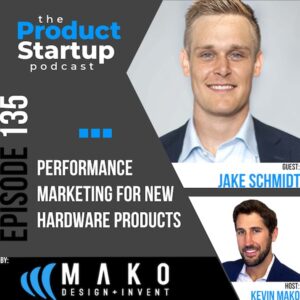
Guest: Jake Schmidt, CEO of Structured Agency, with experience driving more than $500 million in online product sales for clients.
Host: Kevin Mako, founder of Product Startup and the leading expert in hardware startup consulting. A hardware entrepreneur since 1999, Kevin has advised more than 1,500 founders and built and scaled MAKO Invent through its acquisition by TriMech in 2024.
Episode Overview
Jake Schmidt explains performance marketing as a system that includes paid media, search intent, email and SMS retention, and community content. He discusses changing platform opportunities, simple at-home creative, product uniqueness, direct response, testing, and why a quality product remains the foundation beneath every growth tactic.
What You’ll Learn in This Episode
- Performance marketing agency, which is driving revenue for your brand.
- Paid Media
- Push vs Pull marketing
- Retention marketing: Email and SMS Marketing
- Community building: Content Marketing
- It all starts with a quality product
- Social media likes unique content, meaning new invention ideas are promoted much heavier.
- TikTok is similar to what Instagram was 5 years ago
- Repurpose your content to amplify the digital creative work you are doing.
- Show the value proposition within 2 seconds
- Keep the product simple, so that you can sell it extremely quickly
- Authentic video ads are easy to shoot, and the market loves them right now, and that opportunity may not last.
- Consider coupon websites, affiliate selling programs, etc.
Episode transcript
This transcript is provided for accessibility and reference. Download the SRT transcript.
Read the full episode transcript
Kevin Mako: Hello, product innovators. Today we learn from the online marketer of the original fidget spinner on how to sell your new physical product directly to consumers online.
Narrator: You're listening to the product startup podcast.
Narrator: The show that helps bring your product idea to life by chatting with successful inventors, product developers, manufacturers, and hardware industry professionals.
Narrator: Our goal here is to get to the bottom of what makes a product successful, from initial idea to getting your product on store shelves.
Narrator: We're taking you step by step to build a functional product and scale your product business.
Narrator: Hosted by Kevin Mako, one of North America's leading experts on hardware development for small product businesses. Now, onto the show.
Kevin Mako: Welcome back, everyone. Today I'm very excited to introduce Jake Schmidt to the show. Jake has sold over $500 million in products online for customers.
Kevin Mako: He is the CEO of Structured Agency, a digital marketing firm that specializes in performance marketing for hardware brands, direct to consumer.
Kevin Mako: In his early years, he was the online sales guy behind the fidget spinner, which they ended up leveraging to get into major retailers like Best Buy. Today, Jake is going to share
Kevin Mako: some valuable knowledge on how inventor startups and small manufacturers can understand the different
Kevin Mako: strategies to market online, what platforms are most successful in how that is changing,
Kevin Mako: and how to spin up simple ad home ads that convert into real customers for your new physical product. Now, on to the episode.
Kevin Mako: Hey, Jake, welcome to the show.
Kevin Mako: Thanks, Kevin. Thank you for having me. Well, we're excited to have you on today to talk about selling online using paid advertising
Kevin Mako: and a holistic system of content curation, push, pull strategies and all the rest that go in behind
Kevin Mako: this is really an important topic because a lot of people that are looking to sell product this day and age, consider the option of selling direct to consumer.
Kevin Mako: How do you produce a product and then cut out all the middlemen and sell directly to that and consumer and captivate obviously that margin in between?
Kevin Mako: So I appreciate you coming on the show. First and foremost, might give us a bit of a background on how you got to the role
Jake Schmidt: that you're in today. Yeah, absolutely. Well, first, Kevin, I have lots of experience with selling things online. I think I've sold probably over $500 million of products online.
Jake Schmidt: So we've sold a lot at the agency that I'm currently running right now. I would love to give a little bit background and
Jake Schmidt: hopefully I can help your listeners out in any way possible. First, my background, I started selling products. So I understand the product design.
Jake Schmidt: I understand what it takes to go from idea to concept to actual real life product and then eventually selling it to your end consumer. So I can speak to all those
Jake Schmidt: different points. But first, back to where I started. I started my first project that I ever created. It was a survival watch.
Jake Schmidt: So it was a paracord strap watch and it had a custom design face. And then at the end of the paracord, it had a flint and striker.
Jake Schmidt: So it was a fire starter. So if you're trapped at the wood, you could unravel the cords and you could use the paracord to tie up logs or make shelter.
Jake Schmidt: and then eventually you could start a fire. So I created a video for that, and I had posted it on Kickstarter, and it did relatively well.
Jake Schmidt: We ended up, I think, generating about $15,000 to $20,000 in the 30 -day time period, and our target was about five.
Jake Schmidt: But then all of a sudden, out of the blue, it got shut down, just like any entrepreneurs, you're all excited and you're hopeful for the future, and then something comes
Jake Schmidt: out of nowhere, and it completely shuts down your dreams. But I didn't let that discourage me. I continue to learn and just be curious, and I think that's
Jake Schmidt: a really, really important factor for people is just being curious about all these different things.
Jake Schmidt: Even if you don't know about marketing, say right now, just be curious and things come to you.
Jake Schmidt: I started selling more things online and I was just very curious about how the internet works. I'd like to call myself like an internet kid.
Jake Schmidt: I grew up on the internet and played video games. I was obsessed with anything that I had to do with the internet. And I learned how to navigate the internet.
Jake Schmidt: And I eventually realized that people were making money on the internet. line. And they were doing it through advertising. So that's really what caught my attention.
Jake Schmidt: From there, I landed on the fidget spinner. And I can go into that story more. But for time's sake, I think I'll, I'll pass that up.
Jake Schmidt: And if you want to learn more, you can go to my Twitter. I am Jake Schmidt and I have a whole entire thread on how that story happened.
Jake Schmidt: Because you were the original guy selling the original fidget spinner. Exactly. Yes. I am the person who originally started the fidget spinner. I commercialized the fidget spinner.
Jake Schmidt: I did not actually make all the money from the fidget spinner sales because we had so many different copycasts, but we did pretty well.
Jake Schmidt: We ended up getting the fidget spinner in Best Buy, Target, Brookstone. And we also had our direct consumer presence that did great.
Jake Schmidt: From there, that fad went up as quickly as it went down. And I realized, I asked myself, my partner, I was like, what are the things that we really love?
Jake Schmidt: We love making products coming up with ideas. But we didn't necessarily like dealing with the supply chains. So we didn't really like doing the design ourselves.
Jake Schmidt: We just like coming up with ideas. But what really got us excited was the marketing piece.
Jake Schmidt: And the marketing, the idea of putting this product, this new invention in someone's hands,
Jake Schmidt: like that's something that we really got excited about because we could just constantly learn and the environment was ever changing.
Jake Schmidt: And there's just so many things for us to learn and do. And we were actually pretty good at it. And we had a reputation with making the fidget spinner as popular as it was.
Jake Schmidt: And also it was like, what is something that we could be the top 1% of the world? that. And we thought that we could do that with marketing. So that eventually led us to starting a
Jake Schmidt: marketing agency called structured.
Jake Schmidt: agency. That's the website, structured dot agency. And what we're focused on is we're focused on performance marketing.
Jake Schmidt: And a lot of different agencies out there, I know whenever I was starting out and launching these new products, I thought it's like, oh, yeah, you just hired any agency,
Jake Schmidt: and they're going to be the person that goes and they drive you sales. Reality, that's not the case. You need to be focused on a very specific type of agency.
Jake Schmidt: An agency, and most of them, are called like performance marketing agencies. Performance marketing agencies are people that are focused on driving revenue for your brand.
Jake Schmidt: So you put a dollar in, you get $3 out or wherever your target might be. That's the crucial piece in starting your business.
Jake Schmidt: You can start a product, but if you don't have that you or person that's able to drive
Jake Schmidt: those results and really drive that revenue, it's going to be really, really hard for you to get any traction. That again, this is only one way of doing it.
Jake Schmidt: You have performance marketing through digital channels, which you have Facebook ads, Instagram ads, Pinterest ads, Google ads, TikTok ads, all sorts of different ads.
Jake Schmidt: That a lot of the times is like, that's the engine. That's the fire that you have burning.
Jake Schmidt: That's continuing to drive more customers, new customers into your ecosystem. Then you also have other support pieces like retention marketing.
Jake Schmidt: So you have email marketing, SMS marketing. Those are in place to do two things. One, it's helped convert the customers that you're driving through these paid acquisition channels.
Jake Schmidt: and make sure that you have a higher ROI and you're getting a higher ROI on the ad dollars that you're spending.
Jake Schmidt: And then two, it's also so that you can continue to build this life cycle for your customer.
Jake Schmidt: So say you have one product right now in order to really maximize that customer because advertising costs are getting more and more expensive.
Jake Schmidt: You need to be very clear on what is the next product in this customer's life cycle that they're going to buy from me or do I even have another product? So it's so important.
Jake Schmidt: And I can go into a couple of reasons on why I decided I also have a jewelry brand
Jake Schmidt: right now and why I decided to start a jewelry brand after a lot of the lessons that I learned from starting the fidget spinner.
Jake Schmidt: The big reason was because the fidget spinner, I had one product. I didn't have a clear vision on what it was going to take to launch that next product
Jake Schmidt: and continue to get more out of my customers and really build the brand around it. So there's only one product there.
Jake Schmidt: And you can only advertise so much until that product dies out, unless it's a very unique product and you have patents and stuff to protect it so no one else can sell it.
Jake Schmidt: That's a big problem. So focusing in on a category that it could easily build multiple
Jake Schmidt: products without having to go through intensive R&D and all these different things was really
Jake Schmidt: important for me so that I could continue to advertise more and more and I could continue
Jake Schmidt: to sell more products to the customers that I had already acquired, which then lead to the next
Jake Schmidt: point is like initially figuring out how can you actually acquire these customers. Right now, So in the agency for what we're running, it's about a
Jake Schmidt: year and a half ago,
Jake Schmidt: 95% of all spent was going on Facebook ads. Facebook ads was so incredibly powerful. It was unbelievably powerful.
Jake Schmidt: Really? That 95%? Wow. 95%. It was unbelievable. There's a key even account on both my hands.
Jake Schmidt: How many $100 million your businesses were started purely on the back of Facebook ads? So it was extremely, extremely, it was. almost like a cheat code to what you're doing.
Jake Schmidt: Unfortunately, things are not as they used to be, but fortunately, there still are a lot of ways to kind of cut through the noise and gain the traction
Jake Schmidt: and start a really, really massive business. And I think your audience that's listening to this is in an incredible position because initially I'd say two, three years ago, like
Jake Schmidt: the head hire or the most valuable person in your business, your startup was the head of growth. Now, I don't think it's the head of growth anymore.
Jake Schmidt: I think it's the head of products. Because the way that I look at this is the head of product is the person that's supplying the ammunition to you as the head of
Jake Schmidt: growth to go and find the places that you're trying to acquire. That's really, really important.
Jake Schmidt: And if everyone here is credible product designer, they have all these ideas, unique ideas, they're set up to be successful because Facebook likes unique content.
Jake Schmidt: They like to focus on things that have that satisfying or, oh, wow, look at this. This is so crazy that people have
Jake Schmidt: never seen before and they're going to reward you with cheaper traffic as well as TikTok. So when I look at TikTok right now, when I started the fidget spinner, that channel
Jake Schmidt: is very similar to how Instagram was back in 2016, wherever the fidget spinner had started or whenever
Jake Schmidt: that was, just unlimited amounts of free traffic. So if I were in a position of some of the
Jake Schmidt: listeners here that might have this new gadget that they had created and Kevin, they've used you to design the product and now they're ready. They have the manufacturing.
Jake Schmidt: They've got the inventory in hand to start shipping. If I were in this situation, I'd be focused on creating as much content
Jake Schmidt: as I possibly can on TikTok right now because it's an underpriced channel. The reason what I mean by underpriced is on Facebook, on Instagram, if you post
Jake Schmidt: something there, the reach that you're actually able to get, the free reach that you're able to get is going to be solo. So say you have
Jake Schmidt: 150,000 followers, you might actually only get 1,000 people viewing your post. On the other
Jake Schmidt: other hand, TikTok still has all of this reach left because they're still in the infancy. They're still trying to build this network effect.
Jake Schmidt: They want to get people to stay excited about beyond the platform and stay excited about promoting content and rewarding that with views, likes, and comments.
Jake Schmidt: So if I were in this situation, I'd just be creating a lot of content for TikTok. And then eventually, once you start gaining some traction, so I'm very confident you can build
Jake Schmidt: your business to say $20,000, $60,000, $60,000 a year just on you posting content.
Jake Schmidt: And if you have one video that goes viral, I would say, you need to make sure that it's always the 80-20 rule. You're going to do 20 videos. You're going to do 10 videos.
Jake Schmidt: And two of those videos are going to be the ones that make up all the rest of the results. So keep that in mind. It is, it's all about the consistency.
Jake Schmidt: But eventually, once you build a little bit of traction there and you get some sales, you then can just repurpose that content. So you can go and you can take that content.
Jake Schmidt: You can post it on Facebook, Instagram, and you can start running ads to it. And that's most sure way of finding success on
Jake Schmidt: these ad networks or these ad platforms is finding an already proven ad that's converting people and then going and running that on Facebook or
Jake Schmidt: Instagram or even TikTok ads because you know it's already there because you're just amplifying that reach.
Kevin Mako: So that's super, super valuable. I can go into the nitty gritty, but I think I'll keep it kind of high level right now because I think it's probably very, very valuable for most
Kevin Mako: people to take action on this. One of the big things that really strikes a chord there is how you mentioned unique
Kevin Mako: gets bigger amplification, even on the advertising platform side of things.
Kevin Mako: And of course, as an inventor or a hardware startup or a hardware scale up, you've got a unique product. That's why you're in the game.
Kevin Mako: You've created something that in one way or another, either it's an under-service part of the market, you're capturing it, or you've created some unique element, even a slight
Kevin Mako: twist or a slight modification. And you're using that to then leverage these. social media platforms to go viral.
Kevin Mako: We actually just had a client called KickFix. It's this basically laundry hamper that slips under the bed. We designed and built this thing for them and got them
Kevin Mako: into production. The way that they decided to try and get some just early stage traction, just interest was to just start posting some videos on TikTok.
Kevin Mako: They hit like 20 million views within their first month. It was astronomical. Our website started getting all kinds of traffic just from that
Kevin Mako: as its own independent silo just because there were so many people looking at this and saying, oh, that's cool and trying to learn more about it.
Kevin Mako: So obviously that just opened the doors up to all kinds of different opportunities for them as well down the road, right, which we'll see what materializes from that.
Kevin Mako: But it's just incredible to see the power of a platform like that. And of course, not everyone's going to hit in a viral nature, but if you're consistent and
Kevin Mako: reliable and you're posting unique content, which of course you should be, because if you've got a product that is unique, inevitably you're posting unique content.
Kevin Mako: content via that product. So that gives you that early start, which could then open up the
Kevin Mako: doors. I think that's particularly powerful to startups, especially if somebody hasn't yet
Jake Schmidt: started selling and you're considering your different options to actually get your product into market. This is a big channel.
Jake Schmidt: One of many potential channels you can go after, but this is a very powerful one that has all sorts of different elements built into it. Yeah, no,
Jake Schmidt: absolutely, Kevin. It's so incredibly valuable finding these underpriced channels. And that's
Jake Schmidt: a philosophy that I like to follow whenever I'm trying to launch products is, where can I find the cheapest traffic? Where can I find the most underpriced traffic?
Jake Schmidt: Because that's where the opportunity is. And that's where the really, really big businesses are made. The ones that find that underpriced channel
Jake Schmidt: and then lean into it so heavily that as soon as everyone, the rest of the world starts to catch up a little bit, they are the person that's already received all those rewards.
Jake Schmidt: So that's what I like to look at. A story, it won't be too long, but it'll go back to just kind of reinstating, like having
Jake Schmidt: and unique product is so, so important is I had an early in the agency days, we had a client. It was called Bessie Footwear. They had launched on Kickstarter.
Jake Schmidt: They had done really, really well. And we had launched them, and we were the agency in charge of basically helping them go to direct to consumer.
Jake Schmidt: And we did, and we had tremendous success. It was one of probably the best case studies that we had well into eight figures plus in revenue that they had generated.
Jake Schmidt: And the reason why that they were so effective was because they had a unique product. It was a waterproof.
Jake Schmidt: shoe. And as soon as you posted a video, it was like, oh, I'm pouring water on my shoe.
Jake Schmidt: This kind of goes into the biology of an ad that actually converts is in these ads that you're
Jake Schmidt: creating. And when you're creating this content on TikTok or other channels, you want to make sure that you are showing the value prop within like two seconds, within one
Jake Schmidt: second. So a product that you can immediately show what's the before and then what's the after in that video while it's happening. You can demonstrate that.
Jake Schmidt: So in this case right now, it's I have a shoe on and I'm pouring water on it. And then the water beads away and my shoe's not wet. That's showing what that value prop is.
Jake Schmidt: And that's super effective for Facebook ads and TikTok ads and all these different things. People immediately know why I'm buying this product.
Jake Schmidt: And again, no one else really had a product like this.
Kevin Mako: It was hard for them to compete because of all the R&D and everything that they had done to build it.
Kevin Mako: But again, I know I don't want to go too much more into the story and go and give more actual insight.
Kevin Mako: But it just reaffirms that it's so important for people to have unique products and then continue to post that content.
Kevin Mako: Well, it's interesting you mentioned the director of product you feel is the most important person, business.
Kevin Mako: And to me, that comes down to a great product and something that we also really like to double down on, especially for a hardware startup is a quality product.
Kevin Mako: But like you mentioned, the value prop should be explained within, as you say, the first two seconds, meaning that your product should be simple.
Kevin Mako: We've talked about MVP, minimum viable product on the show, keeping really core to your, your, your,
Kevin Mako: primary feature, benefit, whatever else, without adding too many bills and whistles, because
Kevin Mako: it's unnecessary. And you're saying it the same way, I think about it from a design side.
Kevin Mako: Obviously, the simpler of the product, the easier to design, engineered, prototype, goes to
Kevin Mako: production, less warranty defects, easier to produce, cheaper tooling cost, you name it, right?
Jake Schmidt: There's a whole bunch of benefits on the development side, but you're saying the same thing as well on the sales side.
Jake Schmidt: If you keep your message simple, you keep your product simple, but high quality. Target that one feature within seconds.
Jake Schmidt: That is what is converting very, very quickly on social media channels today. Absolutely. I mean, what's the famous saying? Keep it simple,
Jake Schmidt: stupid. It's it's so true. And I see it time and time again. And I've gotten really good at predicting what products work and don't work.
Jake Schmidt: And that's one of the core criteria that I'm looking at is like, can you tell me what is the customer buying in two seconds of this video? What is it? What is the
Jake Schmidt: end result that they're buying. They're buying dry feet. They're not buying a shoe. And if you can show
Jake Schmidt: whatever that is, and you can do this exercise yourself to figure out, what is it that I'm actually selling?
Jake Schmidt: What is the end result that I'm selling in this product? I think it's going to help tremendously. But yeah, so now once you have all this traffic from this organic content that
Jake Schmidt: you're posting and then you're running ads on Facebook and TikTok, the next thing is the way that I
Jake Schmidt: like to look at marketing is you have your push marketing and then you have your poll marketing. So the push marketing, that's like the awareness generation.
Jake Schmidt: That's like if I'm scrolling through Facebook and I see an ad, I see all these different ads, they're being pushed into my visibility. Then you have the pull marketing.
Jake Schmidt: They're trying to grab me. They're trying to get my attention to actually go and take action on this ad.
Jake Schmidt: And that's the reason why having great creative and having creative that shows that product
Jake Schmidt: and what the actual value that they're going to be getting from that product within the first two seconds is so important because social media is a noisy world or online.
Jake Schmidt: it's very noisy. So that's the first type. And then from there, this is always going to be more expensive traffic because they have no idea what the product is.
Jake Schmidt: They don't understand what it does. You're having to convince them on why to use your product. The other hand, then you have, this is
Jake Schmidt: sometimes called like bottom of the funnel traffic. I look at it as pool marketing. So once you've already
Jake Schmidt: gained their attention, or you have someone that's going and searching on Google, it's like, I want to buy a fire pit, or I want to buy waterproof shoes, or
Jake Schmidt: I want to buy baby clothes, it might be, and ads going and they're being pulled in because they've already searched for it.
Jake Schmidt: So those are the two different types that I like to look at. It's so important to understand that
Jake Schmidt: when you're first starting, and if you're creating a product that's brand new, say a product that you create is it's a fireplace.
Jake Schmidt: And there's nothing like this fireplace in the world. Someone might be searching a fireplace that I can put on my deck. And I live in New York City,
Jake Schmidt: like what type of fireplace can I put in my deck? That's there. And if you have Google ads set up and Google shopping, that immediately is going to pop up.
Kevin Mako: And I think just by having that uniqueness and having something that no one else has, it really, really gives you an edge
Kevin Mako: over everyone else that's just selling this generic, non-branded product that comes from China or Alibaba or Ali Express or something like that.
Kevin Mako: It's just not unique in any way. You have a major, major edge over everyone else. And I find it doesn't even have to be a major differentiator.
Kevin Mako: If you can improve some other product by 5%, but then focus the verbiage. and the visualizations of your ad on that 5% difference that you've created
Kevin Mako: over some other competing product or something they're already using and they're looking for an alternative. I mean, it's a huge world.
Kevin Mako: So people are searching all kinds of crazy things on Google as well, right? So you've got to, the more that you could be very specific with the pain point that you're
Kevin Mako: solving, they hire the conversion rate for those people who actually are searching for that rare and unique pain point that you're solving with that 5% difference.
Kevin Mako: You're the ad that pops up. You solved that problem. Well, bam, it's going to be a relatively cheap click because not many people are trying to compete for that.
Kevin Mako: Pepsi isn't competing for that ad, right? It's probably you and a handful of other people, maybe nobody else.
Kevin Mako: Maybe you're the only one who's truly competing for that very long set of very unique keywords.
Kevin Mako: And that can get you some really early wins for some early purchases without putting a ton of money into ad spent.
Kevin Mako: And like you said at the very beginning of this, the whole comes down to return on ad spend. If you put a dollar into ads, do you get $3 in revenue?
Kevin Mako: out and is that enough to float your business? And as you're starting to try these different
Kevin Mako: ad channels, you're going to start to learn what's working, what's not working, and then be able
Kevin Mako: to push on those levers more and more to start scaling up in various verticals as you continue at the same time to experiment, try new ads and other things.
Kevin Mako: Something I'd like to mention as well, and I'll come back to that TikTok video as well. It wasn't a high-quality video production company to put it together.
Kevin Mako: It was themselves, filming the product and how it works. And it was very authentic. You could feel raw. So we're at this really unique point, I think, in digital
Kevin Mako: advertising, I think a tremendous opportunity to right now, which I don't know if it will last forever, where the market demands that authenticity, which is fantastic
Kevin Mako: because it's actually the cheapest way to build a video. If you've got your prototype, film it at home,
Kevin Mako: give your authentic reaction, show your authentic self as the inventor, the person who's created
Kevin Mako: this thing, the passion you've put into it, the time, the money, the ideas, the development,
Jake Schmidt: into all that sort of stuff, and people love that. So why not use this time in history where a relatively cheap home shot video is actually
Jake Schmidt: considered gold standard to take that by the reins? And of course, as you scale, you can get more professional, put more money into the things
Jake Schmidt: that are working to really try and amplify that. But as a starting point, this can be done relatively inexpensive, at least in the beginning. Yep. No, I agree.
Jake Schmidt: There's so many times where I go into people's ad accounts and I see it's like, can you believe this video?
Jake Schmidt: this video that you guys shot on your iPhone, like this is what's actually working. It's amazing. But if you think about it, it's like that's what these platforms want.
Jake Schmidt: They want the authenticity that you're getting from these content. They want it to look organic to the feed. And that's what captures the potential consumers attention.
Jake Schmidt: That's really what it is. Kevin, so I think I want to make sure I give your audience some actionable skills on exactly what I would do
Jake Schmidt: if I were in their situation from starting their business from nothing to getting to the point
Jake Schmidt: where they have enough free cash flow to go and hire experts or go and do whatever they need to be doing. And so what I would do first is, first thing is looking at
Jake Schmidt: your business and looking at your product and creating content for it. Because everything I'm about to explain is it's focused on having good content.
Jake Schmidt: So have a ton of content, kind of videos that you're just making your iPhone. And then from there, you have that ammunition. You have that content to start coaching on these
Jake Schmidt: different channels. Next thing is a really, really valuable place for underpriced traffic is going
Jake Schmidt: into coupon sites and listing your product and giving a little bit of a discount and having them write different things.
Jake Schmidt: And one that I used to use in the past was called Share a Sale. So if you sign up for ShareAsale.com, they can connect you with these people, these affiliates
Jake Schmidt: that can start to sell your product. And if you have a really unique product, you might get
Jake Schmidt: some publications writing about you that have the affiliate links like Gear Junkie, maybe, as it says, one of them.
Jake Schmidt: There are a couple of them out there that are focused on the product design and you will get some traffic there. Once you start getting some traffic from there,
Jake Schmidt: I truly believe you can build your business from so the two things, one posting on TikTok and then having these coupon sites focused in working with you.
Jake Schmidt: I think that you could get to $50 to $100,000 a month in revenue on your product. Assuming you have the right product that's actually going to get
Jake Schmidt: product market fit that people really want in what you need, I think you can get to $50 to $100K. Once you do that, you'll have enough free cash flow.
Jake Schmidt: In that situation, I would expect you have between 25 to $40,000 a month in profits that you can then deploy in different channels. And if you want to
Jake Schmidt: continue to grow, then that's whenever I would focus on going in and launching these different campaigns on these advertising channels. So I would start with Facebook first.
Jake Schmidt: Facebook is still the most effective. It's not effective as effective as it used to be. When I say Facebook,
Jake Schmidt: I mean Facebook and Instagram, because whenever you log into the Facebook ad platform, they own Instagram. So you're advertising on Facebook and Instagram.
Jake Schmidt: So I would run ads on Facebook and Instagram first. You can repurpose your content that you're posting on TikTok for all that
Jake Schmidt: organic reach and that content seems to work very, very well. And then that's going to allow you to continue to start spending more on the budgets.
Jake Schmidt: While you're spending more on these different channels, it's very important that you then set up Google ads is Google ads is going to be like the bottom of the funnel.
Jake Schmidt: So the way that I look at out of traffic is you have top of the funnel, you have middle of the funnel, and then you have bottom of the funnel. Top of the funnel, that's that
Jake Schmidt: awareness. That's that new people don't ever, they've never seen your brand before. They've never seen your product before. You've got to get them interested.
Jake Schmidt: From there, then you have the middle of the funnel, which they've seen your ad before, but maybe they didn't think much of it or maybe they
Jake Schmidt: weren't in the right situation to buy the product. But now they saw another ad and retargeted them with. And they're a little bit more warm.
Jake Schmidt: And then finally a bottom of the funnel. Bottom of the funnel is someone that went to your website. They saw your product. They checked out. They just didn't
Jake Schmidt: actually enter their credit card information. So that's going to be the warmest amount of traffic. And Google is really,
Jake Schmidt: go at that middle to bottom of the funnel and Facebook and TikTok and Snapchat, those are really good channels for focusing in on that top of the funnel traffic.
Jake Schmidt: That's what I would focus on. And I would not start advertising on Facebook or Instagram or any of these top of funnel
Jake Schmidt: channels until you're doing about $25,000 a month in revenue because you're just going to have to spend too much money.
Jake Schmidt: This is assuming that you're bootstrapped and you're not going to invest a ton of money into ad spend.
Jake Schmidt: I think there's ways that you can focus in on getting that 25, that first 25 to $30,000 a month in revenue through coupon sites, as well as just posting organic content.
Jake Schmidt: And then as well as the first channel that I would launch is Google ads. I would launch Google Ads. I would launch Google Shopping campaigns.
Jake Schmidt: I would set up a Performance Max campaign. That's Google's new substitute to shopping and it's very, very effective. There's tons of YouTube videos that can teach you
Jake Schmidt: about how to set that up.
Kevin Mako: So yeah, that's what I would be focusing on first. And to recap, again, content creation, post on TikTok, get that organic reach from there, share a sale
Kevin Mako: or other coupon sites, do deals, offer a coupon to get that free traffic. And then in exchange, give them a commission of some sort for pushing your product.
Kevin Mako: And then after that, set up Google ads, set up that Google shopping, that performance max campaign. And that'll be effective.
Kevin Mako: Once you get to 25 to 30k a month, then you can really start focusing in and start running the Facebook ads, Instagram ads, etc.
Kevin Mako: Jake, that's an incredible high-level. overview of the start to finish of that. And I really appreciate how you break it down into a way that
Kevin Mako: a startup can get into the space, or even an established company can get into the space, maybe with a new product or an existing product, but you're new to e-commerce or direct
Jake Schmidt: to consumer e-commerce marketing. So really appreciate that breakdown. Now, of course, as people are scaling, probably at some point they should reach out to an agency like
Jake Schmidt: yours to actually get some assistance with how you do multi-channel advertising, because I know it's no simple thing.
Jake Schmidt: quite a big feat to figure it out and then continue to A, B, test, tweak and refined, let alone using best practices throughout that process.
Jake Schmidt: So how do people get in touch with you? What would you offer them at this point in time to help them get to the next level via your agency?
Kevin Mako: Yeah, absolutely. So you can follow me on Twitter. I am Jake Schmidt. That's where I'm most active on Twitter. Also, I have LinkedIn.
Kevin Mako: So just Jake Schmidt, J-A-E, space Schmidt, S-C-H -M-I-D-T on LinkedIn. And then yeah, my agency is structured dot agency, so just structured
Kevin Mako: dot agency, no dot com or anything like that. And if, yeah, if you reach out, send an email, fill up a form and say that you heard me from the podcast.
Kevin Mako: And we can give you a free ad account audit or free consultation on what you might need to scale past the next level. Right on. Much appreciate Jake. And as always,
Kevin Mako: I'll put all the links that Jake just mentioned in the show notes. If anybody wants to just click through, Jake, thanks again for all your words of wisdom today.
Kevin Mako: It's great chat. And we look forward to talking again. Yeah, thanks, Kevin, for having me. All right, take care.
Narrator: Thanks for tuning in to this episode of the Product Startup Podcast, the show that teaches you what it really takes to bring your product to market and turn it into a
Narrator: big success. This podcast series is brought to you by Mako Design + Invent, the original and leading firm in
Narrator: North America to provide global caliber in-to-in physical consumer product development to startups, inventors and small product business clients.
Narrator: If you're looking for product development help on your invention, head over to MakoDesign.com.
Narrator: That's ma-k-o-design.com for a free consultation from one of Mako Design's Ford Design Studios from coast to coast.
Narrator: Thanks for listening and see you next time.
Performance Marketing Strategy for Product Founders
Build a Growth System, Not a Single Ad Campaign
Work directly with Kevin Mako to align paid media, search, email, SMS, content, community, offer, creative testing, landing pages, retention, and unit economics around one coherent product growth plan.
Kevin can help you identify the highest-leverage channel, expose product or positioning gaps, and connect marketing decisions with inventory, cash flow, sales channels, and customer experience.
Request a Performance Marketing Call
Tell Kevin what you sell, which channels are active, and where growth is failing to become profitable repeat demand.