
Listen Now
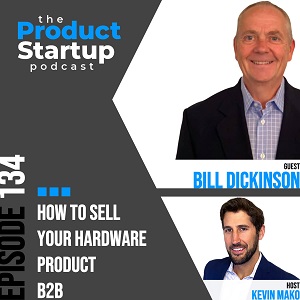
Guest: Bill Dickinson, a 35-year B2B sales executive with experience building sales teams and helping hardware suppliers reach multimillion-dollar growth.
Host: Kevin Mako, founder of Product Startup and the leading expert in hardware startup consulting. A hardware entrepreneur since 1999, Kevin has advised more than 1,500 founders and built and scaled MAKO Invent through its acquisition by TriMech in 2024.
Episode Overview
Bill Dickinson explains what founders need before hiring a salesperson or asking a partner to sell a hardware product. He covers customer need, product type, sales methods, personality and coachability, differentiation, fair pricing, service and support, cold outreach, and building a B2B sales function that can scale.
What You’ll Learn in This Episode
- Sales are critical to any hardware start-up or scale-up, from selling yourself, selling the business, selling
- Hiring for personality is better than hiring for product or industry knowledge
- What type of product are you selling
- What methods are you going to use to sell
- Sellers need a quality product, at a fair price, that has great service and/or support.
- Before you start selling, first ensure you have a need.
- Timing, luck, and skill, in that order, when doing cold calling.
- Make sure you have a product that is at least a little bit different, and unique.
- Spend time and effort finding detailed lists.
- Relationship selling. Build credibility and trust early, and in a small way.
- If you can make the purchaser’s life simpler, they will buy a lot more, and more new products
- 3 sales streams – Straight sales, existing customer sales, and business development
- Some new, existing, and future.
- More connections to a buyer, the higher the probability of an eventual sale.
Episode transcript
This transcript is provided for accessibility and reference. Download the SRT transcript.
Read the full episode transcript
Kevin Mako: Hello, product innovators. Today we learned from a 35-year B2B sales executive on how to sell your hardware product to other businesses.
Narrator: You're listening to the Product Startup Podcast, the show that helps bring your product idea to life by chatting with successful inventors,
Narrator: product developers, manufacturers, and hardware industry professionals. Our goal here is to get to the bottom of what makes a product successful, from initial
Narrator: idea to getting your product on store shelves. We're taking you step by step. to build a functional product and scale your product business,
Narrator: hosted by Kevin Mako, one of North America's leading experts on hardware development for small product businesses.
Kevin Mako: Now, onto the show. Welcome back, everyone. Today, I'm very excited to introduce Bill Dickinson to the show. Bill has spent over 35 years selling business to business,
Kevin Mako: building sales teams, and working with CEOs on optimizing their sales processes for many hardware suppliers. From building
Kevin Mako: Access Machines to communication equipment to IT components, Bill has helped build a number of companies to multi-millions and new sales.
Kevin Mako: Today, Bill is going to share some valuable knowledge on how inventors, startups, and small manufacturers should apply sales to getting your first product
Kevin Mako: going. Start with your first sales hire or sales partner and then scale your product business
Kevin Mako: through sales teams, especially when selling to other businesses like retailers, distributors, and wholesalers. Now, on to the episode. Hey, Bill. Welcome to the show.
Kevin Mako: Thanks, Kevin. Good to be here. Excited to have you on today to talk about sales, building sales team,
Kevin Mako: and selling B2B, which is something obviously very important to any hardware company, startup, inventor, no matter what way you look at it, if you develop a hardware product,
Kevin Mako: at some point, you need to sell it or you need to hire the right people to sell it. And that's why I brought Bill on the show today. Bill, we actually know each other from Squash.
Kevin Mako: I've been playing Squash with you for a few years now. You're always a salesman extraordinaire, international man of mystery,
Kevin Mako: worked for small companies, big companies, selling all sorts of things, building big teams. But what I really like about your experience is you're not just a salesman.
Kevin Mako: seasoned veteran pro at building out sales teams that are highly effective, but you're also involved in the business strategy at the board of directors level of well.
Kevin Mako: So you get to kind of merge business strategy with building effective sales team. Can you just give us a bit of a background of how you got to where you at today?
Bill Dickinson: Yeah, sure. I appreciate you having me on here. This is a great topic. It's something, it's a hot topic for most companies, whether you're an
Bill Dickinson: established company or a brand new company starting out. I spent my career in managing business
Bill Dickinson: development teams, which I guess business development is the newer word for sales teams, because I think there's different types of selling to be done in an organization.
Bill Dickinson: And there's just something about that sales hunt that's always intrigued me, both in direct sales, as well as managing and building sales teams.
Bill Dickinson: And that's, as you say, international man. I've worked for some very small startup local companies, as well as some startups internationally and some large international and
Bill Dickinson: North American companies as well, bridging a number of different products, not all in the technology world, but that's probably been where I've leveraged most of my experience.
Bill Dickinson: So sales is kind of what I do when I get up in the morning and go to bed at night. So it's been fun. That's great.
Kevin Mako: And let's talk about it both from somebody who's thinking about starting to sell or planning
Kevin Mako: ahead and then into somebody who's looking to do it more seriously where they're actually building out either their first sales hire or progressively even further into an
Kevin Mako: actual sales team. So first and foremost, what are some of your tips for sales in general?
Kevin Mako: And then let's get into building the team and then selling B2B, especially with your experience
Bill Dickinson: in those two facets. There are different types of selling. There's product or what we would call almost commodity selling.
Bill Dickinson: And then there's service or solution selling. And those are two very different types of selling streams, as I would call it, requiring different
Bill Dickinson: types of obviously products and services and people. So regardless of what you're selling, my opinion is always being. You've got to have a good product.
Bill Dickinson: I think that would be agreed by everybody. You always want to have a good product out in the market. But I think as good as having a good product, it's the service.
Bill Dickinson: It's having that exceptional customer experience that's backing up what you're selling, service or product that makes for a successful company and a successful product.
Bill Dickinson: I've always tried to involve myself with organizations who believe in the post sales service. So I think if you're going to be successful, yes, you have to have a good product,
Bill Dickinson: but you have to be able to support it on the back end as well. Those are things that I believe are critical, regardless of whether you're selling something
Bill Dickinson: on the shelf to a retailer or to an individual or to a consumer or a service to a large
Bill Dickinson: international corporation. Everybody wants and will pay for the service that will support that product.
Kevin Mako: And I think that's key, whether you're selling director through a sales team. Are you finding that that has been growing over the years?
Kevin Mako: Because it's not just that people want great after sales service so they want to work with somebody who's a good strategic partner, but online reviews really directly are affecting
Kevin Mako: this as well. People not only want a good quality product, but that after sale service that can
Kevin Mako: really smooth a lot of the gaps, too, if you do have some issues, if you have shipping delays,
Kevin Mako: if you have maybe an issue with a product that you need to engineer, now, if you've built a strong
Kevin Mako: relationship that has that white glove feel to it, that real care and attention, maybe they'll overlook some of that.
Kevin Mako: But on the flip side, it's almost like that's being demanded now beyond just, It's like selling more than just the product itself.
Kevin Mako: You have to sell your, they're calling it obviously different names right now, but it's like the brand culture.
Kevin Mako: It's something beyond just the sale of the technical specifications of the product. And I've just been finding that a lot, especially in the consumer product space from the
Kevin Mako: review angle, because people online, if they don't feel like they've got a great reviewer,
Kevin Mako: great experience, that affects their perception of the actual product at the end of the day.
Kevin Mako: But from you seeing it so much on the B-to-B side through sales teams, through these big multinational corporations right down to small entities.
Bill Dickinson: Are you seeing that shift over time as well? Yeah, I do see strong similarities between the business to consumer model and the business to
Bill Dickinson: business model where everybody wants an exceptional experience. They want good customer service.
Bill Dickinson: We look at companies like Amazon who are now prompting and everybody's following where you're demanding something in a day or two.
Bill Dickinson: And that's great service even if you have to return it. But if you had to pay a little more to buy that from Amazon to get the next day or same day delivery
Bill Dickinson: as well as the great price, that's great. If you had to pay a little bit more, I think people would do it. In my experience in the past in selling some of the products,
Bill Dickinson: mostly in the telecommunication space, but some of the products attached to telecoms and the service, people will pay more for an exceptional experience.
Bill Dickinson: And I find in the business-to-business world,
Bill Dickinson: it's not so much online reviews that purchasers will utilize to make their buying decisions, but it's other customers that they know.
Bill Dickinson: So I think going one step beyond just posting a review, it's having that customer testimonial, that bag of real life customer experiences
Bill Dickinson: that have bought from you and enjoyed their experience and referring them on more than going online to a review portal where, let's face it, you
Bill Dickinson: know, there's a thousand and you can get the good, the bad and the ugly and some of these reviews.
Bill Dickinson: And you tend to kind of choose what you want to hear where I find in the business to business world, you're selling a product or a service.
Bill Dickinson: you do well to that customer and that end user, they will buy from you again and they will tell
Bill Dickinson: other people rather than having other people try and find your service excellence or your service
Kevin Mako: delivery model online somewhere. Because those are tough to find sometimes. They're very subjective. Well, that's the thing about B2B, it's a much tighter knit community.
Kevin Mako: You're selling to a handful of people who a lot of the time know each other or at least just a couple degrees of connection away from those colleagues.
Kevin Mako: So it's almost like the power of the online review, but amplified substantially. It's not a public, but it may be almost more damaging than public if you do bad or more
Kevin Mako: positive potentially than a public review if you do good because this is word of mouth from
Kevin Mako: reputable people who presumably if your hardware startup, you're selling large volumes of product
Kevin Mako: to what I find is really interesting about what you're saying is that you're kind of taking the model that we're looking at it as the Amazon example.
Kevin Mako: You're willing to pay a little bit more for that convenience, for the return policy, for all that sort of stuff that comes with being an Amazon customer.
Kevin Mako: But what I like is that you mention that that's also happening in the B2B world. So whether you're selling one unit to a customer on Amazon or whether you're selling a container of
Kevin Mako: product to a distributor, that after-sales service gives you the benefit of the doubt to get better margins on your product.
Kevin Mako: And we've talked about it quite a bit on the show, especially because pretty much all the listeners on this show,
Kevin Mako: whether you're a startup or whether you're a scale-up company, you've got an innovative product. You have something about your product that's unique.
Kevin Mako: And by having that, you immediately should be charging a premium because you have something that is special.
Kevin Mako: But in addition, if you can provide that service that Bill's talking about, you could probably get away with even a higher price point because you've got that
Kevin Mako: premium touch and feel. And to me, when you're looking at scaling, those margins become very important because you can
Kevin Mako: use those margins to further increase the quality and all the other things that go along with all the other pains that go along with actually growing.
Kevin Mako: So let's jump into that a bit. You've done a tremendous amount of work on hiring sales teams. Today's episode, I want to focus on that scale up level of growth.
Kevin Mako: when you've started to potentially make some sales or you're planning to make some sales, but you want to really expand it beyond what you can just do yourself.
Kevin Mako: What are your tips of your tips for hiring your first salesperson? And then what are some of your tips will go a little bit further down the road after that
Bill Dickinson: to how you actually expand that sales team? Sure. And if I just go back to a little point that you covered a minute ago, when you're selling
Bill Dickinson: business to business and you're relying on having that word of mouth populate and penetrate throughout the business community, there's a great amount of scrutiny that
Bill Dickinson: purchasers will go through buying your product. I'm talking now business to business because they've even gotten more pressure on them.
Bill Dickinson: You're not just a consumer of buying something for yourself and you can form your own opinions and tell whoever you want, but if you're a purchaser looking to
Bill Dickinson: buy a product, you're representing that organization. So you've got even more pressure on you to make
Bill Dickinson: sure that you're buying a good product with good service because you may have 10 employees that are relying on you making that purchase.
Bill Dickinson: You may have a thousand employees that are counting on you. you want to buy a product that you know will stand the test of time and won't cause you grief
Bill Dickinson: down the road because you don't want 400 or 500 employees coming to you saying this thing doesn't work or this service doesn't perform as it should.
Bill Dickinson: That's why those purchasers will pay more. It's not always a race to the bottom. Sometimes it is for organizations, particularly to get into
Bill Dickinson: some larger government entities where they have to buy the best price, but a lot of companies don't need to and they'll buy for the value.
Bill Dickinson: So jumping into building the sales team, I remember hiring my first sales rep as part of a sales team that I
Bill Dickinson: had taken over a number of years ago. And this individual had no experience, relevant experience in the telecommunications field that I was joining.
Bill Dickinson: But he had a great amount of interpersonal skills and relationship skills. And you can't really tell how a person can build a relationship until you see them in action
Bill Dickinson: until you can see what that relationship will yield. Will they buy something? But you can tell a lot about how somebody can interact with somebody right from the start.
Bill Dickinson: So what I would suggest when people are looking to build a sales team or hire a salesperson,
Bill Dickinson: whether it's one or a team of 50, you should look beyond the products that are knowledge
Bill Dickinson: that that person is coming into the organization with and more look at their raw traits,
Bill Dickinson: their skills beyond the product and the service and their knowledge base or their schooling or their training.
Bill Dickinson: Look to how they interact with people, how they act with, interact with you. the receptions when they come in the door is typically going to be a good indicator how they act
Bill Dickinson: with customers. So I would suggest right up front when somebody's looking to roll out a new product that they engage Mako with to roll out whether you're doing it
Bill Dickinson: through retail, through distribution network or direct to end user customer, make sure you're getting the right type of person, not just somebody who understands the product.
Bill Dickinson: Just because somebody understands the product doesn't mean that they can sell or position it properly. So the first thing you typically would
Bill Dickinson: want to do it, I would suggest that I've followed along is kind of five or six different points that I would follow when I'm building a sales team or hiring salespeople.
Bill Dickinson: When you're building a sales team first, obviously you need to know what is it exactly that you're selling. Is this a product or is this a service? Does it have a commodity element
Bill Dickinson: to it or is this a solution-based sale? Because those are different types of people who you'd
Bill Dickinson: want to engage in selling your product based on the skill set that they would have. So that's
Bill Dickinson: the first. You need to understand what it is and how they would sell it. Obviously, you need to
Bill Dickinson: understand how much of it you're going to sell that would support the business plan to support the business and other expenses that you need to engage with the organization.
Bill Dickinson: And then when you get down to who you're going to employ to actually sell it, that's an interviewing process that you would take
Bill Dickinson: on yourself. I wouldn't typically leave it to the HR designate because they're not necessarily the best people to vet who are coming in the door that would be able to sell your
Bill Dickinson: product for you. You have to understand and determine what kind of sales structure do you want and how you're going to best position or sell your product.
Bill Dickinson: Is this going to be done through an inside sales team who are behind a desk and just phoning people, never any face-to-face interaction?
Bill Dickinson: Is it going to be an outside sales organization or maybe a combination of both where you've got inside salespeople and outside salespeople?
Bill Dickinson: My experience in the past is some of the most effective sales structures in the past have been to have a combination of the two.
Bill Dickinson: you've got some inside salespeople or some people call it telemarketers, but they're inside
Bill Dickinson: salespeople who are calling customers to engage in some interest, determine if they're interested or have a need for your product or service.
Bill Dickinson: And once you qualify them to some stage, then you hand them out. If there is a face-to-face interaction required, then you hand it out to an outside salesperson.
Bill Dickinson: And that kind of tag team duo I have found over the years has worked really well for a number of reasons we can go into kind of the detailed structure of a sales organization
Bill Dickinson: on a future show if you want but i found that that tag team has worked very effective to hold them
Bill Dickinson: accountable to who's doing what and also to qualify so you don't have outside salespeople running all
Bill Dickinson: over the city or the province trying to make sales calls on people spending you know time and
Bill Dickinson: mileage and gas and everything when it hasn't even been qualified so i i do kind of buy into the whole theory of having a combination sales team you need to
Bill Dickinson: obviously look at what methods you're going to use to sell it, promote it, promote your product,
Bill Dickinson: whether it is through some traditional advertising and marketing avenues or through social media, or maybe it's a combination of both.
Bill Dickinson: It may be that you don't have to advertise it all out in the normal market, but you just use your inside and outside sales team to promote the product.
Bill Dickinson: So I think there's a combination of a number of things you have to look at there when you're building a sales team. And when you say sales team, I say, that could be two people.
Bill Dickinson: It could be 10 or 20 regional people. It could be national people. It doesn't really matter. You have to probably look at keeping some consistency with how
Bill Dickinson: you're going to sell the product, who you want to sell to, make sure that the organization, as I mentioned at the onset,
Bill Dickinson: has the ability to provide exceptional support so that the customer experiences is fantastic. And that just makes it easier to have repeat customers, repeat sales.
Bill Dickinson: And that's what you want. Cold calling is a tough thing to do. It really is. whether you're selling a product or a service, you know, to cold call a customer, pick up the phone,
Bill Dickinson: call them to have the luck, as I would call it, that they have a need for your product or service
Bill Dickinson: at the same time that you're wanting to sell it to them is very rare. So I think leveraging the knowledge of who in the market you think could use your product
Bill Dickinson: and service, your competition, knowing who your competition is, who's not out there in the market, selling to that customer base, and then qualifying.
Bill Dickinson: them to some degree to make sure that you're making most effective use of your sales team.
Bill Dickinson: And then when the sales team get out there, obviously they have to have something intelligent to say. They have to be convincing. They have to be trained, of course.
Bill Dickinson: They have to know what they're talking about.
Bill Dickinson: But having a good product at a good price with some value ad service attached, I think is the way to go. Do you find that cold calling still working in this day and age?
Bill Dickinson: If you look at what would be typically considered the old sales funnel, and maybe I'm dating myself a little bit here, but you know, you figure out at the bottom at the end of the
Bill Dickinson: month, a quarter a year, how much you need to sell. You know what you're selling and you know what your price point is.
Bill Dickinson: You know what your average sale price is when you consider those factors and you look at how many customers you need to call to get an appointment to be able
Bill Dickinson: to get a pitch in front of them, to put in front of them a formal proposal to then negotiate with them and then work it through
Bill Dickinson: that process over the last 25 years. I don't think it's really changed that much in my career,
Bill Dickinson: whether it was me responsible at a large telecom company in Canada with a team of 50 people
Bill Dickinson: in Toronto going out and selling products and services, business to business, or in a smaller
Bill Dickinson: environment selling niche products to a very unique set of customers. Cold calling is a very difficult thing to do.
Kevin Mako: Some can master it in terms of getting in front of the customer, but timing, luck and skill. And I think in that order is often what it takes to land a sale.
Kevin Mako: It's not all, you know, it's just timing. And, you know, to do a, to dial a thousand customers
Kevin Mako: and hope you sell to three of them when you want to sell to them, that's a tough thing to do.
Kevin Mako: So no matter what way you cut it, it is a volume game. And of course, the more specific or the, the closer you can find a buyer that may actually need your services, maybe you can
Kevin Mako: slim up those numbers, but the reality is it's a major volume game. And I know a lot of people rely on that for, especially in hardware getting some of their early sales.
Kevin Mako: So I think the message here is that if you're doing it yourself, know that it may be a long road before you can actually get that fish on the line.
Bill Dickinson: If you don't have thick skin, it may be upsetting at first, but know that there is some conversions that happen. If you're on the other side of the coin bill, what would you
Bill Dickinson: find is a is kind of a better way or an easier way to potentially scale up in sales if you're not
Bill Dickinson: doing cold calling or maybe in conjunction with cold calling? I think it's definitely important that you scale properly and, you know, some companies have a great
Bill Dickinson: amount of funding and they can scale quickly and they can spend a lot of money on the expense side with salespeople, some companies who
Bill Dickinson: are smaller. I think a lot of the companies that are out there with new products out there in
Bill Dickinson: the market, they're not the large national and international companies. They have to scale little differently if they don't have the funding and capital investment
Bill Dickinson: available to them. I assume that most people who come up with a product or service that roll through the assistance
Bill Dickinson: of your organization, Kevin, you know, are coming up with something that is a little unique. It's a little different.
Bill Dickinson: And by that, they should have an idea of who they're selling to. And it should eliminate a lot of the cold calling, in my opinion.
Bill Dickinson: It should be a little more targeted, unless, of course, you're putting a water bottle or a roll a Dave on a shelf, then it's just the masses.
Bill Dickinson: And if your product is a little different and a little more unique and catches the eye of the consumer, then it's going to sell.
Bill Dickinson: In the business to business market, it's important that you understand who your market is as you're developing your product or service so that it meets the need of them,
Bill Dickinson: you know who the competition is, you know where their price point is, you know what the key features and benefit set is of your product.
Bill Dickinson: And then I think you just rely on honing into that market segment who, could use or should use your product and focus on them and sell
Bill Dickinson: something to them rather than the masses. And then, of course, as you develop more products, you can sell to a greater number of
Bill Dickinson: people, but start with a more focused approach with one or two salespeople, make sure they
Bill Dickinson: understand the product, make sure they understand the services support that's going to come behind that product and then get a very, get very focused and
Bill Dickinson: targeted on who you're selling to and go out.
Kevin Mako: And there are organizations that will sell you lists of companies with very specific and detailed
Kevin Mako: information on the purchasers and their contact information and who they, who they represent, whether it's a distributor or direct to customer.
Kevin Mako: And I would spend more time and effort trying to find those lists of customers than just dialing out of, you know, the online phone book, which is a tough thing to do.
Kevin Mako: I like that. You mentioned specific. We talk about this a lot on the show, especially on the development side of making a product.
Kevin Mako: Start with your one core feature. Don't try and make the everything to everybody product first. Keep your niche, right? Find out a very specific, very targeted
Kevin Mako: niche. And what it sounds from you on the flip side, on the sales side is the more targeted that
Kevin Mako: you can be, the easier it's going to be to crack those doors open to have good conversations and to be able to actually convert with these folks.
Kevin Mako: So try and both figure out your very specific pain point that you're solving or that slight, I like how you mentioned that slight unique feature, that slight differentiator,
Kevin Mako: and then go after just that target market very tightly, very exclusively first and see how that plans out.
Kevin Mako: See how you can actually capture that before starting to target the masses. I certainly know that a lot of hardware startup try and shoot for the big picture right out
Kevin Mako: of the gate, which is actually traditionally an industrial design, typically how it was done. When you're designing for a big Fortune 500 company, you're trying to think about
Kevin Mako: how to capture the market. Imagine you're designing the next iPhone. You're really trying to figure how do we sell more units than the last iPhone?
Kevin Mako: How do we capture a bigger market share from Android phones?
Kevin Mako: Whereas when you're a startup, you're just trying to make a little bit of sales. A few thousand dollars to start into hundreds of thousands into a few million, which is a rounding
Kevin Mako: air for those bigger corporations. So the way you design and the way that you target your market is going to be much more niche than using the textbook theory for
Kevin Mako: design and or for sales of a Fortune 500 company's product.
Bill Dickinson: I think that's what a lot of hardware startups have a hard time wrapping their head around. But once you figure that out, it makes it easier to develop because
Bill Dickinson: it's cheaper, quicker and simpler to make something that's more stripped down, more streamlined.
Bill Dickinson: You can do that product at a better quality, which is something, Bill, you keep coming back around to. Quality is key.
Kevin Mako: And then from that, you can very easily, or much easier, let's say,
Bill Dickinson: target that specific buying audience that really would be interested in that and get into those doors and get into those conversations. Oh, yeah, for sure.
Bill Dickinson: And, you know, for many companies that you deal with and that I've been involved with Kevin, a lot of companies don't just have one product, but you can start with one product.
Bill Dickinson: And, you know, in my experience, and we haven't even talked about relationship selling yet, but we can do that either on a future show or episode,
Bill Dickinson: but no, we should touch on that today because that's good. And I think that affects it right from, you know, early vendor relationships. And it's credibility, right? You, you get.
Bill Dickinson: it in, you sell that one product that you know will work to their satisfaction, will meet their need. You sell that one product, you build some trust, you build some rapport, and
Bill Dickinson: then it becomes so much simpler to layer in the other products that you've either already got, but you didn't
Bill Dickinson: want to push on that customer rate up front or that's on your workbench and that you've got coming in in development and you can tease them with them.
Bill Dickinson: You've built some credibility and trust with an organization. It doesn't matter the size, really, because if you're dealing with
Bill Dickinson: the small business, you're dealing with the owner, he wants it to work. If you're dealing with a big
Bill Dickinson: organization, you're dealing with the purchasing person at various levels, they want it to work. They all want it to work.
Bill Dickinson: And if you can make their life simpler and give them a product that meets their need at that time and can build some credibility with that, when you go to them
Bill Dickinson: with another product, it's not a cold call. It's not a warm call. It's a hot call. You're going in there.
Bill Dickinson: They'll take your call at any time for a coffee or a lunch or just. just a drop in meat and creed, and then you can drop some other products on them.
Bill Dickinson: And that credibility goes a long way. And that's where that relationship builds in. If you try and do the quick, you know, slash and burn, sell them one thing,
Bill Dickinson: don't care about them anymore and go on to the next one because you're chasing a quota for the organization.
Bill Dickinson: And that's not typically a very long life in the sales game
Kevin Mako: and in the product lifestyle game, because that'll catch up to you, in my opinion, that will catch up to you. You need to build some credibility, some trust, some relationships.
Kevin Mako: And then they'll listen to what you have say. And if you've got a good product, they'll buy it. And they'll buy back to the thing we said at
Kevin Mako: the onset. They'll buy it at a premium because it's going to make their life easier. They might even buy a product that they weren't looking for.
Kevin Mako: But now you've got a rapport and you say, hey, I don't know all about your organization, but maybe this would work. Have you ever thought?
Kevin Mako: They might not have even thought about a product that you're trying to put in front of them, but because they trusted you on one, they'll trust you on others.
Kevin Mako: That's really good insight. It all comes back to that quality in the first place, but then that after sales service.
Kevin Mako: I guess in part to that, whether you're selling yourself or whether you're selling with the sales team, you need to give yourself some time in your sales process
Kevin Mako: to loop back to some of your original engagements because I think that's a huge problem in sales, whether you're
Bill Dickinson: selling yourself or pushing a sales team. Focus too much on the new leads and the new sales and the new business and not enough on massaging the old ones.
Bill Dickinson: But you have to build in that formula of how much time are you spending hustling that new business as well as how much time are you spending servicing your existing business?
Bill Dickinson: Because a lot of the time, like you said, your existing customers possibly are going to be your bigger next customers.
Bill Dickinson: And that's more a approach for longevity as opposed to quick sales.
Bill Dickinson: Really important when you're looking at, you know, a five, 10 year growth plan of a business. Oh, for sure.
Bill Dickinson: I think, you know, there's always been kind of three sales streams that I talk about with, with my sales folks, you know, one is straight sales because sometimes it's just sales.
Bill Dickinson: Sometimes it is maybe a slash important. you're going in there's a one-time sale you're selling it they'll never buy that again or never
Bill Dickinson: need to this fine that that's sales that's traditional sales then you've got which what you talked touched on a
Bill Dickinson: minute ago which is account management now you're responsible for an account a business whether they're buying from you currently or not so if they're not buying from
Bill Dickinson: you currently you want to sell them something if they are buying from you currently you want to sell them more of that or something
Bill Dickinson: different so that's that's account management in my opinion and and those are very important not to alienate because that is often where you will get much of your repeat business.
Bill Dickinson: So there's the sales, there's account management, and then there is business development.
Bill Dickinson: And I think that spans across selling and managing accounts where you're continually trying to build new business opportunities or business development.
Bill Dickinson: At the end of the day, the shareholders and the owner, they call that revenue, right? They just they just want revenue. They want good revenue, but they want revenue.
Bill Dickinson: I call that business development because you're not just trying to sell a product. You're trying to sell an easier way for that
Bill Dickinson: purchasing person to get what they need. And that's just developing new business opportunities.
Bill Dickinson: And sometimes what I found is that can come full circle back to as you're developing an imagining account and you're developing new business opportunities.
Bill Dickinson: It might not even be a product or service that your business sells, but it could become something. Because as you go to a company and you say, hey, have you thought about this?
Bill Dickinson: I've got this here for you. I've got this widget and it should meet this need. They might come back to you and say, that's good, but I've got this need. Have you got this widget?
Bill Dickinson: And you go, no, no, we don't have that, but we could build that or we could make that. So once you've got that rapport, that business development aspect of a relationship
Bill Dickinson: can be both ways and not just you selling them. They'll then start to leverage and lean on you to become kind of an expert
Bill Dickinson: in that field and say, here's the problem I've got. Can you help? And that's the best, you know, if you're a salesperson, that's the best words that you can hear.
Bill Dickinson: I've got this problem, Bill.
Bill Dickinson: Can you help me with this? Usually there's a way of helping whether it's you directly or you connecting them with somebody who can.
Bill Dickinson: So sales, selling, account managing and business development, I think are three different kinds of streams.
Bill Dickinson: And as you grow your organization and your sales team and your product set, if you are adding more products to your briefcase there, you
Bill Dickinson: may want to also look at having different. types of sales people as we generalize them with, you know, make sure you're not alienating
Kevin Mako: the companies that are wanting you to come back and visit them. I've heard many times in the past as sales manager or as head of sales where we've either, you
Kevin Mako: know, not doing well with a customer and then I go in and try and find out what's happening. And it's often because, oh, I haven't seen one of your sales reps in a year.
Kevin Mako: I haven't seen them like, oh, he sold me this. I haven't heard from him since. And I think that goes back to what you were saying. You can't alienate those people.
Kevin Mako: You have to make sure that you're spending enough time in your day, in your sales prospecting
Kevin Mako: and account management day to go after some new, some existing, and some future and make sure that you're always building that sales funnel that will help yield
Kevin Mako: the results that you need. You mentioned earlier, timing, luck, and skill. And in that order, well, it's interesting,
Kevin Mako: you mention that thing about not hearing it from a year because what a missed opportunity on timing. If you can hit somebody on a monthly basis, the probability at
Kevin Mako: some point in that year of hitting the right timing with that potential customer goes up astronomically.
Kevin Mako: Whereas if you just let it hang, then you've missed those potential opportunities. And the next time, let's say it's a year later, you circle back.
Kevin Mako: The likelihood that you're hitting them on the right time has gone down. So that's what I find one of the easiest things about sales that anybody can do.
Kevin Mako: No matter what your skill level is, you just put in the time to hit them at
Bill Dickinson: the right time. Just put in the effort to communicate on a regular basis. And you can do this if you only have a few potential.
Bill Dickinson: customers are either existing, future, or whatever, you can do this through a very basic CRM system.
Bill Dickinson: There's lots of them online that you can use that are relatively inexpensive to help you keep track of how often that you have been in contact with somebody and
Bill Dickinson: to set reminders to get in touch with somebody. If it's even simpler than that, if you only have a handful, you can do it on a spreadsheet. And obviously, it gets more complicated.
Bill Dickinson: The only thing that you need to know, really, when it comes to timing is the more
Bill Dickinson: face time you get with someone, the higher the probability that they'll actually make a transaction.
Bill Dickinson: absolutely no matter what your skill level is that theory will always remain strong yep no i agree with
Bill Dickinson: you absolutely i mean that you know when you look at the sales funnel i mean it's it's largely mathematical
Bill Dickinson: the more customers you call the more customers you see if you've got something good to say and a decent product to sell you will come out with the
Bill Dickinson: necessary numbers at the bottom like it takes a lot of effort it's not an easy game sales isn't necessarily easy particularly if you're
Bill Dickinson: selling a product or a service that's relatively unknown and it's not out there in the masses, then you've got to work hard to get that out there.
Bill Dickinson: But I think one of the errors that I've seen many companies make is you've got a sales
Bill Dickinson: team that are out there just chasing a quota, a revenue quota or a revenue target at the end of the month and aren't looking at the big picture.
Bill Dickinson: And you touched on earlier, you always want to try and move a sales opportunity or a prospect or our customer along the sales path or along the sales process.
Bill Dickinson: So you can't have everybody buying this month because then nobody's going to buy next month. So you always have to build that sales funnel so that you've got enough
Bill Dickinson: brand new prospects in the hopper. You've got enough customers that you're presenting to at the same time.
Bill Dickinson: You've got customers that you're looking at three, four months at the time. So I think when you talk about that CRM or their customer relationship management tool,
Bill Dickinson: where there's a spreadsheet or something more sophisticated, I think it's critical that companies look at more of an activity-based management scheme
Bill Dickinson: to oversee and manage their sales team rather than just what have
Kevin Mako: you sold this week or this month or this quarter because it's important that you take a customer that's a brand
Kevin Mako: new prospect and who has maybe 10% chance of buying a product from you, you move them to 20%.
Kevin Mako: And then you move them to 40%, then you move them to 70 and then you move them up and you win them
Kevin Mako: you're closing, but you're moving them along that sales funnel and that activity-based sales management, again, whether you're talking about one salesperson or a team
Kevin Mako: of people across the country, it's important that you don't get too caught up in what are you just selling this month.
Kevin Mako: This month is important because you have to pay to turn on the lights and pay all of your bill.
Kevin Mako: So you have to have some focus on the month, but don't lose sight of all of the other prospects
Bill Dickinson: that are in your sales funnel, as I call it, that are going to provide you with some necessary revenue down the road. I love that you put it in your current stuff, new customers,
Bill Dickinson: current customers and future customers. And you've got to think of each of those three brackets
Bill Dickinson: and figure out how, what are your touch points, what are your activities with those individuals to move them each of those brackets forward within your sales pipeline.
Bill Dickinson: Really powerful words of wisdom on sales, Bill, and building out a sales team. We're coming out to the end of the time here.
Bill Dickinson: So just wanted to say thank you for your words of wisdom and looking forward to chatting again. Awesome. Look forward to some future sessions with. Thanks, Bill. Much appreciated.
Bill Dickinson: And I'll put your links as well to your LinkedIn in the show note so that anyone can click through and reach out to you there. And again, thanks for being on the show.
Bill Dickinson: Super. Thanks, Kevin. Talk to you soon. All right. Take out.
Narrator: Thanks for tuning in to this episode of the Product Startup Podcast, the show that teaches you what it really takes to bring your product to market and turn it into a
Narrator: big success. This podcast series is brought to you by Mako Design + Invent, the original and leading firm in North America
Narrator: to provide global caliber in-to-end physical consumer product development to startups, inventors, and small product business clients.
Narrator: If you're looking for product development help on your invention, head over to MakoDesign.com.
Narrator: That's M-A-K-O Design dot com for a free consultation from one of Mako Design's Ford Design Studios from coast to coast.
Narrator: Thanks for listening and see you next time.
B2B Sales Strategy for Hardware Founders
Build the B2B Offer Before You Build the Sales Team
Work directly with Kevin Mako to define the buyer, business problem, product difference, pricing, proof, sales method, partner strategy, outreach, objections, support model, and the first repeatable B2B process.
Kevin can help you decide when to sell personally, use a channel partner, hire the first salesperson, or build a broader team, while keeping sales promises aligned with product and operational capacity.
Request a B2B Sales Strategy Call
Tell Kevin who should buy the product, what business need it solves, and where your current B2B sales effort is stuck.