
Listen Now
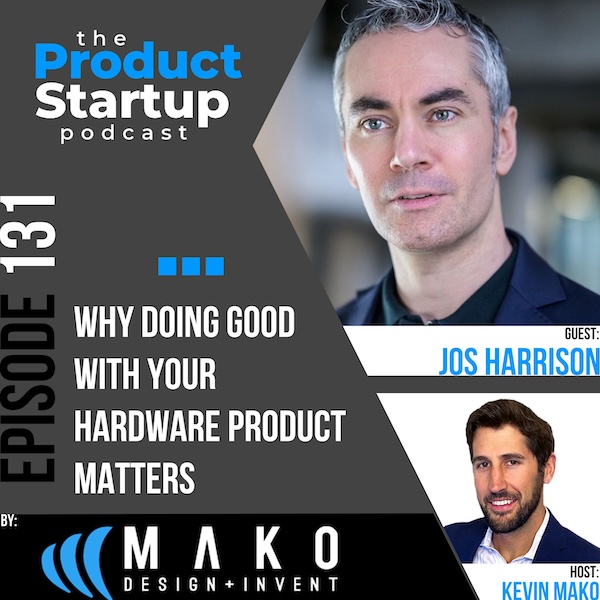
Guest: Jos Harrison, Global Head of Design at Reckitt.
Host: Kevin Mako, founder of Product Startup and the leading expert in hardware startup consulting. A hardware entrepreneur since 1999, Kevin has advised more than 1,500 founders and built and scaled MAKO Invent through its acquisition by TriMech in 2024.
Why ESG Matters for Emerging Hardware Brands
Jos Harrison explains how founders can build environmental, social, and governance priorities into product, brand, and operating decisions from the start. You will also hear practical guidance on product positioning, sustainability strategy, stakeholder expectations, and how to turn responsible choices into a stronger company.
What You’ll Learn in This Episode
- Defining ESG (Environmental, Social, and Governance)
- Why ESG is important for a small hardware business
- Why ESG is important for the world.
- How hardware startups can do ESG well, and how to do it early on
- What can hardware startups and scaleups learn from big organizations that do this well.
- The idea of a consumer is old, that is changing.
- Manufacturing options, packaging, materials all can be done smart for sustainability and environmental reasons
- Think about iterative design to become more and more ESG friendly over time
- Educate your users
- Buyers are willing to pay more now, for a product that lasts longer; however, there is a caveat in selling
- Small business have a huge benefit over big corporate, as society believes that startups were there to solve a core problem.
Episode transcript
This transcript is provided for accessibility and reference. Download the SRT transcript.
Read the full episode transcript
Kevin Mako: Hello, product innovators. Today we learn from the global head of design and brand experience at a large multinational on the importance of ESG and a hardware startup.
Narrator: You're listening to the Product Startup Podcast, the show that helps bring your product idea to life by chatting with successful inventors,
Narrator: product developers, and hardware industry professionals. Our goal here is to get to the bottom of what makes a product successful, from initial
Narrator: idea to getting your product on store shelves. We're taking you step-by-step. step to build a functional product and scale your product business
Narrator: hosted by Kevin Mako, one of North America's leading experts on hardware development for small product businesses. Now, onto the show.
Kevin Mako: Welcome back, everyone. Today I'm very excited to introduce Jos Harrison to the show. Joss is the global head of design and brand experience at Reckitt, the firm which owns many
Kevin Mako: big brands, including Lysol, V, Finnish, Jurex, and more. He's been in the design industry for over 25 years. Today, Joss is going to share some volleyball knowledge.
Kevin Mako: and how inventors, startups, and small manufacturers can learn what ESG is, why doing good for the
Kevin Mako: world is beneficial for an emerging hardware product, and how to start with implementing ESG in your emerging or scaling business today. Now, on to the episode.
Kevin Mako: Hey, Josh, welcome to the show.
Kevin Mako: Hi, Kevin. Thanks for having me. Well, much appreciated being on. It's always great to hear how some of the biggest brands in the world are doing great things.
Kevin Mako: And today we're here to talk about ESG, which we'll define later, of course, but it's all about doing good for the world via your products and your product businesses.
Kevin Mako: So looking to hear how some of the best brands in the world do it. Many of the companies that are obviously part of Reckett, which Reckett owns and it distributes
Kevin Mako: many brands, which people will know, which they'll have in their household today. So I'm
Kevin Mako: excited to learn more about ESG and how that works and how can apply to hardware startups and hardware scale ups.
Jos Harrison: But first and foremost, how did you get to the position that you're in today? It's a long road. Let's put it that way. I've ended up in various parts of the design industry over
Jos Harrison: of the years, working in spaces, kind of creating public spaces, creating private spaces, designing small scale experiences. I've worked in confectionery for a while.
Jos Harrison: And so kind of snacks and the stuff that makes us all smile. And more recently, 15 years or so now, working at a much higher level kind of on branding, building brands.
Jos Harrison: And that's kind of led to what we now think of in our organization record as brand experience, which is effectively managing the toolkit that our
Jos Harrison: brands use to direct all of their activity in building a coherent and ongoing experience with their users. The objective, of course, being finding a way to make the brands
Jos Harrison: so useful to people and so relevant that they are prepared to advocate and recommend to their peers and buy into or associate with the brand over a long period of time.
Jos Harrison: And of course, that's what makes the brand
Kevin Mako: both loved, but also powerful and influential and able to have a positive effect.
Jos Harrison: That's amazing. Talk a bit about what Reckitt does and some of the actual brand names that folks would know. Reckit is a very large or global scale CPG, consumer
Jos Harrison: packaged goods or FMCG, fast-moving consumer goods company. We have a large scale operation, but we own a number of brands that we operate.
Jos Harrison: Some cases globally, some cases in individual countries or regions. So brands that people perhaps will be familiar with are Lysol in North America.
Jos Harrison: It's a huge brand, of course, particularly top of mind over the last couple of years. also some of our over-the-counter health care brands, again North America, Mussex and Delsim.
Jos Harrison: But we also operate a number of brands in the rest of the home care space, things like finish for dishwashing and airwick for air care and kind
Jos Harrison: of mood management in your home. But also through other geographies, we have equivalent brands or similar brands to Lysol. We have a brand called Detol in the rest of the world.
Jos Harrison: And we also have brands in sexual well-being like Jurex and K-Y. more recently, Queen V added to the portfolio, some very cool stuff that has
Kevin Mako: a role to play in most people's lives at some point of another, very often in day-to-day living.
Kevin Mako: You're the global head of brand experience and design there, which means you've got to see a lot of these different brands, both as they are merging and as you're developing them.
Kevin Mako: So let's talk about how they apply to ESG and how ESG is important for startups and scale-ups
Jos Harrison: and how they can actually do ESG well, even at the early phases of their business. Why don't we just start with defining it? What is it?
Jos Harrison: Yes, so ESG is really a lens through which to focus business activity because businesses have the opportunity to have a huge impact on the world and it's the larger the business
Jos Harrison: of course or the more influential the business, the greater the effect. So we have to make a conscious decision to make that effect a positive one.
Jos Harrison: So ESG stands for environmental, social and governance and the areas, as you can probably
Jos Harrison: imagine from the description, environmental is a massive consideration for everyone in any
Jos Harrison: kind of business. Social, similarly, the influence that your products and services have on people, whether in small social units or much larger ones, can be huge.
Jos Harrison: And then governance is more linked to kind of regulatory and registration of certain types of products and the way we work, the way
Jos Harrison: we manage our workforce and that of the other companies that we work with. So governance is a kind
Jos Harrison: of very broad scope of are we operating in an ethical and sustainable way, perhaps? So the two bigger areas, perhaps, especially for startup businesses and scale up
Jos Harrison: businesses, the notion of environmental sustainability, so long term, are the activities of the business, enabling that
Jos Harrison: business to continue to have a role to play in the world 10, 20, 30, 40, 50 years from now. And then social, actually, you could apply the same question.
Jos Harrison: Is the brand or the business enabling an equitable and meaningful social evolution over that same period of time?
Jos Harrison: Is it enabling people to participate in society in a productive way? Is it enabling people to kind of live their best life, if you like? I love the expression.
Jos Harrison: And that has to be the way that we think about doing business in coming years. I think the world faces a number of enormous challenges, some of which are environmental,
Kevin Mako: some of which are social, that businesses, brand owners, tech providers, all have a potentially enormous role in hopefully improving.
Kevin Mako: What I love about this and why I think it's really important for everybody, even in the early in their business to listen to this topic today is because it's beyond
Kevin Mako: just a whole feel-good philosophy. This isn't just about saying, yeah, I want to do a business that's great. This actually affects the bottom line.
Kevin Mako: We're seeing, and right now we're talking to somebody who represents one biggest brands, many big brands, many large brands worldwide. These are big corporations that have
Kevin Mako: deep pockets that are very much geared towards profit, but they also understand the value of doing
Kevin Mako: good for the world, not just in the feel-good attitude, but knowing that that actually will affect the success and the longevity of your business.
Kevin Mako: And in turn, it affects the bottom line. So even if you're just got your head down, you're trying to build your hardware product, you're trying to get it to
Kevin Mako: market, it's important to think of this because these factors, we're seeing it being done as a number one core priority at huge brands.
Kevin Mako: So if they're doing it, then you as a startup who is emerging as a new
Jos Harrison: brand about to make your own cultural identity in the world, it's even more important than ever. It really is.
Jos Harrison: I think as a brand owner or as a business, whether you're massively established or whether you're just setting out, it's being clear about your purpose.
Jos Harrison: What is the role that your business is going to play in the world? And projecting that forward to understand how can
Jos Harrison: your business help to enable conditions that will mean you still have a business 30 years from
Jos Harrison: that. So if you think about some of the environmental challenges we face, how can your brand or business have a positive effect on the availability of freshwater, for example,
Jos Harrison: or the reduction in plastic that we know is a big issue for people, or reduction in carbon generation, particularly
Jos Harrison: carbon dioxide and other sort of greenhouse gases, what are the activities your business can take on
Jos Harrison: that will ensure its longevity and ensure its continued growth in a world where drawing out
Jos Harrison: vast quantities of raw materials perhaps is something we need to reduce and the generation of carbon dioxide is something we need to vastly reduce and so on.
Jos Harrison: So this principle of ESG as a sort of short hand lens to apply to your business really is about ensuring you have a business in the
Jos Harrison: future. And that has to be through having a positive effect on the world, whether it's environmental or social or otherwise.
Jos Harrison: So I think for young businesses, it becomes increasingly important because carving out your space in the world in a often
Jos Harrison: very crowded markets where perhaps there are very large brands and large entities like ours, but also a plethora of other smaller
Jos Harrison: potential competitors, understanding what you stand for being super clear about it, being able to articulate that to your user base or your potential user base, and being able to
Jos Harrison: implement that thinking into your business model, so the way you generate and develop products, the way you bring
Jos Harrison: to market, the way you continue to iterate the innovation pipeline of your particular platform
Kevin Mako: or multiple platforms, whatever it might be, they should all play into that core purpose and should all have a contributed effect on the positive change you expect
Kevin Mako: to make in the world. Very well said. I think this all comes down to the fact that consumers are more sophisticated
Kevin Mako: than ever. The web is connecting information and your user base will prefer to buy from a brand
Kevin Mako: that they trust it is looking out for the world as opposed to a brand that they believe is just strictly for profit and with no other tangible benefit, right?
Kevin Mako: So that's why, you know, I originally opened with the, it all comes down to the bottom line. Well, it's indirect, but there's still a pathway
Kevin Mako: to it. And one of those pathways is very clear, very upfront. It's what are you doing for the
Kevin Mako: environment? What are you doing for the world, which is the social part of it? And of course,
Kevin Mako: governance plays into, well, how do you make sure that that happens over time and grows?
Kevin Mako: something that I find pretty amazing just to kind of prove this point or nail at home is the fact that you and I could have talked about a lot of things today.
Kevin Mako: And the one thing that you said you really want to talk about because it's a main priority for your company and the brands that you represent is ESG.
Kevin Mako: And that was before any other thing that we talked about that we could have.
Jos Harrison: So it just goes to show that how much of priority this element is more than probably ever before in human history, at least over the last few hundred years.
Jos Harrison: Yeah, I don't think by any means you're overstating that, that it is more important now than
Jos Harrison: it's ever been before, and potentially more than it will ever be again, because we're at a crucial tipping point, particularly environmentally.
Jos Harrison: But I think we also see it in the social sphere. There's all sorts of mistrust in certain government, certain non-governmental organizations.
Jos Harrison: And I think people increasingly look to certainly large corporations, but also small brand owners and startups are just as relevant to drive equitable agendas,
Jos Harrison: whether that's better for the planet, whether it's better for people. And that sort of shift in expectation, as you mentioned earlier,
Jos Harrison: comes through such a vast array of touchpoints that people's expectations of that brand,
Jos Harrison: the way it shows up how, where, with what, are vastly more sophisticated than we've ever seen before. I think particularly we see this in our industry.
Jos Harrison: Our entire FMCG or CPG industry is based on the manufacture of billions of individual things, you know, that we, I mean, we even call people consumers.
Jos Harrison: Something else we need to kind of move away from, really, is this notion of consumption we don't exist to consume. And yet the brands that we've
Jos Harrison: built over 100 plus years actually are there to solve a problem. They're not there to simply be consumed. They're there to solve a problem that exists as a fundamental
Jos Harrison: human truth. So how can we reflect the needs of tomorrow and the day after in the way our brands show up and solve problems?
Jos Harrison: This is a big shift that our industry needs to undergo, which is the move from solely consumables, manufacturing those billions of things, to
Jos Harrison: solutions through partly service provision, partly information provision, maybe generating some of the solutions in home so that you're not shipping around lots and lots of things.
Jos Harrison: So I think it's super relevant for an audience. who are largely concerned with building or making things, you know, elements of hardware,
Jos Harrison: whether they're kind of tech-containing or otherwise, are always a solution. They're always designed and built because they solve the problem.
Jos Harrison: So how can we make those things part of a larger-scale solution rather than simply solving
Jos Harrison: the individual problem, perhaps that they're initially being designed for to, in our case, disinfect or sanitise a surface or freshen a room or clean
Jos Harrison: your plates and dishes. How do we ensure that they contribute to something bigger? How do we ensure that their kind of chemical makeup is such that it's not doing any harm?
Jos Harrison: In fact, hopefully helping to regenerate certain aspects of the immediate environment where they're made. How do we ensure that the packaging materials used are entirely recycled
Kevin Mako: or entirely recyclable or ideally both and we're reducing them anyway? So there's all sorts of considerations that hardware designers and producers can build
Kevin Mako: in to have that greater effect than simply solving the problem that is the reason for the product to exist in the first place.
Kevin Mako: Those are really good ideas as well, not just the concept overall. That's brilliant, but some of the ideas that you brought up, and I think we should
Kevin Mako: drop into those a little bit more, especially if we're an emerging hardware brand, looking at some of those low-hanging fruit ways that you as
Kevin Mako: a small product startup can already start thinking forward. One of them that you mentioned in manufacturing is materials. That is one of the easiest things to do.
Kevin Mako: As a design firm, we look at this constantly. So we can design something and then simply make a choice.
Kevin Mako: Is this plastic housing going to be out of recycled plastic or is it going to be out of new plastics? It can be literally that simple.
Kevin Mako: Of course, sometimes it can be much more complex. Maybe there's not a solution that is sustainable or that is environmentally friendly.
Kevin Mako: So you have to do some work researching what that might be or what an alternative solution might be.
Kevin Mako: But if you start thinking about that, even from your early design ages, we can actually do the industrial design,
Kevin Mako: the mechanical engineering, the electronic engineering in such a way that we're thinking about
Kevin Mako: sustainability from the onset and a lot of the time it's simply making a decision, especially with something so easy as material swaps, especially in plastics.
Kevin Mako: Most of the time, especially in today's material selection, most of the time we can find something that very closely matches the
Kevin Mako: property that we were looking for, but has some elements of sustainability or environmental friendliness or future sustainability or the ability to be regrown or you
Kevin Mako: name it. There's a lot of options out there. But I'd like to hear it from your side. What are some of the things that you see
Jos Harrison: maybe in design or even into manufacturing that you think are low -hanging fruit or ideas that can
Jos Harrison: be implemented early for hardware startups that are starting to go through the development process or looking to maybe build a sustainable version of their line going forward.
Jos Harrison: So one of the things that I touched on briefly, I think as I was talking earlier, is a super important one, both for us as an organization at such a large scale, but also arguably
Jos Harrison: even more so for people who are setting up new product streams. And that's the notion of platforms.
Jos Harrison: I'm sure a lot of your listeners will be familiar with the principle of establishing a platform,
Jos Harrison: whether it's tech, sort of electronic tech based, or whether it's a chemical formula platform, or whether it's a physical, mechanical solution platform that you envision
Jos Harrison: will be iteratively improved over time. That's very much a software principle, I guess, isn't it, kind of launched the thing that
Jos Harrison: will just about do the job right now and then update it every three months? Even though the timeframe may change, I think the principle is really relevant.
Jos Harrison: to everyone developing a solution of any kind, is establish that future state, figure out how you're going to get there along a series of iterations or improvements
Jos Harrison: that A, will educate the user as they go, so that it's an intuitive build in the functionality each time.
Jos Harrison: And B, require the minimum necessary addition to that proposition. So ideally, you keep the majority of the platform as is, so a chassis, if you like,
Kevin Mako: and you add on or build in a small additional thing that adds the most relevant functionality, but the trick is then figuring out what's the relevant
Kevin Mako: functionality going to be five years or ten years from now that that you need to kind of build in the facility for. But it's about efficient design and manufacture.
Kevin Mako: Do you know what I really like about what you mentioned there? We talk about iterative design a lot on the show. We've discussed it in many different ways.
Kevin Mako: It is the new frontier of industrial design and mechanical design for physical consumer products. But on the inverse side of what you're
Kevin Mako: talking about, it puts less pressure on the hardware startup to perfect the efficiency or the
Kevin Mako: environmental friendliness or the sustainability or the social implications on their first version. I think that's the opposite side is to look at it and say, you
Kevin Mako: don't have to make the perfect product up front. Start with, as you call it, the platform, which gets you that, you know,
Kevin Mako: maybe your first idea, maybe it's one part of it that you said, okay, based on my resources and the amount of design work I can put into this, I can start with this.
Kevin Mako: But in the future, I plan to have other ideas which may make it more and more sustainable or friendly or whatever over time. Like you said, the timeline could be stretched out.
Kevin Mako: Maybe it's every two years as opposed to the software every three month model or whatever. Maybe it's every production run.
Kevin Mako: Every production run, you do some slight improvements from the other one, not just on
Kevin Mako: functionality is we talk about a lot on the show, functional improvements based on user feedback. Basically, let's call it ESG improvements on the other side.
Kevin Mako: It can be incremental. And what I think
Jos Harrison: that does is that reduces the pressure on the startup to try and nail it out of the gate, but has
Jos Harrison: it built into their business model and into their messaging and into their culture that we are a firm that will make a brand promise to continue to improve and refine this
Jos Harrison: product, not just for functionality, but also for ESG along the way. Exactly right. And inherently, as you think that
Jos Harrison: far ahead, your ability to maintain a more sustainable proposition, whether that's a product or a
Jos Harrison: service or both, is kind of built in because you're encouraging people, A, not to dispose of anything, you know, to keep using the thing by keeping it relevant.
Jos Harrison: This is super important in our industry, as you can imagine. You know, we're affecting this shift from consumables to more sustainable business models,
Jos Harrison: whether they're circular and still involve some kind of product consumption, but a kind of refill or equivalent model.
Jos Harrison: It's vital, really, to kind of have that thing that you retain, the thing that becomes of sufficient value that you want to retain it,
Jos Harrison: and it continues to be updated and kept relevant,
Kevin Mako: even as your life changes or as the society around you changes and so on. So anticipating that is no easy feat.
Kevin Mako: I'm not suggesting it's a kind of an easy thing to do. But the time spent thinking and planning is massively valuable. An old boss of mine used to say first think, then run.
Kevin Mako: You mentioned the concept of refillables.
Kevin Mako: Are you finding that consumers are willing to spend more now to have a product that has much more longevity?
Kevin Mako: because obviously we've gone through and I don't know exactly we could argue this what the time
Kevin Mako: frame was to be but there was a time where everything was built very well meant to last forever right we think
Kevin Mako: of the whatever the dishwasher there's this classic example right and then all of a sudden it went
Kevin Mako: to this model let's call it the IKEA model where it was okay you buy something that's intended to be
Kevin Mako: you know last one or three years maybe more arguably right as they've evolved as well but the reality is there's this massive consumer shift to pay less
Kevin Mako: now get the thing you need and then just basically plan to repair replace it in a very short period of time. And I know Warren Buffett was one of the early advocates
Kevin Mako: to say he doesn't buy anything that he doesn't think will last at least 15 years or more. And he
Jos Harrison: says, if everybody did that, you'd save a tremendous amount of money over your lifetime. Obviously, Warren Buffett has a few extra bucks to spend than the average person.
Jos Harrison: But I'd like to hear from your perspective. Are you seeing that trend change? Are people willing to pay more now than maybe they used to 10 or 15 years ago?
Jos Harrison: I think the easy answer is yes. But it, there's a but. It requires the proposition to be
Jos Harrison: articulated in a way to that end user that helps them to understand the greater value they gain over the lifetime of that thing, whether it's
Jos Harrison: a physical object that you continually use, whether it's a product that you use up and then are expected to refill.
Jos Harrison: I think it's critical that the brand or the owner of the proposition, let's say, is able to help that individual user understand what's the benefit
Jos Harrison: to me in buying into this solution over a long period of time. Now, whether that's a kind of a subscription,
Jos Harrison: subscription model, as we might think of it, or a refill model, whether that's buying into the platform in a hardware sense and then potentially small add-ons or might
Jos Harrison: be software upgrades or whatever that enables that greater functionality over time via some kind of subscription or so on. That's
Jos Harrison: the tricky part, is helping people to understand why you're asking them to
Kevin Mako: shell out a bit more cash up front to enable this longer term additional value, certainly additional sort of usage use
Kevin Mako: cases and more from the thing over time. And I think that's where we see it done well. Absolutely
Kevin Mako: people are prepared to pay a bit more for a durable thing that is going to stay relevant. I guess when it comes to durable, there has to be a strong degree of trust built it that
Kevin Mako: if they're going to, rather than buying an item that they think is going to last three years,
Kevin Mako: they're going to spend more, maybe double the price on something that you're trying to convince them is going to last, say, 10 years.
Kevin Mako: But of course, trust needs to be there.
Kevin Mako: And the quality of the product, and primarily based on user reviews and the brand recognition and all that needs to be there.
Kevin Mako: Otherwise, I imagine that education starts to become difficult, if not done well, because
Kevin Mako: if somebody doesn't trust that your product is going to last longer, if they're simply going to buy the one that does three years and pay half the price.
Jos Harrison: So that's where I could see that real delicate balancing act. between marketing, education, user reviews, all coming together to ensure that that quality
Jos Harrison: or that system that you built really truly has that long-term value baked in, as opposed to scaring somebody off that they may just be overpaying for something that has, you know,
Jos Harrison: equivalent abilities of another product. Well, this is exactly where that initial phase of very careful planning comes into its own for smaller businesses and
Jos Harrison: startups. Because if you're creating something from scratch with no context that anyone is likely to recognize,
Jos Harrison: recognize and therefore you've got to try and establish that trust, thinking about your materialization,
Jos Harrison: the provenance of the raw materials you're sourcing or the subassembly parts that you're sourcing, being able to articulate that to your potential user.
Jos Harrison: So they understand the quality and the conscious design that's gone into it and the fact that it is planned to last 15 plus years. Those sorts of
Jos Harrison: things really come into their own because that's what's going to build trust. And I think one of the things that perhaps smaller startup businesses have as an immediate advantage
Jos Harrison: over the much large and more established businesses like ours, particularly at the moment, is that people inherently understand that a startup business in today's world has
Jos Harrison: come about through a need to solve a problem. And everyone in that business is brought in to solving that problem because
Jos Harrison: it's the reason they started to collaborate in the first place. The reason they started to develop a solution is to solve a problem.
Jos Harrison: And I think people genuinely sort of understand that and the advent of using social media and other digital platforms to both help people to understand what
Jos Harrison: the thing is solving, but also how the solution is being made and is being brought to them.
Jos Harrison: Combine the two, you get to a point where people, as long as you can clearly articulate it,
Kevin Mako: people expect startup businesses, particularly tech and devices, to have a purpose, and I mean this in the larger sense, a positive purpose.
Kevin Mako: So I think smaller businesses can absolutely play on that. And as long as you've got your messaging focused and helping people to understand why
Kevin Mako: your brand and product exists, what's a problem it's solving, how it's solving that problem in a way that's helping the world and helping that user.
Kevin Mako: It's a win-win.
Kevin Mako: Absolutely. And I think if you bring it down to at its core level, a high-quality product, it's interesting. As a design
Kevin Mako: from owner, we get to choose based on what the client wants.
Kevin Mako: They say, look, we want to have this product, and it's like, you pick the quality. Are we doing the Ferrari grade? Or are we doing all the go-kart grade?
Kevin Mako: And it's essentially up to the client to decide. But at the end of the day, we are a huge advocate to reduce the amount of features
Kevin Mako: that you put in a product and instead use that budget now that you've saved up to increase the quality.
Kevin Mako: We're a huge believer, especially with the global marketplace of near 8 billion people.
Kevin Mako: Start with a high quality product. Hit those must have buyers or hit those buyers that are very wealthy. When you have a global marketplace, that's a huge audience.
Kevin Mako: Probably takes a long time to saturate as a startup. Start there. Start with a quality product.
Kevin Mako: And then if you really feel like you're missing a massive part of the market, let's call it
Kevin Mako: middle market or lower spending market, then start figuring out what you can sacrifice when you have more budget to figure out how to retain most of the quality while
Kevin Mako: finding a cheaper manufacturing price point. And as well, you know, how economies of scale, right? So this really starts to balloon. But for me, we're a huge advocate.
Kevin Mako: Even if you're trying to make a tiny little widget, you know, we've got something, let's say one of our
Kevin Mako: whole products, omit, spatula, or club tea or something like that, we still really advocate to start with a high.
Kevin Mako: quality first product, then decide later if you really want to reduce your quality because it's very difficult to go the other way around.
Kevin Mako: You can always start cutting costs, very difficult to either
Jos Harrison: a, increase your price, and B, very difficult to recover from a perceived brand quality if it starts
Jos Harrison: low. So as a hardware startup, I would say 95 plus percent of the time, there's not usually a good
Jos Harrison: argument for why you should come out with a low quality, low cost product to start. Very rarely.
Jos Harrison: I've only seen a handful in my history of doing this with over 1,000 products we've worked on.
Jos Harrison: So it probably lands pretty similar, even at the big corporate level that you work with. Very much so.
Jos Harrison: Once you understand who your user target is, who you're solving the problem for, then your job as a designer is building advocacy with that person.
Jos Harrison: Can you deliver an experience that is so good through the use, well, actually the total engagement
Jos Harrison: with your brand and product proposition, that's so good that that person wants to tell their friends about it. It wants to tell their peers about it.
Kevin Mako: It wants to be known as the person recommending that thing because it's such a good thing. And I think that building that advocate
Kevin Mako: user base is the most critical thing you can do as a business, particularly starting up, because
Kevin Mako: as you said, that's the thing that's going to a, it's going to generate a degree of loyalty, and over time builds you the volume that you can then leverage to achieve some of the
Kevin Mako: economies of scale that perhaps will open up your proposition to an even wide order. So making ensure you're totally focused at the start is just. Josh, we'll wrap it up there.
Kevin Mako: Much appreciated for your words of wisdom. There's tons of great nuggets in here. We look forward to having you back on the show again.
Kevin Mako: And we will talk soon. Thanks again. It's a pleasure. Thank you. Great. Take care. Bye, Josh.
Narrator: Thanks for tuning in to this episode of the Product Startup Podcast, the show that teaches you what it really takes to bring your product to market
Narrator: and turn it into a big success. This podcast series is brought to you by Mako Design and
Narrator: Invent, the original and leading firm in North America to provide global caliber in-to-end physical consumer product development to startups, inventors,
Narrator: and small product business clients. If you're looking for product development help on your invention, head over to Mako -design.com.
Narrator: That's M-A-K-O Design dot com for a free consultation from one of Mako Design's Ford Design Studios from Coast.
Narrator: to coast. Thanks for listening and see you next time.
Make Responsibility Part of the Strategy
Build a Product Brand That Creates Value and Earns Trust
ESG is most credible when it shapes real product and business choices. Product Startup can help you prioritize practical initiatives that fit your customer, stage, economics, and long-term brand.
Work directly with Kevin Mako, the leading expert in hardware startup consulting, on product positioning, sustainability strategy, stakeholder expectations, and how to turn responsible choices into a stronger company.
Plan My Responsible Product Strategy
A focused strategy call on why ESG matters for emerging hardware brands, tailored to your product, stage, and commercial goals.