
Listen Now
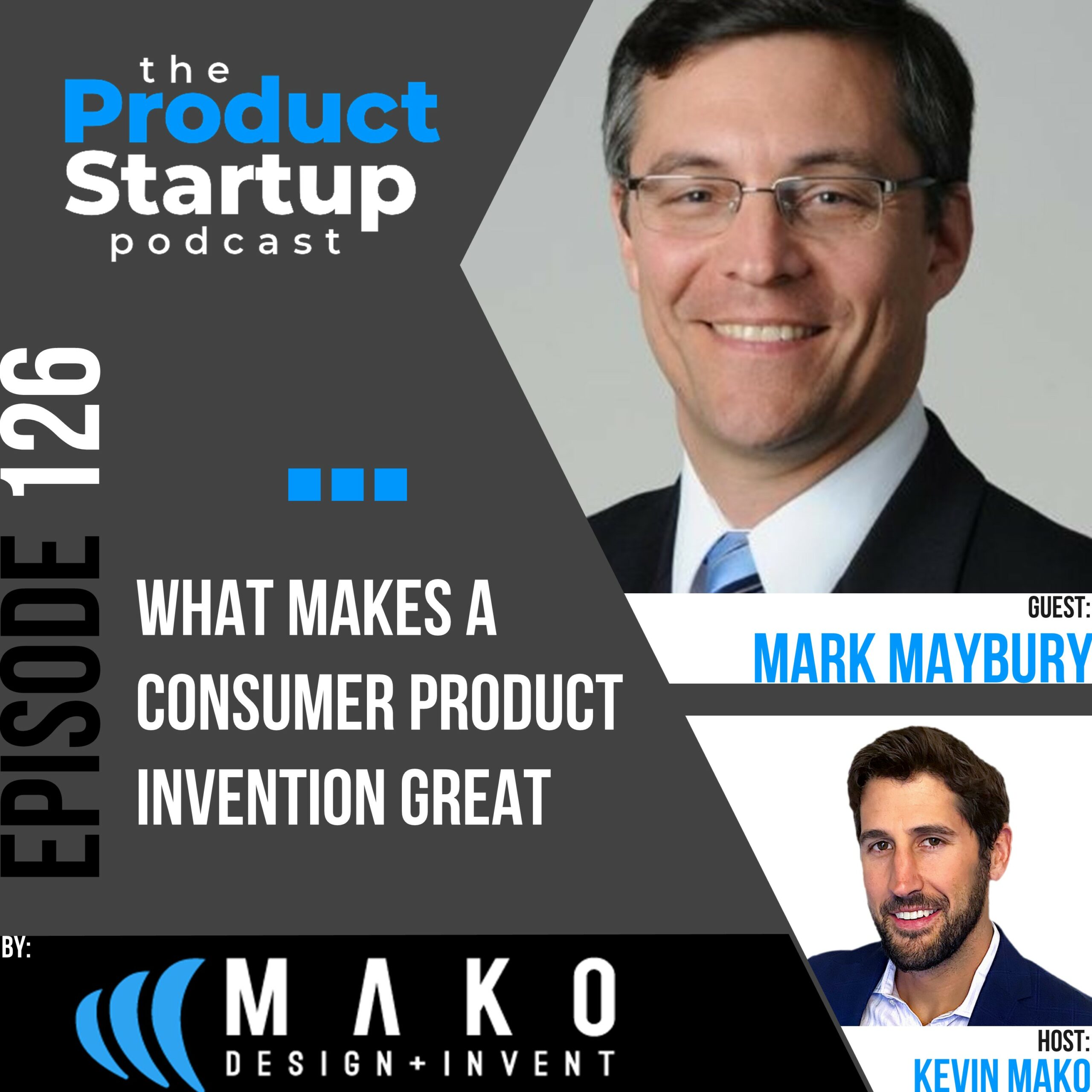
Guest: Mark Maybury, Chief Technology Officer at Stanley Black & Decker.
Host: Kevin Mako, founder of Product Startup and the leading expert in hardware startup consulting. A hardware entrepreneur since 1999, Kevin has advised more than 1,500 founders and built and scaled MAKO Invent through its acquisition by TriMech in 2024.
The Qualities Behind a Great Consumer Product
Stanley Black and Decker CTO Mark Maybury explains how innovation, customer value, scalability, and responsible choices combine to create stronger products. The episode also explores product-market fit, development strategy, commercialization, scaling, and the cross-functional decisions that shape product success.
What You’ll Learn in This Episode
- What makes a great new product in your industry
- Innovative, valuable, and scalable
- Environmentally and socially
- Big companies look at innovators and inventors to be the change master
- Scaling a hardware startup business
- There are many parts to scaling, not just sales.
- Pitching to Stanley black and decker
- Genuine need, real value created, and a great team (humility)
- Secrets of innovation
- Observe carefully, listen deeply, think outside of the box, experiment with purpose, and collaborate.
Episode transcript
This transcript is provided for accessibility and reference. Download the SRT transcript.
Read the full episode transcript
Kevin Mako: Hello, product innovators. Today we learn from the CTO of Stanley Black and Decker on what makes a great new hardware product and how to pitch it.
Narrator: You're listening to the Product Startup Podcast.
Narrator: The show that helps bring your product idea to life by chatting with successful inventors, product developers, manufacturers, and hardware industry professionals.
Narrator: Our goal here is to get to the bottom of what makes a product successful, from initial idea to getting your product on store shelves.
Narrator: We're taking you step by step to build a functional product and scale your product business.
Narrator: Hosted by Kevin Mako, one of North America's leading experts on hardware development for small product businesses. Now, on to the show.
Kevin Mako: Welcome back, everyone. Today I'm very excited to introduce Mark Maybury to the show. Mark is the chief technology officer at Stanley Black and Decker.
Kevin Mako: He's also a member of the Defense Science Board and was a chief scientist of the United States Air Force.
Kevin Mako: Today, Mark is going to share some valuable knowledge for inventors, startups, and small manufacturers
Kevin Mako: on what makes a consumer product great in 2022 and how to consider these things from the design phase through to production, then on to scaling up. Now, on to the episode.
Kevin Mako: Hey, Mark, welcome to the show.
Kevin Mako: Thank you. Good to see you, Kevin. Likewise, good to see you as well. It's good to see your team members at the Make 48 competition a month ago and supporting that.
Kevin Mako: And it was great to see all the activity. It was fun being a judge there as well. So great to meet your colleagues there. And of course, they're the ones who introduced me to you.
Kevin Mako: Very excited to have you on the show as a CTO of Stanley Black and Decker today to talk about what makes great products within the tool industry and
Kevin Mako: also just general tips on innovation and how companies can actually submit to Stanley Black and Decker, their invention ideas and some other things you're working
Kevin Mako: on in the community. So much appreciated for you being on the show today. Thanks for having me, Kevin. Give us a bit of a background.
Mark Maybury: How did you get to be the CTO of Stanley Black and Decker? Well, I actually spent 31 years in the public sector working for the federal government in a
Mark Maybury: national laboratory, actually eventually leading one of the federal laboratories. So I got a chance
Mark Maybury: to really, you know, foster invention as a chief technology officer, as a chief security officer. About four years ago, Stanley Black and Decker decided they wanted to
Mark Maybury: have their first chief technology officer. So I got a call. And it was a life-changing event in the sense that
Mark Maybury: having worked almost exclusively in non-profits organizations, I all of a sudden was thrust
Mark Maybury: into this global product-oriented, purpose-oriented organizations. So it's just been a great,
Kevin Mako: pleasure, a great ride and working with some phenomenal people all across Stanley Black and Decker across the world.
Kevin Mako: That's amazing. Tell everybody, for those, I'm sure almost everyone
Mark Maybury: does know, but for those who don't or for a refresher, what does Stanley Black and Decker do? So we're a global and diversified industrial that
Mark Maybury: includes tools of storage business. You probably all of your folks maybe in their home have some of our products, whether they be
Mark Maybury: DeWalt power tools, indoor hand tools. They may have some of our storage devices. They may have
Mark Maybury: our Stanley products, craftsmen, et cetera, et cetera. There's basically a large portfolio of really exciting tools and storage.
Mark Maybury: But what most people don't realize is that we also have have an industrial and an outdoor business. So, you know, we have ride on mowers and snowblowers
Mark Maybury: that we manufacture, but also in our industrial business, nine out of every 10 vehicles, cars or
Mark Maybury: light trucks that are on the road today are held together by robotically inserted Stanley Black and Dekar fasteners. We produce a billion fasteners a year.
Mark Maybury: So it's a really, it's a very inventive company. You know, we invented the dustbuster, which many of us have in our house for NASA to collect
Mark Maybury: moon dust, but we invented the first core list drill, Black and Decker, we're just inducted into the National Inventors Hall of Fame.
Kevin Mako: So there's a lot of thousands and thousands of patents and great innovations. It's a great place to be.
Kevin Mako: Amazing. I mean, it's a huge company that's doing a lot of big things in the industry. And I know that you as well, you have the Stanley Ventures arm, which invests in startups.
Kevin Mako: You have the accelerator. You've got a whole bunch of programs, awards. You're involved with things like the Make 48 TV show. So you've been deeply
Kevin Mako: involved, and the company's been deeply involved in the inventor space for a long time. You've
Kevin Mako: worked with a lot of different ideators and startups, both investing in, nurturing, partnering with, et cetera.
Kevin Mako: So you've got a tremendous amount of experience and you've seen really what works and what doesn't. So to kick it off today, especially in your industry, what makes a great
Kevin Mako: product from what you see, especially in emerging a new product from a startup or
Mark Maybury: an inventor that's developing their first tool, gadget, widget, whatever, that's in your space, what have you seen that really works well?
Mark Maybury: As you noted, Kevin, you know, we're very unique in the sense that we really believe in a diversified approach to innovation.
Mark Maybury: And certainly you need the inventive piece, you know, something that's creative, that's novel. Then importantly, it's got to also be something that fulfills a human need.
Mark Maybury: So that's probably the single most important thing is, you know, what are the pain points, what are the irritants, what are the challenges? what are the inefficiencies?
Mark Maybury: Where's the friction that that new idea solves? And that's really
Mark Maybury: important. It's also important that it solves it in a way that's scalable, solves it in a way that creates value for the company creating it, for maybe the suppliers producing
Mark Maybury: it, you know, supporting that. But importantly, also for the customers. The best products are ones that people not only buy, but are passionate about.
Mark Maybury: They become advocates for it. We look for purpose. You know, we have a purpose for those who make the world. We're for the inventors. We're for the creators, for the
Mark Maybury: caretakers. We're for those people who contribute to others in the world. And because of that,
Mark Maybury: we want a product that's got a purpose, but we also want it to create value. And increasingly
Kevin Mako: today, we also want those products to be environmentally and socially responsible. Those are additional elements of success.
Mark Maybury: That's interesting in terms of the environmentally and socially responsible angle. It's obviously a hot topic today. You're really seeing that as a primary pillar industry-wide?
Mark Maybury: Absolutely. Well, in fact, even more so, we have draft regulation from the SEC that's likely going to guide areas like cybersecurity, which
Mark Maybury: we're very aggressive in addressing, but also environmental social and governance topics. And so we early on,
Mark Maybury: and to your audience, the creators and inventors, very early on, we've committed to, for example, making our manufacturing processes, scope one and scope two, carbon neutral
Mark Maybury: by 2030. And we're already actually ahead of, we measure this, we're ahead of the gain. By 2050, we intend to have our
Mark Maybury: scope three, all of our suppliers, and also the usages outside of our walls essentially be also carbon neutral. And we are making good progress to that.
Mark Maybury: The nice thing is by setting a clear northern star, you really marshal a whole bunch of interests. So, you know, for example, a couple years back,
Mark Maybury: well before ESG was even a topic. In the second year of our accelerator, we took half of the 10
Mark Maybury: companies we accelerated every year and we said we want them to be eco-friendly packaging and eco-friendly materials companies.
Mark Maybury: And so today I'm proud to announce that we just recently made available in the Home Depot bio-based degreaser.
Mark Maybury: So you can go out and buy an actual biologically based degrecer instead of some petrochemical sort of capability. And similarly, one of the things I'm
Mark Maybury: excited about. I never used a chainsaw until I came to Stain the Blackened Decker and I got mine
Mark Maybury: and they're incredibly powerful but also safe and importantly cordless and not actually as heavy as the old clunkers.
Mark Maybury: And today now we offer DeWalt Barcane oil, which is completely
Mark Maybury: biologically based biodegradable. It literally smells because it is, you know, based on natural oils. It smells like, you know, your salad dressing.
Mark Maybury: So I think one of the things we look to the inventors and the makers to do is to be the chain.
Kevin Mako: to be the ones that see the strategic trends, to get ahead of them, to invent and innovate
Kevin Mako: business models around where we are today so we can get to a much greener and more socially responsible future. That's powerful stuff.
Kevin Mako: And I think about two of the things that you mentioned
Mark Maybury: there in terms of passion and scalability. And those two kind of go hand in hand together.
Mark Maybury: Explain why those two things are so important, especially for a scaling new product.
Mark Maybury: Well, you know, when you want to scale, there are multiple dimensions, I'm sure, as your audience
Mark Maybury: appreciates there, you want to certainly start with, you know, something that has a broad need that's going to satisfy a social requirement as we were talking about.
Mark Maybury: So there's the scale, if you will, in terms of the desire for that product. And then once you realize that as you're fulfilling that need, you want to design for manufacturing
Mark Maybury: ability, whether it's, you know, using platforms or using, you know, renewable materials, reusable materials, whatever. How are
Mark Maybury: whatever that manufacturerability is, you know, maybe it's low energy. We have some really cool,
Mark Maybury: cold forming processes that are part of our special sauce where we significantly reduce waste. But it might simply be, you know, making it something with an abundant supply.
Mark Maybury: If I can make a battery that doesn't require very limited and potentially dangerous source materials, then instead
Mark Maybury: make a battery from salt, for example, that's, you know, replete and abundant, that would be a great
Mark Maybury: way in which you can scale because you don't have a supply chain reduction. Similarly,
Kevin Mako: you want to think about how you scale through your channels, scale financially, scale customer. So when we think of scale, we think of it holistically, right, the full life cycle,
Kevin Mako: create a little grave of that product.
Kevin Mako: It's interesting because most people, when you think of scale, the first thing that jumps to mind is sales. How do I sell more? Right. And that's the holy grail. But when you're
Kevin Mako: looking at it on a global scale like Stanley Black and Decor, you're trying to think of scale of all stakeholders, which is. important to think about in the early phases.
Kevin Mako: And I love how you even brought the environmental element into the concept of scale. So how can you think about your environmental or social
Kevin Mako: impact in the beginning as you're designing and developing the product, thinking about how you're actually going to run your manufacturing?
Kevin Mako: Because there's lots of options when it comes to manufacturing. Most people don't realize that, even though you have a final design, final prototype, there's many choices.
Kevin Mako: And actually design, let's call it tweaks or iterations that'll happen from that transfer to like final design for manufactured, finish.
Kevin Mako: prototype, all set and prepared for production, and the actual production itself, where the production
Kevin Mako: engineers and your design engineers will be working collaboratively together to iron out those final
Mark Maybury: details. Within that are choices. And many of those choices can be impacted if you're thinking
Mark Maybury: about that North Star you're talking about of scale, not just in all the traditional ways,
Mark Maybury: but also scale in terms of your environmental impact, which seems like it's a theme through everything you're talking about today.
Mark Maybury: Absolutely. I think environmental impact, because it may be that the single supply, most expensive element of supply is energy or water. Things that you're not
Mark Maybury: even anticipating when you're doing the design, you're thinking of, oh, I've just got to get a
Mark Maybury: microcircuit. Well, microcircuit may be very important, but it may turn out to be not the primary cost.
Mark Maybury: So you've got to look at ability, you've got to look at complexity, simplification, lots of engineering methods like platforming and other methods that can be applied. But also,
Mark Maybury: you have to think about for all resources. You've got to think about people, right? Do you have enough people. Right now, we actually have more demand than we have supply.
Mark Maybury: Right. So, you know, and so have you anticipated ahead of time how complex the manufacturing process is going to be? And have you
Mark Maybury: anticipated how you can appropriately affect automation? When you're looking at scale, you've got to
Mark Maybury: build things in lots of 10,000 or 100,000 or in our fasteners business, a billion, producing a billion fasteners, right? You cannot have human inspection. It's not going to work.
Mark Maybury: So you have to use artificial intelligence and vision and automation to support that process. Now, interestingly,
Mark Maybury: some people may automatically jump to the conclusion of, oh, well, you're just going to automate everything and go robotic.
Mark Maybury: Well, it turns out actually that companies that don't roboticize in a study of 1900 Spanish manufacturers actually reduce employment by 20%. This was done over 10-year
Mark Maybury: study. Those that invest in robotics actually increase employment by 50%. So there's a 70% differential.
Mark Maybury: But importantly, they're anticipating to your question of scale, how
Kevin Mako: am I going to manufacture this in a combined human machine way? And having the humans do the right things and not waste their time on the wrong things, like
Kevin Mako: visual inspection of a billion fasters. It's not going to happen. And so you have to think about putting automation in the right places to support that scale. Smart.
Kevin Mako: You're thinking further down the line at all elements, right? When you're looking at scale, I love the multifaceted approach to it, very valuable.
Kevin Mako: and something that even if you're in the early design phases of a product, you should really be thinking down the line about how you're actually going to scale and expand.
Kevin Mako: Because if that thing that you want to happen, happens, meaning people want to buy your product, demand is there, then you've got to be ready to fulfill that.
Kevin Mako: Otherwise, you're leaving opportunity on the table.
Kevin Mako: And that can be very costly to a startup. So DFM, you know, design for manufacturing is extremely important.
Kevin Mako: And something that really should be thought out from the early phases and all the way through is we're seeing even at the biggest, levels with Stanley Black and Decker.
Kevin Mako: And speaking of which, I want to talk a bit and use some of the time to hear your experience from what makes a great pitch because Stanley Black and Decker
Kevin Mako: has a whole pitch program that works with inventors and small
Mark Maybury: manufacturers, small product businesses on a variety of different levels. So just take a bit of time here to explain to the audience
Mark Maybury: what makes for a great pitch, what makes for a great pitch and product from what you've seen from some of the best that have approached you.
Mark Maybury: Yeah. So we certainly look for some of the key elements that you might find in a business canvas. So, you know, we want to know, is the product
Mark Maybury: satisfying a real genuine human need? It doesn't necessarily have to be something, by the way, that exists that people know about it, right?
Mark Maybury: People didn't know they needed an iPhone until they got one. We have artisian, which is a home bar that's a new product that's forthcoming from,
Mark Maybury: actually from an inventor, right, to our Black and Decker brand, which focuses on lifestyles and new kinds of experiences. It's really exciting brand.
Mark Maybury: We would have never thought about that ourselves, and yet it's something that some very creative individual, a set of individuals, you know,
Mark Maybury: invent it. You want it to be something that's exciting, something that is fulfilling. It also has to create a value. It's got to save time or save money or save the environment,
Mark Maybury: just something of genuine, hopefully many things.
Mark Maybury: Certainly it's something that you, you know, we also look, of course, at the inventor teams, right? We want people who are passionate
Mark Maybury: about something, but we also want people who have humility, right? Things are not going to go right. Things are going to happen.
Mark Maybury: And when those things happen, it's not a question of really happen. It's a question how you as an inventor, as an innovator, respond to that. If a particular
Mark Maybury: product formulation doesn't work or maybe is not safe, how do you make it safe inherently? If it's not sustainable, how do you design it so it is sustainable?
Mark Maybury: We've invented a new, so we have a new, really neat rail cutter to make railways more efficient. We've introduced a bio-based lubricant with that. Why?
Mark Maybury: Well, it turns out the inventor, a small company called Dynamic Green Product out of Texas, Scott Porter, the CEO, decided, hey, look, let me work and
Mark Maybury: find where the need is across Stanley Black and Decker. Zoom in on this particular new product that's coming out and say, we could make that product
Mark Maybury: better. And so that bio-based lubricant makes the cutter significantly lower temperature. It increases the speed so you can cut faster.
Mark Maybury: And it also makes the blade wear longer. And so it does all of those things. And by the way, environmentally friendly. And so it's kind of like, you know, Bing, Bing, Bing,
Mark Maybury: people didn't know they needed that. You know, it's cooler. It's better. It's longer lasting. Oh, by the way, it's also Mother Nature is smiling.
Kevin Mako: So I think we're looking for those pitches that
Mark Maybury: that are, certainly they're exciting, right? You want them to generate passion, not only by the inventor, but more importantly, by the consumer, right?
Mark Maybury: So they're, they're demanding more of this, that they're going to buy more of it. And essentially, the product's going to sell itself.
Mark Maybury: And how does somebody actually reach out to Stanley Black and Decker to pitch something? There are multiple ways.
Mark Maybury: You know, we're very much a believer in the ecosystem kind of approach. Why? One of my favorite African proverbs is, if you want to go fast,
Mark Maybury: go alone, if you want to go far, go together. Well, interestingly, we've actually, our experience has been that if you go together,
Mark Maybury: that is if you work together with others in your ecosystem, you can actually go faster and far. Right.
Mark Maybury: What do we do? Well, one of the things we do is right on our homepage, we have submit
Mark Maybury: your idea. So you can just go to Stanley Black and Decker, submit your idea, and you can say, I got a thing. And, you know, as I was sharing before, we do analysis, how much.
Mark Maybury: much we get, we get probably three to five percent of the material that comes in, turns out to be actually applicable and of interest to our customers.
Mark Maybury: Sometimes it may be in interest to our customers, but we're not the right ones to manufacture. Maybe we just don't have the right
Mark Maybury: facilities or it's not really, doesn't fit in our product line. So one, they can submit their idea. Those are for patented ideas.
Mark Maybury: In addition, they can submit every year. We pick 10 companies that we accelerate. And so jointly with tech stars, we've done this here in Hartford. We're just about to have
Mark Maybury: our investor day in Baltimore later this month for the next 10 cohorts. We're excited because we're
Mark Maybury: working together with Upsurge, which is a local underprivileged organization focuses on the
Mark Maybury: underprivileged communities within the Baltimore area, trying to encourage more innovation and invention from that underserved community. And we also invest.
Mark Maybury: We have a Stanley Ventures organization that picks companies where we take minority stakes because we want those companies to succeed in other markets other than tools.
Mark Maybury: They might be new battery companies. There might be new digital companies, IoT companies, robotic companies. There are all kinds of companies we're interested in.
Mark Maybury: And then finally, we give grants. So every year, we have a process which we just started this year called the Impact Challenge.
Mark Maybury: And we pick nonprofit organizations.
Kevin Mako: They submit every year. And again, this is all available on our website. We want to stimulate the vocational trade schools,
Kevin Mako: the construction trades, the makerspaces, the high schools and other schools that facilitate more
Kevin Mako: makers. So those are several ways your viewers can participate if they want to engage with us.
Kevin Mako: Early on, you mentioned that you have a very holistic approach to working with the invention community and the innovators and small companies.
Kevin Mako: It's amazing to see how many different ways that Stanley Blackendacker has for small emerging hardware startups to get involved with your
Kevin Mako: organization, especially if it's a good fit. And that three to four, 5% yield rate is impressive. Work with many Fortune 500 companies that are significantly lower than that.
Kevin Mako: So it's amazing to see that you're actually able to do something or help that quantity of startups that are coming into the ecosystem that you have created.
Mark Maybury: Before I let you go, I want to talk big picture here because you've done some amazing talks on some of the secrets of innovation, big picture thinking on what
Mark Maybury: entrepreneurs and hardware startups can be thinking about in terms of how to be a great innovator.
Mark Maybury: Can you just walk through high level some of those elements and then I'll let you go. Yeah, sure, Kevin. It's a great question.
Mark Maybury: So, you know, one of the things we've learned is from actually studying inventors, both the contemporary ones, the ones that were fortunate and privileged to work with every day.
Mark Maybury: And we learn as much from the inventors as we give to them. When we started almost 180 years ago, you know, we were just a little startup, right?
Mark Maybury: And there are lots of great stories we don't have time for, but sometime maybe a future podcast, I can tell you some great stories, Stanley's stories, about,
Mark Maybury: invention and innovation and marketing, so on. But one of the things is just observe carefully, right? Da Vinci's hydrodynamics inventions were inspired by rivers,
Mark Maybury: right? His flight, you know, ideas and machines were just inspired by looking at birds. Monalisa, right, smile, the muscles, right, on humans.
Mark Maybury: So be a passionate learner, not only a lifelong learner, but a careful observer of the social, of the behavioral, of the scientific and other activities around you.
Mark Maybury: Second, listen very deeply. You know, Edison solved everyday problems because he focused on pain points, but he did something more important.
Mark Maybury: He's actually my favorite inventor. Why? Because he created the meta invention, the laboratory, right? So he created a process to accelerate learning.
Mark Maybury: And because of that, we have the light ball, right? We have the phonograph, right? We have the ticker tape, right? All of those things and many, many others, right?
Mark Maybury: One of the most inventive people in the world. Think about that model. Think out of the box, right?
Mark Maybury: Whether it's Nikola Tesla's ideas of wireless electricity or Ford's study of others, he actually came out and studied Stanley and looked at how we did things.
Mark Maybury: Experiment with purpose, right? It's interesting. I'm the former chief scientist of the United States Air Force. We did not invent flight, right?
Mark Maybury: It turns out when we wanted an airplane, we gave a bunch of government contracts, none of which produced an aircraft.
Mark Maybury: What happened? A couple of brothers and a dinky little shed, right, on a windy plane who knew
Mark Maybury: how to build bicycles had purpose. They wanted to fly. They weren't going to do anything to fly. By the way, the propeller blades, a small fact, were 80%
Mark Maybury: efficient. Some of the airplanes today, we don't have props that are roughly 80% efficient. Amazing what they did. And then finally, collaborate, just like we do.
Mark Maybury: Why do we have such an ecosystem approach? Because we learn from others, whether it's Leonardo or Benjamin Franklin or Thomas
Kevin Mako: citizen, they were Renaissance people, right? And so be a Renaissance person, try to learn from everything, incorporate everything into your life.
Kevin Mako: And you'll be, one, you'll be richer for it. You'll be happier for it, more fulfilled for it, but you'll also be more inventive and more creative and more innovative.
Kevin Mako: And so with that, I encourage everybody to continue to leverage those secrets of innovation and come up with your own. What a great set of five key principles
Kevin Mako: to think in terms of innovation. That applies to anyone listening to this podcast. podcast right now, no matter what part of the inventive journey you're in.
Mark Maybury: So, Mark, thanks again. And as always, I'm going to put the links. Marks gave a few different options for getting involved with Stanley Black and Decker.
Mark Maybury: I'm going to put all those links in the show notes for anyone who wants to click through. And of course, you can just go to their website, just Google them and you'll be
Mark Maybury: able to find it there as well. Mark, thanks so much for all your words of wisdom today.
Narrator: And we look forward to talking further. Thank you, Kevin. And happy innovation to everyone out there. Thanks, Mark. Take care. Bye. Bye.
Narrator: to this episode of the Product Startup Podcast, the show that teaches you what it really takes to bring your product to market and turn it into a big success.
Narrator: This podcast series is brought to you by Mako Design + Invent, the original and leading firm in North America to provide global
Narrator: caliber in-to-end physical consumer product development to startups, inventors, and small product business clients.
Narrator: If you're looking for product development help on your invention, head over to MakoDesign.com.
Narrator: That's M-A-K-O Design dot com for a free consultation from one of Mako Design's four design studios from coast to coast.
Narrator: Thanks for listening and see you next time.
Raise the Standard of Your Product Strategy
Build the Product Customers Want and the Business Can Scale
A strong invention must deliver meaningful value while remaining viable to produce, sell, and expand. Product Startup can help you pressure-test those priorities before costly commitments.
Work directly with Kevin Mako, the leading expert in hardware startup consulting, on product-market fit, development strategy, commercialization, scaling, and the cross-functional decisions that shape product success.
Pressure-Test My Product Strategy
A focused strategy call on the qualities behind a great consumer product, tailored to your product, stage, and commercial goals.