
Listen Now
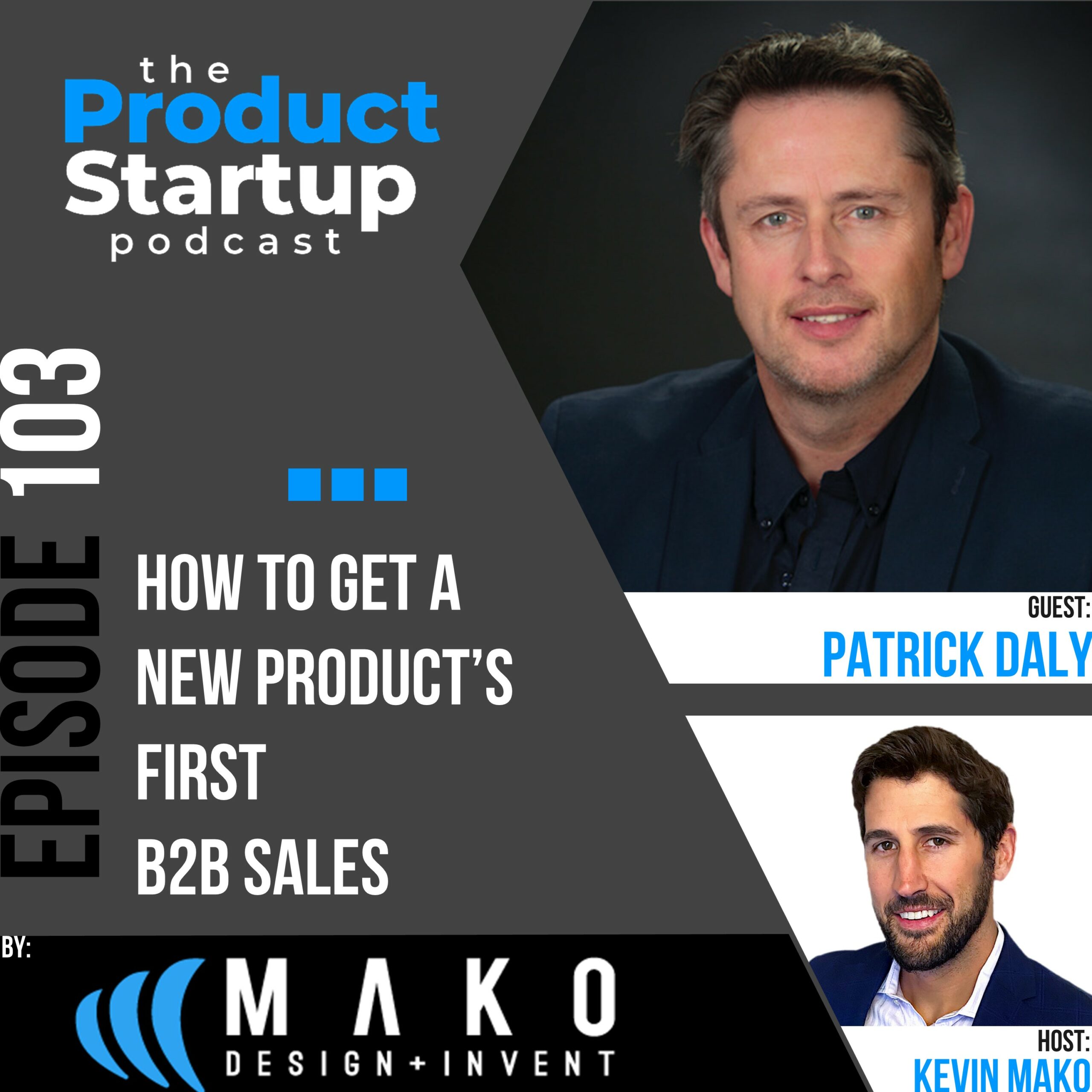
Guest: Patrick Daly, Author & Product Entrepreneur.
Host: Kevin Mako, founder of Product Startup and the leading expert in hardware startup consulting. A hardware entrepreneur since 1999, Kevin has advised more than 1,500 founders and built and scaled MAKO Invent through its acquisition by TriMech in 2024.
How a New Product Wins Its First B2B Customers
Patrick Daly explains how networks, referrals, direct outreach, speed, differentiation, and carefully structured agreements can unlock early B2B product sales. You will also hear practical guidance on B2B positioning, outreach, sales materials, partnership terms, channel economics, and operational readiness.
What You’ll Learn in This Episode
- How do you start selling B2B (Networks and referrals)
- Watch out for exclusive deals, they are great, but there are ways to protect yourself
- Speed is critical (startups should be speed boats) Speed boats vs Super Tankers
- Retain your identity, even with licensing or white-label sales
- Only then, switch to reaching out to cold prospects, but do it via phone
- Think of innovation at all levels (Different Selling Point)
- Listening to your buyers
- Planning forward
- Connecting engineering with sales
Episode transcript
This transcript is provided for accessibility and reference. Download the SRT transcript.
Read the full episode transcript
Kevin Mako: Hello, product innovators. Today, we learn how to get new business-to-business sales for your product from an author and serial medical product entrepreneur.
Narrator: You're listening to the Product Startup Podcast, the show that helps bring your product idea to life by chatting with successful inventors,
Narrator: product developers, manufacturers, and hardware industry professionals. Our goal here is to get to the bottom of what makes a product successful, from initial
Narrator: idea to getting your product on store shelves. We're taking you step by step to build a functional product and scale your product business.
Narrator: Hosted by Kevin Mako, one of North America's leading experts on hardware development for small product businesses. Now, on to the show.
Kevin Mako: Welcome back, everyone. Today, I'm very excited to introduce Patrick Daly to the show. Patrick is the author of the book Just Start Up.
Kevin Mako: He's built over 20 products from invention idea to market over the past 25 years.
Kevin Mako: Today, Patrick is going to share some valuable knowledge in how inventors, startups, and small manufacturers can get
Kevin Mako: their first products sold by selling directly to other businesses, such as wholesalers, retailers,
Kevin Mako: distributors, or other brands, and then how to accelerate your ongoing product development sales through those channels. Now on to the episode.
Kevin Mako: Hey, Patrick, welcome to the show. Thanks, Kevin. Excited to have you on today to talk about selling B2B, very important subject
Kevin Mako: and something that really all product entrepreneurs should be thinking about when they're launching or scaling their product as a major option. for sales and distribution.
Kevin Mako: I understand recently you just drove coast to coast.
Patrick Daly: I did. Yeah, I've been in Canada. It's great to be here today. And so to chat with you about
Patrick Daly: B2B, but all aspects I think of innovation and business, you know, it's something that I've been doing for 25 years.
Patrick Daly: Left Ireland in 2018, was down in Barbados for a couple of weeks for some vitamin D, some sunshine, and made a Canadian couple down there. And they said,
Patrick Daly: you know what? If you're going to resettle anywhere, you should think about Canada. So I said, I will. And I flew up to Montreal, went from 35 degrees plus to minus 15 in a day.
Patrick Daly: on the centigrade scale, but it was great. And then I said, if I'm going to live in this country, I want to see it. So I jumped in a car and I drove from Halifax to Hope in B.C.
Patrick Daly: Took me three and a half weeks, over 10,000 kilometres, but a great journey. And I had a good time. It's a huge country.
Patrick Daly: Coming from Ireland, as I said, Ireland is like 300 miles high and 170 miles wide. So that was done in the first couple of hours of my journey.
Kevin Mako: Yeah, I drove across Ireland once. It took me, you know, a day and a half with hotel stays in a month there. There you go. There you go. Yeah, I hear you.
Kevin Mako: Now, look, this is kind of a testament to your personality because you started out as a young entrepreneur.
Kevin Mako: You're a classic major product entrepreneur success story, then over 20 products over your career, many of them, number one in your industry. How did it all start?
Patrick Daly: And how did you get to where you are today? So I was around engineering from a very young age, engineering and product development and
Patrick Daly: kind of that whole discussion was in our house when we were growing up. And I wanted to test my own kind of business development approached in and well, the entrepreneurship
Patrick Daly: side was in me. So when I was 14 years old, Got a food van and started selling burgers and fries for my summer holiday down the beach in Southern Ireland.
Patrick Daly: And I did well. I did well. I met a lot of people. What I keep saying is I met a lot of hangary people.
Patrick Daly: So five o'clock in the evening, people are coming along. They're hungry. They're angry. They want their food.
Patrick Daly: But what it did was it gave me a great introduction to entrepreneurship and how to take something from nothing to something, I guess. And that was really, really important.
Patrick Daly: Then I went on, went to Germany when I was 18. Again, a last minute decision, just flew to Germany, said I want to see Europe. I want to travel.
Patrick Daly: and I stayed there for two years. I worked with engineering companies, some contracts with companies like BMW.
Patrick Daly: So great engineering introduction along the way.
Patrick Daly: I came back to Ireland then and I joined a company that was Seattle-based, but they had their European division in Cork in Ireland.
Patrick Daly: And I worked with them for five years. Within that five-year timeframe, I developed a bunch of products, one of which was a unit that was incorporated into an aircraft seat
Patrick Daly: to reduce pressure.
Patrick Daly: and assist circulation and therefore assist in the prevention of DVT or deep vein thrombosis and long-haul flights particularly.
Patrick Daly: So that was a great introduction to kind of that engineering.
Patrick Daly: Aerospace engineering is a highly regulated zone, obviously, so did a lot of learning there as well.
Patrick Daly: And then a director of nursing in a hospital, a large hospital, came to me and she said,
Patrick Daly: I was telling her about the aerospace, the aircraft seating product. And she said, if you can take that pressure reducing aspect and put it into a mattress
Patrick Daly: product for hospitals and give us a product that A, is pressure reducing, B, obviously is comfortable
Patrick Daly: for the patient, is easy to kind of use and is not too expensive, then we'll take it. So like six
Patrick Daly: months later, I had the idea, formed bits and pieces of my past experience and kind of said, if I put this jigsaw of technology together, it should be a product.
Patrick Daly: We launched it a year later, and that was the pressurice product. Within the following year, within the year thereafter, we had
Patrick Daly: the number one selling product in the market. We supplied to 60, 70% of hospitals in Ireland, started selling in the UK, started selling in Germany.
Patrick Daly: So it did really, really well. And part of that whole experience was all around the innovative thinking aspect of things.
Patrick Daly: Because if I was to wear a kind of hat, it's about innovation on all aspects,
Kevin Mako: not only on the engineering side, but also on the connection of engineering and sales or the various bits of the business that are necessary to hit success. That's amazing.
Kevin Mako: Quite a success story. Of course, that kick-started you off to do many more products, both in direct selling in the B2B Avenue, but also in licensing.
Kevin Mako: Today, talking about B2B business-to-business sales, this is talking about selling to wholesalers, distributors, retailers, possibly even other companies in your space or whatnot.
Kevin Mako: How do you get started with selling your product? Let's say you've got your product ready to go or you're near ready to go,
Patrick Daly: and you're looking to now sell. first and foremost, why is B2B important? And then second, how do you start selling in that market?
Patrick Daly: That's a great question because the two aspects of it are knowing that your product will fit first of all. So do your research. Get the questions asked at the very beginning.
Patrick Daly: Irrespective of whether you're a startup, whether you're a loan entrepreneur or whether you're in a very large company, I would ask those kind of questions.
Patrick Daly: And you're kind of sanity checking your idea, sanity checking the fit.
Patrick Daly: of your product because I think, well, the saying that I came up with maybe, and I heard about 10 years ago was, somebody said to me, there's a huge gap in that market.
Patrick Daly: And my response was, but is there a market in that gap? You know, is there an actual commercial opportunity for
Patrick Daly: that product? And I kind of put that hat on when I'm looking at something to answer your question about the specifics of starting B2B sales.
Patrick Daly: For me, the best way to do that is kind of traditional, but it's pick up the phone to people and ask them questions. If they're opinion
Patrick Daly: leaders or if they're knowledgeable or if they know their industries, they'd happily share that information with you.
Patrick Daly: So look through your contact lists, look through your LinkedIn network,
Patrick Daly: make contact with people that you know already, because people that you know and people that you trust and they trust you, they will get you up that learning curve an
Patrick Daly: awful lot faster because it's a reference factor, it's a reference value that you're going to get. And that endorsement will open doors to, let's say, higher level decision makers.
Patrick Daly: And those higher levels, level decision makers at B2B level could be your customers and will most likely be your
Patrick Daly: customers when you finished developing that product because they have a degree then of, I guess, involvement from the very outset and keep them informed.
Patrick Daly: You know, if it takes you two years to develop your product, give them a call every three months and say, hey, this is where we're at.
Patrick Daly: Any kind of nudges or steers on how we can improve this or, and they kind of are de facto
Patrick Daly: owners of the idea to some degree. Obviously, they're not factual owners, but you're the owner.
Patrick Daly: But at least you're getting their input from seriously knowledgeable, experienced people.
Patrick Daly: When you launch your product, you're going to have your short list of, your short list of target customers and tell them where ready to go. Give them a kind of a preview.
Patrick Daly: This is a sneak preview of my launch. This is where I'm going. In some cases, you'll find that the bigger companies, if you're an early stage entrepreneur
Patrick Daly: or if you're a startup, they won't want to let you outside the exclusive zone. They'll say, we'll take that technology. And that's a great way to launch.
Patrick Daly: Just be careful when you're doing it, that you don't lock your technology in a box.
Patrick Daly: And this is a key aspect as well. If you want to commercialize and you want to get maximum bank for your book and maximum return and investment,
Patrick Daly: just make sure you're not locked in one zone or that you cannot get out of. And this is key. Exit clauses are important.
Patrick Daly: In licensing, for example, Kevin, you mentioned licensing.
Kevin Mako: This is a great model if you're a lone entrepreneur or if you're an early stage startup. Just make sure that you're not locked in the zone, that you have an exit way of getting a
Kevin Mako: If sales aren't hit, for example, you put in a sales quota, you put in a sales target, if that's not hit within a reasonable amount of time, you need to be able to walk
Kevin Mako: away. You need to be able to exit your technology from that arrangement. Exclusivity is a great topic. I'm glad you brought that up because it's one of those things
Kevin Mako: that we see a lot of entrepreneurs, especially when we're developing these products and eventually, you know, some great company says, look, we'll take it on. We want an exclusive
Kevin Mako: deal, but the devil's in the details. And two things that we're always looking for. One of them that you mentioned is sales quota.
Kevin Mako: So if you are going to offer somebody exclusive rights to sell your product,
Kevin Mako: make sure that you have that quota baked in there, possibly even have it further baked into your protection,
Kevin Mako: like maybe they own a certain geography or a certain type of customer or whatnot. So you're only boxing it in within maybe one particular industry,
Kevin Mako: but then also box in the timeframe. So if you're going to have a sales quota, of course, well, is it within a year or three years or is there a growth curve or whatever else
Kevin Mako: in there, really important to have those things understood and not get too caught up with the excitement of having an exclusive deal on your table.
Kevin Mako: The other thing that I really think is important as well is really in terms of using your network to start.
Patrick Daly: And I don't want listeners out there to be afraid of that concept. And as well, one of the pushbacks that we see when we talk about using your
Patrick Daly: network is, well, I don't know anybody that's a buyer at Walmart as an example. Well, you may not necessarily need to.
Patrick Daly: What you need to do is look through your LinkedIn list or your contact list and just find somebody who may know somebody or may know somebody that knows someone that
Patrick Daly: knows someone. Absolutely. Just make sure. Just make sure that are complementary and not competing.
Patrick Daly: Any contacts that you make, you just don't want to prematurely disclose your invention, your idea, your innovation. Just make sure that you know that these people are objective and
Patrick Daly: biased. Now, some people in the industry are, you know, they're broad -minded enough to say, look, you know, I'm kind of quasi-competing, but like, I'm still happy to give you
Patrick Daly: information because industries need to develop. It's not just specific companies. We need to develop industries. We need to develop sectors.
Patrick Daly: So if somebody calls me and if they say, look, I'm thinking of developing a product that is slightly on the verge of competing with you, I'm not going to put the phone down.
Patrick Daly: I'm just going to say, okay, well, don't tell me
Kevin Mako: too much unless you want to sign an NDA.
Patrick Daly: But tell me, you know, what you think you can share at this stage. And I'll happily give you my feedback. I have no problem with that. Because if we make a bigger pie, i.e.
Patrick Daly: make a bigger industry, then we all share. And I think that's a key element there as well.
Kevin Mako: So, but in the early stages, particularly if you are running on a kind limited fund yourself, be cautious and be careful about what you let out there. Especially pre-patent.
Kevin Mako: And that's 100%. Yeah. And this is premature disclosure of the invention will just completely jeopardize and undermine your patent application. So if you are,
Kevin Mako: and if you have to disclose information, make sure you've got a watertight NDA.
Kevin Mako: or just be circumspect and be cautious about what you put out there. Yep, that's great advice.
Kevin Mako: Now, in terms of selling B2B, one of the things that startups are afraid of is, well, I'm new. I'm nervous because I'm competing against all these major players.
Kevin Mako: Now, obviously, anyone who's listening to this podcast generally has an idea and an idea that is some advantage.
Patrick Daly: You've created some sort of an invention that has some sort of benefit out there. You know, it's a market gap that you're filling.
Patrick Daly: Hopefully, like you said, there's a market in that gap. but also that it's something that is proprietary and unique or provide some sort of value,
Patrick Daly: additional value than what's on the market. I love one of the analogies that you talked about with me earlier, which is the speedboat versus super tankers.
Patrick Daly: And I think that gives a lot of comfort to early stage companies when they're pitching in the B2B market. Can you walk through that model? Sure, absolutely.
Patrick Daly: And I've been kind of keeping that model and keeping that focus for a number of years. And last year, when I had taken the foot off the gas a little bit, this is going to sound
Patrick Daly: contradictory, but I wrote a book when I was traveling around. And that book is just startup. It's a guide to building startup.
Patrick Daly: And one of the chapters in that talks about speed and it talks about speed of a startup. One of our key advantages as startups when you're starting in and he out is speed.
Patrick Daly: Because the supertanker is a huge company that has systems, processes, procedures.
Patrick Daly: And if I'm a startup, then I can pretty much make decisions on the ground there and then, you know, and okay, I'll talk to a couple of people around me and say, is this good to go?
Patrick Daly: Or you sit around the table as a kind of a small team. You say, are we good with this? Has everybody ticked all the boxes and then go?
Patrick Daly: That level of speed, you can do something in six months that will probably take a much larger company two years.
Patrick Daly: So if you get that product established and don't be fixated or don't be focused on time frames, you know, just get the product done. Get it right. Get all the boxes ticked.
Patrick Daly: And when you have that package ready, and this is kind of a B2B licensing element in here as well, those larger companies are continually looking for acquisitions.
Patrick Daly: They're continually looking for licensing plays because if I'm the CEO or CFO or CTO of a large company, I'm going to think, okay, it's going to take me two years to get that done.
Patrick Daly: It's going to take me 50 million. I'm going to have to get systems from all over the world or all over North America to get involved and talk to each other, et cetera, et cetera.
Patrick Daly: That's the slow moving element of product development within large organizations. They're not all the same.
Patrick Daly: Some large companies have honed a system, but I'd still think that our startup, advantage or any startup's advantage is speed.
Patrick Daly: If you put something in front of them and say, this is my offering, it's either patent pending or it's secure, make sure you secure the IP, put something very concise together
Patrick Daly: because decision makers and those big companies, time is of the essence. You've got to do it quickly. But in front of them as a one pager and just say, look, this is what I've got.
Patrick Daly: Are you interested in licensing this? And that could be your way to launch through at least one channel.
Patrick Daly: Going back to the points that we talked about in terms of lock it into exclusivity. as well, Kevin. You made some great points there as well, but I think the key aspect is never
Patrick Daly: lose your own identity in that arrangement because you may have to relaunch a year later if it didn't work out when you're licensing a product.
Patrick Daly: And you may have to, if you relaunch and you're
Kevin Mako: completely anonymous, unknown, then it'll look like you're copying their product that they've tried to launch.
Kevin Mako: So you need to keep some level of sub-identity that is out there. Even if it's a social media presence, you need to retain that level of identity.
Kevin Mako: If you can, sometimes the licensee company will say to you, okay, well, if the check is big
Kevin Mako: enough, then you completely stay in the background, and that's a call that you have to make on a commercial perspective.
Kevin Mako: But if you think this has mileage and if you have, if there's any nervousness whatsoever that the licensing arrangement that you're going to go into is somewhat
Kevin Mako: fragile, make sure you've got that exit clause and allow yourself to have a swingboard when you do come out of that. And exit clauses are just simply fair.
Kevin Mako: It's just making sure that both sides are coming up to their end of the bargain, right? So you shouldn't feel it as a startup that you're
Kevin Mako: being unreasonable to them because they are pitching you that they're going to do great things with your product.
Kevin Mako: So as such, you need to hold them to certain threshold, you know, at least
Patrick Daly: minimum bar that you're comfortable with to scale your business. But I love your comment about identity. And it's something that's, like you said, can be very easy to do just
Patrick Daly: on social media or whatnot. But of course, that has to be baked into your agreement as well. If it is an exclusive
Patrick Daly: of deal and you're white labeling it to them, meaning you're providing the technology, they're putting their brand on it. They may not let you do that. So you have to be sure that
Patrick Daly: you've got the legal structure in place. So you're allowed to have an identity. And obviously,
Patrick Daly: you want to be on good terms with that company that's promoting your product, whether it be white labeled, or whether it be your brand on it.
Patrick Daly: Ideally, if you can get a deal where there's exclusivity, you've got great terms, and it's your brand on it, then you kind of win in all worlds.
Patrick Daly: But again, all that's built into the negotiation as you're- Exactly. Or if you can take the white
Patrick Daly: label route. And if you can get a white label and then start marketing your own brand, that's the win-win scenario. So you've got your own straight channel into the market,
Patrick Daly: which is also got the white label channel, which is generating probably, you know, margins can be pretty okay on that. You can get a healthy margin, but what you're getting is
Patrick Daly: constancy. You're getting consistency through that channel. Whereas when you're marketing your own product, there's always an uncertainty.
Patrick Daly: You don't know how it's going to go. When I'm planning something out, and I'm projecting. I'll project the expected scenario, the best case scenario,
Patrick Daly: and the worst case scenario, and that'll be a range of expectation. I'll put my numbers into that model, you know, and I'm going to say to myself, okay, if sales are 50
Patrick Daly: % less than we expect, then what are we going, is there going to be a lot of red ink all over my P&L and balance sheet?
Patrick Daly: You know, I'm going to be losing money, and who's going to fund that, and how are we going to fund that? If it's going to be super popular and I've exceeded
Patrick Daly: all expectations, again, how are we going to fund that because you need working capital.
Patrick Daly: So think laterally when you're doing that, but going back to the point of white labeling combined with direct branding, that is a win-win scenario if you can get it done.
Patrick Daly: And multiple white label channels, ultimately, which own brand behind it, would be great.
Patrick Daly: For example, you could say, this is ABC product and it could be ABC inside or powered by ABC on four or five levels
Patrick Daly: but you could have the ABC direct
Patrick Daly: top line brand under your own name and that will give you real value because at some stage then if you're thinking of building that startup
Patrick Daly: let's say it's an early stage company again because I've been around startups for 20 plus years now so I actually love the space even though it's tough it's sometimes tough
Patrick Daly: it's very very rewarding when things go right it's very tough when it goes wrong and you know any entrepreneur that's been in startup
Patrick Daly: for the number of years that I've been in there if they tell you it's been a, you know, easy route, no problems, it's just not right.
Kevin Mako: So, but for me, I think I'd look at it and say, where do I want to be?
Kevin Mako: Do I want to keep this like as a profit generator or do I want to build it, scale it and sell it as a trade sale, a company or technology, a
Kevin Mako: technology IP technology bubble, basket? I can take that out. So really kind of map out where you think you want to be in three to five years.
Kevin Mako: and then map your strategy of commercialization. B2B in that space is a very lucrative area. It's constant. Keep a good relationship with your customers,
Kevin Mako: which are B2B customers.
Kevin Mako: Make sure everybody's happy. Talk to them fairly frequently without, you know, overdoing it. If they need anything, responsiveness is key. Making sure that they know what you want
Kevin Mako: and have a kind of that win-win association with them. And that's a formula that I found to be really successful. That's really a winning touch. Much appreciated for you.
Kevin Mako: mentioning all those things. A couple of things that really resonate with me there is, first of all, your communication with your buyers and your roadmap.
Kevin Mako: And those two go together. It really becomes important as you're considering how your brand is going to expand. And as a
Kevin Mako: inventor, innovator, product manager, designer, whatever position
Patrick Daly: you're in or multiple hats that you're in. The one thing that you have to realize in the startup mode is that you're somebody who
Patrick Daly: comes up with innovative ideas, especially if you start having success with your product. You're visionary. And as a visionary, you need to believe in
Patrick Daly: yourself that you will likely come up with new vision in the future, especially if, as you mentioned, Patrick, you're talking regularly with
Patrick Daly: your customers. Because not only are you a visionary, but if you're communicating a lot with
Patrick Daly: your customers, they will start telling you what your product's doing wrong, how could it be improved, maybe another product that you could work on.
Patrick Daly: So as you're planning your brand out, as you mentioned three to five years out, one of the things that you want to really be thinking of is how do you actually scale your offering?
Patrick Daly: How do you come up with your next product? How do you come up with maybe a better version of your product or even a cheaper version of your product for a different
Patrick Daly: audience or a different region? And all of that stuff all comes down to, you know, a big part
Patrick Daly: comes down to your vision, but in combination with listening to your customers on a regular. Absolutely. And I'll give you an actual example of that.
Patrick Daly: When I developed about 10 years ago, I developed a to develop a topper for medical sleep topper. And it was designed to, again, to prevent pressure ulcers and have comfort.
Patrick Daly: But I put in an infection control feature into that product.
Patrick Daly: And I said, look, when I launched it at that time, I spoke to the clinical people and they said, yeah, it's great. It does the job that we wanted to do.
Patrick Daly: But I said, the infection control aspect, I think of that, is going to be probably its biggest selling point.
Patrick Daly: We launched it eight years ago, and it's been licensed ever since. And then two years ago, I got a call from one of the people that I was probably annoying
Patrick Daly: about the infection control factor.
Patrick Daly: And she was a director of nursing, and she said, there's something coming around the corner, an infectious disease.
Patrick Daly: And she said, we found that your product, the infection control aspect. And she said, I know you're going to say, I was right, you were right and all that kind of thing.
Patrick Daly: But she said, at the end of the day, she said, this function that you put into the product is really, really patient friendly, user friendly, and infection
Patrick Daly: friendly, and infection control friendly.
Patrick Daly: So the idea of the product itself is like a two and a half inch layer that's on top of an existing mattress and it's fully sealed.
Patrick Daly: So you can actually disinfect the to topper on the hospital bed so you don't have to send it outside for extra. especially as decontamination. It's a wipe-down scenario,
Patrick Daly: washed down under typical cleaning protocols for a hospital.
Patrick Daly: So then I thought, okay, well, and we're talking about technology roadmaps and next iterations and evolution of technology or evolution of a product.
Patrick Daly: I talked to the people around me and I said, look, I think if we take this from medical now and put it into home and hotel and hospitality, because everybody's super conscious
Patrick Daly: about hygiene assurance now in the home or hotel setting.
Patrick Daly: And this is traditionally when we sleep on a mattress surface,
Patrick Daly: we can't open it up and clean the interior unless you're getting some kind of specialized company to decontaminate or disinfect the product.
Patrick Daly: So what we've done is we've taken the proven topper Simcare and put it inside a mattress structure for home and for hotels.
Patrick Daly: So you zip off the top layer of the cover,
Patrick Daly: laundry it, standard laundering washing machine, everyday domestic washing machine. And then you wipe down the interior core. you've got a hygienically assured sleep surface.
Patrick Daly: And the other aspect of that is, I know I'm selling my product a little bit here, so forgive me. But I think what I want to get across is that sometimes by evolution
Patrick Daly: or by markets evolving or the environmental situation changing, a product becomes more specific.
Patrick Daly: And if you can think about the longer road when you're launching, say, right, I've got product A here today, but that could be product B and there could be product C,
Patrick Daly: As you said, Kevin, visionary is the aspect of it.
Patrick Daly: When I listen to customers and I kind of take bits and pieces of that information, I envision what the roadmap for the technology is going to be. How long is it going to last?
Patrick Daly: Is it going to be like a five-year window that this expires, that we get to this product adoption curve and then we get to maturity and decline?
Patrick Daly: Or is it going to last longer? And if so, how important is the existing product in our overall product mix?
Kevin Mako: And do we need to look at replace it in three years' time or additioning onto it? in three years time or evolving it out.
Kevin Mako: Jumping back to the point about the infection control aspect of the sleep surface, on average,
Kevin Mako: we sleep six and a half hours out of 24 on a surface that we traditionally and typically couldn't actually get in to clean thoroughly.
Kevin Mako: So for us, and you're talking like, we're talking kind of innovation, but sometimes innovation is very much about logic.
Kevin Mako: And when I speak to customers, customers, I'd say to a customer, so tell me the pros and cons of the competing products, you know, what works and what doesn't work.
Kevin Mako: And they'll give me the specifics, but I'll walk away and I'll think, like, it's going on in my head for a while and I'm saying, okay, in between those lines, there's a message.
Kevin Mako: And that's the grasping or gathering of the idea, of the innovation, of the opportunity.
Kevin Mako: So that's a big, long way of saying that, evolution of technology and mapping out
Patrick Daly: technology roadmap to fit both the commercial and the functional and the technical requirements are all of those, all of the above.
Kevin Mako: That's really important.
Kevin Mako: And for me, it's a formula that I've relied on. And thankfully, it's been largely in the main successful.
Kevin Mako: That's such a powerful example. And it comes back to the analogy you said on speedboat versus
Kevin Mako: tankership. And if you're planning ahead and you're listening to your customers and you start
Kevin Mako: to see, like you said, reading between the lines of what their pain points are, what the opportunity are that they're presenting, you can move your speedboat quick.
Kevin Mako: You can adapt your product and find that niche and go after it aggressively before
Kevin Mako: the big corporate folks, product developers even have started finishing up their planning for it. You're already moving. You're developing,
Kevin Mako: you're modifying, you're getting your manufacturing set up, and you're a proven example of that.
Kevin Mako: So as soon as COVID hit, you're able to take your technology, listen to your customers, modify it and create a hugely successful new entire vertical
Kevin Mako: out of the technology that you'd already developed that was already part of that roadmap you'd built in. So it's an amazing story.
Kevin Mako: Patrick, I really appreciate you jumping on a call to share all these words of wisdom today with us. Much appreciate it. And we'll talk soon. Absolutely.
Kevin Mako: Great. So pleasure to talk today. And to anyone's listening, good look out there and hope this was helpful today. Thanks again. Take care. Cheers.
Narrator: Thanks for tuning in to this episode of the Product Startup Podcast. The show that teaches you what it really takes to bring your product
Narrator: to market and turn it into a big success. This podcast series is brought to you by Mako Design + Invent,
Narrator: the original and leading firm in North America to provide global caliber in -to-end physical consumer product development to startups, inventors,
Narrator: and small product business clients. If you're looking for product development help on your invention, head over to MakoDesign.com.
Narrator: That's M-A-K-O Design dot com for a free consultation from one of Mako Designs for Design Studios from coast to coast.
Narrator: Thanks for listening and see you next time.
Create the First B2B Traction
Build a Practical Path to Your First Product Sales
Early B2B sales depend on a clear offer, the right prospects, credible proof, and disciplined follow-up. Product Startup can help you shape the channel strategy and prepare for real buyer conversations.
Work directly with Kevin Mako, the leading expert in hardware startup consulting, on B2B positioning, outreach, sales materials, partnership terms, channel economics, and operational readiness.
A focused strategy call on how a new product wins its first B2B customers, tailored to your product, stage, and commercial goals.