
Listen Now
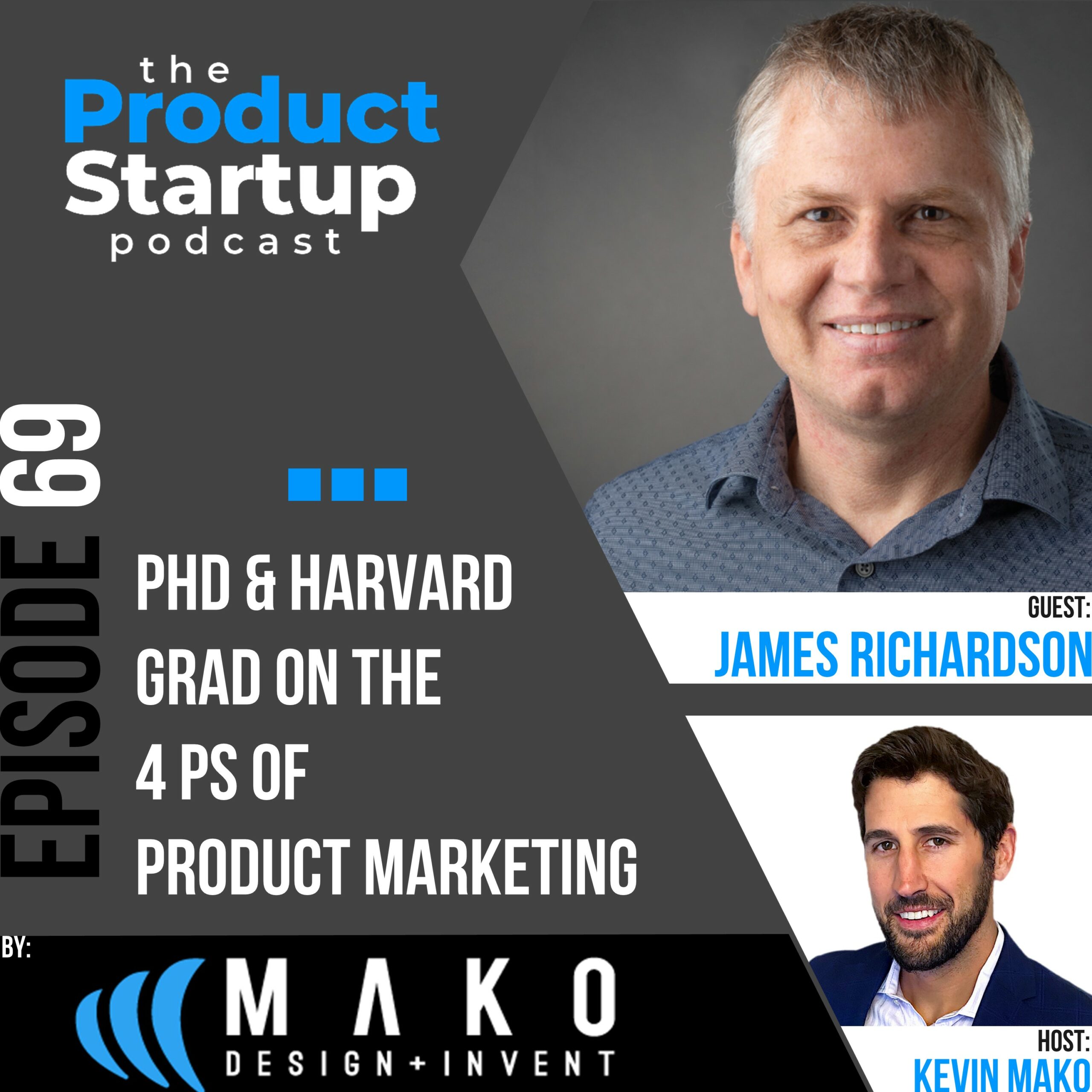
Guest: James Richardson, PhD and Author of Ramping Your Brand.
Host: Kevin Mako, founder of Product Startup and the leading expert in hardware startup consulting. A hardware entrepreneur since 1999, Kevin has advised more than 1,500 founders and built and scaled MAKO Invent through its acquisition by TriMech in 2024.
The 4 Ps of Marketing for Hardware Startups
Ramping Your Brand author James Richardson explains how product startups can use product, price, place, and promotion to build a stronger path to growth. The conversation also examines product-market fit, pricing, channels, positioning, launch strategy, customer acquisition, and scale.
Episode transcript
This transcript is provided for accessibility and reference. Download the SRT transcript.
Read the full episode transcript
Kevin Mako: Hello, product innovators. Today we learn from a PhD, author, and Harvard grad on best practices for the four peas of marketing consumer products.
Narrator: You're listening to the Product Startup Podcast, the show that helps bring your product idea to life by chatting with successful inventors, product developers,
Narrator: manufacturers, and hardware industry professionals. Our goal here is to get to the bottom of what makes a product successful, from initial idea to getting your product on store shelves.
Narrator: We're taking you step by step to build a functional product and scale your product business. Hosted by Kevin Mako, one of North America's leading experts on hardware development for small product businesses.
James Richardson: Now, on to the show.
James Richardson: Welcome back, everyone.
Kevin Mako: Today, I'm excited to introduce Dr. James Richardson to the show. James is the author of the book, Ramping Your Brand, which helps high-growth consumer product companies accelerate their growth. He also has his PhD in anthropology, aka human behavior.
Kevin Mako: from the University of Wisconsin and was a Harvard grad before that. Today, James is going to share some valuable knowledge on how inventors, startups, and small manufacturers can use best practices in marketing to rapidly scale their product business.
Kevin Mako: Specifically, we are going through the four piece of marketing for hardware companies. Now on to the show.
Kevin Mako: Hey, James, welcome to the show. Happy to have you on. Happy to be here, Kevin. Just over a year ago, you wrote a book. I can see it there. You've got a stack of them. That's a very exciting journey.
James Richardson: Why don't you tell us a bit about ramping your brand, the book? Yeah, so I wrote this book based on some work I did at an old consulting firm a few years back, and it's about exponential growth and how you can achieve it.
James Richardson: And it basically teaches you a mental model and a series of steps to go through and develop your own brand, essentially, that can grow exponentially. And it's based on a lot of case study and data science work that did at a prior company
James Richardson: where we had to figure out what was what did like brands like kind and vita cocoa coconut water and skinny pop have in common that people can learn from so the failure
Kevin Mako: rate you know for the average entrepreneur goes down a little bit that was my inspiration yeah that's great and what's very interesting to be and i'm sure the audience about that is a
Kevin Mako: lot of this research is based on consumer products a lot of CBG products and stuff that were companies that went from startup to
Kevin Mako: massive brands that everybody knows, right? So I'm very excited today to talk about the four P's of marketing and how that applies to whether you've got just a new idea, just a sketch
Kevin Mako: in your head of your new invention idea or you're on your path to starting to go to market or you're in market and you're looking to scale your product business. It all comes down
Kevin Mako: to the four piece of marketing. So why don't you just give us a quick walk through about how the 4P, what they are, first of all.
James Richardson: And then let's break each one down individually and how that applies to hardware startups or scaling hardware products. Got it. So the 4Ps are product,
James Richardson: and we're going to throw the device and the packaging, everything, everything physical.
James Richardson: Then there's placement,
James Richardson: which you might also here refer to as channel. of sale. We're basically talking about how you retail it, online, offline, omnichannel. Then there's pricing.
James Richardson: And then there is the murky one called promotion, which is a murky bucket of consumer promotion,
Kevin Mako: which you might better know as advertising.
Kevin Mako: And then there's retail promotion, which in some retailers gets, well,
Kevin Mako: it's a big deal.
Kevin Mako: So let's walk it through because those are also somewhat in order, right, of priority.
James Richardson: When you're thinking about really anything to do with your product, explain that as well. You mentioned it's me earlier on the call before the show about how important these things are
James Richardson: and why it can diagnose almost any problem or any opportunity in an emerging consumer product company.
James Richardson: So what I found as a professional diagnostician of problems or areas of optimization and growth for emerging consumer
James Richardson: product brands is that you need to look in the order that I just gave you to
James Richardson: make sure that you're looking at the biggest potential source of problem first. when your growth rate is not what you want it to be.
James Richardson: And in my world, that's sub-exponential. So that's less than 75% year-over-year annual growth. Now, some of you might be going, like, I wish I had that problem.
James Richardson: But that's the world I'm in. And so if you're like doing 20% year-over-year growth, I would come in and say, you've got a problem.
James Richardson: Wow.
Kevin Mako: Let's figure out what it is. And you might be saying, why did I hire this jerk to, like, like raise the bar where I don't need it to be.
Kevin Mako: But look, I'm just telling you that in a highly competitive categories like beauty or personal care or food or beverage,
James Richardson: if you're not growing 75 to 100% year over year off of an initial base of, say, half a million million dollars in trailing sales and be very hard to ever scale at all.
Kevin Mako: Well, and the beauty is when you're in that startup mode, that early mode, you really should be looking at that degree of scale.
Kevin Mako: If you only, you know, your first sale is 100 units, then it shouldn't be a challenge to double that to 200 and so on to 400. We are, yeah, it gets harder when you're in seven figures and that's absolutely.
Kevin Mako: That's when people basically get nervous and hire me. Well, this is why this is great. Yeah, absolutely. And this is why this is great information for, especially for hardware startups, because you can look forward and understand what do you need to be doing once you start selling.
Kevin Mako: So first and foremost, how do you, you know, looking at the sales, making sure that you're selling, but then understanding that scale is important after that.
James Richardson: And as we've talked about on prior shows here, one of the big things when you have that great scale is it creates tremendous valuation for your business, both for investors coming in. Or from an acquisition perspective, if somebody's looking to buy you, right? So let's, let's jump back to product here.
James Richardson: Okay. Right. The first things first, right, whether you're a new product coming on boards where you have an existing product and you're looking to scale and you're not hitting. those growth targets that you're looking for. How do we break down product? How do we look at our own
James Richardson: product, thinking forward to this four piece of marketing? So I just want to, I'm going to get there, but I just want to add one key performance indicator that would apply to your listeners.
James Richardson: For sure. It's all over my book. And there's exponential growth rate, which I think is ideal when you're small because you're growing just fast enough to gain long-term traction. but there's another one.
James Richardson: And that is what is your month-over-month growth rate online,
James Richardson: and then what is your month-over-month velocity growth in retail? So velocity is a technical term for how many units per store over a period of time you're selling. And that should be growing month-over-month if you're selling in retail,
James Richardson: even in a small scale. And online, you want repeat purchase to be steady, if not,
James Richardson: the steady is a percentage of your sales,
James Richardson: and you want it to be at least holding steady or growing, depending on the category you're in.
James Richardson: But generally, it's that notion that on a monthly basis you can see incline in your revenue, and when you smooth the data out. And when you
James Richardson: don't see that, that's the first signal before you've done your annual summation and realized, oh, yeah, I only grow 30% this year. You should see that coming long before. Right. So that's the initial mathematical clue that there's a problem.
James Richardson: So the question then becomes, let's look at product first.
James Richardson: I want to be clear, your product may not be the problem, but you still got to look there first. That's the first part. So what are we looking for? We're looking for,
James Richardson: and this is the one that, this is the one that it seems a little obvious when I mention it, and yet nobody doesn't. You need to communicate with your fans.
James Richardson: Duh.
James Richardson: Because the secret for diagnosing whether there is an issue with the product offering
James Richardson: is based on talking to the people who have bought it already. Now, if you're in a long purchase cycle hardware category, which many of you are, you're going to talk to basically a random sample of anybody.
James Richardson: Much easier. A lot of my clients are in a repeat purchase-driven consumer package goods category, so they need to actually talk to the people who've bought it two and three times because the one-timers, they basically said, I don't like it. Right. And I'm gone.
James Richardson: I'm back to Lays Bededithjus.
James Richardson: So depending on your category, you've got to look at a slightly different group of buyers.
James Richardson: But what you want to figure out is what are the key,
James Richardson: I call them outcomes.
James Richardson: Clayton Christensen calls them jobs to be done. I hate that for it.
James Richardson: But the idea is, what are the outcomes that they purchased your products to achieve and how do they feel they worked, right?
James Richardson: And the key is you have to be able to have a fairly objective conversation about this.
Kevin Mako: And that's why I recommend that the founder not actually do the interview, but have like some ancillary staff person who's got less skin in the game, less emotional investment.
Kevin Mako: They can do the interview. But pick up the phone, right? Call a random 8 to 10 of these people and ask them.
James Richardson: Open-ended questions to get the stories of how they, now, and you're in a lot of hardware categories. These are actually interesting interviews, right? Because you can actually ask them why you use it. When did you use it? What did it replace? Blah, blah, blah, blah. And you'll get really interesting information. And if you do it objectively with open-ended questions,
James Richardson: you can pull out some quick patterns over 8 to 10 people and you realize,
James Richardson: you need to realize one key thing very quickly to see if there's a problem. One is that is everybody who's buying it and happy telling you about some outcome that's like way off in your peripheral vision as a creator?
James Richardson: That's the first thing you need to look for. Because if that's the case,
James Richardson: the chances are pretty high that your feature set screwed up and that your early people are just putting up with it.
James Richardson: And it could be a beautiful opportunity too, right? They could be telling you something saying, hey, you know what, we love this about your product. And you're sitting there going, that really wasn't even.
James Richardson: what I was going for, but you're not going to get that deep information without having that communication, which is key.
Kevin Mako: And I know in a lot of product, in a lot of hardware businesses, there's always this sexy thing lurking in the peripheral vision, and that is subscription reoccurring revenue based on something that's, you know, 100% margin.
Kevin Mako: And we all know what that is. It's some kind of app-based, customized information flow and whatever, you know, and people
James Richardson: want to put it in a blender and they want to put it in their kitchen gadget anywhere they can.
Kevin Mako: But I think there are some where it's often the case that the physical hardware designer isn't even thinking about any of them at all, unless they have a VC who's been pushing that because every investment guys know that's the way the money is, is recurrent subscription revenue
Kevin Mako: and data analysis is not the product.
Kevin Mako: So if you have any kind of opportunity like that, this is the kind of research that will shove it in your face because it may not, it may not be obvious to you. You might have been solving an actual technical widget problem that actually It was important to solve,
Kevin Mako: but your research, very quick research on the phone could tell you that emotionally, their experience of using your product is connected to something else in their life, do you have no clue about? You weren't even thinking about it.
Kevin Mako: The earlier in the product lifecycle that you do this, the exponentially easier it is to access, if not all of your customers, I think about one of our clients, the CNCT cooler.
Kevin Mako: It's basically a beautiful cooler that's designed for a Tesla. It goes into the, it goes into the, I think the frunker trunk or whatever. They have placements sorted out, don't they? Right. So it's great.
James Richardson: This amazing cooler. He's even got like the Tesla style handles we design into it and all this that pop out. And they're so, you know, this thing's just beautiful, whatever else. But Graham, what he really does, which I find is amazing, is he's talked to so many of his early buyers.
James Richardson: And they've asked some questions. He's then spun those questions onto YouTube. Anytime he gets the same question more than two or three times, he'll actually post it on YouTube and say, hey, people are asking me if this could fit in the model, whatever, it's
James Richardson: a different model version of the car or whatever else. He'll say, here's how it fits. Here's what you have to look out for, whatever else. So he's not only is he getting great feedback, which is going into his future design considerations, his future product considerations, his brand expansion considerations.
James Richardson: But he's also doubling down on those conversations to actually get in front of additional even prospective clients. You use that as almost an advertising tool or another method to help maybe those people who are having those same hesitations for buying the product.
James Richardson: So it can be very easy. It can be very complicated, but it can also be very easy.
James Richardson: Just pick up the phone and call some of those early customers, especially if you've got a new product that's just launched. And you only have a couple hundred customers. This is easy, right? And free. So one of the things that Clayte Christensen, I think, gets right and I agree with them,
James Richardson: and it really applies to consumer technology on hardware devices that they tend to get designed by engineers, let's be honest, engineers who are, because they're good, they're super nanoscopic and how they define what a problem is.
James Richardson: And this is like, this is, and if that's the founder, then they'll benefit the most from this open inquiry because they may realize that the problem they designed the widget to solve it's actually embedded inside a much bigger problem. And from my perspective, as a social scientist,
James Richardson: that problem is usually sociological in nature.
James Richardson: So I give you an example from the world of food, just to make things interesting.
James Richardson: Years ago, I did some work for Activia.
James Richardson: And one of the things, this is before their U.S. launch, so, you know, I think the NDA is kind of moot.
James Richardson: But, you know,
James Richardson: one of the things we found out for their marketing, organization, which did affect their commercial strategy and their advertising strategy for one, is that the core audience early on were people who had IBS,
James Richardson: Crohn's, chronic constipation,
James Richardson: you know, they basically have a colon problem.
James Richardson: It's not pleasant to talk about either. In fact, they don't talk about it at the time. So we got them to talk about.
James Richardson: And what we found out was
Kevin Mako: that they didn't just need, like a, they weren't just trying to, the problem of the constipation, their bowels was connected to something much more compelling, which is the social problem
Kevin Mako: called, I'm literally canceling, randomly canceling dates with my girlfriends, and I can't too embarrassed to say why.
Kevin Mako: I can't go out to dream with my boyfriend. I'm too embarrassed to say why.
Kevin Mako: Whatever it is. I mean, so basically it was affecting their social life, right? So whenever you have a, Whenever you have a hardware widget, which to you may seem like a very narrowly constrained engineering issue,
Kevin Mako: when you can unlock a solution to something social in their life, and at least they believe it's going to improve their life,
Kevin Mako: you need to, not only does that need to be the foreground of your marketing, but it needs to potentially, it could potentially lead to, you know, hardware device, a whole bunch of other revenue streams and services and other stuff.
Kevin Mako: So you can't really do that in food, you know, because it's just because I bought Octavia yogurt and I think I'll poop better because I eat it. I'm not going to go to Dan in USA for like therapy.
Kevin Mako: But, you know, there's other, there's other hardware things where you can, we could actually do that, right? Because they're in categories that are more platformable and the consumer will jump from product to service inside a brand really easily.
Kevin Mako: They don't do that in food, by the way. Yeah, I mean, this is.
Kevin Mako: It's a great subject because there's a lot that you can be thinking about when you're developing the product about what that end user's pain point is. What problem are you actually solving? How are you changing their life?
Kevin Mako: And that all comes into marketing, right? Don't sell them your features, sell them how that changes their life and improves the life. One of the things that we do, when we're doing design and engineering for consumer products, and I know the exact thing you talk about when it comes down to engineering,
Kevin Mako: You can get very caught up in the weeds focusing on a nut and a bolt and how it's going to go together. But one of the biggest things that we always push our clients, because most of our clients are either small businesses or startups or inventors, right?
James Richardson: So generally, this is either the first product or it's a fairly revolutionary product in their product line. So one of the first things that we do is we call it brilliantly simple design. How do you constrain this great vision you have and all these features that you think
James Richardson: are going to be very, you know, the next thing? And how do you condense that into like one or two key benefits to that user, then designing around that. So that should be the model for it. Here is the one or two features.
James Richardson: I think of our client class magic. Her one key features, she allows people who struggle to put bracelets on to put a bracelet on with one hand with this device. That is it.
James Richardson: So we broke it down to the core of that thing. How do we create a device? How do we engineer it? So when you have the designers and the engineers and we're getting into prototyping, thinking of going into production, we're thinking about this one key
James Richardson: feature, not worrying about the other bells and whistles, not worrying about all the tack-on features that you could or could not have, not trying to create this perfect blend of 28 different versions of this thing that could appeal to everybody.
James Richardson: Focusing on a very niche demographic,
James Richardson: who are we actually solving, and then creating a very specific niche product for that demographic. And that as well, you know, helps it to be wildly successful, both for messaging and all the rest of the stuff, which we can get into. So actually, why don't we do that?
James Richardson: Why don't we switch to the next P? You know, now let's assume, okay, you're very focused. You've got your niche. You understand that you're thinking about the customer's pain point first. How are you actually creating something for that?
James Richardson: Let's jump into the next one, which is placement in the four piece of marketing. So now, now you.
James Richardson: You've got to figure out where in the Omnichannel universe of retailing, you are going to appear for this early audience.
James Richardson: And we'll assume that your early audience is a niche subpopulation of people who tend to try and do things in that general area. Or at least temporarily they're in the market for the new thing, like pregnant women buying the latest baby stroller.
James Richardson: So where do you go? And all I can say is there's no one answer with a few exceptions.
James Richardson: The downstream, what I would call everyday low price, mass discount retailers are not where you want to be in general as an entrepreneur.
James Richardson: If you're just filthy rich and you have $30 million sitting in the bank, you could potentially try to create a Walmart ready, super cheap.
James Richardson: widget that does solve the problem that everybody already has, yada, yada, yada, and blow the thing out. But the average person, and this is why I wrote this book, is an undercapitalized entrepreneur.
James Richardson: And so one of the baseline assumptions for the whole book is that unless you just like throwing money away and want to, you like train wrecks because you need some emotional stimulation,
James Richardson: you have to be doing a premium priced product at the start because I love you're not going to be generating enough gross profits to feed back into the business to drive further
James Richardson: growth. Absolutely. And investors, most endangered investors today,
James Richardson: the ones you want to work with aren't stupid enough to donate $100,000, $200,000, $500,000 to businesses that have no gross profits.
James Richardson: Right. And I have clients who are in food. I'm telling you, man, food is tough. of it's not hard at all to find yourself if you make the wrong placement decision because of
James Richardson: distribution costs to find out you're making 10 pennies a unit before you get to your operating costs
James Richardson: like your salary and your you know all that stuff so the business the business has no it doesn't have a fuel injector inside of it it's screwed so you need the premium price
James Richardson: for the reason of just cash flow and enough gross profits so that you can get to say a million,
James Richardson: in my world is generally about a million dollars in trailing revenues when you've covered your fixed costs finally with the gross profits per unit.
James Richardson: In some hardware categories, you might hit it a lot faster because your penny profit production on a $25 electronic thing is actually pretty high. I often work for people who are doing $4 units, $5 units.
James Richardson: So just think about it. You're making a buck, two bucks,
James Richardson: pretty, pretty. It's like very little money.
James Richardson: So gross profit is one. The other reason you need premium price is what we were just talking about. You initially don't want to waste any time moving your inventory to people who are remotely
James Richardson: price sensitive in your space. Because when you remove price
James Richardson: completely, basically,
Kevin Mako: from the unconscious mind as they're shopping, you can focus their brain, which is what you want to do, very quickly on.
Kevin Mako: what you would call feature and that outcome, right? And that basic signaling process. And if you've done the packaging right,
Kevin Mako: like you just said, it's going to be highly focused, right? So you're going to have, you guessed right on the pain point. You've got the one or two key features. It's very clearly laid out on a very clean package. It doesn't have a million electronic features.
Kevin Mako: And on food, it's usually a million claims, like gluten-free vegan. It's like, who cares?
Kevin Mako: I don't know. Why do I care?
Kevin Mako: And one of the first things I do with some of my clients is that we just move half the we move 80% of the symbols to the back panel. It's very simple. It's like these aren't helping you. It's just noise.
Kevin Mako: And the same thing with feature design on the packaging where people in retail or on a website are going to be going like, well, what does it do? What's it got? How do I know the outcome is going to happen? You have to make that really clear.
Kevin Mako: But when you remove price by having a premium price,
Kevin Mako: you've opened. up a lot more cognitive space now to have a marketing argument, a persuasive argument. If the person is bringing, because anybody who's done market research for more than two years
Kevin Mako: on mass market products already has seen the surveys, a mass market consumer survey on any category with just your average Walmart shopper of shopping variables, the number one that hits
Kevin Mako: every survey, the number one on any survey aimed at a general audience is price, because that's what most people look at.
Kevin Mako: They filter the shelf digital or otherwise for some price range they're
James Richardson: comfortable with. You don't want to waste your time with people like that. Right. As an undercapitalized entrepreneur,
James Richardson: I train people to be just relentless snobs.
James Richardson: It helps because I'm a social scientist.
James Richardson: And so actually one of my expertise is social class. So I basically say, look, dude,
Kevin Mako: you're not poor. That's why you're starting this business, right? So who are your friends? Let's talk about your friends. Well, your friends are guess what, your friends are probably your customers, right? You probably already knew that. So we just need to find people you don't know that are like them.
James Richardson: And so, you know, and then they're like, oh, yeah, I get it. And then suddenly they get less interested in selling at Target because Target is full of price-obsessed looties and you don't want to deal with them yet. You don't want to deal with them yet because your P&L can't handle it.
James Richardson: Right. And I find this is particularly important. When you're dealing with a new hardware startup, you have, created an innovation. You've created something. That's why you're doing this. That's how you found this vision, right? You've created something unique, something that's solving a pain point.
James Richardson: That is the opportunity, the best opportunity in your business to say, look, I've got this new thing. First of all, it's new. Second of all, it's never existed before because it's new, obviously.
James Richardson: And therefore, it's solving a major pain point. As such, you're going to have to pay a little bit more for it. Anything that you know of that comes out that it's the new hottest thing, it always starts at a premium price and then and only then you can start working your way down.
James Richardson: Like you said, as you have more success, more scale, better economies of scale on the back end, cheaper manufacturing, more well-oiled manufacturing on the back end, you can really start
Kevin Mako: to pull yourself back to look at lower and lower and lower price points to hit more and more of that consumer market. But why not, especially in a global population of seven plus billion people, you can find
Kevin Mako: a handful of people who are willing to pay a premium price for your unique thing. And that is the opportunity. You can always bring the price down as well. It is impossible to bring your price up.
Kevin Mako: You cannot start at $10 and then decide now you're actually selling it $20 because you want to bake in bigger margins. The customers will not accept that. And customers are very savvy this day and it, especially if there's digital technology behind it, they'll know what the price was before.
Kevin Mako: So you have one opportunity and an amazing opportunity to have a, high priced, high margin product of which you can use those profits, which I really like what you said about capital. You can then reinvest that capital into growing your brand. And that is a
Kevin Mako: big part of that exponential growth. So you really hit placement and pricing in one shot there. So I appreciate that. They're all interrelated. They are, of course. It's somewhat a false
James Richardson: game to totally separate them. But I still think there's an order that we're going through that makes sense because if you have misperceived the highest value outcome your thing is dealing with, then a whole bunch of other stuff is just going to start to misfire.
James Richardson: Well, let's get to that promotion one before we wrap up here. So this is the fourth one promotion we haven't talked about yet. What can you talk about in terms of promotion, both, you know, digital and obviously brick-and-border retailers when it comes to hardware startups?
James Richardson: I think that,
Kevin Mako: you know, most of you guys can sell direct. right off a Shopify website there's nothing stopping you and we've now learned uh I'm totally convinced now because I've had some clients do crazy things that should not be possible
Kevin Mako: in a logical universe um the highest return on that spend and I mean return not just on your
Kevin Mako: on revenue return on ad spend but the profit return on ad spend is coming um from extremely entertaining video-based performance campaigns on social media. This is probably not news to a lot of people listening,
James Richardson: but it was news to me in the last year.
James Richardson: So if you have a D-to-C site and you're able to work that and create video content that actually is entertaining, not instructional,
James Richardson: right? We're not talking about YouTube, how-to videos.
James Richardson: I mean, you may need one once they buy it, but that's not what's going to get people to go spend and potentially irrational amount of money with your thing. You need an entertaining video.
Kevin Mako: Entertainment really has become a big part of advertising, right?
James Richardson: That entertainment on social media fees, it should all be about the outcome. And it doesn't have to be expensive. Look at Dollar Shave Club, right? A billion dollar company off a $5,000 ad, right?
James Richardson: There was largely just done in-house by the owner, right? So you don't have to spend big bucks, especially in the early phases. But think about it in terms of entertainment. Don't just say, here's my product and here's what it does.
James Richardson: And we're all bad for that, right? Add one other layer, especially in a product. You have a great opportunity. You're solving a major problem for somebody. Highlight that. Make it clear. It doesn't even necessarily have to be funny. And I think that's a misnomer when it comes to entertainment. Everybody says, well, I'm not a funny person.
James Richardson: It doesn't have to be funny. It can be catchy. It can be unique. It can be just inspiring. I mean, you've got a crazy new hardware product so you could do beautiful renderings. That immediately is going to catch somebody's eye. like, wow, look at that product, you know, just look at it move and whatever else.
James Richardson: Look at the reflections and the shadows. It's beautiful, right? So you've got a lot that you can package into that entertainment bracket, but the key is to be thinking about that in conjunction with your features, but really focus first on entertainment.
James Richardson: If you've done, I mean, if you, if you, if you are following the sort of the luxury hardware
James Richardson: physical structure, sort of Apple computer model of design, then you need to have a video that's going to highlight that as well in a specific way because part of
James Richardson: high-priced hardware is you're going to have to have a utilitarian benefit, a functional benefit, but you also,
James Richardson: it's much easier to justify that high-price point to a very large audience when you're selling art, object as art, right? And I think that your video might actually
James Richardson: be able to exaggerate those features of your product much better than packaging. And that's That's great because as we wrap this up, that brings you full circle right back to product, which was the first one, right? If you've designed a beautiful product, if it's simple, if it's targeted,
James Richardson: if the pricing is a premium product and then you're promoting it as a premium product, entertaining, bringing people in to look at this beautiful thing that you've created that's very focused to a specific
James Richardson: group of users that will end up being raving fans because it is so targeted to that user base. that's how you wrap all of all of these four peas into one bow so i really appreciate all this
James Richardson: insight where can people find your book and learn more about what you're doing so you can go to amazon right now and type in ramping your brand it's available in every format including
James Richardson: audible if you are not a big reader i will read it for you and i would love it if you guys did
James Richardson: check out a copy. And if you nobody in the consumer package goods, which is set on my sweet spot who's getting, who's jumping off the diving board, please send them a copy of the spoke or tell them to get it. That would be great. Well, Dr. James Richardson, much appreciate you being on the show and
Narrator: looking forward to talk to you again. Thanks. Thank you so much, Gary. Thanks for tuning in to this episode of the product startup podcast, the show that teaches you what it really takes to bring your product to market and turn it into a big success. This podcast, this podcast,
Narrator: podcast series is brought to you by Mako Design + Invent, the original and leading firm in North America to provide global caliber in-to-in physical consumer product development to
Narrator: startups, inventors, and small product business clients. If you're looking for product development help on your invention, head over to Mako-design.com. That's m-a-k-o-design.com for a free
Narrator: consultation from one of Mako Design's Ford Design Studios from coast to coast. Thanks for listening and see you next time.
Align the Four Core Marketing Decisions
Build a Product Marketing Strategy That Works as a System
Product, price, place, and promotion should reinforce one another. Product Startup can help you find the disconnects and prioritize the changes that can improve traction.
Work directly with Kevin Mako, the leading expert in hardware startup consulting, on product-market fit, pricing, channels, positioning, launch strategy, customer acquisition, and scale.
A focused strategy call on the 4 Ps of marketing for hardware startups, tailored to your product, stage, and commercial goals.