
Listen Now
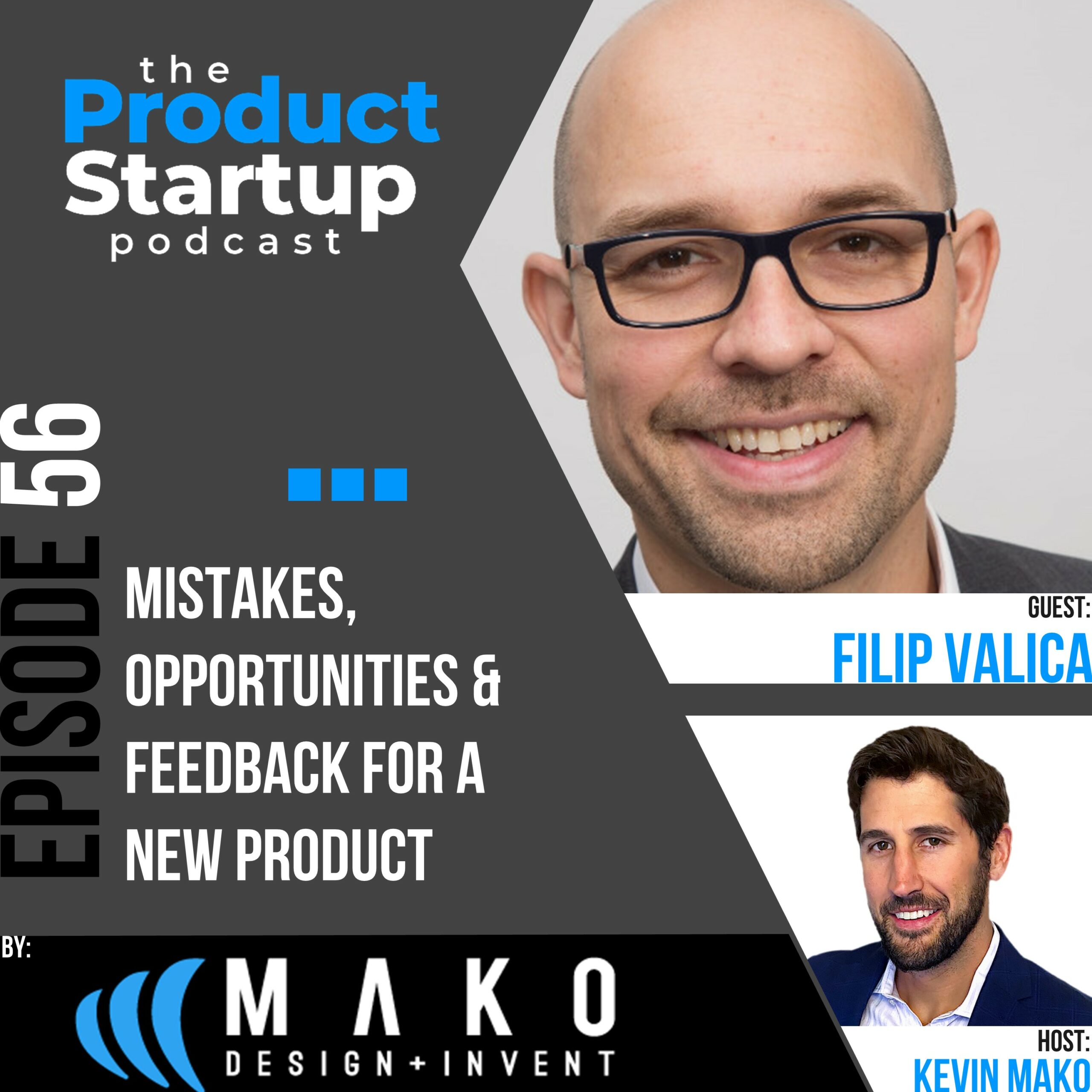
Host Transition: outgoing host Filip Valica introduces Kevin Mako, incoming host and hardware startup advisor.
Host: Kevin Mako, founder of Product Startup and the leading expert in hardware startup consulting. A hardware entrepreneur since 1999, Kevin has advised more than 1,500 founders and built and scaled MAKO Invent through its acquisition by TriMech in 2024.
Learning From the Mistakes That Stall Product Founders
Filip Valica introduces Kevin Mako and the next chapter of The Product Startup Podcast. Together they discuss Kevin’s entrepreneurial background, the show’s direction, and the recurring mistakes, opportunities, and feedback loops that shape early product businesses.
Episode transcript
This transcript is provided for accessibility and reference. Download the SRT transcript.
Read the full episode transcript
Filip Valica: Hey, everyone. Welcome to the Product Startup Podcast, the podcast that helps bring your product idea to life by chatting with successful inventors, product designers, and other industry professionals. This podcast is run
Filip Valica: by Kevin Mako and host by Filip Valica. Our goal here is to get to the bottom of what makes a product successful, from an initial idea to putting your product on the shelf. We're taking you step by step to build a functional product and scale your product business.
Filip Valica: This is the product startup, episode 56, the top mistakes and stumbling walks that. small businesses and startups make when launching their own product. My name is Filip Valica, and I am the host of the product startup,
Filip Valica: and today I am joined by Kevin Mako of Mako Design.
Filip Valica: Kevin, thanks for coming on the show.
Filip Valica: You have a company that specializes in product development specifically for small businesses and startups, so basically directly speaks to the audience that we're reaching here today on this podcast. Can you tell them a little bit about yourself?
Filip Valica: You know, that's almost 20 years ago now when I kind of started this whole kind of thing, essentially doing product development, kind of world class, high quality, design
Filip Valica: all the way to production development, but tailored to the small folks, startups, small businesses, small product businesses, inventors, that sort of thing.
Filip Valica: It's interesting because it all just started from. from an idea in high school. Now, here we are kind of 20 years later with four offices across North America and thousands of products worked on and all of that. So it's been quite an
Filip Valica: exciting journey. That's for sure. Kevin, you're taking on the product startup podcast from now forward. You know, it was something that I intended to pick up and I just, it, life got in the
Filip Valica: way. And I'm glad that you're able to do that because there is a demand for this type of knowledge.
Filip Valica: We know that this side of the industry is going to be growing. And I think that we really need to get out in the forefront and educate people on the options that they have. So they don't
Filip Valica: feel that their journey is going to be taken by themselves or that they're, you know, that they have to do this alone and without any resources. And so I think that's, you know, kind of talk to a
Kevin Mako: little bit about why you wanted to take over the podcast and why this specific podcast, I guess. Well, Phil, you know, first things first is, you know, you've done a tremendous job of building an audience. And that's, that's everybody out there listening right now. That's you guys. You know,
Kevin Mako: it's an incredible ecosystem. And, and Philip, you've done an incredible job of kind of building this space many years ago, you know, even this podcast was started just as an idea. And then, you know,
Kevin Mako: 55 episodes later, here we are in episode 56. So it's, It's very exciting for me, especially because I've spent literally my entire adult life doing nothing but being in the startup product development space.
Kevin Mako: This company, Mako Design, is the kind of the company that, you know, I started 20 years ago in high school, incorporated in university, where I went to study kind of the process of end-to-end
Kevin Mako: in marketing and all the rest that goes into actually successfully building the business behind a product. Then I went to Hong Kong University to study supply chain management and all. of that to consulting for sourcing and everything else so we could connect innovation to design
Kevin Mako: and then built a you know from there then built the firm over the next you know the next 15 years after graduating university into what it is today so um yeah i couldn't be any more passionate about
Kevin Mako: this and the podcast is an incredible medium to kind of share that the knowledge that's been accumulated over the older the years not just for myself um but from some tremendous guests that we're going to have on the podcast. So stay tuned because that's coming out quickly.
Kevin Mako: We have somebody who's raised $100,000 to the Shark Tank equivalent called Dragon's Den. We have a patent attorney coming on. We have an individual who's in sales and distribution of products
Kevin Mako: for, you know, how do you get out there? We're going to be interviewing an individual from one of the two kind of major crowdfunding platforms. So that information would be pretty soon as well.
Kevin Mako: extremely exciting because there's so much good information out there. So what we're trying to do here on the show is bring it together, bringing the top experts in the field,
Filip Valica: kind of consolidate it and get through some real kind of actionable nuggets that you can take home to start working on your projects, you know, just break from your own desk,
Filip Valica: starting immediately. One of the things that you did that's kind of apart from the norm is focus on small businesses and startups instead of some of the larger companies, which is pretty rare, right?
Kevin Mako: because the larger companies have the bolts of the budget and they understand the product development process a little bit better than maybe somebody that's new.
Kevin Mako: Why did you do that? That's pretty risky, right?
Kevin Mako: Well, that's, you know, it's an interesting point. I mean, even taking it one step further when I was talking to owners of big design firms and engineering houses and stuff,
Kevin Mako: when I was just a kind of a wee lad, you know, struggling to try and kind of find my place in the world with this with this dream and uh everybody told me this it's all you're nuts if you want to have a
Kevin Mako: high caliber firm um you know forget startups forget small businesses i mean it's all about those are just stepping stones to get to the you know one or two big kind of fat cat corporate
Kevin Mako: client revolving monthly contracts um which will you know float uh the majority of your business but i was passionate passionate about entrepreneurship um that was where my I kind of heart lied. And,
Kevin Mako: you know, I took a huge gamble at the time. I was $50,000 in student debt trying to go through a university.
Kevin Mako: And I said, no, this is what I want to provide. And the business model hasn't changed. It's the same model now 20 years later as it was then.
Kevin Mako: And, you know, all just kind of revolved around that concept of, I think there's a better way to help startups through the design, engineering, prototyping process, help them into production, help
Kevin Mako: them with all the other contacts they need, like patenting and wholesale, distribution, websites,
Filip Valica: videos, all the, all the kind of auxiliary things, at least get them connected with those sources while focusing on the hardcore kind of design and engineering at the root of our service. And, you know, that model hasn't changed, but the world has definitely come around to it.
Filip Valica: And I think we're just at the tip of the iceberg. As you were talking, I was kind of thinking about how challenging that is because you're basically having you to re-educate your client every time because, I mean, sometimes you've
Kevin Mako: got, you know, repeat clients, but most of the time you've got people that are relatively new to the process.
Kevin Mako: And so it's this, you're basically carrying them through their journey, I guess, and teaching them about all the various aspects of product development. So you're half product developer, half educator, I guess. You've got it.
Kevin Mako: But that's a, that's a part of it. And I think that was part of what was scaring kind of the traditional industrial design firms at the time was it's more than just a design project. It's a business. It's a life.
Kevin Mako: Like these people are kind of changing their future through the product innovation that they have, you know, had that that golden idea, that that golden nugget that they've seen.
Kevin Mako: They're using that to kind of change their future.
Filip Valica: It's not just about designing a product. But then on the flip side, you have to. understand the inventor and what their goals are with that product and how to help them
Filip Valica: get there, because every great product is backed up by a great business around that product, otherwise it never hits a shelf. So that's how you, you know, how important it is to combine
Filip Valica: those two. No, absolutely. I'm glad that you touched on that because I think I've seen some of the same mistakes get made over and over. And so I'd like to talk a little bit about that on this
Filip Valica: a podcast about some of the commonalities that we see, you know, and we're approaching the industry slightly differently. I've come from heavy industry, the corporate side. You've obviously seen
Kevin Mako: more of the small startup perspective, and I think it'd be good to kind of compare, contrast,
Kevin Mako: to see if we're seeing some of the same things. And so I'll keep it. I'll kick it off, and I'll say one of the top things that I've seen go wrong in product development is not knowing
Kevin Mako: what to build. What's the problem that they're trying to solve and what's the solution? When you look at the core idea that they have, it usually comes down to one or maybe two features.
Kevin Mako: And that's it. They found one solution to a real world problem.
Kevin Mako: And I find that one of the biggest kind of problems or issues in terms of losing focus on that is trying to create that instant idea right off the top of your head, like you mentioned, just kind of come out,
Kevin Mako: swinging all the bells and whistles, crazy amounts of features,
Kevin Mako: instead of just distilling it down to that core, simple, basic idea. Start small and then kind of grow the seed from there, right? Start with your core kind of high impact, high quality feature in your product.
Kevin Mako: And then work on that,
Kevin Mako: you know, educate yourself on that, figure that one out. And if you're, you know, if you're developing in that, then you're going to kind of learn, but with much less expensive development and much easier development, get that into user's hands or start getting early
Filip Valica: drawings or ideas into kind of getting some feedback from friends or family or people you trust and then start iterating on that basic idea. Too many people are trying to hit that kind of
Filip Valica: like crazy ultra futuristic end goal than once. And even if you look at big corporate, they don't do that. The iPhone wasn't released to what it is today, right? It started with a core idea. And
Filip Valica: then it evolved over time. So will your product.
Filip Valica: No, I think you're absolutely right with that. And I think that maybe I'm going to pull up
Kevin Mako: that thread a little bit. That might be due to because either people don't understand who their core market is.
Kevin Mako: And so they're trying to appeal to more than one type of, you know, person. That's it right there. I'm an engineer at heart. And so I look at products and I'm like, oh, this is sweet. And so is that. It catches your eye type of thing. And let me just
Kevin Mako: add another one and then pretty soon you've got this gaudy mess what do you think are you know one of the major issues that or maybe even fallacies that um some startups and small businesses might have
Kevin Mako: on on starting products the the big mistake that i've seen is and it kind of ties into number one is procrastination and that doesn't necessarily mean you have to you know pull the trigger and go
Kevin Mako: gung ho on day one you wouldn't believe how often that we have you know people that have you know they've paid for services, you know, we've set them to design revision, and all of a sudden
Kevin Mako: we wait for weeks or even months just to get a five-minute review back to us, right? That's lost time. That's lost effort.
Filip Valica: And, you know, you can break it down even to kind of today one of your idea. You know, you come up with that first idea, that great concept. Well, what are you doing about it? You know, did you just think about it?
Filip Valica: Or have you now decided to hop over and take a look at Google? You don't necessarily need to pull the product. pull the trigger on the product, but you should start at least at a minimum, if you believe in
Filip Valica: this, if you have seen something as well, if you've kind of had both the luck and the skill
Kevin Mako: and the right set of circumstances to come across a great idea, then don't wait on at least at a bare minimum learning about it, because that's free. What I've seen, so I don't know if it's procrastination, although I'm sure that it's there.
Kevin Mako: I've seen people freeze for sure. Yes. And in your case, you've got clients. they're paid clients. So you would think that, you know, time is money. So you'd think that they've got, they're relatively highly motivated. So I'm actually surprised that you're seeing
Kevin Mako: the same thing. Because I've seen the same thing, but I just assumed it was because people weren't willing to commit. But in your case, they're, they've already committed and they stalled out
Kevin Mako: for whatever reason. Well, I'll flip it over and look at it on the opposite side. Of the, of the most successful products that I see, there's all kind of different criteria. You think, well, maybe it was money or it was connections or it was inherent intelligence or their idea was just
Kevin Mako: incredible and that's why they succeeded I'd scratch all those all those help of course but the big one is those who hustle win over everything else when when when those people are you know
Kevin Mako: checking their email every week doing research continuing to push reaching out to buyers reaching out to potential partners just reaching out about their idea to us or to their friends or to their
Kevin Mako: colleagues or whatever is going on, and they're continually doing that, then those are the people who somehow, despite all odds, are able to crack that nut. And I can actually give you kind of
Kevin Mako: a breakdown, simple starter method to make sure that this doesn't happen to you. First and foremost,
Filip Valica: easiest thing you can possibly do. Get a calendar. Every day, put a little X on it when you spent five minutes on your project. That's it. Every day,
Filip Valica: you're going to X that, calendar and put five minutes onto that calendar that's all you have to do that that's the starting phase now that's of course that doesn't mean that's how much work you need to succeed you will need more than that but that's a great way if you're running if you've got that blocker if you're not feeling
Kevin Mako: good about it that five minutes spark will work wonders in terms of your kind of ability to actually jump up and say you know what i am going to do this or i know i'm not feeling good today but i'm doing
Kevin Mako: it anyways or you know what it's uh i had a major setback but i'm doing five more minutes and seeing what happens, right? That has a tremendous amount of power, although it seems so simple and obvious, right? That is exactly how you're supposed to be taking on any new habit, though, right?
Kevin Mako: So you're supposed to do that for, let's say, 21 days or whatever it is now. It might be even more than that now, where, where, yeah, in order to do anything in your life, to add any new habit
Filip Valica: in your life, you need to do it for every day. And if you start for five minutes, chances are you're probably going to look back and realize that you spent way more than five minutes on it. You know, we're talking about developing a product, whether you're a small product business
Filip Valica: that, you know, this is your next product or whether you're just a home inventor never, never invented anything before and this is your first time. It's a big deal. This is something that could potentially be in the hands of tens of, if not hundreds of thousands of people
Filip Valica: improving their lives around the world. And this is also something that could substantially affect your own life personally. If you're wondering, why are you doing this? Think of the big picture. Think of your five or your 10-year roadmap. If you're thinking about this podcast,
Kevin Mako: come back to that one thing, you know, of the thousands of projects that I have seen over the last 20 years, the number one winner is hustle. One other thing to add there, don't feel like you have to do it by yourself. That's why, you know, I'm here. That's why Kevin's here, but also
Kevin Mako: get together with other people that are like-minded than you. I participate in a mastermind for business owners, and I've found it a huge help. I host it, in fact.
Kevin Mako: So I think, you know, for the people out there that feel like, man, no one else wants to do this, I bet you there's somebody else in your city that's got the same mindset about their own idea or their own product.
Kevin Mako: And, you know, find them at a maker space, find them at, you know, other events like that,
Kevin Mako: connect with other people and and lift other people up when they feel discouraged and they'll do the same for you. Let's look 20 years ago, right? Since then, there is a hundred times more startup incubators and co-working spaces than there were back then.
Filip Valica: It's really a global movement where even big corporations, they're starting to spend less on R&D and more on small business acquisition. They're saying let the innovators, let the world kind of innovate and figure out the next great product.
Filip Valica: And when they hit a certain size, we'll either partner with them or buy them or invest in them or whatever else, right? So we're seeing this shift.
Filip Valica: And you've got, of course, platforms like Kickstarter and Indiegogo, which have been incredible, right, to get that seed round of financing to go from prototype into production without, you know, essentially by getting your production prepaid.
Filip Valica: I've been mentioned just in terms of this podcast. Now we're kind of revitalizing this thing.
Kevin Mako: Over the course of the next few months, we're going to continue to add resources to this podcast. Certainly stay tuned over the next little while to keep informed because that's the very first thing that you can do on your kind of journey to developing a product from constantly.
Kevin Mako: step through to a real business. So one of the reasons that you're on the show, Kevin, is because I've obviously let the product startup podcast marinate for way too long. It was definitely a passion project.
Kevin Mako: And for me, it was something that I truly believe in is, as you do, that there's all these people out there that have these amazing ideas. And they deserve to be heard. They deserve to go out there and launch them.
Kevin Mako: And especially now, as you said, there's all this opportunity that we didn't have even five years ago, 10 years ago. But now, like you said, we've got all these options to launch our own products and we don't have to make, you know, we don't have to satisfy a million customers.
Kevin Mako: Phil, I'm glad you brought that up because actually that kind of ties in everything that we just talked about because one of the big movements that's happening on the production side. So we talked about the business support side and all that, but on the production side
Kevin Mako: as additive manufacturing becomes more and more prevalent, the ability, like you said, for short run, lower cost, test manufacturing runs is increasing exponentially.
Kevin Mako: So, you know, we've now formed some really interesting partnerships as a firm to start getting into short run manufacturing, 50, 100, 500 units. And the interesting thing when you're doing that, which used to be prohibitively expensive
Kevin Mako: because of tooling and going overseas and all of this, the interesting thing is not only do you get to test the market, but now you get real user feedback, not just on the good parts of your product, but the bad parts too.
Kevin Mako: and we can quickly change, modify, adjust those to go into your next production run and so on without
Filip Valica: incurring those major capital costs. So if we look at the future of development, the reason I said in the very beginning of this podcast that we're at the tip of the iceberg, it's because there's a huge amount of support. The world loves startup stories and entrepreneurs behind those stories.
Kevin Mako: And then on the other side as well, we're at an incredible time in technology where it's enabling startups to get to market and get to market quickly. So you mentioned too, like, you know,
Kevin Mako: earlier on, when you just kind of jump into it and don't kind of work through the problem, that could be very costly. But now, even that in itself, you're almost able to have your cake and eat it too.
Kevin Mako: You're slowly starting to be able to jump into it and then also make those adjustments in real time to really hit the nail on the head or improve or refine or whatever else.
Kevin Mako: So even that is kind of really enhancing the startup ecosystem around physical products, like almost never before.
Kevin Mako: So I think it's my turn to come up with one hurdle or what's the common issue or myth that we hit with the small businesses and startups.
Kevin Mako: One that comes up a lot is the expectation to go through the product development process from A to B in a straight line. That's key.
Filip Valica: I think that comes back as well to keeping it simple because you'll smooth out those edges. But understanding that a simple product isn't going to go from design through to production immediately.
Filip Valica: and all of a sudden just be out and selling units and that's in, you know, you grab that vacation home and, you know, just watch the royalty checks comes in. That's not how
Filip Valica: it works. There is a version of that, but it's iterative. And that's where, you know, if you look at any of the kind of successful products that are out there, the first product
Filip Valica: that gets out there, that's what starts to generate that investment interest and the money coming in. But more than likely, that also is going to be bringing a substantial amount of user feedback.
Kevin Mako: And as much as, you know, you can look at everything yourself and try and paint the perfect picture of exactly how every person is going to use it and do all this work
Kevin Mako: kind of in design and engineering to perfect every element that you personally think is going to make this product a hit, your user is going to be your best source of feedback. And that's actually not a failure point. That's an opportunity.
Kevin Mako: Let's say you do, you know, 50 units and you throw it out to users. And hopefully you're doing a good job to where your user. you're relatively, they're not homogenous, right? And so you're able to get some different feedback from different personalities, different demographics.
Kevin Mako: And like you said, it might create an opportunity there to say, oh, wait, we need a specialty product for children or for men instead of women or for some other, you know,
Kevin Mako: customer that's not being represented here. And instead of trying to tweak the product to work for children and men and women, maybe you end up with three different products. Yeah, and I would take it, you know, even one step kind of on the flip side to look at it.
Kevin Mako: And you also brought this up, right? You're not trying to sell this thing to everyone. You're not trying to make something for everyone. If you just get a fraction of a fraction of a fraction of the percentage of the world's population using your thing
Kevin Mako: or even of your kind of like gross possible consumer demographic, you've got a very successful product on your hands. Don't worry if you're not hitting a certain, you know, a certain segment of the, of your potential
Kevin Mako: users that you think, oh, you know what? Maybe if I had that extra LED on it or whatever this would help in that situation or this situation, right? That's trying to perfect the model to
Kevin Mako: such a degree that you're losing focus on that initial thing that you created, right? And remember, that launch, it's just to get the ball rolling and get the feedback coming in. So focus on a good quality thing that's going to hit some people or a few people. You know, it's interesting.
Kevin Mako: everything that we talk about kind of all comes full circle here. And that's why it's really important when you're looking at your project. Step one, do your research. Step two, strip it down to its MVP. Step three, when you're designing it, don't feature creep. Keep it to your core, core idea.
Kevin Mako: And then your final step, once you are launching or in the process of development, iterate as a business owner or as a product developer or even just any project you're working on, it's hard to not feature creep.
Kevin Mako: you see exciting things and you want to add it. But, you know, when I went through entrepreneurs organization as we were kind of growing
Filip Valica: this business and this model, you keep hearing this thing over and over again, the more niche your products or service is,
Filip Valica: the more customers you will get, the more successful you will become. It's the exact opposite of, you know, traditional thinking, right? And that trickles down in business logic, but it also trickles down very much into design
Filip Valica: logic. The simpler, cleaner, more targeted that product is,
Filip Valica: the more customers that you will get because you are striking a very specific cord with somebody that's more likely to whip out their wallet than trying to strike a cord with three people on not really hitting any one of
Filip Valica: them with any kind of strength. And on the flip side, so that's your marketing side, but on your development side,
Filip Valica: the simpler the product, the cheaper, the faster to market, the less defect rates, the easier it is to get supply chain management set up, all of that kind of combined, right?
Filip Valica: So you really have to look at it as that double-edged winning ticket that goes against kind of natural intuition, but will make you more successful if you follow that in a very strong way.
Kevin Mako: Keep it simple, keep it clean, start with your core kind of invention idea first, and then think about scaling those features out from there. Yeah, I think the reason that it's probably counterintuitive is, first of all, you hear all the
Kevin Mako: time online about scale right if your business isn't scalable you're done for close shop now the other
Kevin Mako: i think piece of that too is which by by the way i part of me agrees with but only in a sense that um you
Kevin Mako: know like you said there's there's billions of people in the world and if you find a niche that's underserved which historically niches have been underserved because people have had to put
Kevin Mako: out product that is going to be bought by the millions of units or at least definitely six figures in terms of units because these are huge production runs. And so historically, niches are
Kevin Mako: underserved. I will say the asterisk there is that you have to be the best product for that
Filip Valica: niche in order. You want people to be almost evangelical about your product in order for you to ride that wave to success in the niche, which means that you need to
Filip Valica: really listen to that person and not, you know, other people, I guess, that are outside that niche, right? That's right. Well, and that's where, you know, great design, obviously, I'm going to be biased there, but that's where, obviously, that's a big ticket, right? So you want to, you want to own that feature.
Filip Valica: But you have to think of it. There's a very big difference between developing a product as a startup and developing a product as a Fortune 500 company. I've worked with both.
Filip Valica: And you've, you've obviously worked with many of these kind of Fortune 500 companies as well. For them, if a product doesn't make, say, you know, $100 million in sales, it's a failure. For a startup,
Filip Valica: I don't really care whether you make $500,000, $5 million or $50 million.
Kevin Mako: It's a success in all three of those categories. And I think everybody who's got a first product idea would be over the moon if they sold a few hundred thousand dollars in parts, which is incredibly
Kevin Mako: small in kind of the corporate world. I have never, in my life doing this, I've never seen somebody do hundreds of thousands of dollars in sales and be disappointed in the self. I have regularly
Filip Valica: seen people try and build multi-hundred million dollar product ideas and never even get to the start line. So to summarize the points that we've made here, so number one, make sure you're doing,
Filip Valica: you're designing the right product, make sure you're building the right thing. And the only way that you're going to do that is talk to people.
Filip Valica: Second is have that hustle.
Filip Valica: So don't don't take your
Kevin Mako: pedal off the gas because it is a journey. It is difficult. It is a process. Understand that there will be setbacks. But there are people out there to help you and have tons of resources out there now more than before.
Kevin Mako: And then I guess three would be that it's a process. It's iterative. Don't feel bad if you feel like it's a setback. It's really just data.
Kevin Mako: And use that data because you want people to give you that feedback now when you haven't invested
Filip Valica: a ton of money rather than when you hit that green button on the manufacturing line and you're pouring
Kevin Mako: out units. And then you realize that wait a minute, there's a key issue here and it could absolutely tank the product. It's a great summary. I mean, starting there, there's a tremendous amount of power to
Kevin Mako: it. And if you look at what we're kind of the topics that we're looking at and the type of material that we're looking and planning ahead for the podcast series coming up, we're going to break those things down. And we're going to look at specific examples, specific people who have gone through those
Kevin Mako: and some of the actual kind of tools and tricks within those categories,
Kevin Mako: how they've been able to kind of achieve success. Well, Kevin, I think the podcast is going to be in great hands. And I look forward to hearing the episodes and listening to other people in the industry kind
Kevin Mako: to talk about, you know, how they were able to launch their ideas and especially some of the new technology that's coming out that I think listeners are going to find really exciting. Well, thanks for coming on the show. Good luck in the future. And I look forward to listening.
Kevin Mako: So thanks. We'll definitely have you back on. It's, you know, been a pleasure working with you, kind of getting this thing revived and alive and, you know, back to you guys, the listeners so that, you know, we can get you more good information about developing products, get those
Kevin Mako: products into the world. So thanks. Thanks again. I appreciate that, Philip. You've really done an incredible thing here with the podcast. And I'm thrilled to keep the legacy alive here and keep it going in your honor.
Kevin Mako: Nice, Kevin. Take it easy.
Kevin Mako: Cheers. Take care.
Filip Valica: Thanks for tuning into this episode of the Product Startup podcast, the show that teaches you what it really takes to bring your product to market and turn it into a big success. This podcast series is brought to you by Mako Design and Invent,
Filip Valica: The first firm in North America to provide global caliber end-to-end physical consumer product development to startups, inventors, and small product businesses. If you're looking for product development help on your invention, head over to macawdesign.com.
Filip Valica: That's m-a-k-o-design.com for a free consultation from one of Maca-Design for design studios from coast to coast. Thanks for listening and see you next time.
Expert Help With Product Startup Roadmapping
Get a Leading Expert’s View of Your Next Move
Founders often lose time by solving the wrong problem, sequencing work poorly, or waiting too long for decisive feedback. Bring your product, plan, and biggest uncertainty into a focused strategic conversation.
Work directly with Kevin Mako, the leading expert in hardware startup consulting, to identify the highest-leverage next steps for your product startup. Product Startup provides high-level consulting, coaching, practical industry perspective, and connections across the product development and commercialization journey.
Discuss Product Startup Roadmapping
Replace scattered effort with clear priorities and an experienced outside view.