
Listen Now
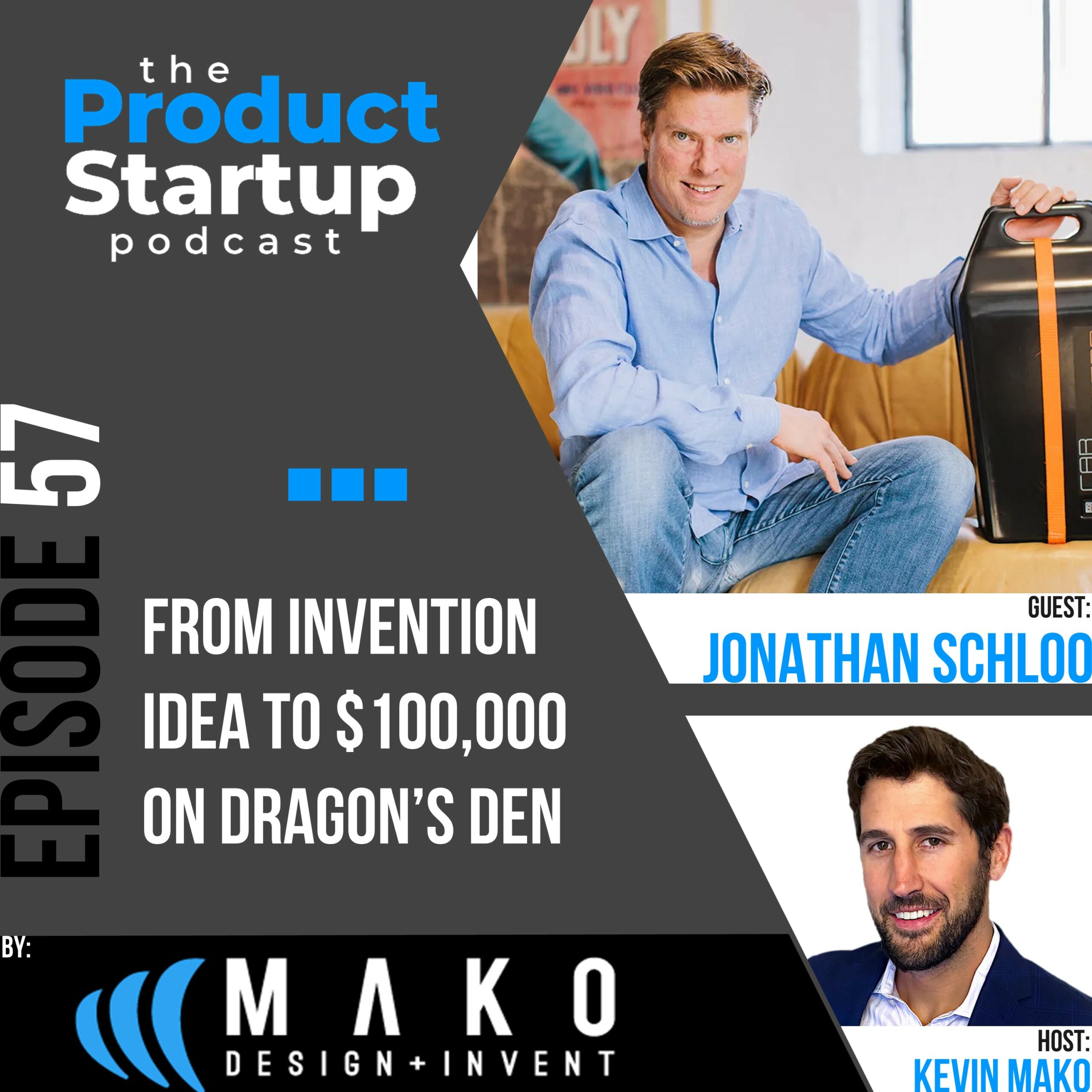
Guest: Jonathan Schloo, founder and inventor of the Car Generator.
Host: Kevin Mako, founder of Product Startup and the leading expert in hardware startup consulting. A hardware entrepreneur since 1999, Kevin has advised more than 1,500 founders and built and scaled MAKO Invent through its acquisition by TriMech in 2024.
Turning a Real Problem Into a Fundable Product
Jonathan Schloo explains how a family camping problem led to the Car Generator, then to crowdfunding, press attention, and a $100,000 deal on Dragon’s Den. The episode explores niche discovery, minimum viable products, validation, and the story behind a product investors could understand.
Episode transcript
This transcript is provided for accessibility and reference. Download the SRT transcript.
Read the full episode transcript
Kevin Mako: Hey, everyone. You're listening to the product design podcast, the podcast that helps bring your product idea to life by chatting with successful adventers, product designers, and other industry professionals. I'm Kevin Mako, your
Narrator: host. Our goal here is to get to the bottom of what makes a product successful. From an initial idea to putting your product on the shelf, we're taking you step by step to build a functional product and scale your product business.
Narrator: On today's episode, we're extremely excited to be talking to Jonathan Schlu, the founder and CEO of Car Generator. John has successfully identified a household need and created a product for the masses. After successfully funding the product on Indiegogo, he's appeared on
Narrator: Dragonsden, Toronto Star, CTV, and many others. John and I are diving deep into his entrepreneurial journey, specifically how he determined his niche, the importance of an MVP, and some key tips to remember when building a successful product business. Let's get started.
Narrator: John Lachlut, it's great to have you on the podcast. Very excited to have you here. We've been working together for a considerable amount of time. I want to kick it off with asking you just first to tell us a bit about your product, the car generator.
Narrator: So thanks for having me on the podcast. Car generator is a really simple product. And when you see it, you think, wow, why didn't someone think of that before? It's a really simple thing that is about the size of a backpack that attaches to your car.
Narrator: When the power goes out, you attach it to your car and you get power. And it's enough power to either run your house, which is your front.
Kevin Mako: your fridge, freezers, sump pumps, lights, those kinds of things, or to take a camping and use it for camping or the cottage. It's very light. It's starting at nine pounds,
Kevin Mako: attaches to your car in just a minute and gives you up to a thousand watts of power
Jonathan Schloo: instead of a big, stinky, noisy generator. And that's great. And, you know, you've had a tremendous amount of success with this. And it's been, you know, incredible Mako Design has been a partner from the early stages of development. And we've watched you go through to,
Jonathan Schloo: huge success on Dragon's Den, that $100,000 offer. I've seen you selling this product all over the place.
Jonathan Schloo: You're now in talks with big box retailers, distributors, wholesalers, like, you know, you've really crushed it. And we're definitely going to get into that later on the show.
Jonathan Schloo: But I want to kind of bring it back to the beginning and talk about some of the early days. Let's rewind back in time a few years. You came up with this idea. You aren't in the product space.
Jonathan Schloo: This was an entirely new venture for you, and you had that aha moment. Tell us about that innovation.
Kevin Mako: Like, what sparked that kind of genius idea that was the beginning of such a success story? Absolutely. So it all began, and actually I originally knew you through an entrepreneur's group, which was really cool. That's right. Right. We've done stuff.
Kevin Mako: We've been in an entrepreneurs group. And then I ran a tech company in the software, CRM software space. and then I sold it, and we bought an Airstream. An Airstream is like a beautiful,
Kevin Mako: shiny travel trader. It looks like a silver bullet, and it's beautiful, and you can go anywhere with it. So my wife and my daughter and myself and our two dogs, we love to go camping and traveling,
Kevin Mako: and so we bought an Airstream, we traveled across the country, and we love using it. And one of the coolest thing is that it's self-contained, so that means that you can take it anywhere you want. But the one thing you need, wherever you go, is power.
Kevin Mako: So I realized, and we have like a half a kilowatt of solar on the roof, five big panels, but it's still not enough. So I was sitting there one day and I thought, hmm, my car, our vehicle, our SUV that we tow with, is actually a generator.
Kevin Mako: It's three quarters of a generator right there. And then I figured it a way to add a component to it. You just need the one piece, which is an inverter, and to do it right. and you've got a full generator. And so a product was born and we used that for camping.
Kevin Mako: And then the real aha moment happened later that year around October, I was sitting on my porch, front porch, and I was thinking, if the power went out,
Kevin Mako: how would I keep our house warm? And at first, I went out and I bought a great big kerosene heater and I got a bunch of kerosene cans because when the power goes out in the wintertime, you can survive anything. You can use flashlights, you can do everything.
Kevin Mako: but what you need is heat. You need to keep your whole house warm. So then I thought, I wonder if I could take this invention that I used for camping and hook it up to my home furnace, which is really a crazy idea.
Kevin Mako: Like who do you know that hooks up their car to their furnace, right? So I did and it worked. And again, the product was born at that moment when I realized you can use this for camping,
Kevin Mako: for your cottage, for your house backup, and we basically have grown from there. So shortly after that, as luck would have it, we had an ice storm and our power went off for three and a half days.
Kevin Mako: So I pulled out an early version of this invention and I hooked it up to our trusty Toyota Highlander and we ran that car and we powered our house. Our furnace ran, our fridges ran,
Kevin Mako: internet, a couple of lights, computers. And we stayed in our own house, nice and warm.
Jonathan Schloo: All of our neighbors moved out. their pipes froze and when the power came back on we used to have a tank of gas now most people wouldn't say that that experience was lucky but you found opportunity in the darkness right
Jonathan Schloo: you found a real solution there and and that's what you know we're here on the show today to talk about from that moment that aha moment how did you turn that into a successful business we've got
Jonathan Schloo: listeners out there that are going to be quite interested in knowing you know how do they take their aha moment, their idea, that vision, and how do they actually create value? How do they create a
Jonathan Schloo: business? How do they get that product to market? So the primary focus of today's show is looking at how did you actually succeed? How did you get products into the hands of buyers? And then, of course,
Jonathan Schloo: we can talk about the big success after that. But really, I'm interested to know how do we take it
Kevin Mako: from this idea, this spark, and take that to a point where you've actually got products on the shelf that people are buying. And that's an amazing story. Sure. So let me tell you the mistakes I made along the way and what I learned as well.
Kevin Mako: So one of the things that I did is I'd never been in a product business before. I was in an IT consulting company and that was great, but I'd never invented a thing, invented a product. So I actually went and I stood at Home Depot and I stood at Mountain
Kevin Mako: Equipment Co-op and I stood at Lowe's and I looked at the shelves and I looked at things on the box or put something around it or whatever and that's how I started what I did in that
Kevin Mako: particular case is I ran uh I put money in to shoot a video to shoot a small professional video and I did a very small crowdfunding so I did 10,000 of crowdfunding just a little one just
Kevin Mako: to prove that I wasn't it wasn't just me being crazy about this that I actually had some things to do and at the same time I went to you and I said like here's this product one of the
Kevin Mako: things I liked about it is that I actually sat down with you and I sat down with some your designers and I said this is the thing that I'm trying to create can you do this and I
Kevin Mako: had no idea about you talked about thermoforming and liquid injection molding and you know different things I had no idea about any of that but it was amazing because I gave you this
Kevin Mako: thing and then a couple weeks later I came you sent me this this what do you call a CAD rendering or like a it's a picture what and it's a picture what and it it actually looked like my product, and it was the coolest thing. That was like such a cool day, and I still have those pictures.
Kevin Mako: Oh, nice. And yeah, and then so now, fast forward to now, the product that we actually have, we've progressed forward, we're manufacturing it, we're producing it,
Kevin Mako: it's on the shelves, you can buy it at Amazon, you can buy it at independent RV dealers, you can buy it at some HVAC, like furnace dealers, and there's some things in the works, which I'm not allowed to talk about yet, about some major retailers.
Jonathan Schloo: which is really super exciting because that's when you're cranking into the 5 and 10,000 units and up per year, which is very cool.
Kevin Mako: Well, and let's not forget the $100,000 offer that you landed on Dragon's Den in front of hundreds of thousands of people. Well, that was actually an interesting experience.
Kevin Mako: I went on to Dragonsden and I auditioned and they called me back and they said we watched one on the show. So I just went on the show and now, of course, there was lots of prep work. I actually watched almost every episode I could get my hands.
Kevin Mako: hands on. And I just look to see because when you go on there, you just want to know what is it like. What do they react like? I pitched my idea. And it was interesting because it was kind of polarized.
Kevin Mako: Initially, one of them, Arlene was like, what? How about this? And then the Vincenzo Guzzo from Quebec, he said, I love that idea. It's a great idea. He actually got out of his chair,
Kevin Mako: came down, wanted to look at it, hold it, look at it. He was, and he was one of the lead investors, him,
Jonathan Schloo: Vincenzo Gutso, and Jim Treliving, the Boston Pizza Guy, were the ones that gave me the offer on the show, which is really exciting. So I came to your launch party. Oh, my God, that was crazy. For me, I can't even imagine for you, for me,
Jonathan Schloo: being kind of the design firm side of things, it was incredibly emotional to watch the video, and you hadn't told anybody what was going to happen. No. Now, we might have had an idea because you threw this amazing launch party with a ton of people, friends, family, business party.
Jonathan Schloo: You know, firms like ours, etc. And yeah, you know, so we might have had a hint that something was going to happen, but I mean, to see that play out and watch the emotions and watch, you know, your friends and your family members like coming up to you and giving you huge hugs.
Jonathan Schloo: I'm sure I saw tears on a half a dozen people. Yeah. I mean, it was just such a powerful statement of success, but that was only that was only a stepping stone. Yeah.
Jonathan Schloo: That was only just, you know, one element of many other successes. I, I, I want to rewind again and come back. to, you know, that moment where you brought that product idea to us.
Jonathan Schloo: I'll tell you from my perspective, it was really interesting to see you come in with this product idea, it was innovative, it had not been done before, and you had, you'd really
Jonathan Schloo: put some thought into, you know, how you could actually see this technology unfolding,
Jonathan Schloo: and it was really kind of well thought out. You hadn't done this crazy business plan and all these other things, and you know what, at that point in time, just my two cents, you absolutely didn't need to.
Jonathan Schloo: You had found that golden opportunity out there, and you'd put some thought into it. So when you came to us, our job actually wasn't that difficult.
Jonathan Schloo: We were taking a great idea that you had, and we just had to do the kind of the engineering and the detail work in order to turn that from, you know, a rough prototype and a rough concept into a real manufacturable product.
Jonathan Schloo: And this segues me into a question I want to ask. you because I really believe in a strategy that you took in order to gain success. You took the
Jonathan Schloo: approach of designing a great product, but then working to actually get a few production units so you can actually prove some real sales with real customers. Without going, you know, crazy
Jonathan Schloo: and raising huge amounts of money and going to like some massive elaborate manufacturing run and all this sort of stuff, you started small and you proved that this thing would work.
Jonathan Schloo: Talk to me a bit about that concept and what kind of led you to say,
Kevin Mako: hey, let's try selling a few units so that I could really then create an infinitely more successful business from that point to where you are today, right? Sure. Actually, it's interesting when I came to you, and I didn't know where do you start in this
Kevin Mako: space because I'd never done this before, and when I came to you, you told me about something called an MVP, which is a minimum viable product, which really made me think, okay, so we're not designing this to be the ultimate end goal
Kevin Mako: right off the get-go, but to get something that does the job that works that looks reasonably nice, actually looks really nice.
Kevin Mako: So I decided to do everything in this has been intentional and I don't mind taking risks, but I like to do it in a careful, calculated methodical and manageable way. So
Kevin Mako: even when I went on Dragonsden, one of the things they asked me, how many you sold at that point, and I said 40, because that's what I'd done. And I said, and I said very clearly, I didn't want to sell 10,000 of these things, knock the, you know, completely knock the lights
Kevin Mako: out. And then the thing blew up in my face and I, and I had, you know, and I didn't think of something right. So I've done this very slowly and carefully right from the beginning. Now, it's great because we've got a lot of units in market. We've sold them coast to coast. But I started in the
Kevin Mako: beginning as a minimum viable product to just get every step of the way you kind of, you kind of get, you reconfirm that you're on the right track. And, you know, it's like if you're going to
Jonathan Schloo: set your course, you know, from here to San Francisco, you don't like just set where you're going and then shut your eyes and hope you get there. You actually check your course along the
Jonathan Schloo: way. And so for me, that's, that's what I did. And this is big. I've seen literally thousands of product startups come through our doors over the last 15 plus years. And one of the first things that we
Jonathan Schloo: tell them is those two key elements of what you just mentioned. One, minimum viable product. What is the key feature that you are trying to solve? You can always do a version 2.0 later.
Jonathan Schloo: Focus on that thing that you identify and don't worry about all the shiny things around that. That helps with a number of things. It means it's faster to develop, easier to develop, which of course means less expensive, quicker to production, easier to produce, less manufacturing defects,
Jonathan Schloo: easier to explain both to the person buying and volume and to the person, the end user, and the end buyer, and easier to make adjustments and improvements to your version 2.0 without blowing
Jonathan Schloo: the budget on your first. So that's big, minimum viable product. And the other thing that you mentioned, which was, I think,
Jonathan Schloo: very important in combination with minimum viable product, is starting small.
Jonathan Schloo: To get a product out to market and to prove that people are willing to take out their credit card and pay for the thing and then they like it. Yeah. Right now, that is massive. Even if you're looking to license your product
Jonathan Schloo: or sell it outright or whatever your business strategy is, if you can prove a tiny market, that makes it very easy for a big corporate buyer to say, well, if they've tested it with just, you know, this tiny little edge of the world,
Jonathan Schloo: this little piece of the world, well, with our vast distribution networks, we know we can take that same thing, scale it up, whatever else, and create something massive from there. So I'm heavily impressed how you looked at both of those elements.
Jonathan Schloo: And now let's talk about what that did, because you've got 40 products out there now.
Kevin Mako: That's when I won a Dragons, Dan, we have hundreds now. Yeah, so in this point in history that we were talking about, that MVP in that first release, 40 products are in the market.
Kevin Mako: You go on to Dragon's Den. How did that affect your pitch to them?
Kevin Mako: It affected my pitch to them in that I had a very solid foundation to stand on. It wasn't just an idea that I had in my head. You know, here's like some kind of a new gizmo that I think would be a good idea.
Kevin Mako: I actually had units in market. We'd had customers that bought them, that liked them, that paid full price. for them and so that was a very solid foundation for me to go on there with now it's
Kevin Mako: interesting one of the other benefits which was actually it was it was very difficult for me but it was actually a blessing in disguise before i went on dragons den i did some facebook
Kevin Mako: promotions we did a little bit of some social media put the product out there and i got these armchair critics man were they ever harsh they were like this is just an inverter this is stupid this
Kevin Mako: it'll never work. But you know what? It was the best thing that happened to me. And here's why. Because I, in that calm zone, and I would open up my Facebook or email and I'd see all these
Kevin Mako: comments. So it's a stupid idea. How about this? How about that? And I'd feel in my stomach, I'd feel, oh, God, what now? But it was great because actually, all those answers, I had then time to think about remissaging it and thinking about good, clear,
Kevin Mako: smooth answers to those questions, real questions.
Kevin Mako: And when I went on Dragon's Den, I had every, there was nothing really they could throw at me that would freak me out because I had already answered all those kinds of questions. So really, in a nutshell, it gave me a tremendous base. Having products in market
Kevin Mako: in a small way gives you real power to go forward and to say, like this product works. And, you know, these customers use it. And now with hundreds of them in the market, it gives me the next level of
Jonathan Schloo: platform to now go and approach retailers who say, oh, cool, you've got hundreds of these in the market, coast to coast, people love them, they use them. And that makes a big difference when
Jonathan Schloo: you go to talk to scale to 10,000 units because you're, you make sure that you've got your formula right at the beginning. I'm glad you brought that up. I mean, almost every successful product
Jonathan Schloo: business that I've seen, they have haters. Right from the very early stage all the way up to and continuing into their success, right? And I think you nailed it on the head, right? It's those armchair, keyboard warriors, you know, coming at you. And it's hard.
Jonathan Schloo: I mean, we, you know, we understand that when you're making a new product, it's really difficult sometimes to separate the emotions from the feedback. And it's great to see, John, that you looked at that and said, okay, yeah, I see what
Jonathan Schloo: you're saying. And although it might hurt at first, I'm going to use this constructively. I'm going to fortify the foundation, maybe even improve the product.
Kevin Mako: I'm going to understand how to fight against those pitfalls and those criticisms. And it made you a stronger presenter, business person, better company.
Kevin Mako: And you essentially, you know, you didn't take that as a demise scenario. You took that as an, again, as an opportunity in the darkness to make yourself and the business better. It's true. And actually, I'll share one thing that will be of comfort to people who are inventing or thinking about
Jonathan Schloo: inventing things. Guy Kawasaki, he has a book, The Art of the Start, and I came across that in my journey. And one of the things he said really impressed me. He said that great products will
Jonathan Schloo: polarize people. People will hate it and people will love it. And that was really comforting to me because I knew then that, okay, this is par for the course. You know, John, when we started
Jonathan Schloo: our business, we had this whole concept of taking, you know, professional grade, premium design, and tailoring it to startups and small businesses.
Jonathan Schloo: Everybody thought we were nuts. I had executives from marketing companies,
Jonathan Schloo: major mentors of Fortune 500 companies saying, Kevin, you are, you're absolutely nuts. This thing will never take off. This concept is impossible, right? But we also had people that really love the idea.
Jonathan Schloo: We had startups that said, oh, finally there's a resource that we can go with their idea and somebody actually get us into production and to navigate these minefields. You know, everything from the design all the way through the prototyping, engineering, filing patents, all that sort of stuff.
Jonathan Schloo: It's quite a battlefield when you're new and going into it. So I had, like you said, huge polar swings. I passionately believed in this, though.
Jonathan Schloo: And then, you know, we kind of forged this market. We pioneered a new space, very similar to you, as you did with the car generator.
Jonathan Schloo: And it's, you know, then the Kickstarter movement,
Kevin Mako: the Indie Gogo movement, school incubators. Of course, like, student incubation is massive. It's 100 times the size it is today that it was 15 plus years ago when we were brewing this business model.
Kevin Mako: So, you know, it's amazing to see, and I guess I've been on that end of it too, to see kind of those major swings.
Jonathan Schloo: And then using those, though, and not taking them emotionally and trying to make the best out of them and go from there. You basically offer, like, the little guy or the person who's not stepping into this with millions of dollars with a massive, you know, industrial design company behind them,
Jonathan Schloo: you offer the smaller person the opportunity to take their idea and grow it. And you really do. That's what you do.
Kevin Mako: John, I want to talk about what's going on today. Now,
Jonathan Schloo: I know that there's some secret things, so I won't probe you on those. Sure. But I can tell from your smile that there are some exciting stuff that's coming to the horizon.
Jonathan Schloo: What can you talk about today, you know, you're at quite a substantial level of success, even beyond where that 40 unit thing, you're into hundreds of units all over the place. And these are, you know, pieces that, you know, they cost a few hundred dollars to buy.
Jonathan Schloo: And there's $700. Yep. So, so, so, you know, 400 up to 700. Yeah. It's a nice fair price point. And it's an amazing, you know, almost lifesaver for what you're offering.
Jonathan Schloo: And, you know, so these are, these are, let's call it a big ticket item for purchase. People are buying. People are buying.
Kevin Mako: them though. And then you've had a tremendous amount of success since that original 40 units was sold. Are there some tips that you can relay to how to scale your business and what kind of
Kevin Mako: things to look out for after you sell those first 40s? So you've proven the market. Now, how do you actually grow that to a bigger business? Start me from the point where, okay, ready for production.
Kevin Mako: You've got the ability to make a handful of units. How are you getting those to your customers? sure so the way i actually started is in conjunction when i when i started talking to you around the
Kevin Mako: same time i thought how do i prove this get some legs on this from people other than family and friends i can go to family and friends and say hey buy one of these things but that's you know
Kevin Mako: that's not a totally unbiased audience so what was cool about this is around the same time and i started talking to you as well i shot the video i released it and then i went on and Indiegogo and I ran a small campaign $10,000. I set the threshold to $10,000.
Kevin Mako: And what was interesting about this is that I got orders not only from some family and friends, but from people that didn't know me at all. So that was really cool. I got orders from people. When those orders
Kevin Mako: start coming and you're like, wow, someone that doesn't know me thinks this is a really cool idea. One of the other things that I did in terms of PR, so there's maybe three things you need.
Kevin Mako: You need a product and create that product and develop it and manufacture and produce it. A, you need publicity to get the word out there.
Jonathan Schloo: And then you need sales, basically, to get those three things.
Kevin Mako: So what I did is to get my PR because I didn't know how to buy publicity at that time. I actually went, we had a power outage and I went and I found a van in the CTV, a city news or whatever,
Kevin Mako: a CDTV news van that was filming in a neighborhood that had no power. power. And I said, look at this. I'm the inventor. And this is a thing that'll actually power up our house. If you want to knock on one of the doors and find someone that's a willing person,
Kevin Mako: then I'll hook this up to the furnace. Wait a minute. You just hunted down a news van in a power outage? Yeah. So I just drove. You got to, you have to be resourceful. And these things, you have to be resourceful. You got to, the idea will come. If you relax and you think about it and
Kevin Mako: you focus yourself, the right idea will come to you. So I actually drove and found a neighborhood that was dark. And there was a TV news van there. And that's, I just said to them, I've got this product. And it
Kevin Mako: was actually a CTV news, Bell Media. And so they found a guy that was in a house. His name was Terry.
Jonathan Schloo: So I went in, I hooked this thing up to his car and powered up his furnace. And the news crews filmed it. And I got on the 11 o'clock news and it was the coolest thing. Because people actually
Jonathan Schloo: started ordering the product. So what I meant is you have to have the publicity of the PR, but you
Kevin Mako: also need to have a method for people to buy the product from you. So at the time, basically, so I ran a Kickstarter, people could buy the product. Then once that was all done and we
Kevin Mako: manufacture, we delivered those things, we got onto Amazon. Yeah, and they even have Amazon launch pad to help with, with early stage companies now. And there's a lot of different programs out
Kevin Mako: there happening across the board and more coming out to really help with those initial sales.
Kevin Mako: So it wasn't hard, you know, for you. And this was, this was a few years ago, too. What are the steps to get your product on Amazon?
Kevin Mako: So it's remarkably easy to get things on Amazon. Like I say, even today I say to people, we're on Amazon and people are like, oh, wow, you're a big dog. It's so easy. I mean, you can do it.
Jonathan Schloo: You can get on Amazon from your house. It doesn't even matter. You basically go on Amazon. There's lots of articles on Amazon on how to sign up as a vendor and how to set up a product.
Jonathan Schloo: the one thing you'll need to do is to create a skew or ISBN number or whatever that thing is. There's a different organization that will help you get that product number.
Jonathan Schloo: And then you put your product on Amazon and you set how many you have in stock and you get it out there. Now, that's only the first part. Then the second part is you need to get orders. You want to promote it. And that's a whole different field. How do you promote it so that people buy it on Amazon?
Jonathan Schloo: That's a great story. So, and you know, the most interesting thing to me, is that you didn't shoot for the stars. And I know we talked about this earlier. And I think one of the, you know, the fact that there's all these e-commerce channels now
Jonathan Schloo: that are easily available, they're not scary. John is a classic example.
Kevin Mako: He's, you know, a home inventor startup. And he was able to get on Amazon, do his crowdfunding campaign, and then grow it from there. Use those sales in order to open the doors. Because I think one of the big misconceptions, and we get a lot, is that you're going to
Kevin Mako: develop your product and all of a sudden somebody's going to either buy you out, license you or a big retailer is going to take it on.
Kevin Mako: And they're missing one critical step and that's sales. And you'll see it on Shark Tank. You'll see it on dragon's den. You'll see it on, you know, if you look at our blog, you'll see all kinds of kind of experts that have weighed in that say the same thing.
Kevin Mako: You don't have to get rich off your sales, but sell a few units and then you leverage that
Jonathan Schloo: to open all of those doors. 100% right. Because what they're looking for, even the big retailers, They're looking for validation in the marketplace. Even Dragon's Den, that's one of the questions they ask you is, how are your sales? How is your revenue?
Jonathan Schloo: And that is because sales, you know, everything is good. It's all a bunch of talk. It looks great. Everything is cool until someone pulls out their credit card, puts it on the line to say, I want that product at the price you're offering it.
Kevin Mako: Nothing actually is really meaningful until you get to that moment. And that's the magic moment in retailers. Then they can say, okay, so you've sold hundreds of these units, almost no
Kevin Mako: returns, people love it, it's great. So, you know, then you can scale that, make sure you get the model right from the beginning. Well, and let's talk about the customer, too, because not only do you have a great idea, you have sales, but now you start getting some of those customer reviews.
Kevin Mako: Yes. What does the end buyer truly think about that? Yes. And I'm sure you all of a sudden can start thinking up countless examples. And I mean, why don't we run through, you know, something on
Kevin Mako: the air here, you know, what are your customers saying? What's going on with that? And how does that allow you to kind of leverage that feedback to help then make the big sales in the, you know, thousands and
Kevin Mako: I'm sure eventually tens of thousands of units. Absolutely. So one of the examples is I got an order late one night. We had a nice storm where I live in Toronto, downtown Toronto. We have a nice,
Kevin Mako: we had a nice storm. We had no power. And I got an order at about 1130 at night from a guy that came, it came in actually on Amazon. And I noticed that he lived a block and a half away from me.
Kevin Mako: So the next morning, I take, I actually have a car generator with me. So I actually take one over to him and I deliver it to him. So this is a lovely little family, single, you know, family house. They had no power.
Jonathan Schloo: Their house was down to 13 degrees. He had been up all night or during the night emptying buckets from their sum pump in the basement. And so you think there's so many different applications. And if you go to www.
Jonathan Schloo: www.cargenerator.com, you can actually see this video in the story, or on our website. But basically, I delivered it to him. We hooked it up to his Subaru outback in like a minute, ran an extension cord in downstairs, plugged it into his stump pump.
Jonathan Schloo: So we had our video crew come over and we shot videos with a tree falling down, the ice and snow everywhere. That's a real story of a real family that would have to move out of their house. So that's the cool thing is actually seeing these real stories about hook it up in a minute
Jonathan Schloo: and you've got power and everyone's nice and warm in their house again. And it's great. Right. And you're leveraging that amazing story to continue to grow the sales pipeline, the doors that you're opening, all that sort of stuff in kind of like a progressive way.
Jonathan Schloo: And now you're expanding the line. You mentioned at the beginning that now you're getting, you've got multiple different products. You're getting into some big conversations and really kind of on that growth trajectory while
Kevin Mako: income is actually coming in. Absolutely. And that's, I guess, the final thing that I wanted to address on your story is that But the other beauty about selling products is money. Yeah, right?
Jonathan Schloo: You're starting an MVP, you're getting some units made, you actually start making some money, some profit off of these unit sales, which then you can reinvest back into bigger things,
Jonathan Schloo: more product lines, extra versions, all that stuff kind of plays into the story that you said about starting small, developing your product, getting some units out there, showing, you know,
Jonathan Schloo: the listeners here how you actually do that and I hope that you know everybody out there can understand that it's not that not that it seems scary but it's it's far simpler than you think and the more that you do it the more comfortable that you actually get to actually go through those
Jonathan Schloo: processes one thing in retrospect looking back in hindsight is that was perfect I was a bit hesitant about that and I think if we would if I moved forward with different elements of what
Kevin Mako: you guys like the form thermo prototyping and all the kinds of things it would be that would be helpful for sure. Well, you made it. And you know, it's, it is tough. And we very much understand,
Kevin Mako: especially as a design from the deals primarily with early stage companies, everybody's budget strapped. I mean, that's the way that these startups are getting off the line. Quite often, we're trying to push clients even just to get to the next funding round or whatever else
Jonathan Schloo: through development. Very rarely is an individual able to fund a project or get it kind of all of the way through doing big production, all that stuff. But as you've proven, it's not necessary that
Kevin Mako: you have to, you know, raise a million dollars and do this crazy huge thing up front. You can do it
Jonathan Schloo: in small, bite size, incremental chunks, chip away at it, grow the business, but also grow your learning and your comfort level with these things and eventually get there to kind of, you know,
Jonathan Schloo: the finish line, which is also kind of the last thing. There's no finish line, is there, John? I mean, just bigger pastures, right? there is never a finish line but the best thing about this is for the first time in my life
Kevin Mako: I can say I love what I do oh my God I love what I do I can't wake to wake up in the morning that's actually the icing on the cake is I don't get up and think oh God I gotta go to work again
Kevin Mako: I actually love what I do and that's that's the best thing I would have to say well all of this you're certainly in a very very cool space and you're you know one of those success stories is you had this product dream you had this invention idea and you made it happen.
Kevin Mako: So I love the passion that you have. You actually, you always had a lot of passion, but now I can really see it resonating. Because this is what I love doing. Yeah. And that's the magic, right? This is, I really love doing about this. So yeah, you're right. So is there any other tips you can,
Kevin Mako: you can kind of be on maybe a lot of specific things here? But what about the emotional side? There's a lot of hesitation,
Kevin Mako: nervousness, all the rest. Like,
Kevin Mako: can you speak to the emotional side of it? Absolutely. and how, you know, somebody can kind of overcome those hurdles and really get it done and
Jonathan Schloo: is it worth it, right? Which is no question. I can totally speak to that because there was days. The thing I'd say is always remember,
Jonathan Schloo: tomorrow is another day. And it's interesting sometimes you get beat up. You have to like put it aside, go to sleep, step away from it, come back to it
Jonathan Schloo: the next day. So there was plenty of times when I got beat up on the internet by putting this idea out there and people, man,
Jonathan Schloo: that actually feels like someone kicked you in the stomach because not just because they said it, because it's your baby. This is the thing that you had the idea of and this is the
Jonathan Schloo: thing you dreamed about and you brought it to life and it's actually your baby and someone just kicked your baby. And it's really hard. But what you have to do is you just put that aside and you remember there's some people who love it and some people who hate it. Don't get discouraged.
Jonathan Schloo: Put it times or keep trying. And a lot of business experts will say that the number one product is an issue is tenacity, being persistent, keeping at it. Figure it out. Keep at it. That's amazing,
Jonathan Schloo: John. And I do a lot of kind of guest speaking. And one of the biggest things that I have seen
Kevin Mako: with the startups that come through is that grit. And it almost overcomes all of the things, which the inverse is procrastination to see, John, you saw power outage. You went out and
Kevin Mako: chase down a news van right like you just and it's not difficult to do and yes occasionally it won't work and occasionally it will work and you learn from the losses and you celebrate the wins and do more
Kevin Mako: of those right so i definitely think that one of the biggest roadblocks is procrastination which
Jonathan Schloo: the inverse of course is grit and if you know you stuck with it you those hard days didn't didn't stop you. You continued on that path that you believed in and kept getting out there.
Jonathan Schloo: See, that's one thing that I think pairs with what you were saying as well is that you also had no hesitation, even in tough times, to just try it. And that's something that really anybody can do,
Kevin Mako: right? You don't need a fancy funding. You don't need a special type of education. You don't need to be an engineer in the product space to just get out there and try things, right? All of that is really within your own control, your own emotional control.
Jonathan Schloo: And I would say there's definitely, there's two things. Think about it. I spend a lot of time thinking about it. I don't even watch TV because I just love to sit there and close my eyes and think
Kevin Mako: and put this stuff on a work bench and think about putting things together and how it works. So think about things. But number two is take action. Like get in the car when, you know, my case, I got in the car when there was a winter storm
Jonathan Schloo: and I went out and I found this neighborhood with it. So you need to think about it.
Kevin Mako: spend a lot of time thinking and be wise about it, but then actually take action because you need both of those. Absolutely. Pick up the phone. Make that call. Check out that website. Get in the car. Do what you've got to do. I'm going to get out there.
Jonathan Schloo: So, John, we're going to go through some kind of rapid fire questions here to help our listeners through entrepreneurship and
Kevin Mako: product development from your experience.
Kevin Mako: Question number one. What are two or three main tips that you think are important in the product development process?
Jonathan Schloo: Number one, I would say think about what is the purpose
Kevin Mako: for the product. Number two is what's the need or what's the pain? And then third is think about how does your product specifically answer it and in what way does it answer that for those people? Awesome. You mentioned MVP,
Narrator: minimum viable product. Why is that so important to keep in mind when developing your first consumer product invention? Minimum viable product lets you build a product that's good enough that people can see, taste, and touch,
Narrator: and that you can actually have people buy or give you feedback on before you launch into tens of thousands of units. Next question. When you're developing your product, what should you be doing every day as an entrepreneur?
Narrator: Think a lot about what problem it is you are trying to solve. Think about your customer. Take action. Get out there and start doing things. Like, you need to go out there to think about how. How could this be your look or do?
Narrator: What are the two or three avenues that a startup should use to actually get their product to market? Number one, you can do crowdfunding.
Narrator: Number two is figure out who your customers are going to actually be, whether they're the actual end customers or whatever, and go out and take your product to them and say, look, this is the product. What do you think about it? John, really appreciate you being on the show.
Narrator: How can we buy a car generator? So you can buy a car generator by going to www.cargenerator.com, all one word. And you can see examples. We've got a couple of different models there.
Narrator: And you can see testimonials, videos, people that use it. And it's really, it's the generator for people that never want to buy a generator. It's that thing that it'll just work when you need it. And the other rest of the times, put it away and forget about it.
Narrator: That is a good pitch. Thank you. John, really appreciate you being on the show. And we look forward to having you back another day. So you're quite an inspiration to many of the listeners out there, I'm sure. Thanks, Kevin. Thanks again. Thank you.
Narrator: Today we chat with Jonathan Shlu, the founder of Car Generator. During the episode, Jonathan mentioned a few key insights to highlight. One,
Narrator: identify a true need. Test the waters and make sure that what you want to provide is actually what your customer needs. Two, create an MVP first. A minimum viable product is a great way to get feedback on your product, lower production costs,
Narrator: and test your price point. Number three, start slow. You don't need to scale up your production in the beginning stages of development. Start with a small niche and iterate as you determine your market's needs and wants. And number four, just go for it.
Narrator: Don't procrastinate. Get on Amazon. Addition for Dragon's Den. Hunt down a news fan. Whatever it takes. Not everything will work. But when it does, celebrate that win. Thanks for listening to the Product Design Podcast.
Narrator: The podcast that teaches you what it really takes to bring your product to market. I'm your host, Kevin Mako. See you next time.
Expert Help With Product Validation and Investor Strategy
Turn Your Product Story Into Evidence and Momentum
Investors respond to a clear problem, credible validation, and a plan that connects the product to a meaningful market. Get help strengthening the milestones, narrative, and outreach behind your next funding conversation.
Work directly with Kevin Mako, the leading expert in hardware startup consulting, to connect your product validation, business case, and investor pitch. Product Startup provides high-level consulting, coaching, practical industry perspective, and connections across the product development and commercialization journey.
Discuss Product Validation and Investor Strategy
Build proof and a story that make the opportunity easier to believe.