
Listen Now
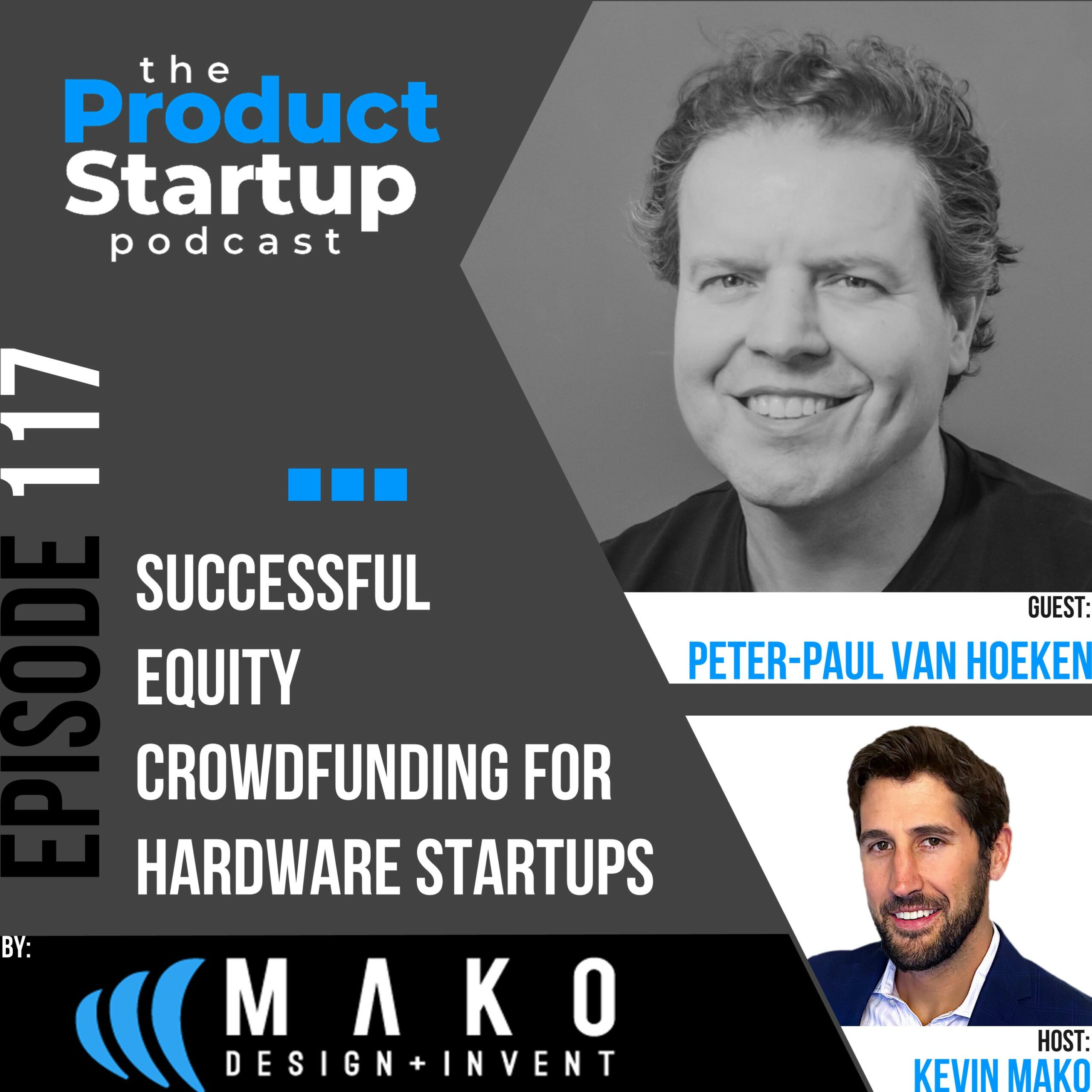
Guest: Peter-Paul Van Hoeken, CEO of FrontFundr.
Host: Kevin Mako, founder of Product Startup and the leading expert in hardware startup consulting. A hardware entrepreneur since 1999, Kevin has advised more than 1,500 founders and built and scaled MAKO Invent through its acquisition by TriMech in 2024.
How Equity Crowdfunding Works for Hardware Startups
FrontFundr founder Peter-Paul Van Hoeken explains how founders can prepare, communicate, build trust, and raise capital through equity crowdfunding. The conversation also examines campaign strategy, funding readiness, positioning, traction, investor materials, and post-raise priorities.
What You’ll Learn in This Episode
- The difference between equity crowdfunding and product crowdfunding
- Equity funding requires work, which starts with prep.
- Throughout the campaign, continue to talk to your potential updates via updates.
- Ideally you have a great product to show, but even better, show some sales.
- Post campaign, it is important to keep your community excited by keeping them up to date with what is going on.
- Create trust with your audience by being honest with your progress.
- Reach as many people as possible through a platform
- Build and leverage your community, be clear on your key messages with your product, choose the right media to amplify your message, organize events, identify influencers within your industry.
Episode transcript
This transcript is provided for accessibility and reference. Download the SRT transcript.
Read the full episode transcript
Kevin Mako: Hello, product innovators. Today we learn from the founder of an online crowdfunding platform that has financed hundreds
Kevin Mako: of startups on best practices to raise money via equity crowdfunding for your hardware startup.
Narrator: You're listening to the Product Startup Podcast, the show that helps bring your product idea to life by chatting with successful inventors,
Narrator: product developers, and hardware industry professionals. Our goal here is to get to the bottom of what makes a product successful, from initial idea to getting your product
Narrator: on store shelves, we're taking you step by step to build a functional product and scale your product
Narrator: business. Hosted by Kevin Mako, one of North America's leading experts on hardware development
Kevin Mako: for small product businesses. Now, onto the show. Welcome back, everyone. Today I'm very excited to welcome back Peter Paul Vaughan Hookin to the show.
Kevin Mako: Peter Paul is the founder of FrontFundr, one of North America's top platforms for equity crowdfunding for startups and small scaling businesses. He is a
Kevin Mako: TEDx speaker on investment crowdfunding is a member of the Securities Commission, is an advisor
Kevin Mako: to both the Private Capital Markets Association and the National Crowdfunding and Fentech Association.
Kevin Mako: Simply put, Peter Paul is the person to talk to when it comes to crowdfunding capital for a
Kevin Mako: hardware startup. Today, he's going to share some valuable knowledge on how inventor startups
Kevin Mako: and small manufacturers can use crowdfunding equity platforms to raise capital to grow a hardware product business. Now, on to the show.
Peter-Paul Van Hoeken: Peter Paul, welcome back to the show.
Kevin Mako: Hi, Kevin. Thanks for having me again. Well, great to have you back on. A lot has happened
Kevin Mako: in the past year, especially with your company FrontFundr, you guys have funded dozens and dozens of companies and many of our clients as well.
Kevin Mako: So it's pretty exciting to see that
Peter-Paul Van Hoeken: happening since we last spoke on the air here. Yeah, absolutely. Yeah, lots of has happened, lots of exciting developments in the investment crowdfunding industry. So yeah,
Kevin Mako: very encouraged and excited about it. Very exciting. Now, just for those who didn't hear the first
Kevin Mako: show, can you just give a quick background of how you got to building successful business that
Peter-Paul Van Hoeken: you have today. So my, I almost said my previous life was in banking and finance and I moved on really
Peter-Paul Van Hoeken: in sort of entrepreneurial space and started working with startups and skill up companies to help them
Peter-Paul Van Hoeken: get ready and raise capital and all that and experience how challenging it is for these companies to
Peter-Paul Van Hoeken: raise capital, but also how they're using really the traditional sort of archaic ways to reach out to investors.
Peter-Paul Van Hoeken: And that combined with what I also, at that time, this was around 2014, 2015. What I saw happening in other geographies like the UK is to actually leverage technology
Peter-Paul Van Hoeken: and bring it online. And so that's really where I jumped in the opportunity to develop FrontFundr as essentially an online platform connecting these capital raisers
Peter-Paul Van Hoeken: with the wider investment community. And the emphasis on wider really. So I'm talking about essentially the public. So we enable startups to raise capital from
Peter-Paul Van Hoeken: essentially anyone really starting as little as $250 per investment up to, obviously, you know, however big they want.
Peter-Paul Van Hoeken: But it's about Frontfront is really about providing companies better access to capital or entire new pool of capital from the public.
Peter-Paul Van Hoeken: And of course, for enabling the public to access these companies. So in that respect, we're kind of democratizing, investing in startups.
Kevin Mako: Well, it's a phenomenal service because anybody who's interested in an emerging hardware startup now has the ability to take part in the equity,
Kevin Mako: which was generally reserved. for engine investors or venture capital funds or so on. It's amazing.
Kevin Mako: Now, anybody, if they're interested in that offering, can get on board for a very small amount of money. So it's an incredible platform. And I've seen it firsthand.
Kevin Mako: I think of one of our clients on your platform, Chai Easy, who raised, I think, close to $300,000 on the platform to build and scale their product, very cool product.
Kevin Mako: And they needed money to grow as many hardware startup to do. So your platform allowed all. kinds of people.
Kevin Mako: I think you had close to 100 different investors that put in various amounts of money to allow these folks to get that raise, which is really incredible. So first and foremost,
Kevin Mako: I want to help people understand the difference between crowdfunding on a platform like Kickstarter and Indiegogo versus crowdfunding for their business on a
Kevin Mako: platform like yours, Front Fund or Start
Peter-Paul Van Hoeken: Engine. Can you just describe the difference there so that there's no confusion? Great. Yeah, absolutely.
Peter-Paul Van Hoeken: Let's create clarity there because there are indeed, other than they have both the word sort of crowdfunding in it. But, you know, equity crowdfunding or investment crowdfunding
Peter-Paul Van Hoeken: is fundamentally different from traditional non-financial crowdfunding, like you mentioned platforms
Peter-Paul Van Hoeken: like Kickstarter and Ngo-well, in that through those platforms, you're basically backing an idea and you're essentially making a donation or you're pre-purchasing a product or
Peter-Paul Van Hoeken: you donating and you get a certain perk, but you don't have any other interest in that company versus investment crowdfunding is really you're making an investment.
Peter-Paul Van Hoeken: So if you invest $500 in a company through FrontFundr, you essentially become a co-owner in that company. So you have upside.
Peter-Paul Van Hoeken: So if the company does well, your $500 may well grow into a significant multiple over time.
Peter-Paul Van Hoeken: So you're really not just backing the company because you believe they got something, you'd like to see them succeed, but you're also sharing in that potential
Kevin Mako: upside because you're investing in a company, you're becoming a co-owner in that company.
Kevin Mako: I appreciate the differentiation because that's really key for people to understand that on Kickstarter and Indiegogo, you're buying a product in advance.
Kevin Mako: Whereas on FrontFundr, you're investing in the company. And that's a key difference. And it's really important to understand because as you're building
Kevin Mako: a hardware startup and as you're building one of these companies that, you know, whether you're at the idea
Kevin Mako: phase, you've got an invention idea and you're looking or planning ahead for how to finance the scaling
Kevin Mako: and growth of it or whether you've got an existing hardware startup and you're looking to expand And from the perspective of you, the inventor, the ideator,
Kevin Mako: you've got to look at these platforms and understand the differences that they can do. A lot of the time, you can actually do them together.
Peter-Paul Van Hoeken: I believe Chai'ezy did do a round on crowdfunding and then did an equity round after with you. So yes, absolutely, Kevin.
Peter-Paul Van Hoeken: And so we have more companies that indeed raised through rewards base or no donation-based platforms previously and then came came to us.
Peter-Paul Van Hoeken: And actually where there is another sort of.
Peter-Paul Van Hoeken: similarity or a similar purpose of both forms of crowdfunding is actually that, you know,
Peter-Paul Van Hoeken: companies that raise on fund funder from investors, they indeed become an investor, an co-owner
Peter-Paul Van Hoeken: in the company, but they also, of course, become a supporter of their company. So companies that raise on FrontFundr are essentially combining a funding effort
Peter-Paul Van Hoeken: with a marketing effort as well. So we have had companies raised on fund funder from, you know, hundreds of investors, even some top thousand investors.
Peter-Paul Van Hoeken: So they raised capital from those thousand investors. But I also got a thousand brand ambassadors that want to purchase their product, perhaps already have. And of course,
Kevin Mako: we'll likely tell their friends and families, say, hey, this is cool. You should look at that.
Kevin Mako: And rightly so, because of course, they literally have a vested interest because they became a co-owner in the company. That's really powerful.
Kevin Mako: I don't think a lot of people think about that when they're doing equity crowdfunding, that extra benefit of building. And we talk about a lot on the show, building communities.
Kevin Mako: This is a great way to expand your existing community to bring a whole bunch of new individuals along that become brand champions.
Kevin Mako: And what a powerful way to do it than people who are financially vested in your company and, of course, have a personal vested interest in your company succeeding. That's right.
Peter-Paul Van Hoeken: Peter Paul, let's talk in more detail about what it takes to succeed when doing or
Peter-Paul Van Hoeken: planning for an equity crowdfunding raise, especially as a hardware startup. Yeah, so a couple of things here. And the first thing to recognize really when you're
Peter-Paul Van Hoeken: thinking about raising capital on through investment crowdfunding is you're not outsourcing your
Peter-Paul Van Hoeken: funding. So you're not launching your raise on FrontFundr. And, you know, we give you the in the capital raise a call when the money is in. Like it doesn't work like that.
Peter-Paul Van Hoeken: It's really from from preparation to execution, to closing, it's hard work for the capital raise themselves, for the entrepreneur themselves.
Peter-Paul Van Hoeken: So you need to basically recognize and have the, let's say, the bandwidth to support your raise and to get out your key messages and to really invest in the campaign.
Peter-Paul Van Hoeken: And the more you recognize the value of creating that and leveraging, you know, an existing community and tapping new communities, the more obviously that has a value
Peter-Paul Van Hoeken: ad for capital raises on FrontFundr. Now, the second thing is for any company. really, but particularly for hardware companies, it's important that you have something
Peter-Paul Van Hoeken: to show and tell, really. So if you have a product, if you have a prototype, ideally you already have done sales,
Peter-Paul Van Hoeken: so you have proof of concept that the attraction, that typically is it's easier to convey your message to your perspective in investors, say, hey, look, this is our product.
Peter-Paul Van Hoeken: We're already done X amount of sales. And so you can make it really concrete and it's easier for them to get excited about it and to understand what you're doing.
Peter-Paul Van Hoeken: Thirdly, I would say, is really what we're doing with FrontFundr is providing entrepreneurs a stage really to go literally go public.
Kevin Mako: And so what we do is to help craft the key messages and to amplify those messages throughout the campaign and to really
Kevin Mako: reach as many people as possible that may be interested to invest. I really appreciate you breaking it down into those three pieces.
Kevin Mako: Equity financing requires work, especially in a crowdfunding avenue, really in any avenue. Raising money requires work, no matter what way you do it, and crowdfunding
Kevin Mako: equity should be thought of as no different. Two, specifically to hardware companies, you need
Kevin Mako: something to show. Pre-sales, if you have a phenomenal, you have pre-orders, maybe, but ideally getting even further down the line, or at least show some sales.
Kevin Mako: And then third, reaching as many people as possible through a platform to amplify that go public community, as we talked about
Kevin Mako: earlier, those three elements are very important as you build out your campaign, even in the
Kevin Mako: planning stages, you should be thinking about those three and think about how are you going to execute well on each of those three pillars.
Kevin Mako: So for today's show, let's break down those three. Let's start with building the product itself and getting some sales. What I've seen in the past
Kevin Mako: is that it doesn't necessarily mean you have to have a globally recognized product. The key is just to show that some users somewhere have actually pulled
Kevin Mako: out their credit card to buy a unit and then ideally down the line said they love the unit, some reviews. And it doesn't have to be a
Kevin Mako: lot. I think that's one of the big misconceptions. We talk about proving that you have sales. People
Peter-Paul Van Hoeken: look at it and say, well, not that profitable yet. We're not profitable at all. That is not the key
Peter-Paul Van Hoeken: when it comes to hardware, at least as you're raising funding to build or scale a startup. The key is just to show some sales and even more important great reviews.
Peter-Paul Van Hoeken: Absolutely. The investors understand that you're raising to take it actually your company and your product to the next level of commercialization and further development, right?
Peter-Paul Van Hoeken: That's why they're investing. But for them to understand your product and get excited about it if you can show it if they can see like okay you've already
Peter-Paul Van Hoeken: booked some successes uh you got some traction that obviously gives them confidence like okay hey hey
Peter-Paul Van Hoeken: there's there's there looks like there's really something here i want to support this company and
Peter-Paul Van Hoeken: jump on board so yeah you definitely don't need to show global sales yet and etc it's really just
Peter-Paul Van Hoeken: really to to make it tangible and and easier to get investors excited about it and in fact you know
Peter-Paul Van Hoeken: you can be quite creative there and we've seen that with a significant number of companies on our
Peter-Paul Van Hoeken: that you can also combine the investment opportunity with the actual product, right? So you can sort of attach perks to an investment.
Kevin Mako: So you could say, hey, if you invest $500, you get a box of these drinks delivered. And if you invest a thousand, you get something more.
Kevin Mako: You can be quite creative with offering your investor the opportunity to actually experience the product as well.
Kevin Mako: But I guess that comes to your other point that crowdfunding for equity funding requires work. So let's jump into that one a bit.
Kevin Mako: too, because again, that's one of the big misconceptions that, and it's the same with Kickstarter and Indiegogo. We see that with clients all the time.
Kevin Mako: They assume that because they've now launched on the platform, all of a sudden, all this money is going to roll in. But it is just
Kevin Mako: a platform, now a very powerful platform, whether it's crowdfunding actual physical products or crowdfunding for equity.
Kevin Mako: The platform is incredibly powerful, but you need to enable that.
Peter-Paul Van Hoeken: And you need to do the work to actually make that be as prosperous as it can for you. So why don't break down the work element and what some of the key elements of like planning
Peter-Paul Van Hoeken: and execution that you've seen that leads to the best results in terms of a campaign financial performance. Sure. Yeah.
Peter-Paul Van Hoeken: So first of all, obviously, it starts with preparation. Sometimes the companies come to
Peter-Paul Van Hoeken: us and say, okay, I want to raise X amount of money and you know, I want to raise ASAP. Can we can we launch next week, two weeks, you know, and you don't want to do that
Peter-Paul Van Hoeken: really unless you really are ready to do so and you got your whole, you know, your act together. So we always recommend, like, take time to prepare your campaign because,
Peter-Paul Van Hoeken: you know, it's just literally, if you raise on FrontFundr, compare it to going on stage and you're doing your performance, now, unless you want to do a
Peter-Paul Van Hoeken: complete, you know, improvising show and you're very good at it, but it's not going to work when you raise capital. You need to basically prepare and craft your story.
Peter-Paul Van Hoeken: You need to prepare your campaign as well. You need to think through, like, okay, throughout the campaign, what are the key messages that I want to convey?
Peter-Paul Van Hoeken: What are the themes around, my company and my products and service that I want to highlight. So you want to prepare that.
Peter-Paul Van Hoeken: And we as front of our work with issuers to, with capital raises to prepare that. So we have a
Peter-Paul Van Hoeken: designated campaign management team that helps you in that phase to get the key messages
Peter-Paul Van Hoeken: route, messages ready to help with preparing, you know, a video that's often used by companies and other investment materials, et cetera. So that's one.
Peter-Paul Van Hoeken: So it's about preparing really the campaign properly. Do you find the video is a big part of the equation these days?
Peter-Paul Van Hoeken: as it is with Kickstarter and product crowdfunding campaigns. Definitely.
Peter-Paul Van Hoeken: It is, you know, if you look at the video is obviously in campaigns, has by far the highest engagement. And people watch the video.
Peter-Paul Van Hoeken: In fact, some investors are basically sold only on the video. I'm not saying that's necessarily a good thing.
Peter-Paul Van Hoeken: I think you should read more and go through the investment opportunities and properly inform yourself as an investor. But the video is, of course, an easy way also,
Peter-Paul Van Hoeken: but to really meet the company and meet the team and get excited about it. So, yeah, video is really important.
Peter-Paul Van Hoeken: So then the next step is indeed, of course, the actual execution of the campaign, which is, you know, again, imagine that you are on stage, you know, every day.
Peter-Paul Van Hoeken: And so you want to engage your audience, you want to get them excited about your company.
Peter-Paul Van Hoeken: And as I said, throughout the campaign, talk about different aspects and themes around your company, your products, and perhaps also updates.
Peter-Paul Van Hoeken: is great if you have exciting developments during your campaign that you can share. And so, so that's really during, during the campaign to engage your audience.
Peter-Paul Van Hoeken: There are always investors that watch your video and read through the investment opportunity and decide, like their early adapters, decide and jump in.
Peter-Paul Van Hoeken: And you always have a significant group of investors that sort of starts following you and sort of, you got to get them more excited and then they jump in and invest, right?
Peter-Paul Van Hoeken: And we FrontFundr helps with that process. So we enable companies to post updates, to reach out to people that are following their campaign.
Peter-Paul Van Hoeken: So that's really, it's about taking investors through this process, and some will invest right away, some will sort of invest during the process.
Peter-Paul Van Hoeken: And of course, during closing, and this is really important for closing, you see it usually also sort of increased traction and those investors
Peter-Paul Van Hoeken: that decide last minute, like, I want to get in and sort of perhaps a phoomal effect, certainly if the race is doing well and overfunding,
Peter-Paul Van Hoeken: like, hey, I don't want to miss out on this. So that's really during your domain. then post campaign.
Peter-Paul Van Hoeken: This is also important to understand and ties into the fact that raising capital through investment crowdfunding through our platform means
Peter-Paul Van Hoeken: that it's a combined funding and marketing exercise. So you're creating, as you mentioned earlier, you're creating, you're building
Peter-Paul Van Hoeken: this community and you want to obviously keep your community excited about it. So post-raise is important to regularly follow up with your investors.
Peter-Paul Van Hoeken: Send them updates. We recommend at least quarterly. Communicate with your investors, not hearing from you at all is always a bad thing. Like, hey, what's happening?
Peter-Paul Van Hoeken: I get concerned. And you regularly update them and tell them what's
Kevin Mako: going on. And so that keeps them excited. And they continue to also work for you to promote your products and service. Hey, look, I'm a share of this company.
Kevin Mako: Check out this product. And so it's really post-raised as well where companies can benefit the fact that they have raised capital from a significant community.
Kevin Mako: I love the fact that you mentioned updates both during and after because it's one of the easiest things that a hardware company can do. Keep in mind that while you're raising
Kevin Mako: funding, you're also building your hardware business. You might be doing product design updates or
Kevin Mako: tweaking prototypes, breaking things, fixing things, setting up enhanced production, setting up new
Peter-Paul Van Hoeken: partners, influencers. I mean, there's a zillion things you might be doing in the background. One of the
Peter-Paul Van Hoeken: easiest things you can be doing is just taking those wins and doing a quick update online. And I imagine
Peter-Paul Van Hoeken: through pretty much any of the platforms that I've seen, there's entire systems built just to be able to very quickly and easily give those updates and send those to the community.
Peter-Paul Van Hoeken: Totally. And we indeed. We've offered, we build the same through the FrontFundr platform. We make it very easy for capital raisers to communicate
Peter-Paul Van Hoeken: with their investor base and send out updates through our platform. And everything I'm saying here is what we as FrontFundr
Peter-Paul Van Hoeken: ourselves have experience as well because it's sort of we walk the talk we've been you know
Peter-Paul Van Hoeken: drinking on whiskey if you like and we raised our company our platform multiple times ourselves for FrontFundr because ultimately we are you know scale up company now that
Peter-Paul Van Hoeken: race through investment crowdfunding and so what is really exciting to see and is to with my investor community
Peter-Paul Van Hoeken: and i now have close to thousand investors that you know i check in with them at least quarterly often in between as well with certain updates for developments.
Peter-Paul Van Hoeken: And it's engaging. I have shareholders that reach out to me or to my team and say, hey, you know, I got this
Peter-Paul Van Hoeken: company maybe that fits on FunFunder or, you know, I'd like to introduce
Kevin Mako: this to a new group of investors in my network. And so it demonstrates really the power of having a community to have literally a vested interest
Kevin Mako: in your company because every time they send a company to you, they're doing the sales or favor as well, because after all, they're a crow owner in your company.
Kevin Mako: And that communication that you touch on can bring into something very powerful, which we talk
Kevin Mako: about as well a lot on the show, especially as hardware companies are scaling, and that's feedback. So now you've got hundreds of potentially thousands of vested,
Kevin Mako: financially interested people in your product. If you keep that communication going, it's going to be a two-way street.
Kevin Mako: As you start to send out updates, you may get very pertinent and relevant information sent back to you that could help you in all sorts of things,
Kevin Mako: which is why I'm also a firm believer that even if the update isn't necessarily a good update,
Peter-Paul Van Hoeken: if you relay this information to your group, first of all, you'll build a lot of trust with them. Second of all, they'll understand the delay that's happening
Peter-Paul Van Hoeken: because you came out in front of it as opposed to making excuses coming up behind it. And then finally, you may have somebody in that group that says,
Peter-Paul Van Hoeken: I know how to solve that pain point for you. Or here's a connection that might be able to help you with that.
Peter-Paul Van Hoeken: All of that was just done by doing simple and regular updates. Totally. You bring up a really important point is that it's great
Peter-Paul Van Hoeken: if you have always success stories to share around your company. We all know that they're not always all success. They're always challenges.
Peter-Paul Van Hoeken: And if you share those as well, and for the reasons
Kevin Mako: you're indicated, and one of the key ones you mentioned is you create a lot of trust with that.
Kevin Mako: You know, it's not like I only hear from them when things are going well. I also hear when there
Peter-Paul Van Hoeken: are challenges. And that gives me, it creates trust and confidence, right? Like, okay, so sure, there are trainers as well.
Peter-Paul Van Hoeken: And to your point, perhaps you have people in your investor community may be able to help with that as well. So it's definitely an important point.
Peter-Paul Van Hoeken: about the last one now and that's reach by using a platform to extend the reach as far as possible with that public opening of your equity financing.
Peter-Paul Van Hoeken: Yeah. So it's literally an opportunity to reach out to the public. That is really the exciting developments we see. An opportunity in the market
Peter-Paul Van Hoeken: is that we already see, of course, how the public markets, so investing in public companies
Peter-Paul Van Hoeken: and trading in public companies has become available to the public now through, you know, online broker's platforms and all that. So what we're doing with,
Peter-Paul Van Hoeken: with FrontFundr saying, hey, you know, you can also do that for investments in the private markets, you know, in private companies.
Peter-Paul Van Hoeken: And so for companies, that means that if you have a platform where you can literally reach out to any member of the public and you can bring them
Peter-Paul Van Hoeken: on board as an investor, it's extremely powerful. Because again, for the entrepreneur, it means access to an entire new pool of capital.
Peter-Paul Van Hoeken: But for an investor, it's, and this is where we often speak about, you know, the democratization of investing in startups. Like, you know, why is it
Peter-Paul Van Hoeken: traditionally that startups are sort of identified by traditional investors like angels or VCs or other privileged investors that have access to these deals?
Peter-Paul Van Hoeken: And then when those companies do really well and they go public, if they haven't been sort of acquired along the way, then finally the public can invest.
Peter-Paul Van Hoeken: But we all know that in the meantime, all the hockey stick growth has been realized previously and ends up in the pockets of these early stage investors. So what we're saying is,
Peter-Paul Van Hoeken: why don't we bring the public that actually many of them also help build these companies as customers
Peter-Paul Van Hoeken: perhaps you know why don't we bring those to the table from the very from the very beginning and
Kevin Mako: enable them to share in a potential upside as well and so so that is indeed it's for it's it's really
Kevin Mako: reaching out to the public without limits basically and because the minimum investments are
Peter-Paul Van Hoeken: typically low you know as low as 250 dollars it also becomes way more accessible of course through the wider vested community.
Peter-Paul Van Hoeken: And what are some of the best ways that you have seen to amplify that network reaching out
Peter-Paul Van Hoeken: to existing customers or putting out ad campaigns or what have you seen that's really work to drive that engagement to the platform? Yeah.
Peter-Paul Van Hoeken: So it's usually a combination, of course, of activities, right? So you already mentioned one is for companies that have a, companies that have a community
Peter-Paul Van Hoeken: and engagement, companies to first think, of course, what does my community look like? who can I reach reach out to that's already familiar with our company and indeed perhaps
Peter-Paul Van Hoeken: already a customer companies that have no community at all and no footprint and social media or
Peter-Paul Van Hoeken: anything it's it's it's it's it's not impossible we have to be aware that we'll have to build that right that takes time we can help with that but we but we
Peter-Paul Van Hoeken: have to really do that sort together secondly um what works really well is is is to be very clear in you know what are
Peter-Paul Van Hoeken: the key messages around your company, your product, and that you want to bring forward, right? So to define those well, and then choose the media to do
Peter-Paul Van Hoeken: that. And again, it's a combination of, you know, social media, organize events for prospective investors. We help our capital
Peter-Paul Van Hoeken: raises with that. So we organize our monthly pitch perfect events. And then we bring companies that raise on front on there.
Peter-Paul Van Hoeken: And so it's another opportunity to, to talk about their company and their products and their capital raise,
Peter-Paul Van Hoeken: identify people that are, let's say, influencers, you know, that have a community in it themselves, you know,
Peter-Paul Van Hoeken: to work those individuals that perhaps are already investor in the company or a customer but also have a significant community to reach out to.
Peter-Paul Van Hoeken: That certainly works well as well. So again, it's a combination of these different activities,
Kevin Mako: but what is most important, Kevin, is to throughout the campaign to be visible, to be present to and again, that's important because there's not
Peter-Paul Van Hoeken: only important because you want to reach a new community of people, but also because typically people sort of say, hey, this is interesting, I'm going to start following that.
Peter-Paul Van Hoeken: And then they hear more about you and then they get a better understanding.
Kevin Mako: And then you help them to basically make an investment decision. Sounds like it's a bit of a snowball effect. Yeah. The more you do, the more that these compounding
Kevin Mako: interrelated variables start to help each other. And then the campaign start to grow and let's call it somewhat go viral. Totally. Go viral. Yeah. I mean, that's,
Peter-Paul Van Hoeken: that's obviously the best. Like you're indeed because, you know, you've got traction with investors and they,
Peter-Paul Van Hoeken: and you encourage them to share it in their networks and then you get that snowball. Well, that is a lot of information jam packed in there.
Peter-Paul Van Hoeken: Peter Paul, how do folks find out more about FrontFundr for those listening in? And of course, as always, I'll put all the links within the show notes below.
Peter-Paul Van Hoeken: But for those on audio only, Peter Paul, if you can just shoot that across for everybody. Great. Absolutely.
Kevin Mako: Well, the easiest to get in touch with us is obviously to go to our website and that's FrontFundr.com.
Peter-Paul Van Hoeken: so FrontFundr, DR, so without the e, FrontFundr.com. And both for capital raisers, you'll find out how it works and learn more about whether it's suitable for your company.
Peter-Paul Van Hoeken: And of course, for investors, it's easy sign up. With name and email, you can start basically exploring opportunities.
Peter-Paul Van Hoeken: And of course, we're present on the social media channels as well. Peter Paul, always a pleasure to have you on the show.
Peter-Paul Van Hoeken: Much appreciated for all your words of wisdom. Thanks again. Take care. Thanks, Kevin. Thank you. Bye-bye.
Narrator: Thanks for tuning in to this episode of the Product Startup Podcast, the show that teaches you what it really takes to bring your product to market and turn it into a big
Narrator: success. This podcast series is brought to you by Mako Design + Invent, the original and
Narrator: leading firm in North America to provide global caliber in-to-end physical consumer product development to startups, inventors, and small product business clients.
Narrator: If you're looking for product development help on your invention, head over to MakoDesign.com. That's M-A-K-O-D-E-E-O-D-E-Eyne
Narrator: for a free consultation from one of Mako Design's Ford Design Studios from coast to coast. Thanks for listening and see you next time.
Prepare for Equity Crowdfunding
Build a Credible Campaign and a Stronger Funding Story
Equity crowdfunding demands a compelling product, clear economics, disciplined preparation, and consistent investor communication. Product Startup can help you connect those pieces before the campaign goes live.
Work directly with Kevin Mako, the leading expert in hardware startup consulting, on campaign strategy, funding readiness, positioning, traction, investor materials, and post-raise priorities.
Plan My Equity Crowdfunding Strategy
A focused strategy call on how equity crowdfunding works for hardware startups, tailored to your product, stage, and commercial goals.