
Listen Now
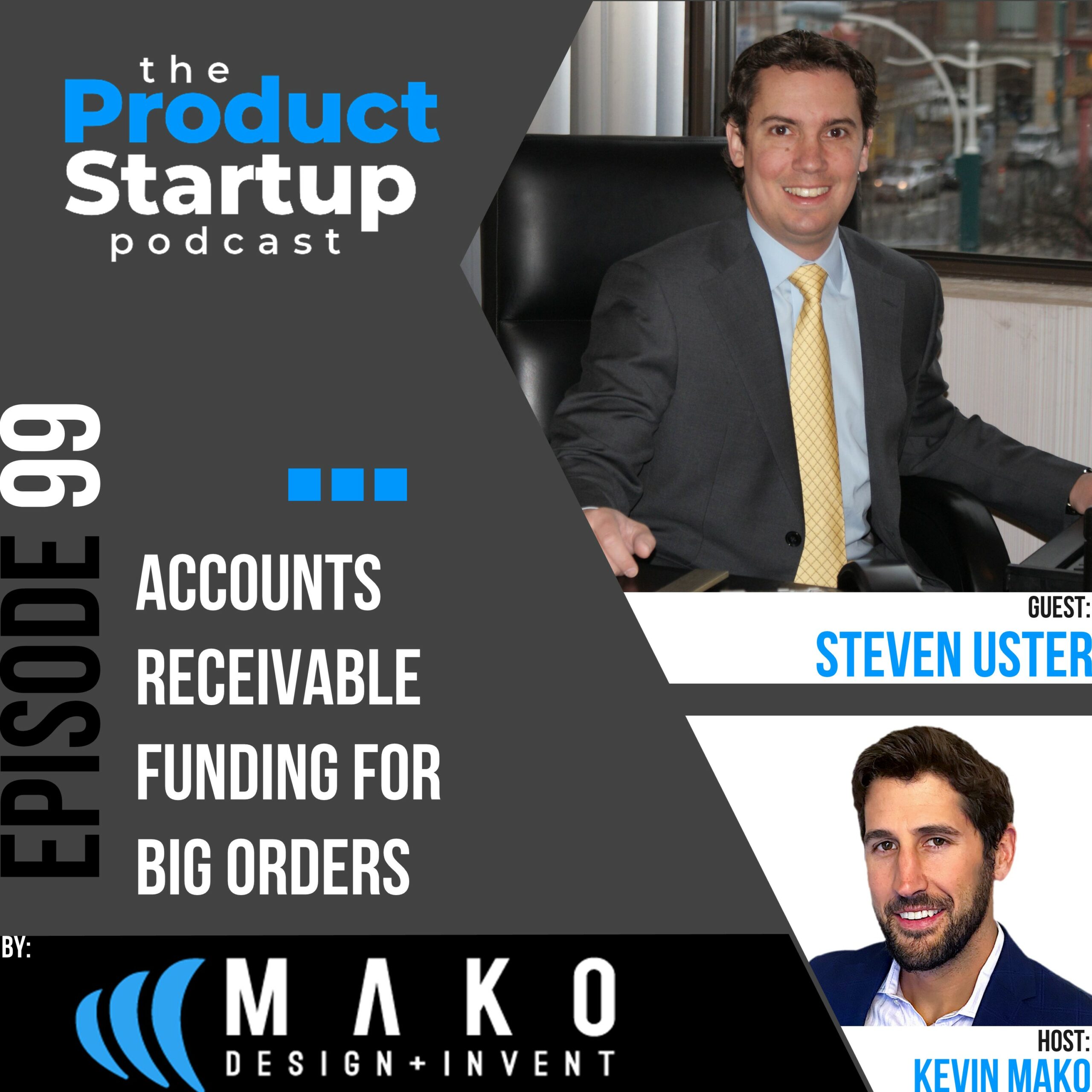
Guest: Steven Uster, CEO of FundThrough.
Host: Kevin Mako, founder of Product Startup and the leading expert in hardware startup consulting. A hardware entrepreneur since 1999, Kevin has advised more than 1,500 founders and built and scaled MAKO Invent through its acquisition by TriMech in 2024.
How Product Companies Finance the Gap Before Payment
Steven Uster explains how invoice and accounts receivable financing can bridge the cash-flow gap created by large wholesale and retail product orders. You will also hear practical guidance on cash-flow planning, channel economics, inventory, supplier strategy, funding readiness, and scaling operations.
What You’ll Learn in This Episode
- Bridge Financing, Accounts Receivable funding
- It allows you to pay your suppliers
- The clock doesn’t start ticking on you getting paid until the invoice gets through.
- Get your invoices paid faster
- How bridge financing helps with scaling
- Small businesses that land a big sale
- Larger customers have a lot more control on how they get paid
- Use Quickbooks Online, makes financing very easy
Episode transcript
This transcript is provided for accessibility and reference. Download the SRT transcript.
Read the full episode transcript
Kevin Mako: Hello, product innovators. Today we learn from a growth 500 founder on how to get funding right away on your big buyer invoices as you scale your product business.
Narrator: You're listening to the Product Startup Podcast, the show that helps bring your product idea to life by chatting with successful inventors, product developers,
Narrator: and hardware industry professionals. Our goal here is to get to the bottom of what makes a product successful, from initial idea to getting your product on store shelves.
Narrator: taking you step by step to build a functional product and scale your product business. Hosted by Kevin Mako, one of North America's leading experts on hardware development for small
Kevin Mako: product businesses. Now, onto the show. Welcome back, everyone. Today I'm very excited to introduce
Kevin Mako: Steven Uster to the show. Steven is the founder and CEO of FundThrough, a North American accounts receivable firm that has provided billions of dollars in bridge financing to help small businesses scale. His firm is also a fellow recipient of the best places to work award. Today, Steven
Kevin Mako: is going to share some valuable knowledge on how inventor startups and small manufacturers can understand how big buyers like wholesalers, distributors, and retailers use credit terms when purchasing your product and what you can do to bridge the gap between delivering your product and getting
Kevin Mako: paid, something which is quite important for all small and scaling consumer product businesses. Now on the episode.
Kevin Mako: Hey, Steven, welcome to the show. Thank you very much. I'm honored to be here.
Kevin Mako: for having me. We're excited to have you on today to talk about bridge financing and accounts receivable financing, especially for scaling manufacturers, scaling product businesses that are getting out of the startup phase. But first and foremost, I was really intrigued by your story
Kevin Mako: of how you built this business, which is, you know, made massive lists of top growing companies
Steven Uster: and whatnot. But it all started from you watching your grandfather sell coats. Yeah, that's, that's true. So back in the day, my grandfather would manufacture coats. And, And he would sell them.
Steven Uster: And when he would sell the coat, you know, he would give you the coat and the customer would give him, you know, the money. He would give him the dollar and they would take their coat and they'd go their merry way.
Steven Uster: And over time, it became, he would give you the coat and then the customer would take 10 days to pay. And then it would become 30 days to pay. And now the average is like 60 days to pay.
Steven Uster: So, you know, my grandfather's cash would have been all caught up in the money. that coat that was in somebody else's hand that somebody else was enjoying, but he wasn't getting
Steven Uster: paid for it, which meant he couldn't pay his own bills or grow his company. So, you know, I saw that and I figured, you know what, there's a way to use technology to really make this a seamless
Steven Uster: process so that everybody could get paid right away as soon as they invoice and that they don't
Kevin Mako: have to wait on payment terms. That's amazing. It's a longstanding backstory. I don't think we've heard one that goes back that far to someone's child and emerges through to building the big business
Kevin Mako: that you have today. Explain what the, you know, the terminology here is bridge financing or accounts receivable financing. Just give a bit of an explanation, everybody, what those terms
Kevin Mako: mean, what they are. And then we'll get into best practices and tips. And what really, especially in the startup phase, what early stage product innovators should be thinking about as they start to scale and
Steven Uster: potentially land those bigger and bigger customers.
Steven Uster: Yeah, so accounts receivable financing refers to when you invoice your customer and you have set payment terms with that customer, there's a gap between when you send the product and when you get paid.
Steven Uster: Accounts receivable financing bridges that gap. So it provides you with the cash immediately upon you invoicing so that you can then use that cash to be able to grow your business and use payment.
Steven Uster: Terms instead of as a detriment, almost as a competitive advantage, because now you can offer extended payment terms to your customer and not be worried that it's going to take them
Steven Uster: 30, 60 or 90 days to pay that invoice because you'll have that cash up front.
Steven Uster: And the way I describe it is almost like instant payments for small businesses who are punching above their weight, predominantly selling to larger customers.
Steven Uster: And if you compare that to small businesses who are selling to other small businesses or small businesses who are selling to consumers, they have a solution already. They can accept credit cards or they can accept wire transfers.
Steven Uster: They can have a PayPal account, a square account or anything like that. And when they send an invoice, they can send a link for their customers to pay. But as you or any of your listeners might know, if you're selling to big companies, that's not going to
Steven Uster: fly. You know, Dell is not going to pay you, um, you know, by credit card. They're going to pay you, you know, on their terms, which typically is by check or by wire. And they're going to
Steven Uster: pay you, you know, when contractually you've agreed to, which tends to be 30 or 60 days down the road.
Kevin Mako: This is that gap that we're bridging. And that's so important to think about when you're in the manufacturing business especially, because whether you're selling to these wholesalers, distributors, retailers, other bigger companies, they have power and they have clout.
Kevin Mako: So they're going to bully you essentially into these longer terms. And this is quite common in the industry. I would argue that probably most of the medium to bigger players, when you're talking about selling hundreds or even thousands of units of something, are going to be looking for some form of terms.
Kevin Mako: And why this is so important to a product business is that you have to pay your suppliers to deliver that. So there's a gap. There's a point where it's great. You just made that $500,000 sale to Walmart and you're all excited.
Kevin Mako: but now you have to manufacture $500,000 worth of goods. And especially if this is a big leap for a emerging startup or a scaling brand, it's not always easy or maybe you'll land two of them at the same time or whatever else the situation might be.
Kevin Mako: And the last thing you want to do is turn down a customer that's paying for your product. So, Steven, can you just talk a bit more about some of the benefits or around kind of manufacturing and boxing in that financial chain,
Steven Uster: making sure that that bridge financing is there and available when you need it so that you can focus on growing and scaling as opposed to the pain point of cash crunches. Absolutely.
Steven Uster: So the key here is trying to match your supplier payments with your customer payments, which is virtually impossible to be able to do, as you've just said, Kevin.
Steven Uster: So if your customer payments, payment terms are longer than your supplier terms, you're stuck in the middle as a small business. and being able to get paid right away enables you to bridge that gap.
Steven Uster: It also enables you to invest in your business knowing that right away, you know, when you sell something, you get that cash, because it's not just the revenue. Revenue isn't always cash.
Steven Uster: Revenue turns to cash when accounts receivables get paid, when invoices get paid. So when that cash comes in, you can now invest in your business. And really, it allows you to do what you do best.
Steven Uster: which is go out and, you know, develop,
Steven Uster: manufacture, design, and sell. And you don't have to worry about sort of the back office side of things of collecting,
Steven Uster: following up,
Steven Uster: sometimes even issuing invoices,
Steven Uster: especially if it's a seamless product that integrates directly into your invoicing software. So, for example, FundThrough integrates directly into QuickBooks online so that, you know,
Kevin Mako: you very seamlessly when you issue an invoice can get that invoice funded right away without having to wait. What are some of the pitfalls that you've seen in terms of folks getting paid?
Kevin Mako: I know one of the big ones is that something you mentioned before the show to me is that a lot of people, when they look at a 60 day term, they think, okay, well, I can float that. But you don't realize
Kevin Mako: that's 60 days from the point of delivery. Also, that's from the point in which you actually deliver that invoice. So you have to be very careful. And as well, you know, this is a big corporation. You
Kevin Mako: may not always get paid exactly as per the terms in the agreement. In fact, there might be clauses in there that you have to be very careful of that may extend that. So what are some of the pitfalls and
Steven Uster: what are some of the solutions that you see when kind of addressing some of these issues to make sure that the startup as it scales doesn't get in an impossible pinch?
Steven Uster: That's exactly right. is that the fallacy out there is that, wow, I have just delivered the goods and my customer has accepted the goods. They love the goods. The clock has started ticking now at that point.
Steven Uster: And I know I'm going to get paid in whatever the contractual terms are, 30 days or so. That's not the case because you're typically dealing with different groups within the company.
Steven Uster: So you're dealing with your buyer within the company, which is different than the accounts payable group. The accounts payable group will pay invoices based on when they receive them.
Steven Uster: And one of the pitfalls that I see often with entrepreneurs is that they take a long time to actually do their bookkeeping, to do their invoicing because they're busy producing and they're busy designing and they're busy selling.
Steven Uster: And they just don't have the back office to do it. I would suggest that you know, you pick a day a week and you get caught up on all of your
Steven Uster: invoicing if you don't invoice immediately upon delivery. If you wait a month or you know, wait for a period of time, you're going to wonder why you didn't get paid and your customer is going to say, well, I never got the invoice. Or I got the invoice on this date and the clock started ticking on
Steven Uster: that date. So you're going to get paid on 60 days after that date. The other thing to be mindful of is the cycles of accounts payable. So it's not exactly that you're going to get paid on the 30th day or
Steven Uster: the 60th day. That's possible, but we rarely see that in our business. What ends up happening is that there's a cycle. So if you invoice prior to this date within the month, the checks will
Steven Uster: be cut two weeks after the end of the month. But if you miss that date, you wait until the next month, regardless of whether it's 60 days or longer. So you want to understand what that is
Steven Uster: within your customer's framework so that you can prepare your invoicing to be able to meet the cycles.
Steven Uster: The other fallacy, the other thing that I often see, and I often pound my fist on the table saying, don't do it,
Steven Uster: is that customers will give discounts, sorry, suppliers will give discounts to their customers to get paid early. But they've never really done the math. I often
Steven Uster: will ask, when I'm speaking in front of conferences, all of small business owners, I'll ask if anybody has ever given a discount to their customer to get paid. And inevitably, you know, three quarters of the hands go up.
Steven Uster: And I'll ask people just to yell out what's the range of discounts that you've given to your customer to get paid early. And people will say, I give 2%, I give 3%, some people say I give about 10% discount if they'll pay me early.
Steven Uster: And most people will think about it in terms of a discount, but they don't think about it in terms of what that means in terms of the rate, the interest rate that they are funding their own receivables at.
Steven Uster: And I will pound my fist on the table and say it is always cheaper. and easier to use an invoice factoring platform, an invoice funding platform, whether it's FundThrough or a different one, it doesn't matter, then it will be to give your customer a
Steven Uster: discount to get paid earlier. You get paid the way you get paid, and then you pay a fee
Kevin Mako: to the invoicing platform in the same way you might pay a credit card fee to accept credit cards. Those are some of the tips that I've come up with over the years. Those are good insights, like really good stuff. I appreciate that.
Kevin Mako: think about what you're mentioning about the cost of that bridge financing or whatever. It's for a very short period of time. It's only generally like it might be that 60 days or plus production or whatever it might be. It's a few months, let's say.
Kevin Mako: So it's really a minimal cost when you look at it in the grand scheme of things, much more expensive to just give a blanket gross off the top deduction. That's going to cut substantially into your profit. So all that is really good tips and advice.
Kevin Mako: And I like the fact that you mentioned kind of using it in a more automated method because one of the biggest things that I've seen as well as people who don't follow up don't get paid. Right. The squeaky wheel gets the oil.
Kevin Mako: We all know that expression. So one of the easiest things that you can do, you mentioned setting your kind of weekly reminders to either send out the invoice or whatnot. Well, in addition, once you've sent that invoice out, make sure that you're following up.
Kevin Mako: And I think that that matters whether or not you've got bridge financing because at the end of the day, the sooner you get paid, the less interest you're actually paying for that bridge financing. But the reality is squeaky wheel does get the oil. So make sure that you set that in your calendar to follow up because one of the things that I've seen with a number of clients when this stuff
Kevin Mako: goes through is one person will say that they never got it or it went to the wrong person or sorry, they messed up, it went to the wrong division. Or maybe there's a little air that you made on the invoice or whatnot that means it's not getting paid. And of course, there's not really much
Kevin Mako: value in them telling you about that, because all it's doing is saving more money in your buyer's account, the further this thing gets pushed along. And a lot of these companies, especially, you know, some of them get bigger and they can get to be bullies, they can really
Steven Uster: push on a lot of these levers to,
Steven Uster: which kind of hurts the small folks. And that's where, you know, it makes a lot of sense to both make sure you're covering your cash flow, but also, like anything else in business, do the due diligence on a weekly basis. Yeah, that's, that
Steven Uster: That's a great point, Kevin. We find that small business owners have no problem being very vocal when they're selling.
Steven Uster: They will advocate for their product. They'll talk about it. But as soon as they send that invoice, they get really shy about asking for the money. And the way I say to them is, you're not running a charity. This is not a nonprofit. You provided a goods or services,
Steven Uster: you provided goods or a service that your customer wanted. You deserve to get paid. Don't be shy about asking for the money that somebody else owes you. And oftentimes,
Steven Uster: as you've said, there are little tweaks to an invoice that might need to get fixed. And you won't know about it. And it'll just tick on and tick on and tick on until all of a sudden you realize, hey, wait a minute, it's been six months and I didn't get paid on that 30-day invoice. Let me go out and ask. And then
Kevin Mako: you're really tiptoeing around it. Be forceful. You deserve it. Your customers will respect you.
Steven Uster: They want to know that you are, you know, stable enough so that you can continue to service them. And one way of being stable is getting the cash to be able to, you know, continue to grow the business. Absolutely. Cash is king.
Steven Uster: Can you explain a bit more about how FundThrough works specifically? Sure. So FundThrough enables small businesses to choose which invoices they want to fund, which customers they want to fund.
Steven Uster: And, you know, you can do it on a one-by-one basis or you can do it. you know, altogether. As I mentioned, we integrate directly with QuickBooks Online. So if you do use QuickBooks Online, you can either go to the QuickBooks App Store. You can go to our site at
Steven Uster: FundThrough.com and connect. We ask you to connect your invoicing software so that you then pull in your invoices directly into the FundThrough dashboard. You basically click whichever
Steven Uster: invoice you want. We then sort of verify that the customer data and the initial data is all accurate.
Steven Uster: And then you get that money deposited into your account right away, and then we get paid when your customer pays that invoice on whatever the normal, whatever normal terms are. Typically, to get set up,
Steven Uster: you know, you first have to connect a few data sources and get sort of approved to be on the platform.
Steven Uster: And once you're on the platform and your customers are approved to be funded, after that, and that could take, you know, maybe a couple of days to happen.
Steven Uster: After that, when you invoice and want to fund an invoice, it's same day. You know, you just click that invoice and you fund. So the way I describe it as your second invoice is, you know, basically same day or almost instant.
Kevin Mako: The first invoice will take a couple of days to fund. And then once you're on there, there's no commitment. There's no fees. You pay for it when you use it. You know, you use it when you need it. And it's that simple. The idea is to put the control back in your hands as a small business owner.
Kevin Mako: and level the playing field with your much larger customers. Well, that's great. Super helpful, especially in manufacturing like we talked about.
Steven Uster: Are there certain sizes of customers or whatnot, like to the end buyers that, or other approval criteria that either work or don't work or anything that you can touch on in terms
Steven Uster: of the type of buyers that would be approved through this program, but maybe also some of the types of buyers that wouldn't be approved through the program so that folks can kind of wrap their head around that. Yeah, absolutely.
Steven Uster: So we will let you know whether your customer is, according to our databases and our analysis,
Steven Uster: creditworthy and therefore, whether we expect that there to be any issues or no issues in getting paid by them. That's actually a really valuable piece of information that we would give to you that you likely want to know, regardless of whether or not you use a service like FundThrough.
Steven Uster: You want to know whether your customers are actually going to pay you or whether they're on risk of going bankrupt before. they pay you and then you sort of not getting paid. So we'll provide that information.
Steven Uster: An important thing to note for using FundThrough is that we will fund that gap between when you have delivered the goods and your customer accepts the goods or completed a service
Steven Uster: and your customer accepts that the service has been completed and when your payment terms are. We don't take the performance risk of you having to put everything together and manufacture it and
Steven Uster: then, you know, send it on. So what that means is an invoice that would get funded, that would qualify to get funded, is one that is sort of a true sale. There's no chargebacks that, you know,
Steven Uster: or no, no consignment sale or, you know, sale, pay when paid contract terms in there. If there
Kevin Mako: are chargebacks, that's okay. You know, we expect that there, there would be charged backs and not every invoice gets paid, you know, 100%. And we account for that. But the key is to, to know that the invoice itself is done. You have done what you're supposed to do. Your customer
Kevin Mako: accepts that you've done what you are we're supposed to do. Now you're just waiting to get paid. Yeah, that makes sense. And I guess that's how it's such an easily automated system. It's once the delivery has been confirmed by the customer and there is that gap, whether it be
Kevin Mako: 30 or 90 or possibly even more, then you're there to fill that gap, which is quite important. I also really like that value ad you mentioned about that you first look into.
Kevin Mako: the buyer on the behalf of the manufacturer, that in and itself is really valuable because a lot of especially early stage startups, you don't have access to that kind of information or you really don't know how to vet that type of information. So this is something that's exciting that fund
Kevin Mako: through can really almost kind of behind the scenes audit who that that customer is before you jump in bed with that with that customer because maybe you're right. Maybe this is a company that's
Kevin Mako: about to default and that's going to come down on you. That means you're not going to get your money
Steven Uster: If they go bankrupt in the time that you're waiting for those funds, you'll never see them again. Or you'll see very, you know, pennies on the dollar from that if it goes into a bankruptcy sale.
Steven Uster: So that in itself, I think, is quite a valuable add-on, especially as you add more and more customers to the list. It's a really simple way to just vet them out to make sure that that is the type of customer that you want to be selling to beyond, you know, your usual vetting process.
Steven Uster: Exactly. Yeah. And we we have enough experience now with enough buyers. out there,
Kevin Mako: that we can also tell you that, oh, despite you having 30-day terms, I can tell you that on average, this particular buyer pays you in 47 days. Oh, very nice. So you can plan a little bit that way.
Steven Uster: And, you know, this is all stuff. If you have a question about a new customer that you're thinking about onboarding, reach out to us, you know, no commitment.
Kevin Mako: We'll simply do our search and tell you whether you should be mindful or not about that particular customer. Well, I really appreciate that for our listeners.
Steven Uster: And as always, I'll put all the show links, your LinkedIn and your company website and all that in the show notes. But what is the exact company website just for anybody who's listening in?
Steven Uster: Yes. If you want to come check us out, it's FundThrough.com. So that's F-U-N-D-T-H-R-O-U-G-H.com. Perfect. Steven, really appreciate you being on the show and sharing the words of wisdom around us. Awesome. Thanks for having me, Kevin. Take care.
Narrator: Thanks for tuning in to this episode of the Product Startup Podcast, the show that teaches you What it really takes to bring your…
Protect Cash Flow While Sales Grow
Prepare Your Product Business for Bigger Orders
A major order can strain cash before it creates profit. Product Startup can help you model the operational needs, payment timing, supplier commitments, and financing options around growth.
Work directly with Kevin Mako, the leading expert in hardware startup consulting, on cash-flow planning, channel economics, inventory, supplier strategy, funding readiness, and scaling operations.
A focused strategy call on how product companies finance the gap before payment, tailored to your product, stage, and commercial goals.