
Listen Now
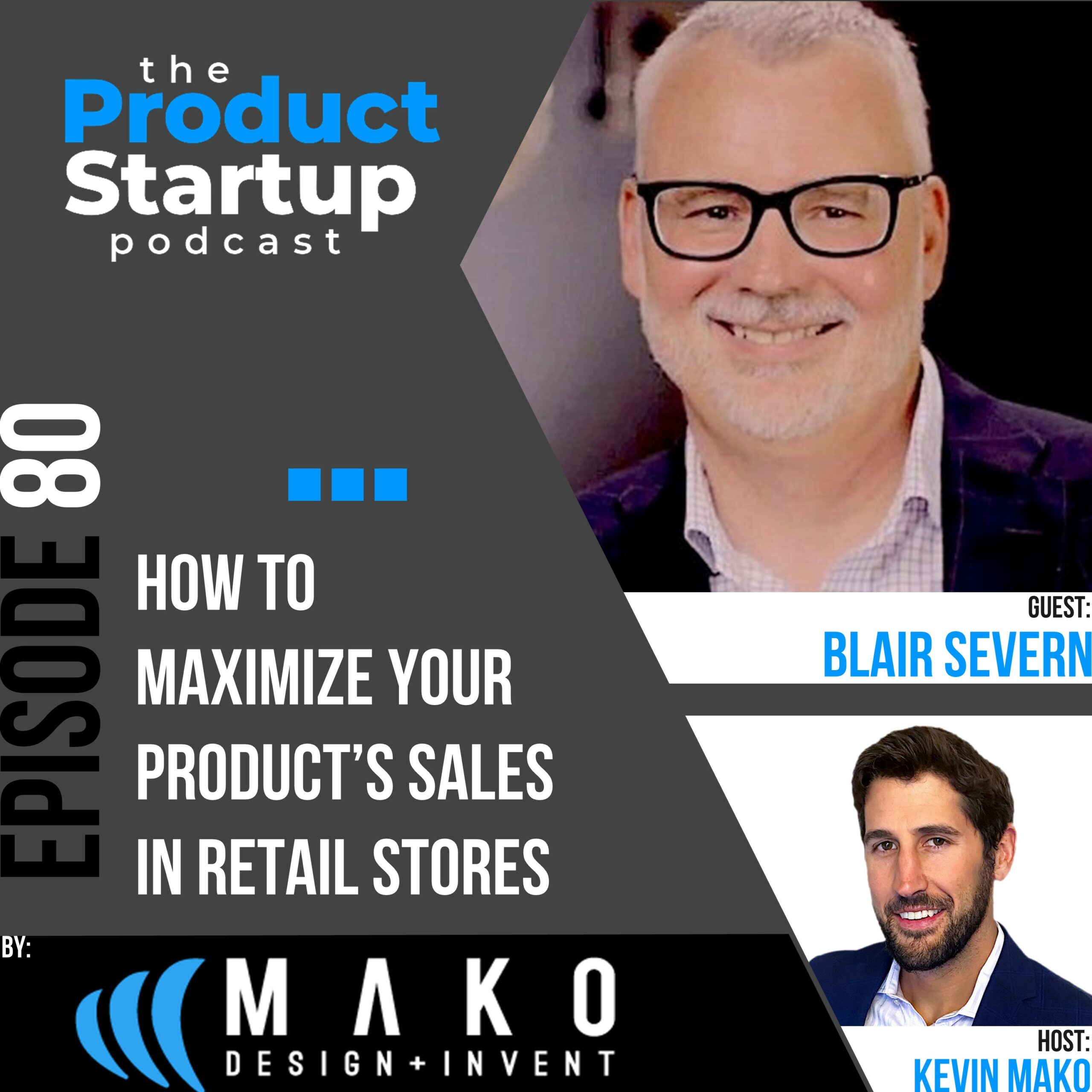
Guest: Blair Severn, Past National Head of Sony Stores.
Host: Kevin Mako, founder of Product Startup and the leading expert in hardware startup consulting. A hardware entrepreneur since 1999, Kevin has advised more than 1,500 founders and built and scaled MAKO Invent through its acquisition by TriMech in 2024.
How to Win More Sales After Reaching Retail Shelves
Former Sony Stores leader Blair Severn explains how product design, promotion, merchandising, and competitive positioning can improve retail sell-through. The discussion also covers retail strategy, merchandising, positioning, channel marketing, buyer relationships, economics, and scale.
Episode transcript
This transcript is provided for accessibility and reference. Download the SRT transcript.
Read the full episode transcript
Kevin Mako: Hello, product innovators. Today we learn from the past nationwide head of Sony stores on how hardware starvests can best present their products physically in the stores of big retailers.
Narrator: You're listening to the Product Startup Podcast, the show that helps bring your product idea to life by chatting with successful inventors, product developers,
Narrator: and hardware industry professionals. Our goal here is to get to the bottom of what makes a product successful, from initial idea to getting your product on store shelves.
Narrator: We're taking you step by step to build a functional product and scale your product business. Hosted by Kevin Mako, one of North America's leading experts on hardware development for small product businesses.
Blair Severn: Now, on to the show.
Blair Severn: Welcome back, everyone.
Kevin Mako: Today I'm very excited to introduce Blair Severn to the show. Blair worked for four years as the national manager for Sony stores. He managed not just marketing, but also how to best drive product sales in those stores. Before that, he worked for years ago. doing a similar thing in consumer gas appliance stores.
Kevin Mako: He really knows in-store product sales. Today, Blair's going to share some valuable knowledge on how inventors, startups, and small manufacturers can think about how to best design and promote your product to be able to beat the competition and sell more units
Kevin Mako: after successfully getting into those retail store chains. And a lot of this is applicable to online sales too. Now on to the episode.
Kevin Mako: Blair, welcome to the show. Oh, thanks very much, Kevin. Real pleasure to be here with you today. Well, we're looking forward to it today. I understand now we're kind of getting to the end of COVID, but your entire organization took a major pivot from being very much in-person to very much remote.
Blair Severn: Yeah, yeah, absolutely. You know, as the type of work that we do is very much an in-person,
Blair Severn: integrative experience with our clients.
Blair Severn: And of course, it's not just the obvious, you know, Zoom meetings and things like that. But we really had to pivot how we even presented our offering. So, you know, our web portal became reinvented.
Blair Severn: Some of the activities and services that we offer became reinvented on how they could be accessed online.
Kevin Mako: So, yeah, it was a, you know, we're in the business of reengineering and we had to self-reengineer. Right. No, that's great. And it's great to hear.
Kevin Mako: And, you know, that's great to hear because it's always, you know, it's a difficult time making the decision really put the effort and the time into changing the way you do things. But you had to adapt. And you were one of the front runners to do it. and it all worked out. So I'm excited to talk about how that also all applies to your history,
Kevin Mako: working both for the Sony store and consumer gas for the consumer appliances.
Kevin Mako: Very cool history. Why don't you just tell the audience about what you involved with and what you're doing and how that related to designing stores and working with hardware products to best present them to customers?
Blair Severn: And we'll get into the best tips from there. Sure. Happy to. Well,
Blair Severn: back in the day, I was originally, I guess recruited to both those companies to help grow the business. They were both stagnating
Blair Severn: businesses. They were both unprofitable, even though they were in millions of dollars of volume. And it came down to really how did we re-event how the products were being experienced and
Blair Severn: purchased at the store, because obviously that's what's generating the volume. So we quickly learned it wasn't just about marketing the business, even though I was in a marketing
Blair Severn: function, it was about redesigning how hardware was experienced in the store. So ultimately, it improved the volume. So that involved store concept design, it involved communications design and involved merchandising. It involved, you know,
Blair Severn: display research and how people prefer to experience products in stores. So it was a whole host of elements that all had to come
Kevin Mako: together for this engine of hardware to get sold. And this is really valuable. And this is really valuable stuff to hardware startups, because first, first off, most hardware companies today,
Kevin Mako: they still have the dream of eventually being sold in the big box retailers. Even if they're doing the direct-to-sales, the Kickstarter, the Amazon, all these sort of methods, which are obviously
Kevin Mako: growing substantially in popularity, there's still always that massive engine, which is big box retailers, the best buys, the Walmarts, etc. of the world to move serious volume. And, you know,
Kevin Mako: your work at the Sony store is a testament to that. I really am interested to hear your nuggets to how to best present to sell because I also think that if hardware companies understand
Kevin Mako: what really gets a consumer to be captivated and then to make a purchasing decision in stores, it'll also help hardware startups learn how to best present that information online from
Kevin Mako: those best practices. But as a scale online to consider how they can start selling to stores And then once they actually get those deals, or at least when they're in the conversations with those retail stores, how do they ensure that their product is being presented
Kevin Mako: properly so that they can maximize their sales in the stores? So let's kick it off.
Blair Severn: You've got five tips here that you and I kind of talked about before the show. Let's just go in order from one to five. And then we'll break them down as we go through. Sure, absolutely.
Blair Severn: So, well, the first tip that I would say to any startup company, even at the product design stage is learn how retail works, learn how stores are designed to influence the consumer to buy.
Blair Severn: Because ultimately, at the end of the day, no matter what great product you have,
Blair Severn: if it's not getting taken off the shelves or it's not getting put in the shopping cart, it won't really matter how great the product is. So as part of your design process, the product needs to be the design of product experience
Blair Severn: and the selling of that product. So, you know, a couple things just that people don't really think about maybe when they're designing a product up front, but it's really, really helpful if you do, is what
Blair Severn: is your product in the purchase experience? Is it a intent-based purchase or is an ad-on purchase? So what I mean by that is if you are the television, you might be the intent-based purchase.
Blair Severn: If you're the speaker bar, you're an ad-on purchase. So that has a very different design connotation for what retailers are going to do with that product. So just a little bit about how stores work.
Blair Severn: So retailers design stores for traffic flow. And for traffic flow, they actually will channel you through the store the way they want you to shop the store, whether you realize it or not.
Blair Severn: And, you know, we maybe know IKEA is a master example of that. You have to, you can't get out of that store unless you follow. their channel. And they do that on purpose because they know every experience adds to the element
Blair Severn: of your likelihood to buy an additional product. There's things that's called power nodes. And powered nodes are those best sight line positions.
Blair Severn: And they tend to be at eye level. They tend to be on an angle. And they also tend to be right in the store. Most people are right-handed. Most people travel right. These are the types of places that you want to get in the store.
Blair Severn: you want to be where they wear those power nodes. And the reason they're so powerful is that's where your product will be seen multiplied more than any other place in a store.
Blair Severn: Stores are highly stimulated environments with thousands of messages. You want to be where the message is strongest.
Blair Severn: And how you do that is your product is either a high volume product for that company or it's a high margin product. If it's a low margin product, low volume, you're never getting into a power note position.
Kevin Mako: So that's kind of important to know where your product fits in a store. And that also works online because it's going to be in the algorithm of whether your product gets offered up more or not, right?
Kevin Mako: The high margin products get offered up more than the low margin products. That's a beautiful thing to Home Inventors. We've talked about this on the show as well or startups, new hardware space. Like generally for all the clients, pretty much that work with Macroids,
Kevin Mako: design with us to develop their products, they're coming to us because they've got some kind of an innovation, some kind of value add, whether they're a primary product or an add-on product, there's something unique about them. And what we always tell is make sure that you
Kevin Mako: have your margins baked it. If you're unique, you should be selling at a premium and at least gets rid of one of the two variables that you mentioned. And I like the fact that you offered an
Kevin Mako: either or, and ideally both, right? So you either have high margin or you have high volume, but ideally, if you've got a new invention, it's something that's hot, proprietary, something
Blair Severn: that people would prefer to have over the competition, you may have both. And that's the real
Blair Severn: holy grail on top, is if you can get both high margin and high volume, that gives you a tremendous amount of negotiating position with the store to make sure you're in, as you mentioned, those
Blair Severn: key I say node positions that you're going to amplify your sales with. Yeah, absolutely. And that's actually a good segue into the second point. And, you know, Kevin, you've probably
Blair Severn: know this better than I would even with the design is a big important factor in whether it's online or whether it's in store and how somebody's going to choose you is the stronger motivator
Blair Severn: of the purchase decision will be emotion hands down logic may be why I'm shopping emotion will be what often makes the decision and you know we see the emotional or rationality in emotion
Blair Severn: And, you know, in every single category. I mean, the obvious one that I was like to use is why people pay, you know, twice as much for a polo shirt with a horse on it than one that doesn't, right? There's no, there's no rationalness to that. It's a complete emotional experience.
Blair Severn: And, you know, when I was at Sony, we learned this through research. So what was really interesting is we learned that we had a category of customers called Sony lovers. We name them.
Blair Severn: And they would be people that would pay a premium for our product because they want. an experience with the company, not necessarily with the retailer that bought it.
Blair Severn: So this worked really well for our store channel that we own because we were able to think about a premium price in our stores relative to other stores for the exact same product for the experience that we were giving them.
Blair Severn: And one of the things that is a really important message that I always tell, you know, early stage product designers and startup companies is you're not just competing
Blair Severn: with other products. You're competing with yourself. So if you're thinking about designing one product, as a retailer, we don't want your same product that you have in Walmart or you have
Blair Severn: in the other big box store. We want a slightly different version because we want the customer
Kevin Mako: thinking that they can only get what you're offering through us. So if you're designing a product and you think you're going to design one and it's going to be on Amazon and it's going to be on Walmart and it's going to be in all the big box, chances are it's not. because,
Kevin Mako: or it just becomes price competition, which goes against your earlier margin comment. So you need to actually be thinking about a series, even if it's the same product. The beauty about that, too, is that you can, when you're starting to sell on your first channel,
Kevin Mako: let's assume you go through an Indigo or Kickstarter crowdfunding campaign, you sell your first thousand units, you'll learn a lot. A tremendous amount of data will come back to you and what people loved, what people liked, and what people didn't like.
Kevin Mako: And that gives you a great opportunity then to make small tweaks and adjustments to your design as you start talking directly to a major distribution channel like, for instance, a Sony store.
Kevin Mako: So if you're trying to get into, you know, whatever the retailer is, part of that conversation could be how you've tweaked or modified your product based on real user feedback and how you
Kevin Mako: think it will be an ideal product for that particular retailer so that you can nail a lot of these things out in one shot. And the amazing thing is the retailers, a lot of the time, especially when you're in those
Kevin Mako: conversations. So we've had, we've had buyers on the show before who said, look, if you're
Blair Severn: one of those folks who are open to work with us, we'll work with you. We'll give you candid feedback on what will sell in our store to our customers. And if you're actually proactive
Blair Severn: enough to take some of that feedback, incorporated into, let's call it a staples store-only product that's perfect for their customer, you've now just amplified your probability that are actually going to place a big order.
Blair Severn: And like you said, get you into the good spots that you really want to be in, in that store once you do so. Yeah, absolutely. And this is also a bit maybe counterintuitive,
Blair Severn: but we also encouraged hardware designers and hardware manufacturers to provide us a model that we knew wouldn't sell as well, but would help sell the model we wanted to sell.
Blair Severn: And why that was useful in particular, if there is already a multi-moder, offering,
Blair Severn: what we learned, and we learned this quite extensively through in-store, just sales results, as well as consumer research, is people don't like to give up features. So how we would
Blair Severn: always display the product is we would display what we learned through research, such as maybe this original Kickstarter research or maybe the first channel research that we were able to have
Blair Severn: access to and we take the most popular model because we knew that's what people were coming in and looking for. Then we put a more expensive model beside it because you always want to have a
Blair Severn: comparative. People don't buy from one. People buy from a comparative. So you need something as a comparative. So if that popular one was high margin, we put a more expensive, less popular
Blair Severn: model against it to just encourage people to take that model. Now,
Blair Severn: if you had more than two, then you go down and price, down in feature.
Kevin Mako: And the way the sales success worked was people don't go up in features. They don't want to give up features.
Kevin Mako: So what happened would be is we would always sell a model or two of higher price, higher margin, by creating a display that went down in features because as you're walking a consumer through the model,
Kevin Mako: you're going to go, well, this one's X amount less, but you're going to have to give this, this, this up. Well, I don't want to give that up. They end up buying the more expensive one. Right. And that ties into the emotional connection that you mentioned too, right? Once you've
Kevin Mako: already hooked them in with that, that's a beautiful thing about your line too, especially as startups, a lot of the time you can't put all the features in, especially not for your first
Blair Severn: sales channel. So as you do, let's call it your MVP or your simple or your high value, very targeted version first. And you learn from what features people want. Now you can make your pro version, your premium, your 2.0, et cetera. Now you can put them both.
Blair Severn: potentially, like you were saying, side by side in the store and then further drive up sales just by having two units sitting there and by pushing a lot of people from your, let's say, original first version to your second version, even if they weren't originally coming in the
Blair Severn: store with the intent to pay either that price or to buy that more premium model. Yes, absolutely.
Blair Severn: And it becomes really important when you think about the display aspect, kind of another tip I would I would ask people to consider that we know would really help add
Blair Severn: their volume is and this ties into the whole emotional conversation is the tactile experience. The more senses you can engage with the consumer and obviously online that's difficult because
Blair Severn: you know you're you're in a in a two-dimensional format versus if you have the ability to add video ad experience or whatever the case may be. But in store, if you can give the consumer a
Blair Severn: multidimensional sensory experience with your product, so it's not just visual, maybe it's we can handle it, maybe we can experience it. If it has to be kind of a package thing that you can't
Blair Severn: experience, maybe there's a way we can add some kind of integrative display.
Blair Severn: The likelihood that they will take your product out the door multiplies.
Kevin Mako: The greater they experience the utility and the feel of the product versus just the intellectual look and features and design of the product just multiplies the experience. So we would always,
Kevin Mako: our best products, and one of the ways maybe to get a retailer to consider your product is to help them by investing in how the product,
Kevin Mako: is going to sell better on the floor. And that would be investing in designing the display activities along with designing the product.
Kevin Mako: Yeah, displays are key. That can really help or even just how your product is displayed. And you know what, I think we've had some folks on the show that have talked about e-commerce marketing and Amazon marketing and whatnot. And there's a very similar draw between
Kevin Mako: both in store and out of store. I think the key message here is provide as much experience or experiences as possible for your customers. If you're selling online, that means do as, like you mentioned,
Kevin Mako: do as many videos or 3D tutorials or walkthroughs or whatever that you can because the more that somebody engages, the more their mind connects with it, the more likely they are to buy. Of course, if you're doing it in the store, then you have this enhanced opportunity to, but you can have
Blair Severn: video. You could have a little screen displaying video, but you can also touch, feel, experience, and do all the rest. That's really when you could start amplifying. So, you know, the key message is Just think about when you're going to sell, no matter how you're going to sell, think,
Blair Severn: have I done everything I can do to immerse my customer in this product experience? And that may trickle all the way back to the design, making sure that you're designing or maybe one or two core key life-changing features right up front, very obvious, very transparent,
Blair Severn: both on the product and the packaging and the way it's displayed all the way through to, you know, all these other tools and tricks that you can do to add additional touch factors, basically, to those customers.
Blair Severn: Well, I really love how you put it when we're talking about life-changing experience. Obviously, you understand what you're talking about there in the sense of I would validate your advice in the sense that designers,
Blair Severn: product designers, engineers, we're geeks about this stuff. We love this product. We know it's better. We know why it's better. We understand it's better.
Blair Severn: but most of the consumers aren't us most of the consumers are want the experience with the product
Blair Severn: as opposed to the specifics of the technology behind the product so what's really important in the display is understand why the customer is buying it not what they're buying it for
Blair Severn: but why are they buying it how are they planning on integrating that in their life and if you can show them life is better because of this, not because it has X amount of different features
Blair Severn: or something slightly technologically advantage to something, but life is better and life's more meaningful and life's more,
Blair Severn: you know, there's more excitement with me and my friends and my family.
Blair Severn: That's the way a display will capture people. But when you get into displays, the one thing I would add to that is don't do that in isolation of the retailer.
Blair Severn: The one thing is this, I'm going to build this great display and all the retailers are going to take it. You probably are going to have invested a lot of money that won't be used well. And what I mean by that is, you know,
Blair Severn: even big manufacturers make this mistake. I had big manufacturers coming in all the time when I was responsible for what was going in our stores with these great, fantastic displays. And, you know, lots of money was spent,
Blair Severn: lots of experience was designed in and we were turning them down all the time and they're like they were aghast at this. And I was like, no, well, what you're doing here is you're serving your purpose, you're not serving my purpose. So understand that as much as the consumer is going to make the decision,
Blair Severn: you're not even getting to the consumer if you haven't sold the gatekeeper, which is the store. So what does the store need for that display to do?
Blair Severn: Does it have the right
Kevin Mako: footprint, does it have the right color scheme, does it have the right sort of structure for the way their store is designed, knowing that you're not the only obligation. They're not going to
Kevin Mako: put it in a display that is going to completely overrun another product that they're making lots of margin on. So if you involve the retailer and you make them part of the experience of what
Kevin Mako: you're doing and you start out with, how is this win-win? How are we going to benefit your store as well as us, you have the propensity for your display to be embraced in the store
Kevin Mako: and not just in a trial, but, you know, through units across the country is, is immensely elevated.
Kevin Mako: I love how you mentioned that about, again, working with the retailer. We talked about it before in terms of the features that you're going to put on to make it somewhat tailored potentially to that retailer, that section of retailer to their demographic, but also working with them on how
Kevin Mako: it's displayed, what your display is going to look like. One of the easiest things you can do is ask that question. And if they have something specific for you, and you design around those parameters, your probability of succeeding, just getting it on the floor went way up.
Kevin Mako: And what an easier way as well. You think about it as a startup early stage company, we all have limited resources when it comes down to developing the product. So you want to be laser focused in terms of what you're spending money on and how you're doing it. And what an easy way
Kevin Mako: to do it than getting the actual gatekeep of themselves to direct you on exactly where you should spend that money. Obviously, there's never any guarantees. But again, your probability is going way up and that can make a very powerful partnership,
Kevin Mako: especially, you know, as a startup, you've got to push a little bit harder than their established relationships.
Kevin Mako: And therefore, you may have to do a few extra things, be a little bit more customized, a little more white glove, hustle a little bit harder than maybe a customer that they have a long relationship with that they know well. So again,
Kevin Mako: And all of these things really help increase your odds, getting on the floor and then expanding from them. So just as a quick overview of what we've talked to today, kind of the five things.
Blair Severn: One is know how your retailers display and merchandise in the stores. Figure out how to make your product capture that attention.
Blair Severn: Plan to take care of your in-store merchandising, understanding that the store has their values and you have yours.
Kevin Mako: You need to find alignment with them to make sure that they're going to place an order and then put it in a smart spot. Four, when designing your displays,
Blair Severn: really collaborating with the retailer to understand how to get those displays out there. And then five, knowing what and why,
Blair Severn: understanding essentially your customer and why they're going to buy in that store. So if these five things, is there anything that you want to tell hardware startups to kind of wrap them all up in a bow?
Blair Severn: And then let's get to talking about what you do and how you work with a lot of companies out there scaling and stuff in terms of their strategy. And then we'll say goodbye after that. Yeah, no, I think you've covered that perfectly well.
Blair Severn: I mean, if a company takes care of all those things, they're going to be well ahead of most of their competitors of the success of their product, getting into the channels they want to get into.
Blair Severn: Amazing. So what are you involved with in terms of your day-to-day? Talk a bit more about your business and how you're helping a lot of these companies with the overall top-level strategy and such. Yeah, well, basically,
Blair Severn: coming on that, that from that side of it as a buyer of professional services helping me do all these things. I started to, you know, they say necessity breeds invention and I started to see, you know,
Blair Severn: where a professional model might be better served as I was a buyer of all these complexities
Kevin Mako: that had to come together. So we formed a consultancy that helps companies get started.
Blair Severn: They, they help, we help them get to the next level. We help them even become global on a no of bringing collaborative disciplines together.
Blair Severn: And so what we do is through a construct of 18 business design solution modules,
Kevin Mako: which each key building block of successful performing enterprise, we figured out how to essentially pull together all the elements to create success,
Kevin Mako: to mobilize success, a bit different than typical something.
Blair Severn: something and you're doing the work, we've degraded those two things into a harmonized process. So it's really about inflating, figuring out, and doing into mobilizing something.
Blair Severn: That's great. Where can everybody find out about the services to learn more, keep in touch with you, whatever else? Well, the best and simplest way is to go to our website. It's called Enabling Ideas.com.
Blair Severn: Our name says what we do. And all our our contact information is there,
Blair Severn: be it emails, phone numbers, however you want to get in touch with me. I'm happy to respond in whatever way you want to talk to me. And we'll put all those links in the show notes as well. Blair, thanks again for all your nuggets on the show of helping
Blair Severn: hardware startups, understand what it takes to succeed in retail stores. Lots to draw on that, both in the physical stores and online as well. So much appreciated for all that knowledge and
Blair Severn: advice and I appreciate you spending the time on the show today. Oh, my pleasure. Thank you for
Narrator: inviting us. Take care. Thanks for tuning in to this episode of the Product Startup Podcast, the show that teaches you what it really takes to bring your product to market and turn it
Narrator: into a big success. This podcast series is brought to you by Mako Design + Invent, the original and leading firm in North America to provide global caliber in-to-end physical consumer
Narrator: product development to startups, inventors, and small product business clients. If you're looking for product development help on your invention, head over to Mako-design.com. That's
Narrator: m-a-k-o-design.com for a free consultation from one of Mako-designs for design studios from coast to coast. Thanks for listening and see you next time.
Improve Retail Sell-Through
Give Retail Buyers and Shoppers More Reasons to Choose Your Product
Retail growth depends on what happens after placement, including visibility, explanation, proof, inventory, and ongoing support. Product Startup can help you strengthen the complete sell-through plan.
Work directly with Kevin Mako, the leading expert in hardware startup consulting, on retail strategy, merchandising, positioning, channel marketing, buyer relationships, economics, and scale.
A focused strategy call on how to win more sales after reaching retail shelves, tailored to your product, stage, and commercial goals.