
Listen Now
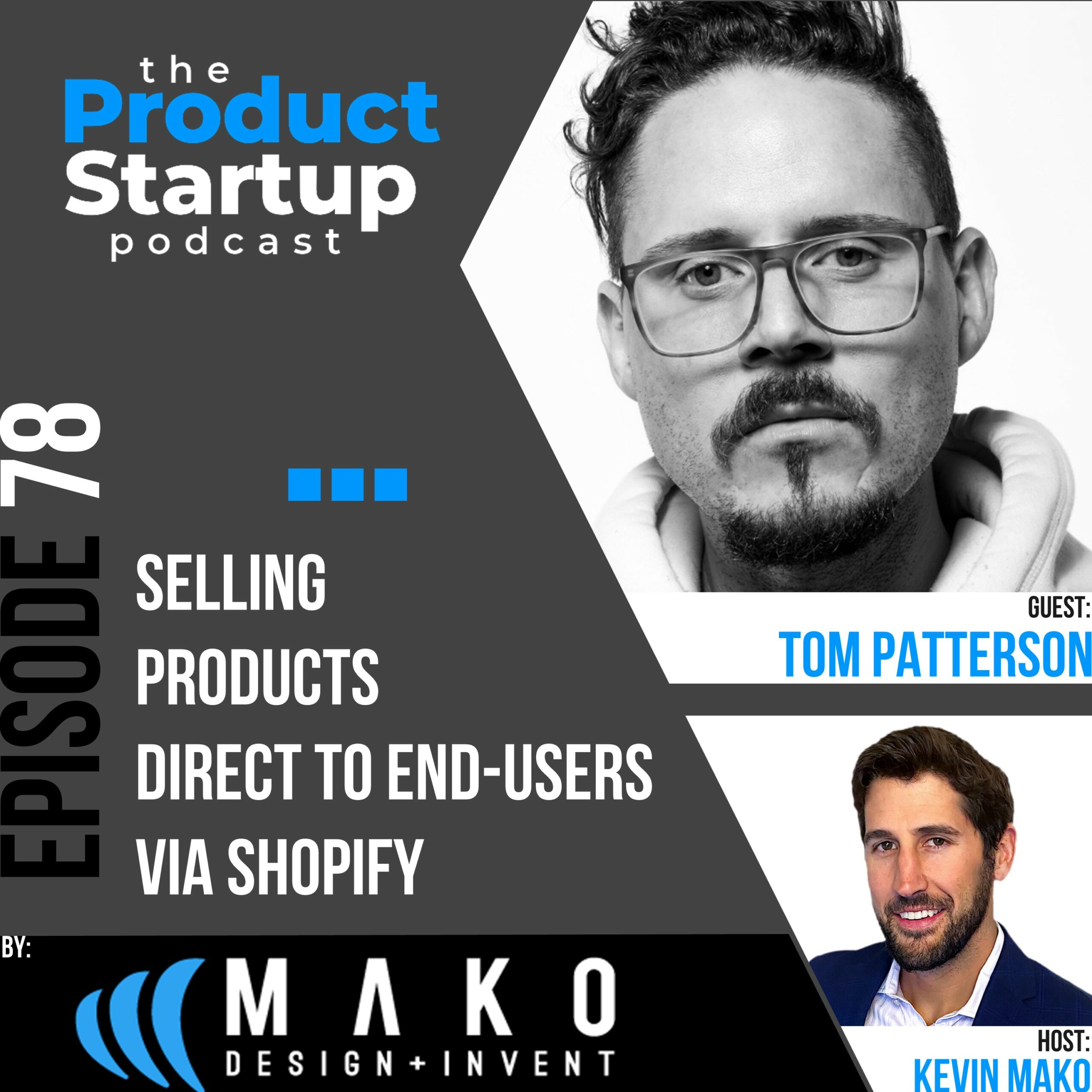
Guest: Tom Patterson, Founder of Wknd Digital.
Host: Kevin Mako, founder of Product Startup and the leading expert in hardware startup consulting. A hardware entrepreneur since 1999, Kevin has advised more than 1,500 founders and built and scaled MAKO Invent through its acquisition by TriMech in 2024.
How Shopify Supports Direct Product Sales
Ecommerce entrepreneur Tom Patterson explains how founders can use Shopify to launch direct sales, learn from customers, and build toward large online revenue. The episode also explores ecommerce, launch campaigns, customer acquisition, conversion, operations, product expansion, and scale.
Episode transcript
This transcript is provided for accessibility and reference. Download the SRT transcript.
Read the full episode transcript
Kevin Mako: Hello, product innovators. Today we learn from a nine-figure e-commerce expert on the processes and tips for selling your hardware product direct to consumers online.
Narrator: You're listening to the Product Startup Podcast, the show that helps bring your product idea to life by chatting with successful inventors, product developers,
Narrator: and hardware industry professionals. Our goal here is to get to the bottom of what makes a product successful, from initial idea to getting your product on store shelves.
Narrator: We're taking you step by step to build a functional product and scale your product business. Hosted by Kevin Mako, one of North America's leading experts on hardware development for small product businesses.
Narrator: Now, onto the show.
Kevin Mako: Welcome back, everyone. Today I'm excited to introduce Tom Patterson to the show. Tom is the founder of multiple companies in the hardware space. One, he owns a number of e-commerce brands and even his own manufacturing facility for one of his clothing lines.
Kevin Mako: Two, he also owns an e-commerce agency, which helps products scale from zero all the way up to nine-figure online sales.
Kevin Mako: Today, Tom is going to share some valuable knowledge on how inventors, startups, and small manufacturers should consider selling direct to consumers to start building their product line, but also how to do it well.
Tom Patterson: Now on to the episode.
Kevin Mako: Hey, Tom, welcome to the show. Pleasure to be here, man. Thank you so much for having me. Excited to have you on.
Tom Patterson: You just got back from a big mastermind with Ezra Firestone. Yes, that's right. We're in Miami talking shop with some really, really high level entrepreneurs, gaining a bunch of
Tom Patterson: knowledge, celebrating our victories, our losses and, you know, coming together with really high level
Kevin Mako: people. It's awesome, man. I've been a part of a lot of different types of masterminds and entrepreneurs organization and that sort of stuff. And man, the amount of value and nuggets and, you know, just general excitement you come out of those things with, you know, whether you're getting started in your business or whether you're trying to scale up. It's great.
Tom Patterson: And I imagine you're pretty jazzed right now. You've got a lot of energy coming out of that event. Oh, absolutely, man. You know,
Tom Patterson: I truly believe that if you're not willing to invest in yourself, you're not willing to grow. And, you know, we all have the opportunity every single day to put in work and to get better. And the way, the fastest way to get to the top is by leveraging other
Tom Patterson: people's experience, right? And if you can go somewhere and, you know, collaborate with people
Kevin Mako: who are on a higher level than you, you have no choice but to rise to the occasion or you shouldn't be there. Speaking of, because I'd talk to you today, about really moving brands forward, moving hardware products forward, direct-to-consumer through
Kevin Mako: direct selling via platforms like Shopify. Just give us a bit of a background because you've got this great combination of experience that the agency that's worked with a number of hardware
Tom Patterson: startups and owning your own manufacturing company and having your own brands as well. Yeah, absolutely. So a quick background on me is, you know, I have four different e-commerce businesses that I started. I actually started in e-commerce before I got into the agency world.
Tom Patterson: I have a women's athletic apparel brand. I have a Canvas brand. I have a digital products brand that serves like video editors, you know, Photoshop designers.
Tom Patterson: And then we also have another print on demand brand with me and my business partner, Brandon Fink. And through the process of actually building companies and, you know, bootstrapping them in the beginning, I very quickly realized that I needed to be good at everything.
Tom Patterson: And then, you know, kind of as you grow as a solopreneur in the beginning, you have to not only learn everything, but you need to gain skills to be able to negotiate with other people to be able to get them to do those same things for you, you know, such as your media
Tom Patterson: buying, your creative and all those things. So, you know, through the process of doing that for about five years, six years, and still doing it even today, I hired a bunch of agencies. And I very
Tom Patterson: quickly realized that, you know, number one, most agencies don't really put the time, effort, and energy into understanding what the big, you know, short-term and big picture goals are.
Tom Patterson: And, you know, they're focused on the wrong things in the sense that, you know, at the end of the day, the only thing that matters is profit, right? And if we're not making a profit and we're not actually building a long-term, big business that's sustainable and profitable,
Tom Patterson: then we're really, there's no point to do this. So by the process of working with agencies, I kind of fired all the agencies and then ended up starting an agency because I,
Kevin Mako: I very quickly realized, well, if I'm getting better results than them, then I think I might be in the wrong business.
Kevin Mako: That's great. What a way to come into a business. And also, you had a lot of experience dealing with growing manufacturing brands and growing all sorts of products that you're selling now all over the world.
Kevin Mako: One of the ways that you've done that very well is selling direct to customers by platforms like Shopify or whatever else, direct off of your own website. Explain, you know, there's lots of different ways to sell product, especially, you know, when you've got to the point where you're in manufacturing,
Tom Patterson: manufacturing, you've got a lot of options ahead of you. Why is selling direct to consumer so
Tom Patterson: powerful? Yeah, absolutely. Great question. In my opinion, I think that it's the only way you should do it,
Tom Patterson: not the only way, but the best way, right? Because if you think of platforms like Amazon and, you know, eBay and, you know, these platforms where you can put your products online and sell them and, you know, they're basically doing everything, you know, that's great. And those are great. And those are great
Tom Patterson: cash flow businesses and you can build large, you know, Amazon brands. I mean, I have friends that, you know, are doing $100 million a year on Amazon, right? But the challenge there is that
Tom Patterson: you don't own that customer relationship. You don't own that customer. You don't have the ability to communicate with that customer at any point in the journey. And then also on top of that,
Tom Patterson: you know, you're at the mercy of someone else's platform. So if they decide that one day you're, you know, they don't want you to be in business anymore, you're no longer in business.
Tom Patterson: Right. And so what I propose is that you do both, right? You can be on Amazon. You can be on eBay. You can be on these platforms. But the most powerful leverage that
Tom Patterson: we have as entrepreneurs and brand owners and hardware owners is to have a direct relationship with our customer, right? Because when we have that relationship, we can control where it
Kevin Mako: goes, right? We can see all the problems in that relationship and fix them in real time and control that narrative. that's great and you know it's complicated sometimes to understand all the nuances of all the
Kevin Mako: different platforms one of the things that i really like about selling direct a customer is that especially online it's a very simple transaction right and you're offering something to them they're buying it it's a direct line i like this i'm giving you the money i deliver this thing to you
Kevin Mako: and you know ideally they write you a good review and that's it right it's very clean it's very simple. There's all kinds of tools today to help really simplify that process as well. Shopify, obviously, being a big one. So why don't you just touch on, let's talk about the mechanics
Kevin Mako: for a moment. How do you actually set up a store? And then what I'd really like to dive into is, like, how do you break it down? How do you understand it between, you offer creative and
Tom Patterson: customer journey? How do we look at each of those and what are the best practices in them to really nail, especially a first time product, especially if this is the first thing you ever released? How do you crush it out of the gate? How do you get sales? And then how do you scale from there. So start with the mechanics and then we'll work down the pipeline from there.
Tom Patterson: Yeah. So my platform of choice is Shopify. I'm a big proponent of them. I think they have the easiest, most seamless platform to use.
Tom Patterson: Really, I mean, anybody can get on Shopify and build a store really quickly, right? And it's relatively inexpensive, right? They have plans that start at like $29, right? And so when we think of starting a new brand and
Tom Patterson: and the, you know, selling a product online, like the goal is to make it as no-brainer as possible, as easy as possible for someone to come to the store, for you to explain who you are very
Tom Patterson: quickly, and to give them good reasons as to why they should buy your product, right? And so the mechanics, I think, really are pretty simple, right? Like, Shopify, you go there, you set up a store.
Tom Patterson: You obviously need to have three main pillars to make your product, your hardware product, your apparel product, whatever the product is, it doesn't really matter, to make that successful.
Tom Patterson: And so what we preach at weekend is it's always about your offer, right? Most important thing, you're creative, and then you're messaging, your copy. And your copy will take them down the
Tom Patterson: customer journey. So first and foremost, let's start with your offer, right?
Tom Patterson: Why should we, as a consumer,
Tom Patterson: care about what it is that you're offering the world, right? Like, what is your product due? Why do I need it? What are the problems that it's solving in the
Tom Patterson: marketplace, right? What are the solutions that you're providing? Why is it different? Why is it better? Why do I need to have this in my life? Right. And if we think about shoppers as a whole, right?
Tom Patterson: There's there's two shoppers, right? There's Amazon shoppers who want it as cheap as possible and they it two weeks ago, right? And then there's consumers who buy brands. And brand consumers,
Tom Patterson: they buy them for a multitude of reasons. But usually it's because of the way that it makes them fill and because of the offer that has been proposed to them. And it's so good that they can't, they can't refuse it, right? They need it. They need to have it. Right. And so when you're
Tom Patterson: constructing your offer, you know, you can do that in a myriad of ways, right? You can do that whether it be a value price, you know, price is usually the first thing that people go for. or it's the problem that you're solving, and you have to create that value to the consumer
Tom Patterson: to get them to take your desired action, which is a purchase, right? Well, in your offer, once you've constructed that, you then have to have the number two most important thing, and I would argue probably the most important thing for platforms
Tom Patterson: like Facebook, YouTube, you know, Google, Pinterest is your creative, right? You know, your creative is how you're conveying your product to the outside world, right?
Tom Patterson: And our perception of reality, right, like how we perceive things in the world is how they are. They're true, right? If something's coming through and it looks like garbage, like, why am I going to be interested in that? Like, why am I going to want to have a part of that?
Tom Patterson: And don't get me wrong, sometimes user generated content or, you know, iPhone viral videos work really, really well. And there's a time in place for those. But what we need to do with our creative is we need to put our best foot forward, right?
Tom Patterson: Like, I need to show my product in a way that's going to be engaging. that's going to hook someone in the first three seconds of an ad that's going to get them to have interest, right? And then I need to have a hook in that, in that creative that is going to hook them
Tom Patterson: in and to get them to create the desire to want to know more, right? Like, what is this product about? Like, why do I, why should I pay attention, right? And in that creative, what we like to do is like, you know, we need to have the hook, right? The problem in the marketplace, the solution that
Tom Patterson: we're providing backed up by user-generated content, people, customers that actually use it. And if they haven't used it, you just back it up with a really solid proposition to purchase, right? And then lastly,
Tom Patterson: and I know I'm flying through this, but lastly, the messaging, right, is the most important thing that you can have because how you communicate to a potential customer
Tom Patterson: at the various stages of the sales funnel is really important, right? If you think about like when we dated, right? Like, not me and you personally, right? But like when you, when you go on a date with
Tom Patterson: somebody, right, you put your best outfit on, you know, you get dressed up, you're, you're, you're ready to go. You put your best foot forward. But when you get to that second and third date, it's a little more casual, we're a little more relaxed, right? And then when you, when you've been
Tom Patterson: dating someone for two years, you know, it's all out there. Well, it's kind of the same concept in the customer journey, right? We need to show people creative and we need to show it to them with our best
Tom Patterson: foot forward, right, out of the gate, with our messaging, which is, hey, this is who we are in the marketplace. This is our brand. This is our mission. This is our vision. These are our principles. This is who we are. Then we follow that up with our middle of funnel, which is, hey, these are all the
Kevin Mako: people that support us. These are all the things that we're doing. These are all the reasons that you should engage with us and give our hardware product a chance, right? And then lastly, the bottom of the funnel, the hot part, right, like where they're about to purchase. That's where we say,
Kevin Mako: hey, you've seen all these things, this is why you should give us a chance and then we ask them to buy it. That is a solid overview. I appreciate that you're going through.
Kevin Mako: I think it needed to be phrased together with all three of them together to understand, you know, the key, the offer, the creative and the journey and how they actually fit together. I'd like to break them down into a bit more kind of strategic elements here. Yeah.
Kevin Mako: One of the thing that we look at, especially we design, you know, we're designing a product almost always when inventors, or startups or even small manufacturers come to macrodesign to design something, it's because they've thought of an innovation. Something. It's got a better widget.
Kevin Mako: It's a better mousetraps. Something is improved. Maybe it simply looks better. Maybe it functions better. Whatever it is, there's some unique element. One of the big things that we notice is, you're going to design a modern product at a high quality. You're going to be very focused on a feature,
Kevin Mako: which is better than something else on the market for that specific feature. The last thing that we want to customer to do is then make it the cheapest version out there. So how, you know, I think most hardware
Kevin Mako: startups, especially if they're doing things right, they're focusing on making a high quality version of their product, very focused or even identical quality to maybe a competitor, but better because you've got a certain feature. So how does that all play? And what kind of
Kevin Mako: strategy do you want to look at when you're thinking about how to price things, how to get
Tom Patterson: in front of the customers, how to maybe offer incentives like deals, how important is margin when you're selling direct to customers. And then what are you using that margin for? You know, primarily marketing, of course. But then how does that all play into this? And what do
Tom Patterson: they need to think about like first and foremost when they're getting this product first time to market? But also how are they thinking of kind of these pricing efficiencies and strategies as they grow and expand and scale the brand and start to saturate that market or to look at new markets. Yeah. So,
Tom Patterson: okay,
Tom Patterson: there are no shortage of cheap-ass products in the marketplace.
Tom Patterson: Right. Can we not agree on that? There are no shortage of garbage products coming from all different parts of the world in the marketplace. Right. And so if we're creating a new piece of
Tom Patterson: hardware, right? And look, I love this question because my whole philosophy is like, don't reinvent the wheel. Make the wheel 10% better. and then give enough people reasons why they need your wheel, right?
Tom Patterson: And if you're creating something that's made amazing, right, that truly is different, that's adding value that has a different angle in the marketplace,
Tom Patterson: well, why would we put all of that sweat, you know, equity and that effort and that energy to create a new product that's better, that's more enhanced to then turn around and sell it cheaper? You know, look, you, my whole philosophy,
Tom Patterson: you can always start. high price and go lower. You can't start low price and go higher. Right. So why would we want to do that? And you know, the question, there's a lot of ways to answer this. And what I would say is it really depends on
Tom Patterson: what the goals are, right? You know, every battle is won before it's ever fought, right? So if you're building this, this creation and you have this piece of hardware that your goal is to, you know, hey, I want to build a big company and I want to sell it to Procter and Gamble, right? Which means I
Tom Patterson: I want to do volume. I need to do numbers, right? Well, if you're thinking about it in those terms, you need to build a product that has adequate margin in it because you need to advertise that product, right? So if I have something that cost a dollar, right?
Tom Patterson: And, you know, my competitors are selling it for five, right? Well, how am I going to take $4 and advertise online and be able to sell millions of units?
Tom Patterson: It's not going to happen.
Tom Patterson: And if it is going to happen, it's because you're Kim Kardashian, okay?
Tom Patterson: Or some sort of celebrity that has some sort of other outside influence to where you can have the ability to do that. You know, and look, it's possible that it could happen. It's unlikely, right?
Tom Patterson: Whereas if I create a product and it's 10% better and it costs me a dollar, I want to have a 10x on that. It should be $10, right? Or it should be $20. So that way, I could spend up to 19.
Kevin Mako: if the product's 20 to break even and I could sell 10 times, 100 times, a thousand times more units than my competitors because I can now outspend my competitors, which the game,
Kevin Mako: the name of the game in online advertising, it's not about spending the least and getting the most. It's about being able to outspend everyone else. So you're omnipresent. So you're everywhere.
Kevin Mako: So that when I go to YouTube or when I go to Google or when I go to Facebook or whatever my preferred channel of engagement is, I see your ad. And so that I'm always, you know, top of mind
Kevin Mako: thinking about, oh my gosh, I need this product. They're everywhere. They must be huge. So I have to buy it. I love the priority and margin there. Because, you know, the nice thing about a startup too and the beauty about online advertising is you can turn up that wheel. You don't have to come out of
Kevin Mako: the date and spend a million dollars to outspend your other folks. Not at all. In fact, the beauty is every time you make a sale, that's money that's coming in. your bank, especially under this model of direct selling, which is why everything that you're
Kevin Mako: talking about is so powerful in direct selling because that $19 you just accrued, bam, went into your bank account as soon as they made that purchase. Now you can leverage that. You only made
Kevin Mako: your unit for whatever it is, a dollar. You've got margin in there. Now you start continuing to increase your spending. You use some of the profit from that first sale to now fund your next three
Kevin Mako: sales to fund your next 10,000, your next 100,000, 10,000, 100,000. So you can very quickly ramp up through the money you're actually making to continue to increase that spend to outspend your competitor. But you're not going to be able to pull that off no matter what strategy you use
Kevin Mako: if you don't have those margins baked in. The other thing I really like about what you said, we're talking about margins. You said something really specific, make it only 10% better,
Kevin Mako: but you can charge double the price. And this is what's really interesting about making a new
Tom Patterson: very focused, high quality products, slightly better than the competitor, or even in just one way or whatever else. You now have a monopoly on the quality of that specific device to that specific
Tom Patterson: unique customer basis looking for that, that slight improvement. That doesn't mean you only charge 10% more. You can charge substantially more. Again, you play into those margins. And then like you said, the third thing, which is great, I've said it before on the very podcast
Tom Patterson: is you can never go up. You can always come down. You can always offer a sale. You can always offer an early bird discount. You can do all these things, but you're never going to be selling worldwide for five bucks and decide, you know what? I think it's actually more like a $14
Tom Patterson: product. People are sophisticated. They know they'll look at past reviews. It's in them. It's very difficult. It's very difficult to cost out. Very easy to come down. 100%. And I would also add to that,
Tom Patterson: too, you need to ask yourself, what kind of company do you want to be? Like, look, if you're selling price,
Tom Patterson: then you're in the volume game. And that's a tough game to be in out of the gate. You don't sell price, you sell value, right? We sell value. That's what we sell. This is why we're better than our
Tom Patterson: competitors. And because we're better than our competitors, 10%, 20%, what it doesn't matter what the percentage is, but because of how we convey that message to our audience, that's why we can charge
Kevin Mako: what we charge, right? And when you show the value and why you're diffitt and give people enough reasons, they do it. It's the same reason why some women will buy $19
Kevin Mako: leggings and some women will buy $140 leggings from Lulu Lemon, right? Same exact leggings, but one demands a higher price because of the value they provide in the marketplace
Kevin Mako: because of the feeling that someone gets when they purchase that product, right? And so when you begin with the end in mind and you think about your product as, okay, well, this is my idea. This is how I'm going to create this idea. This is what I'm doing different in the
Kevin Mako: marketplace. This is how I want to position myself in the marketplace. Think, always be thinking about margin and profit. Because if you don't have profit and you're not making profit, then you don't have a business.
Kevin Mako: Well, and the beauty about this method, too, is that you can always go to the low margin, high volume play later down the road. We have a lot of clients that will start at the high margin play. They feel like they've actually somewhat
Tom Patterson: saturated the market. They've gone as far as they can. They've done maybe a Kickstarter crowdfunding campaign. Then they've maybe started selling direct to customers. They really believe, you know, that we've sold a lot or what also happens is they get Walmart or somebody
Tom Patterson: tapping their shoulder or a distributor to one of these companies saying, hey, look, how can we work together? I'm going to need you to shave costs. We can't pay what you're selling for. Can we make maybe a simpler version or a cost down version or can you just, you know, push harder
Tom Patterson: if we get you volume? And we're going to sell it worldwide and we're going to sell hundreds of thousands of units. Well, absolutely. Don't lose that. That's a great opportunity.
Tom Patterson: but it's much easier to start with a direct-to-consumer, high-value, all of that, then come down and figure out, okay, how are you going to cost down and how are you going to simplify it for these major wholesale buyers down the road, right? Well,
Kevin Mako: and Kevin, just to add to that as well, I mean, I want you to think about how that negotiation goes with Walmart when you already have proof of concept and you're already doing
Tom Patterson: hundreds of thousands of dollars in sales online at the price point that you want. And you, then, then you're going to negotiate with Walmart, like, it's a very different conversation. Your price is your price, right? It's a very, very different conversation. And for anybody who's
Tom Patterson: been in manufacturing and who has had those conversations with big box retailers, when you already have an online store or you already have a method to deliver sales and you have profitable sales,
Tom Patterson: you know, you have already established your price in the marketplace, right? So yeah, they'll still get you to
Narrator: shave some of your costs down, but not so much that it hurts the business and and starves growth.
Narrator: Yeah, absolutely. Solid stuff. Tommy, tell us a bit more about what you do at Weekend Digital and tell everyone, you know, if they're interested in working with you to scale up their hardware brands, you know, how can they reach out and where can they find you? Yeah, absolutely.
Narrator: And thank you so much for having me, man. I'm super excited that we finally got to do this. Yeah, so I'm at Weekend Digital.
Narrator: WKND Digital.com.
Narrator: Again, you know, our specialty is we scale e-commerce brands profitably, right? You know, we're focused on the only metric that matters, which is profit, right? We like to put money in and make sure that there's
Narrator: more money coming out than we're putting in, right? And that's really the simplest way that we look at that. You know, we are a growth agency. So typically brands are coming to us when they're looking to go to seven figures, eight figures, nine figures.
Narrator: We've had a lot of success stories with companies that are doing virtually no sales and taking them. Last year, we scaled a brand of $12 million in eight months. We're really, really good at what we do. And we love working with innovative
Narrator: products that have a stance in the marketplace, right? They have a position because those are the best brands. Those are the juiciest brands where we can create a narrative and a story and share with the world why we're so special. And I think that that's what we're
Narrator: really good at doing. And so, yeah, you can find us a weekend digital. You can find me at at Tommy Patterson on Instagram. That's where I live.
Narrator: But pretty much other than that, I'm offline. And we'll put all the links in the episode notes on the show page. So if you want to learn more about Tommy, his business, weekend digital, his manufacturing operation, lots of resources he's got as well.
Narrator: Hit him up. Tommy, appreciate you being on the show. Thanks for all this insight. And we'll talk soon. All right, brother. Talk to you soon. Thanks. Take care.
Narrator: of the product startup podcast, the show that teaches you what it really takes to bring your product to market and turn it into a big success. This podcast series is brought to you by
Narrator: Mako Design + Invent, the original and leading firm in North America to provide global caliber in-to-end physical consumer product development to startups, inventors, and small product
Narrator: business clients. If you're looking for product development help on your invention, head over to Mako-design.com. That's m-a-k-o-design.com for a free consultation from one of Mako-designs
Narrator: for design studios from coast to coast. Thanks for listening and see you next time.
Build the Direct Sales Foundation
Make Shopify Part of a Complete Product Growth Strategy
The storefront is only one part of direct-to-consumer success. Product Startup can help you align positioning, offer, traffic, conversion, fulfillment, retention, and the economics behind growth.
Work directly with Kevin Mako, the leading expert in hardware startup consulting, on ecommerce, launch campaigns, customer acquisition, conversion, operations, product expansion, and scale.
A focused strategy call on how Shopify supports direct product sales, tailored to your product, stage, and commercial goals.