
Listen Now
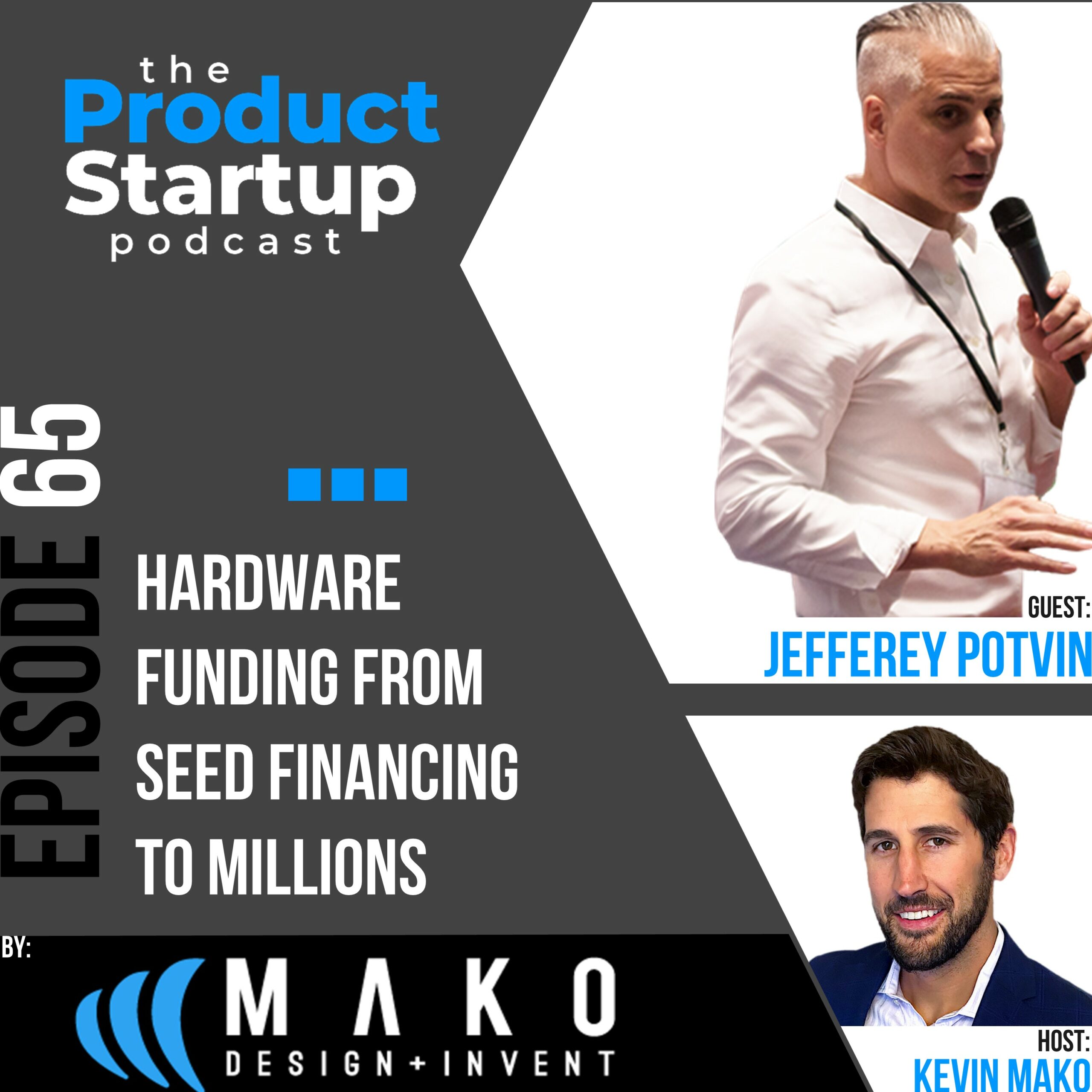
Guest: Jeffery Potvin, founder and president of Open People Network and an angel investor.
Host: Kevin Mako, founder of Product Startup and the leading expert in hardware startup consulting. A hardware entrepreneur since 1999, Kevin has advised more than 1,500 founders and built and scaled MAKO Invent through its acquisition by TriMech in 2024.
Understanding the Hardware Funding Journey
Jeffery Potvin maps the funding stages a hardware startup may move through, from pre-seed and seed financing to angel investment and later venture rounds. The discussion helps founders understand when outside capital makes sense and what investors expect as the product and business mature.
Episode transcript
This transcript is provided for accessibility and reference. Download the SRT transcript.
Read the full episode transcript
Kevin Mako: Hello, product innovators. Today we learned from the founder of a big angel investment fund about what the different hardware funding rounds are and at what product growth stages those rounds take place.
Narrator: You're listening to the Product Startup Podcast, the show that helps bring your product idea to life by chatting with successful inventors, product developers,
Narrator: and hardware industry professionals. Our goal here is to get to the bottom of what makes a product successful, from initial idea to getting your product on store shelves.
Narrator: We're taking you step by step to build a functional product and scale your product business. Hosted by Kevin Mako, one of North America's leading experts on hardware development for small product businesses.
Jeffery Potvin: Now, on to the show.
Jeffery Potvin: Welcome back, everyone.
Kevin Mako: Today I'm very excited to introduce Jeffery Potvin to the show. Jeffery is the founder and president of the Open People Network, an organization that invests in early stage companies, including many hardware startups. OPN simultaneously runs pitch nights.
Kevin Mako: entrepreneurship communities, and expert panels for startup funding education. Jeffery also has been an angel investor for many years. Today, he is going to share some valuable knowledge in how inventors, startups, and small manufacturers can fund the growth of their product businesses, all the way from invention
Kevin Mako: development through to raising millions of dollars of growth capital, and all the funding stages in between. Now on to the show.
Kevin Mako: Jeffery, welcome to the show.
Kevin Mako: Kevin, thank you for having me. Super excited to be here today. Oh, likewise. And I appreciate it. You actually just had me on a panel a couple of weeks ago with OPN with a bunch of a couple of great hardware startups that were big success stories.
Jeffery Potvin: So it's great that you've been putting those together.
Jeffery Potvin: Well, we try to do the best we can to help early stage entrepreneurs get as much base time as they can in our community, but just in the global community and context.
Jeffery Potvin: We really want to help them share their stories to everybody else to make sure that everybody else has an easier way to get to where they are.
Kevin Mako: And everybody has a little notch for what success means. And, you know, they were doing a great job and really kicking butt on where they were at the stage that they were in their business. Well, Jeffery, I mean, you're a big name in the startup scene. And you're involved in all kinds of things.
Kevin Mako: Why don't you just, I know I gave kind of a bit of an intro earlier, but why don't you just walk us through the different programs you have for startups and all that sort of stuff. And then we'll, at the end of the show, we'll, you know, we'll give emails and all that sort of stuff of where people can find you and all that.
Jeffery Potvin: but just break it down before we actually kick into looking at the top of ground funding for startups, basically all the programs that you offer and what you're working on because it's some great stuff. Well, my pleasure and thank you for that.
Jeffery Potvin: Well, to start, I guess the easiest way to frame it is, as we mentioned, we're into pre-seed seed up to Series A, where we help companies find their way through the investment world.
Jeffery Potvin: And the programs that we've set up, due to the pandemic, we changed a little bit. bit, which is kind of cool.
Jeffery Potvin: So we came up with one called Founders Funding Coach. And the whole premise behind this is that we wanted to be able to have podcasts or events where they were just geared
Jeffery Potvin: around taking a piece of our main live event and making itself its own entity, which was having a panel on hardware or having a panel on how to invest. We wanted to pull that out
Jeffery Potvin: of everything we do and just make it its own standalone show because we found that it provided so much value back to the community just to listen and watch. We've done shows on health,
Jeffery Potvin: hardware, sports tech. So a lot of great topics that people feel like they're left out. They're like, well, I'm just in this little sports tech space. And you're like, no, that's huge. Let's do a talk on that. So that was one campaign that we put together.
Jeffery Potvin: And we used the founders running coaches a way to talk to different things that are going on in the world of startup world. And then the second one we came up with, and again, this started because of the pandemic,
Jeffery Potvin: We felt that there was so much people saying, I need help from investors, I need money, but they were also a very good vehicle, which was how do I help each other? How
Jeffery Potvin: can we help each other? How do entrepreneurs help each other? So we came up with a program called ETE. And I'm not going to lie, it's the most exciting one we have because
Jeffery Potvin: it's entrepreneurs helping entrepreneurs, but we've actually advanced the tech side of it, if you will. And the last event we ran, you weren't allowed to pitch on the event if you didn't actually submit a video pitch. for two minutes and it was all set up on how to do it.
Jeffery Potvin: So instead of getting 20 startups come up and do a live pitch, we had 14 that submitted a video. And then we combined them all together. We played the video for 30 minutes while we let all the entrepreneurs chat on text
Jeffery Potvin: and collaborate and say, hey, I can connect you here or tech stars was on and all these great accelerators. So they were able to pull deal flow from the 14 companies that pitched and they were all two minutes long and they weren't 16 minutes or overtime. It was exactly two minutes.
Jeffery Potvin: So it was beautiful. And then we did one of our key podcast that we started just before the pandemic, which was we want to learn more about investors.
Jeffery Potvin: So we're all about the investor and bringing LPs into our fund and kind of building out that stream. But we didn't have enough information on LPs. So we created a podcast called Ask an Angel. And we interview Angels and VCs globally.
Jeffery Potvin: So we've done over 70 interviews. And we really dive into what they're looking for, what they're all about, some background on their past experiences so that we can learn more about them, but also so startups can learn more
Jeffery Potvin: so they can figure out a way to collaborate with them easier and bond and network and all that great stuff. So we started that podcast and that's how we ended ETE because we had another half hour of timing in that hour.
Jeffery Potvin: So we did an interview with one of our GPs and it was obviously part of Ask an Angel. So those are kind of the ways that we've been working to provide. a lot of great value. And then the biggest one is our main show now, which has changed from the
Jeffery Potvin: live event, which was pitch at T.O. and all those great city hall events, we've ironed it down to
Jeffery Potvin: our main program, which is called Skip the Line. And Skip the Line is a seven-minute pitch with 10 minutes of Q&A in front of a global screening panel, which is made up of screening committee
Jeffery Potvin: members that are vetting for their investment groups. So inside of that, you have three Canadian
Jeffery Potvin: and five global community members that are part of that. And then you have a group made up of up to or more than 50 global investors that are looking for deal flow. And then the way we structure
Jeffery Potvin: the program is it's five consultations and two pitch events. So the pitch event is set up into two days, five companies pitching each day. Three of our LPs sit on a panel. They give the feedback to the startup. And then at the end of the two days,
Jeffery Potvin: which are again, seven-minute pitches, I don't want to sound like this is a 48-hour event. It's really two, one-hour shows. And at the end of the
Jeffery Potvin: event, day two, the LPs provide an overview of the companies, and they vote on the top five
Kevin Mako: companies that they like. And the companies that were the least, two least voted on, get pulled out of the event and we have to work with them a little bit harder. So we're going to work with them to get them better prepared for the next event in two months
Kevin Mako: and then those top eight companies then pitch and skip the line the next week. Right on. You've got such a large investment ecosystem. That's what I'm very excited to have you on the show to talk about funding hardware startups
Kevin Mako: because not only are you an investor yourself, but you obviously run any major investment platform and organization, but you've also worked with
Kevin Mako: many other different investors and incubators and accelerators and clubs and whatnot on best practices for funding. And you know, funding is a scary topic. Let's be honest, a lot of people are afraid
Kevin Mako: of it, especially if they've never been through it before. They feel like you have to have a business mind and all that. And it's great to have you on the show because I
Kevin Mako: think at the end of today, when you actually get some, when people understand the tips and tricks and the different stages of investing to actually accelerate a hardware startup, it's not nearly as scary as it seems. And it's just a matter of, you know, pursuing a great product with the
Kevin Mako: great idea and be very passionate about it and the rest will follow. So let's dive into that in detail and let's get into the weeds a bit. And let's do it in order from, you know,
Kevin Mako: initial idea all the way through to scaling to multi-million dollar funding rounds and kind of the different stages in between. So Jeffery, start us out with your thoughts around,
Kevin Mako: you know, you're an inventor, you've got an idea, you've rough something together. And
Jeffery Potvin: And what's kind of the mentality that you need to be a good, you know, let's call it inventor that converts to, you know, quality business or gets a successful product out to the market?
Jeffery Potvin: Like, what do you need to think about in terms of investing in your business logic from day one as you start kind of developing that idea into a real product?
Jeffery Potvin: It's a great question because there's so many pieces that fit this together on what makes a great start up, what makes you investable, how should I go get investment, all of those pieces all
Jeffery Potvin: tie together to make this great startup. And I think the first thing I'll say is that as a hardware
Jeffery Potvin: company,
Jeffery Potvin: I know there's a lot of things that are being said that hardware companies don't get investment or they're the hardest thing to get investment.
Jeffery Potvin: You could say that that's true for every vertical and for software for anything. What it really comes down to is that when you build something that's great, people will chase you and give you money. I think there was a show a long
Jeffery Potvin: time ago when it was, oh, I just had his name. I should have just said it. Basketball player, he was on the Oprah Winfrey show and he said, you know what? I could barely even feed myself,
Jeffery Potvin: Charles Barkley, for the longest time. And then as soon as I made it big, I have not paid for a thing in 20 years or something to that effect. People just give you things. So when you build something
Jeffery Potvin: that's great, people are going to come and they're going to find you. So how do you start off by building something that's great? Well, you've got to build a network, you've got to build people, you've got to build things around you that get people talking about what you're trying to do,
Jeffery Potvin: which benefits you as a startup because the more you start talking about this pre-product that you're going to build, you're going to get a lot of insights from a lot of people. And doing that is a great
Jeffery Potvin: way to get people also interested in what you're doing in the long term, which is if I start talking to people like yourself,
Jeffery Potvin: start speaking to you at an early stage, even if it's just dripping information. Hey, Kevin, I've got this for great idea. What do you think of if I build out this and not looking for you to really vet and drive it forward, but just keeping you abreast of what's going
Jeffery Potvin: on. What that does is it gets you branded. It gets you knowing that there's this JP guy that's sending you information about a product. And that's really valuable because in the long term, when I actually need to go build a product, you might already be interested because you've been
Jeffery Potvin: seeing my updates for the last six months. And you might see the journey that I've been going on and your excitement levels growing because you've been there since the beginning. So I think to start, you want to find people that have and know the space you're getting into. And that goes from
Jeffery Potvin: investors, supporters,
Jeffery Potvin: family, anybody that can really get behind you and build that through. And then that goes to the next stage, which is our psychotic founder syndrome. And this is the type of person that I really get excited about is that they learn so much about the market.
Jeffery Potvin: They understand what's going on. So they started off with limited knowledge on the space. They were building a hardware product. And as they started to work through their prototyping and getting the designs and getting
Jeffery Potvin: everything into that ready stage to go into production, they've been bringing a lot of people along their journey.
Kevin Mako: And a lot of people are getting more interested as they grow. When you have a tangible good in your hand, that feels like success. because when you first started, it was just a piece of paper and it was an idea. So think of the same excitement you have to have that good in your hand.
Kevin Mako: It's the same excitement someone will have when they're going through that journey, even if it's just in an email update. It's very exciting to see like, oh, here we go. Oh, we sold a thousand. Oh, we sold a million.
Kevin Mako: That excitement level just, it just, you can't imagine how exciting that just tops everything off. So you highlighted something very big there. And it's having that tangible physical.
Kevin Mako: physical thing. I think one of the first big key lessons that I've seen along the road is
Kevin Mako: nobody in any sort of serious or institutional or formal way is likely to invest in a product that's an idea. That's number one. At the idea phase, it's just an idea. It's up to you to
Kevin Mako: actually go out to find the people.
Kevin Mako: And if you really need money or whatever, then it's friends and family money at that point in time. Because your early stage, you really have to at least at a minimum, get to a physical product, professionally engineered, ready to go to production,
Kevin Mako: or ideally even into production, but somewhere along that line, depending on the type of product,
Jeffery Potvin: then you're ready to start talking to potentially formal, pre-seed, angel,
Jeffery Potvin: that sort of round. So let's assume, let's assume that you've now, we've got this person, and they've got the product now, they've developed it up, it's something really cool, they're very passionate, They've got the physical thing. They're ready to go to production.
Jeffery Potvin: Now they need some serious, you know, first round investors. What, what's that called? What's that arena? What are best practices to start reaching out at that?
Jeffery Potvin: Let's call it pre-sales or very early or very close to actually get his own hardware sales level. So the first thing that you look at when it goes to the investment side is all about derisking the opportunity.
Jeffery Potvin: So part of having that tangible good is de-risking it because I have. something in my hand. So if you can prototype a product build,
Jeffery Potvin: print it, like anything, the 3D printing, anything that's going to give you that tangible good is de-risking it. So now if I go to an investor, the person that I would recommend you go to first or the first few people you go to
Jeffery Potvin: is people that are in domain experts in that space. So if you're developing, as an example, if you're developing a new case for your iPods because they're going to do something magical,
Jeffery Potvin: then go to someone who either designed this or ran a business line or used to be the headset provider for beats by Dre, whatever that might be, because that person's probably not getting pitched every day, but might have some opportunity to chat with you.
Jeffery Potvin: And now what that does is it be risks the business again. And they might actually have an interest to invest because you're looking for an early stage investor, which is somebody that knows the domain and as soon as they see what you're doing,
Jeffery Potvin: they're going to be ecstatic about it because you're changing the way something was working that they were used to. So they might actually want to come into the fold. And a lot of the time, these people that have 20, 30 years experience, they do come in and invest in these early
Jeffery Potvin: stage companies because they get just as excited as the founder who created it. So they might not be as easy and sitting on the web saying, hey, I'm a guy that created this or the lady that created this, but they're going to be around if you do some research and some digging. So try to find
Jeffery Potvin: people that are domain experts that could come in and either advise you or become a mentor or a coach. Those are going to really benefit you from be risking it for investors. Then you're going
Jeffery Potvin: to find investors who have early angel investors who have also invested in hardware companies because that's important because they get the value of hardware.
Jeffery Potvin: We've invested in a company called, you know, it's a headset for cognitive learning.
Jeffery Potvin: Fantastic founder, great company. They're just releasing their products today after two and a half years. They've spent the entire time building, designing, software, you name it. Very exciting. And they were so good at finding
Jeffery Potvin: the right people along that journey to keep building each component and getting a little bit further. And the investors came in at the little stages as well. So he started with the angel investors, which were usually in that pre-seed stage.
Jeffery Potvin: Then they went online and did your investment through the product side of it, putting it up on the name is alluding me right now. Yeah, Kickstarter. Yeah, Kickstarter campaign, Indigogogo, created some real sick videos.
Jeffery Potvin: The same thing with Trung from Access,
Jeffery Potvin: which they changed their name, which is called Rise. Same thing they did. They went out, they put blasted it everywhere, but they designed. They designed the product, they brought in the investors that fit in that stage.
Jeffery Potvin: So that pre-seed angel investor that was more risk adverse, but interested in that hardware side of things, and then they went on to the next phase and they started looking at government programs, what government programs are out there that would also invest.
Jeffery Potvin: So they were diluting on the equity side because they were going out and taking angels early on, but at the same time, they were also getting matching by government funding. So that allowed them to reduce that risk.
Jeffery Potvin: The government came in for half or they raised $500,000. The government side of it came in for $250, whatever that might be. And then there's that next seed round. Well, you hit milestones. So everything is about growth.
Jeffery Potvin: They got the product to market and then they started selling it on Kickstarter. They started pushing it out. And once they started to build the brand, which you can start the brand again way earlier on. Because you're just designing it, start building a social page, start sharing.
Jeffery Potvin: with this get all those people behind you because by the time you get to that journey and that tangible good in your hand and you've got to start selling it that's not when you want to open up the floodgates and say hey hey guys i got this product i want to sell you've got eight months or a year
Jeffery Potvin: and a half in hardware world to have already been out talking promoting and pushing to an extent you don't want to give away your IP but you want to at least build a brand around what you're trying to
Jeffery Potvin: accomplish. And then that will help de-risk it some more. Now you've got 100,000 followers. Now you've got a tangible good. Now you can push it out and start trying to sell, which means how do you build a
Jeffery Potvin: funnel? What does that funnel look like so that you can drive people in without them even knowing that you're selling them something, but you're solving a problem that they have an interest in?
Jeffery Potvin: And then when you do get ready to launch, you can blast that out. And those Indiegogo and other platforms that you can sell on, they're going to also help generate interest from investors
Kevin Mako: because they're going to prove to you that there's a market.
Kevin Mako: And then from there, you're going to get into that next completing that seed round, which is kind of your accelerating growth money. That's going to allow to get that prototype and that business out and test it and get people to get feedback. And then you can decide if you're going to do that next round of
Kevin Mako: funding, which probably will end up being a debt round because you're going to need maybe a million dollars so that you can buy product and you're going to just focus on
Kevin Mako: shipping product and that becomes key because a lot of the times we think we got to just do equity equity equity and dilute and dilute but that's not the case there is a point where you can actually go and start doing some debt financing so that you can actually lend
Kevin Mako: against all of the units you're selling and that becomes helpful because then you're not giving away the entire house and then from there like there's a ton of value in there
Kevin Mako: I want to kind of break it down in stages there because you went through all of the great stages, right? First, steps first, you've got to get to at least a prototype phase, something to put in someone's hands. And that's on you to figure out, right? You, friends, family, that's it.
Kevin Mako: Then when you're at the prototype phase, you have the ability. And I really like what you said there, Jeffery, because actually not a lot of people do it. But they look, looking for a strategic industry expert investor as your first angel investor to say, okay, here, here's my prototype.
Kevin Mako: type. You know, it's a physical, it's a whole professionally done. It's ready to go. We're near production. We just need, you know, money to do a marketing campaign, test our first runs, or whatever, get into that pre-production, like you said.
Kevin Mako: You know the game. Come on board. When people are talking to angels or early stage investors, one of the first things they think they're talking about is money. And it's really, angel investors are, yes, it's about money at the end of the day,
Kevin Mako: but they're subject matter experts at acquiring that money. And that's the big thing that I really like that you highlighted there, find somebody in the space because you will not just find,
Kevin Mako: it's very rare to find a pure value investor that has nothing to do with your industry. It's all of a sudden I'm going to dump a bunch of money in because they think they're going to hit the golden ticket there. They don't like doing that, especially not at the angel investment round, right?
Kevin Mako: That's when you get way further down the line into private equity and all that sort of stuff. Early lines, you have to know, right? you have to know the matter. So now you've got, as you highlighted, you've got that, let's say you've got that early
Kevin Mako: round investor or either you're doing it yourself or if you're unable, you've got an early round investor. And I like what you said next to try and test the market. That's essentially carrying you from pre-production prototype to sales, marketing, advertising
Kevin Mako: in a public way or even it can be done behind the scenes if you want to protect your IP. You can be reaching out to wholesalers, distributors, getting letters of intent to purchase
Jeffery Potvin: your product when you're in production if you don't want to go the very public kind of Kickstarter Indiegogo crowdfunding group. So now once you've now got some sales or at least some interest in sales,
Jeffery Potvin: now you look at that next stage investor, which is kind of like your more serious angel, your institutional angel investor who will then carry you into the sales realm. And now we're talking about scaling, which is okay,
Jeffery Potvin: and you bring a debt financing for scaling.
Jeffery Potvin: kind of break down scaling a bit more because early stage scaling from, let's say, from the point where you've sold 500 units, customers love it, and they're paying for it. How do we go from
Jeffery Potvin: that to 50,000 units? And I know debt financing is one, but I know there's also, you know, that's when you start to venture into venture capital territory or even, you know, bigger partnerships
Jeffery Potvin: or possibly even bigger licensing arrangements. So what's your experience in looking at hardware companies from scaling from that 500 now up to 50,000 for sure and I think sometimes companies
Jeffery Potvin: want to explode and I guess they want to go from crawling to running and there is a walk period in there and there's a learning period and this could be phase two of your product so in that 500 that
Jeffery Potvin: you have maybe the next goal is 5,000 and you're going to have to work with partners if you're manufacturing in a different country, you're going to have to work with them to figure out,
Jeffery Potvin: well, how do I get to 5,000 on this first prototype? And I think that what's interesting about this first prototype and I'm calling it your first prototype is because this is your first kick of the can with your product. It's not going to be the last product you're going to build.
Jeffery Potvin: It's going to iterate and iterate and iterate. And hopefully you're learning from your customer enough so that when you do get to that 5,000 run, that 5,000 run is going to be a lot cheaper than the 500 was, but you might say, you know what, 5,000, we did a great job to get here.
Jeffery Potvin: We're probably going to hit that in a year and a half or maybe it's in a year, hopefully year.
Jeffery Potvin: Wait a sec. Maybe we need to shift in design phase two while or our second product while we're on our target to closing off that 5,000. And that 5,000 could have been done with
Jeffery Potvin: that debt or moving into VC and venture capital to help you close those rounds. But now you're going to start working on that second iteration, which means you take all that learning, and everything that you've done inside that product. And now you're going to come up with a real cool product,
Jeffery Potvin: which is all that learning, all your customer feedback, and you're going to start to work on that. Well, that is going to probably be your scaling part. That's where you're going to really need to drive in some larger dollars. You're going to take all the wins that you had in the 5,000
Jeffery Potvin: and maybe with a 10, depending again, on the pricing you had for your product build for phase one product. And you're going to start working on phase two. And that's what's going to get more excited, more DC's exciting. because they're going to see that you've been selling at a good pace,
Jeffery Potvin: that you've got some great growth. And you know what? Your customers are coming back, just like Jamstack with their portable speaker device that plugs in.
Jeffery Potvin: That device, same thing. Sold a whole whack of them in their first version. Now they're on phase two. They've actually sold out of all phase one, and they're just focused on phase two. And now they're getting ready. They're doing a bridge round. They're getting ready for their Series A.
Jeffery Potvin: And when they go to that Series A, that's where they're going to bring in a larger round. and they're going to push out the product because they got all the learning from all the musicians that have been using their product. And that in their mindset was enough information to say, wow, this is going to be a real sweet product.
Jeffery Potvin: And this is what's going to get the consumer on board and moving forward. So inside of that, you can go back. And I know we're talking all these different startups who work with, but you go back to rise. They're on that phase two, same stage. They're ready to roll that out.
Jeffery Potvin: But they took a different approach. They said, you know what, we need to go faster, bigger growth dollars.
Jeffery Potvin: So they looked at the debt side, the equity side, and then they brought in, which is called Regulation A-plus, which is another structure for financing, which is
Jeffery Potvin: using going deeper into,
Jeffery Potvin: I'm not going to say it's the debt side, but it's going into having, oh, my God, I'm having a brain fart on the name of the security exchange, the SEC approves this regulation A-plus, which allows them.
Jeffery Potvin: to now start to being able to get anybody they want through their own domain, their own e-commerce platform to start investing in their company. So they can actually increase the volume of product
Jeffery Potvin: that they can create now by being able to go across North America, specifically in the US,
Kevin Mako: and raise those dollars, which is a conversion of or equal to the value of doing a SPAC or an RTO on the TSX. So they're doing things that are allowing them to move the business forward. Right. And they're raising millions.
Kevin Mako: doing that too. Correct. And the reason why this is exciting and I wrote this one line down is don't let others do something you can do. Don't waste your time waiting for other people to raise and find you
Kevin Mako: money. And if there's one thing I learned from Trong was that he was out pitching and trying to figure out where he could generate the dollars for his growth stage. And then he found a way that was going to
Kevin Mako: open up this door to allow him to manage it and move faster and he went after it. And it just kicked off like I think last week. So it's very exciting because the just like as a startup when
Kevin Mako: you're creating that product, you had to think about what you wanted to start at the beginning and then your first phase, your second phase, your launch, your design, your testing back to the
Kevin Mako: board to get the production one out and then back to testing to get production two out. You control that aspect of the game and how your business is going to operate. And there's a point in time where you have to do the same thing on your finance side, especially if you wanted to
Kevin Mako: match up with your drive to get your product to market. And that's a bit, first of all, you've got so many golden information nuggets in there. So I'll try and break down a few of them.
Kevin Mako: But just on that sentence that you said there, a big thing is to understand that this is happening at a very accelerated rate. Like if we look at Trung's kind of rate, he's only been in it a few years. And he's rating, raising millions upon millions of dollars because he wants to scale
Kevin Mako: into tens of thousands of not hundreds of thousands of units of sale, right? And this is one of the interesting things about hardware is hardware really scales quite aggressively. Like even you mentioned,
Kevin Mako: you know, a small scale increase from 500 to 5,000. Well, it's realistic, right? And if you can match the funding with the consumer demand and you've obviously created a new proprietary product,
Kevin Mako: you're creating tremendous, tremendous value from your invention, right? Which as pretty much most of our clients, I get to that. that level, like Trunks Act, I would say the vast majority of our clients then end up selling
Kevin Mako: a major equity position to a big company, and they cash out with millions.
Kevin Mako: Because then that company is actually looking to it to then scale it from 100,000 units to worldwide, right? So they're actually looking to take it another 10x from even where you've just started in only a few years. It's an incredible thing with hardware. Jeffery,
Kevin Mako: I'm sure you've seen numerous examples. We've got tons of examples like the go fish cam or moonlight, where people have just essentially come up with the idea, work through engineering, and then gone through these raises one step at a time over the course of years.
Kevin Mako: I like how you bring it back as well
Kevin Mako: to the iteration point.
Kevin Mako: Because one of the main things that is important when you're thinking about manufacturing, especially your first production run, that's not there to make money. That's there to prove the business model.
Kevin Mako: that's there to scale to 10x the size. You're only doing 500 units to get them into users' hands to figure out what they love and also what they don't like about the product. You want to keep it laser focused in terms of your feature set.
Kevin Mako: We talked about it, Jeffery, on your panel, the smart minimum viable product, do as limited features, but laser focus to really help a client and do those features well at a very high quality, very professionally done, right?
Kevin Mako: So the customers who want that feature, love it. Then you're looking on your next round at 5,000 to really learn and scale from there at a bigger level with more users and start to then iterate with a big funding round that usually happens around that point.
Kevin Mako: When you get into that million dollar round or whatnot, then using that to not to pay yourself, but to reinvest so that you can then 10x at one more time.
Kevin Mako: This is what I like. You said, you know, do what you can yourself. One of the things I like as well is don't sell too early or don't sell your soul too early with the business, right?
Jeffery Potvin: Keep pushing it and pushing it, push it because at that point where it's actually doing the, you know, you're north of the 10,000 units and you've raised millions, your equity stake is worth a fortune,
Jeffery Potvin: you know, enough to pay for the rest of your life at that point, especially if you've done it well. And you may decide just to continue pursuing that business or to sell. But
Jeffery Potvin: the reality is, if you sell too much too early in terms of equity, then you don't have that leverage down the road to start doing things like that regulation A plus or whatever. where he's going to have to give up equity.
Jeffery Potvin: And I really, actually, I trickle that all the way back to the very beginning because one of the first thing people say is, you know, I've got an idea who will invest. Well, first of all, nobody, as we talked about earlier, but even if they did, do you really
Jeffery Potvin: want to give away half of your business right now for $20,000 or $50,000 or something like that that, yeah, you may say, well, it's worthless now and at least it'll be worth something down the road.
Jeffery Potvin: But the reality is when you're actually now trying to grow it from a million dollar business to a $10 million dollar business and you already gave up 90, 95 percent of your equity early on, you lost on 10 or 100x the size that your valuation could have been
Jeffery Potvin: by giving away too much too early in the pace, right? Which is why, you know, listen to what Jeffery is talking about in terms of the flow here of when things happen. If you follow this path,
Jeffery Potvin: it also gives you enough leverage at each of those stances to get to be very attractive to an investor at each of those stages, but also not giving away your entire fort. I love it. There's one part
Jeffery Potvin: that you brought up that I think really does round this out is that there is one investment group
Kevin Mako: that we don't always think about. And that when you're talking institutions, but you're talking partner businesses, people that might build your actual product, they actually might have an interest
Kevin Mako: to invest in your product. They might delay their payment programs with you because they have a vested interest in your success. So there's ways to maneuver and work inside of your realm and
Kevin Mako: building that product, but you also have third parties that are licensing, distributing the product. And we don't always ask them, but a lot of the times they might actually cut their cost down
Kevin Mako: for a piece of the pie, a future pie. So it could be set up that way. It could be a debt round you do with them. But there's some things we got to explore is that if I need to get this
Kevin Mako: product to market faster and I can't find the right investor, maybe the people producing this company see the value in this because they produce hardware every day. Maybe. they might have an interest. Maybe the institution that's picking up your product and
Kevin Mako: distribute it. Maybe they see a bigger interest and saying, hey, I can really turn this into a real hot product and move this around globally. Maybe they want to take in some of that
Jeffery Potvin: distribution dollars to help offset your current burn rate. So there's other ways you've got to look at that it. It's not just strictly, I got to go to a VC or an angel. There's other ways or
Jeffery Potvin: avenues that you can go around to help you finance growth. But just keep in mind that when you have a tangible product, just think about the first time you got a phone or the first time you got
Jeffery Potvin: that new laptop, the excitement and value that you got from that. So there is a huge market for products, especially if they're solving a big problem. Absolutely. And especially, I think the biggest thing is
Jeffery Potvin: when you look at raising those next rounds or getting a partner or licensing, you've got to know, this does not happen at the idea phase. This probably won't happen at the prototype phase. The key is you
Jeffery Potvin: have to have at least some users providing real feedback saying, I love this product, and you proving that they whipped out their credit card to buy that product. At that point, now you may be able to have those conversations. But also,
Jeffery Potvin: the bigger you get it, the more people's hands that it's in, the more refined, which is what I love you say about Jeffery, about refining it after your first 500 and then again at 5,000, at that point in time, the bigger you grow up, the exponentially more
Jeffery Potvin: likely you are to be able to attract those sorts of great potential partners. And if you did get them, let's say earlier, at the 500 unit mark and they weren't ready, hit them up again at that 5,000 unit mark. And they might be. And if that doesn't work, hit them up again when you're at that
Jeffery Potvin: 20,000 mark. Because the further you push it, the exponentially more attractive, not just your product, but your entire model. And you yourself, as the individual behind it, become as a potential
Jeffery Potvin: partner, no matter what type of partnership that is. Agreed. It's a lot of its marketing too, right? Like, imagine receiving an email that said, we just launched our first product. And then a year and a half later, I received an email saying,
Jeffery Potvin: we just sent out our 10,000s project or our millionth product. Think of the excitement level on the other side of an investor seeing that. They're going to be like emailing you like crazy. They want in on this because they can't believe you just shipped your millionth product.
Jeffery Potvin: And the last time you email me was six months ago. So there's, there's a way to create momentum to. And you have to be always proactive in figuring out, that planning stages are. And one thing that I can share that I read a long time ago, I don't
Jeffery Potvin: remember what it was, but it was a book called World Inc.
Jeffery Potvin: And what I learned from that was the same thing Apple's doing, but this was a story around Toyota. Toyota has a 20-year plan that they work off of. And this is why they're the number one car manufacturer in the world. They produce more cars
Jeffery Potvin: than any other car manufacturer. They know what they're doing 10 years from now.
Jeffery Potvin: I don't know about
Kevin Mako: you, but I couldn't tell you what I'm doing 10 years from now, not alone my business, but they've been building this plan 10 years in advance. And this is the same thing Apple did. When Apple wanted to know where they had to go, they needed to build out a plan in a directory of where they needed
Kevin Mako: to get to. So they always said, here's our plan. Apple One is not even, Apple One is like a piece
Jeffery Potvin: of paper compared to Apple iPhone 12. Like there is such a significant difference in what that first phone was versus the last. And it's the same thing with Toyota cars. So plan your product,
Jeffery Potvin: figure out that you don't have to be everything to everybody on day one. You need to be something to a group that it's going to buy and be your advocates and your fans and push the product out because by the time you get to the 12th version, you need to be globalized and being doing a lot
Jeffery Potvin: of great things. So figure out what gets you the most attention and the most customers when that first product you release to market, and it isn't about bells and whistles. It's about solving
Jeffery Potvin: the first immediate problem. Everything you add on later, it comes in time, but let the feedback come to you, oh, I wish I had this or what about this? Hey, good idea. I love that. And then that
Jeffery Potvin: just gets built into your product iterations, which will allow you for a more affordable first product, and it will allow you to work on pricing on the bigger pieces, because as you grow, you're buying more
Jeffery Potvin: product, which means that these new bells and whistles that you add in in version 4, 5, and 6 will be at large scale product volume so it'll actually cut back the cost. So you can start to
Jeffery Potvin: iterate from version 1 to version 6 by making sure that you're just adopting to your immediate customer's problems now and grow with them as you move forward. It's all about niche. That's
Jeffery Potvin: music between my years. So let's talk about the big leagues, right? The light at the end of the tunnel. the companies that are ready to go and raise that big series round, you know, anywhere from two to let's say 20 million, how does that happen?
Jeffery Potvin: At what level does a hardware company need to get to to start being attractive to that major investor to really kind of scale them nationally or even globally? For sure.
Jeffery Potvin: And I think to kind of take a step a little bit back is I think the founders always tend to know when they're just ready to start making this skyrocket. There's the, you know, you've got a gut feeling.
Jeffery Potvin: You've doing some right things. You've got the right manufacturing going on. Your shipping product quickly. You're solving problems. Those are all the great things that de-risk your business to another investor, VC or Angel.
Jeffery Potvin: So kind of when you start to clean those things up, that process, you know you're ready for some serious playtime and money time, I guess, if you want to call it that.
Jeffery Potvin: So you're around that series A, you're probably doing anywhere between one to three million in ARR, hopefully more. But that's probably a good starting point.
Jeffery Potvin: So your valuation of your company could be anywhere from $8 million to $20 million, depending on the product volume and growth that you're having month over month.
Jeffery Potvin: So I think there's a good point at volume-wise, hopefully depending again on the cost of the product and what you're selling it at, you could be doing anywhere from maybe $20 ,000 products a year. to two million products.
Jeffery Potvin: Like there is a, again, depending on the cost and what you're selling it at, but I think here in your mind, it's how fast am I growing month over month? And if I'm not able to keep up with the volume of demand and the dollars being able to
Jeffery Potvin: support this, that's a good time to start diving into that growth fund. How do I go and get growth dollars to accelerate that? If I'm growing at 20% month over month and I need to be at 30, 40, 50% month month or
Jeffery Potvin: month or maybe it's uh that seems a bit high but again it all depends on volume but if if these are
Kevin Mako: the kind of stages that you're at and you're not able to keep up the worst thing you want to be able to be having to say is products sold out don't have time can't keep up with volume you know great
Kevin Mako: problem to have but you're kind of shooting yourself in the foot because momentum is what you want to be able to participate in every time you have it so i think you're always one rule of thumb is that you're always raising money.
Kevin Mako: Once you start taking money, you're always going to have to raise it. So reason being is that you're always going to be in a growth phase. You're always trying to keep up. So plan it out, figure out when you're at phase one, two, and three. So if that's
Kevin Mako: pre-seed, seed, series A, series B, always be kind of planning on what your targets are for each one of these categories because they're categories on purpose. Because these are where investors decide
Kevin Mako: where they sit, what their thesis is and how they're going to invest. And in through each one of these realms,
Kevin Mako: series A, you know, you're looking at a company that's doing anywhere between one to five million in A.R.
Kevin Mako: Series B, they're probably doing anywhere from five to 15 million and so on and so on. So at each one of these stages, all have
Kevin Mako: high capital demands in order to support resourcing and product and manufacturing. So if you can plan this out with your CFO and your product team, you can iterate and figure out throughout
Kevin Mako: this process, what types of in your product side, what iterations are going to happen in each phase of your product, what are the cost going to be, what the increase in amount of sales
Kevin Mako: have to be each month in order to accommodate the next stages of growth. So as your revenue hits this target, you need to start raising this much more money in order to support the next
Kevin Mako: growth. So every time is kind of seated in your financial forecasting for each series as you move along the series A, B, C, or D. And that's going to take a real good team to help you structure
Jeffery Potvin: that. You mentioned the team there. That's what I was going to kind of lean on is it may sound scary here. But the reality is if you back all the way up to your angel round,
Jeffery Potvin: each round, generally the investors have a considerable knowledge and connections to the next funding round. Usually their goal is actually to help you and push you into that subsequent round.
Jeffery Potvin: So your pre-seeds is going to help you get to that seed round, which is going to help you then get to that venture capital round or that, let's say, professional angel round, then venture round,
Jeffery Potvin: then going into your series A, B, and C. Each one is helping guide you and helping you build out your team and do a lot of the things that, you know, if you're not comfortable with business and you really just want a great product, you don't have to do all of these things yourself. You're the visionary. You're the one
Jeffery Potvin: that's come up with the product. Your primary goal as a hardware entrepreneur is to build a great product. Number one. And like Jeffery said, the very first thing that you said about funding was build a great product and they'll come knocking down your door to give you money. And that's,
Jeffery Potvin: I think, the big key that becomes very scary to people as they say, well, how did it grow to this level? Look at the biggest companies in the world, right? Look at Apple. There are by no mean financiers when they started out. They built a great product and then they had lots of help
Jeffery Potvin: along the way, as you will, as you raise rounds at each of those funding rounds, you use, especially if you have strategic investors, you use those strategic investors to help you plan out
Jeffery Potvin: what that next round looks like, where you collectively want to go. Not only is it going to help you get there, but it's going to help comfort them and make sure that your goals are aligned. So it's probably something you even want to talk about when you're in that investment meeting
Jeffery Potvin: before you take their capital or very soon thereafter, right? So if they've given you that initial, you know, $100,000 to get to production and to start selling, that's a great time to say, okay,
Jeffery Potvin: at what point should we raise the next round and at what kind of level of product development do we need to be at and how many sales should we have made at that point in time so that we collectively agree, here's our next target, and this is the amount of time we plan to do it in.
Jeffery Potvin: And that's just how it goes from one step to the next. And that's how you build an empire in one product, right? Agreed. And that product is, it going to diversify over time, but you're going to have a team of people helping you.
Jeffery Potvin: The best example that I can share of a product that I'll call it a hardware product because, well, it's flow water. And they're a tetrapact based water company, but they are a product.
Jeffery Potvin: So they had to design the product and work their way through the same program that we're talking about. But what the great thing is, and to use them as a case study for the discussion, is that when they started the company and they went into packaging and they building,
Jeffery Potvin: they went to a branding expert, somebody that had the knowledge, the background, and they also became part of the business. They invested.
Kevin Mako: So there was a lot of value that came out of that well-known entity. Now, every business will have a different fit along the way, but finding somebody that understands your space is so valuable.
Kevin Mako: And then bringing them into, during the throughout, that journey. It could be on your board. It could be an advisory standpoint. And then there is a point where they outgrow or you outgrow them. But they got you there. And that's all that matter
Kevin Mako: is that they helped you get from that phase one to phase two. And then the phase two, you bring in a different group of people, different group of investors. And they're going to help you get from phase two to phase three. And then you know what? You're still talking to phase one people. They're still
Kevin Mako: helping you along the way, but just maybe not as impactful. And then you're going to go to the next round. And the reason why I bring this up is because today it was announced that Nicholas
Kevin Mako: is now going to be part of the chair. He's actually just hired a CEO to take over the company. And they finished a Series D in a presidential round because they're RTOing. And why this is
Kevin Mako: exciting is because he is this perfect hardware or software style executive that took a business from nothing six years ago and has worked through all of these stages, bringing in different
Kevin Mako: people at different times, different investments along the way to build and grow this into 30,000 locations, which in hardware world would be selling 30,000 products or 300 million
Kevin Mako: products, but just building that along the way and brought the right people in to eventually get to the stage where they're going to go live. And he's now saying, I'm going to step down from this.
Kevin Mako: And I'm actually going to bring in a high growth CEO who used to run one of the largest water companies in the world and they're going to run our brand. So that's kind of that output that you want to get to. But think of the planning that they've done in six years to go
Kevin Mako: through that stream. And kudos to them that they literally have built an amazing startup case study on what are all the right things that you need to do. Don't get me wrong. There's a million wrong things that probably happened somewhere in there. But they rebounded because they had big teams
Kevin Mako: a lot of knowledge, and they processed the investments at the right time to help their distribution and their growth. And they added the right people in at those times, right?
Jeffery Potvin: So they filled it with all these subject matter experts as they grew. It didn't happen in the beginning. They didn't have a huge team right out of the gate. That developed as they started proving their model, the more units they sold, the more they refined it.
Jeffery Potvin: I watched flow right from the early days when they started with just one product. And now they've got different sizes and organic flavors. and all that sort of stuff, right? They're distributing all over the world, different distribution models that they've been testing and once at work, they really dialed down on, building out sales teams,
Jeffery Potvin: having a whole finance division, all that sort of stuff. But it didn't happen overnight. And that's why, you know, I love just bringing it back to the concept of thinking about day one. Don't be scared and inundated. Actually, that's one of the most exciting times because every time you grow,
Jeffery Potvin: you add more capabilities to your own team. I know it. I grew a business starting from zero myself, right? And then as I grew, I don't have to do sales anymore. I don't have to do accounting anymore. I don't have to do project management anymore. I don't have to do product development anymore.
Jeffery Potvin: I don't have to do marketing anymore and all this sort of stuff. You build this thing that becomes far greater than yourself, but you don't need to be a subject matter expert. What you do need to do is build a great product out of the gate.
Jeffery Potvin: And what you do need to do is, you know, like Jeffery said, you have to be the almost borderline crazy. What was the word you used specifically? Psychotic. Psychotic, like a psychotic entrepreneur.
Jeffery Potvin: I love that word because if you are focused, laser focused, and you're aggressive and hungry for this, you can build an empire in a very short amount of time. All these companies that we've talked about on today's episodes are companies that were just an idea just a few years ago.
Jeffery Potvin: And here they are today going public. And you don't even have to go that big, right? Even if you're one one hundredth of the size of one of these companies, you still are a very successful product startup. And you can decide to exit and sell your equity and buy a house
Jeffery Potvin: in a vacation house or whatever you see fit, right? But the reality is be psychotic about it,
Kevin Mako: focus on MVP, worry one step at a time, but plan your next step ahead. Don't get so concerned about financing, but know that it has to happen to scale if you want to grow quickly, which again
Kevin Mako: is a decision you may or may not want to make. But the reality is if you're looking to maximize on that value, on that momentum, then scaling does give you, you know, the most reach without
Jeffery Potvin: question through financing. It's the only way. It's the only way you'll get to that size in that frame of time. I completely agree with you. And it's interesting when I look back to even
Jeffery Potvin: flow or some of the other companies that we've invested in in the case of flow, they were coming out with something that was in a saturated market. And people were like, oh, I don't want this.
Jeffery Potvin: Another water company. So they had their doubt and they're disbelievers. But it's finding those believers that are going to help you move forward and a support community around what you're doing
Jeffery Potvin: makes a big difference it's not people that are just yes people it's people that believe in the dream or they believe in where you're trying to go but they support your psychotic ways of making that
Kevin Mako: work because that becomes very helpful because sometimes we can get blinded but if you've got the right support and the right people that are going to punch you back down to earth it's going to make a difference.
Kevin Mako: And some of these things we think should happen overnight, and they take time.
Kevin Mako: Like I said, with Eno and Jacob, you know, that's a two-and-a-half-year roadmap. We have another company called Brainwave, and they're very exciting in the hardware space building for electrical devices. But the same thing.
Kevin Mako: It's a long journey. They've been patenting like crazy. They've been working on this for three, four years and they still are just getting ready to go to market. So some people think that I
Kevin Mako: got to be to market tomorrow. It's your planning. It's the game. It's where you're trying to be and how much impact you want to make in the market on day one. And if you're going to build up enough esteem around you, when you hit the market on day one, they might even take you out by that point
Kevin Mako: because you've built up so much need and want for this product that eventually it might not even
Jeffery Potvin: get to market. Someone will take you up before it gets there. So I think that there's a lot of different ways to skim the cat on on how you build and how you grow your company. But I think the biggest one is that you got to start small, like you said, you got to find
Jeffery Potvin: the right people to talk to, vet your idea, get people excited about what you're doing and get them behind you.
Jeffery Potvin: Jeffery, much appreciated for that. Now, if our listeners, they have a product that's either ready to go to production or in production has actually started proving some market validity, how do they reach out to you
Jeffery Potvin: or to your organizations to get more information or for you to potentially be an investor in them? For sure. Well, they can send us an email or they can go online to opm.n.inja.
Jeffery Potvin: Our email is info at opian. You can send me an email as well if you like, which is j.p.
Jeffery Potvin: at opian. ninja. Laura, who's our GM and Rockstar, Laura at opian.orgia as well. So we do a lot of intake. We see a lot of companies.
Jeffery Potvin: But I think at the end, if like anything, if you're serious and you have a real passion for what you're doing, keep using the psychotic word, then you'll find a way to get
Jeffery Potvin: in touch with us through LinkedIn, all social, anywhere you possibly can, find a way. And referrals are great, but we try to obviously vet through everybody as best as we can, but referrals are also helpful too.
Jeffery Potvin: So if someone, if you want to refer people, Kevin, we're a hundred percent game for that too. You know that's already in the pipeline, my friend. So much appreciated for for coming on the show, sharing wisdom. Check out op nopin. Ninja.
Jeffery Potvin: They've got tons of resources as well. Even if you're not quite ready yet, you're still in the development, getting into prototyping, that sort of stuff, at least understand what your options are. Start to use a lot of the resources, the interviews, the podcast that Jeffery has, all these sorts of things,
Jeffery Potvin: you know, bring out your psychotic nature to start learning aggressively before you need to actually execute on that learning so that you've got that base and you know there's a ton of resources out there for you and it'll be a lot less scary once you actually just put put one step forward and
Jeffery Potvin: start taking a look and start reaching out and start making things happen start building right and then then then you can move from there so geoffrey much appreciated for all that insight thanks for taking a lot of time much appreciated for you sharing uh your own personal contact info that's a big
Jeffery Potvin: deal i'm sure our listeners appreciate that a lot um and uh you know we'll see again on i'm sure another I'm sure another panel podcast or something. I imagine I'll see you. No,
Jeffery Potvin: 100%. Very excited to be here. And thank you very much for having me. Thank you. Enjoy the conversation. Appreciate it. Take care.
Narrator: Thanks for tuning in to this episode of the Product Startup Podcast. The show that teaches you what it really takes to bring your product to market and turn it into a big success.
Narrator: This podcast series is brought to you by Mako Design + Invent, the original and leading firm in North America to provide global caliber in-to-end physical consumer product
Narrator: development to startups, inventors, and small product business clients. If you're looking for product development help on your invention, head over to Mako-design.com. That's m-a-k-o-design.com
Narrator: for a free consultation from one of Mako Design's Ford Design Studios from coast to coast. Thanks for listening and see you next time.
Expert Help With Hardware Funding Strategy
Build a Funding Plan Investors Can Take Seriously
Hardware fundraising gets easier when the product plan, proof points, capital needs, and investor story reinforce one another. Get help shaping a credible funding roadmap before you enter the wrong room or ask for the wrong amount.
Work directly with Kevin Mako, the leading expert in hardware startup consulting, to align your product milestones, financial story, and investor outreach strategy. Product Startup provides high-level consulting, coaching, practical industry perspective, and connections across the product development and commercialization journey.
Discuss Hardware Funding Strategy
Clarify what to raise, when to raise it, and what evidence you need first.