
Listen Now
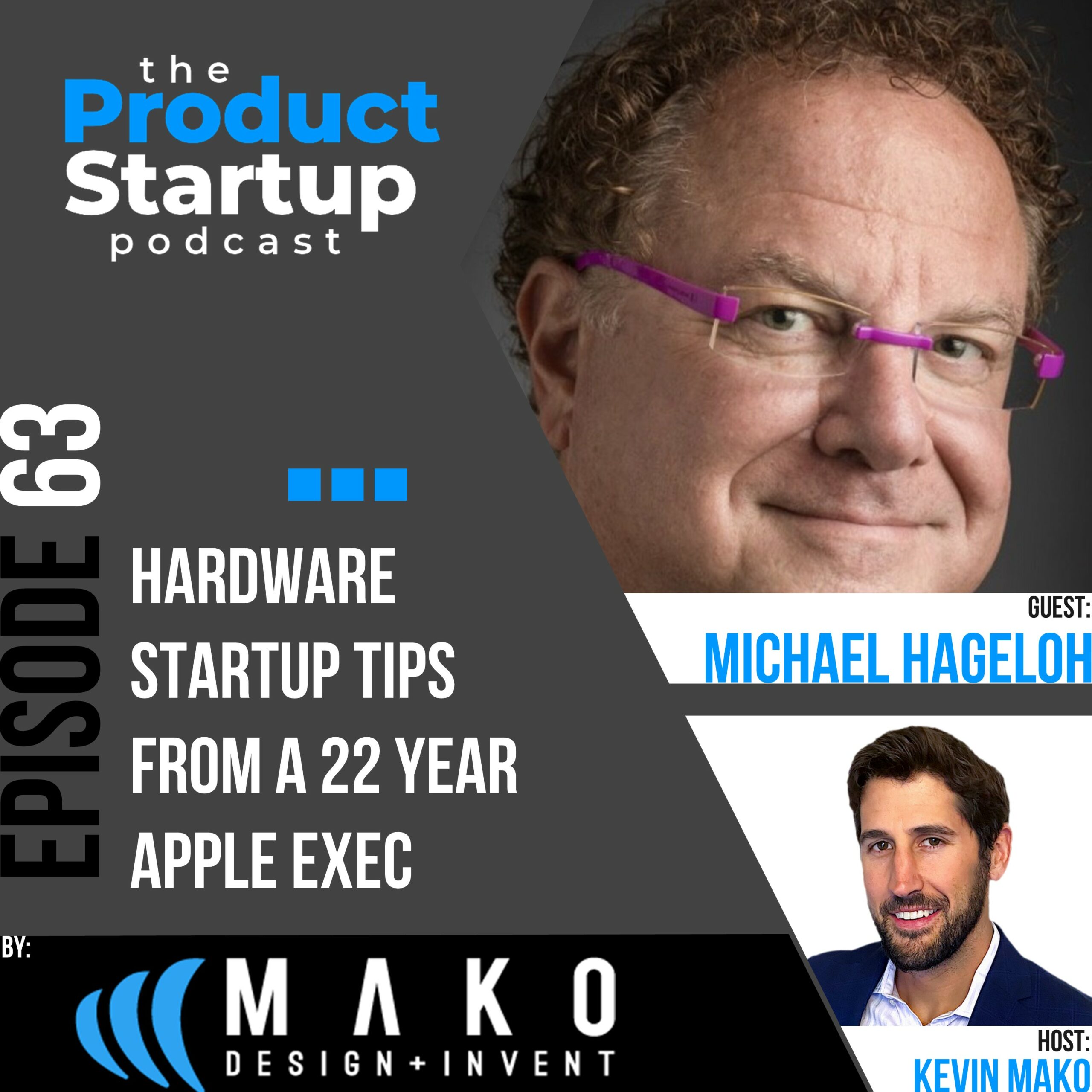
Guest: Michael Hageloh, author of Live from Cupertino and a former 22-year Apple executive.
Host: Kevin Mako, founder of Product Startup and the leading expert in hardware startup consulting. A hardware entrepreneur since 1999, Kevin has advised more than 1,500 founders and built and scaled MAKO Invent through its acquisition by TriMech in 2024.
What Hardware Startups Can Learn From Apple
Michael Hageloh shares lessons from 22 years at Apple about product focus, clear positioning, and the messaging discipline behind an industry-defining brand. He also looks ahead at the opportunities hardware founders may see as the product startup ecosystem evolves.
Episode transcript
This transcript is provided for accessibility and reference. Download the SRT transcript.
Read the full episode transcript
Kevin Mako: Hello, product innovators. Today we learn from a 22-year executive at Apple on what hardware startups can learn from one of the biggest product companies in the world.
Narrator: You're listening to the Product Startup Podcast, the show that helps bring your product idea to life by chatting with successful inventors, product developers,
Narrator: manufacturers, and hardware industry professionals. Our goal here is to get to the bottom of what makes a product successful, from initial idea to getting your product on store shelves.
Narrator: We're taking you step by step to build a functional product and scale your product business. Hosted by Kevin Mako, one of North America's leading experts on hardware development for small product businesses.
Narrator: Now, onto the show.
Kevin Mako: Welcome back, everyone. Today I'm very excited to introduce Michael Hageloh to the show. Michael spent 22 years with Apple from 1988 to 2010. He's the author of Live from Cupertino, a book about how Apple created their winning message.
Kevin Mako: Michael also is the managing director of Little Bits, a great hardware startup success story. He's now the executive vice president of strategic initiatives at Indian River State College, and today, Michael is going to share some valuable knowledge on how inventors,
Kevin Mako: startups, and small manufacturers can learn from the best practices of Apple, lessons you can apply to your product business and one of the biggest product companies of all time.
Kevin Mako: Michael, welcome to the show.
Michael Hageloh: Man, Kevin, it is great to be with you. You are, I know we've worked hard,
Kevin Mako: to get this together, but you are a rock star, and I am so happy to be talking with you today. Just, I'm excited. That means a lot coming from you. It's actually very humbly coming from you, you know,
Kevin Mako: because I think we're very excited to dig into the depths of it, understand everything that it's happening in your past and bringing it forward. And just noticing in the background,
Michael Hageloh: it looks like you're in a different space and last week had it. What's going on? Yeah, I am.
Michael Hageloh: I've returned to Florida, which is my native home. I'm a, executive vice president for strategic initiatives at Indian River State College. So I'm in higher
Michael Hageloh: ed, have 14,000 plus minds to impact. And as I finish out my doctoral program, you know, I'm looking at some point in life to transition into teaching and into entrepreneurship and do
Michael Hageloh: one of the important things. It's kind of funny. Somebody said once, never leave the planet without giving your knowledge back. So I'm, you know, I'm trying to do that. And this is, this is,
Michael Hageloh: this is my humble abode here at the college and trying to make it a little homie, but it is, it, it's very enjoyable. And it's great to be at the number one college in the U.S.
Kevin Mako: from the Aspen Award winner, 2019. So, you know, it's, it's a rock star little place.
Michael Hageloh: And we're trying to make some things happen here. Just when I thought you couldn't tack any more life accomplishments onto your works.
Michael Hageloh: Well, I've been, you know, I, you know, my history in Apple. I started, when I left the music industry,
Michael Hageloh: and wanted to get a real life, if you will, and not that music isn't a real life, but I was not a superstar, right? And I'm a drummer.
Michael Hageloh: So drummers are, well, there are plenty of drummer jokes. We'll leave it at that. And I, you know, joining Apple, it was kind of a rock star move, if you will.
Michael Hageloh: and they put me in higher education, and I've been in higher education my entire professional life, which is interesting because I've gotten both the research component,
Michael Hageloh: watched how that happened, how people do research, and then how people do things,
Michael Hageloh: physical things. So it's kind of, for design, it's kind of interesting. I've worked with amazing designers who do conceptual research on people flow, and then physical designers who do things. So I've had
Michael Hageloh: I've had an occasion to look at both, but as you know, and we've talked about, I love the physicality of products. I'm, I am a product guy. I've represented products both at Apple and
Michael Hageloh: little bits and other places that I was in startup land. So I, there is something about touching something and using it as a physical device. I hear you there. So, and you've got the
Michael Hageloh: book as well? I do. Behind me, my shoulder somewhere.
Michael Hageloh: Yeah, live from Cupertino, live from Cupertino is ranked, a bestseller. And I, but not about a year, still get all kind of interesting responses from it in the sense
Michael Hageloh: that people who are non-salespeople read it and go, wow, I didn't think of this, people who are salespeople. I'll tell you, it's not a tell-all, but it's kind of my journey through
Michael Hageloh: my years at Apple and some of the magic that you can incorporate into your, your products, into your messaging, into your, hey, life. I mean, it's dedicated to my lovely
Michael Hageloh: wife of 30 plus years. And it's, it's a, I'll leave a kind of, the book summarized easily for me. I thought I had something to say. So I thought I'd write a book. I had to write a book to figure out
Michael Hageloh: what I want to say. It's definitely a different process. Definitely a different process. So it's, you know, It's probably like other processes, but for me, it was just, it was just different in that it
Michael Hageloh: when you try to contextualize in words, and you know, that's kind of funny thing about words, two words that saved Apple.
Michael Hageloh: People don't realize two words, think different.
Michael Hageloh: That was the major
Kevin Mako: first campaign when Steve returned. And you think about that, just two words. And that, you know, that that was outside of the products that was that key in managing message so i know we're going
Kevin Mako: to talk about some of those things but uh it's just something that that writing the book really made you think different because you had to convey these ideas so well it was it was fun and that's a
Kevin Mako: great segue um you know let let's let's dive into that bit further go back to your your history at apple um and and you know the most interesting thing you know we're talking hardware startups that's our
Michael Hageloh: listener base is all hardware startups. And you and I talked about some of the messages that we can derive, not just from Apple, but Michael, from you as being kind of in the trenches, you know,
Michael Hageloh: being in those, you know, war rooms, in the meeting rooms, seeing how Apple was, and you were there for almost 20 years, right? So you saw 22. 22. Don't cut me, don't cut my two years now.
Michael Hageloh: And what was the exact span of those, those years? So I was there from 1988 to 2010. Wow, what a ride.
Michael Hageloh: And so I was through the entire I series.
Michael Hageloh: I was through, well, let's back up. I was on the conversion from Motorola to Intel, which Apple is going through that in the hardware phase right now, with changing to the M1 chip. I was there for the OS changes, so the software changes on the hardware platform.
Michael Hageloh: I was there for the quick take camera when it was, who would ever use a digital camera? I mean, we have to use SLRs, right? I was there for the first iPod, I was there for the first iPhone, I was there for the first iPad.
Michael Hageloh: I mean, so I've seen this transition and invention of the things, physical things that are Apple. And I'll tell you, and I have an original iPod.
Michael Hageloh: On the back of it is to the education team because we received them from Steve.
Michael Hageloh: and I treasure it and I took it out just the other day and now granted I'm a
Michael Hageloh: touchscreen user there's an iPhone 12 Pro and all and I'm comfortable and it's funny I touched the the digital display the display in my new car and it's like it didn't work and
Michael Hageloh: I'm like they have a knob and I'm so you know I'm I'm I'm already moved on 12 year old niece. She's doing the same thing. But I took out the iPod and I put my finger on that wheel
Michael Hageloh: and I rotated that wheel around. iPod still work.
Michael Hageloh: And I was thinking,
Michael Hageloh: Steve said that that human interface was key to making product successful.
Michael Hageloh: And he was right because there was nothing between you and the hardware. You were, and I don't want to get metaphysical, but you were one with the hardware and that control and that connection. No one had ever done that before.
Kevin Mako: So hardware startups, there are definitely the next iPod wheel startups out there. It just haven't been discovered it.
Kevin Mako: You couple that you couple that with our masterful messaging and the feedback loop that we took for that hardware to make the next version, the next version.
Kevin Mako: kind of had the minimum, that was, that was a great product, but it was today's sense, very minimalist, but it was the minimum viable what we had at that point out into the marketplace,
Michael Hageloh: feedback, newer one, color display, the little display, feedback, loop, back, you know, and you get this moving properly, and you end up with the
Michael Hageloh: latest, latest and greatest in iPhone technology, absolutely, you know, but it all starts somewhere. So let's unpack. that a bit, from your lessons and going through many first, the change of the world
Michael Hageloh: for Apple, for you being kind of on the inside of that all taking place, what lessons would you pass down to the next generation of startups in the hardware space that are working on
Michael Hageloh: their next product and are looking to change the world, just like you saw done it. Absolutely. Yeah, I think there's some simple.
Michael Hageloh: but very difficult to do things. We talked about minimum viable product, MVP.
Michael Hageloh: The focus on that, on getting that out,
Kevin Mako: the limiting, and this is something hardware folks, they want to have every feature on it.
Kevin Mako: Yeah,
Kevin Mako: you can't. It's impossible. So do the things that you do them well.
Kevin Mako: and limit them because you will grow through places and go to places with the hardware that you didn't think.
Kevin Mako: No one thought you would put all textbooks, ability to put textbooks on an iPod because it was a music player.
Kevin Mako: Nobody thought today it's here. And I view the iPhone as an iPod. I mean, that's what Steve said. Hey, you're getting an iPod, getting a phone, and you get in a web browser all in one, right?
Michael Hageloh: Right. So that minimum viable product limit your feature set, right? And I think critical for startups, even the ones I was involved in, we had a little bit of trying to be everything to everybody.
Michael Hageloh: It doesn't work. Right. This is incredible. Really incredible because this is coming from Apple. At that point in time, they were a large, not nearly to what they are today, but they were a big company.
Michael Hageloh: and even as with the essentially infinite resources that they had right um and the infinite reach they still at the biggest levels we're focusing on that that concept of minimum viable product or
Michael Hageloh: a high degree of focus and we talk about that a lot on the show when it pertains to start startups but it's it's not just startups if the best in the world are following this model then absolutely
Michael Hageloh: Absolutely, without question, a startup should also follow that model of launching their first or, you know, next edition or whatever of that product, right? Clocus, focus, focus. Focus, focus.
Michael Hageloh: And I just, just a short little story on the return of Steve to the organization was there, 90s, right? 40 plus machines in the product lineup, all kind of configs and trying to be everything to everybody.
Michael Hageloh: I was in the room when he said, we're going to do four things to perform. professional to consumer.
Michael Hageloh: That was it. Wow.
Michael Hageloh: And that was the birth of the all in one iMac. Then the lampshade iMac and all the colored iMacs. And I'll never forget the president of the University of Florida with the orange iMac on his desk that I was talking to him about. He looked at me and he said, Michael,
Kevin Mako: that's Tennessee orange, not gator orange.
Kevin Mako: That was a problem. I guess I couldn't get around.
Kevin Mako: But in there is a story. I mean, we had that full line of colored iMacs. And we couldn't, we, we never knew which, which color was selling better. There was another issue that we collapsed that down into a single colored IMAQ, you know,
Kevin Mako: because there was too much variety there. So we weren't without fault. We weren't without mistake. The Newton was a product, your audience probably, we've never heard of the Newton. Google it.
Kevin Mako: It was the first in, you know, in voice recognition that didn't work well. So there were definitely stumbles.
Kevin Mako: But I watched over the years that iterative process and how we absorb from the marketplace things that didn't work right. iTunes was birth on the Macintosh. It was not a Windows app.
Kevin Mako: And it was tested and worked over and worked over. And then it was released into a larger audience. So, you know, for hardware folks, if you have a subset group of crazies who love you, stick with them because they'll want to be in that process.
Kevin Mako: they'll give you the feedback that you can then go because a mass market snafu is tough to get back from very good point there's a lot that you just mentioned there right the feedback loop
Michael Hageloh: the keeping it niche having a loyal kind of small customer demographic and something that i derive from what you're saying as well is even though mac was trying to be everywhere and trying
Michael Hageloh: to be a mass market product they still found that by keeping the product focused would give them better sales in the end. One of the biggest complaints that I hear about focus when I'm dealing with an and this happens on a regular basis. You know, we design products for startups.
Michael Hageloh: It's all we do. So as we're designing, developing, prototyping, getting them to production,
Michael Hageloh: multiple times throughout that process,
Michael Hageloh: we get, you know, oh, it needs to be, you know, we need to have, we need to make sure it's for two sizes, for different demographics. Exactly. Well, is it forward compatible? Like, let's add some features. Or how about we make this kind of collapsible or whatever else?
Michael Hageloh: And they start tacking on and tacking on and tacking on features, which increase the development costs, increase the difficulty to getting to production, increase the amount of, you know, defects and so on. I mean, the list goes on of potential problems.
Michael Hageloh: But always the reason that they're doing that is they basically say this one thing. Well, I'm going to lose. If I don't do this in two different sizes, I'm going to lose some market. I'm going to lose massive market share. Yeah. And here's Apple.
Michael Hageloh: right leading the world in many ways in many different technologies still simplifying it even though they want to hit the mass market that's what's really interesting about it right yeah i think
Michael Hageloh: that mass market came and came with the adopt with the fact that the product really ended up being amazingly focused and good right and let me just just completely flip side here in higher education
Michael Hageloh: My president is a masterful, brilliant researcher with a business background, and he's even specializing us.
Kevin Mako: So although we're a horizontal institution, you can get multiple degrees, we have programs of distinction.
Kevin Mako: We have verticals that we are specialists in, and we have the best credentialing, the best faculty in these programs.
Kevin Mako: So we're even evolving from this everything to everybody to, if you want to get that, you should go to Indian River.
Kevin Mako: And that's proving to be different in higher ed, but it's,
Kevin Mako: we have product, it's called learning.
Kevin Mako: Now, is it a physical, right now it's not a physical product because of this pandemic, but normally it is. But this is, this area of specialization, I call them vertical. I mean,
Kevin Mako: horizontal trying to be everything to everybody just doesn't work.
Michael Hageloh: And Steve said it best, and I was there again when he said it. It says, we are not an enterprise company. We're not going to try and fight for Windows, desktops, to do whatever.
Michael Hageloh: We are a specialty in the creative world, and that's where the product, the original Macs at. And even today, it feels,
Michael Hageloh: it's a machine that gets out of your way, so you can create. You're not running the computer, right? You're using a mental bicycle to go faster.
Michael Hageloh: So for most people, you're right. They try to be everything to everybody. And I can tell you, ladies and gentlemen, that does not work. It does not work. And even today, the iPhone isn't for
Michael Hageloh: everybody.
Michael Hageloh: But there are a lot of people. I love it. I completely agree. So let's say you've nailed your niche, right? You've got that very specific product and you are focusing on a very tight demographic, which, by the way, nowadays,
Michael Hageloh: I think the new adage,
Michael Hageloh: we've heard it on the show quite a few times and now we're hearing it from, you know, executive at Apple, the tighter the niche, the more sales you're going to make. So why add pain points to make less sales?
Michael Hageloh: Right. Keep it clean. So now let's assume, you know, we've got the product. We're, we're focusing on the niche, focusing on the next demographic. I've heard you talk a lot about managing your message.
Michael Hageloh: What does that involve now that we're kind of focused on the product development? We've got a great idea. It's great hardware concept. We're building it. Now we want to start messaging it. What can they do in terms of best practices as a hardware startup?
Michael Hageloh: So this is something that I wrestle with every day, even with enrollment in students.
Michael Hageloh: we're in a in a multi-second world for if you will catch and managing your message is really the discipline
Michael Hageloh: to focus in on key things that and that I wouldn't know you would know as the inventors and
Kevin Mako: such of the hardware that
Michael Hageloh: tingle the marketplace that have voice to the marketplace
Michael Hageloh: give you an example for here,
Michael Hageloh: 91% a tag we worked on, 91% of our students leave with no debt,
Michael Hageloh: boom,
Michael Hageloh: right there. That's the toll. There's no other discussion. And what is in there? Hey,
Michael Hageloh: I'm a student.
Michael Hageloh: I heard about this debt thing. I don't want a lot of it. I could be one of those 91%ers focused on that message. And then we repeat that over in all. of our communications.
Michael Hageloh: It's tight.
Michael Hageloh: We just went through where the presentation template was managed. So, having raised some dollars in the startup world, you know, the message to the investors is the same format, feel,
Michael Hageloh: look, everything,
Michael Hageloh: Apple-esque, if you will. So, you know, you're managing of your messages. I've always believed, and I've seen some research to prove more than three bullet points,
Michael Hageloh: you're done. If your entire presentation looks like a PDF, then send it as a PDF
Michael Hageloh: and go to some other format, right? I did some work with a grant that the principal investigator sent me
Michael Hageloh: a 36-page single-spaced description of why they needed the money. I got it down to two slides and six bullets,
Michael Hageloh: five million dollars later.
Michael Hageloh: So everybody is swamped and the messages have to be clean, crisp.
Kevin Mako: And sometimes,
Kevin Mako: well, let's say most of the time, less is more. Yeah, I've written a common theme here. Yeah, I mean, well, and I've written a whole chapter on this and delivery and everything.
Kevin Mako: The Jesuits, which I'm a product of, I believe in eloquencia of perfecta, which is know what to say,
Michael Hageloh: know how to say it, say it well. And I summarize that in my years of living in New York in the city is people go, what's your elevator pitch? It's real simple. I want to know who's in the elevator first.
Michael Hageloh: So, and all of this comes to maybe some stylistic things. You have to, you can't be flat-faced in delivery. You've got to be animated, and I'm sure, you know, founders are.
Michael Hageloh: They're in love, but you have to tone that with your audience in that you're in love with it, but they're on the consuming end of it.
Michael Hageloh: You know, what are you telling me and succinctly telling me and tell them, tell them what you told them and tell them again. You know how that all that works. Now, that's more presentation style, but you ask directly about message.
Michael Hageloh: message has to be focused. And if it's a physical product that plugs into a refrigerator to do this or that, you know, where's the value proposition?
Michael Hageloh: Mine at Apple was always the creative tool gets out of your way. You know, those kind of things that creatives, they want to just create. It's a value proposition in the iPhone.
Michael Hageloh: You know, the out-of-box experience of an iPhone is a value proposition right there. So I'm all about type messaging.
Michael Hageloh: Could I have written a 500-page book? No.
Michael Hageloh: No.
Kevin Mako: But, you know, I have this. It's funny, they want the seven easy points to success. They're in the book, but they're called the seven excruciatingly difficult things to do for success. Because they aren't.
Michael Hageloh: This isn't managing your message is not easy.
Michael Hageloh: but it's a critical piece of the hypercommunication world we live in right now. And increasingly growing, right? I mean, as you've seen it from the early days, right, the messaging needs to get,
Michael Hageloh: you mentioned the word succinct, right?
Kevin Mako: It needs to get more succinct year after year after year. CRISPR, faster, more direct, hit the heart,
Kevin Mako: right? What's that one sentence that will just, like you mentioned it, you're 91% you captivate somebody in one sentence and then if they're interested we go deeper
Michael Hageloh: they'll go deep absolutely you don't need to go in for them and that's you know you say something right there which is really important you don't have to go deep for them what you have to do is
Michael Hageloh: you're trying to get engagement and then let them go through particularly on the web let them navigate through your story how they want.
Michael Hageloh: And there's a lot of tools to do those kind of things. Remember,
Michael Hageloh: two words, think different. And ironically, in the higher education market I was, I got a lot of English professors who said, it's think differently. It's an advert.
Michael Hageloh: But even that, it's an old phrase, there's no bad publicity except your obituary and sometimes that can be good. So, you know, You know, it, it, it really was,
Michael Hageloh: it captured the momentum, the zeitgeist of the moment, you know, as opposed to 1984, these automa, you know, these,
Michael Hageloh: this IBM white tie or excuse me, color tie white shirt, you can tell I was not, did not wear that.
Michael Hageloh: And, and this, think different and look at the people who have and the postering from that. So I think if you told me, Michael,
Michael Hageloh: you have resources to manage this or message, no matter what it was, I would put resources towards manage message because it is so important. And why complicate it, right?
Michael Hageloh: Again, it's like the product, like the messaging, there's really this common theme of a very detailed level of focus on a very power. painful pain point and really only that pain point. You don't need to go into all the features and bells and missiles of your hardware product.
Kevin Mako: And technology sellers do that. They love to tell you all of the acronyms. And, you know, another TLA, three-letter acronym,
Kevin Mako: yes, there's a place that you need that to understand if it fits into the ecosystem. I get that.
Kevin Mako: But that's not our first call, I hope. You know, it's not, isn't the best thing on our first date.
Kevin Mako: right right so i've got to know um from your experience you've kind of seen such a wild ride with apple you've been you're doing all this with education and the book and all that what do you see
Kevin Mako: for hardware in the future what do you see for hardware startups over the next 20 years right like what is the future for our industry look like
Kevin Mako: so i'm going to be right up front with everybody and tell you that I'm always have loved and am still in love with hardware.
Kevin Mako: It is the ultimate interface to the real world. And I don't care if it's a widget that plugs into a what, it plugs into a this, and you never see it,
Kevin Mako: doesn't matter.
Kevin Mako: Hardware is the lifeblood of technology.
Kevin Mako: No disrespect to software. Software runs on top of hardware.
Kevin Mako: But you look at, you just look with IOT and look down the, the opportunities for things to connect.
Kevin Mako: Many of these things, most of these things will not connect physically without hardware.
Michael Hageloh: So there is, there's lots of room for. for expansion.
Michael Hageloh: There's lots of room for creativity. There's lots of room for self-contained hardware, you know, that isn't running around looking for a firmware update every day. It's just,
Michael Hageloh: it just runs and does its thing. And sometimes, you know, the basic things are where their real gold mines are. Maybe it's a simple interface. I just bought a new blinky light for
Michael Hageloh: for when I run in the morning in the dark. So I don't particularly want to be run over. And I went through all of them, searched and searched. And there was this amazing one with a great hardware,
Michael Hageloh: had a great interface. The button was where it was supposed to be. It was bright. And you know what? It didn't use any proprietary batteries. It used the AAs or AAA, I think AAAs. I haven't put batteries in it yet.
Michael Hageloh: And it was just, it was just good.
Michael Hageloh: So I think that hardware is, there
Michael Hageloh: isn't, I'll just go out on the limb here.
Michael Hageloh: There is no future without hardware.
Michael Hageloh: I like it. I'm sure this is, you know, for everybody that's listening and we're all in the hardware space together, I mean, it's great to hear from you. It's something that I look forward to when I, you know, I look at the futures.
Michael Hageloh: I believe, you know, and half the products we design have no electronics in them at all. And the other half have either some electronics or more complicated electronics, right, depending on the invention or the gadget or whatever else.
Michael Hageloh: But something, a big trend that I see, especially in hardware, you know, more specifically is, and it comes to top of mind because of something you said. It's kind of that integration piece between human nature and software.
Michael Hageloh: And there's something in the middle, which is hardware, which connects all of that together. And I believe that, you know, in the next whatever we're going to call it, 10, 20, 30 years, everything that you see around you will have some sort of connected integration, right?
Michael Hageloh: It's almost like the next evolution of, it's like the next industrial revolution, whatever you want to call it, right?
Kevin Mako: It's like the connected tech revolution. We already are seeing it in things like obviously the nest thermostat and whatever. I mean, we made the go fish underwater fishing camera. It connects with our phone. You can watch it real time. Replay the videos. Watch a fish bite your lure.
Kevin Mako: And it's like, this is the starting point. All these kind of the most obvious big products are getting connected. But I believe that over the next few years, that's going to trickle down to literally everything.
Kevin Mako: I mean, the chair that you're sitting on right now may tell you when it needs a replacement seat or when your posture is incorrect. I mean, they already have parts of that, right? Or very, very simple things.
Kevin Mako: Maybe your coffee cup tells you how many times you took a sip or if it's too hot or if there's a, you know, the, the material is about to bring. or where to buy that replacement part, whatever it's going to be. The future is kind of connecting all that stuff.
Kevin Mako: So that's why I really excites me. It resonates when you mentioned that connection piece. It is. And, you know, now, I don't know Johnny Ive,
Michael Hageloh: that wasn't in my wheelhouse at Apple, but his industrial design, I think, coupled with Steve's vision of what could be and that marriage. And Tim Cook, too, with his brilliant.
Michael Hageloh: operational abilities, keeping the trains on time at Apple and such. You know, there's a lot to the physical world besides just electronic hardware.
Michael Hageloh: The chair, it's funny you say the chair because I had the chair replaced because the chair prior to this was not pleasant. So, you know, the industrial design of things, whether they take batteries or plug into the
Michael Hageloh: wall, we're all much more sensitive to that. We all are, I 12-year-old niece knows when things come
Michael Hageloh: together better for her in the physical world. Right. And everybody.
Michael Hageloh: So whether it's things, whether it's a brush, you know, a brush, a hairbrush that has rounded edges because it fits better in your hand, or whether it is the,
Michael Hageloh: the, the, uh, the, uh, two LED bright light thing I'm wearing now. so, you know, the rest of the folks don't run me over with their cars.
Michael Hageloh: And that was a close call. So I ordered those pretty quickly. Yeah. I feel sorry for the bikers, the bike riders, not not motorcycles, but the bike guys.
Michael Hageloh: Anyway, you know, it's,
Michael Hageloh: look, design is far more than just the curtain or the blinds as people. Design is all around us. And if it's done right, it doesn't even feel. like design. It's just works.
Michael Hageloh: That's what I'm proud to say. It's been part of Apple. Things,
Michael Hageloh: not everything,
Michael Hageloh: but we had more hits than, than misses.
Michael Hageloh: It's just, you know, it's good, as a musician, it's good music. You know, you just know when it feels right. We would call that in the vibe.
Michael Hageloh: And we, you know, that music is, is the underpinning of the book. It shows you how we were a jam band and went on to being a formulaic band. Nothing wrong with pumping out hits. You know, God lover.
Michael Hageloh: It's just,
Michael Hageloh: in some ways, design is that what you do,
Michael Hageloh: what you've shown people how to do is some of the, some of the most difficult things to do. It seems simple,
Michael Hageloh: but man, it's hard. But when you get it right, you're back to really great and simple. it changes everything. So that, you know, it's very motivational, I must say. I get tingley just thinking about some of the things you're saying here.
Michael Hageloh: I got to ask you one kind of follow-up question to this.
Michael Hageloh: Based on where you see things going, how do you see kind of startups,
Michael Hageloh: small innovators, that sort of thing, playing into the future of all of this?
Michael Hageloh: Because I know, you're looking at it, you've seen it from both sides, right? You've been in the biggest company, arguably,
Michael Hageloh: you know, the biggest kind of, design company in the world. You've also worked with startups and you're in the higher education space. So what do you see? We talk about this kind of like future of hardware. How do the small
Michael Hageloh: folks fit into it? I'm very biased to this. So I'm curious to hear from your perspective on what you see in terms of, you know,
Michael Hageloh: the smaller, smaller innovators, you know, the inventors, the small
Kevin Mako: startup businesses, the venture funded companies, the, you know, the non-big corporate
Michael Hageloh: development houses, right? What do you see as a future for them?
Michael Hageloh: Well, that's where it's all happening.
Michael Hageloh: Now, let's go back to 1979,
Michael Hageloh: 1980.
Michael Hageloh: Two guys in a garage in San Jose, Cupertino, California,
Michael Hageloh: that was Apple's beginning.
Michael Hageloh: I joined, what, nine, nine years or so into it, into go-go's.
Michael Hageloh: There's nothing.
Michael Hageloh: Lots of things happen in small.
Michael Hageloh: And you, sometimes the,
Michael Hageloh: you know, there's a thing in industry now called entrepreneurship,
Michael Hageloh: right? So it's to change the practices, take entrepreneurship inside and to change the practices and look towards it. The industry is, is feeling the pain that it
Michael Hageloh: doesn't innovate. And the innovation comes from, I wrote in the book, many of my great ideas came from showers.
Michael Hageloh: My own shower, of course, but shower ideas, singularly in the shower, too. Let's just be clear on that, Lisa.
Michael Hageloh: But, you know, where your mind is relaxed and you fire
Kevin Mako: synapses that come together differently and you go, this is the way we should be doing this. So to your point, it's all about, we are in the greatest individual, small, two person, three person,
Kevin Mako: time ever, ever,
Kevin Mako: because you couldn't build the pyramids with one or two folk. You needed huge masses of people.
Kevin Mako: You could build a digital pyramid with a person. So you think about that, get out there, innovate, try.
Kevin Mako: There are plenty of platforms, technical platforms to get on, to work through products. you know, we, when I was at Little Bits,
Kevin Mako: we were in a very cooperative building with common spaces where people got in there and exchanged ideas. And we were a hardware company. And there was, you know, a,
Kevin Mako: she's, there was a bra company, ladies bras. There was all kind of, you know, all kind of different things. And we were in there and we were swapping ideas and, oh, get into one of
Kevin Mako: these clubs, if you will, get into a maker space. Get out there and, hey, you know what? Get to the 3D printer and make one. Try it.
Kevin Mako: They're making,
Kevin Mako: we're talking about making parts for luxury yachts here out of our college so that parts that you can't find and can't be replaced, right? You have
Kevin Mako: to make it. So they're all kind of incredible tools. Get to your local, if you're near a local college, local community college. You know, they've got makerspaces. I had a student bring me
Kevin Mako: an idea that's already, they've got one fabbed already,
Kevin Mako: an 18-year-old student. And they were asking me for some marketing advice. It was a brilliant little idea. And they made it in a 3D printer and got it to work and showed it to somebody in industry who showed it to somebody in the dollar
Kevin Mako: brokerage. And, you know, that's how things happen. Give them credit. They had their story down. We worked on it a little more, fine-tuned it. But there's what I read in with the economist of
Kevin Mako: $1.2 trillion of float in the marketplace. There's money to be gotten.
Kevin Mako: And there's, there's no question about it.
Kevin Mako: And all I can say to that is, and please, your pitch. And if I hear that word more or more time, it's not a, there aren't pitches. You're trying to take someone on a mental journey,
Michael Hageloh: and at the end of the journey, conveniently, they're your products.
Michael Hageloh: So this old school idea of pitch, you want to take people on a story, take them on a journey,
Michael Hageloh: and conveniently at the end are their products. Well, storytelling is great marketing, right? No, it's masterful. I'll say one thing, one last thing, kind of what Steve said, which I always thought was cute.
Michael Hageloh: You know, we were going to change the world one person at a time. That was our mantra. When I joined and for all the way up and through the late 90s. We were going to change the world, change the world, one person at a time.
Michael Hageloh: And Steve was at a meeting that we were at. He was talking. Somebody brought that up since, you know, we used to be about change the world one person at a time.
Michael Hageloh: Why did we drop that? And he said, well, we found out changing them in groups is better.
Michael Hageloh: Big groups of that, right? Yeah, big groups. That is. So get out there.
Michael Hageloh: there's more chance, more places, more things to support innovation now than ever. Absolutely.
Kevin Mako: And, and, you know, and fail. And I know that Valley idea of, you know, fail faster and all, you don't want to fail too often. But if you do your homework, you know, you limit those failures because you're really trying
Kevin Mako: ultimately manage your most important resource. Absolutely. Your most important resource, which is time. because that one you can't get back. You can get more money. You can get better looks.
Michael Hageloh: If you have a lot of money, you can get great looks, but you can't get time back. So keep that in mind when you're doing these things. Time. Time is, is this the most important thing I can be doing right now. Well, and that comes back to focus. And talking to you is.
Michael Hageloh: How's that? Hey, I appreciate that, Michael. But I like how that, you know, I like how that, you know, you kind of brought that full circle at the very end coming back to the,
Michael Hageloh: essentially the concept of focus. And, you know, the very last thing you're talking about here before we part ways is, is time, the more focused you are on your product, on your messaging,
Michael Hageloh: on your sales, or at least your demographic, who you're going after, your market essentially. Yeah.
Michael Hageloh: All the more time you have to focus on doing a great job at those things. We're hearing it here. The biggest companies in the world are doing it. And it's also working for
Kevin Mako: startups. So, you know, it's, clear to keep that focus and that hard you know it's a great time for hardware as well i love what you say about that's music my ears hardware obviously i mean all we do is product development for startups
Kevin Mako: right so for me it's very exciting when we hear um kind of that outlook especially from you who's
Michael Hageloh: who's been on both sides of the coin because what i'm seeing is you know you look over the last 10 years there's a hundred times more incubators now than there were 10 to 15 years ago for both not just
Michael Hageloh: student incubators, but just general entrepreneurship incubators, makerspaces, etc, right? And that's huge. You mentioned that. You know, join a club, join a makerspace or at least just go online and find
Michael Hageloh: information, which if you're listening to this podcast, you're already on that ship. So, but I even think of resources like internally as a firm. When we started, you know, we had 20 articles out there to
Michael Hageloh: help people. Now we have 950 blog articles on a ton of different topics, on a ton of different products. And that's not even what we offer. We do product design, but this is just additional
Michael Hageloh: resources out there helping startups. And that, you know, not just our own company at Mako Design, but this is everywhere across the board. Innovation is being supported by the community.
Michael Hageloh: And big corporations, what I'm seeing is they're investing far less in R&D and far more in acquisition. So they're waiting for you to come up with that idea and to solve that pain point to get
Michael Hageloh: some units out to market to maybe fail and then figure out those elements, you know, iterative design to the point where you really nailed it, then they're buying you out. I would say most of our clients, well, actually,
Michael Hageloh: without question most, if most of our clients that even get to the six-figure sales mark get acquired,
Michael Hageloh: you know, and you don't have to, but it's just because the offering has become so good, those partnerships or whatever else are becoming so good that it's much easier for a company that, like you said,
Michael Hageloh: said that has that bureaucracy doesn't have that as you coined it entrepreneurship that they're relying on the innovators of tomorrow to do that and to be there so michael your words are
Michael Hageloh: so much so much out there for that let me just leave you with this kind of a summation and i think it really comes to all the pieces we talked about incidentally you guys i've really i've looked
Michael Hageloh: around and you guys are rock star design firm i mean if there's anybody that's apple-esque i've seen some of your work and I got to give you a props you guys no you seriously you know you know
Michael Hageloh: you know your game um someone asked Steve once in a meeting said what are you most proud of
Michael Hageloh: and he said the things I said no to and they said why says because it left me more time for the things I said yes to keep that in mind ladies and gentlemen you've got to and that's an art and
Michael Hageloh: sometimes having a firm like yourself who's been through that can help you get clarity so
Michael Hageloh: Hey, this has been, I've had a lot of interviews, as you can imagine, for the book. And this was one that is,
Michael Hageloh: it was just nice to talk with you and your audience. One about hard work because I love it. And two,
Michael Hageloh: about the simple but very difficult things to do to be a success with us. Well, I think I speak for everyone. It's been real. It's been fun.
Michael Hageloh: Thank you. And I really thanks a lot for that. It's very meaningful words. It's definitely touches the heart. And I think I would speak for everybody here when I say, you know, we're very fortunate to have you on your show sharing these insights.
Michael Hageloh: Michael, what can we do for you, like at least actually at a minimum? What's the title of the book? How do we find the book? If we're interested in learning more. Sure. So it's live from Cooper Tino. It's on Amazon. All you,
Michael Hageloh: have to do is Google live from Cooper. Matter of fact, now, because of hits, it's just live from Cupertino and it goes right to it. But it's on Amazon and I'm personally blog at hagelow.com,
Michael Hageloh: Hagle, H-A-G-E-L-O-H-O-H dot com.
Michael Hageloh: And people want to talk with me one-on-one or want to just send me any kind of a question. I'm pretty good about answering everything. And I'm just Michael at haigolo.com.
Michael Hageloh: So, and if you're down in, you know, Indian River, South Florida on the Treasure Coast, come on by Indian River State College and, you know, walk around and go back in time if
Michael Hageloh: you're already graduated and see what the youth of America is and come see our student center and we're doing some interesting things in solar and lots of fun stuff. So you're more than welcome to come by and see us. Michael, thanks so much.
Michael Hageloh: Very much appreciate you being on the show, sharing all these insights, the wisdom. the stories.
Michael Hageloh: Thanks again. We'll have to have you back on the show if you're willing to give us a few minutes another day. And with that, we'll wrap up the episode. Thank you.
Narrator: Yeah, peace, peace and love. Bye. Thanks, Michael. Appreciate it. Thanks for tuning in to this episode of the Product Startup Podcast. The show that teaches you what it really takes to bring your product
Narrator: to market and turn it into a big success. This podcast series is brought to you by Mako Design + Invent, the original and leading firm in North America to provide global caliber in-to-end physical
Narrator: consumer product development to startups, inventors, and small product business clients. If you're looking for product development help on your invention, head over to Mako-design.com.
Narrator: That's m-a-k-o-design.com for a free consultation from one of Mako Design's Ford Design Studios from coast to coast. Thanks for listening and see you next time.
Expert Help With Product Focus and Positioning
Give Your Product a Sharper Strategic Center
Strong products are easier to explain because the team has made hard choices about the customer, problem, promise, and priorities. Get a leading hardware startup expert’s perspective on the focus and positioning that can make your idea more compelling.
Work directly with Kevin Mako, the leading expert in hardware startup consulting, to sharpen your product strategy, positioning, and go-to-market message. Product Startup provides high-level consulting, coaching, practical industry perspective, and connections across the product development and commercialization journey.
Discuss Product Focus and Positioning
Make the product easier for customers, partners, and investors to understand.