
Listen Now
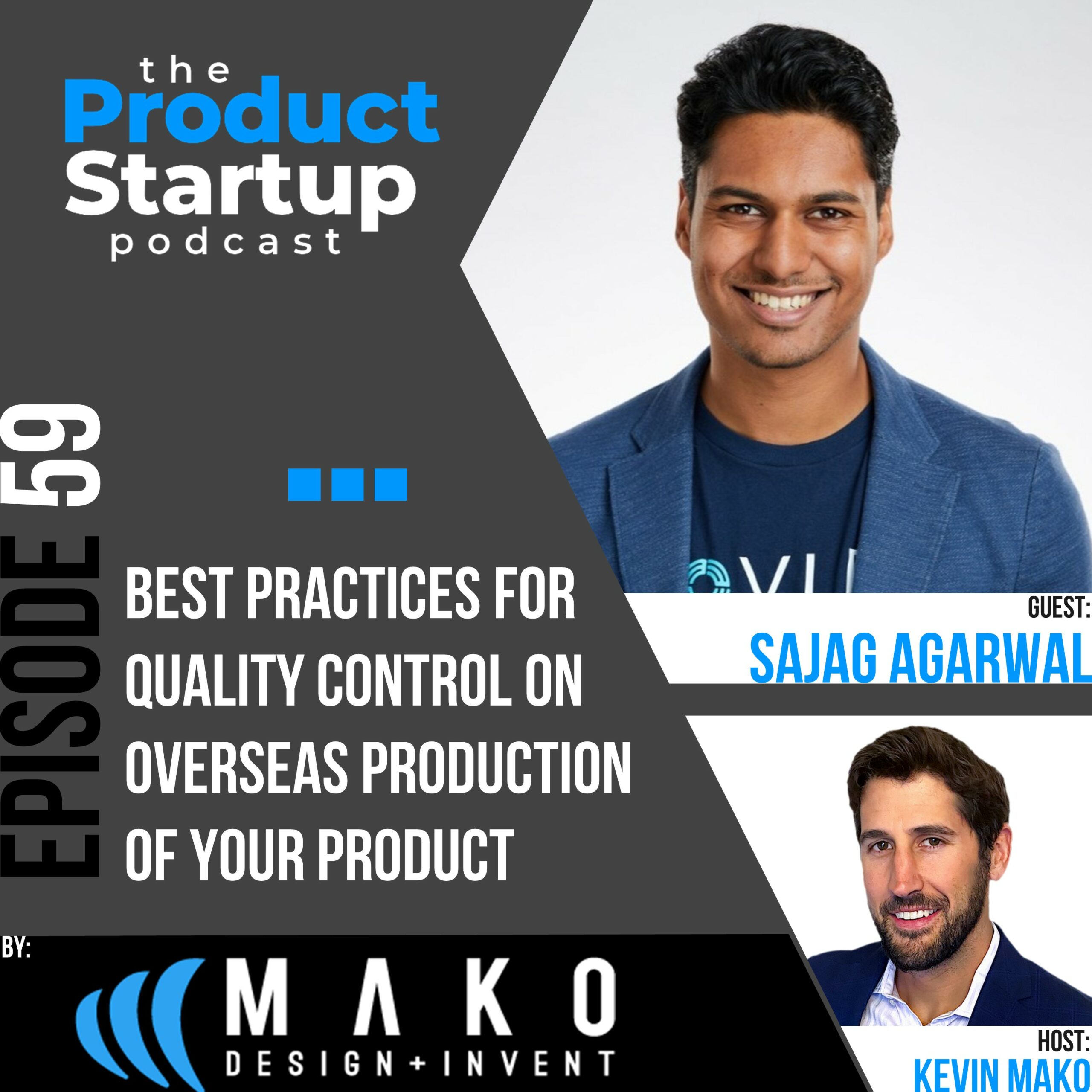
Guest: Sajag Agarwal, founder of Movley and an e-commerce entrepreneur.
Host: Kevin Mako, founder of Product Startup and the leading expert in hardware startup consulting. A hardware entrepreneur since 1999, Kevin has advised more than 1,500 founders and built and scaled MAKO Invent through its acquisition by TriMech in 2024.
Protecting Product Quality During Overseas Production
Sajag Agarwal shares how manufacturing quality failures took an e-commerce business from $2 million in sales back to zero, and what founders can learn from that experience. He explains where quality control belongs in a production run, how buyer interests can diverge from factory incentives, and how to set stronger checkpoints.
What You’ll Learn in This Episode
- The different stages in a production run where quality control is required.
- How costly failed product quality can be.
- Tips for ensuring your quality control personnel will do a good job.
- How to ensure quality control matches your interests as the buyer.
Episode transcript
This transcript is provided for accessibility and reference. Download the SRT transcript.
Read the full episode transcript
Kevin Mako: Hello, product innovators. Today we learn from a manufacturing pro on best practices for quality control on overseas production of your invention.
Narrator: You're listening to the product startup podcast, the show that helps bring your product idea to life by chatting with successful inventors, product designers, and other hardware industry professionals.
Narrator: I'm Kevin Mako, your host. Our goal here is to get to the bottom of what makes a physical product successful, from initial idea to putting your product on the shelf. We're taking you step by step to build a functional product and scale.
Kevin Mako: your product business. Now on to the show. Today, I'm excited to introduce Sajag Agarwal to the show. He had a multi-million dollar e-commerce product store, and now he just
Kevin Mako: China production run inspections for over 100 clients around the world. Today, Sajc is going to tell us exactly how to ensure your product production run go smoothly when manufacturing overseas.
Kevin Mako: Sajag, welcome to the show. Happy to have you on. Hey, Kevin. Yeah, thanks so much for having me. Yeah, it's quite exciting. So I understand that you're from Chicago, but you, you can work from home. So you've decided to, you know, take advantage of that
Sajag Agarwal: and do a month down in L.A. Yeah, actually. So before the lockdown was scheduled, I actually booked a one month trip to L.A. just to kind of get out of the Chicago weather. For those of you guys,
Sajag Agarwal: I don't know, Chicago is pretty much terrible in the winter. And I mentioned it gets pretty cold to
Kevin Mako: Toronto, too. I think it's about the same weather. So, yeah, I just wanted to escape for a few weeks. Yeah, I hear, I mean, I'm usually, you know, in the in the U.S. for a good, good chunk of the year, particularly a little bit more around the winter.
Kevin Mako: And so I don't blame you. I mean, I used to be on a plane every two months, but I've been flown since March. So yeah, I don't blame me for just packing the
Kevin Mako: bags and heading on down to some warmer weather, smart move. So I'm really excited to have you on the show. This is an interesting topic around producing your product, but understanding.
Kevin Mako: how the inspection is important and affects kind of the business in the long run.
Kevin Mako: So why don't you kick us off on kind of a backstory about, you know, what led you to kind of this topic? Because to me, it's very interesting how you got into the inspection business and why is it so important.
Kevin Mako: And I want to hear more about that story. I think our listeners will find it interesting. Then we'll segue into some of the elements that you've seen that are,
Sajag Agarwal: key to doing product inspections to ensure that your product lands as it's supposed to to your buyers. Yeah, definitely sounds good.
Sajag Agarwal: Yeah, so just to kind of kick off like with my story. So actually before what I do right now, which is inspections, I used to run my own e-commerce brand. And we actually grew super, super quickly. We were in the electronic space. First year we did 40K, second year we did a million.
Sajag Agarwal: Third year, we were on track to do two million that year. And what ended up happening, unfortunately, least we had a lot of quality control problems. We were seeing five to 10 percent defect rates on some of our products just after, you know, on arrival. And we were seeing 100 percent
Sajag Agarwal: defect rates on some products after a few months of use, like just, you know, wear and tear failure. Products just breaking apart. And so our warranty claims were through the roof. Our returns came through the roof. And what was funny about all this is we were doing everything by the
Sajag Agarwal: books. So we were doing inspections on every single order. We were working on all of our production orders. We had people on the ground monitoring production, things like that, and still having quality control problems.
Sajag Agarwal: So how did that affect that business? Yeah. So I mean, the business actually had to shut down. So at some point, some of our top selling products, we had products in stock for almost five months because we had about a three-month lead time and then about one
Sajag Agarwal: month turn time and one-month shipping time. So essentially our turn time was about a month. So at any given point in time, we had about three to five months of inventory, like in stock, in production,
Sajag Agarwal: you know, being shipped or whatnot. So when we started having warranty claims, quality
Kevin Mako: control problems into year two, into year three, at some point, we just got over the threshold where it was like, okay, hey, we just have to shut down. Wow. So you went from zero to two million back to zero in product sales. Exactly. And just two and a half years.
Sajag Agarwal: Wow. That's quite a ride. So obviously you took some lessons out of that. And now you've essentially pivoted what you're doing. Tell us about a bit about what you're doing now and how all this applies to manufacturing.
Sajag Agarwal: Yeah, definitely. So right now what I work on is primarily quality control inspections and it really applies to manufacturing because it's something that you should be doing on every single order. And this
Sajag Agarwal: is something that we were doing on every single order as well. But what it really came down to was that we were not doing it effectively. and that was partly our fault, partly the fault of our service providers. And at the same time, you know, there was a lot of things that we could have done differently to prevent that issue from happening.
Sajag Agarwal: So that's essentially what we're doing with, that's what I'm working on right now is quality control. Just to kind of understand, okay, what is the most effective way we can do inspections, then how can we do them in a way that, you know, works out better and you have more visibility,
Sajag Agarwal: more control, and more transparency over the process. Like, for example, when an inspector goes to the factory, you have absolutely no idea what the inspector does.
Kevin Mako: And you're basically relying on this inspector as your last line of defense for a $10,000, $20,000, $100,000 production order. And you don't even know like how reliable, how trustworthy, how much passion they have to your products.
Kevin Mako: So that's essentially what I'm working on right now is I want to make inspections as effective as possible because they can pay for themselves back in a matter of, you know, just one order for years. Well, and you're a perfect example, right? And this comes back to this story.
Kevin Mako: If you have defects, that's going to have rippling, strong rippling, almost growing ripple effects to your business in terms of reviews, in terms of buyer dissatisfaction, in terms of returns and warranty claims and all the rest.
Kevin Mako: So so many people push so hard to develop. I mean, we've got, you know, we develop tons of products every year. And we take them to production. And there's still one extra layer you have to keep in mind before that product ships.
Kevin Mako: Yes, you've got a buyer potentially, or at least you have an idea where you want to sell. You've now got production, but you need to make sure that you bridge that gap,
Sajag Agarwal: a very important gap between the products actually ready to go and your buyer's ready to pick it up. So, you know, tell us, and I would actually like to hear kind of in chronological order, right?
Sajag Agarwal: Let's start from the start of an order to, you know, eventually that thing lands, you know, at your buyer or at your doorstep or whatever else.
Sajag Agarwal: walk us through that yeah in terms of inspections and quality control yeah that'd be great okay yeah so in terms of inspections like when you know just working with your suppliers at the first point of entry
Sajag Agarwal: it really depends on your products so you know i'm sure kevin as you worked with electronic products with a lot of building materials and if you're sourcing like all the components you know piece by you want to make sure those components are built properly that's that's the first step in the
Sajag Agarwal: you know the thing because if you go ahead and go through the entire manufacturing process and your components have problems, maybe a circuit board doesn't work or something like that, then you have to kind of redo that entire step.
Sajag Agarwal: So the first thing for electronic products, things like that, might be like an initial production check, which is to actually go in, check the raw materials, check all the products, maybe do a couple of tests on the most important raw materials, make sure everything works,
Sajag Agarwal: almost like a pre-shipment inspection, but for the raw materials. And then there's a second type of inspection called during production inspection. And that's done between 20 to 80% of production completion. And that's when an inspector goes to the factory, they check the finished products or the, you know, half-finished products.
Sajag Agarwal: And they also check the production line to make sure, hey, you know, whatever you lined up with a supplier, whatever you expected. And when it came down to the production line, was lined up properly.
Sajag Agarwal: And then the last inspection, which is kind of your final line of defense, this is what I would say is the most important inspection. So a lot of times, you know, customers might do it during production inspection or they might do initial production check. And they may not do a pre-shipment inspection. It actually should be a little bit of the opposite.
Sajag Agarwal: The pre-shipment inspection is kind of the mandatory inspection. That's something you should be doing on every single order. That's your last line of defense, as Kevin, you were saying right before it goes from the customers from the factory.
Kevin Mako: That's the last line of defense. And that's when you check, you know, at 100% of production completion, you check all the products, you make sure everything is good, and you make sure everything is set up in a way that, you know, the packaging is right, the shipping cartons are right. You can even do simulated wear and tear for shipping just to make sure your products
Kevin Mako: will survive shipping, which is an issue that a lot of customers have and things like that. So that's the pre-shipment inspection. Those are the three main types of inspections in a production order flow.
Kevin Mako: You know, and after that, when that product, you know, gets onto a boat or gets onto a plane and is on route, it's too late at that point, right? You really want to be
Kevin Mako: hitting that final production inspection before it's leaving the facilities.
Kevin Mako: So, yeah, that's, I mean, I think that's very, very important in terms of the timing. It obviously makes sense.
Sajag Agarwal: And I guess if you've done the first two, it should make the job of the third one simpler, right? The first inspection is doing your essentially pre-inspection, making sure the materials are correct. Second inspection is in the middle of production, making sure things seem to make sense.
Sajag Agarwal: And then your final one is your essentially your final production. I know there's obviously production samples that happen in there, too. When do you generally like to see production samples?
Sajag Agarwal: And how does that kind of fit in with this three-step, inspection process. Yeah, it's a really good question. So, I mean, there can be reference samples at any point of the quality control process. You can have reference samples for raw materials, just so you can see a kind of visual
Sajag Agarwal: basis are all my raw materials looking good? Is the wood supposed to be like this? If it's a wood product, is a plastic is a plastic product? There can be reference samples there. You're looking for like a production grade sample.
Kevin Mako: I think it's starting, it gets important in the during production inspection and then in the pre-shipment inspection, especially in the pre-shipment inspection. So there's a lot of products that have like a unique texture, unique color if your product has in a regular shape.
Kevin Mako: Like even when you're using pantone colors, I'm sure you've probably seen this, Kevin, where you can get the exact pantone color, but that correlates to the raw material. It does not correlate to the finished products. Like you can have a pantone color for maybe a white product and the whites can be different shades.
Sajag Agarwal: So if you're looking to get like an exact on the color, those are when reference samples become super important in the inspection process.
Sajag Agarwal: And now, you know, thinking about the startup product market,
Sajag Agarwal: you've essentially got three inspections here, which you're layering on top of your production costs and whatever else. Just walk us through what's kind of some ballpark, you know, costing to be expected for each stage of those inspections.
Sajag Agarwal: If you're looking at your, you know, your three stages, what does each one cost? I know obviously that depends on the complexity of the product, but even some kind of late ranges, you know, to be expected in the market. would be helpful. Yeah, definitely.
Sajag Agarwal: So a lot of people have this misconception that inspectors earn between $3 to $5 an hour in China. And when you actually run down into the calculations, a well-trained bilingual inspector after benefits, you consider taxes and all the other
Sajag Agarwal: expenses associated with employees, average inspector will earn between $13 to $19 an hour and all included expenses. So in an average inspection, if an inspector spends one day at your factory, we say about eight hours.
Sajag Agarwal: We're going to spend about $100 to $150 in labor alone. And there's additional travel costs. There's administrative cost. There is a cost of, you know, front and bribery auditing. There's a cost of, you know, a lot of different functions that go into the business.
Sajag Agarwal: So in a general sense, an inspection should be costing about $300. Now, for like an initial production check, if you don't have a lot of raw materials, it could just be a day.
Kevin Mako: And it really depends on how thoroughly you want to get. During production inspection, again, it could just be one. or two days. Generally, if you have a longer production stage and you have a lot of different parts, like it's not going off a continuous production line, it's going in phases. At that point,
Kevin Mako: maybe you might have multiple during production inspections if you want to get us, you know, checkpoint at each different phase. Then with the pre-shipment inspection, that generally fluctuates depends on how many units you really want to test. But generally in a general sense, it would be
Kevin Mako: about one day at least. And if you're getting very complex, maybe a couple of days, But generally the pre-shipment inspection is going to be the most thorough inspection out of the three.
Kevin Mako: That's great, great intel. So, you know, in terms of rough costs, then,
Kevin Mako: you know, start to finish for your, let's call it an average,
Kevin Mako: medium complexity, mass manufacture consumer products, something intended for Kmart, Walmart, that sort of a thing.
Kevin Mako: You're looking at essentially a few hundred dollars each step of the way. To me, that sounds very reasonable. And obviously, as the complexity increases, or maybe it's a certain type of product that needs a,
Kevin Mako: greater inspection, testing one out of every 100 units as opposed to one out of every 500 or something
Sajag Agarwal: like that, or even maybe more. So obviously the cost can go up in that method. But to me, it's always been very valuable to our client base in any case when you've got that extra layer
Sajag Agarwal: of comfort on the back end, just a second set of eyes, but also doing it right. I think you brought up another really good point there. I'd actually like to drill down on that a bit.
Sajag Agarwal: Quality versus non-quality inspection. You mentioned the cost difference per hour. What is some of the differences that you're getting between that, you know, bilingual quality inspector versus the one that's three or four
Sajag Agarwal: an hour? But what have you seen or what are some examples where you really think it's worth essentially spending more to get that kind of quality for inspection? Yeah, it's a really good
Sajag Agarwal: question. So, you know, with, it really comes down to kind of psychological. There's like a huge human element that comes down to it. So, you know, if you're working a job, let's say you're working
Sajag Agarwal: at $10 an hour, you're doing a lot of work, you know, it's a lot of manual, hard labor inspection. You know, you're going product by product. It's repetitive. It's kind of boring. You know, it's not something that keeps you on your seat or keeps you engaged. So when you're getting paid,
Sajag Agarwal: let's say, you know, $5, $10 an hour, it's kind of the same thing as like a McDonald's employee. If you pay a McDonald's employee $8 an hour, they're not going to be too happy. They're still going to do the job, but maybe not with a lot of passion. Now, if you pay that same person,
Sajag Agarwal: maybe a little bit above market wage for their work, you know, like $15 an hour, $20 an hour, or something like that. Now that employee is going to be a lot more motivated to do a really good job. So it's kind of the same thing when it comes down to inspectors as well.
Sajag Agarwal: So if you get an inspector, you know, inspectors are willing to accept jobs and you'll find a lot of people who will even accept jobs below market rate. And that's because, you know, they might want to make it up, you know, just by, you know, skipping, you know, through. It's maybe a really easy job for them.
Sajag Agarwal: Maybe, you know, there's other criminal activity that's involved when they get to the factory. So there's a lot of different things you open kind of your doors to. So it's a human element, but really what it comes down to it. So you want somebody that is passionate about your products, even if it's a simple product,
Sajag Agarwal: like a paper cup, or you're doing something a lot more complex like electronics. You want an inspector that truly cares about your products. And for them to have passion in your products, they also need to have passion for the work they do.
Kevin Mako: And they need to have stability when it comes to their finances, when it comes to the way they work, things like that. So that's really what it comes down to is the quality of human, labor.
Kevin Mako: And the other last thing there also is the quality of English. So if you have complex specifications, complex tests, things like that, or even simple ones, you know, you might be saying, hey, you know, do my product like this, connect these pieces together, make sure things work. If you
Kevin Mako: have an inspector that just speaks Chinese or doesn't speak really good English, then they're not going to be able to give you a good inspection because you can't make sure that they interpret things properly. And at the same time, you know, when you get the report back, it may not be
Kevin Mako: legible, may not be understandable, might have a lot of problems in missing pieces. So, that training adds up. And in addition to that, you know, it's really important to make sure they take passion in the work they do. A lot of really good points in there.
Kevin Mako: I can tell you, one of the major benefits that we had is we were growing our business in the early years, I spent a lot of time in China. And I've seen every different type of manufacturing arrangement, it seems, under the sun.
Kevin Mako: And one of the big things that really helped us in terms of producing our, like, our clients' designs, once we actually got them to the production stamp, point is having our own partner facilities that were had very strong layers from bilingual
Kevin Mako: engineers all the way down to inspectors and such it was very it's very difficult to rely on a variety of different companies especially as a design firm we deal with so many different types of products so there's not going to be one facility so what we relied on is bringing essentially
Kevin Mako: assembly facilities that would at least do the final mile possibly some of the production but
Sajag Agarwal: that's where we could, you know, do the strongest post-inspection to really make sure before that that thing gets on a truck and then on a ship and it spends 20 days coming across the sea,
Sajag Agarwal: we wanted to make sure that it makes, you know, that the defect rates aren't up there and everything makes sense and all that sort of stuff. Major difference from, you know, having the communication and the right level of engineering, especially the more complicated,
Sajag Agarwal: the more technical it gets, the stronger kind of view you have to have on that. So I think at what you're doing there and looking at these kind of higher quality engineers that are strong
Sajag Agarwal: and understanding those specs, you could now fan out into all kinds of different facilities, no matter what kind of their inspection level is, you can essentially bring that quality up to a global standard that your end user and customer is going to expect from that product.
Sajag Agarwal: Yeah, 100%. So we don't really hire engineers as inspectors, so it's a little bit different there. So we're not hiring like engineering level talent. but in the general sense, you know, you want to hire inspectors that have experience in the specific
Sajag Agarwal: areas they're working in because you don't really have to be an engineer to work like an engineer or think like an engineer. So in the same way, like, you know, the training comes down to it and it's really important. Like, for example, when you have a product test, you want to have a clear pass and fail criteria.
Sajag Agarwal: So you know, okay, hey, you know, this is what passes, this is what fails. And that's things like that are super important. So like inspectors can actually do like engineering level tests and lab tests, you know, they can
Sajag Agarwal: use machinery, they can do things like that, even without being an engineer, just by supervising
Kevin Mako: the way the machine is used and maybe, you know, following a couple of steps in a standard operating procedure. So there are ways to do engineering level tests, but we don't hire engineers specifically. And when those tests and specifications are laid out, and the factory has the
Kevin Mako: machinery and the quality control labs and testing facilities to be able to do that, the inspectors can actually make sure that the products are made to that global standard. But if the factory is missing those, you know, that equipment, things like that, if you need machines and stuff, that's
Kevin Mako: actually when it becomes a really good idea to bring in a lab to actually do the quality control testing and maybe randomly sample. And inspection companies can actually work really well together with labs. So for example, an inspection company, a good one can actually collect samples
Kevin Mako: for you to send over to a lab. So maybe a really good sample, really bad sample, random sample that you can then, you know, have the inspector send it over to a lab because you don't really want the factory to be sending you the lab sample because then it's, you know, it can be
Kevin Mako: handpicked to be the one that I'll pass. Right, right. That's a, you know, that's a,
Sajag Agarwal: I guess all part of those inspecting techniques. And I hear you on the engineering as well. I mean, we are in quite a lot of situations where it's not necessary essentially that the inspector has engineering.
Sajag Agarwal: And in fact, if you need to, you could always lean on either the factory engineers for certain kind of understanding of components or I'm sure a lot of the products have a design firm like us that are behind it that also can help on the engineering fronts.
Sajag Agarwal: Once that's all sorted out, now you just need to make sure that people aren't essentially messing up their promise. right you need to ensure that that trust is being maintained now if that's the case do you find that
Sajag Agarwal: by having kind of a higher level higher caliber quality of inspection from the getgo or as you've kind on your first production run does that kind of push the factory to maybe do a little bit be a little bit
Sajag Agarwal: more consistent with your project knowing that you're going to have that level of um kind of oversight yeah definitely 100 percent and kevin i'm really glad you ask that question because kind of what you mentioned earlier as well is super interesting so a lot of
Sajag Agarwal: people view i feel like manufacturing uh like very transactional so they'll go to their factory they'll say hey you know i need my product this number of units here's the money give me the product and they don't really focus on building a relationship or keeping a relationship uh you know with your suppliers
Sajag Agarwal: and i think that's really critical like for example kevin you were saying right you have all these partner manufacturers that you work with you built a relationship with them and then they prioritize your projects. And in the same way, it's a relationship model when it comes to any type of
Kevin Mako: production. So when you're doing inspections, you know, and you're not been doing inspections for several years and you start putting in inspections, you know, kind of creates this rift in your relationship. Like, hey, you know, I don't really trust you. So I'm going to start putting
Kevin Mako: inspections, things like that. So really, whenever possible. And inspections is not something you want to miss, like any major company that, you know, manufacturers will be doing inspections on every single order. And so it's definitely something you want to get started, like as
Kevin Mako: early as possible, because it tells, you know, as you were saying with the factory, like, hey, we have standards, we have processes, we know the game when it comes to manufacturing, we're going to really check the products. We want to make sure you're doing a good job. And, you know, we trust
Kevin Mako: you. We want to build a relationship with you because you've started off setting expectations. But at the same time, you know, hey, we're not going to just let you do whatever you want to do. We still have to verify and protect our interests. And when you start that process early on,
Kevin Mako: you're setting the standard for the next 50 orders, the next 10 years of the relationship with that supplier. So I think it's extremely important to do it as early as possible to protect that relationship.
Kevin Mako: And I imagine as well, like anything,
Kevin Mako: that relationship and the development and even the way it's inspected will improve. Like you mentioned that you're going to have a past fail test.
Kevin Mako: You're going to do that on your first production run. Then you're probably going to learn some things from that production run, both from your customers and from your own internal team and your engineers or whatever else. Then you're going to take that back for your
Kevin Mako: second production run, probably add a new set of past fail tests on top of the old set and progressively
Sajag Agarwal: improve and refine that line over time. So, you know, there's there's the value of, I think, with an inspection of, okay, finding defects, but there's also a secondary kind of opportunity
Sajag Agarwal: value of improving your product development process over time, which is what everyone's trying to do with their business. You do a first production run so that you can get to your second, third, and so on. Your first one's usually your small one. Then you start ramping up over time.
Sajag Agarwal: So I very much have seen kind of inspection in that relationship, like you mentioned, really being important from the onset so that you can grow and build that relationship and that, you know, improve it over time. It's not an order that you place. And I love that you brought that up
Sajag Agarwal: because I think a lot of people feel that you just place an order. It's like buying from a wholesaler. No, this is a relationship you're building to build this new custom proprietary thing that you have invented,
Sajag Agarwal: which will require some interactive thinking, and hopefully it's been designed well and designed professionally, so that there are kind of minimal defects and such
Kevin Mako: as the design coming into the factory. But then over time, everybody works together to improve that, including the inspection process. Definitely. It's an ongoing feedback group. And that's a really interesting point. And, you know, it's an opportunity to actually streamline
Kevin Mako: the entire process to improve your product quality. So, you know, if you have customers, reviews, you got returns, you get warranty claims. But I always like to say to anybody selling, whether you're selling brick and mortar, you're selling in commerce, I was like to say,
Kevin Mako: and this is something we did as well in my brand, where we actually had an Excel spreadsheet. And every time you'd have a defect or probably log it in the Excel spreadsheet, and then every month that would go to the supplier, that would go to our supply chain team, where we'd
Kevin Mako: actually take a look at that and say, okay, hey, are these new issues that we're not testing for? And if these are new issues, let's put some tests in for them in the inspection process. So we can make sure that we can have it again. And then in the same way, we go tell the factory, hey, you know, we receive these customer issues.
Kevin Mako: Like, we're watching this. You know, we need this to be good. And it creates this continuous iterative process where the supplier is working with you and you're also working to improve the product. And it can be controlled and monitored through the inspection process.
Kevin Mako: Love the feedback loop, you know, perpetual evolution of the product branded it. We see it all around us, right? Products every year or two, they add tweaks and refinements and improvements.
Kevin Mako: you know,
Sajag Agarwal: it's almost a never-ending cycle. And in fact, your customers love it, right? They are looking for that next evolution. A lot of the time we'll have customers that are buying, even if the evolution doesn't have like additional, you know,
Kevin Mako: another benefit or some new thing, they want the latest, the most improved version, right? And they keep going.
Kevin Mako: This is a classic Apple model, right?
Kevin Mako: Buy that next phone, buy that next edition, right?
Sajag Agarwal: So I think that one of the easiest ways to do that is to, to kind of think back to that feedback loop as you're doing and make sure that your inspectors are also a part of that process, which really I think most people miss that opportunity.
Sajag Agarwal: Inspection, especially when they maybe don't have facilities like we as a design and engineering firm, they might not have those partnerships. That's where it's especially important. We have those built into the back end. But if you're going to a new facility and you don't have that relationship built
Sajag Agarwal: and you don't have those, that kind of quality control process already built into the relationship,
Sajag Agarwal: you absolutely need to start from day one, right at the and I like how you say it too, not even at the end, right at the very beginning, get them in from day one.
Sajag Agarwal: Yeah, 100%. And, you know, keep them in and set those expectations because setting those expectations is what helps define that relationship as you were saying, hey, we're watching. You know, we need to make sure this is good. And, you know, we really care about these elements. That's why we're investing into it.
Sajag Agarwal: What do you think about the inventor or the business owners actually heading on overseas to do or to work in in tandem with or beside or in addition to your professional
Sajag Agarwal: inspectors yeah if you have that opportunity i think it's a fantastic opportunity to do because when you show face at the factory and just kind of say hey you know i'm the business owner you know even
Kevin Mako: if you're at a high up employee you know sea level or things like that you know you going to the factory meeting with your suppliers face to face having lunch with them having dinner with them It's huge for the relationship. And if you're able to work side by side with the professional inspectors and learn the
Kevin Mako: production line, learn things like that, I guarantee you, you will probably find places you can improve your products. When I was in China, I was basically working 12 to 60 hours days on the factory floor every single day.
Kevin Mako: I didn't really work side by side too much with the professional, like the professional inspectors, but I was doing my own inspections. I was checking my own products. And I was learning things like, okay, hey, you know, these are the different checkpoints in our production line. These are the different elements.
Kevin Mako: Now, good inspections should be able to get those elements for you, even remotely, so you can kind of learn your production from, you know, a little bit far away remotely,
Kevin Mako: but learning that hands on and seeing, okay, these are where the problems happen. These are where we've seen the most defects. These are where we've seen the problems and understanding that process that's critical to improving your quality control. So if you have that opportunity as an engineer, as a business
Kevin Mako: owner, I'd 100% recommend it. And I feel like any business owner with a strong amount of competence. They will be able to understand this pretty easily because, you know, it just comes down to common sense. Hey, you know, what's a production line? What are the steps?
Kevin Mako: What, how does the product get built? And, you know, it's not as overwhelming as a lot of people think. It's just a process to build a product. We love it when our clients want to go overseas.
Sajag Agarwal: In fact, we encourage it, right? When you're on your production room, just even if you don't think you need to, even if the samples are all great and all that, head on over and just spend some face time. As you said, you'll probably find something of value. And I think of one of our
Sajag Agarwal: clients, Alice and Brett, class magic. We designed this product end to end, but she was really particular about the colors. They had to be right in line with brands. She said, you know what, I'm going overseas. I'm going to meet with the production engineers. We'd set her up with all the
Sajag Agarwal: manufacturing line and all that sort of stuff. And sure enough, you mentioned pantone color. She was sitting there with the factory managers and engineers figuring out drop by drop how to get that pantone color just nailed. She did a great job. I mean, it's beautiful. It's right in line
Sajag Agarwal: with the designs that we made and everything like that. And production is going well.
Sajag Agarwal: And I think even just the peace of mind that she had. And she was by no means an engineer or a product professional. This was the first product she'd ever done.
Sajag Agarwal: This first time that she was working with overseas manufacturers, obviously we were helping her along with many of the elements along the way. But it wasn't something to be afraid of or it wasn't like such a crazy idea. I mean, you're already on the crazy, the big idea, right? You're getting your product out there.
Sajag Agarwal: Might as well make the trip over. overseas and see it through, right? Or at least make sure you have somebody who you trust that knows what they're doing, helping you with that process at a minimum, right? Yeah, 100%. I mean,
Sajag Agarwal: when you show face at the factory and you say, hi, you know, I'm the business owner. You're producing, you know, 10,000 units of my product. It shows that you're serious. You care about the products.
Kevin Mako: I care about that relationship. And that goes a huge way because that factory is then like, okay, hey, you know, think about it from a factory perspective as well. Your factory on Alibaba or anywhere in China, you get approached by people, small clients, big clients, all the time, and they're all the
Kevin Mako: same hand. You need this product, XYZ, super transactional. No one's flying out to China. No one's doing, you know, the proper processes. When you get a company that does, you know, proper RFQ process, does a, you know, proper management process, you know, gives a presentation on your company.
Kevin Mako: I'm sure that that's a lot of what you guys do at Kevin Head at Mega Design. So, you know, taking into account all of that and doing it properly, you know, they don't get a lot of clients like that. And so when you're one of those clients, you know, they can have 100 clients and,
Kevin Mako: you know, maybe only 10 will do that. And if you're one of those 10 clients, you're immediately going to get put up to the priority list. You're going to get put up with, you know, on the nice books. You know, you're on the naughty or nice list. You're on the nice list, right? They're going to prioritize your products. They're going to prioritize your production. They're going to
Kevin Mako: help you out. They're going to give you terms. You know, one of the things that a lot of e-commerce entrepreneurs were talking about is that the first time they went overseas, they just were able to get terms on that first meeting just by saying hi showing face saying hey I'm a real
Kevin Mako: person you know this is a real business I want to meet you and they were instantly able to negotiate terms on like nine out of 10 of those supplier meetings just from showing up so I think there's definitely
Kevin Mako: a huge impact and you know there's a huge like instant relationship that can be built and then one that can grow further on absolutely that's great and you know having that human touch to anything it just
Kevin Mako: adds that peace of mind adds that comfort
Sajag Agarwal: And like you said, to the relationship, that is really key, especially because you're building a new product. You're probably pushing, as we generally push our suppliers to help our clients out, we're pushing for a lower minimum order quantity.
Sajag Agarwal: So, you know, and of course, a manufacturer pushing back because they really don't make any money or very little money if they're lucky on a first production run.
Kevin Mako: They and also, you know, they as the manufacturer, you as the inventor, or the business owner or whatever else, you are probably not going to make much money on a first production run either. So that relationship is very important
Kevin Mako: so that you can allow that manufacturer maybe to give you a little bit less units for your first order or help you out on pricing or like you said, terms, payment terms, right, to allow maybe a little bit more towards credit or a little bit less of a down payment
Kevin Mako: or whatever else, you know, can help kind of financially.
Kevin Mako: So, you know, when you are a new product, you have to understand that that manufacturer already has hesitation. So anything that you can do to reduce that hesitation for that manufacturer improves a relationship, and they're going to reward you for that as well.
Kevin Mako: And one of the big ones is just showing up or having the quality control, right, or just coming to them with an actual professional bill of materials, project spec, properly engineered, right? All the roadmaps actually built out for them to make their job relatively easy.
Sajag Agarwal: I imagine that you've probably found with a lot of your factories or probably some of the clients you've worked with, people who come with something that's 50% done or even what they think is 90% done and say, well, the factory will just figure out the rest.
Sajag Agarwal: That's tough, right? So yeah, 100%. I think this is a good, good time to mention the red flag also with that. So if you have a supplier that
Sajag Agarwal: tells you, hey, you know, you can't visit my factory unless it's the owner visiting, that's a red flag. So it also goes the other way. So a factory that's too insistent with that. And they're like, you can't do a factory audit, you can't do an inspection, owner has to show up, that's not a good sign.
Kevin Mako: So that's not a supplier you want to work with. I appreciate that red flag.
Kevin Mako: Well, so, this has been a very informative talk,
Kevin Mako: you know, just as a quick recap, first things first, look for that inspection. You know, at the start, the middle, at the end of your production run, make sure that you understand that. Two, build the relationship.
Kevin Mako: Make sure that you've got that relationship with the factory. Three, think about just showing up or having somebody show up or at least making sure that you're doing everything as professional as you can.
Kevin Mako: And therefore, that will lead to hopefully a much exponentially more successful product for you so that you can obviously take that into subsequent production runs and so on. I think that's been a great stopping point right there.
Kevin Mako: So it's been a ton of information, lots of digest. I'm sure anybody who's kind of about to get into the manufacturing process right now has been taking out some notes and probably going to,
Kevin Mako: start taking some action. So what's the easiest way for our listeners to get in touch with you if they want your support on helping with manufacturing oversight overseas? Yeah, definitely.
Kevin Mako: So for those of guys don't know, don't know, so I'm the founder of Moveli and Movley essentially does product inspections for sellers that are manufacturing overseas. We do inspections super differently. So we use data analytics. We're innovating to bring in,
Kevin Mako: you know, real-time inspection information, body camera footage. We're actually building out a tech platform for inspections right now. So our goal is just to make inspections as effective and also as efficient as possible.
Kevin Mako: So you can find us at Movley.com, M-O-V-L-E-Y-com, and just reach out to us if you're looking to do an inspection or you're currently manufacturing and you're looking to get some more oversight. So, I appreciate it. Great information, good podcast.
Kevin Mako: Much appreciated for you being on the show. Thanks again. Thanks so much, Kevin, for having me. All right. Take care.
Narrator: Thanks for tuning into this episode of the Product Startup Podcast. a show that teaches you what it really takes to bring your product to market and turn it into a big success. This podcast series is brought to you by MakoDesign and Event, the first
Narrator: firm in North America to provide global caliber, end-to-end physical consumer product development to startups, inventors, and small product business clients. If you're looking for product
Narrator: development help on your invention, head over to Mako-design.com. That's m-a-k-o-design.com for a free consultation from one of MakoDesign's four design studios from coach to coast. Thanks for listening and see you next time.
Expert Help With Manufacturing Quality Strategy
Build Quality Into the Plan Before Defects Arrive
Quality cannot be inspected into a product at the very end. Get strategic help defining the requirements, checkpoints, supplier expectations, and independent oversight your production plan needs.
Work directly with Kevin Mako, the leading expert in hardware startup consulting, to develop a stronger manufacturing and quality-control roadmap. Product Startup provides high-level consulting, coaching, practical industry perspective, and connections across the product development and commercialization journey.
Discuss Manufacturing Quality Strategy
Catch risk earlier, protect your margins, and avoid preventable production surprises.