
Listen Now
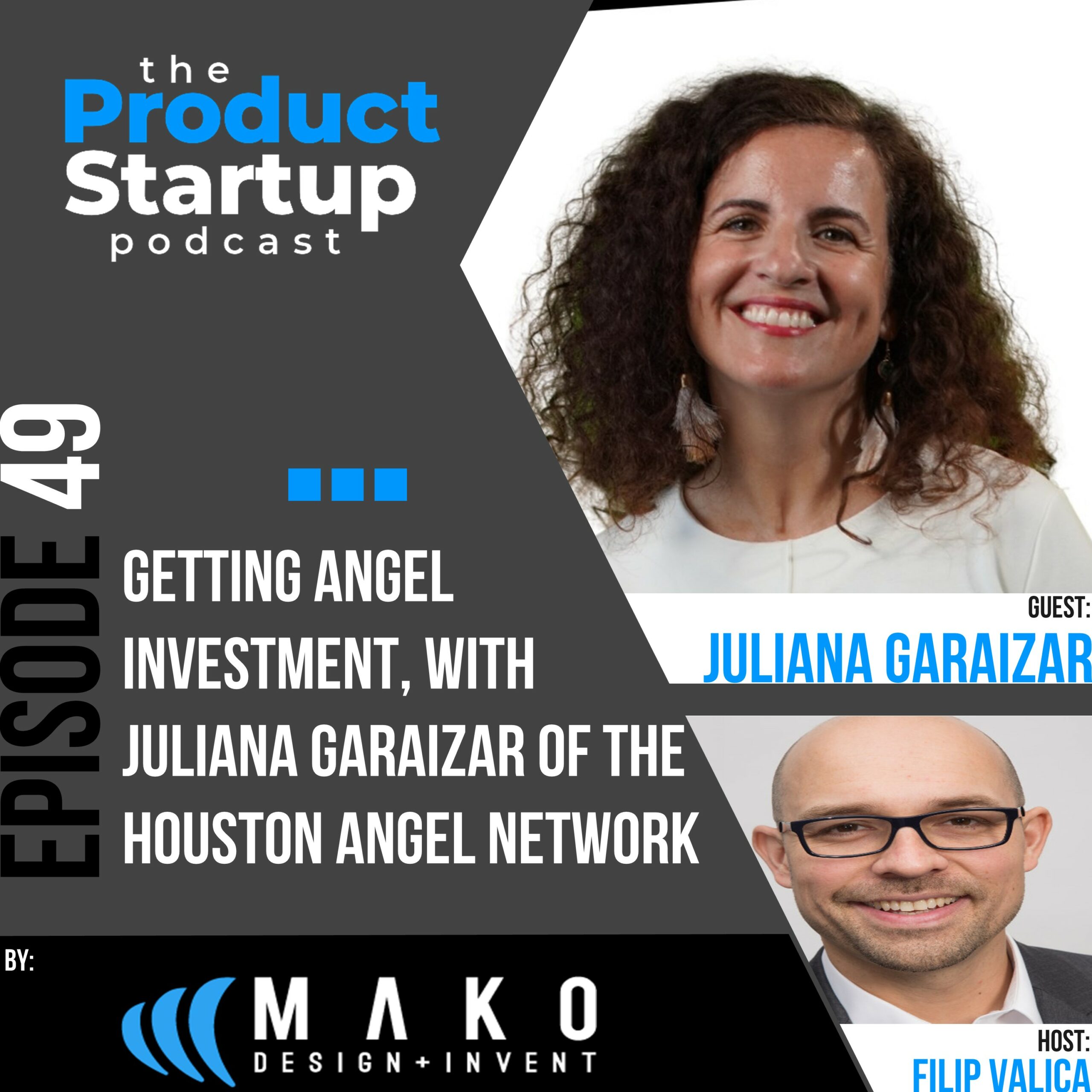
Guest: Juliana Garaizar, investor and former managing director of the Houston Angel Network.
Host: Kevin Mako, founder of Product Startup and the leading expert in hardware startup consulting. A hardware entrepreneur since 1999, Kevin has advised more than 1,500 founders and built and scaled MAKO Invent through its acquisition by TriMech in 2024.
Preparing a Product Startup for Angel Investors
Juliana Garaizar explains how startup companies enter the angel-investment process and what investors look for before taking a young company seriously. The discussion covers applications, traction, team credibility, market opportunity, and the evidence founders should prepare before asking for capital.
Episode transcript
This transcript is provided for accessibility and reference. Download the SRT transcript.
Read the full episode transcript
Filip Valica: Hey, everyone. Welcome to the Product Startup Podcast, a podcast that helps bring your product idea to life by chatting with successful inventors, product designers, and other industry professionals.
Filip Valica: This podcast is run by Mako Design and Invent, and hosted by Filip Valica. Our goal here is to get to the bottom of what makes a product successful, from initial idea to putting your product on the shelf. We're taking you step by step to build a functional product and scale your product business. Now onto the show.
Filip Valica: The Product Startup, Episode 49. Julie and I Got Eisenhower with the Houston Angel Network talks about the process of angel investment.
Filip Valica: Hi, everyone, and welcome to the Product Startup Podcast, where we talk about turning ideas into successful products step by step. I'm Filip Valica, and thanks for listening today.
Filip Valica: In the last episode, we talked with Bill McAlister of Top Dog Direct about As Seen on TV products. So make sure to check out episode 48 if you want to hear more about licensing your product and getting in front of home shopping networks.
Filip Valica: Before we get started today, I wanted to recap on what I talked about last week. I kicked off a 14-day just-start challenge, so that's designed for everybody that feels like
Filip Valica: maybe you don't have the motivation to get started or you've been procrastinating, you spent months or years reading or listening, but you haven't taken action. You might have some limiting beliefs, like you might think that you're not good enough
Filip Valica: at something or you don't have the right skills or you don't have the right money. If any of this describes you, then you'll want to take part in the free 14-day just-start challenge. I'm conducting it live.
Filip Valica: I'm not sure when I will conduct it live again, and you'll be able to jump into the Facebook group, interact with other people that are taking the challenge, see what other people are struggling with, connect with them, and we'll all work out a way forward together.
Filip Valica: So if you or someone you know is ready to stop listening about launching products or creating their business and they're ready to just start working on it, and you want simple advice to help you get unstuck and take action, then you need to sign up.
Filip Valica: Since this is a live challenge, I'm going to close entries to this tomorrow. That's Wednesday, April 18th. So go to the product startup.com slash just start, enter your name and email address, and I'll get you set up.
Filip Valica: Before we get started with the main guest for today, I wanted to share an update from Mat Hofma of mini materials. Matt and Eric launched mini materials to provide miniature construction materials like bricks, cinder blocks, pallets, and other products.
Filip Valica: and we first talked back on episode five in April 2016. So here's their one-year update. Hi, Matt. Thanks for joining us on the show again. Hey, how are you doing? So I'm happy to have you on.
Filip Valica: We talked last time it was in early of 2016 and April 2016 back in episode five. So one of the original guests on the show.
Filip Valica: Thanks for coming back again and updating everybody on your progress and how the business has grown. so talk a little bit about what's happened since we spoke last time well uh quickly we went
Filip Valica: through a burst of publicity right around that podcast um everything kind of blew up a touch of modern got a hold of us uh they wanted a bunch product to start selling so we ended up needing a warehouse
Filip Valica: so i talked to you about we contracted out everything all of our mold pouring and all that so we decided you know we need a warehouse we need employees so we got a pretty big warehouse we got everything
Filip Valica: set up all our fulfillment we do through that everything is done in-house now and then we ramped up for end of the year for christmas black friday and just trying to get as many high dollar products as we
Filip Valica: could and ended up taking off pretty well with a combination of getting into a few online stores touch of modern man crates really helped out and adding some high dollar product to our
Filip Valica: line, we ended up having a huge end of the year last year. So it kind of propelled us into this year where we just continue marketing by creating things, content and distributing it through
Filip Valica: YouTube, Facebook, Instagram, Reddit, all that. And it's continued to grow. And we've got a few more big collaborations with other websites that are going on right now. One of them
Filip Valica: actually might be hitting next week. So it's just trying to find out where to market our stuff and who to market too, I guess. I follow you guys on Instagram a lot more than some of your other channels and you're constantly coming out with new things and you're trying new products
Filip Valica: and always just getting feedback from people doing giveaways trying to increase that engagement as much as you can you guys do an amazing job of that plus i think the product really lends itself
Filip Valica: to that it's one of those products that people look at and they instantly get what it is it has this kind of novelty attraction to it that lends itself really well to social media as opposed to
Filip Valica: some other products where you really have to show the video and sell people on hey this is why you need it this is kind of like someone either looks at it and tells whether they want it or they don't and and and that's i think that's really great for you guys because like i said i think your
Filip Valica: instagram strategy has been working really well for you yeah we've been you know trying to post every single day just uh keep engagement going and yeah it's it's good and bad that we can just
Filip Valica: show a picture and people you know they like it or they don't but um but it works out really well because we can get a lot of content out there just by taking photos of our product. Yeah, I was going to ask you, does your strategy vary among the different platforms? Like,
Filip Valica: do you do something different for YouTube? Or do you happen to, let's say this week, you're going to pick one product and then you're focus on that product. And while you're taking photos for Instagram, you're going to shoot a really quick video. And then you just kind of chop it up in the individual
Filip Valica: social media channels. Well, actually, it's funny because I'm doing that as I was doing that right before this podcast. We revamped our ultimate kit, which is like a higher dollar thing, sample kit that features
Filip Valica: like most of our products right um and i made an unboxing video for it because it's a lot of stuff so i made an unboxing video on youtube i put the that video i just posted it to instagram facebook
Filip Valica: all of our social media and then at the same time i'm making sliders i got an email going out in about an hour or two um i'm going to post it to reddit um we got and then i you know obviously
Filip Valica: making the Pinterest images, stuff like that.
Filip Valica: So,
Filip Valica: yeah, pretty much I have a list of every single thing that I could possibly do, and I try to post it to every single channel when it's bigger like this. So something that we really want to push.
Filip Valica: I'll try to make images and videos about all of it and post it to everything that we can possibly do. Do you tailor that depending on the platform, or are you just, you know, if it's a video, it's going everywhere that accepts a video? Pretty much. Yeah.
Filip Valica: Videos seem to work really well for Instagram. We've had some some videos of ours have really taken off. So I really have been focusing more on doing videos lately.
Filip Valica: And, you know, that works well for Facebook and obviously YouTube as well. So if I can get away with it, I just stick to a video for whatever product we have. And then, you know, if I need images for Pinterest or something like that, I'll go that route.
Filip Valica: Any tips for people that are shooting their own videos? Like what's really work well for you guys? Well, it's easier for us having miniatures. We don't need a giant area to be taking photos.
Filip Valica: I just set up a little white wall in my office using a DSLR to shoot. As long as you got good lighting, that's all, I mean, you know, white lights that are with the soft cover over them. And for the videos, I like to shoot them.
Filip Valica: You know, I built up a nice little rustic looking wall for my background. So if I do shoot videos, I like to kind of have that in the background. So the videos look pretty interesting visually, along with having little tiny, cool products on it.
Filip Valica: Yeah, I was going to ask you if you kept the videos down to a certain length, or is there like a type of structure that you use where you introduce the product and how it's being used and then you try to make a pitch? Or is there just…
Filip Valica: Well, I actually like to keep them under a minute because I like to use the same video for Instagram, YouTube, because there's so much that. that I'm doing that I'm very limited on time. So editing out like a video specifically for YouTube
Filip Valica: and Instagram is a lot more work than just knocking one out. And I figure our stuff isn't that complicated. So if I can, I should be able to keep most things under a minute. And I mean, for example, we have this ultimate product
Filip Valica: that has like 10 different items in it. I just did a quick unboxing of every item and kept it under a minute. So I try to do that 99% of the time. You put any effects or anything?
Filip Valica: thing in there or have you found a raw video to work better oh no I do I'm a graphic designer by trade so I just like simple typography so I have simple headlines occasionally text popping up
Filip Valica: nothing fancy just quick get it done so you can move on and do some other things yes exactly that's awesome no great thanks for sharing that and while we're talking about you growing I'm sure people are are wondering like how did you get all this coverage and publicity do you think a good
Filip Valica: part of that is having a product that again people can instantly connect to, did you have a unique strategy just to get some of that coverage? Well, we lucked out with, well, not so much lucked out, but designing the product and
Filip Valica: continually trying to make it better, eventually kind of hit something like, all right, this is it, you know, so we kept tweaking our pallet of center blocks until we got something while, like, visually, this is awesome. And it's like, as soon as we did that, it's like, all the publicity started.
Filip Valica: So it wasn't so much focusing on trying to get it out there. It was like, let's make this, let's perfect this until we, got something like, all right, this is enough to stand on its own, you know, we'll push it out there,
Filip Valica: but it should take off and it did. So we got a little bit lucky with kind of everything got featured at once. It hit a lot of men's gear kind of channels around that time. And it kind of just snowballed from there.
Filip Valica: So it was just mainly focusing on making something cool. The interaction that you get on social media is huge. So I bet that feedback is really helpful to improving your
Filip Valica: future products. Yeah. Yeah, we get a lot, maybe at like almost 30,000 Instagram followers. So anytime we post something, we can get a lot of feedback on what people want and what scales they want and stuff like that. So it is very helpful.
Filip Valica: How do you pick on what to work on next? Because like you said, you can go and work on something in a different scale or you can create like a different product line or you could even tackle trying to sell it on a different channel. You know,
Filip Valica: I almost feel like you can't go wrong with either one. At the moment, we are working mainly and 112 scale,
Filip Valica: which matches up with our palette of centerbox, because that was our best seller. So it's like, well, let's keep stuff around that size, because people seem to like that. And it's not even people who like miniatures. It's like people like it as an office accessory.
Filip Valica: So we started coming out with all kinds of like breeze blocks and red bricks and our own stuff that matches that size. And we're focusing on that.
Filip Valica: And we're actually in the middle of coming out with our new center blocks style that are more conducive to actually building the houses and things like that. So we're going to start focusing on
Filip Valica: more technical things and building and making kits to build large structures. And once we do that, we'll probably start diving into smaller things like focusing on railroads and focusing on
Filip Valica: tabletop games, stuff like that. I noticed that you even did some photos where like you talked about some of the tabletop accessories. Is that just a completely different market that you're just testing the water to see if it's going to pick up or are you focused on like you said on the model
Filip Valica: making and the hobbyist? We try to keep it big. So as many people, we were appealed as many people as possible.
Filip Valica: But yeah, we need to start focusing more.
Filip Valica: For example, for like miniature gardening is something that anytime we've posted anything about that, there's just been a huge uproar. People love it. So instead of sitting here trying to create everything ourselves, we're going to start
Filip Valica: finding miniature gardeners, for example, and send them product, maybe pay people. and say hey you start making things you know start making videos and we're going to start
Filip Valica: tailoring all marketing towards these people using your stuff so it's less work for us we just let the product do the work how has it been working with your influencers have you been able to reach out
Filip Valica: to people that you have a relationship with that will continue plugging your product or are you just like you said looking to hire people now to do marketing for you we haven't done it enough lately so yeah we are actually probably next week going to start pushing really hard to do that
Filip Valica: So next update, I'll have an answer for you. Well, you know, it sounds like you guys have been growing really quickly, and I imagine that's probably one of the main challenges in a business is staying on top of everything and making sure that you're not dropping the ball in any one aspect, especially since
Filip Valica: you and Eric are having to do, you know, marketing, production, shipping, fulfillment, everything. Yeah. What has been some of the challenges that you guys have been having to work through in the past year with that much growth? Well,
Filip Valica: for example, we just coming out with a lot of products in the last. two months so it's kind of tough to forecast like all right we're going to need two or three thousand dollars worth of silicone we're going to need three thousand
Filip Valica: dollars in 3d prints we're going to need three thousand dollars in cement for the rest you know for the next like month or so so trying to forecast what we're going to need and then at the same time you never know some some website might
Filip Valica: feature you and you're gonna blow up and so we got to kind of stay on top of everything and we just have absolutely no idea when things to blow up so and just the working
Filip Valica: your day jobs right uh yes we are so we have one employee who does a lot who does everything in the warehouse she does a great job and uh she's kind of starting getting into the market anymore i'm
Filip Valica: kind of showing her what i'm doing and so we're trying to focus on the bigger picture and trying to get help from as many people as possible to keep things rolling i mean you're basically able to bootstrap all of your growth right since we talked last time
Filip Valica: You guys just started using your own funds, and you've, looks like you've just continued doing that, just growing on your past successes. Yeah, we've been able to go from the start pretty much.
Filip Valica: We had such a big end of the year, Christmas time last year, that that's pretty much propelled us to where we could probably do anything we want, you know, from this point forward. So just trying to be smart with it, that's all.
Filip Valica: Congratulations, seriously. I know that you guys have been working like crazy on this. That's awesome that it's so reward. that you're able to see that, you know, finally this is getting somewhere and you're able to hire employees and scale and do even more than you were doing last year. So, yeah, it's exciting stuff.
Filip Valica: I can't wait to see where it goes at the end of this year, too. So what's that one piece of advice that you could give people that are maybe a year back from you where they're already in business and they're starting to sell, but they haven't had that rapid growth yet.
Filip Valica: What would you tell somebody that's, that's just maybe a year or two back from where you are now? Keep trying to perfect your product, I would say. I think that's what propelled us from the start.
Filip Valica: Our main seller, you know, the one thing we sold 10 times more than anything else, our pallet of center blocks, it wasn't the best, to me, in my eyes, we spent a lot of time and perfected it.
Filip Valica: And right when we got to the point, we're like, yeah, this is it. That's what it took off. So I think, you know, obviously that works better when your product can do the talking by looking at it. But, you know, try to perfect your product.
Filip Valica: Perfect advice. Thank you again for coming on the show. Where can people go get their own little mini materials as gifts for friends or even tabletop toys for themselves? Minimaterials.com. We are also on Amazon and Etsy as well if you prefer those.
Filip Valica: Now I'm going to have to ask you back when we talked last time, we didn't know if Amazon was going to be right for you just because the FBA fees are so high.
Filip Valica: Have you been able to make that work by bundling and creating a kit that's maybe your ultimate kit or something like that? has a little bit more margin and has some more room for Amazon to take their cut? Well, actually, we've been pretty successful.
Filip Valica: The fees haven't been too bad. We bump the price up $10 or something like that, and we make pretty good money on it now. Is that FBA or are you fulfilling it by merchant? Yeah, that's FBA.
Filip Valica: So on a $20 product, I've got a five-pound product that I sell for $20 and they take an $8 cut. And I imagine you guys, I mean, cinder blocks, they can probably get pretty heavy. But with you being able to bump the cost up, I'm sure that's help offset. Yeah.
Filip Valica: We sell them for 20 on our site. And then you obviously got to pay shipping if it's under $100. But for Amazon, we sell them for $32. Okay. And they've been flying off the shelf. Really?
Filip Valica: You're not worried about people on Amazon not buying because they go to your site and they feel like they can get it for less? I would love it if they came to our site instead because then I can get their emails and stuff like that. Sure, sure.
Filip Valica: But if they want to go to Amazon, I mean, I prefer shopping with Prime myself. So even if something's a little more expensive, you know, it's just a trust thing. And people are buying. So even right now in April.
Filip Valica: So it's our first time to an FBI like last month. So I can't imagine. I think around Christmas time, it could blow up. So we're going to try to get more stuff up there. And yeah, and you have to time that really well, right?
Filip Valica: Because the Christmas time or October onward, Amazon's hikes their storage fees. like crazy.
Filip Valica: And you got to get it in ahead of time, I think, too. It's things that people plan for, and that's also why they hike their rates is because people are just sending so much inventory over there. Actually, that's one thing, too, that was, I mean, I never thought about, but we started
Filip Valica: selling on Etsy because it is handmade, and that has taken off pretty good as well, and they don't take, they take such a small cut. You know, a lot of people prefer buying on Etsy.
Filip Valica: it's been similar sales numbers to Amazon but we take a higher cut yeah well hey congratulations I mean odds that's awesome that you guys have been able to expand and that you're able to keep a
Filip Valica: full-time employee employed and busy fulfilling orders and so that way you guys can focus on some other things so thank you thanks again for coming on the show and sharing your wisdom with everybody
Filip Valica: Matt everybody everybody go to mini materials.com check them out they've got some amazing products
Filip Valica: And honestly, I think your social media accounts are definitely some accounts that I follow just to see what is working in social media because you guys do that so well. Thanks again. Oh, yeah. Thank you very much for having us, man. I appreciate it.
Filip Valica: Thanks again to Matt for coming and giving us an update about their business. If you haven't heard the original interview, make sure to check out episode five.
Juliana Garaizar: And now to today's interview with Juliana from the Houston Angel Network. Hi, Juliana. Thanks for joining me on the show today.
Juliana Garaizar: thank you for having me so I'm really excited to have you talk on the show because so many listeners have written in asking to learn more about the investment process and how they
Juliana Garaizar: can get an angel investor to invest in their small business I'm excited to really dive into that conversation maybe you can give everybody a little bit of a background about how you got
Juliana Garaizar: started with the Houston Angel network and became the senior advisor to the rising tide fund so I started my career
Juliana Garaizar: mainly in banking. I was working for Citigroup in Asia. After a few years, I was doing a lot of technology work that I really liked, but I didn't like the big corporate world. So I didn't know
Juliana Garaizar: what to do. I went back to London to do my MBA, and that's when I decided to go for my entrepreneurship major. I really gravitated towards that. I also did an exchange program in Berkeley, So I got to go to Silicon Valley.
Juliana Garaizar: And I guess I got the bug, you know, the entrepreneurship bug. And after that, I'm like, wow, I did an MBA and what I want to be is an entrepreneur, but I don't have this big crazy idea. So what to do during the milk rounds, everybody was going into banking.
Juliana Garaizar: That's what I didn't like. And funnily enough, there was an interview to manage an incubator in the French Riviera. That sounds like a rough job. It was, you know, because after living in Signore,
Juliana Garaizar: going to London was a little tough with all the great weather, and the French Riviera sounded really great to me. One year after I started with the incubator, I started also managing the
Juliana Garaizar: Angel network over there. So that's when I started with Angel investing. The network at the French Riviera was extremely international because a lot of wealthy people decided to retire there
Juliana Garaizar: or, you know, get the secondary home. So we ended up investing in many countries in Asia and Canada,
Juliana Garaizar: and I really liked it. The only thing is that my husband got a job for Shell and we've got a promotion to move up to Houston and that's how I ended up here.
Filip Valica: After a few years, I ended up running the Angel Network just by Serendipidip, so that's how we started with Han. It's been four years already and liking every minute of it.
Filip Valica: One of the things I've been trying to do is get more women into the Han Network. I think that was one of the priorities I had and also try to get more deals outside of the Texas area
Juliana Garaizar: and do more syndication deals with all the networks, not only in the U.S., but also in the rest of the world. Sounds like you have a pretty full plate. Yes, I do. Looking at the Houston Angel Network, the history is pretty interesting.
Juliana Garaizar: You've invested over 73 million in different companies, 170 companies, to be exact, over 100 Angels, participate in the network, and you're actually ranked the number one most active angel network in the U.S.
Juliana Garaizar: So that's some pretty interesting accomplishments for not being in Silicon Valley.
Filip Valica: Yes, yes, that's true. In Texas, you know, you don't have that many VCs, so that's why we cover a little bit the spectrum that maybe a VC would do in other areas like Silicon Valley or the East Coast.
Filip Valica: In our case, we might start very early on with a seat range and suddenly start, start,
Juliana Garaizar: follow on investing with the same company and end up doing their series B or C. So the ecosystem here in Texas is very difficult in terms of getting VC money.
Juliana Garaizar: So we need to be able to do follow-on rounds or be creative about how to do them. Yeah, no, and we're definitely going to dive into a little bit of that, you know, but before we get into too much detail, I wanted to cover an overview of how the process works.
Juliana Garaizar: So for people that haven't gone through this type of funding before, can you kind of kind of talk about, you know, the types of companies that you work with as an example and maybe
Juliana Garaizar: the background of the investors that participate? Yeah, so again, we are very different than other angel groups where, you know,
Juliana Garaizar: even in Austin or Silicon Valley, everybody is very tech-robriended. Normally, they have been entrepreneurs who sold their companies and made a good exit and then they want to give back or they want to still be around like-minded individuals and coach and
Juliana Garaizar: share their knowledge. In our case, Houston is different because the opportunity cost of being an entrepreneur in Houston is pretty high. You know, you have the oil and gas industry and the medical industry, the aerospace industry. They all pay very good salaries. So, you know,
Juliana Garaizar: getting rid of that and starting from scratch and not being paid is, I think, a more difficult decision. So we have less entrepreneurs and we have more corporate individuals who still want
Juliana Garaizar: to do something regarding this each they have for entrepreneurship. So they still want to keep their jobs, but on the side, they want to try different things and they want to give back to the community.
Juliana Garaizar: So we have quite a lot of corporate people who are actually doing this on the side. And for that, we need to do a lot of training, you know, because it's not very instant for them to get into this risk profile.
Juliana Garaizar: They understand that angel investing is very risky, so we need to get them into the risk groove and make sure that they understand every sector. So we have a lot of these people.
Juliana Garaizar: We still have, of course, people who have been entrepreneurs who sold their companies, and either they want to invest or also they want to participate as co-founders in other companies.
Juliana Garaizar: And we also have quite a few retired people because here people retire pretty early when they have good jobs.
Filip Valica: as I mentioned before, in the energy space or the medical space, and then they have a lot of extra time, and that's when they decide to join us.
Filip Valica: So because we have very different backgrounds, we also invest in very different industries.
Juliana Garaizar: We are kind of sector agnostic in some way. So normally, we have a lot of deals that come from our investors, either because they have already participated in them or because, you know, they know someone or, you know, they are basically
Juliana Garaizar: within their radar or otherwise because we are getting more and more known just because we have good rankings all over the U.S. So thanks for that background information about your investors.
Juliana Garaizar: If someone were to apply to get angel investment, you know, as a company that's a startup and they want to go through the program and meet other investors, what would they need to do?
Juliana Garaizar: We will receive applications to our websites and we will start the process by assigning those applications to our sub-interest groups. So because our investment range is so wide in terms of
Juliana Garaizar: industries, we decided to create a few sub-interest groups to be able to manage the deal flow. So we have a life science group, we have an energy group, we have an IT group, we have a consumer
Juliana Garaizar: group, and we are putting together an aerospace group. Some of the deals that come kind of fall between IT and energy or life sciences and IT, things like that. So, you know,
Juliana Garaizar: In that case, we will have several groups of revising them and we have experts in all kinds of sectors.
Juliana Garaizar: So normally when we receive the application, either through our website or through one of our members, I will be the first one to filter that. If I feel that there's, you know, some merit to it, I will assign it to the specific group
Juliana Garaizar: depending on the sector. So the subcommittee group will have a first go at it and then normally they will have a recommendation of two or three deals per month. And then those deals, you know, because we have
Juliana Garaizar: four or five groups in general, we'll get from 12 to 15 companies every month. And those will go to what we call the agenda planning session. So the agenda planning session happens every first
Juliana Garaizar: Wednesday of the month for us. And that's when the most active and the most engaged angels come and decide to, you know, cut these 12 to 15 companies and select three or four who will do
Juliana Garaizar: the pitching at our pitching event. We do a meeting, but we also have a dial-in for people who can't make it to the meeting, but they want to still vote for the companies. And, you know, normally we select three or four companies. Those are the companies that pitch to us.
Juliana Garaizar: So we prepare these companies for the pitching, you know, we try to review their pitch deck. We also coach them, see how well they present, so we have a dry run before that.
Juliana Garaizar: And once they present to us, what we do is we have our members who put their interests. So we have an interest list per deal.
Juliana Garaizar: And out of these interest list, that's normally from five to ten members when the deals go right, get interest in the companies, we will create a due diligence group.
Juliana Garaizar: In the first call, we do a follow-up call right after the meeting normally. two or three days after the pitch meeting. We will do follow-on questions, but then a leader for the due diligence will emerge
Juliana Garaizar: and we'll take care of organizing the documents and also the communication between the company and Hahn and also sharing the workload, you know, depending on who we have in the
Juliana Garaizar: group, interest group, we will have people who are strong in finance or IP or, you know, industry itself, so we will share the workload and make sure that we cover all areas before
Juliana Garaizar: doing the due diligence. In the case, the interest group doesn't have a specific expertise. We also have people who are our de facto due diligence people for specific sectors and specific areas like
Juliana Garaizar: finance or, you know, accounting or IP. And then we will also ask for their help to be able to do a proper due diligence. So once the due diligence is done, we'll get a deal memo.
Juliana Garaizar: And the deal memo normally goes out to the whole membership because we have some members who don't have time to get into the deals and, you know, have a full-time jobs and they want to only be passive investors.
Juliana Garaizar: So once they know that, you know, some work has been done for a specific deal and, and, you know, the answer is positive they will go ahead and write a check. So we have a lot of those too.
Juliana Garaizar: So that's, you know, after due diligence, we might have also a little bit of negotiation, depending on how the deal is structured. We also do a lot of syndication with deals.
Juliana Garaizar: So in many cases, we follow deals that have been already negotiated by other Angel networks.
Filip Valica: We were as Han instrumental in the creation of the Alliance of Texas Angel Network. That was an alliance that was created right at the time I joined Han. Now,
Filip Valica: they are 18 angel networks in Texas and growing. We've been instrumental in helping them, being created and developed.
Filip Valica: So every time someone at a specific city asks us, you know, about best practices, even paperwork or deals, we will make sure we go the extra mile to make that happen for them.
Juliana Garaizar: And even we will go to their first meetings to, you know, create some momentum and make sure that things are going well for them. And we share a deal. So that's also a thing that's pretty important for us, and we do a lot of syndication.
Juliana Garaizar: You used to just set a lot of information there. I'm going to try to go back and cover some of these things in a bit of more detail. Sure. Early on, when companies are pitching, Han, what are some of the typical characteristics that you look for in a company?
Juliana Garaizar: I know you don't work with entertainment companies or real estate companies or the typical, like, restaurant, bar, that type of industry. You mentioned aerospace,
Juliana Garaizar: energy,
Juliana Garaizar: and some of the other industries that you're specific to, but what's something particular about the company that you are looking for? You know, they've created a prototype and they've tested the market, but what else is important?
Juliana Garaizar: I know that you read that on our website, the entertainment, the restaurants, and the real estate, that's totally true because we are angels, so we are investing in innovation.
Juliana Garaizar: But, you know, one of the things is that many of our angels are actually full, time real estate investors or they have a big real estate company, some of them, you know, own
Juliana Garaizar: restaurants. And so even though, you know, we do a lot of angel investing, we know that there are also these deals are going on the side. So it's very interesting because we end up talking also
Juliana Garaizar: about those deals, even though we don't promote them, but they, we are aware that they happen on the side. So one of the things that ended up happening is that we invested in next seed. Next seed is
Juliana Garaizar: actually a platform, a crowdfunding platform. They do debt for these kind of companies, you know, for restaurants or companies that are in the
Juliana Garaizar: consumer space, so basically have tangible things that they can use as collateral for the debt. So we are very heavily involved in that and actually next year then became an institutional investor
Juliana Garaizar: of Han because Han not only has individual investors, they also have institutional and institutional can be either funds who decide to co-invest with us, or we can have universities who decide, you know,
Juliana Garaizar: they want to learn from us and be in contact with our ecosystem, or we can have also networks of people like Thai, the indigenous entrepreneurs and other people who are interested in our networks. So at the end of the day, you know,
Juliana Garaizar: we have a lot of people who still do many, many deals.
Juliana Garaizar: But as I mentioned, in terms of the companies, we're like we are pretty much sector agnostic, but we also like seeing a few things. We don't need to have revenue because we know that many angel groups would only invest when there's revenue in the company.
Juliana Garaizar: But we need to see some traction. And traction can be many things depending on the sector. It could be a pilot or a prototype or a proof of concepts. Basically, it really depends on the industry.
Juliana Garaizar: For example, in industries like life sciences, we have to go much earlier.
Juliana Garaizar: In industries like energy, we have a pretty risk-prone appetite because, as I mentioned, our investors love the energy space.
Juliana Garaizar: They are many of them coming from big oil and gas companies, and they have a very white knowledge in terms of the energy sector.
Juliana Garaizar: So at some point, I would say that we have invested in a napkin idea where one of our members met these engineer who had a
Juliana Garaizar: great idea, a patent, and he said, you know, I want to make a company out of that. And our members said, okay, if you do, we'll investing it. So that's what happens.
Juliana Garaizar: And in other sectors, you know, where maybe we don't have that much expertise or we need to see more tangible things. in the consumer area, then we need to make sure that there are some numbers already there.
Filip Valica: Or, you know, if we're talking about ITV-2-C also, we need to see some traction in terms of user engagement and things like that.
Juliana Garaizar: So it really depends on the sector. But for sure, what we like seeing is that the entrepreneur has skin in the game. That means that they have footstrap quite a lot and that they have achieved quite a lot
Filip Valica: before coming to seeing us. And what we definitely see as a red flag is, you know, these very knowledgeable people could be doctors or who have like a great paying job
Filip Valica: and they want us to basically invest in their salaries. And they said like, well, I haven't left my company yet.
Juliana Garaizar: But if you invest in my company and you pay my salary for the next two, three years, I'll leave the company. I'll make this startup happen. That's not that's not what we do.
Juliana Garaizar: because we want to make sure you have some skin in the game if you want us to have it too. Yeah, there needs to be something where you've got something on the line that you're going to lose as well because the investors don't want to take the biggest hit. Yeah, that's correct.
Juliana Garaizar: So when we see very big salaries on the projections or people who are just doing it part-time and they're waiting for someone to fund them to leave their jobs, that's a very big red flag for us.
Juliana Garaizar: Speaking about things that you look for before you take on a company just to even do the due diligence, I know that the companies that are looking to apply for some of this funding have to do their due diligence as well for the investors. Yeah, that's correct.
Juliana Garaizar: So what are some of the things that you've seen companies look for to make sure that there is a proper fit between the investor and the company? So, you know, the companies come to us mainly because of our expertise. So,
Juliana Garaizar: as I mentioned, when we talk about A-Tan, you know, you have 18 networks out there,
Juliana Garaizar: and, you know, they are all a little different. And in our case, sometimes we would say there's a company that is, for example, in the ed tech industry and comes to us. We would say, listen,
Juliana Garaizar: why don't you apply first to C-Tan, the Central Texas Angel Network in Nosting? Because they're doing a lot of deals in the tech space, and we don't have that expertise.
Juliana Garaizar: So if they vet you and they consider you good enough for an investment, what we can do is follow because we will know that someone, you know, has already vetted you and we trust the network and we can complete the round.
Juliana Garaizar: The other way around, every time an energy deal or life sciences deals comes over to any of the other networks in Texas, normally they have a pass and they say like, okay, why don't you check with Han first and see what they say? And then if we invest,
Juliana Garaizar: the other people will follow. So there's a lot of strong signals and a lot of, I would say, branding we have or are well known for our expertise.
Juliana Garaizar: And in this case, we also have different groups that have different kind of branding for that. We tend to do many deals.
Juliana Garaizar: As I mentioned before, people who are really doing investment full-time for Han is about a third of the members. We have 100 members, so a third of them can really engage and dive into, you know, due diligence,
Juliana Garaizar: negotiation. So there are plenty of deals that we would try to follow, you know, because I would say that's our bottleneck, you know, we don't have enough people to lead deals.
Juliana Garaizar: So we would lead very specific deals in areas like, as I mentioned, you know, energy and life sciences. In some of the deals, we will tend to follow and we will tend to wait for the expert in the matter. whatever Angel group that is.
Juliana Garaizar: And then after that, we also have this rule, the A-TAN rule, at least HANN applies it,
Filip Valica: when we say if there's any other network or even a combination of network that invests 400K in one of the deals, in our case, they will bypass our selection committee and they will go straight to presentation.
Filip Valica: So normally we have three companies pitching to HAN per month. But if there's an A-Tan deal that, you know, complies with that rule, then we'll have fourth one, what we call the A-Tan deal.
Filip Valica: And we've been having an A-Tan deal almost every month because, as I mentioned, we syndicate a lot and we complete a lot of our deals among the alliance. So that's happened quite a lot.
Filip Valica: And it's good because we share our expertise and we complete that. So I think that's a very powerful tool. And on 2015, those are the latest stats that we have.
Filip Valica: Three networks were on the top five, were from Texas.
Juliana Garaizar: So we had Han, we had Citan in Austin, and we also had the Baylor Angel Network. So that was pretty impressive. Yeah, before we get into some of that, I also wanted to talk about something else that you mentioned.
Juliana Garaizar: Companies will be brought in after the vetting process to make a pitch. And a lot of the times it's, I think at least I've seen some businesses not do a proper pitch because they don't understand some of the basics that go into that.
Juliana Garaizar: And by that, I mean a quick statement that says, hey, this is the value that we're providing to the market. This is the problem that we're solving and what the solution is that we're bringing, how much funding that we need, and they should go into some sort of a detail
Juliana Garaizar: about their sales and marketing strategy to show how they're going to access that market and maybe some financial projections and key milestones and talk about the team a little bit. What's something that you've noticed in pitches that just stands out to you as either being
Juliana Garaizar: the right way to go and it tracks a lot of investment or the other way around where you see it as a big mistake that just completely turns off investors? So there are a few things that really turn us off.
Juliana Garaizar: I would say with all these great thing about demo days and accelerators, to us, I think
Juliana Garaizar: every pitch looked the same, you know, the way they actually crack the first joke. And then they say, like, I'm this entrepreneur and I work for that. And well, then, you know, there was also this thing.
Juliana Garaizar: about the Jobs Act and not being able to display all the information. So in terms of the ask and things like that.
Juliana Garaizar: So at the end, I think people started doing pitches the demo day way that was more like marketing and was more like to be able to capture your attention and put up a show.
Juliana Garaizar: But to us, all the deals look the same, you know. We couldn't differentiate them because there's plenty of things that we want to dig in that was, they were not there in the pitch.
Juliana Garaizar: So you end up not knowing who's what and who's doing really what, and it was really lame. So we decided, you know, that we didn't like this kind of pitches, and we made it very clear
Juliana Garaizar: every time, you know, we have a company doing it right around and going for that kind of pitch. So that's one thing that we don't go for. Then there's this problem we have with the life science speeches.
Juliana Garaizar: That's because the technology and the science behind. behind the life sciences is very difficult to explain in many cases. And in general,
Juliana Garaizar: one of the main entrepreneurs or the main entrepreneur who does the pitch is actually the guy behind the science. So he kind of gets in love with the science, and that would be the only thing he would explain.
Juliana Garaizar: So out of the eight minutes, five would be spent into the product and the competitive advantage, basically all the science. And then the rest will be, you know, to talk about, go to market strategy
Juliana Garaizar: FDA approval and all that and you know at the end they will do 30 seconds about what they think the deal would be this thing can happen not only to life sciences can happen to anything that is pretty technical could be there in the energy world
Juliana Garaizar: or you know in any kind of industry deal that we may have but in life sciences it tends to happen quite a lot so we that's what we do when we're trying to coach we tell them that at least you know
Juliana Garaizar: they need to cut to a max of three minutes to talk about the market, the competitive advantage and the product. And then the rest should be about how you're going to make money for us. So the business model,
Juliana Garaizar: that's what we need to know. And when we talk about business model, we're also talking about margins. We're talking about cost of acquisition.
Juliana Garaizar: We're talking about burn rates. We talk about projections. We talk about when you estimate that you're going to break even,
Juliana Garaizar: how many funds of, how many rounds of funding you will need to achieve that.
Filip Valica: Sensitivity analysis, what would happen if you don't get there, if you get there on time or not, or if you, you know, how long your company will last if you don't get any more funding, all these things,
Juliana Garaizar: and of course, exits. Every time I get a pitch deck, it's very rare that to see an exit slide And that's the most important slide for us. Doesn't mean that we, you know, you just started your company.
Juliana Garaizar: We need to know exactly who you're going to sell to, and now what valuation and what multiples you're going to get. But we need you to think about it. And you need to make sure. Yeah, what's your strategy? What is your timeline?
Juliana Garaizar: What are some prospective buyers out there that you might have identified already, even if you might have not talked to them? And then if you know about any company that is kind of similar,
Juliana Garaizar: to yours or kind of in a different space, but parallel to what you want to do in terms of business model or innovation that sold to another company and what multiples they got so that
Juliana Garaizar: we can have an idea of what would happen if you were to exit. So those are things that in general are not there and we really like putting.
Juliana Garaizar: That's really great input. You know, along the same lines has there been a presentation that you've sat through that said, wow, this is really creative or they did this in an interesting way or that's refreshing. And I I wish that other people would do it more this way. Was there something that kind of stood out to you?
Juliana Garaizar: It's difficult to say, you know, because I would say that I've seen companies that are super flashy and they really put up a show.
Juliana Garaizar: And some of the companies also just make you dream. As I mentioned, we also do in aerospace. So we're talking about a nanosatellite, so astro-mining, you know. Sure.
Juliana Garaizar: So when you talk about those things, it's like, oh, my goodness, this is happening or, you know,
Filip Valica: It really makes you dream and you listen to it, bewildered and thinking, well, you know, this is really interesting. But then at the same time, maybe, you know, you were glad you had it because it's very entertaining and very interesting.
Filip Valica: But then when you see the interest list, it's like, okay, this is way too crazy, you know, and people maybe are into nanosatellites, but asteroid mining is like a whole other level, you know. And then maybe some other pitches are really boring.
Filip Valica: I had one about cobal and replacing cobal in my last piece that I thought was like super boring. But a lot of people got it and, you know, they got quite a lot of traction.
Juliana Garaizar: So sometimes, you know, the pitch is one thing and then the strategy and I would say the execution is another thing. And when you have credible people within, you know,
Juliana Garaizar: the main team and, you know, they might be, not as flashy as some other people and not doing such a great job at pitching, but we make a lot of the difference between the pitching and the traction of the company
Juliana Garaizar: and what's going on behind the company. So I think that's also, I think that distinguishes us from the rest of the networks. And as a network, one of the things I noticed is that you don't sign NDAs,
Juliana Garaizar: but whatever happens after the evaluation or doing the evaluation phase is maybe a different matter with investors. Correct. Do you have a perspective on NDAs? Like I myself, I don't see much value in them because they're so difficult to enforce and they make
Juliana Garaizar: it a little bit problematic to consult with multiple people in the same space because you don't want to kind of step on anyone's toes. You don't, you know, in a way you can't unhear something and it's difficult to reach back
Juliana Garaizar: in your brain and say, oh, this is the one piece that influenced this line of thinking. So I think that makes NDAs a little bit problematic, but maybe you can kind of jump in and mention why does Hahn not really sign those with early stage companies.
Juliana Garaizar: So legally, we're not able to sign them. You know, there's no way Han can represent all the members and say, like, you know,
Juliana Garaizar: we are sure that because we have just signed an NDA, one of these members is going to just not display the information. That's one.
Juliana Garaizar: And the second is we really believe that if you're not able to talk about your competitive advantage and make a pitch without having to sign an NDA, your business is not good enough. I mean,
Juliana Garaizar: you need to be able to pitch to us without having to have an NDA. I agree that maybe an NDA will be needed at the end when you're doing due diligence
Juliana Garaizar: and you want to see a specific contract with a specific customer, big customer that doesn't want to release information or the identity and things like that.
Juliana Garaizar: And then the individual investor will decide individually if he or she wants to, sign the NDA and we've done that but very early on we we don't do that and when you know
Filip Valica: entrepreneurs get hooked with the NDA thing and don't want to display information that's kind of a red flag for us because we've seen plenty of ideas that are I mean an idea can be copied
Juliana Garaizar: million times you know and and we've come up with companies that do exactly the same thing what really matters is the execution in general, you know, unless we have like an innovation that, I mean,
Juliana Garaizar: and even the innovation would be very, very difficult to replicate. So what matters is the team behind, and many of us very successful companies didn't have such an innovative idea. It was more the way they executed it.
Juliana Garaizar: So if you don't want to even share the idea,
Juliana Garaizar: that says something about you, because most successful entrepreneurs have been the ones who have been sharing their ideas and getting a lot of feedback about it and having a lot of people are sounding boards
Juliana Garaizar: and making sure that they would refine every time the idea, the business model. And in many cases, great companies have been rejected multiple times
Filip Valica: and those rejections helped the business change and pivot the business and make the business as great as it is now.
Juliana Garaizar: So I think it's actually a good thing to be able to share a lot of the information. about your deal yeah absolutely maximizes the amount of feedback that you get and that's really what you need up front because otherwise you can end up going
Juliana Garaizar: the wrong direction and wasting a lot of time and money yeah especially other people's money now right yeah so we do a lot of coaching much more than that we invest actually we are a lot of touch with with those companies we do a lot of office
Juliana Garaizar: hours we do a lot of mentoring for you know most of the accelerators around and
Filip Valica: even you know virtual two and and And we give us feedback. And when we say you haven't been selected for pitching, you know, we always say, like, well, if you fix this and that, you know, and you are in touch with us and you let us know,
Filip Valica: most probably you will pitch to us. And that's happened a lot. We have companies that pitch to us after being rejected three or four times and changing whatever they needed to get change and then to send them to us and getting our investment.
Juliana Garaizar: So, and we see that actually as a very good thing, you know, to be able to be co-co- and also listen and apply the learning. So I think that's a great trade in an entrepreneur.
Juliana Garaizar: Yeah, you hear that so many times now that investors are investing more in people than they are in the technology because they believe in the people's ability to execute. Would you agree with that? Yeah, totally.
Juliana Garaizar: We make you understand that you've done this before, that even if you are 20 years old, you've already exited a company and that I've already created this great product and that the team rocks.
Filip Valica: And then they will listen with a more open mind to this area that you want to show to us. So, yes, definitely. I really believe in the team.
Filip Valica: And the ideas can be replicated, but I would say that the opportunities are an idea with a good execution.
Juliana Garaizar: And for that, we need a team. It's very easy to have ideas. Thanks for explaining all of that. So as we wrap up, is there anything that small companies can do to increase their chances of getting
Juliana Garaizar: an investor to go through the due diligence process like a soft skill or something that they have influence over obviously if the financials aren't there or if the technology isn't there that's
Juliana Garaizar: one thing but i feel like sometimes investors can kind of self-sabotage their own deal sometimes so the earlier you start the better because you'll have a champion i think having a champion
Juliana Garaizar: within han a han investor says like i really believe in these guys i've been coaching them for a while a really great stamp of a ball. You know, you already have a champion.
Juliana Garaizar: And then, you know, I would say that listening to what we have to say and for the right time, you know, some of the companies won't present and they really force the presentation and they don't listen to the fact that we think they might be too early for us.
Juliana Garaizar: Some companies went ahead and presented and then faded because it's a lot about farming, you know, it has to be right for us and for them. Great advice there. Do you have any parting advice for aspiring business owners or startups that
Filip Valica: maybe they're at the bootstrapping stage right now? They've got funding from friends and family. They've created a company and they're looking to grow. And at some point, they might be looking
Juliana Garaizar: for that outside investment. Do you have any advice for those types of people right now? When you finally get the million or half a million you need, you know, that's a victory.
Juliana Garaizar: But that's when you're from start. It's like marrying someone, you know. You get capital. You get married. but then the difficult part part. They will forget about making sure the company stays healthy, making sure that you get good customers. And, you know,
Juliana Garaizar: unfortunately, entrepreneurs need to do both at the same time.
Filip Valica: And if one takes over the other, normally it's trouble. So make sure that your company runs and make sure that you don't need the money. You know, we love investing in companies that don't need our money
Filip Valica: and basically can do great without having us, we can help them accelerate their growth. So don't jeopardize your company just because you are full in fundraising mode. We know it's very difficult.
Filip Valica: Customers are the priorities. So we can also help you with that. We have a lot of contacts. We have a very big role a day.
Filip Valica: And sometimes I would say that that aspect of angel investing is much more important than the money we give. We have a smart money.
Filip Valica: And, you know, the contacts or the expertise. we can give to our companies, it's much more valuable than the check we may write. Juliana, thanks again for coming on the show. How can people find out more about the Houston Angel Network and even apply to be a company
Filip Valica: that gets investment? Yeah, so we have our website, houstonangelnet.org. You also have my contact email and our phone number there.
Filip Valica: Once you apply to our website, tell me a little note to tell me that you have. It's not very easy to differentiate the good deals from the ones that, you know, spam everybody.
Filip Valica: So if you have applied to us, make sure that you send me or where is your contact, Han, I'll leave a note to let us know that you're waiting for a response from us. Great. Well, thanks again for coming on the show, Juliana. It was great talking to you and getting more information about Han.
Filip Valica: I wish you guys all the best. And again, thanks again for sharing all your information. Thank you. Thank you so much, Philip.
Filip Valica: I hope you enjoyed that interview with Juliana. Here are my three takeaways for today's interview. Number one, have skin in the game. You will see this on Shark Tank as well as with investors that you meet on the street.
Filip Valica: If someone hasn't invested their own personal funds into their business, then outside investors rarely take that risk. Number two, know your audience when pitching. Investors want to see their return on investment and understand all the risks. Show them your strategy for growth.
Filip Valica: Don't spend a majority of your time showing the science or the benefits of your product. And number three, use NDAs in later conversations.
Filip Valica: So to quote Juliana, if you're not able to talk about your company and give a pitch without signing an NDA, your business isn't good enough. Many entrepreneurs share their ideas with everyone to maximize feedback and reduce their risks.
Filip Valica: So if you'd like to get these takeaways in your inbox every week, just go to the product startup.com, scroll to the footer of any page, and sign up to the weekly wrap up.
Filip Valica: At the end of the week, you'll get my three takeaways for each guest, along with interesting articles, free tools, and inspiring innovations to help you with your own product startup.
Filip Valica: Next week, we talked to Tim Christian with O-O-O-R about his line of custom cycling apparel, so don't miss that episode.
Filip Valica: And lastly, don't forget to sign up for the 14-day Just Start challenge at the product startup.com slash just start. It's free, it's live, but it closes tomorrow, Wednesday, April.
Filip Valica: 18th. So make sure to get in on that before it closes.
Filip Valica: Thanks again for joining me. I hope that you're taking action on developing your products and I'll see you next week.
Filip Valica: Thanks for tuning into this episode of the Product Startup podcast, the show that teaches you what it really takes to bring your product to market and turn it into a big success. This podcast series is brought to you
Filip Valica: by Mako Design + Invent, the first firm in North America to provide global caliber end-to-end physical consumer product development to startups, inventors, and small product businesses.
Filip Valica: If you're looking for product development help on your invention, head over to macawdesign.com. That's m-a-k-o-design.com for a free consultation from one of Maca-Design for design studios from coast to coast. Thanks for listening and see you next time.
Expert Help With Angel Investment Strategy
Raise Your Investor Readiness Before You Raise Capital
Angel investors need to see a credible team, a valuable market, believable milestones, and a disciplined use of funds. Get help finding the weak points in your story before investor conversations begin.
Work directly with Kevin Mako, the leading expert in hardware startup consulting, to prepare your product startup, milestones, and pitch for angel outreach. Product Startup provides high-level consulting, coaching, practical industry perspective, and connections across the product development and commercialization journey.
Discuss Angel Investment Strategy
Know what investors are likely to challenge and strengthen it in advance.