
Listen Now
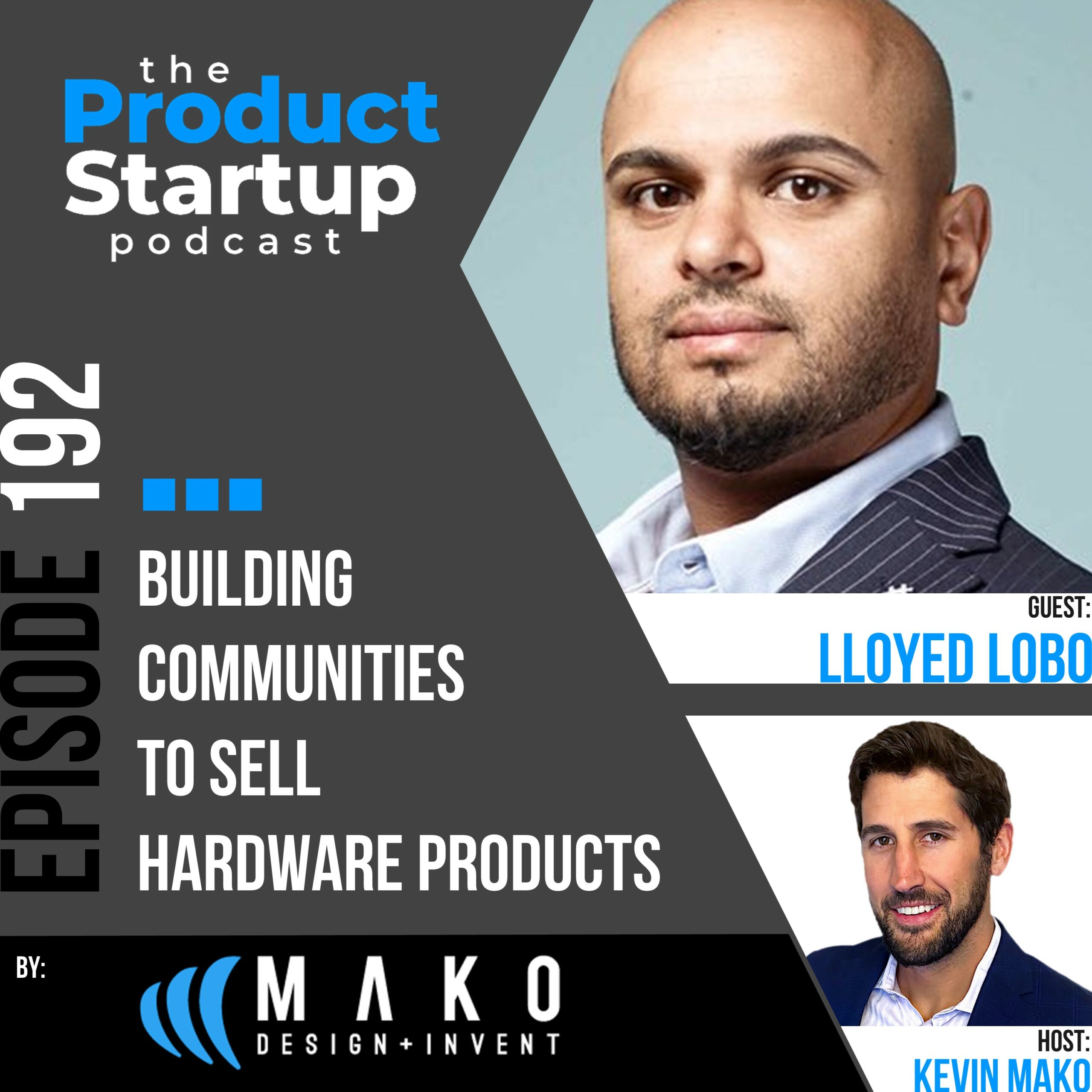
Guest: Lloyed Lobo, Co-Founder of Boast.AI and Traction and author of From Grassroots To Greatness.
Host: Kevin Mako, founder of Product Startup and the leading expert in hardware startup consulting. A hardware entrepreneur since 1999, Kevin has advised more than 1,500 founders and built and scaled MAKO Invent through its acquisition by TriMech in 2024.
Episode Overview
Lloyed Lobo maps the path from audience to community to a deeply committed brand following. He explains the roles of purpose, connection, consistent value, customer recognition, feedback, and a clear ideal customer profile in creating community-led product growth.
What You’ll Learn in This Episode
- Every obscure concept that evolves into a global sensation traverses four distinct phases.
- Understand the progression from an audience to a cohesive community and eventually into a dedicated cult brand following.
- Discover how to transform an obscure idea into a devoted cult brand by focusing on communication, creation, and unwavering consistency.
- Embrace inbound marketing strategies to educate and engage your audience effectively.
- Recognize that your audience evolves into a community when they come together around a shared purpose that transcends your product.
- Foster an unyielding belief in your mission, as yesterday’s innovation can quickly become today’s commonplace, as seen by Nike, Harley, and Apple.
- Cultivate a feedback loop that transforms customers into brand evangelists, driving organic growth.
- Build a thriving community by adhering to six core values that unleash happy “CAMPERs” – Connection, Autonomy, Management, Purpose, Energy, and Recognition.
- Identify your ideal customer profile to effectively target your community-building efforts.
- Map out your circle of influence to discover the platforms where your potential community members congregate.
- Choose the type of community you wish to create, be it a community of practice, product enthusiasts, or playful engagement.
- Focus initially on building your audience, subsequently nurturing them into a thriving community.
- Concentrate on acquiring email addresses as a key step in your journey to interact and engage with your audience effectively.
Episode transcript
This transcript is provided for accessibility and reference. Download the SRT transcript.
Read the full episode transcript
Kevin Mako: Hello, Product Innovators. Today we learned from the founder of $100 million-dollar-plus company on the power of community in driving sales to hardware startups.
Narrator: You're listening to the Product Startup Podcast, a show to learn from top leaders in product development, prototyping, manufacturing, product selling, and everything in between.
Narrator: Hosted by Kevin Mako, the leading expert on product development for physical product startups, sponsored by PTC's two best-in-class 3D CAD product development software solutions,
Narrator: Onshape, and Creo, and produced by Mako Design + Invent, the original firm providing world-class,
Narrator: consumer product development services tailored specifically to startups, small manufacturers, and inventors.
Kevin Mako: Welcome back, everyone. Today, I'm very excited to introduce Lloyed Lobo to the show. Lloyed is the founder of many companies, including Boast.ai, a company which has raised
Kevin Mako: over $100 million in funding. He is also the author of From Grassroots to Greatness, 13 Rules to Build Iconic Brands with Community-Led Growth.
Kevin Mako: Today, Lloyed is going to share some valuable knowledge for inventors, startups, and small
Kevin Mako: manufacturers on what the stages of audience engagement are, why they're so powerful to help with
Kevin Mako: sales for your hardware product, and the tools to execute on building your community right now. Now, on to the episode.
Kevin Mako: Hey, Lloyed, welcome to the show. Hey, I'm super excited to talk to your audience.
Kevin Mako: Thanks for inviting me. Well, we're excited to talk to you today about building an audience and the power of having
Kevin Mako: a real community behind that audience, empowering an emerging hardware startup. Most people are focused on the product when you're building your new,
Kevin Mako: innovation, your new invention, you're focusing on the design, the engineering, the prototype, you getting it to manufacturing. But then, how do you sell?
Kevin Mako: And selling and building communities very much can go hand in hand. And in fact, communities can be a huge proponent of growth, both to early
Kevin Mako: sales and mass adoption of your invention or innovation. But before we get into breaking all that
Kevin Mako: down and the power of community and how to really build your community well, give us a bit of a
Lloyed Lobo: background. How did you get to be the big success story that you are today? Just being in an environment that constantly required me to punch above my weight class.
Lloyed Lobo: I think necessity is the mother of all inventions, right? I mean, I didn't grow up to a rich family or anything. My childhood was spent in the slums of India.
Lloyed Lobo: And my parents were working in Kuwait when I was born. So every summer, we couldn't afford to go anywhere else. So we'd visit India and my childhood was spent in the slums there.
Lloyed Lobo: And so just experiencing the camaraderie of people and coming together, I mean, watching TV was communal. Eating food was communal, right? Every probably 10 homes had a TV there.
Lloyed Lobo: That house that my mom lived in was just four raw-ish walls with an aluminum roof. It would rain a lot, and so puddles would turn into ponds and would swim together.
Lloyed Lobo: So that was my first experience with community. The second experience with community was one morning when I was eight or nine years old,
Lloyed Lobo: my mom wakes me up and says, you can't go to school anymore. The Gulf War has hit. Heron Csies became invalid, security at lap, and you need to find your way to get out of there.
Lloyed Lobo: And that was when I experienced two big things. One, the largest grassroots movement that came together to evacuate people,
Lloyed Lobo: the safety, coordinating like building to building to building, word of mouth spreading, to communicate with embassies, to communicate with countries.
Lloyed Lobo: This was the time the internet didn't exist, phones didn't exist, security was invalid. And so as a kid, I saw that great purpose of saving
Lloyed Lobo: people cascade to the lowest common denominator where I felt like an eight-year-old rambo.
Lloyed Lobo: The other thing I experienced through that was the entrepreneurial spirit, which is not necessarily about making money, but it's about how do you take an obscure idea and drive
Lloyed Lobo: it all the way to execution and impact while dealing with extreme risk and uncertainty. So that was the second experience. Then fast forward a few years.
Lloyed Lobo: We immigrated to Canada, finished engineering. And I didn't want to go to 9 to 5 job. I didn't want to get a job that just did the same thing, like either
Lloyed Lobo: wrote code or build a product. I wanted something else. I wanted to build a business. I was craving the risk.
Lloyed Lobo: So I asked around, hey, what's the best skill I could learn if I want to be an entrepreneur
Lloyed Lobo: someday? And everyone I talked to said, one of the key things you got to do is communicate. You got to sell man. The best way to get good at something is to put yourself in an
Lloyed Lobo: environment that requires you to read that something over and over again. So the first job I took was in sales. I applied to a lot of
Lloyed Lobo: sales jobs that I wouldn't get Xerox and Apple and everywhere else. They're like, why would you hire an engineer to do sales?
Lloyed Lobo: Finally, I begged my way to get a job cold calling at a startup and they were desperate so they would pay me peanuts to do cold calling. My parents freaked out, right? They're from
Lloyed Lobo: Indian descent and they're like, our son just finished engineering and he's making cold calls while our friends' kids are working at Microsoft in that.
Lloyed Lobo: But fast forward today, it's the skill that served me the most because everything from finding early customers to building your community to convincing investors.
Lloyed Lobo: And so fast forward a couple years, I only ever ended up working alongside founders. So going from cold calling for a startup to working in sales to working in running sales.
Lloyed Lobo: So it was just a natural progression. You become the sum of the five people around you. Actually, the way I like to phrase it is it's neither the destination nor the journey,
Lloyed Lobo: but it's the companions that matter the most. Who you're with shapes your world. If you're just surrounded by founders and founders and founders, one day you're going to
Lloyed Lobo: found a company because you learn everything and it's just a natural progression. So that has been my journey.
Lloyed Lobo: And I think three of the key learnings, which is super valuable for startup founders, early
Lloyed Lobo: state startup founders, hardware founders, in general, anyone looking to build something. You can get everything in life if you are good at these three things.
Lloyed Lobo: Communication, because communication is everything. Communicate helps you connect with audiences. If you can't connect, all you have is an empty room.
Lloyed Lobo: The second thing is creation, because you need to create. You need to provide value and that comes through creation. And the last one is consistency.
Lloyed Lobo: And this, I can't stress enough. Consistency is the secret ingredient that turns small actions into big outcomes. So many times I've seen people, they just stop at a certain point.
Lloyed Lobo: And I've seen others that have the same traction proceed and they hit an inflection and they explode. Consistency is very underrated, but is the only thing that matters.
Kevin Mako: Consistency is so powerful, especially if you have the other two done well,
Kevin Mako: communication and creation, then consistency is going to get you there in time. Maybe not in the beginning,
Kevin Mako: but again, that's the whole purpose of consistency and the concept around it. Stick to it and eventually it will come through if you put that consistent, reliable effort.
Kevin Mako: I think a lot of people mix up the concept of consistency with hard work as well. Consistency, in my opinion, is actually more important,
Kevin Mako: especially in the beginning days than hard work if you have to choose. Ideally, you can do both,
Kevin Mako: but most people build a hardware startup, especially as a side hobby or as a side job or as a side gig among their primary employment or primary course of work.
Kevin Mako: So you won't be able to put 80 hours a week into a hardware startup in the beginning if you have a full-time job.
Kevin Mako: But what you can do is consistency, a few hours each week working towards your goal. And as you start to progress more and more in terms of a success framework, then at some point,
Kevin Mako: you can realize that there's much more to meet the eye. And eventually now put in the hours, do whatever you've got to do to potentially put that into a full-time gig.
Kevin Mako: When you start achieving the success, it's guiding you in that path. So it's amazing that you brought up those double-ed short.
Kevin Mako: Before we get too deep into the concept that we're talking about today in terms of how do you create a community around your hardware product in
Kevin Mako: order to drive sales and to build your brand. Before we get into that, just give us a bit of a background of your success in the business world.
Lloyed Lobo: What have you done to achieve to where you are today? Definitely. So after I did the first cold calling job, I started applying for sales jobs in the states in New Jersey.
Lloyed Lobo: And I happen to get a sales job at a startup at a supply chain hardware software company. My next job was then head of GTM at another startup.
Lloyed Lobo: And then this company boast end up hitting over time, we grew, we grew, we grew. And in 2020, a growth equity firm acquired 52% of the company.
Lloyed Lobo: So it was like a exit, mini exit for us while playing the long game. We also inadvertently built this community called traction.
Lloyed Lobo: And I can talk about all the community-led principles from that perspective and the book, which I wrote. After I left the day-to-day of the company, I said I want to give back.
Lloyed Lobo: I have all the free time. I don't need the money. How can I give back? I will write a book about it.
Lloyed Lobo: community. And so I started studying all the big brands, like the Peloton's, the Nikes, the
Lloyed Lobo: Harley-Davidson's, smaller companies, startup, SaaS companies, rewatched all our community content over the last seven years, which was like 400 or so videos, talked to a thousand
Lloyed Lobo: community members. What's really, really interesting is as I talk to more and more people, I found a common link between every obscure idea that eventually became
Lloyed Lobo: a worldwide phenomenon. From Christianity to CrossFit went through these four stages, to build iconic brands, startup
Kevin Mako: brands, hardware brands, by leveraging the power of community. Let's talk a bit about community and how powerful that can be because clearly that was a big success element
Kevin Mako: to the successes that you had in the business world. And of course, then since I'm writing the book and all sorts of stuff as well, let's dive a bit into what is it?
Kevin Mako: What did you find when you studied all these examples of many of the best products in the world? And what took them from that zero to being
Kevin Mako: something that basically had a brand cult following, that would continue to increase and grow the sales and the capacity of those organizations.
Kevin Mako: And how can we learn from that as hardware startups to apply that to our community building
Lloyed Lobo: initiatives as we're launching our hardware products for the first time to market? Definitely. So, you know, one is people listen to you or they buy your product or service.
Lloyed Lobo: You have an audience. That's where you start, build an audience. The next step is you bring your audience together to interact with one another.
Lloyed Lobo: So two-way communication and you start to form a community. Now, this community is the key element from taking an audience to a cult-like following. The next step is
Lloyed Lobo: when your community comes together to create impact towards a greater cause, that's far beyond your product or your profit, it becomes a movement.
Lloyed Lobo: And when that movement has undying faith in its purpose through sustained rituals over time becomes a religion or a cult. And that was a very fascinating thing.
Lloyed Lobo: Audience, community, movement, religion, or cult. We can take one very simple example. Harley Davidson. Now, Harley Davidson is a big, iconic brand, but the reason why I bring
Lloyed Lobo: this up is because yesterday's innovation is always going to become tomorrow's commodity. The theme there was you build a community, you won't become a commodity.
Lloyed Lobo: It becomes your mechanism for feedback when people admire you, they love you. And so taking back that example to Harley Davidson, when the Japanese
Lloyed Lobo: manufacturers came in, they faced bankruptcy. The management came out and said, we're going to rebuild the company on the ethos of community.
Lloyed Lobo: Community became a company strategy, not a marketing strategy. rituals like the weekend warrior thing. Let's come together around the camaraderie of brotherhood
Lloyed Lobo: of ridership. What's really interesting is it's a very rare brand where people tattoo its logo on their body. You can recognize a Harley fan from what they're wearing.
Lloyed Lobo: I mean, this is the pinnacle of a cult-like brand. It's a hardware company that back then was more or less a small company that became an iconic brand with the power of community.
Lloyed Lobo: If you look at what Apple does, release is a ritual. People stand in line. You don't get there if you just have an audience. You got to bring people together and show them love.
Lloyed Lobo: and make them successful beyond the product or service. And if you see a lot of Apple's marketing is not talking about features,
Lloyed Lobo: but it's talking about the aspiration, the aspirations and the goals from the product. Or Nike being another great example. Nike doesn't sell shoes.
Kevin Mako: It sells people on the dream of becoming better athletes. You've brought up these stories about Nike, Harley, Apple, etc. And it's amazing.
Kevin Mako: Obviously, we all know how powerful the community became in building their brands. What can we distill from those lessons and from your research and from your book
Kevin Mako: on how a hardware startup can make actionable commitments today in order to start achieving some
Lloyed Lobo: achieving results from their new communities that they're forging. And I found six core values that are relevant to building a community.
Lloyed Lobo: And I think my rule number one is called Unleash Camper. And I'll dive into what Camper is. If you have camper in your community, in your company as your ethos, you'll have happy
Lloyed Lobo: campers in your company. These are some of the key values of every product-led company. And so C stands for connection.
Lloyed Lobo: What that means is they help people feel connected and empath. power them to support one another.
Lloyed Lobo: By incorporating connection in your values, you're saying you want to forge genuine bonds.
Lloyed Lobo: So with a Peloton, for example, even like sweating and working out together virtually leads to a sense of camaraderie. The second one is autonomy.
Lloyed Lobo: You're granting freedom and independence. So when people have the space to make their own decisions, they take ownership and drive innovation.
Lloyed Lobo: A great example of when you give individuals the ability or the resources to hone skills and expand knowledge, they do great things. The fourth one is purpose.
Lloyed Lobo: When people feel they're making a difference, they find fulfillment in their work. A shared purpose that's larger than your product or your profit fuels motivation
Lloyed Lobo: and provides meaning. Patagonia, again, like a physical product. It actively promotes environmental stewardship by encouraging employees to volunteer for sustainable initiatives.
Lloyed Lobo: But it also donates a percentage of its sales for nature preservation. The fifth one is energy. Creating this environment of enthusiasm and passion.
Lloyed Lobo: When your culture is full of lively energy, people are inspired and it jazzes them up. Community is all about energizing people because you not only get your
Lloyed Lobo: employees working on it you get volunteers you get your customers everyone rallies and if you cannot
Lloyed Lobo: energize them you kill the staying power red bull is the perfect example right hosting events and festivals
Lloyed Lobo: their drinks are full of energy their events are full of energy energy is a key value you need to have if you
Lloyed Lobo: want to build a long-term sustaining community and the last one is recognition proactively recognizing people
Lloyed Lobo: when people show up for your brand you need to find ways to thank them whether it's swag or or
Lloyed Lobo: little discount just remembering their name and being in touch with them is key having a set of values
Lloyed Lobo: that are community oriented, because if it's like, oh, I want to build a community, should I start a Facebook group and when can I profit?
Lloyed Lobo: Then, you know what? Just do direct response ads and direct response sales.
Kevin Mako: You won't be able to build a long-term sustainable community. That's amazing. This camper method, that's very powerful and very actionable as well.
Kevin Mako: Let's distill that down, since we're almost out of time here, to the final stage, what are some of the actual tools that somebody can use to build these communities
Lloyed Lobo: around this camper methodology? So the first thing is, assuming you're building a physical product, you know who you're building it for. I can't say this enough, right?
Lloyed Lobo: A lot of tools is not technology. It's framework. So the first framework is, who is your ideal customer profile? Where do they eat, breathe, drink, sleep. What are
Lloyed Lobo: their pains? What are their goals? But what are the aspirations and what stands in their way?
Lloyed Lobo: It's very important to understand your ideal customer profile from a positioning standpoint.
Lloyed Lobo: Now that you understand your ideal customer profile, go and spend time with them, hang out with them,
Lloyed Lobo: understand them. Like at the early days of both, we went and hung out with startup. founders to figure out if that's our community. We resonated. We started
Lloyed Lobo: to participate in a hackathon. So we really understood their pains. We started writing down all the problems, all the goals, all the aspirations.
Lloyed Lobo: Once we had that, then we drew out the circle of influence. Circle of influence, meaning now you have this ideal customer profile, who's the founder
Lloyed Lobo: of the company. Who do they follow? Who are the influencers in the space? Who do they fund? Meaning what other tools they pay for? What are the services they pay for?
Lloyed Lobo: Ancillary to my offering. What do they frequent? Meaning what platforms they're prevalent on? Is it TikTok or is it LinkedIn? And what magazines and blogs they read.
Lloyed Lobo: When you make lists of these, you now have the ideal customer profile and you have the circle of influence. So what that does for you is if you decide on an audience
Lloyed Lobo: building strategy, let's say it's a meetup or it's a podcast or it's a YouTube series. You know
Lloyed Lobo: exactly which guests to invite that will drive social proof for your obscure brand. In the early days when no one knows you, that social proof is everything.
Lloyed Lobo: You know which magazines to reach out. You know which platforms to promote on. If you know what other service providers they're paying that are
Lloyed Lobo: Ancillary, there could be partners with you, co-promotion, sponsorship, etc. So it's joined that.
Lloyed Lobo: The third thing is figuring out what kind of community you want to build. There's three kinds of communities you can build.
Lloyed Lobo: One is a community of practice, which is learning about a specific field to get better at it, right? Better digital marketers, better hardware developers, those kinds
Lloyed Lobo: of things. The next one is community of product. Becoming an evangelist for the product, like Apple or Nike or Peloton.
Lloyed Lobo: And the third one is a community of play, which is bringing people together to have a good time, like Harley Davidson or Red Bull, their communities are played.
Lloyed Lobo: And so you got to decide what kind of community you build. My framework for figuring out in the early days what kind of community build is understanding
Lloyed Lobo: if I have product market fit or not. If people are not buying my product, I have no users and I try to build a community of product
Lloyed Lobo: around my product, people might not be as interested. They'll feel like they're being sold to.
Lloyed Lobo: So if your hardware product, explore, is your hardware product a mechanism that enables learning, then build a community of practice where you can leverage it to,
Lloyed Lobo: teach. Or does your hardware product bring joy around a specific field, then build a community
Lloyed Lobo: of play? Like maybe it's a fitness tracker and you build a niche fitness community. So you're teaching something or can serve as a piece of education.
Lloyed Lobo: The next step is now audience building, right? This path of audience, community, movement, religion. We'll stop at community in the interest
Lloyed Lobo: of time. But now how do you build an audience? All these platforms that you build audiences on, you don't really own that audience.
Lloyed Lobo: Meaning, if the platform changes the algorithm, your mindshare with your audience will die. Facebook, how it started, first it would show your content to all your followers.
Lloyed Lobo: Now when you post on Facebook, you'll see less and less of your followers are seeing your content because they are showing your followers the content of sponsors and other
Lloyed Lobo: people because that's how they make money. And so Nas Daily, one of the top YouTube channels,
Lloyed Lobo: had a stat that said their Facebook group of 21 million followers is virtually dead because their content went from being shown to 50% of their followers to 5%.
Lloyed Lobo: And their revenue went from 100 to near zero, 100,000 a month to near zero. It's an important thing to think is, yes, I'm building an audience.
Lloyed Lobo: that's great, but how can I immediately start collecting that audience's email addresses and phone numbers so I can maintain a direct connection with them?
Lloyed Lobo: If you don't maintain a direct connection with them, you don't own that audience. Start establishing how do I collect this? One way to collect it is you have valuable content.
Lloyed Lobo: Package it up or turn it into a course or turn it into a online meetup and get people to subscribe. Write a newsletter. Newsletters are blowing up. Start a Kickstarter
Lloyed Lobo: campaign. Create things which forces you to interact with them. Once you do that, now you can do cool things.
Lloyed Lobo: You can do swags. But even beyond that, I love hosting events. And that builds stronger connections.
Lloyed Lobo: Now, you don't have to wait to host a multi-thousand Red Bull Festival or like we do a thousand-person traction conference. You can just host meetups in different cities.
Lloyed Lobo: The thing is, if you do that on cadence, the affinity spreads. People come together around your brand. That's what the apples and the Harleys and the Teslas did in the early days.
Lloyed Lobo: Just because they have thousands upon thousands of people engaging today, don't get deterred. because they started with 5-10-2.
Lloyed Lobo: What made it stick was they were providing value consistently over time.
Kevin Mako: And compound interest on consistency is what we call overnight success. I like that statement. Good way to wrap it up.
Lloyed Lobo: Before I let you go, just give a quick highlight about the name of your book and where people can buy it. And then we'll say goodbye. Definitely.
Lloyed Lobo: So my book is called From Grassroots to Greatness. 13 rules to build iconic brands with community-led growth.
Lloyed Lobo: I put the digital for 99 cents so you can buy it on FromGrassrootsToGreatness.com, or on Amazon.
Lloyed Lobo: If you go to FromGrassrootsToGreatness.com on September 12th when the book releases, you'll also get access to a Notion doc with all the templates for each chapter,
Lloyed Lobo: which you can implement. I wrote the book in stories, so I could digest it. And then I didn't want the book to be academic, but we have all the templates and notions.
Lloyed Lobo: So you can follow it as a step-by-step guide to building a community and get some inspiration and frameworks from the book. 99 cents online. So it's accessible to everyone.
Lloyed Lobo: And then if you want the physical book, it's like a collectible. You can well-designed, all-color.
Kevin Mako: you can buy it. Thank you so much, Kevin. This was great. Very nice. Lloyed, appreciate all your
Kevin Mako: words of wisdom. I look forward to reading the book, and we'll talk again soon. Take care of
Narrator: then. Thanks for tuning in to this episode of the Product Startup Podcast.
Narrator: If you found some value in the show, please do us a huge favor and leave us a quick five-star review. If you have any questions,
Narrator: guest suggestions, or anything else, feel free to reach out to us anytime at our email, podcast at MakoDesign.com. That's podcast at MakoDesign.com.
Narrator: This show is hosted by Kevin Mako, North America's leading expert on product development for physical product startups.
Narrator: Huge thanks to our sponsors, PTC, and their two best-in-class 3D CAD product development software solutions, Onshape, and Creo.
Narrator: Mako Design + Invent, the original firm providing world-class consumer product development services tailored specifically to startups, small manufacturers, and inventors.
Narrator: Thanks for joining and see you next time.
Community-Led Growth Strategy for Founders
Build Demand Around More Than the Product
Work directly with Kevin Mako to define the audience, shared purpose, founder story, content, feedback loops, community experience, and launch moments that can turn early product interest into durable demand.
Kevin can help you connect community building with product validation, crowdfunding, direct sales, partnerships, and brand growth so the work supports measurable business outcomes.
Request a Community Growth Call
Tell Kevin who your customers are, where they already gather, and what you want your community to help accomplish.