
Listen Now
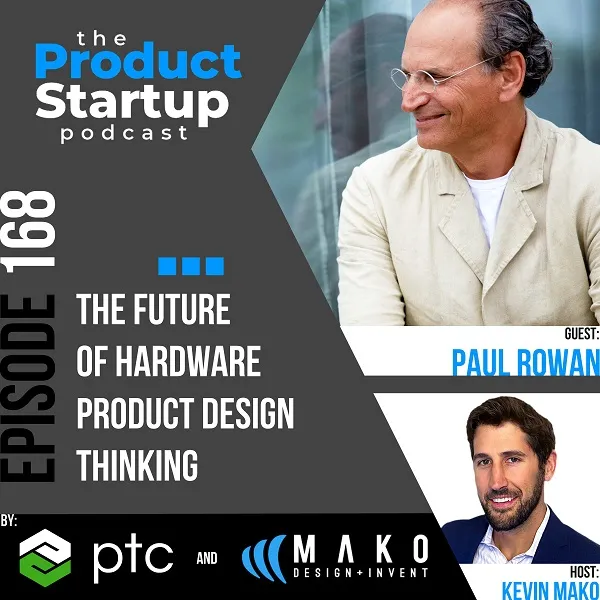
Guest: Paul Rowan, Co-Founder of Umbra, a global household product company whose products have reached more than 70,000 retail stores.
Host: Kevin Mako, founder of Product Startup and the leading expert in hardware startup consulting. A hardware entrepreneur since 1999, Kevin has advised more than 1,500 founders and built and scaled MAKO Invent through its acquisition by TriMech in 2024.
Episode Overview
Paul Rowan reflects on the future of hardware product design through decades of building Umbra. He discusses sales-led insights, changing work culture, emerging customer needs, AI as a creative tool, global design quality, and why a humanistic approach remains central to products people value.
What You’ll Learn in This Episode
- Ideas for hardware products can be driven by sales, which is an effective sales strategy if you already know the desires of your major buyers.
- The future of work culture in hardware product design is rapidly evolving.
- Hardware designers will have ample opportunities to create products that address work-from-home needs, mental health concerns, collaborative office spaces, and other emerging prospects in the design landscape.
- Artificial Intelligence (AI) is a significant area of interest.
- AI cannot replace human intelligence.
- Rather than a threat, AI is the next tool to be embraced.
- Using tools can exponentially enhance the quality of your hardware startup.
- The humanistic approach versus the robotic approach.
- Purposeful, sustainable, and human-centered design is key to long-term success.
- Incorporating humanistic values can differentiate your company.
- Good design is essential to entering the market.
- Poor design cannot be sold.
- Adding humanistic values beyond excellent design can be beneficial.
- Competing with big corporations is possible by emphasizing humanistic values as a startup.
- Sustainability, carbon footprint, sourcing, and labor practices must be considered.
- Putting your name on a product can be a valuable branding strategy.
- Do not hesitate to put your name behind your brand.
- When making short-term problem-solving decisions, prioritize long-term value, which is now more critical than ever for modern businesses.
- Long-term thinking leads to significantly more success.
- Using design thinking to prototype and test until you get it right is crucial.
- The human element is crucial to the design process.
Episode transcript
This transcript is provided for accessibility and reference. Download the SRT transcript.
Read the full episode transcript
Kevin Mako: Hello, product innovators. Today we learn from the founder of one of the world's largest home product brands on the future of hardware startup product design thinking.
Kevin Mako: You're listening to the product startup podcast,
Narrator: a show to learn from top leaders in product development, prototyping, manufacturing, product selling, and everything in between.
Narrator: Hosted by Kevin Mako, the leading expert on product development for physical product startups,
Narrator: sponsored by PTC's two best in class 3D CAD product development software solutions, Onshape, and Creo,
Narrator: and produced by Mako Design + Invent, the original firm providing world-class consumer product development service,
Narrator: is tailored specifically to startups, small manufacturers, and inventors.
Kevin Mako: Welcome back, everyone. Today I'm very excited to introduce Paul Rowan to the show. Paul is the co-founder of Umbra, a household product company that designs, manufactures
Kevin Mako: and sells hundreds of consumer products to 70,000 retail stores across 200 countries. Paul ran Umbra for 37 years. He spends much of his time these days as a lecture
Kevin Mako: in the design-thinking colleges as well. Today, Paul is going to share some valuable knowledge
Kevin Mako: in how inventors, and small manufacturers can understand the value of quality design in modern
Kevin Mako: times, how to leverage that design to be world class in the modern era, and how do you utilize humanity to ensure the long-term success of your hardware product venture?
Kevin Mako: Now, on to the episode. Hey, Paul, welcome back to the show. Thank you. I'm glad to be back. Well, excited to have you on today
Kevin Mako: to talk about humanistic design, the workplace, what's happening in the future of hardware, because big things are happening right now, especially around the concept of AI.
Kevin Mako: And a lot is happening in the world in terms of how the future of products are going to be developed, but more important,
Kevin Mako: How are those product startups and product scaleups going to actually compete? What are they going to do with these new tools that are revolving over the next few years to be
Kevin Mako: at the forefront of their game? And what better person today to talk about it than yourself? First of all, I want to mention that I notice you've got mountains in the background.
Kevin Mako: You're down in Miami in Columbia right now teaching down there.
Paul Rowan: Give us a bit of an update on where you're at. Well, I'm in the mountains and the Andes right now outside of Medellin, Colombia. I just love Colombia.
Paul Rowan: Yeah. I mean, I love the spirit of the people are amazing.
Paul Rowan: You know, obviously, they had a lot of problems in the past with gangs and violence and so forth. So people really had a bad idea about the place.
Paul Rowan: But really, it's in a wonderful place that people are wonderful. They're trying to forget about their past and move forward in a really innovative way.
Paul Rowan: They're known for social innovation and their cities. And I got introduced through one of my customers from Umbra. Umbra was selling products in South America.
Paul Rowan: And one particular, there was a company called To Go, who was like a mini-Ikea. kind of company, and they had a lot of umber accessories. And they said, why don't you come down to
Paul Rowan: Columbia and we'll do some workshops? We'll introduce you to the universities here. You could talk about design.
Paul Rowan: And I did. And when I landed in Medellin, I called my wife Marcii, I said, oh, my God, we're going to live here one day because this is an amazing place.
Paul Rowan: It's so productive. It's not a third-go country. It's a developing country for sure, but it's also very modern. The architecture is amazing.
Paul Rowan: The people are amazing. The food is amazing. So, and the climate, okay, especially coming from Toronto this winter.
Paul Rowan: Living down here for the winter, it's been just so relaxing and so nice for my body, I got to say.
Kevin Mako: So everybody, come down to Columbia. It's wonderful. That sounds great. Give us a bit of a background of the last 40 years of how
Paul Rowan: you got to where you are today. Okay. Well, so the first product, it was very intuitive. And, you know, I know we talk a lot
Paul Rowan: about strategizing for hardware developers and like and startups and having a really good idea, but their vision and mission and so forth. I had none. However,
Paul Rowan: I had a real strong passion for design. Actually, I should say that. I didn't even know what design was. I did things that I really out of necessity.
Paul Rowan: I started this whole company 40 years ago that grew to over like 200 countries and 70,000 retailers.
Paul Rowan: Just based on one idea, like an idea that was actually a window shade for my apartment in Ottawa.
Paul Rowan: And yeah, it's amazing. And we just, my partner, Les Mallebaum and I said, okay, let's just make it. Everybody likes this thing. You know, no research, no nothing.
Paul Rowan: But, you know, a lot of hard work, a lot of wearing a lot of hats, manufacturing through marketing, sales, design, going out on the road, putting the window
Paul Rowan: shades in the back of my car, driving all over the country with them, eventually discovering the houseware show in Chicago and launching it through a series of reps.
Paul Rowan: And then, yeah, the reps kept saying to us, this is interesting, too, by the way, for you
Paul Rowan: startups, you know, the salespeople were really driving a lot of product development because They said, hey, you got this one product out there, but they're asking for more.
Paul Rowan: Can you please give us more product? I said, okay, sure, I could do it. So we just started developing more and more product.
Paul Rowan: And strategy was, okay, yeah, sales driven, a lot of it.
Paul Rowan: And then market driven, and then just hiring a team of designers, a lot of them out of OECAD and Humber in Toronto,
Paul Rowan: really relying on young people to bring new ideas and inspiration to the company with the senior designers kind of guiding them through the process.
Paul Rowan: And then it just, also I'd say looking for export markets. You look to the U.S. right away, look to Europe, look to China, look to Asia.
Paul Rowan: And so, yeah, the company just kept growing with a lot of hard work and dedicated people, passion, and always innovating.
Paul Rowan: Never worrying about the copies that much, but very, you know, defending as much as we could with patents. But just innovating, innovating.
Paul Rowan: I have to say that in the last 20 years, I did like a product a day with a big team. But still, we did so many products.
Paul Rowan: and a lot of them flopped, but we had this base of really dedicated customers, retailers,
Paul Rowan: partnerships, trusted people that really trusted us. So building trust with your businesses and really having them rely on your role, being a trusted
Paul Rowan: advisor to these people as you're developing products, they're key and making them stakeholders
Paul Rowan: too, like the biggest companies in the world coming to us and trusting us and sharing ideas and developing them with them as stakeholders just turned into a huge business for us.
Paul Rowan: I mean, I have so much to say about this, but we have other things. to talk about today, which is about my experience with starting with George Brown College.
Paul Rowan: I've been an advisor there for over 20 years and I've recruited a lot of people. I'd encourage all you guys out there to keep in touch with your schools and use, lean on them
Paul Rowan: for recruitment and stay connected to education, okay? Because it's never going to, it never stops, right? You know that, Kevin.
Paul Rowan: So George Brown started this initiative to do a study for kind of like a student-based Deloitte sort of idea.
Paul Rowan: And I suggested, let's do the study of the future of work and the workplace, because every
Paul Rowan: executive I talked to over the last year is saying, okay, what are we going to do about bringing people back to work? We don't really like hybridization of work.
Paul Rowan: We don't like working at home only. We want them back at work. And the workers are saying, no, we want to work when we want to
Paul Rowan: work at home. And so it brought up a lot of issues about the culture of work at the workplace and how to address that. And also, how do we live with work at home now?
Paul Rowan: So I thought it was a great opportunity for designers to really step in and solve problems for business by developing
Paul Rowan: product that would facilitate work at home, facilitate mental health, reduce carbon footprint by working at home, but at the same time, how do we design office spaces in
Paul Rowan: the work so that we have culture at work and not just work? So the future of work is, hey, there is no work at a workplace anymore.
Paul Rowan: It's about getting together with people and promoting the brand and the culture of the company. So that brought me to, thank you very much,
Paul Rowan: this idea that, and everyone said to me, oh, AI is going to solve all our problems. It's going to make things easier to work with. The internet's
Paul Rowan: going to make everybody allow them to work remotely and so forth. But then when I started to look at
Paul Rowan: actually the tools of AI that are available now, it really brought up a lot of questions to me about the future and the nature of work.
Paul Rowan: Because AI, when you look at people, like obviously everyone knows about chat, GPT, exploding on the bit unseen and the threat of it or the benefit of it
Paul Rowan: and then mid-journey for AI generic design, which I've been experimenting with, I find it really fascinating. And what I came up with, and I want to talk about today is AI
Paul Rowan: cannot compete with H.I, which is human intelligence. We have to shift our design businesses to focus on the
Paul Rowan: humanistic values of what we can bring with our products and services. I mean, It's just so obvious to me that AI cannot have the spirit, cannot have
Paul Rowan: that innovation that humans bring to it. And everything that you see in mid-jurney is a hybridization of human ideas that
Paul Rowan: basically is copying and kind of hybridizing.
Kevin Mako: So let's talk about how we can promote humanistic values and purpose in our design companies. Yeah, especially as a startup.
Kevin Mako: Startups have a huge advantage over big corporate with this sort of a thing. and we can get into that in detail. Paul, I want to just go back a bit because this is really
Kevin Mako: interesting topic coming from you. You've been in the product development world at an extremely high level for 40 years. You've seen the evolution of various tools.
Kevin Mako: I mean, when computers were first introduced, when CAD was first introduced, all these tools that, you know, if you go back
Kevin Mako: in time and you look at some of the actual records, so many people were saying basically, this is
Kevin Mako: the end of design, or this is the end of creativity, or this is the robotic takeover. of product development and you've watched these things essentially these theories
Kevin Mako: come and go and really what ends up happening is these technologies truly become tools tools
Paul Rowan: that require humans to use them and the more sophisticated the human at using the tool the better the output so well said and so why are we
Paul Rowan: now changing the way we teach the way we create do creative workshops in our businesses it should
Paul Rowan: all be about the human experience and how we can lead with creativity. I love this time. It's such a great opportunity. Some people see it as a threat.
Paul Rowan: But I say, like, let's shift to the human experience, to studying behavior, to inject human
Paul Rowan: values, purpose, spirit, the understanding of our place in the universe. This is something that AI doesn't understand right now. If we just
Paul Rowan: continue in a sort of robotic way that we have since the Industrial Revolution, the term people to robots, the AI can do it better.
Paul Rowan: So we have to shift our whole way of thinking about this. And for me, it's very exciting because I just think there's a great opportunity right now
Paul Rowan: because of this generic kind of ubiquity of good design today that's been created by CAD and all these other really great programs that we use.
Paul Rowan: You know, you can see a Kia versus a BMW
Paul Rowan: on the street and the design like proposition is just as good for both of them. You know,
Paul Rowan: Obviously, one has a little heavier and a bit more power and everything else, but the design is excellent for even the lowest cost items.
Paul Rowan: So if you're a startup and you don't have, we talked about this being raising that bar on very, really, really good design, you won't even get it to market.
Paul Rowan: But now the next level is how do we inject that kind of spirit and purpose,
Kevin Mako: human value, human engineering and human intelligence into our businesses? That's the question right now. That's powerful.
Kevin Mako: I want to break that down into both those elements you mentioned, first talking about good design and the fact that the bar has been set.
Kevin Mako: You and I have talked about it in the past where you said back in the 80s and 90s, you could take really just a product, apply great design, and it would become a market success.
Kevin Mako: But as you mentioned now, you know, there's so much quality and caliber and learning and education and tools that have surrounded design for so many years that
Kevin Mako: good design is at a minimum, a low bar for a market.
Paul Rowan: Entrant. Talk a bit about that, especially for people that are starting in the development process and are trying to get their first new product to market and how important.
Paul Rowan: Yeah, well, don't think of yourself as a brand manager, as an entrepreneur, as an inventor. Think of yourself as a consumer.
Paul Rowan: I mean, what are we accepting and what are we buying in the stores today? It's top quality, excellent design. There is no bad design in the stores because
Paul Rowan: it cannot even be put on the shelf these days.
Paul Rowan: Good design is ubiquitous. So we have to elevator. So, okay, we've got to at least be great design.
Paul Rowan: And what does that include? Well, I think just to differentiate ourselves from the competitors and to not just compete on price,
Paul Rowan: we need to inject this kind of idea of human values and purpose. And how do we attract great people to work for us too?
Paul Rowan: That has to be part of our vision and mission to attract those people, just like you have. And like, I think this kind of thing that you're doing to educate startups
Kevin Mako: and hardware startups, I think it's an excellent thing that you were doing, injecting into your business. You're a great example of it. I appreciate that very much.
Kevin Mako: The biggest thing that I can appreciate from this podcast is having incredible people coming on the show to talk that have been extremely successful in the
Kevin Mako: hardware world to give their best nuggets of advice to emerging brands today. And that's so powerful
Kevin Mako: to understand concepts that are very obvious to somebody like you, Paul. But when, especially if somebody said, this is their first product that they've developed or they're in the
Kevin Mako: ideation phase, like just ironing out the general landscape for today can be incredibly valuable to helping them get pointed in the right direction.
Kevin Mako: And now we're talking about right direction. We've talked about the concept of a minimum caliber of design, which is required just
Kevin Mako: to compete. But what you're talking about is this humanistic value, which is really how you
Kevin Mako: can go from great design, which is a standard essentially to get into the market to how do you be
Kevin Mako: the best or how to be one of the winners or how to be one of the leaders or the pioneers or the
Kevin Mako: innovators or the award winners, that comes down to what you coined as humanistic characteristics and values.
Kevin Mako: Now, let's talk about that specifically to hardware startups, because that is something
Kevin Mako: that hard work startups can compete on far easier than a big corporation. So let's dive into
Paul Rowan: some of those details into how that really can be powerful and how they can actually not only use
Paul Rowan: humanistic considerations in their product, but then their overall product business and brand. Wow. Well, that's very well said because I think you're right.
Paul Rowan: A startup can compete in a lot of different ways to a big company by injecting those kind of values. First of all, the actual personality.
Paul Rowan: I'm a big supporter of entrepreneurs that really want to put their name on the product. I mean, but we have to overcome a lot of fear in doing that.
Paul Rowan: And I think just look to yourself and see why you would stop yourself from doing that. People are looking for a story. Consumers
Paul Rowan: want to know a story about how things are done, why you thought of it and how you did it. So putting your personality first is really an interesting idea.
Paul Rowan: Consider having a lot of empathy about things that are happening in the world today, about sustainability, about your carbon footprint, about your sourcing,
Paul Rowan: about your labor practices. All those things are really important to consumers today. Those are the things that actually differentiate us from really giant companies.
Paul Rowan: Giant companies are trying to do it too.
Kevin Mako: Actually, you see all the advertising that you watch the basketball game tonight, you know, everyone's talking, hardly anyone talks about the product anymore.
Kevin Mako: They talk about the humanistic side of their business, right? We've talked about it a number of times on the show. There's so much
Kevin Mako: value into you as the inventor, the innovator, the pioneer, the designer, being the actual spokesperson of your own brand.
Kevin Mako: It's so powerful to how far that goes just in sales and marketing tactics. So leveraging up, obviously, you've got a great product. Hopefully you've done great
Kevin Mako: design and you've got great manufacturing set up. But to put your own name and your own personality and your story. Everybody has a story.
Kevin Mako: I mean, we've developed well over a thousand products for hardware startups. And I don't think I've ever had one that didn't have some interesting, unique twist of a
Kevin Mako: story behind either the product or how they got to the concept of the product or what they did in
Kevin Mako: developing it or what they did in testing it or how they ideated it or the partners they brought on or a hundred other variables that come into it.
Kevin Mako: If you dig deep into your background,
Paul Rowan: about your product, know that there's a whole bunch of really interesting nuggets there that add that humanistic value that will allow you to connect very powerfully
Paul Rowan: with your buyers. I think we're going to have to have a whole other podcast just on design. I'm going to coin that right now, design therapy, because the only reason people will
Paul Rowan: not do that is because of the fear of failing or because they don't have the self-confidence to do that. And they want to hide behind a name.
Paul Rowan: And let's say, let's put it this way, a lot of designers out there have a lot of difficulty putting their self forward. I mean, I've seen a lot of my colleagues and everything
Paul Rowan: sit in front of a computer and never want to talk about design, but they're excellent. They're amazing engineers.
Kevin Mako: They sort of have to break out of that whole thing and start becoming the face of what their design is. This is a great topic.
Kevin Mako: And I think it's going to really change people's careers in their businesses if they start thinking that way. Very interesting. Well, let's talk about
Kevin Mako: this humanistic value and how that applies to the future of the brand and the business, particularly around those long-term elements that you talked about.
Kevin Mako: Sustainability, labor practices, just your impact on the planet, your value to other people. These are really long-term considerations as opposed to
Kevin Mako: potentially short-term profit centers. Looking a little bit further down the pipeline, realizing that
Kevin Mako: for a hardware startup to compete at a global level, A, you have to have great design, but on top of that,
Paul Rowan: you have to have humanistic value. Now, how you enable that humanistic value from what you're saying here is to really look at that community characteristics in the long term.
Paul Rowan: Well, that's that's so true. I mean, I think we have to embed all those values in our businesses and our, in our, in our mission for our businesses.
Paul Rowan: You know, if we can get just a couple of good nuggets out of this podcast, it would be that, you know, when you're in that decision tree about going left or right to the short
Paul Rowan: term, you know, decision problem solve or the longer term one, I think.
Paul Rowan: this is the place where we hopefully, in the back of their minds, they'll say, yeah, let's go for the longer term one. Let's figure it out.
Paul Rowan: I know it's going to be easier short term. Maybe it's going to be easier economically too, but let's figure out a plan where we can actually embed
Paul Rowan: those values in what we're trying to do in a longer term decision.
Paul Rowan: And look at it this way, too, like all these people that work for you and the people that are going to be your customers, they're going to recognize that too.
Paul Rowan: So like if you have a short-term gain problem issue, it's going to be a short-term relationship too with your customers and your staff, long-term
Paul Rowan: thinking about the implications
Kevin Mako: of what your business is, the empathy you have, the sustainability of it, your transparency
Kevin Mako: with your workers, all these great humanistic values are the things that you have to keep
Kevin Mako: trying to strive for, even though it's going to be a lot more difficult than a short-term plan. That is so powerful. I mean, I look at it like investing in compound interest.
Kevin Mako: So in the short term, right, you can get a quick ROI and there's all these get rich, quick schemes.
Kevin Mako: But the reality is if you invest for the long term, you're constantly thinking forward.
Kevin Mako: If you look years out, you're 10 or 50 or 100 times larger in terms of your overall value than you are looking for a quick buck.
Kevin Mako: And the reality in your business is that's become more important. And the window has become more clear and transparent to the outer world seen into the inner business.
Kevin Mako: You know, there's online reviews at a minimum. There's all kinds of like stakeholder engagements and social media spreads the word quickly, both on the good things and
Kevin Mako: the bad things. So the reality is it's more transparent than ever to what you're actually doing. What is the core values behind your business? So if you focus on the long term,
Kevin Mako: sure, they might be some short term pains to get there. But the inevitable truth is you'll be
Paul Rowan: exponentially more successful in the long run by focusing on those big picture things more so than
Paul Rowan: ever in history because of the evolution of the importance of those humanistic characteristics as you're talking about here.
Paul Rowan: And based on the, you know, you've done quite a better research on this too. I'm glad that you brought that up because I think sustainability is also, there's
Paul Rowan: also financial sustainability, but there's also financial sustainability or business. And so what these long term or longer term decisions are going to yield is
Paul Rowan: better stability, financial stability for you. I'm so glad you brought that up because that's something that you got to take to the bank. I mean, they may say, yeah,
Paul Rowan: sell out to a mass merchant, but the product gets killed after the first shipment. Well, maybe that's not the right decision for the long-term health of the business.
Paul Rowan: Or how do we maintain longer-term relationships with these very powerful customers?
Kevin Mako: Is it a short-term game thing where you make a lot of money, but the product fails? I mean, we used to do a lot of very agonizing decisions.
Kevin Mako: Like customers would say, we want to ship 10,000 of these things and say, you know,
Kevin Mako: you better start with 1,000 to test it because we didn't want to damage the business relationship. That's amazing.
Kevin Mako: You had an order for 10,000 units turned it down so that you can ensure the long-term success. Many times. That's powerful, right? And you've been through it.
Kevin Mako: And you've now seen the net benefit. And I think for a lot of hardware startups, it's hard to see that. You've obviously, like you mentioned, gone through that many times.
Kevin Mako: But for somebody new that hasn't gone through that, sometimes it can be daunting.
Kevin Mako: Sometimes they're really looking at that and saying, no, I need to do this now for the short-term gain. And it's worth sacrificing it in the long term.
Kevin Mako: But that doesn't work anymore. Not in 2023 and on. This is really something that, even those stories that, you know, people fake it till you make it, that whole mentality is gone.
Kevin Mako: Hardware startups, especially, that is not something that works. That is not really something that any successful hardware launch does in this day and age.
Paul Rowan: In fact, if anything, it's reduced feature set, reduce the amount of bells and whistles, but really double down on the quality of the core offering that you're going to present for
Paul Rowan: your first version. Make sure you deliver something great to the customer and then let them help you with feedback and whatever else for the next versions. It's great advice.
Paul Rowan: And I was just thinking that we promote design thinking as designers. And we have
Paul Rowan: to actually put that, make that part of our business strategy because like test, test again,
Kevin Mako: test again, prototype, test again. And so you don't have to overcommit. You can test, you can test, you can test until you get it right.
Paul Rowan: And so yeah, let's use design thinking to be successful with our startups. That's a whole other podcast, isn't it? Yeah, probably. We could spend that one up as well.
Paul Rowan: Paul, thanks so much for all your words of wisdom today. Is there anything other words you want to leave? Well, no, I just would like to say thank you very much for this, Kevin.
Paul Rowan: And like I just think this is such a great support for startups and what you're doing is amazing.
Kevin Mako: And I think education as part of our purpose and our business is really an important thing to like continuously reeducating
Kevin Mako: our staff, continuously contributing to conferences and staying connected with our schools is a really important idea for me.
Kevin Mako: Paul, so much I appreciate it, especially coming from you.
Narrator: saying that you're obviously, especially in the consumer product world, you're one of the leading names
Narrator: on earth for product development, product scale up, product commercialization. I mean, you name it, anything to do with physical hardware consumer products.
Narrator: Talk to anybody. They know who you are. Looking forward to having you back on the show again.
Narrator: Thank you so much. Thanks for tuning in to this episode of the product startup podcast.
Narrator: If you found some value in the show, please do us a huge favor and leave us a quick five-star review. If you have any questions, guest suggestions, or anything else.
Narrator: Feel free to reach out to us anytime at our email, podcast at MakoDesign.com. That's podcast and MakoDesign.com. This show is hosted by Kevin Mako.
Narrator: North America's leading expert on product development for physical product startups. Huge thanks to our sponsors, PTC,
Narrator: and their two best-in-class 3D CAD product development software solutions Onshape and Creo. Mako Design + Invent,
Narrator: the original firm providing world-class consumer product development services tailored specifically to startups, small manufacturers, and inventors.
Narrator: Thanks for joining and see you next time.
Product Design Strategy for Founders
Build a Product Vision That Can Endure
Work directly with Kevin Mako to connect customer needs, design quality, brand ambition, technology choices, market opportunity, and long-term product-line thinking before short-term decisions narrow the business.
Kevin can help you pressure-test the product vision, prepare stronger direction for specialist teams, and keep human value at the center of development, manufacturing, and commercialization decisions.
Request a Product Vision Strategy Call
Tell Kevin what you are building, the market change you see, and the design decision that will shape the brand’s future.