
Listen Now
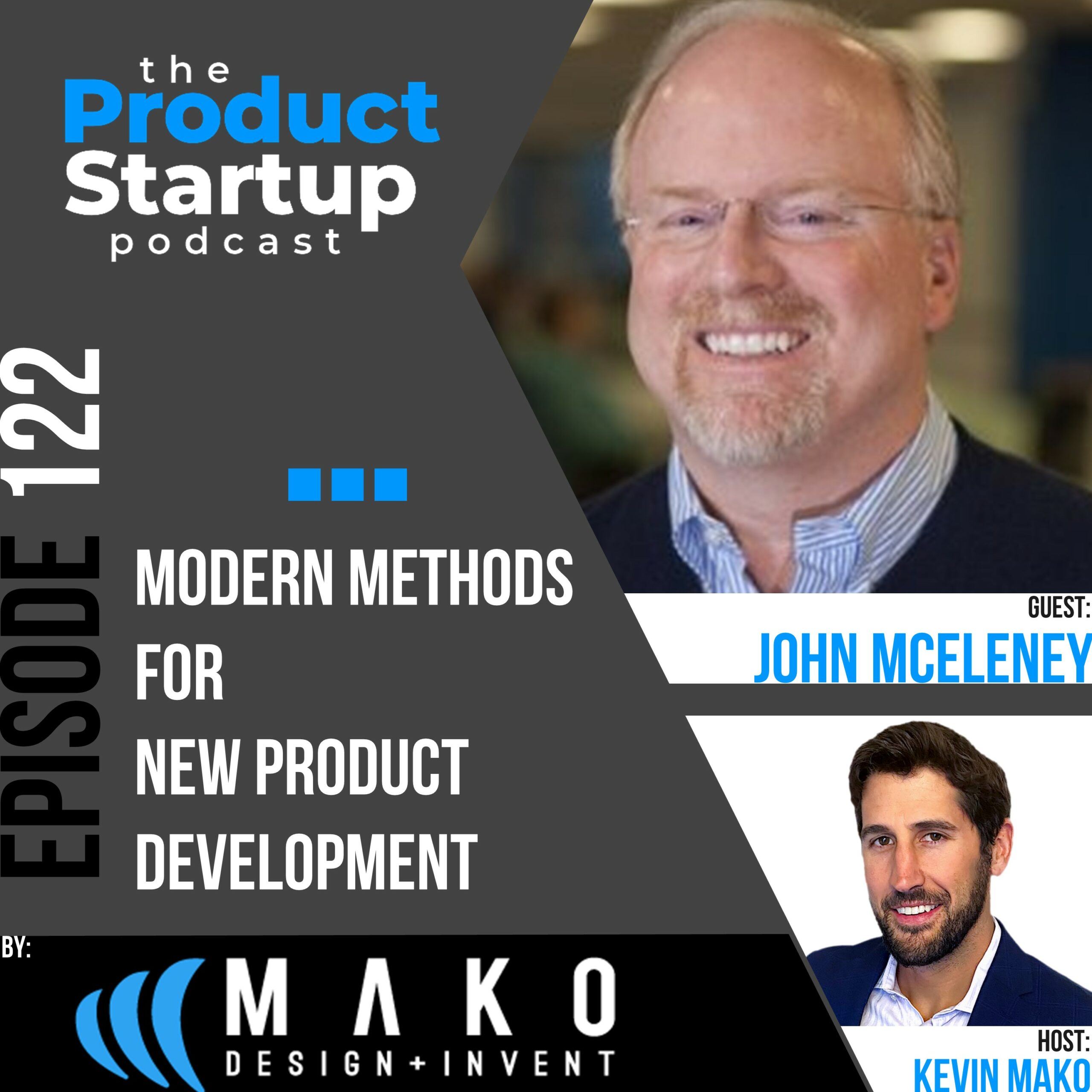
Guest: John McEleney, Co-Founder of Onshape.
Host: Kevin Mako, founder of Product Startup and the leading expert in hardware startup consulting. A hardware entrepreneur since 1999, Kevin has advised more than 1,500 founders and built and scaled MAKO Invent through its acquisition by TriMech in 2024.
How Modern Tools Improve Product Development
Onshape cofounder John McEleney explains how cloud CAD, controlled iteration, collaboration, and customer learning help hardware teams develop with agility. The episode also explores development planning, collaboration, iteration strategy, expert coordination, validation, and commercialization.
What You’ll Learn in This Episode
- Building products is all about iteration
- Cloud-based CAD software is making modern product development far easier
- Don’t worry about opening and working with it
- Control your CAD, and control parts of it
- Everything is saved step by step
- Continue to test and try
- Collaborate with peers in real-time
- Figure out the product-market fit quickly
- Getting products into customer’s hands so that you can observe
- Does your product solve a problem or delight a user
Episode transcript
This transcript is provided for accessibility and reference. Download the SRT transcript.
Read the full episode transcript
Kevin Mako: Hello, product innovators. Today we learn from one of the biggest CAD software CEOs in the industry on how new 3D design tools are improving hardware startup success.
Narrator: You're listening to the Product Startup Podcast, the show that helps bring your product idea to life by chatting with successful inventors,
Narrator: product developers, and hardware industry professionals. Our goal here is to get to the bottom of what makes a product successful, from initial
Narrator: idea to getting your product on store, shelves. We're taking you step by step to build a functional product and scale your product
Narrator: business. Hosted by Kevin Mako, one of North America's leading experts on hardware development
Kevin Mako: for small product businesses.
Kevin Mako: Now, onto the show.
Kevin Mako: Welcome back, everyone. Today I'm very excited to introduce John McEleney to the show. John is the co-founder of Onshape, a leading cloud-based
Kevin Mako: 3D CAD design software used by almost 2 million product designers worldwide.
Kevin Mako: He was one of the the early innovators at SolidWorks and ended up being CEO there for seven years before eventually founding OnShame.
Kevin Mako: Today, John is going to share some valuable knowledge on what inventors, startups, and small manufacturers can look forward to in modern CAD design tools.
Kevin Mako: And how to best use those tools to get new innovative products to market in an agile way, learning from customers and thus best ensuring product market fit.
Kevin Mako: Now on to the episode.
Kevin Mako: Hey, John, welcome to the show. Great. Thanks for having me. I really appreciate it, Kevin.
Kevin Mako: I'm excited to have you on today to talk about the modern tools of software today, specifically around CAD design and designing new hardware products.
Kevin Mako: I got the chance to meet some of your team members, actually, just a couple of weekends ago at the Make 48 record.
John McEleney: You've got a phenomenal team there. There was just at the event, let alone everything I heard going on at Onshape back home. Yeah, thank you.
John McEleney: You know, as you know, being involved in helping startups and yourself with your
John McEleney: experience, it's really all about the people that you surround yourself when you're building the company
Kevin Mako: because you can't do everything yourself. So building your team and that's wonderful to hear. And I know they had a wonderful time as well.
Kevin Mako: Well, it's great to see you there and supporting the competition. It's on PBS and Amazon Prime and we're a huge fan to make 48 and that whole movement.
Kevin Mako: They actually had me on as a judge for this season five. So I'm very excited for the show to come out in September and we'll see how it goes. Some of your team will be in it too.
Kevin Mako: I'll look forward to seeing it. Great. Give us a bit of a background.
John McEleney: You've got an extensive and incredible history in the CAD design space. How did it all start? And what was the journey along the way? Well, you're very kind.
John McEleney: Well, my background, I'm a mechanical engineer by training. It started at the University of Rochester. One summer, I had an internship at the laboratory for laser energetics.
John McEleney: This is a trillion-watt laser. To give you a perspective, it's about three football fields long. And it's funded by Department of Energy, and it's really about nuclear fusion
John McEleney: research. Vision is splitting atoms, fusion's trying to use the creation of energy through fusing a deterrent tablet with high amounts of energy.
John McEleney: I'm not a high-energy physicist, but that summer I did some design work from beam splitters to
John McEleney: mounts to just standard targeting equipment and stuff like that for all the physicists and optics
John McEleney: people. And the guy I worked for, I think gave me a backhanded compliment. He said, you're kind of better at computers than you are design, aren't you?
John McEleney: And this was sort of circa 1983 where we're still using drawing boards. And so he said, can you help me find a CAD system?
John McEleney: So that summer, I went and researched basically different CAD systems. At the time, PC-based CAD systems were
John McEleney: just starting. And there was literally, in our office, I think we had about 8,000 drawings that were rolled up and laid out and it was kind of a mess.
John McEleney: And so that summer, basically, I helped find a CAD system. I helped find a physical way to store the drawings, put this almost like 3M tape on the top
John McEleney: of the C size, D size, and E size drawings. And then at the same time, there was a product called D-Base, which was the first sort of PC-based database software.
John McEleney: And I wrote an application on top of that. And he came up with a numbering system to figure out the capacitor bay, the targeting area, and kind of
John McEleney: got it organized. So I helped them find a CAD system. organize the drawings and organize the process of how you design. And 40 years later, I'm helping people
John McEleney: find a CAD system, organize the process and change, and make it reduce the kind of heat loss due to friction along the way.
John McEleney: My background from there, I worked as a design engineer at Raytheon, which is a large defense equipment manufacturer here in Boston area. And then I ended up going to
John McEleney: computer vision, which is one of the early CAD pioneers, and was at Computer Vision for many years,
John McEleney: and then ended up joining SolidWorks when we were just about to bring the product to market. We hadn't sold any software yet. No users of. into commercial users of SolidWorks.
John McEleney: In my journey at SolidWorks, I had multiple roles, everything from sales and marketing to building out the whole partner sort of ecosystem, and then ultimately
John McEleney: was the CEO for the last seven years. I took some time off after my father was ill, and I saw
John McEleney: this thing called the Cloud, and it was very fascinating to be early on, this idea that you could get access to computers and rent them at a short time basis.
John McEleney: And I went to the first meet up in Boston. This is when Werner Vogels, the CTO of Amazon, came, and there was probably 30 of us in the room.
John McEleney: And I was amazed at discussions and met a bunch of people. Now, if he was to give a conference in Boston, there'd be 20,000 people there. So it was just sort of very, very early
John McEleney: days. And I realized that's where I wanted to plant my flag and learn about how the computing platforms could change how and what people were doing.
John McEleney: When was this? Around what time? That was around 2007. And so ultimately, I found a couple of people who were working on a very
John McEleney: interesting idea, and join them as a CEO, and the company was called Cloud Switch. And ultimately,
John McEleney: Verizon acquired the company to use it as sort of their platform to get people into their enterprise cloud.
John McEleney: And then after getting the team settled, I ended up very good friends with John Herschick, who I'd met at Computer Vision. John was the founder of SolidWorks.
John McEleney: We had a long history together, and he and our close personal friends. And we were talking about how the world had evolved in product design
John McEleney: and that some of the fundamental problems really need to be re-looked at and addressed. We realized
John McEleney: the care and feeding of these systems was becoming disproportionately kind of more of the effort
John McEleney: of engineers. So people were wasting a lot of time and energy and money, doing things that, quite frankly, with the advent of mobile devices and web browsers, it would
John McEleney: allow us to rethink the whole problem. So John and I, along with some of the original Solworks team, ended up starting
John McEleney: Onshape in the beginning of, I guess it was November 1st, 2012. With the idea that basically we're going
John McEleney: to take everything that we had learned in the past, but take all the current systems that were installed
John McEleney: software and sort of swipe them off the table and start with a clean sheet and say, if you had smart people
John McEleney: who were highly motivated because we wanted to really put a dent in the universe, change how people
John McEleney: worked and could attract the venture capital to be able to fund what we were doing. That's why we started Onshape. And it's motivated by kind of a demographic shift as well.
John McEleney: If you look around most companies, you know, people with hair at my color, which is skin tone or what's left up there,
John McEleney: those types of people are not sort of cloud and digital native. But yet the people in their third
John McEleney: and certainly young engineers coming out of college, you know, this idea of installing software, this idea of kind of, you know, the way in which it currently works with
John McEleney: how people manage information, kind of like a bank bank vault metaphor. Let me check this in and let me check this out. You know, their whole world has been about Google Docs.
John McEleney: Let me shut down my laptop. I don't worry about saving. And I just, you know, really have the freedom to collaborate and share real time with people.
John McEleney: And so we wanted to bring that to the product design space. Because people like you and many of the people that you work with, in the
John McEleney: early days of, you know, when you're, when you're starting a new hardware startup or building new products, it's all about iteration.
John McEleney: It's all about trying to get an iteration of the new device or the new product out so you can get market feedback and you can do mid-course corrections.
John McEleney: So everything we can do to sort of make it faster and easier for people to get that thing, that object in the ultimate
John McEleney: customer's hands and see how. how they use it. See what they like, what the aha moment is, and all of the things that they
Kevin Mako: don't like. They may not tell you, but you have to observe them. So the sooner you can get that
Kevin Mako: in people's hands, the quicker you can go and iterate and make sure that your product actually kind of hits the mark when you ultimately release it.
Kevin Mako: So that's really our motivation for creating Onshape. That's so valuable. And that whole motivation behind it is really key. I can tell you from
Kevin Mako: running a 30-person design firm targeted to hardware startups. It's all about time to market, efficiency, quality of specifications, testing, tweaking, refinement, that
Kevin Mako: whole concept is essentially the software world of agile development brought into the hardware world. I think that's what's changed
Kevin Mako: a lot in design, especially to hardware startups, is the fact that we are looking at product
Kevin Mako: development, not as in hitting the holy grail on the first run, tooling up, getting that production run and sitting on it for 10 years to collect in the money for the sales of it.
Kevin Mako: It's saying let's get a few units to market, test, tweak, and refine. So on that thread, especially with what Onshape's doing
John McEleney: in modern CAD software, I want to go back to that concept that you mentioned in terms of that iteration. How is the software today making that easier for
John McEleney: design firms like ourselves or for designers that are coming up with their own products or just for the industry in general?
John McEleney: There's some very practical things that happen when you're using a cloud native sort of platform
John McEleney: and mobile native.
John McEleney: But to do that, you kind of have to look at the current state of the world. The current state of the world is that people are sending files around to everybody.
John McEleney: And the problem is when you're sending files around to people, and by the way, CAD files are inherently a little more complex than just simple a word document or a simple PDF.
John McEleney: Because many of them have nested files and they're just very fragile. And you have to worry about does the person who's receiving this file that I'm sending them,
John McEleney: are they using the same revision of the software? Are they using the same software as I'm
John McEleney: doing? So it could be that I'm using the same brand of software, but it might not be the same revision. So they might not be able to open it up.
John McEleney: So there's kind of all this overhead that, that quite frankly, when I was in SolidWorks and we did it, we didn't do this intentional. It's
John McEleney: just the only way we could build software, but it's an artifact kind of the platform. And when you have new platforms, it allows you to think differently. So one of the concrete
John McEleney: examples is when a designer's working on something, rather than sending the file to somebody, what you're actually doing is much like in Google Docs, you're sharing a link.
John McEleney: You don't have to worry whether or not the person has a CAD system. They've got the link. They click on it. And there's no software installed.
John McEleney: You literally click on that link and you are actually, whatever your permissions might be that the person is granted to you, you have access to that model.
John McEleney: You might be able to make edits. You might be able to make comments. And if you, the owner, who shared it with somebody, you can change those permissions as time goes on.
John McEleney: So first, you're not worrying about whether they can open it or work with it. Two, you you can control what they can do with.
John McEleney: They may not be able to make changes or they may only be able to edit, comment, and mark up, or they might have full access to it.
John McEleney: And the beauty of these systems is that there is literally no save button in any of these systems because everything is saved as a transaction, which means you
John McEleney: can literally go back to, you know, T0 when you started the design. So the idea of feeling like I'm walking on this
John McEleney: very fine edge and I don't want to break something and you become very cautious and you become a slave to the system. This idea allows you to
John McEleney: radically change things and check things and try things. And so, you know, one of the other benefits, so that's one is sharing.
John McEleney: Two is collaboration how people can comment in real time. I can share a link with you and we both can work on the same model together. And the system will hold together.
John McEleney: You don't have to worry about who can override each other person. And you can see those changes.
John McEleney: The other thing is, you know, I'll just bring up my phone. So I have a regular iPhone. My wife, you know, she likes a bigger phone.
John McEleney: Well, if you were designing in classical systems today, you'd kind of take that design and you'd work on that small phone.
John McEleney: And then if you wanted a bigger version, you'd copy all those files and somebody and start another version of that. And you'd go ahead and make it.
John McEleney: And then all of a sudden you realize with the larger phone, oh, I like this enhancement, you make a modification.
John McEleney: If you want to add that to the small version, you have to go back and redesign it into the smaller version to make the changes.
John McEleney: Much inspired by the software world, the idea. of being able to go and create branches and explore and go and try things, and it doesn't affect
John McEleney: necessarily that main branch. So it allows people literally to start working in parallel.
John McEleney: And if there are things that you like that they've done in the branch, you can merge them in. So it's a really powerful way of getting and breaking down this serial process.
John McEleney: I send you the file, you have the master, make the changes to it, then send it back to me and I'll make changes to it where it's this sort of ping pong back and forth.
John McEleney: Now, people can literally work, and it's almost like a subway map. You can work in parallel, and you can take the things that you want and merge them together.
John McEleney: So very, very powerful of taking serial processes and turning them into powerful parallel processes.
John McEleney: And again, it's all about how do you take that time of design and manufacturing? Because remember, some of these things you want to send out to manufacture right away, you
John McEleney: know, where you want a quick mold or you want a quick prototype, you want to be able to do these things and not work. worry about what happened with the design.
John McEleney: So it's really about being fearless, being agile, making changes, and taking that time
John McEleney: and compressing it so that you can do the most important thing, which is for a startup.
John McEleney: For hardware startups, just like software startups, and trust me, I've lived this, you want to figure out the product market fit.
Kevin Mako: That is to say, whether your product is a software product, a service, or actually a physical
Kevin Mako: device, a physical piece of hardware, what you want to make sure is that when it gets to your
Kevin Mako: intended customer, as they use it, you want to be able to observe them, you want to see what is
Kevin Mako: the aha moment, what is it that they love, what is it that they don't love, so that you can take that and iterate that back into future designs.
Kevin Mako: And so to the extent you can iterate
Kevin Mako: early on, the better chance you are of making sure that the product is the right product for the market when you actually release it for production.
Kevin Mako: This is so powerful. There's a couple big things that come to mind from somebody who runs a design for doing this. First of all,
Kevin Mako: especially for people who are new to the hardware development world, they don't realize how extremely complex all of the different stakeholders pieces
Kevin Mako: are to building a CAD file, doing the initial concepting, then design and engineering, prototyping, subsequent rounds of prototyping,
Kevin Mako: pre-production, production, then as you're saying, continuing to tweak as you get feedback along
Kevin Mako: the way. There are numerous different stakeholders, numerous different designers, numerous, see customers, clients, investors, et cetera, all weighing in on this.
Kevin Mako: So if you can centralize it into one space, which has all of these features that you're
Kevin Mako: mentioning, including tracking revision history and being able to tweak on different branches,
Kevin Mako: it makes the job so much easier for all of the different stakeholders within the design field
John McEleney: to quickly get to market, test, tweak, and refine, which brings me to the second point,
John McEleney: which is so powerful from what you're saying, something that we're a big advocate for on the show, which is the feedback loop.
John McEleney: And that's where we're talking about getting to market, small amount of users, getting that feedback loop and then kicking it back into the system, bringing back in those
John McEleney: stakeholders again to continue to tweak and refine, not just to solve problems, not just to fix issues, but also have to find opportunities because the feedback is
John McEleney: in both directions there, opportunities and problem solving. And if you can do both of those well, that's what creates not just a great product, but a big product brand behind it.
John McEleney: For sure. You know, one of the things I talk about when I talk to people who are in startups
John McEleney: And this applies to people who are doing a service, people who are building software. Most importantly, people who are building things, physically building things, is this idea
John McEleney: of, you know, that iteration, but also the idea of getting it into people's hands so you can observe. Because observation is such an empowering and powerful concept.
John McEleney: So what I often describe is, for those that may have young children in your audience,
John McEleney: and those that don't, they may be able to, they may be, you know, able to reflect back when
John McEleney: they were a child. There was a, there's a children's book that's called, Are You My Mother?
John McEleney: You know, it's about this little bird that falls out of a nest and it goes around in this farmhouse and it goes up to the chicken and says, are you my mother?
John McEleney: And it goes up to the cow and says, are you my mother? And it keeps going around and sort of saying, are you my mother? Are you my mother?
John McEleney: Well, and finally a steam shovel, you know, brings it and puts it back in its nest. Beautiful little story. But product market fit, I break it down into, and
John McEleney: that's really the essence. Does your product solve a problem, delight a user in terms of that person in the market?
John McEleney: That is ultimately what you want to figure out in your product development phase. And so I call it, you know, the kind of that, are you my mother sort of moment?
John McEleney: It's really about shoe leather and observation going around and meeting prospects, meeting people who are potential users of your product and observing how they do it.
John McEleney: So the more you can do that early on, the more you can get those iterations, it's going to allow you. because people are never going to say, oh, I want this.
John McEleney: They're going to talk about the problem they're trying to solve or what they're trying to what they need, not necessarily how to do it.
John McEleney: And that's the role of an entrepreneur and innovator is to be able to translate kind of the observations of what they want back into what the product can do.
John McEleney: I mean, that is how we came up early on. If you go look at the patent for the feature manager, every CAD system today has a feature manager. Okay.
John McEleney: And the left-hand side, it sort of orders the future. It's kind of recipe generator. That was started by Bob Zafonte, John Herschstick, and
John McEleney: Steve Krug. And Steve Krug, you know, he spells CAD with a K. You know, he's a product design, really an observation person. And they
John McEleney: actually went to a person out of Nichols Aircraft that makes manifolds. And they noticed the person
John McEleney: kind of, this may be interesting to your users, but I'll show the story, because every CAD system
John McEleney: uses this. The first thing they noticed is the person, they said, oh, use this, the system at the time
John McEleney: was pro engineer and just model something and just tell us what you're doing. And they were watching this person model.
John McEleney: And the first thing they noticed, they had this big silicon graphics kind of, which was a Unix workstation for those people that don't even know what that is. And they had a big
John McEleney: monitor and they kind of had a big space between kind of where he was sitting and where his monitor was. And the next thing they noticed is he had a big stack of these things.
John McEleney: And what the guy was doing was actually modeling, writing down the feature number because in the early days, and he was laying out these 3M notes in kind of a hierarchical format.
John McEleney: And when he needed to change something and change the structure, he would lift up the 3M note pad and change it around. And afterwards, John, Bob, and Steve were discussing it.
John McEleney: And Steve said, well, it seems to me what the person wants to do is interact with the graphics, but also have some kind of hierarchy to understand how these things
John McEleney: interrelate. And that literally is what came up with the idea of what the feature manager was, Now every CAD system uses.
John McEleney: And nobody would have ever told you, I need a feature manager that does this.
Kevin Mako: And of course, they had many enhancements they wanted afterwards once they understood what it could do. But the original concept and innovation came through observation.
Kevin Mako: And the quicker you can do that, the better. And in the startup world, which is the world I live in and love, you
Kevin Mako: know, when we built our mobile device, we never wrote an ounce of code. We had literally a camera and we had taken some icons that we had printed out.
Kevin Mako: and we had a person sit there and move the little pieces, a paper prototype to move the pieces around to show the actions they'd want to go and do.
Kevin Mako: Our investment was minimal, but it allowed us to see and understand how they wanted to interact with it. And so in the hardware world where all
Kevin Mako: of your users are trying to get things done, the sooner they can get it, even if it's the
Kevin Mako: ugliest prototype ever, but they can get into people's hands to understand the functional part of it, that's valuable for customers. So powerful.
Kevin Mako: Getting units into users' hands. And
Kevin Mako: especially if you can use the software to do this, not only can you do a better job of it because
Kevin Mako: you have more stakeholders collaborating properly, not only do they have all these more advanced
John McEleney: tools, but it's cheaper.
John McEleney: It's simply cheaper to do this now than it was even a few years ago and then exponentially cheaper than it was before that. And you guys were the guys.
John McEleney: That's what's so amazing about having you on the show. You were the guys that came up with some of the early CAD software.
John McEleney: And you created some of the most powerful software on Earth.
John McEleney: Over the last almost 10 years now, you've now created the next evolution of that in Onshape, which is so powerful.
John McEleney: Basically, taking a lot of those tools, making it now enabled on the cloud, which we all love.
John McEleney: We're all big fans of Google Docs and the simple reversion history and all those sorts of things that we've come to know.
John McEleney: And yet it's built into CAD software, which is much more complex, but requires many more stakeholders and a huge degree of complexity in design.
John McEleney: So all of that leads to better products being developed out of the gate and faster, thus cheaper.
John McEleney: Exactly. And oftentimes people say, well, have you just taken kind of what you guys did before and kind of just moved into the cloud? And the short answer is no.
John McEleney: We actually rethought sort of the fundamentals. It's sort of like we understood the language of how people wanted to work is the idea of feature-based modeling.
John McEleney: Why? Because it works. You know, the concept of features makes sense. And that's a lingua franca in the industry.
John McEleney: It doesn't matter which CAD system you use, the idea of extruding and kind of how you make things. These are all things that all engineers understand.
John McEleney: But what we decided to do was to use that as sort of the language or the framework, if you will,
John McEleney: but we rethought how you did it, how you work with people, the concept of multi-body parts and all the fundamentals we ultimately really rethought and redid.
John McEleney: And so, yeah, it's single goal, as we call it agile product design.
John McEleney: That's really what we built this from the beginning to do, is to enable, and you know,
John McEleney: here's the thing, people, people don't understand in the software world, and it's probably true, I
John McEleney: think, a little bit in the hardware world too, which is when you have platform shifts, they enable new levels of innovation that were never possible before.
John McEleney: And I'll take it in the software world, but I'm going to tie it back to the hardware world in a second.
John McEleney: So in the software world, we used to have, you know, main frames and mini computers, and then PCs came out, right? And that's when I started. my career actually is in the PC world.
John McEleney: And it allowed people to do things very differently.
John McEleney: And then all of a sudden you had kind of high-end Unix workstations that allowed you to do really practical solid modeling.
John McEleney: And then you had powerful PCs and windows with a Pentium chip coming out. And that's when we created SolidWorks. And then the next platform shift is Cloud Web and
John McEleney: mobile. And it allows you to do collaboration better. It allows you to share better on permissions, how you manage data.
John McEleney: And interestingly enough that the CAD system in the past used to be just the CAD system was a platform. They were individual productivity tools.
John McEleney: And if people needed the work together, you kind of put this layer of what was called PDM software on top.
John McEleney: And that was sort of the bank metaphor of kind of checking something in, checking something out so people don't step on each other's toes.
John McEleney: And like most good innovations, we kind of inverted that thinking. And we took that management control layer, if you will, and we built it at the core.
Kevin Mako: We built a collaboration and sharing engine, much like Google Docs. And metaphorically, we wrapped the CAD system around it. so we inverted it.
Kevin Mako: Now, why do I say there's a platform shift in the hardware world? Find a piece of hardware today that doesn't have some kind of connected device
Kevin Mako: to it. I mean, sure, there's, of course, physical devices that don't have hardware connected to it. But more and more people are
Kevin Mako: embedding electronics into the hardware and they're building connected devices for all of the obvious reasons.
Kevin Mako: So I would argue that connected devices, smart devices, even what might seem like mundane products, in fact, can benefit by being connected.
Kevin Mako: And that's a new way of thinking about sort of hardware, if you will, because the world is going to expect it. You know, tell me a device
Kevin Mako: that you're going to install that you don't think that should be connected in your household. Like, it's like, hello.
Kevin Mako: You know, yes, there's a whole generation of people that will never connect any of their light switches or the music. And there's a whole other generation that will
Kevin Mako: never have hardware switches without them being connected. Like, and that's, you know, and the connectedness favors sort of the demographics moving forward. Yep, absolutely.
Kevin Mako: I've said it on the show before. I said, look around your room in the next 20 to 30 years. Every single object you see in one way or another is going to have a computer chip in it.
Kevin Mako: It could be very small and light, like telling you when your couch cushion needs to be replaced, or it could be much more extensive like a nest thermostat.
Kevin Mako: But the reality is connected devices are becoming easier and cheaper to work with. Software is merging with hardware.
Kevin Mako: Our physical presence is migrating with the metaverse and digital world more and more frequently,
John McEleney: as we're seeing now in mainstream media. So the reality is hardware and software have to join forces. You need one to have the other and vice versa as we migrate through
John McEleney: this, you know, next arguably kind of industrial revolution or the next product revolution. And that's going to be connected devices. It's already started.
John McEleney: It's already all around us. For sure. It's happening at a rapid rate. And that's why software like Onshape really helps bring all of those pieces together.
John McEleney: I had the pleasure of meeting Greg Brown. I believe he's one of the heads of your product.
John McEleney: There at Onshape, one of the things that I was quite blown away with about the software when I was
John McEleney: learning about it is the fact that you've got all these different plugins and modules that both you're creating internally, but also that users can create.
John McEleney: They can use it internally with their team or they can share it with this global library. So you're almost creating
John McEleney: like a quasi open source platform as well to have all these different unique innovative features that you crowdsource brought into the software and usable by everybody.
John McEleney: That to me is phenomenal because that's the tip of the iceberg of what could potentially expand into thousands and thousands
John McEleney: of options that you didn't even have to think up in the first place. You know, one thing that's, yeah, so thank you.
John McEleney: And you're hinting or you're sort of talking about a fundamental concept called feature script.
John McEleney: And feature script essentially is our language at the core that we built Onshape with.
John McEleney: You know, when we were building Onshape in the very beginning, we had built a prototype and we were sort of kind of growing off of that prototype.
John McEleney: And a brilliant engineer who's part of our team came to us, I'd say about a month after we built
John McEleney: a prototype and we were sort of starting to do some more things with it. And he came to us and he said, I have an idea.
John McEleney: And he came in and sort of laid out his vision of what feature script could be. And that required us.
John McEleney: You know, now it was two months into a three months into kind of this prototype.
John McEleney: And it required us basically to hit the pause button and rewrite the whole core because it's a day zero decision. This is not something you retrofit in.
John McEleney: It's sort of at the core you're going through and saying, okay, this language is how the system is going to be built.
John McEleney: And so it turns out inside of Onshape, all the features that we build are built using FeatureScript. And we publish it. It's open.
John McEleney: And so people can then take the code that we've written and modified it if they want. And it'll be guaranteed to work each revision because FeatureScript is part of the core of
John McEleney: how we built it. This is not like macros or automated features that people have built, which creates sort of geometry in an automated fashion.
John McEleney: This is at the core, you can write your own custom essentially programs and routines. Why did we do that? Well, we did that for a couple of reasons.
John McEleney: In the end, people have a CAD system, but people tend,
John McEleney: it's a general purpose platform, but in general, people tend to have very specific things they're doing.
John McEleney: And if they're doing it over and over again, they might want to automate it. they might want to sort of make things that make sense for their world,
John McEleney: but may not make sense for the world at large and stuff that we would never write ourselves. And so what we've done is built this extensible platform.
John McEleney: And we've extended also to prepackaged applications, much like, you know, these guys have taught us kind of how people deal with apps, right?
John McEleney: You know, the whole app store of view. So our view is that we're building this core platform.
John McEleney: We're making it extensible so you can make your adjustments and modifications that you want for, you know, kind of personalization in terms of automation and modification.
John McEleney: And then on top of that, we have other application partners that work in our ecosystem that people are going to take advantage
John McEleney: of that are, you know, very specific, whether it might be, you know, analysis or manufacturing or a whole host of other kind of applications.
John McEleney: So we think this is sort of the way in which, you know, the next generation and the whole industry is shifting. It's one of these things, and it's my experience
John McEleney: in the software world, but also in just the startup world in general.
John McEleney: Very hard to prove that you're right until you're right.
John McEleney: And there's an element to trust me and you can get some validation, but in the end, you know, it gets proven with adoption.
Kevin Mako: And, you know, we saw it right now. I'm working from my home office today.
Kevin Mako: With COVID, you know, all of a sudden the dedicated hardware that people had, the labs in education space and certainly some large organizations, they had, you know,
Kevin Mako: kind of desktop workstations that had specific graphics cards to run whatever Cad Packers are working on.
John McEleney: People had to try and do remote logins because they couldn't go to the office because of COVID. And it was kind of a disaster.
John McEleney: And certainly in the education space, it was a disaster. They could not get access to the CAD Lab. The CAD Lab had a lock on it and it was shut.
John McEleney: So, you know, we went from, I think, pre-pandemic, around 75, 80,000 educational users to today
John McEleney: we have about 1.7, 1.8 million users. So it was sort of like this.
John McEleney: And, you know, it's obvious why this is beneficial. And by the way, the people are using now, they're not surprised that you can work in a web
John McEleney: browse and it works on mobile because they expect that's the way it should work. So it's very interesting to look at the demographics and look at the perspectives.
John McEleney: So we're excited about what we can do because if in the end we can remove a lot of the friction
John McEleney: about how people design and how they can build things, we know in the end that's going to create value for all of our users.
John McEleney: And if it creates value for people, we'll be rewarded over the long term in terms of kind of the adoption of the user base and growth.
John McEleney: And I think that's a fundamental philosophy that we have, which is, you know, create value
John McEleney: and at the end, you'll be rewarded for the value that you create.
John McEleney: John, much appreciated for all the insight in behind Onshape. How can people find out more about Onshape?
John McEleney: Just given the website, for those that are listening, of course, as always, I'll put all the links in the show notes. But give everyone to wrap up.
John McEleney: And if you have any last minute kind of tips or tricks, then we'll say goodbye. Great.
John McEleney: So go to Onshape.com. There's access to people who can get, you can get access to Onshape. There's all kinds of tutorials, YouTube videos, et cetera, et cetera, et cetera.
John McEleney: For people who are building hardware, I'll give you one startup advice. I'm going to hold this up to my wallet. I'm not saying I'm going to give you money.
John McEleney: But I would say that oftentimes people go and beta test their product and they give it to people
John McEleney: and they say try this, try this to see their observation of how they're going to use it. And that's a good thing to do.
John McEleney: also beta test the wallet see if they're willing to spend money for your for your product and if they
John McEleney: spend money for your product it's important for two reasons you know I'm not saying you can lose money
John McEleney: in the first couple of them that you may have people pay for what you want to see will they open their wallet will they create a PO will they go through and actually
John McEleney: sort of purchase something that's a you know one dollar versus zero dollars versus free is a very different thing so beta test
John McEleney: the wallet as well but make sure iterate and observe that's the key thing in the in the entrepreneur world. I love what you're doing. Keep going.
John McEleney: And thanks for having us. Unshaped wants to be part of this journey as well. And we're here. If you're users have questions,
John McEleney: they can reach out through the links that you're going to provide. John, much appreciate it. Thanks again for joining the show. Great. Have a great day.
Narrator: Thanks for tuning in to this episode of the Product Startup Podcast. The show that teaches you what it really takes to bring your product to market and turn it
Narrator: into a big success. This podcast series is brought to you by Mako Design.
Narrator: and invent, the original and leading firm in North America to provide global caliber
Narrator: in-to-end physical consumer product development to startups, inventors, and small product business clients.
Narrator: If you're looking for product development help on your invention, head over to Mako -design.com.
Narrator: That's M-A-K-O Design dot com for a free consultation from one of Mako Design's four design studios from coast to coast.
Narrator: Thanks for listening and see you next time.
Create a More Agile Development Process
Use Better Decisions and Workflows to Reach Market Faster
Modern tools matter most when the team has clear requirements, ownership, review points, and learning goals. Product Startup can help you structure the process around business and customer evidence.
Work directly with Kevin Mako, the leading expert in hardware startup consulting, on development planning, collaboration, iteration strategy, expert coordination, validation, and commercialization.
A focused strategy call on how modern tools improve product development, tailored to your product, stage, and commercial goals.