
Listen Now
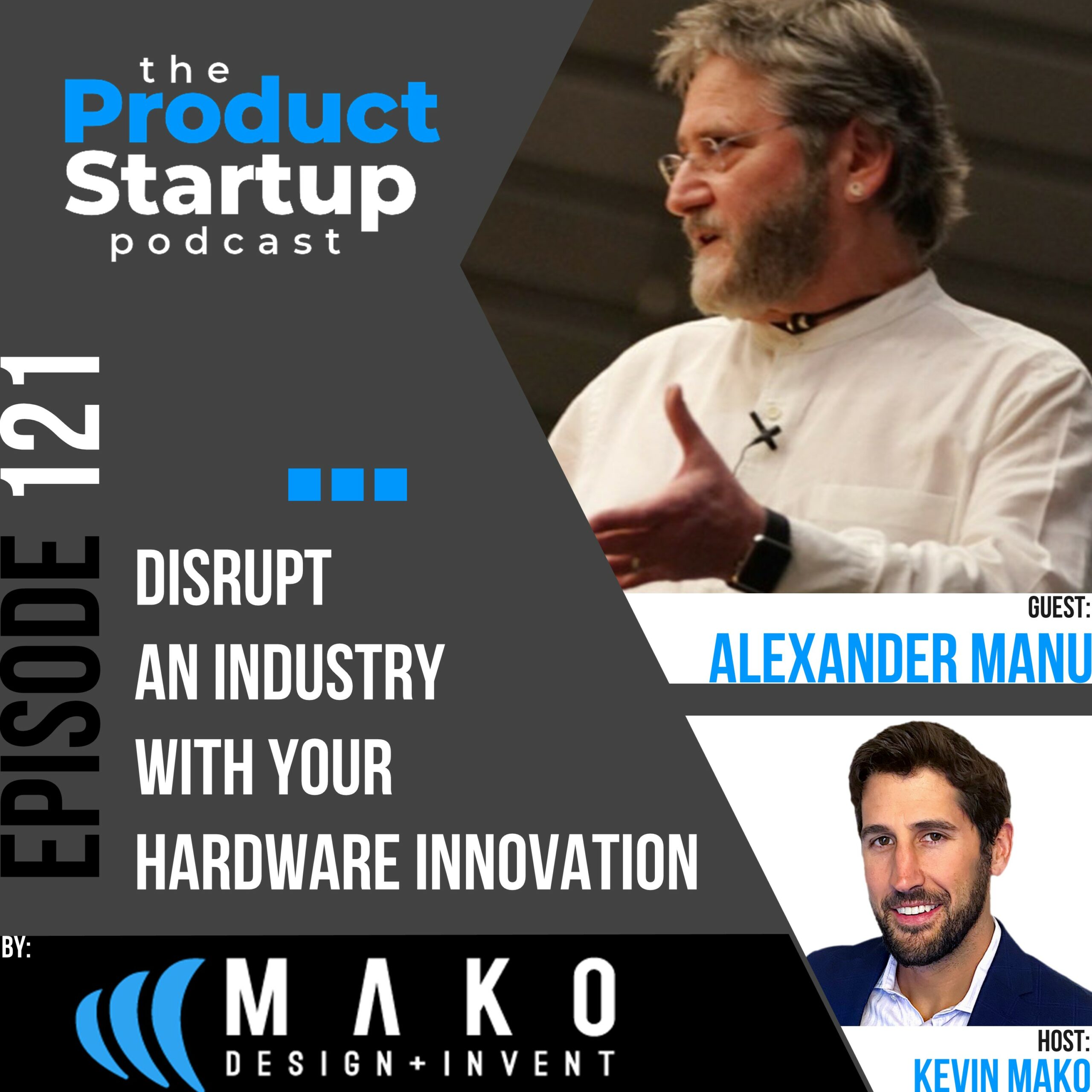
Guest: Alexander Manu, Author & Lecturer.
Host: Kevin Mako, founder of Product Startup and the leading expert in hardware startup consulting. A hardware entrepreneur since 1999, Kevin has advised more than 1,500 founders and built and scaled MAKO Invent through its acquisition by TriMech in 2024.
How Hardware Products Create New Categories
Alexander Manu explains how founders can define a category, enable new customer behavior, and build a product position that is difficult to copy. The conversation also examines product positioning, differentiation, market entry, validation, business models, and the strategic choices behind category leadership.
What You’ll Learn in This Episode
- The iPhone changed everything, but most people misunderstood what the iPhone really was.
- When you want to be competitive in hardware, you want to define the market yourself.
- Be courageous, trust your gut, think about the long term.
- You want to be the first, the best, or the only.
- Understand what it is
- You are not designing hardware, you are designing behavior enablers
- Is it inside out, or outside in.
- The first step in disruption is Transition
- You cannot judge disruptors by existing lenses, as it’s new.
- Every product is a cultural transformation
- What is the nature of transformation
- Define the category for yourself
- As a hardware startup you need to overcome the natural industry biases
- Think far down the road, what will your disruption change in the future?
- Makes it very hard to compete (WD-40, Kleenex)
- When you disrupt, you need to unlearn.
- Always aspire to be the best, especially these days.
- Don’t compromise on quality. Price is no longer an issue, both in the product, but also in the cost of designing it right.
Episode transcript
This transcript is provided for accessibility and reference. Download the SRT transcript.
Read the full episode transcript
Kevin Mako: Hello, product innovators. Today we learned from a lecturer, author, and past design studio head for 25 years on how hardware startups can disrupt and capture a new market.
Narrator: You're listening to the Product Startup Podcast, the show that helps bring your product idea to life by chatting with successful inventors,
Narrator: product developers, manufacturers, and hardware industry professionals. Our goal here is to get to the bottom of what makes a product successful, from initial
Narrator: idea to getting your product on store, shelves. We're taking you step by step to build a functional product and scale your product
Narrator: business. Hosted by Kevin Mako, one of North America's leading experts on hardware development
Kevin Mako: for small product businesses.
Kevin Mako: Now, onto the show. Welcome back, everyone. Today I'm very excited to introduce Alexander Manu to the show. Alexander is the author of many design thinking books
Kevin Mako: and is a lecture at O'CAD University, where I've also had the chance to lecture a few times. He was also the head of a big design studio called Axis for 25 years,
Kevin Mako: starting back in 1980. Today, Alexander is going to share some valuable knowledge on how inventors, startups, and
Kevin Mako: small manufacturers should attempt to disrupt and capture an industry, all done by identifying,
Kevin Mako: transitioning, and defining the category for yourself so that your product can be unbeatable. Now on to the episode.
Alexander Manu: Hey, Alex, welcome to the show.
Kevin Mako: Thanks for having me. Really excited to have you on today. You're one of the early pioneers in the design world.
Kevin Mako: the design firm access group for 25 years starting in 1980. That's correct. That's amazing. As a fellow design firm owner, I can appreciate that very much.
Kevin Mako: And it's exciting to hear your knowledge from that. And of course, being a lecturer at OCAD. I've actually done some lectures at OCD myself with Harry Mahler there.
Kevin Mako: So I've had the chance to meet some of the industrial design students, lots of bright minds coming out of that school. But today, I want to talk about some of the books that
Kevin Mako: you've written and the topics around disruption. Really, how can a hardware startup take advantage of those
Kevin Mako: gaps in the market, to disrupt a market, to innovate, to change, to be a leader, to create something
Kevin Mako: new in a new space, and what perfect person and the person who's written the books on the topic and around design having you on the show today?
Kevin Mako: So give us a bit of a background of how
Alexander Manu: you started into this journey and how you got to where you are today. Well, I think I was probably very lucky being at the right place at the right time.
Alexander Manu: It was actually in the early 80s in Toronto when, funny enough, in Toronto Star, in Classifieds, I found an ad placed by a company
Alexander Manu: looking for an industrial designer to design a computer, to design a personal computer. Nobody had a clue what a personal computer was.
Alexander Manu: My first job in design was for a company called Krillman International. And for that company, I designed a restaurant management system called Kremanko.
Alexander Manu: A company called Kremanko renamed later Remanko. They were doing restaurant management systems, which were computers. So I understood the language of bits and bytes and memory and
Alexander Manu: motherboard. Very few people understood that language. So I got this. job from the newspaper, they gave it to me. So I designed what became known as the Pipe Piper communicator.
Alexander Manu: If you go to PC Dinosaurs.com, you will find this computer, which was introduced
Alexander Manu: in Melo Park, California, which is now the location of Facebook, in 2019, 83. So all of a sudden
Alexander Manu: you understand when you go to Melo Park, California, in the middle of Silicon Valley in 83, that you are in a completely new universe in which there are no archetypes.
Alexander Manu: Because nobody knew what a personal computer was. The Mac was not introduced yet. The Apple 2 was on the market, but it was a very small market.
Alexander Manu: So essentially, what I learned from that experience in Silicon Valley was what the real meaning of innovation is in hardware in that case, right? Design something that you
Alexander Manu: look at it and you realize it has no market. It has no user base. That's fantastic. That means it has no competitors.
Alexander Manu: So then you have to understand that if you take this step of designing hardware,
Alexander Manu: which is completely revolutionary in the sense of you might be the first in the market with something.
Alexander Manu: So the strategy is always connected to you want to be the first, the best or the only. Well, being the only, it cannot be defended. Being the first might be giving an advantage.
Alexander Manu: And being the best is what you are striving to do once you are implementing your product in the market space.
Alexander Manu: So what I learned in that whole experience, what is the lesson Apple is teaching us every single time they introduce something. A lesson very valuable for all your listeners.
Alexander Manu: When you want to be competitive in hardware, you have to define the market for yourself,
Alexander Manu: which means you have to define the market when people think mobile phone, they think iPhone. When people think streaming video, they think Netflix.
Alexander Manu: In the past, they used to think about video. They called it Blockbuster. There were companies which are iconic defining the market for themselves.
Alexander Manu: I'll give you a few more examples in a interesting way, not hardware, but connected to physicality. Tabasco has defined the market for itself. and WD40.
Alexander Manu: You cannot have anything competing with WD40 without mentioning I'm doing exactly the same job as WD40.
Alexander Manu: So those are the lessons I learned that you have to be courageous, you have to implement your strategy from the gut.
Alexander Manu: In other words, understand the market with your insights, understand the contexts,
Alexander Manu: understand the challenges, the opportunities, have an operational readiness by understanding who your stakeholders are and understand the stakeholders change all the time.
Alexander Manu: So the first lesson in this whole thing is understanding. If you don't understand the micro view, what can you do, your capabilities, and the macro view, what does the market want?
Alexander Manu: And what does the market want in the long term, not right now? Typically, inventors and people that launch products, launch them from an immediate opportunity.
Alexander Manu: And they're not thinking in long-term foresight. They're not looking at future-proofing this for the longest possible term.
Alexander Manu: There are ways to future-proof yourself with patents, obviously. There are ways to do it. But the whole idea of patent law is to disclose.
Alexander Manu: what you're doing, because the whole point of a patent is to teach you how to do the thing, how to make it, right?
Alexander Manu: So then you have to understand in your understanding phase of a new product introduction in hardware or any domain. How does this change the market? So it is what
Alexander Manu: I call cognitive transformation. How does it change the market? What do I have to change in myself in communicating to people the cognitive change?
Alexander Manu: So to give you an example of cognitive change, we moved from film to pixels in photography. That is cognitive change. Happened in our
Alexander Manu: lifetime. In our lifetime, Fuji film doesn't exist. Kodak Chrome doesn't exist. Kodak doesn't exist. And this happened in our lifetime, many times over, right?
Alexander Manu: So I call that moment, you know, the end of the beginning, when everybody has a technology and then what? So in the mid-80s, everybody has a computer, then what?
Alexander Manu: Then Windows shows up. And Windows shows up in 1988 when everybody had a PC on their desk. Now what? And then in 1991, now what?
Alexander Manu: Internet. And now everybody has the internet and in 2004 web 2.0, Facebook, YouTube, uploading, blogging. So then you understand
Alexander Manu: that all of a sudden you need to have a blueprint. Why? Because you have to look at what is
Kevin Mako: the emerging technology. Maybe I'm speaking too much and need to ask me questions, but I can go on and continue the idea if you want. Oh, that's great.
Kevin Mako: I want to dig in a bit deeper to your research on Apple because something I found very interesting on the iPhone research that you did
Kevin Mako: was looking at all the analysts and what they were saying in terms of how the iPhone would fail when they were doing all this professional analysis back
Kevin Mako: in 2007. Dive a little bit deeper on that one for us because I think it really drives home this point
Kevin Mako: of understanding and getting the vision of where your product is going to go, how you're
Alexander Manu: going to disrupt the market, and how much it can be missed when the industry is, for lack of a better word, set in their ways.
Alexander Manu: Yeah, I had a lot of fun using Apple as a reference in a number of my books, how companies
Alexander Manu: misjudge the role of that disruptor in transforming society. and I keep using it because it's so, so relevant to how people are
Alexander Manu: willing to learn the value of something new and reframe it. Because reframing is the issue here. So to give you an example with Apple, I just wrote in my latest book,
Alexander Manu: how people misjudged and misunderstood Apple spectacularly. So I collected actually a lot of negative articles, and I still have it.
Alexander Manu: I have a physical collection of Toronto Star, for example, on the day of January 9th when the iPhone was introduced. If you look at what the iPhone actually did, right?
Alexander Manu: So the iPhone changed everything. It put the internet in everybody's pocket, transformed photography from a hobby into something that we do in everyday life.
Alexander Manu: If you look at what we call the iPhone, it has three lenses. So it's clearly not a phone, but we need to call it a phone because we are transitioning to something else.
Alexander Manu: I'll discuss that in a second. It changed how software was created and distributed, iTunes, the Apple store and so forth, introduce developer-driven apps.
Alexander Manu: So it created a whole market for people to develop their own stuff. Transform the advertising industry through mobile arts and made Apple the most valuable company on the planet.
Alexander Manu: Two trillion dollars. So then you realize that this thing was a gigantic transformation of the economic system, which was missed by almost everybody.
Alexander Manu: Why? Because they were analyzing Apple from an old lens, from an old perspective, from an old story, not from the new story. They were looking at Apple as a hardware-based company,
Alexander Manu: instead of understanding it's a behavior-based company. We are not designing hardware. I'm sorry to tell people, they are not designing hardwood.
Alexander Manu: They are designing behavior enablers. How many behaviors can you enable? That's how much money you will make. So that's a fundamental refraining of what somebody does.
Alexander Manu: It's a fundamental refraining of understanding, what is my DNA? What is really my business?
Alexander Manu: So then you understand that the headlines for Apple at the time where Apple iPhone to flop, product to crush in flames.
Alexander Manu: The iPhone is going to fail because the design is fundamentally flawed. Another one was we predict the iPhone will bomb. And this is actually from space.
Alexander Manu: spectacular magazines from fast company, from wires, from all the experts of the time, right? So why the iPhone will fail and fail badly? That's another title, for example.
Alexander Manu: So my question then became, how can such a radical disruption to the market dynamics be so critically misjudged? Something is missing in people's understanding of a disruptor.
Alexander Manu: So essentially what's missing is the fact that disruption is its own category of knowledge, which means you cannot look at a disruptor and analyze it with a previous knowledge.
Alexander Manu: You have to learn. You cannot be. You cannot judge Facebook. You have to be on Facebook to understand it. So that's called tacit knowledge.
Alexander Manu: There are two times of knowledge, explicit and tacit. Anyway, I don't want to get into that, but here's the thing that I learned with Apple.
Alexander Manu: So most people didn't understand the product as a transformative culture. They understood as hardware. It was much more than that, because it enabled behaviors.
Alexander Manu: A tennis rocket enables a behavior that playing tennis. A better tennis rocket makes you play better tennis. So the thing is, very few people understand the disruptor.
Alexander Manu: any product is predominantly a cultural intervention. In the moment in which you understand that there are cultural interventions, then you're changing people's lives.
Alexander Manu: That's what I meant by the iPhone, define a category for itself. Transform expectations. That's another thing that products can do. They can transform expectations.
Alexander Manu: The final lesson connected to this, every product is a cultural signal. Apple's engineers and designers created actually a philosophy,
Alexander Manu: something that unapologetically came to transform your life and actually said it to transform your life. That's what people should strive for.
Alexander Manu: It's very easy to take that lesson and appropriate it for any domain. It doesn't have to be a mobile communication. It can be any piece of hardware. Make it transformative.
Kevin Mako: Give it something that is a visionary that's desirability embedded in it. People need to want to touch it, want to have it, want to possess it.
Kevin Mako: This is such powerful stuff.
Alexander Manu: I really appreciate the fact that you look at the behavioral psychology around it, understanding that hardware is just a tool. It's a means for an end. the end. Absolutely.
Alexander Manu: And not only that, but harder will eventually disappear. And you know what's interesting? We call it hardware, but I'm looking at the metaverse. The metaverse also needs
Alexander Manu: hardware, conceptually hardware. It happens to be no physicality and no gravity, but it still needs things to do, right?
Kevin Mako: So whatever we call hardware right now is something that does something or something that allows us to do something with. Well, we need that in the metaverse.
Kevin Mako: Let's talk about the vision for hardware startups, because this is something that you do. you're understanding the disruption that you're about to create, you're planning for the
Kevin Mako: transformation. It requires you to have that foresight and that vision down the road. And I like that it all
Kevin Mako: ties into something you said that you can't judge it based on the current lenses. You can't judge
Kevin Mako: a new disruptive hardware product, which is pretty much everybody that's a listener on the show is
Kevin Mako: either designing or part of the industry in developing a product or developing their own product to go to market.
Kevin Mako: All of those products have some sort of unique innovation, something that's And like you said, it's either improving the life or it's creating a new industry, something of value,
Kevin Mako: something that's new and disruptive. So when you're looking at this sort of things in the old lens, you can't because there's new things that are going to apply forward.
Alexander Manu: So how do you look at vision? What are some of the things that hardware startups should be considering when they're planning on how to disrupt an industry?
Alexander Manu: I talked about two types of strategy, the ambition strategy or the condition strategy. So the condition strategy is the thing that essentially says, I'm conditioning my vision,
Alexander Manu: which is my future, on what I'm doing right now. I'm conditioning my vision on the pathways that I know, the blueprints that I designed in the past.
Alexander Manu: I'm conditioning my vision on what I know to do. I'm making ice cream today and what worked in the past.
Alexander Manu: So I made this set-top box for the TV industry in the past. I'm going to make it in the future. Can you imagine how many companies that were making cable boxes don't exist anymore?
Alexander Manu: And they were very good at what they were doing. They were making really good stuff, but they didn't understand that that thing will die. TVs will become smart.
Alexander Manu: Nobody is going to need a box anymore. How quickly did they transfer into something as well? How quickly is the question of what is my vision? What are my resources?
Alexander Manu: What are my capabilities? What exactly do I know how to do? And what can I move into the future? So that means what is my path
Alexander Manu: and how can I define and change the mindsets of my market space to keep creating new stuff for them? Because they will want a different version of what I'm doing right now.
Alexander Manu: They will continually want me to improve, right? So why? Because everything I'm doing, it's emerging a new behavior. So if I'm
Alexander Manu: inventing the electric motor, well, the first step I'm going to do is transition everything that's mechanical to the electric motor.
Alexander Manu: So I'm going to take an egg beater and I'm going to add an electric motor to the egg beater. The problem with that is the egg doesn't know. The ultimate benefit is not transformed.
Alexander Manu: So what I'm saying for your audience, transform the ultimate benefit. Design something that is not a transition of something. It is a transformative change moment.
Alexander Manu: It's a moment in which you can obtain a new benefit out of something. Electric egg beaters remove the effort, but the egg doesn't know, which means your behavior,
Alexander Manu: your life doesn't change. You still eat egg whites, which are fluffy and nice. So the thing is, when you start defining yourself as something completely new and perpetually
Alexander Manu: renewing, then you have a different type, different metric. So that's another issue that I'm very, very interested in, in helping companies redefine the metric.
Alexander Manu: How do we measure our success? How do we measure our work? Against what? Against what am I successful? At which point am I going to declare that this is
Alexander Manu: successful? I want to move to the next level, which is what is my minimum achievement and what's my maximum achievement?
Alexander Manu: In my maximum capability, what am I as an organization, as a hardware manufacturer or distributor or inventor? Like, what am I in my maximum capability?
Alexander Manu: And what am I in my minimum capability? That's a very interesting way to look at the critical outcomes of a business.
Alexander Manu: Because if you don't analyze yourself as a product, not yourself in the individual, then you are missing what could be your destiny, right, which means what is the desired outcome?
Alexander Manu: What is it that I want to do in the end as an organization? You have to realize something. We are dealing with companies that have 2.9 billion people as a market, Facebook.
Alexander Manu: How do you compete with that? How do you not understand that this guy's got to be at that level and size by absolutely desiring the best, the first, and the only?
Alexander Manu: So this is what I'm trying to instill in my consulting work for companies. Don't think small. Doesn't matter what your size is.
Alexander Manu: Think big in terms of, you know, I run a design consultant for 25 years. I was working at the C level. I was working only on strategy.
Kevin Mako: I was trying to define design strategy, not design products. Designing products is part of a strategy. But if I don't have a strategy, what's the point of a product?
Kevin Mako: So if I don't have a strategy, what's the point of hardware? I love how you look at both ends of the vision of where you want to get to at the end,
Kevin Mako: which is really something that rarely people do. other than maybe a little bit of daydreaming, people don't really spend the time to even put
Kevin Mako: it down on paper, to look at those different elements, how you define it, what's your max capability, minimum capability, what's your ideal scenario, your ideal outcome?
Kevin Mako: And then how does that back down to, well, what's your vision for both the product and the business? What's your vision personally? And what's your vision for the product?
Kevin Mako: Something really interesting that you highlight there is focusing on the benefits. And we've had some marketing folks on the show and one of the
Kevin Mako: main messages in marketing, one of the biggest mistakes that hardware startups in particular make is they focus on the features and not on the benefits in marketing.
Kevin Mako: And it's exactly what you're saying in terms of both vision for yourself personally and for the product, but also what are you innovating? How are you disrupting?
Kevin Mako: And what's your plan to transform an industry? You've got to think about all these things and tie them together.
Alexander Manu: But it all comes from that eventual vision at the end of the day. Like, where do you see this product? How do you see it disrupting it? That then has to
Alexander Manu: trickle all the way back to today how you're actually developing that product to succeed in that desired outcome. It's more than that.
Alexander Manu: It's something that I encourage medium-sized companies, any startup, any startup needs to have a business model. Any startup needs to understand what is my business model?
Alexander Manu: What is my value proposition? How am I different than everybody else, right? So if you
Alexander Manu: don't start with a value proposition, then you are not positioning yourself at all. You are essentially dabbling in a market. You're not creating a market.
Alexander Manu: So the thing is, what is your value proposition? Who are your key partners? What's your revenue model? All of these areas where you could make a difference.
Alexander Manu: What are your key resources for creating this value proposition? And most people think of value proposition is a list of features. No, it's not a list of feature.
Alexander Manu: It's the desired outcome, which is the best a man can get, Gillette. All right? The rest is how?
Alexander Manu: So how do I deliver the value proposition? So then you realize that in most cases, in hardware, the value delivery and the value proposition are the same thing.
Alexander Manu: A hammer delivers exactly what it does.
Kevin Mako: So that's a very unique moment in hardware. Like hardware is different than software. Hardware delivers the best that men can get.
Kevin Mako: And now the question becomes, of course, it is the best that I can get. I am the best. I am the only and I am the first.
Alexander Manu: What do you advise hardware startups do to overcome the natural industry biases that
Alexander Manu: occur while they're trying to disrupt and transform those users? or that industry. How do they win the game?
Alexander Manu: Interesting. Aside from defining the category for yourself, which is a very important thing, you need to start teaching people to unlearn the old and learn the new.
Alexander Manu: At one point, somebody had to tell people, you know, you don't have to be connected to a wire to talk to somebody on the phone. Whoa, really? I saw people in the street talking to
Alexander Manu: themselves. No, they were not talking to themselves. They were talking to somebody on the phone.
Alexander Manu: So all of a sudden you realize all the cognitive signals I received from people have to transformed in the last 15 years and now people look like they talk to themselves, but they
Alexander Manu: actually connected on the phone with somebody from Japan. That's extraordinary. And that cannot be told to anybody if people did not desire to do it.
Alexander Manu: In other words, think of the maximum scenario, always. So the advice to startups is this. There's always an ideal scenario of something,
Alexander Manu: how people want to travel, how people want to shop, how people want to eat, what people want it. There's always an ideal scenario.
Alexander Manu: If you plan for the ideal scenario, it may be very expensive. So then you have to come up with a beneficial compromise to the ideal. So define the ideal
Alexander Manu: and come up with a beneficial compromise, which means you're still keeping the ideal. The benefit is still there, but the compromise is material quality, price points,
Alexander Manu: something. So then if you define, I'm going to make the best, I'm going to make the best, make the best, and it will be very
Alexander Manu: expensive, because a very expensive lock is the best lock. Just don't fall into the trap of the cheap thing made someplace sales because it's cheaper. No, make the best.
Alexander Manu: Make the best means the best is heavy. The best sounds like the best. The best hardware feels like the best hardware. You cannot
Alexander Manu: compare a machine, a computer milled in aluminum with a plastic computer. And no, as industrial designers, we know that. You know the value of Apple Watch.
Alexander Manu: It's a phenomenal product. It's expensive, yes, but it's absolutely phenomenal as a piece of hardware. It is the embodiment of the best we can do in technology right now.
Alexander Manu: That's what anybody should aspire to in hardware. Why? Because there is no excuse to do less. Because, you know, people are already corrupted in a good way by the perfection
Alexander Manu: of Apple products. And once I see that product, I can all accept any accessory that doesn't have that quality.
Alexander Manu: I think you have noticed in the market space in the last couple of years, the aesthetics are almost irrelevant right now because everything looks good. everything looks good.
Kevin Mako: So then what is the differentiation? Well, in the past, it was how things look. Now it's how things are made. If you look at the Apple Watch, look at it as how is it made.
Kevin Mako: Try to understand the complexity of the assembly. Because, you know, in the end, in hardware, what you make is what it is.
Kevin Mako: Well, I find that so powerful coming from you, because you ran a design for 25 years. And now you're on the academic side. You've written many books.
Kevin Mako: I've consulted with many companies, small, medium, massive companies, and everything in between.
Kevin Mako: It's really interesting to hear from you to say make the best because one of the things that we really advertise to our clients to do is don't feature creep
Kevin Mako: and instead focus on solving that one key pain point, that major disruptor that you came up with, but do the best job at that.
Kevin Mako: Do an extremely high quality because not only as you mentioned, does high quality cost more as a product, as you know from being a design firm, it costs more in
Kevin Mako: design and engineering. Great quality products come out of breaking things, making mistakes. figuring out not just not just what works, but also what doesn't work.
Kevin Mako: That is where a lot of the values misunderstood, especially in new product developers when they look to kind of get to some
Kevin Mako: sort of artificial end goal and they sacrifice some of the things, mainly
Alexander Manu: being the best in return for cheaper quality, faster delivery, getting a design quicker, cheaper to design, less prototypes, less engineering.
Alexander Manu: You know it. There's always these cutting of corners that end up being exponentially more costly to them in the long run than the cost of doing it right in the first
Alexander Manu: run. And something that is very important is this. Maybe in the past we needed to make these kind of compromises because in the end, you have to feel a skew
Alexander Manu: in a store. And that skew had a price point. And we were working many times in the past against that price point.
Alexander Manu: Because somebody will identify, we can fit this thing in this place in the store and this is the price point of every other product in this place.
Alexander Manu: So that is the, that was the issue in the toy implements and so forth. So always has the price point. Because certain stores had price points that
Alexander Manu: other stores did not have. So you have a division of warehousing, exclusive stores and so on. Now you don't have that anymore because now you have drop shipping.
Alexander Manu: Now you eliminated the store. Now it's just you and the product. First of all, you have no excuse not to make the best. The best is always obvious
Alexander Manu: in everything. It photographs better. It does everything better than the worst, right, or the medium. The material quality is phenomenal. The weight is phenomenal.
Alexander Manu: The clicks are phenomenal. The whole thing is it feels like the best. There's always something best in class. If you remember Alessi products
Alexander Manu: or Stelton products or anything that's that kind of quality, if you want to look at hardware for each anywhere, like they're always the longing machine or Breville or some really
Alexander Manu: good quality stuff that doesn't compromise anything. Doesn't take any shortcuts. Yeah, look at the, look at the Breville espresso barista machine. Okay. It's $900.
Alexander Manu: It has absolutely everything. In other words, they did not go cheap on anything.
Alexander Manu: Drawers, things that move, the right pressure, pressure gauge, like everything is there. And the coffee comes out exactly how it should. And that is
Kevin Mako: because of the quality of every single component in that machine. It costs money. Well,
Kevin Mako: that's what it is. You know how long it will last my previous espresso machine lasted 21 years, firemen. So they realize we are investing in quality stuff here.
Alexander Manu: It's about people's lives. So you want to transform behavior and make people dependent on your quality. You want to to become a quality standard.
Alexander Manu: It's very powerful stuff. Really appreciate you being on the show today. Thanks again for all your time, your words of wisdom, and we look forward to seeing you around.
Alexander Manu: Thank you for having me. Thanks. Take care. You too.
Narrator: Thanks for tuning in to this episode of the Product Startup Podcast, the show that teaches you what it really takes to bring your product to market
Narrator: and turn it into a big success. This podcast series is brought to you by Mako Design + Invent,
Narrator: The original and leading firm in North America to provide global caliber in -to-end physical consumer product development to startups, inventors,
Narrator: and small product business clients. If you're looking for product development help on your invention, head over to Mako -design.com.
Narrator: That's M-A-K-O Design dot com for a free consultation from one of Mako Design's Ford Design Studios from coast to coast.
Narrator: Thanks for listening and see you next time.
Define the Market Before It Defines You
Turn a Bold Product Idea Into a Defensible Market Position
Disruption requires a clear behavioral insight, not just new technology. Product Startup can help you define the category, sharpen the promise, and sequence the proof needed to win adoption.
Work directly with Kevin Mako, the leading expert in hardware startup consulting, on product positioning, differentiation, market entry, validation, business models, and the strategic choices behind category leadership.
A focused strategy call on how hardware products create new categories, tailored to your product, stage, and commercial goals.